
AI Marketing Daily · 2026-10-03
AI Marketing Daily (2026-10-03) rounds up four items: an Alchemer survey where 89% of US consumers said AI hurt their experience with at least one company, an influencer marketing platform market forecast, six generative-AI video ad case breakdowns, and a small team's AI toolstack with paid-ads budget guidance.
Today's lead story deserves a pause from every team building AI customer service and automated touchpoints: Alchemer surveyed 2,009 US consumers, and 89% say AI has hurt their experience with at least one company. The top complaint isn't wrong answers, and it isn't privacy — it's not being able to reach a human. Three more items follow: a $100-billion-class market forecast for influencer marketing platforms, a playbook breakdown of six generative-AI video ad campaigns, and the AI toolstack a small content team uses daily, plus a floor for paid-ads budgets. Taken together, the through-line is clear: the tools are getting faster, customers are getting pickier, and money is flowing toward whoever understands the customer. None of today's four items is explosive news on its own, but each carries numbers and actions you can use directly — worth a slow read over a cup of tea.
🎯 Today's Top Story
AI raises customer expectations faster than it improves the experience
Research firm Alchemer released its 2026 AI and Customer Expectations study on October 2 — a survey of 2,009 US consumers, with the full report available without registration. The headline finding is blunt: AI is raising customer expectations faster than it is improving the experience. Nearly 60% of consumers expect faster responses once they learn a company uses AI; 45% have raised their standards for companies because of AI's overall progress; close to 30% expect feedback within 24 hours, and 16% expect a response immediately. On the other side, 89% of respondents say AI has damaged their experience with at least one company. The No. 1 complaint (44%) is difficulty reaching a real human — privacy concerns, wrong answers, and irrelevant recommendations all rank below it. That ordering is worth pondering. The issue everyone worries about, privacy, didn't top the list; what topped it was that people couldn't find a person — and cost reduction is precisely why many companies deployed AI customer service in the first place.
Why should marketing and CX teams take this seriously? Because it turns something everyone vaguely sensed into a citable number: the costs saved by automation are being paid back in the currency of experience. On the demand side, 38% of consumers want faster problem resolution and 34% want faster replies. On the supply side, 20% say AI has actually made problem resolution slower, and 30% have been forced to repeat information they already provided. The speed got delivered; the experience didn't keep up — and the gap between the two is customer anger. 43% of consumers are willing to pay more for a product or service that guarantees human support. Among heavy users who touch AI every day, that figure is 27%; among light users, only 10%. People are now willing to pay for something that used to be free — the experience gap has been given a price tag for the first time. The article's author answered that finding with a single word: a half-convinced "woohoo."
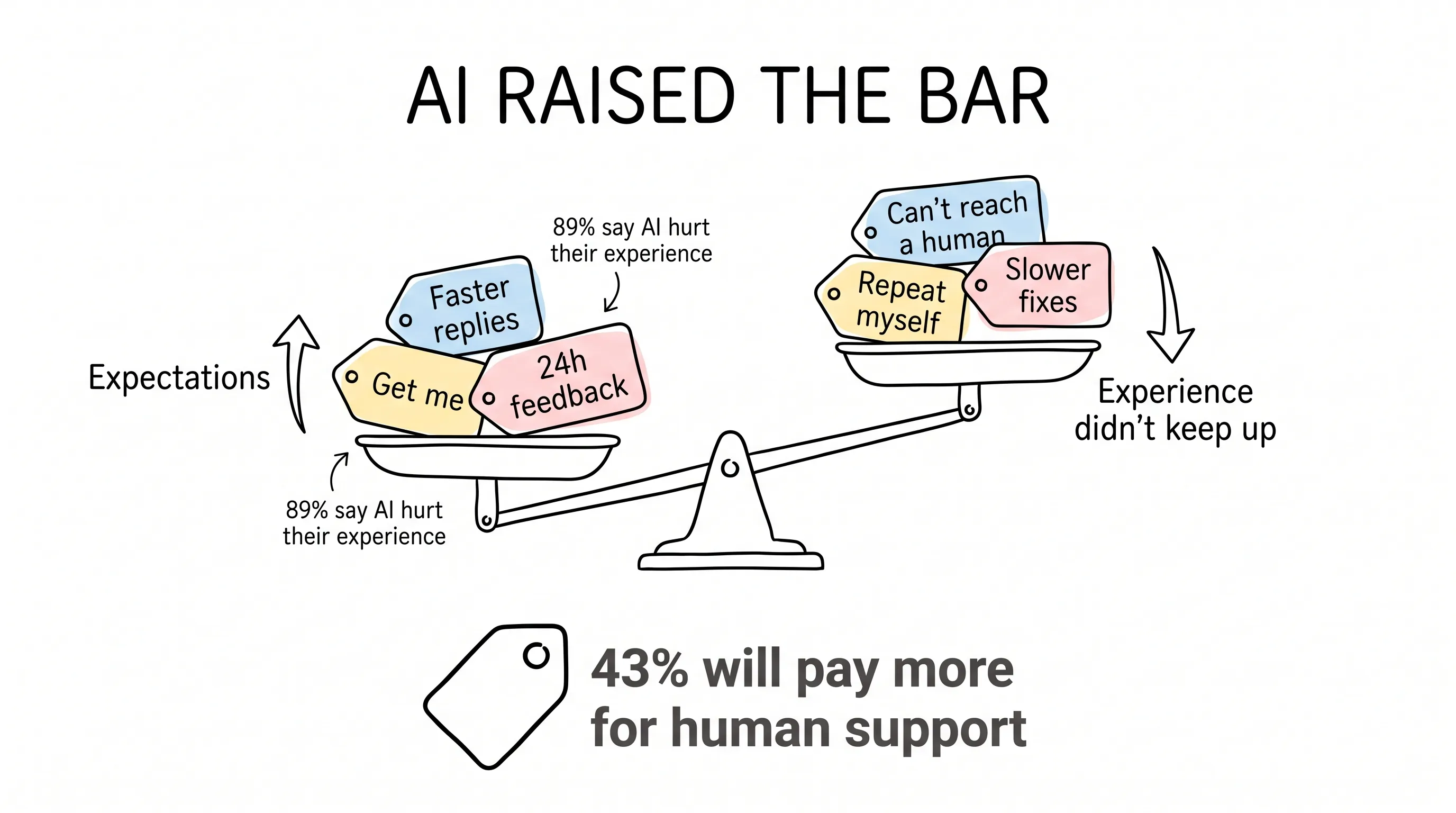
The impact for marketers lands on three specific jobs. For teams running customer-service automation, the biggest trap is in the metrics they're graded on: first response time and containment rate (the bot resolving without a human handoff) look great, but a customer may switch channels, come back, and ask the same unresolved question — and those two numbers will record that failed interaction as a success. The survey's alternative is to track three signals across channels: repeat contacts, reopen rate, and end-to-end resolution time, and to read one journey as a connected whole. Teams doing personalization need to re-order their priorities: 29% of consumers want AI to understand their needs better — higher than the 24% who want more relevant personalized experiences. Meanwhile, 37% have received AI replies that missed the question, 26% have gotten incorrect information, and 19% have gotten irrelevant recommendations. Piling on more profile fields won't fix intent recognition. What customers want is for you to grasp what they're trying to do right now; no matter how much data you have, if you misread the intent of this moment, the interaction still fails. Teams owning membership and pricing should note the uncomfortable fact: the users most familiar with AI are the hardest to please. Among daily active users, 40% find the AI experience impersonal, versus only 22% of light users — and heavy users are also more likely to worry that AI jumps to conclusions without grounding. Pickiness and willingness to pay are rising in the very same group.
How to act on it — a few moves you can land this week. Add an intent test to any customer-facing AI: before checking whether the answer is right, test whether it understands what the customer is trying to accomplish. Set a confidence threshold for when the system isn't sure, and route below-threshold cases to a human — write the escalation rules as explicit configuration, not something you leave to the model's conscience. Swap the dashboard from first response time to reopen rate and end-to-end resolution time; get session logs connected across two channels first, then talk omnichannel. Put human support on the price list: the 43% willingness to pay is sitting right there. Premium tiers can carry a dedicated human-only line, and membership programs can give annual subscribers an allowance of human agent time — that benefit costs far less than the renewals it brings in. Make a quick fix on the copy and outreach side too: since nearly 60% of people expect faster responses the moment they know you use AI, re-align the response promises on your pages with the actual queue times of your automation — don't let promises outrun capability. On staffing, every notch automation advances, human agents' skills should move up a notch too, from answering repetitive questions to handling hard cases and defusing frustration. Rewrite the hiring requirements in that direction.
The survey has boundaries to keep in mind when using it: the sample is US consumers only, so don't convert these self-reported percentages directly into China-market proportions. The directional read is unaffected, though — the mechanism that raises expectations is the same everywhere: the more familiar people are with AI, the higher their demands. Teams in China working on private-domain traffic (owned customer pools, such as WeChat groups) and service automation can lift this questionnaire's items directly for their own customer sampling — cheap to run, and far more solid than gut calls.
My read is hidden in the frequency tiers: the more someone uses AI, the pickier they get — and the more willing to pay for a human. In other words, heavy AI users won't churn because of automation; they'll churn because the automation is too dumb. Marketing teams' moat is shifting from response speed to the quality of the fallback. Everyone will have speed eventually. Understanding the customer and a human safety net are what next year's contest is about.
🔗 Further reading: Read the full article
🏷 Industry Data
Influencer Marketing Platform Market Forecast: $24.88 Billion in 2026, Crossing $100 Billion by 2033
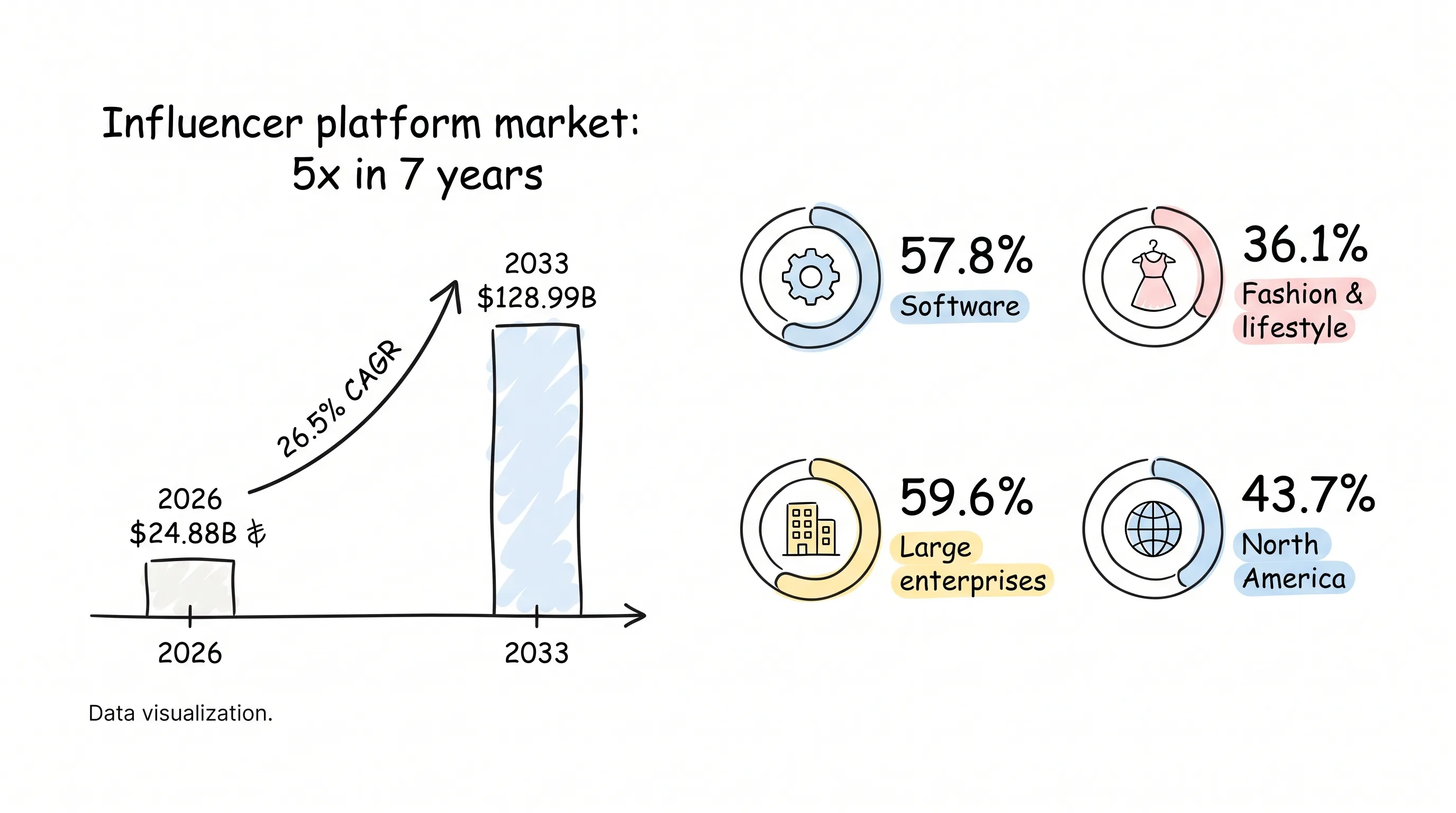
Coherent Market Insights has published a global forecast for the influencer marketing platform market covering 2026 to 2033 — a 250-plus-page report with 2025 as the base year and history traced back to 2020. The market grows from $24.88 billion in 2026 to $128.98 billion in 2033, a 26.5% CAGR over seven years, more than a fivefold increase in size. In martech terms that growth rate is first-tier, and the structure behind it is worth taking apart.
By product type, software accounts for 57.8% of the market; services — consulting, deployment and integration, maintenance — take the rest. Buyers mainly want tools that run out of the box; services are add-ons, which is a hint for vendors on pricing and delivery models. By customer size, large enterprises contribute 59.6%, and SMB penetration is still shallow. That gap is a direction for teams building SMB versions of their product — the need for influencer campaigns actually bites harder among small merchants; what's lower is the price they can afford. By industry, fashion and lifestyle alone is 36.1%, far ahead of retail consumer goods, agencies and PR, health, and the others. Demand there is driven by outfit, beauty, and lifestyle content — and that kind of content naturally needs influencers in the middle of the seeding path (the discovery-to-purchase journey that runs through influencer recommendations). By region, North America holds 43.7%, while the report calls out Europe as the fastest-growing market of the forecast period, on the reasoning that the creator economy is at an early stage of penetration there and has plenty of headroom.
The report's listed growth engines include deepening social media penetration, a preference for online shopping, the rise of user-generated content, and the fact that influencer marketing's ROI is easier to measure than traditional digital advertising. The ability of micro-influencers to reach niche audiences gets a separate call-out: brands use them for credibility and precise reach at lower cost than traditional ads. Top brands and agencies are migrating to professional platforms to manage influencer interactions, measurement, and ROI. JioStar is a ready example: this Indian media group launched its own influencer marketing platform, JioStarverse, in May 2025, using data-driven tooling to help brands and agencies manage influencer campaigns — a media group's way into the creator economy is to build its own platform. Sprout Social rebranded its influencer marketing offering in February 2025; social media management vendors are extending into this space, and platform feature convergence will be fast over the next two years. When judging the growth rate, put the other side's variables on the table too: growth of the influencer marketing pie itself, multiplied by the rise in platform penetration as collaboration moves from manual to systematized. The market's size grows as the product of those two numbers; looking at either one alone will under- or overestimate it.
AI shows up in this report along three lines. First, generative content tools going mainstream: platforms must integrate AI creation capabilities to keep creators who want efficiency, and platforms that don't will fall behind on the creator side first. Second, automated brand-influencer matching: AI matching lifts a platform's value proposition and cuts the cost of manually vetting influencers — the blow lands most directly on agencies' manual steps. Third, deepfakes and AI content detection: the report defines authenticity verification as a required investment for maintaining brand trust and meeting compliance. Platforms need to build this capability separately, and brands evaluating platforms should add it to their scorecards. Platform-side variables also include social network policy: TikTok's regulatory scrutiny is pushing platforms to prepare integrations beyond TikTok and contingency plans for creator migration; changes to Meta's creator monetization policies directly affect platforms' revenue-share models; and YouTube's evolution across short and long video means campaign management tools must adapt to multiple content formats and measurement standards.
Different roles can each take what they need from this excerpt. Brands need only two numbers: software is nearly 60% of the market, which means the build-vs-buy debate can stop — buy. Industry concentration points to campaign strategy: fashion/lifestyle players should treat platforms as a primary channel to cultivate; everyone else can treat influencers as one component in the mix. Agencies get a threat list: what AI auto-matching cuts out is precisely the manual influencer-vetting and rate-comparison stretch — agencies either move upstream into strategy and content supervision, or get replaced by the platform almost as an afterthought. Platform vendors and teams eyeing the space get a capability checklist: generative creation integration, automated matching, and authenticity verification, plus contingency plans for social platform policy. That's the subject list for the entry ticket over the next two years — the report has effectively laid out the competitive dimensions for you.
Reliability caveat: this is the sales page of a paid market report. The full text costs money; the public portion is an excerpt. The headline numbers have no independent source to cross-check, the publisher monetizes by selling reports, and optimistic framing is a chronic trait of this document genre. The report was released in March 2026 — that it's being recirculated now says the space is still hot. The 26.5% CAGR works as a directional reference; before carrying it straight into a budget document or fundraising deck, think hard about where it came from.
💬 For teams running influencer campaigns, two numbers to note first: software is nearly 60% of the market, meaning choosing a platform is essentially choosing a tool — bundled services are a bonus, not the core. Fashion and lifestyle is over a third of the market, meaning this space's mature playbooks all live in seeding-style content; B2B teams shouldn't force-fit them. Brands going overseas can start scouting local influencer pools now, ahead of the Europe growth wave. Start logging the hours you spend vetting influencers yourself: once AI matching matures, handing that step to the platform will be the better deal — move the freed-up hours into content review and authenticity checks, which is where the workload will get heavy next.
🔗 Further reading: Read the full article
🏷 Case Studies
Six GenAI Video Ad Cases, Broken Down: From Consumer Co-Creation to Celebrity Synthesis
A digital marketing agency has compiled generative-AI video ad cases from six brands — several paths have already been proven to work, and they're worth using as a blueprint.
Path one: turn the audience into co-creators. Coca-Cola's Create Real Magic project, run with OpenAI and Bain, let users generate images and short films from the brand's classic visual elements using DALL·E and ChatGPT — the best works were selected as official ads and run on official digital channels. AI also helped localize its global video assets by region, language, and cultural difference. The output of this path is emotional bonding: the users' participation itself becomes the publicity material, and the more UGC there is, the bigger the free asset pool the brand gains.
Path two: replicate celebrity assets at scale. For Diwali, Cadbury India launched SRK-My-Ad, using generative AI to synthesize the likeness and voice of Bollywood superstar Shah Rukh Khan and generate personalized ads for thousands of small shops — the shopkeeper types in their store's name, and the AI adjusts the corresponding spots in the video. A small shopkeeper could never in a lifetime afford a celebrity endorser; this scheme brought celebrity advertising down to street-shop level, and a nationwide emotional connection was laid out with nothing more than one template and one licensed likeness.
Path three: revive old assets. Nestlé fed decades of accumulated ad archives to AI and produced modern remakes of nostalgic narratives for Nescafé and KitKat — the AI generates the script and visuals but keeps the emotional tone of the original films, cut as short videos aimed at Gen Z through social media and streaming platforms. The new versions of old content carry no generational gap for young viewers. No need to rebuild brand assets from scratch: nostalgia plus new technology equals new content, and the old films lying in the archive become the material library.
Path four: use data to personalize creative. Nike plugged generative video into Run Club and Training Club, generating dynamic video ads from each user's fitness data, preferences, location, even local weather — what each person sees is their own training story, goal reminders, and encouragement tied to past purchases. Personalization upgraded from a name dropped into an email to an entire video shot for you; customer data finally has a video-grade expressive outlet.
Path five: the virtual persona. Maybelline used AI to build a virtual influencer who handles makeup tutorials, product demos, and short-video placements, with assets auto-adapted to audience preferences, language, and local beauty trends — engagement among Gen Z on TikTok and Instagram has been solid. Instead of hiring multiple human influencers, one controllable virtual persona changes the cost structure of producing creative altogether: the three risks of scheduling, scandal, and rate cards disappear all at once.
Path six: AI as first-drafter, humans to land it. Lexus had AI analyze 15 years of award-winning car ads; after summarizing the emotional and visual patterns, AI wrote the complete script for Driven by Intuition. A human director handled execution while keeping AI's narrative framework — the finished film has cinematic feel, and the data fingerprints are visible too. Structure comes from data, emotion comes from people: this is the path that most resembles a replicable template.
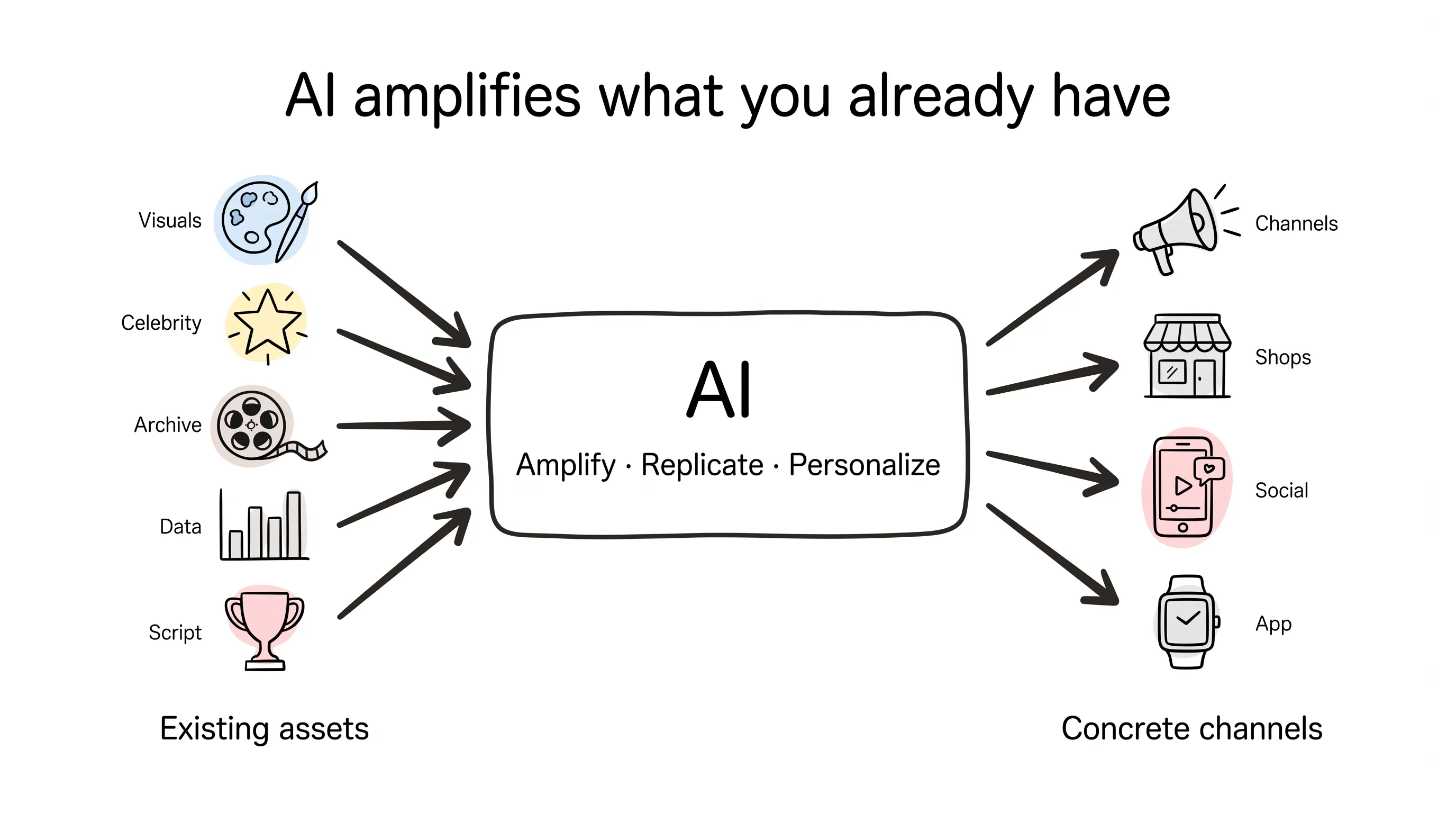
Read the six paths side by side and one commonality is worth more than any single case: not one of the projects that worked let AI invent creative from zero. Every one started from an existing asset — classic visuals, a celebrity likeness, an ad archive, user data, an award-winning script — and AI's job was to amplify, replicate, and personalize that asset. The reverse approach, letting AI produce creative out of thin air and forcing it onto the brand, has a far lower success rate. So teams that want to walk this road should first inventory what assets they already hold, then choose a path. The second commonality is distribution: all six cases' output was wired into a concrete channel — official accounts, small-shop-owner communities, social media and streaming, Nike's own app. Generated content that never lands in a channel is as good as not made. On process, run it as a small loop: produce three to five test assets, check the data, scale only what wins — don't fill the entire content calendar on day one.
The roundup distills four lessons: AI helps people land creative faster while creative decisions stay in human hands; personalization is the direction for engagement; data plus emotion is what makes it work; and AI has lowered the bar for high-quality ads to where small businesses can reach it. Reliability caveat: all six cases are secondhand retellings of well-known 2021–2023 projects — the DALL·E and early video tools used back then are two generations out of date today, and the piece ends with a pitch for the agency's services. Read it as a map of the playbook lineage, not as news; as news it's already stale.
💬 Small and mid-sized teams should copy paths two and six first. Path two needs no celebrity: turn a top client's testimonial or the boss's on-camera talking-head piece into a template, have AI batch-swap the store name, city, and selling points, and you can ship a batch of localized assets in a week. Path six turns the topic-selection meeting into a data job: first have AI break down the structure of the highest-converting ads in your industry over the past three years, then let humans fill in the emotion and brand details. Small-budget teams can use exactly this process as their creative test bench — get it running first, talk about scaling later. Anyone going the celebrity-synthesis route should clear legal first: the likeness and voice licensing terms must state use and duration explicitly.
🔗 Further reading: Read the full article
🏷 Marketing Tools
Amy Porterfield's AI Toolstack and the Paid-Ads Floor: At $380 a Month, the Algorithm Never Learns
The marketing podcast The Amy Porterfield Show rates 4.9 on Apple Podcasts from more than 4,600 ratings, updates weekly, and its host has run an online-course business for 16 years — a company with revenue past $100 million. Her listeners are small owners of online-course, coaching, and membership businesses. The AI-relevant content sits in the two most recent episodes, and together they make up exactly what a small team needs: a productivity stack plus a paid-ads budget benchmark.
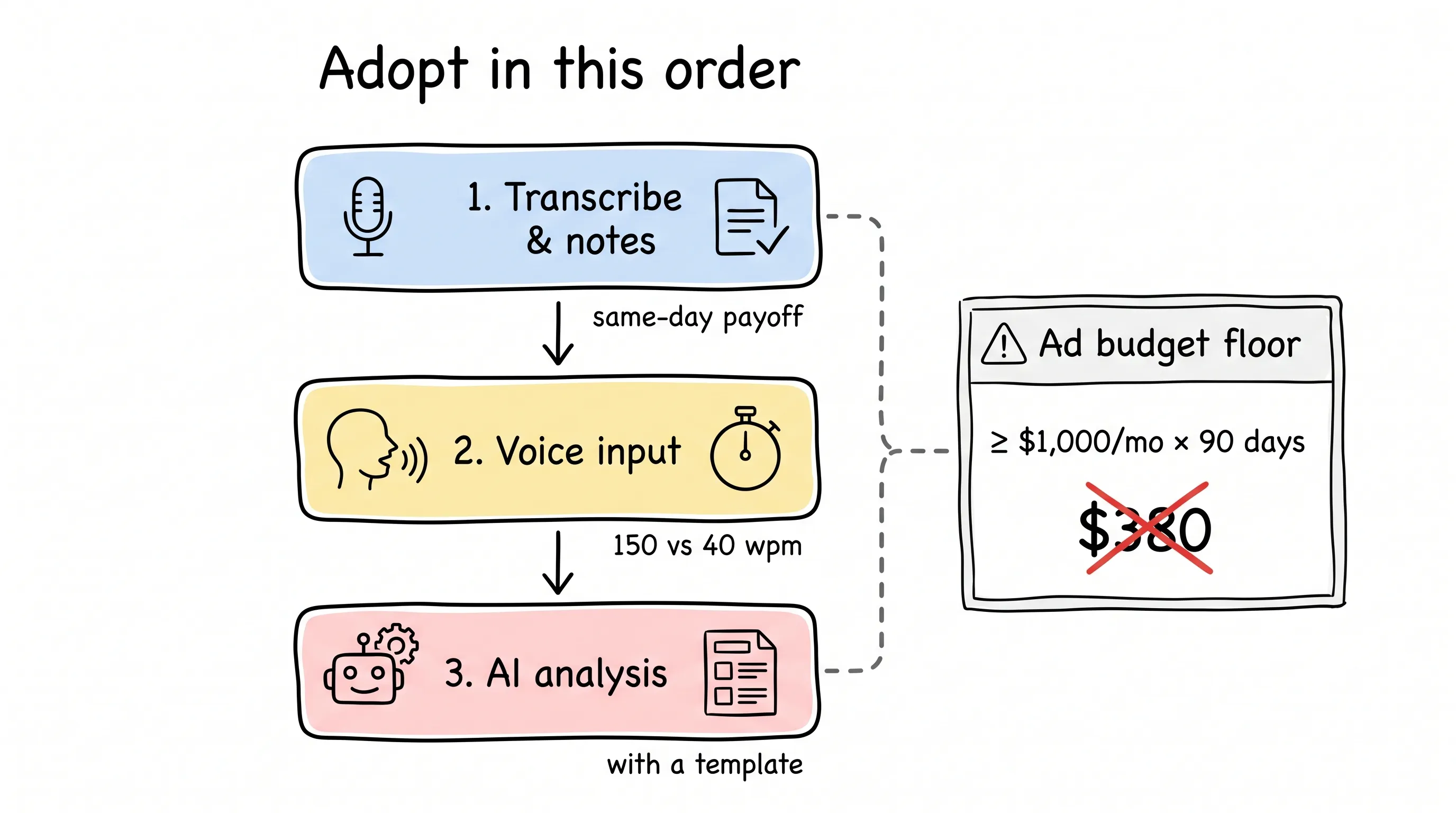
The September 22 episode, "The 4 AI Tools I Can't Live Without," lays out a small content team's daily toolstack: Claude, Wispr Flow, MacWhisper, and Granola, each with a clear job. The host's justification is a set of numbers: people speak about 150 words per minute but type only 40 — speech is nearly four times faster than typing, and every email, brief, and post-mortem written by hand pays three times the time cost of that gap. Each of the four tools covers one lane. Wispr Flow handles voice-to-text, so writing email and briefs moves at the speed of speech. MacWhisper transcribes recordings. Granola auto-generates meeting notes during calls, so you can actually talk instead of taking minutes. Claude squeezes value out of recordings you already have: one podcast episode's audio can yield a full week of content topics, plus the sticking points where buyers hesitate, mined from customer conversations. The episode promises three deliverables: extract a week of topics from recordings already on your computer, find the sticking points in buyer decisions, and let meeting notes write themselves. The logic of this stack is worth noting: not one of the tools generates content from thin air — all of them turn words already spoken and meetings already held into reusable written assets.
The August 11 guest was Ashley Brock, who has managed more than $200 million in ad spend cumulatively and teaches founders to take their ad campaigns back in-house. This episode covers the budget floor for paid ads and where AI fits in. Her threshold number is concrete: a monthly budget of $380 isn't enough for the ad algorithm to finish learning. Meta's algorithm needs sufficient budget and time to figure out who actually buys from you — at the $380 tier, an account can't learn a reliable audience model. Her floor is at least $1,000 per month, run for a full 90 days before judging results. Don't rush to pause mid-run: frequent on-off switching is exactly what wrecks an algorithm's learning window. She points to two places where AI lands in paid media: creative production and decision support for campaign judgment. On writing ads she has a method too: people who aren't trained copywriters have to write ads specific enough to work — if the ad isn't specific, no quantity of creatives will save it. She also notes that some Meta Advantage settings can still be switched off manually today, and that there's one data column that tells you whether an ad you're about to pause is actually one step from converting — check that column before pausing. One context worth noting about this episode: her position is teaching media buyers to build in-house capability, the opposite business interest of outsourced agency operations — factor that stance in when hearing the budget advice. That said, the 90-day learning window lines up with mainstream paid-media practice.
Reliability caveat: this is a podcast listing page, heavy with promotional copy for free bootcamps. The AI content is concentrated in a couple of individual episodes; the tool list and budget numbers come from episode descriptions. Until you hear the original episodes, don't treat them as verified conclusions — and the budget benchmark assumes a Western (US/European) ad environment and a course-type business. I also took a quick look at the show's overall quality: the newest episode is an entrepreneurship Q&A; September also had two episodes on restructuring business models and team building — AI is only a side thread of this show, so followers should pick by episode.
What's actually worth learning from this toolstack isn't the four specific names — it's the logic behind the adoption order. First, turn words already spoken into text (transcription, meeting notes): low risk, same-day payoff, because someone would have to write that output anyway. Second, add voice input — this changes your own input habits and takes a few days to adjust to. Only last, feed your backlog of recordings to Claude for topic and sticking-point analysis, and give the AI an explicit task template when you do — for example, "extract ten topics from these 40 minutes, each with a title and a hook." No template, no stable output. Get the order backwards — fantasize first that AI will write content for you — and you'll most likely quit within two weeks.
💬 Two things you can do today. Switch briefs and weekly reports to voice input: at one hour of writing a day and speech four times faster than typing, you claw back 200-plus hours a year — try the free tiers before you buy. If you're running Meta ads, audit your budget first: below $1,000 a month, either raise it to $1,000 and let it run 90 days before judging, or keep the money and make organic content instead — at the $380 tier you're most likely paying tuition for nothing. If you're on Advantage, walk through the smart settings one by one, switch off what can be switched, recover some manual control, and watch the data for a week. Solo teams don't need all four tools on day one — start with the meeting-notes one; the pain it replaces is the most tangible.
🔗 Further reading: Read the full article
💡 Today's Big Picture
Connect the four items and today's through-line is this: automation and the human touch are being re-priced.
The consumer survey in the lead says that once AI made response speed a given, customers started asking for something else: understand me, give me a human, don't make me repeat myself. Willingness to pay for a human safety net has hit 43% — the experience gap has turned, for the first time, into a clear pricing opportunity. What sells is no longer response speed; it's certainty. The influencer-platform forecast is the market version of the same story: platforms are building AI matching and authenticity verification into the product, the industry grows fivefold in seven years, and money is flowing toward the steps that solve for efficiency and trust — even deepfake detection has become a capability that needs its own line item. The six GenAI ad cases are the playbook layer: every project that worked put AI in the position of structure, replication, and personalization, leaving emotion and execution to humans — which echoes exactly what the lead story's customers are asking for. Machines do the volume; humans make each piece of that volume feel addressed to you. Amy Porterfield's toolstack and ads floor are the personal version: AI takes over transcription, notes, and first drafts; humans stay in the meeting and the judgment call. Below $1,000 a month, don't expect the algorithm to teach itself — and nothing in that toolstack thinks for you; everything in it saves you time.
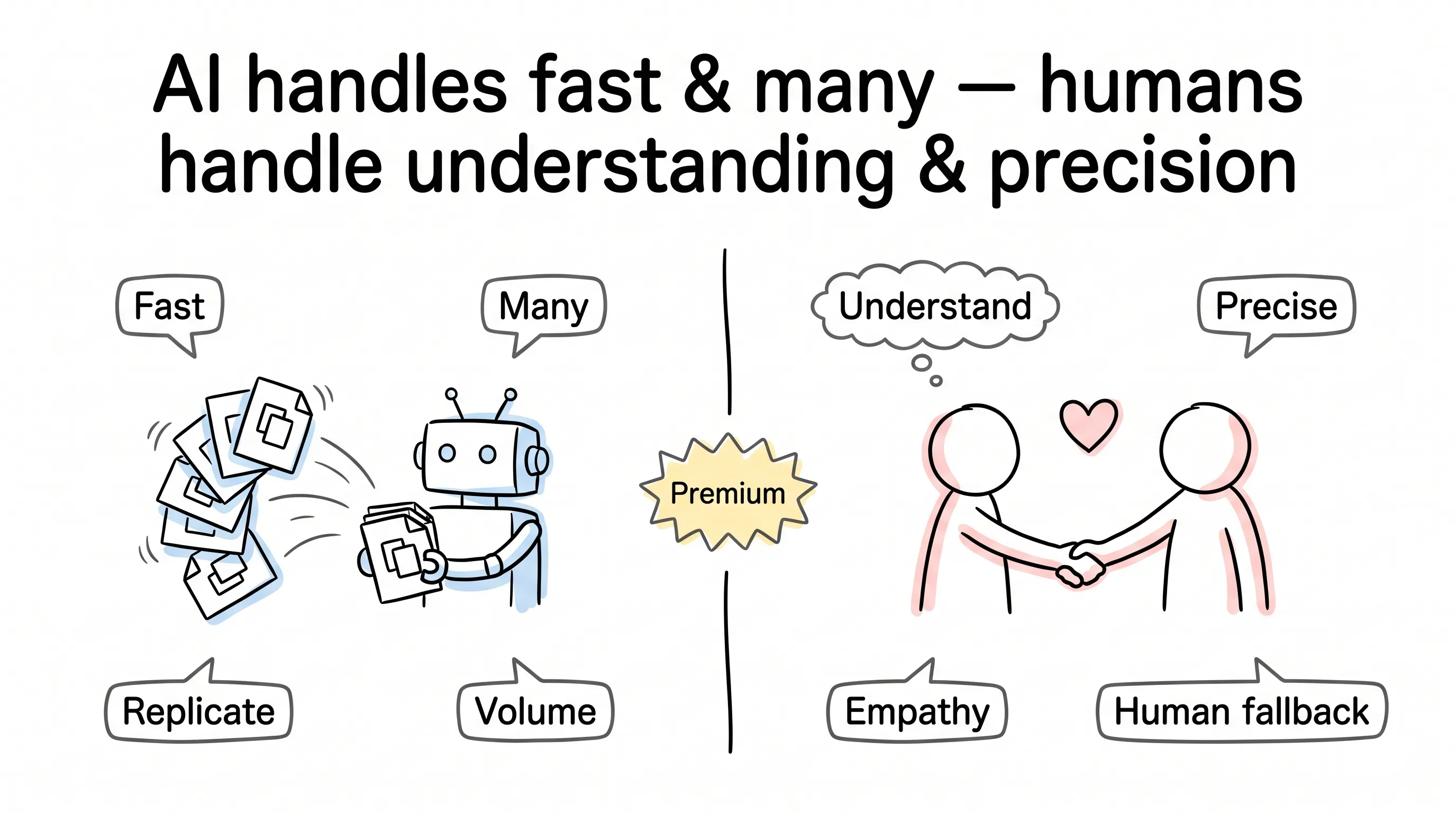
One sentence to bind it all: AI handles fast and many; humans handle understanding and precision — and whoever wires the combination best takes the premium. Three prompts for tomorrow's work: customer-service teams, slot intent testing and confidence thresholds into this week's iteration; paid-media teams, audit your budget floor — accounts under $1,000 a month should either add money or pull out; content teams, pick one case-study path and run one small test loop — three pieces of creative is enough. Starting tomorrow, book the cost of human fallback as a line item on par with automation savings — don't count only the half you save.
Continue reading
Related articles

AI Marketing Daily · 2026-10-09
AI marketing daily for 2026-10-09 covering 11 items: brand measurement moving from survey panels to search, social, e-commerce, and AI prompt signals; GEO and share of model playbooks; safety guardrails for agentic ad buying; and tool roundups for ad platforms, cross-border tools, and social media uses.

AI Marketing Daily · 2026-10-08
AI Marketing Daily for 2026-10-08 curates 20 items across AI search visibility (GEO), advertising, platform selection, cross-border e-commerce, and ROI measurement. The headline argues that strategic marketing decisions should stay with humans while AI assists execution.

AI Marketing Daily · 2026-10-07
Today's throughline is answer engine optimization (AEO — getting your brand quoted in AI answer engines).