
AI Marketing Daily · 2026-10-02
Daily digest of ten AI marketing signals, led by a report on creator content becoming evidence in AI search answers, with sections on influencer marketing practice, ad brand safety and buying, and industry data roundups.
Today's ten signals all crowd in one direction: AI search is treating creator content as evidence for answering purchase questions, while platforms and regulators lay the infrastructure for authenticity. The top story comes from Influencer Strategists' 2026 playbook report — 40% of U.S. searches now trigger AI Overviews, and 99% of the YouTube videos cited by AI come from creators. The rest of the lineup covers an influencer-marketing monthly digest, ad brand safety, agentic campaign buying, an AI social-media data roundup, and a cross-border e-commerce tool list. No breaking frontier-model news today; it's all practical material you can drop straight into a Q4 plan. If you're setting budgets right now, read it end to end.
🎯 Top Story
Creators become AI's evidence of choice: a report breaks down the five-step 2026 playbook for AI search × influencer marketing
In mid-September, Influencer Strategists published a data report that joins two budget lines that used to live apart — AI search and influencer marketing. The report aggregates first-party data from Similarweb, BrightEdge, Semrush, and Pew: more than 40% of U.S. searches now trigger AI Overviews, and Google AI Mode crossed 1 billion monthly active users in May 2026. Search didn't flow to ChatGPT; it turned AI-native itself. Google Search still draws about 3.38 billion monthly unique visitors against roughly 680 million for standalone AI chatbots — a scale gap of nearly 5x.
The sources being cited are changing hands. Tracking May 2024 through September 2025, BrightEdge found YouTube's citation rate in Google AI Overviews (AIO) at 29.5% — roughly 200x that of rival Vimeo. Semrush analyzed 89,000 LinkedIn links cited by AI: LinkedIn now appears in 11% of AI answers on average, and the overwhelming majority of those citations point to creator posts, with company pages sidelined. One number is even more striking: 99% of YouTube citations come from creator videos — help documentation barely ever gets picked. BrightEdge research from March 2026 also found that on review and comparison queries, Google AI Overviews cite YouTube 2.5x as often as ChatGPT — exactly the zone where influencer demos and head-to-head reviews concentrate.
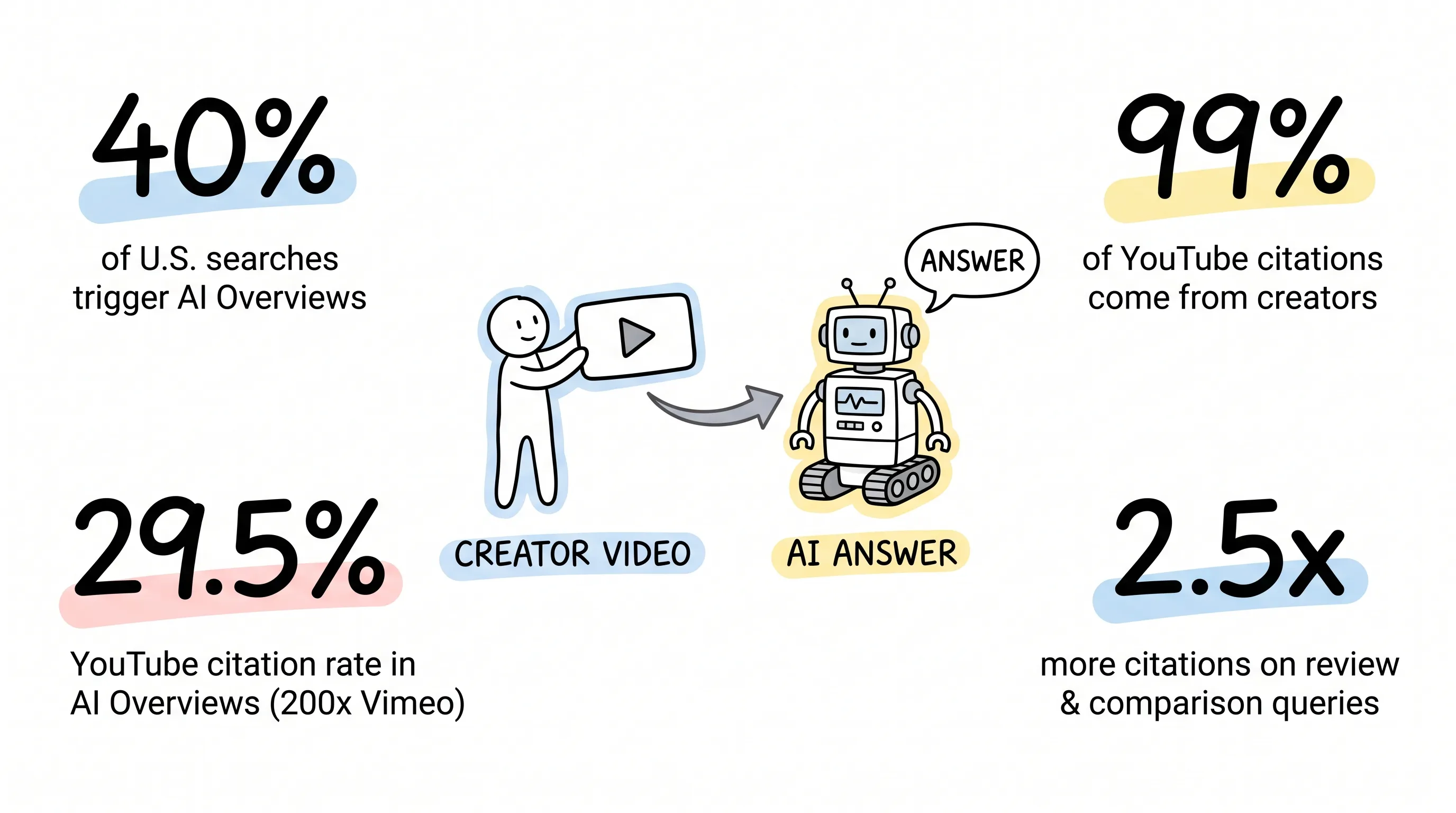
The data says the role of influencer marketing has changed. The value of a review video used to end at the creator's own followers and reposts; now it is a retrievable information asset — when AI answers judgment-type questions like "which running shoe suits a heavier marathon runner," it holds that video up as evidence. Ahrefs' own case gives a reference point for commercial strength: AI search brings only 0.5% of its traffic but 12.1% of signups, with per-visit conversion 23x traditional organic search, and AI-driven traffic up 12x year over year. Small traffic, heavy intent.
The price is broken attribution. Pew's study sampled 900 U.S. adults and nearly 69,000 Google searches — modest in scale, but the direction is consistent: when an AI summary appears, clicks on traditional results fall to 8%, versus 15% without one, and only 1% of users click a link inside the summary. Similarweb fills the gap from the other side: users who receive an AI recommendation are 2.5x more likely to visit that brand within 7 days, and 55.9% of AI-influenced visits loop back through search rather than arriving directly from AI. Rand Fishkin, co-author of Zero Click Marketing, put it this way: AI influence is real, and marketers need new ways to measure it. Real impact, invisible pipeline — that's the most awkward part of running influencer campaigns in 2026.
By role, the influencer marketing lead and the SEO team feel this hardest. The influencer selection criteria need a new column: retrievable authority. The report offers an example — a creator with 150,000 subscribers but command of the category's review language may be worth more commercially than a 3-million-follower general-traffic account, because the former owns the buyer's question context. Content briefs must change too: reviews, comparisons, hands-on demos — evidence-style content is what earns AI citations; pure-exposure material has no place at the answer layer.
The buying side feels it too. Seer's 2026 update shows organic click-through on AIO-affected queries compressed from 1.76% to 0.61%, with paid CTR down 68%. Yet brands cited in AI Overviews enjoy an organic CTR premium of 2 to 5x. Clicks are shrinking; citations are appreciating. Google has also started putting real data on the table: the newly launched AI Performance Insights in Merchant Center shows a brand's share in real conversational shopping across AI Mode and AI Overviews. Measurement needs to move from last click to five layers: AI visibility, brand search demand, commercial outcomes, incremental experiments, post-purchase research.
The report lays out five steps you can run week by week. Step one: list the 10 bottom-funnel purchase questions in your category — for instance, "which influencer platform fits a global beauty team?" Step two: take those questions and audit Google, AI Overviews, AI Mode, YouTube, and ChatGPT, logging the recurring sources, creators, and claims. Step three: negotiate where authority already exists — don't grow accounts from zero. Step four: make evidence-style content explicit in the brief; every video should answer one concrete purchase question. Step five: rebuild measurement — treat UTM and referral traffic as a floor on influence, not the whole story, and test incrementality with staggered launches and control groups.
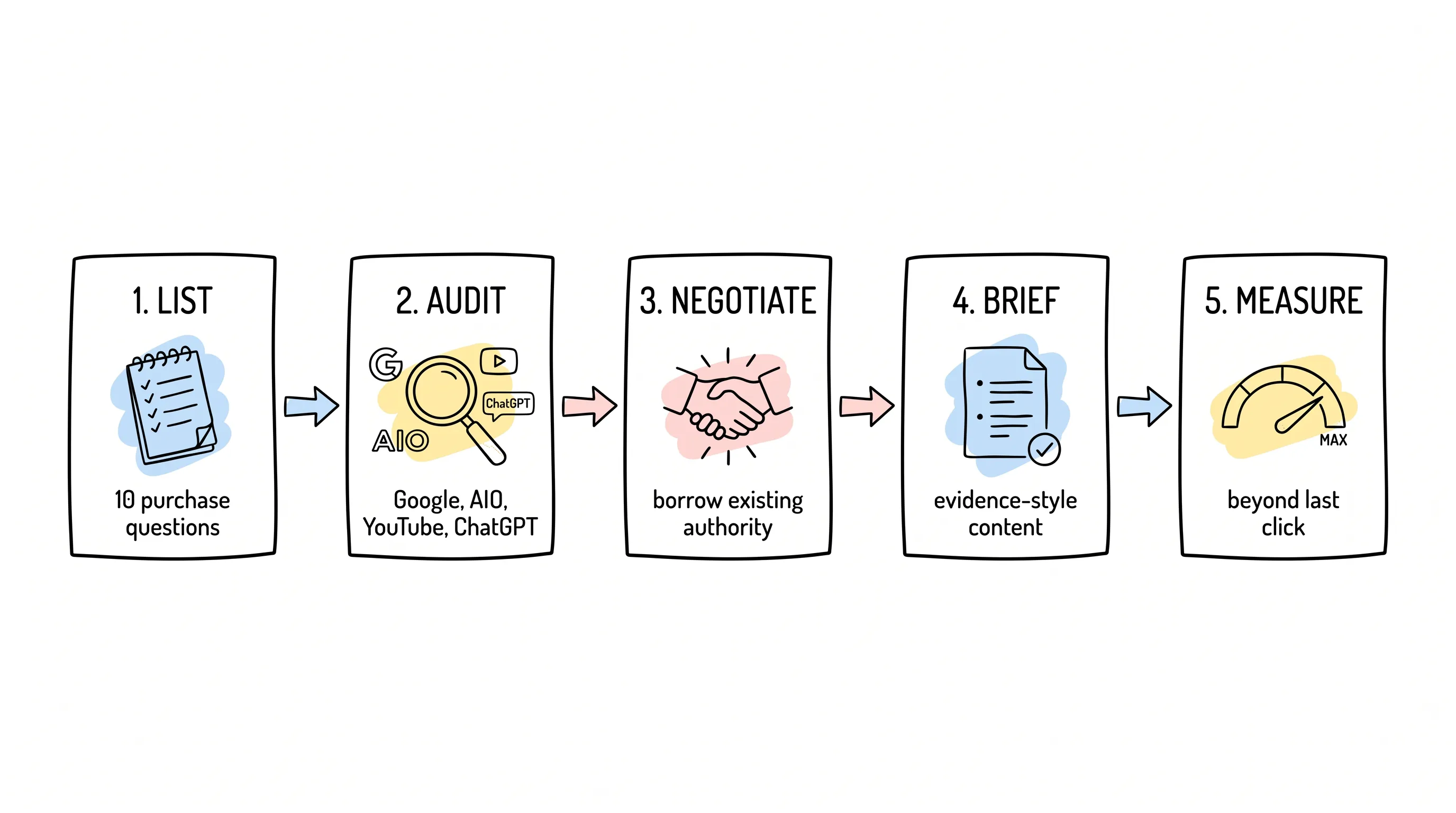
The move you can make this week is step one plus step two; the cost is nearly zero, and two people can finish a 10-question audit in a day. Ipsos data gives you the confidence to do it: Google and YouTube appear in 82% of new-brand discovery journeys; search, creator content, and e-commerce have merged into one continuous decision environment, and you should at least know how strong your hand is at every stretch of that chain. The report has a quip worth passing along: your next influencer brief may need a keyword map. Not because creators should write for robots, but because buyers' questions are becoming the distribution system itself.
My take: the report's biggest value isn't any single number — it merges the influencer budget and the GEO (Generative Engine Optimization) budget into one agenda. You used to pick creators by audience profile and rate; now you first ask whether their content can become the answer to some purchase question. That will push a small set of vertical creators' rates visibly higher over the next year, and shrink brand deals for a large pool of general-entertainment accounts. My recommendation: marketing teams should run the category purchase-question list and the answer audit this month, ahead of competitors, to capture the first baseline map of who is being cited by AI. That map is worth more than any influencer rate card.
🔗 Source: 🔗 Further reading: Read the full article
🏷 Influencer Marketing in Practice
AI recommendations and creator trust rise in tandem: 43% of consumers have bought an AI-recommended product
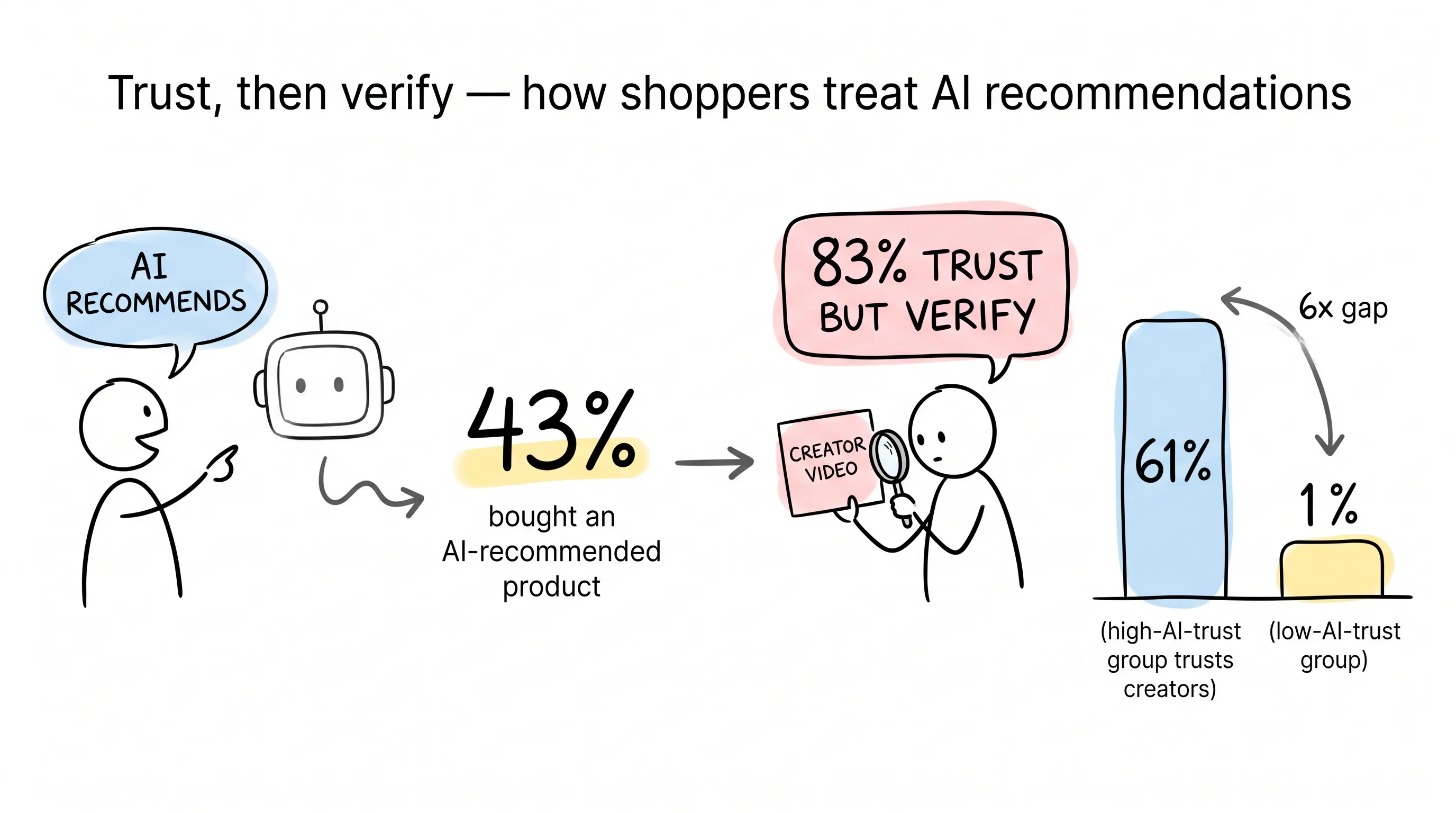
New Engen's September influencer-marketing monthly offers three sets of signals. The first is about trust: PartnerCentric's holiday survey found 43% of consumers have bought a product recommended by an AI chatbot in the past three months, and people who trust AI recommendations trust creators at a 61% rate, versus 11% among the low-AI-trust group — a 6x gap. RTB House research shows Google AI Overviews and ChatGPT have already overtaken TikTok, Instagram, and Facebook on shopper trust. 83% of consumers take a "trust but verify" stance toward AI recommendations, and 76% worry about how chatbots use their data. After an AI recommendation, the consumer's next move is finding a human-seeming source to verify it — creator content sits exactly in that slot.
The second is authenticity infrastructure. The New York Times exposed hundreds of AI-generated fake health personas mass-promoting supplements; Anthropic began embedding invisible watermarks in AI text under the EU AI Act, with Meta, Microsoft, OpenAI, and nearly 200 companies signing the same code of conduct; LinkedIn rolled out a report button for suspected AI slop, and detection data shows close to a third of the platform's short posts and more than 40% of its long posts are purely AI-generated.
The third is average order value. TikTok Shop is moving upmarket: multi-brand seller Spreetail's pool and SPA category grew 125% year over year on the platform — 5x the growth rate of the same category on other marketplaces — 51% of consumers have spent over $100 on TikTok Shop, and delivery times have been squeezed from 5 days to 2.
The monthly also carries a case worth chewing on. Natalie Acopian, owner of a New York boutique, put the good days of in-store queues and the bad days of a neighbor's complaint about her pink storefront into the same shot, and built nearly 250,000 followers across Instagram and TikTok. Real records of stockouts, bad reviews, and lines build more trust than polished brand films — a perfect mirror image of the AI-persona flood.
💬 Practical takeaway: two small moves before Q4. Audit whether the creator reviews of your top 10 products can be found in search — if not, that's your first influencer brief. Then go back over the AI-assisted creator content you used last quarter and set an internal disclosure standard before platforms' detection tools spread. For high-ticket items on TikTok Shop, don't mass-seed samples: run a small pilot with 5 to 8 creators and redesign commissions around high margin and low volume.
🔗 Source: 🔗 Further reading: Read the full article
AI's division of labor in influencer marketing: Armani lifts engagement 20%, Dove cuts AI remixes into 3.5 billion impressions
Sprinklr's enterprise-grade overview splits AI's role in influencer marketing into two segments. The discovery segment brings four capabilities: audience-profile matching, authenticity fraud detection, predictive fit analysis, and collaboration-format personalization. The activation segment brings four scenarios: content-format performance prediction, optimal posting time, real-time sentiment monitoring with mid-flight adjustments, and tying ROI to revenue metrics.
The case numbers are more useful than the capability list. Armani used AI sentiment analysis plus influencer insights to lift engagement 20% and influencer-marketing ROI 15%. Northwestern Mutual used AI-driven campaigns to pull engagement up 10x. The Unilever Dove × Crumbl collab is the most striking: AI remixed content from more than 100 creators into multi-platform versions and landed over 3.5 billion impressions, with 52% of buyers first-time customers of the brand. Of the four discovery capabilities, authenticity fraud detection is the most immediately useful for campaign teams — spotting fake-metric creators used to depend on spot checks by eye, and the misjudgment rate never came down.
On methodology, Sprinklr's division of labor is worth recording: AI handles shortlists, fraud detection, and ROI tracking; humans handle creative, storytelling, and relationship management. Supporting moves include quarterly cleansing of the influencer database, AI first screen plus human final pick, pilot before scale, and wiring influencer data into CRM and media-planning platforms for cross-market governance and compliance. One caveat: this is Sprinklr's own blog, heavy on product placement, but the case numbers have traceable sources.
💬 Practical takeaway: don't expect one AI platform to run influencer marketing end to end. Hand fraud detection and shortlists to the machine — what you save is the weekly hours spent vetting accounts, roughly one full-time head's worth. Creative direction and creator relationships must stay human; Dove's 100-plus creator assets could be cut into 3.5 billion impressions only because the asset pool was big enough to begin with. Pilot one campaign to validate attribution before talking about full rollout.
🔗 Source: 🔗 Further reading: Read the full article
Upfluence bets on the Shopify ecosystem: choose influencer platforms by integration depth, not feature checklists
Everything-PR's vendor profile explains Upfluence's survival logic. This influencer-marketing platform, founded in 2013 with dual bases in New York and Paris, has staked everything on one bet: creator-marketing performance should plug natively into e-commerce platforms, not sit alongside them. Promo-code generation, affiliate tracking, attribution, conversion measurement, post-purchase audiences — all grown directly inside the Shopify stack.
The bet has ridden two waves of tailwinds. From 2018 to 2022, DTC brands clustered on Shopify, and native integration became a must-have; from 2022 to 2024, the DTC correction eliminated a batch of weak players, and the surviving brands have stronger unit economics — needing creator-marketing infrastructure that can handle e-commerce data even more. The Shopify ecosystem carries its own gravity: brands are used to picking marketing tools from the App Store and certified partners, and Upfluence stands right on the decision path. The Paris base brings European GDPR and DSA compliance fluency, and the density of its European influencer database is a blind spot for purely U.S.-based platforms.
One spot on the scorecard is worth pondering: in EPR's AI Citation Share study, Upfluence ranks 11th at 2.9%, below enterprise-grade CreatorIQ (3rd) and DTC leaders GRIN (7th) and Aspire (6th). The competitive logic versus GRIN and Aspire is also worth a note: GRIN is deep in DTC financial integration, Aspire is fast at marketplace matching, Upfluence is deep in the Shopify stack — each plays a different rhythm. One caveat: this is a PR site's vendor profile, with a vendor-leaning stance and no independent evaluation data.
💬 Practical takeaway: Shopify-based DTC brands choosing an influencer platform should weigh "can it directly read your order and attribution data" ahead of the feature list. The CFO question for influencer marketing is one sentence: of the sales influencers drove this quarter, how much can be traced to promo codes and affiliate links? A platform that can't answer that — park it, however long the feature list.
🔗 Source: 🔗 Further reading: Read the full article
🏷 Ad Buying & Brand Safety
Every practitioner agrees GenAI poses brand-safety risk: AI content is near 20% of Google's top 20 results
Basis's long read sorts advertisers' AI risks into three domains. The brand-safety domain has the most striking data: 100% of surveyed practitioners believe GenAI brings brand-safety and misinformation risk, and 88.7% rate the risk moderate or above. The share of AI-generated content in Google's top 20 search results rose from 5.6% in 2022, right after ChatGPT's launch, to over 19% by early 2025. ANA's supply-chain transparency study found programmatic advertisers spend 15% of budget on MFA (made-for-advertising) sites. Meta dropped fact-checking for Community Notes, and the platform's moderation pullback has made the ad environment dirtier. TurboTax and H&R Block's AI support agents were field-tested by media, with wrong-information rates of at least half. Gemini paused its people-portrait feature in 2024 after generating images of historical figures who never existed — hallucination and bias remain common ailments, hardly rare events.
The consumer domain's trust curve slopes down: Edelman's 2024 report shows U.S. consumer trust in AI fell from 50% to 35% within five years, and about two-thirds of American adults feel uncomfortable with AI-generated ads. But a Yahoo and Publicis survey offers a reversal: ads that proactively disclose they are AI-generated gain 47% in appeal, 73% in credibility, and 96% in trust toward the brand itself. Hiding hurts trust more than coming clean.
The legal domain has three items to note: FTC enforcement against dark patterns hasn't eased, and it applies equally to AI-designed manipulative interfaces; the U.S. Copyright Office's January 2025 report makes clear that purely AI-generated content gets no copyright protection — only parts where a human author determined the sufficiently expressive elements are protected; state privacy laws keep tightening, so run a compliance review before connecting any AI tool with murky data provenance.
💬 Practical takeaway: three things you can land this week. Attach an MFA block list to programmatic buying — instant savings of ~15% of wasted budget; write AI disclosure into the creative brief — a 96% brand-trust lift is free money; keep documentation of the human creative process for anything AI touched — your copyright claim depends entirely on it. Don't skip these because the regulatory mood has loosened: all three are cheap, and all three are expensive to get wrong.
🔗 Source: 🔗 Further reading: Read the full article
A Trade Desk executive calls AI a telescope: the buyer's job shifts from turning dials to managing agents
Aravind Chandrasekharan, Senior Vice President of Engineering at The Trade Desk, published a signed op-ed in The Current whose point fits in one sentence: AI doesn't change the essence of marketing — it changes the scale of signals a marketer can see. Audience, context, content, and outcome data now drive more than 20 million bidding decisions per second, far beyond human oversight. He likens the personal computer to a bicycle for the mind and AI to a telescope for marketers: the deciding factor shifts from doing more to seeing farther.
He also pours cold water on today's fashionable agentic buying. On closed platforms, AI can only work from incomplete information, and scale doesn't fix data gaps — it amplifies bias: once AI learns from skewed inputs, it accelerates the skew into outcomes. His fix is open interoperability: DSPs (demand-side platforms) should evolve into modern marketing operating systems, connecting AI to the open internet and integrating signals across sources. Closed systems optimize for their own inventory and economic interests, and AI can't change that. Worth noting: The Current is operated by The Trade Desk, and this piece carries an obvious platform stance.
On how marketing jobs change, the piece is fairly grounded: the interface is turning from dashboard to conversation, with buyers starting to ask "why is this campaign underdelivering" and "which audiences are contributing conversions," while AI systems handle diagnosis and recommend actions — The Trade Desk's Koa Agents are one example of this kind of interface. Also, conversational and generative search are creating new ad inventory: a long prompt — a few sentences — carries intent and preferences, suits audience targeting better, and the old keyword targeting can't catch these queries.
💬 Practical takeaway: schedule the skills migration for buyer teams now — from adjusting bid buttons to asking questions, diagnosing, and setting guardrails — and change the performance yardstick along with it. When the media team evaluates any agentic buying product, ask first: which data can it see, which can't it see, and will the bias in the unseen part get amplified? In long-prompt scenarios, move budget toward audience targeting.
🔗 Source: 🔗 Further reading: Read the full article
A comparison table of the big four ad platforms' AI tools: a 2024 primer, not a 2026 playbook
In June 2024, Medium author Damla Tuban wrote a checklist of the big four platforms' AI ad tools; read today, its value is as a point of comparison. Meta has Dynamic Ads auto-matching users who browsed products, Lookalike Audiences to find similar people, and automated copy-and-creative suggestions. Google has Smart Bidding bidding in real time at every auction, Responsive Search Ads auto-testing headline and description combinations, and GA4 providing predictive insights. TikTok is strong on Smart Optimization and creative optimization tools, plus immersive assets like AR Branded Effects. LinkedIn leans on Matched Audiences' professional-profile targeting and dynamic ads.
The author closes with a three-dimension comparison — targeting & personalization, automated optimization, programmatic — and groups machine learning, deep learning, and NLP as the shared technical foundation of all four, a judgment that still holds in 2026. The conclusion reads bland now: all four use machine learning for targeting and automated bidding, and the tool layer is converging on sameness. The list's timeliness weakness is also on display: written in June 2024, no first-party data, missing newer variables like agentic buying and generative-search inventory. It reads better as a historical coordinate than a playbook.
💬 Practical takeaway: hand this list to new hires as lesson one of onboarding — one hour to build the full picture. But don't make budget decisions by it: the big four's AI tools no longer separate on capability; what decides is the quality of first-party data you feed the machine and the speed of your creative iteration. In a budget meeting, if anyone offers "we turned on Smart Bidding" as differentiation, feel free to interrupt.
🔗 Source: 🔗 Further reading: Read the full article
🏷 Industry Data & Case Studies
88% of marketers use AI daily, but only 17% of companies have an AI governance policy
Memeburn's August roundup pulled together a set of AI social-media-marketing numbers. Adoption is nearly saturated: 88% of marketers use AI daily, 93% to speed up content production, 90% to speed up decisions, 81% for insights. On the market side, forecasts diverge widely: Market.us estimates the AI social-media market at about $3.9 billion in 2026, reaching $22.4 billion by 2033, a 28.37% compound annual growth; Precedence Research forecasts $60.5 billion by 2035. Know the methodology gaps in secondhand roundups before you cite them.
The two sets of contradictory numbers carry the real weight. One set is about content: 71% of social-media marketers believe AI-assisted content performs better, but 78.4% still need moderate-to-heavy human edits before publishing. AI drafts, humans edit — that workflow is now industry standard, and nobody dares ship directly. The other is about governance: 61.5% of teams will add AI budget in 2026, yet only 17% of companies have a formal AI governance policy, and 50% list data accuracy and hallucination as major implementation challenges. The money is going up; the rules aren't being set.
On the technology mix, machine learning and deep learning hold 46.8% of the market, NLP 25%, generative AI only 10%; Mordor puts NLP's compound growth at 29.1% from 2026 to 2031, driven mainly by chat assistants and automated copywriting. One more practical number: LLMs are 73% stronger than rule-based filters at toxicity detection — if you're doing brand-voice control and comment moderation, it's time to switch solutions.
💬 Practical takeaway: that 17% is today's best homework to copy. Before adding AI budget, spend half a day writing the team's AI usage guidelines — which content types may be AI-drafted, which must be human, how disclosure is marked. The cost is nearly zero; the cost of getting it wrong is high. And don't cut human editor roles: a 78.4% edit rate says the editor is the gate that turns AI drafts into brand content.
🔗 Source: 🔗 Further reading: Read the full article
A structural reminder from old case studies: what to hand to AI, what to keep for humans
MarketingSherpa's three cases from October 2022 aren't young, but their structure hasn't aged. The author, Daniel Burstein, opens by declaring professional skepticism toward every new hot topic, so the framing here leans conservative. Brazilian TV network SBT used Echobox for AI-driven social-publishing automation: machine learning continuously reverse-engineers the Facebook Feed algorithm and dynamically adjusts the posting time of every post; over four months, Twitter page views rose 63%, Facebook daily impressions rose 52%, and 14 hours of manual work were saved daily — with the freed hours redirected into content planning. In a cookieless environment, SAP used GumGum's AI contextual targeting: machines scan page text, images, and audio-video to match ads, touching neither cookies nor PII; brand awareness rose 4%, viewability hit 93.2%, CTR 0.9% — no worse than behavioral targeting.
The third case runs in the opposite direction. Outdoor adventure platform 10Adventures uses no AI writers: it relies on human-written, high-quality route content plus SEO fundamentals — metadata, URL structure, internal links, site speed, polishing each one — and built $1 million in sales from organic traffic. The author's warning is worth even more today: the efficiency of AI writers is often paid for in quality, most visibly in vertical niches. While everyone else piles on volume, going deep becomes your differentiation.
💬 Practical takeaway: the three cases draw a division line. Hand to AI the work with clear feedback signals — repetitive distribution, posting-time optimization, contextual matching; the 14 hours SBT saved are real working hours. Don't skimp on humans for brand-judgment deep content — that $1 million in organic sales was written. A small-budget controlled test on cookieless contextual targeting is worth running — it doubles as your backup plan for signal loss.
🔗 Source: 🔗 Further reading: Read the full article
The cross-border e-commerce AI hours ledger: land customer support, HS codes, and translation first — and discount the numbers
WarpDriven's March blog compiled AI adoption data in cross-border e-commerce. It's vendor-produced, so discount the numbers — but the direction of the hours ledger is real. On support, AI cut tickets by 30 to 60%. On compliance, manual HS (Harmonized System) coding work fell 50 to 80%, customs clearance sped up 34%, and FlavorCloud's HS classification accuracy reached 98%. On personalization, there are named cases: Clarks used social-proof elements to lift new-visitor conversion 4.5% and overall conversion 12%; Office Depot optimized product pages on user behavior and earned an extra $6.9 million; Fingerhut customized homepage content for a 4% lift in product views and 1.1% in total conversion.
On localization, AI translation costs 30 to 80% less than traditional vendors, and skipping human review saves over 95%; another survey says acceptance of personalized recommendations is highest in East Asia, next in North America, and relatively conservative in Europe — don't roll out one localization template worldwide. On forecasting, demand-prediction accuracy improves 10 to 20%, stockouts fall by up to 65%, and overstock by up to 40%. Stord's State of AI 2026 report claims 74% of e-commerce leaders believe AI is driving their business. A few figures in the piece are clearly off — localized pricing lifting conversion from 3% to 41%, for example — so verify original sources before citing any of these numbers.
💬 Practical takeaway: sequence cross-border rollout by hours saved — support automation and HS-code recognition go first, with short payback cycles and quick wins. Using AI translation on product detail pages is fine; skipping human review on marketing copy is a road you don't take — one brand blow-up is enough. Wire demand forecasting into inventory planning before you go further, and never let the forecast model place purchase orders directly. When citing these numbers in internal reports, label them as secondhand sources.
🔗 Source: 🔗 Further reading: Read the full article
💡 Today's Big Picture
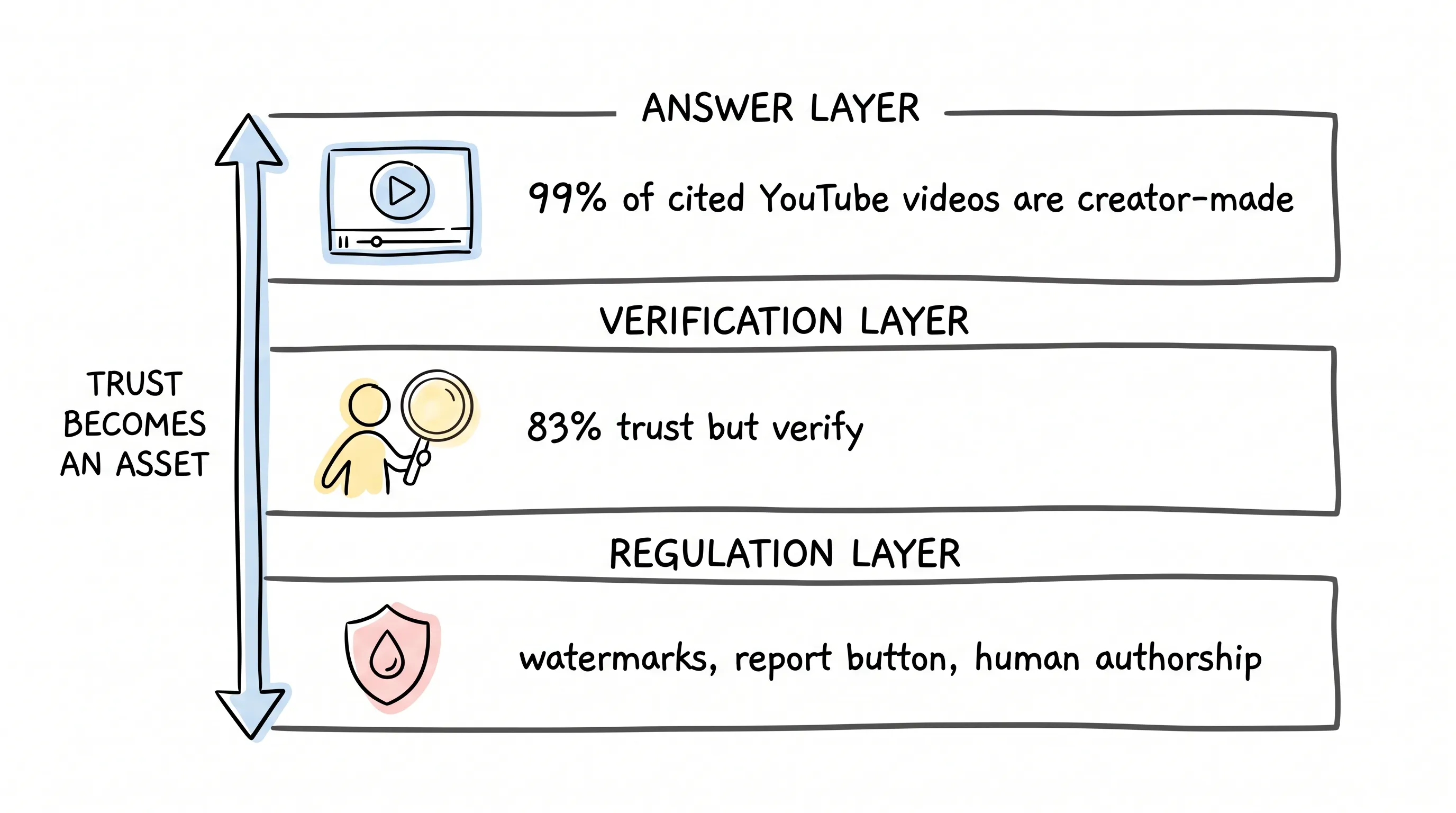
Put today's ten items together and a three-layer structure of one main line comes into view: AI is turning trust into an asset you can operate.
At the answer layer, the top-story report nails creator content's new identity: 40% of U.S. searches trigger AI Overviews, 99% of AI-cited YouTube videos are creator-made, and influencer content has moved from media inventory to evidence in AI's answers to purchase questions. At the verification layer, New Engen's numbers show 83% of consumers take a "trust but verify" stance on AI recommendations, and creator content becomes the credibility checkpoint before checkout. At the regulation layer — invisible watermarks, LinkedIn's AI-slop report button, the Copyright Office's human-authorship standard — authenticity is turning from a slogan into technical infrastructure.
One judgment for marketers: influencer content should no longer be budgeted as an independent channel — it is the defensive fortification of AI recommendations. If your competitor gets cited by AI and you don't, the loss won't appear in any report's click column; it will appear two months later in your brand search volume. The companion action: get the purchase-question answer audit run first. It costs a day of labor; the cost of doing it late is watching competitors build the answer ecosystem ahead of you.
One more reminder from the data set: 88% adoption against 17% governance policy — the biggest asymmetry in all ten items today. Whoever first finishes the three cheap things — AI usage guidelines, disclosure standards, copyright documentation — will do less firefighting when regulation tightens next year. And one honest note: four of today's items come from vendor blogs; discount all the numbers, and remember to trace back to original sources before citing them in reports.
Continue reading
Related articles

AI Marketing Daily · 2026-10-09
AI marketing daily for 2026-10-09 covering 11 items: brand measurement moving from survey panels to search, social, e-commerce, and AI prompt signals; GEO and share of model playbooks; safety guardrails for agentic ad buying; and tool roundups for ad platforms, cross-border tools, and social media uses.

AI Marketing Daily · 2026-10-08
AI Marketing Daily for 2026-10-08 curates 20 items across AI search visibility (GEO), advertising, platform selection, cross-border e-commerce, and ROI measurement. The headline argues that strategic marketing decisions should stay with humans while AI assists execution.

AI Marketing Daily · 2026-10-07
Today's throughline is answer engine optimization (AEO — getting your brand quoted in AI answer engines).