
AI Marketing Daily · 2026-10-01
AI marketing daily digest comparing Meta, Google, and TikTok ad APIs and MCP readiness, covering Meta's conversational ad tests, a GEO optimization guide, AI personalization scenarios, cross-border seller case numbers, and a 2026 privacy compliance checklist.
Start today with the interface layer of advertising AI. One long read lays the APIs and MCP status of the three major ad platforms side by side, and Meta has pushed conversational ads a step further into real-world testing. On the execution side, cross-border sellers' savings ledgers and Klarna-scale case numbers keep building the ROI case for AI investment, while three guides — on GEO, personalization, and privacy compliance — draw a new threshold to clear. Today's main theme: AI is moving from generating content to executing on people's behalf, and both the gains and the risks have entered the math-it-out stage. Whoever gets their data, creative assets, and compliance in order first is the one who can take delivery of the automation the platforms are handing over. After the top story, scroll straight down to the wrap-up at the end and match it against your own to-do list — ten minutes to walk away with today's action items.
🎯 Top Story
Meta, Google, TikTok ad APIs compared: MCP is rewriting the front door to ad automation
Zernio's technology comparison, written from a 2026 vantage point, puts the APIs of the three major ad platforms in a single table and checks them item by item. The hierarchy differs across all three: Google uses three layers — Campaign, Ad Group, and Ad — with Performance Max organizing assets separately through Asset Groups; Meta adds a layer with the Ad Account, running from account to Campaign to Ad Set to Ad; TikTok mirrors Google with three layers. On architecture, Google runs REST plus gRPC, ships six official client libraries (Java, Python, Ruby, PHP, .NET, and Perl), and queries data with its own GAQL (Google Ads Query Language) — the steepest learning curve of the three. Meta offers the Graph API, exposing endpoints by objects and connections, with reporting through the Insights API that supports breakdowns by age, gender, country, platform, placement, and device. TikTok uses REST plus JSON, with a reporting system spanning six categories — from basic reports and audience reports to Playable Ads, Dynamic Showcase Ads, Business Centre, and GMV Max Ads — plus bulk management of ad accounts, balances, and Business Centre assets. Each platform pairs its API with an automation product line — Performance Max, Advantage+, and Smart+ — that respectively takes over bidding, targeting, and creative optimization, all aiming to shrink the space for manual tuning to a minimum. Server-side conversion tracking also comes in three flavors: Google's Enhanced Conversions and offline conversion imports, Meta's Conversions API that sends conversion events directly from the server, and TikTok's Events API collecting web, app, and offline events. The quality of server-side signals directly determines how fast each platform's algorithms learn, so which route you pick depends on your own event tracking capability. None of the three charges for the API itself; the cost lands on development and maintenance.
What really separates them is MCP (Model Context Protocol). Meta offers an official hosted MCP with read and write access, packaging ad capabilities as tools with scoped permissions — reports, A/B tests, product catalogs, signals and datasets, activity logs, and searches of the Merchant Help Center can all be handed to an AI client. Google's official MCP is read-only and not hosted, so you have to deploy it yourself locally or on Cloud Run; it can query metadata and performance for clients, campaigns, and ad groups in natural language, but any write still has to go through the API. TikTok's Business MCP supports managing campaigns, analyzing performance, configuring audiences, and managing catalogs and creative assets in natural language. For the same requirement, the three platforms' AI-readiness is a full generation apart. The pitfalls around authentication and rate limiting differ too: Google requires OAuth plus a developer token, with tiered token quotas and a lengthy approval cycle for production access; Meta applies dynamic rate limits based on app level and account activity, makes ad review a hard gate before launch, and changes to fields like creative, targeting, optimization goals, and billing events can trigger a second review; TikTok rate-limits at both the global and endpoint levels. All three APIs iterate frequently and deprecated fields are routine — keep a standing maintenance budget line for this.
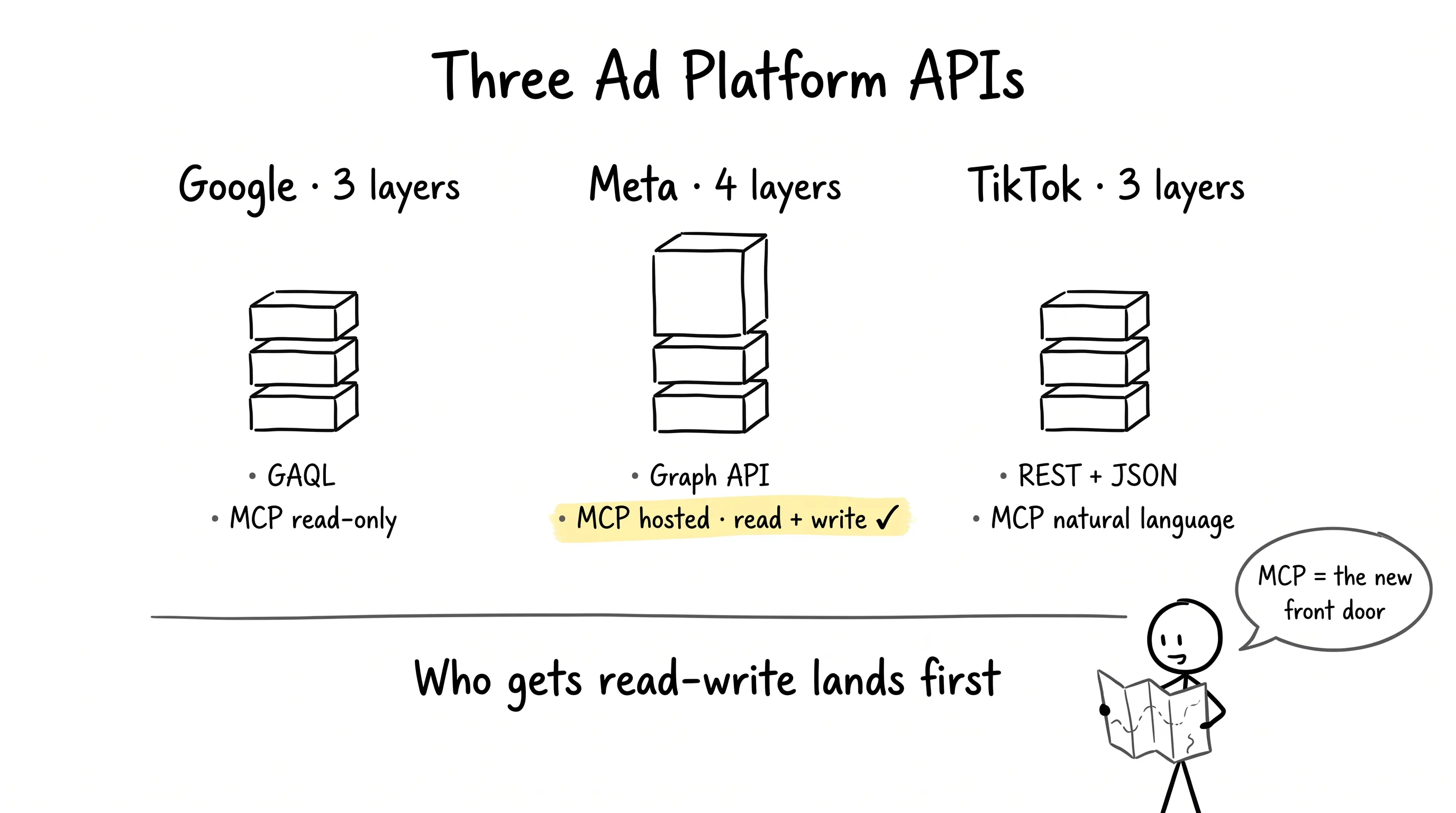
For technical teams building AI ad workflows, this comparison amounts to a selection map. If you want AI agents to directly modify campaigns, Meta has the lowest barrier right now: a hosted MCP with no deployment and full read-write access, where everything from pulling reports to running A/B tests happens inside a conversation. If you want AI to analyze Google Ads data, the official read-only MCP can query campaign and ad group performance in natural language, and you can pair it with optimization scores and recommendation APIs to find improvements — but weigh GAQL's learning curve and the token approval cycle before automating every write step, and design the OAuth authorization matrix up front if you manage multiple accounts. TikTok's natural-language management suits small and mid-sized teams that iterate fast; bulk account creation, balances, and Business Centre assets can all be handled through the API. The second half of the article pitches the author's own unified API, folding Meta, Google, TikTok, LinkedIn, Pinterest, and X into one interface — the free tier covers two social accounts and 500 ads, paid plans start at $6 per month, and each extra ad adds one cent per month. This is a vendor advertorial. The genuinely true parts: a unified interface saves maintenance and doubles as a convenient way to research competitor ad libraries. The also-true parts: data normalization losses and the rate-limiting black box are real, and anyone who has tried to reconcile multi-platform reports knows exactly how the metrics refuse to line up.
Three steps you can land this week. Step one: inventory your automation needs and sort them into read-only and write — read-only analytics can plug into all three platforms' MCPs today, while write operations should be trialed on Meta only. Step two: build slack into the Google-side schedule — developer token approval plus getting up to speed on GAQL should be budgeted in weeks, not days, and multi-account scenarios need the authorization matrix drawn up clearly first. Step three: turn Meta ads changes to creative, targeting, and optimization goals into a whitelist process — touching those fields can trigger re-review, and every automated step must route around ad sets that are actively spending. As for whether the unified API is worth buying, run the free tier's reports first and decide after.
Read this piece with a discount on its stance: Zernio spends the whole article laying the groundwork for its own unified API, the closing FAQ literally answers "which API is best" with its own name, and the end of the body carries a promotional banner for its social publishing feature. But the side-by-side information in the table itself is solid, and the MCP column in particular reads out an industry direction: ad platform APIs are being rewrapped in MCP, and who gets read-write versus who is only allowed to look determines on which platform AI agents land first. Meta has stolen another step ahead, while Google's read-only posture signals it is still guarding the data floodgate.
🔗 Further reading: Read the full article
🏷 Marketing Tools & Strategy
GEO practical guide: get AI to cite your content — swap CTR for citation frequency
GoCodex's content marketing guide turns GEO (Generative Engine Optimization) into an executable checklist. Three underlying shifts: AI Overviews serves summary answers directly at the top of search results, the share of zero-click searches keeps rising, and AI agents bypass the search page entirely to deliver information inside conversations. The guide's judgment: ranking well is no longer enough — if your pages aren't being cited by AI, you remain invisible in AI-driven discovery. Traditional SEO leans on keyword matching, backlinks, and technical optimization; generative engines look at intent understanding, semantic relevance, structured content, and authority signals, and the two logics need to run in parallel. The five strategies, in order: rewrite titles as question-style phrases and open each section with a brief summary, breaking content into tables and lists that AI can easily extract; deploy conversational long-tail phrases, organizing content the way users ask full-sentence questions and building content clusters around related questions and entities; shore up E-E-A-T (experience, expertise, authoritativeness, trustworthiness) signals — author credentials, real case studies, verifiable data, and citations from credible sources, because AI checks for trust markers before citing; go multimodal with image alt text, video transcripts and captions, and timestamped chapters, paired with VideoObject and ImageObject structured data; and add schema markup such as FAQ, Article, and HowTo — the article includes a FAQPage JSON example so AI can lift question-answer pairs directly — folding voice search and visual search into the same optimization, validated with Google Rich Results Test. The KPI section offers a comparison table: organic traffic becomes AI Overviews impressions, keyword rankings become long-tail question performance, CTR becomes AI citations and brand mentions, backlinks become trust signals and off-site references, and engagement metrics become dwell time and scroll depth. The closing warning: don't over-optimize your way into AI summaries — plagiarism, bias, and factual errors all boomerang, and AI-assisted creation must be disclosed. The article projects that GEO will become standard practice in 2026, with optimization targets expanding from Google alone to Microsoft, OpenAI, Anthropic, and others.
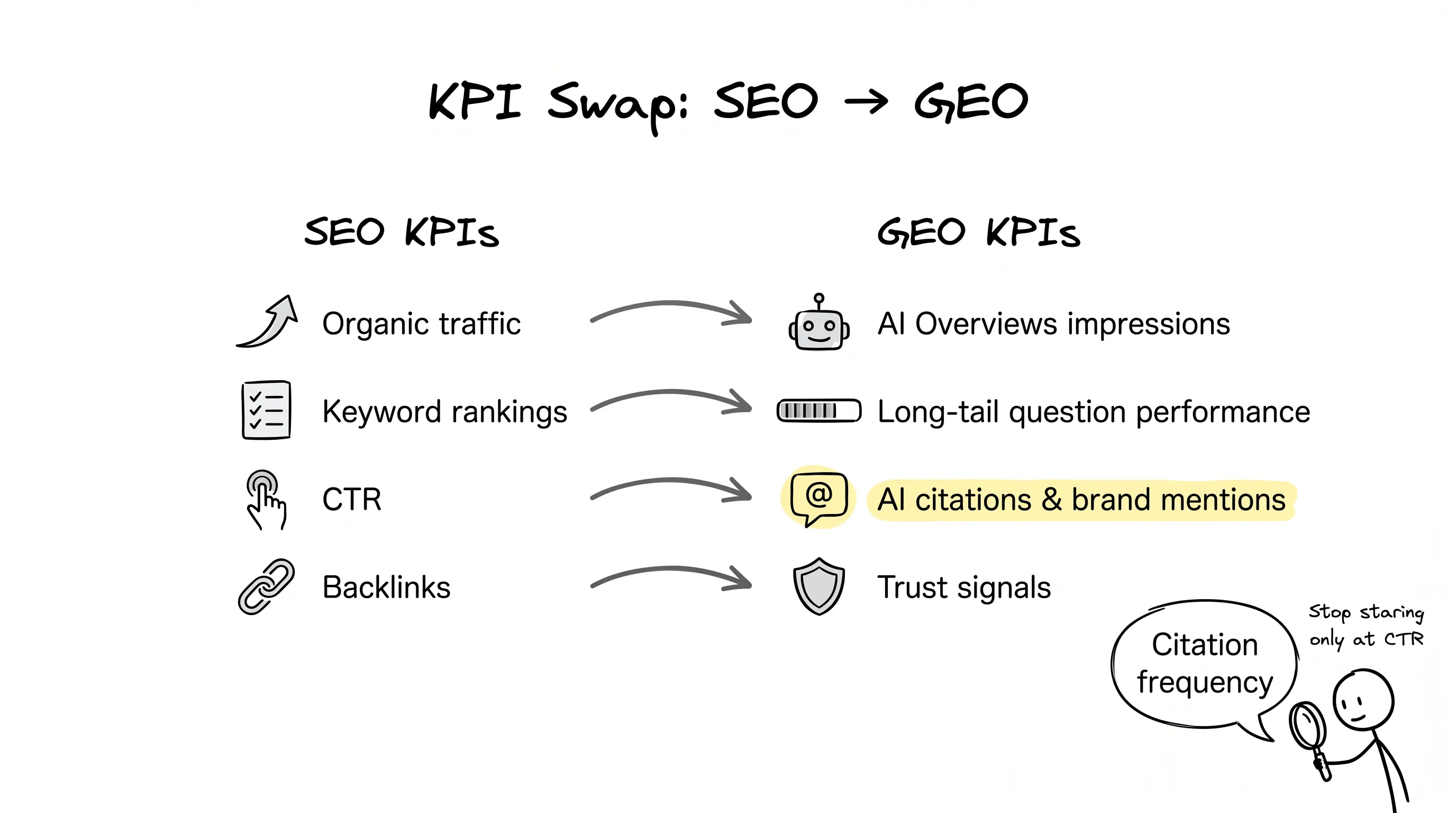
💬 The two cheapest moves this week: rewrite the titles of your key pages to match how users actually ask, and give a direct answer within the first couple of lines of each section; add FAQ and HowTo structured data and run it through Rich Results Test. Add an AI-citation monitoring column to your reports and compare month over month — stop staring only at CTR.
🔗 Further reading: Read the full article
AI personalization playbook: four scenario types matched to tools, starting with email
Future Design Group's primer maps out how AI personalization differs from traditional segmentation. Traditional marketing buckets users by age and region; AI pushes it to one-to-one — combining individual behavior patterns, purchase history, on-site interactions, and real-time context (location, device, time) to deliver each user their own messages and offers. The example in the piece is concrete: a returning user opens a product page on their phone at 8 p.m., and the site immediately surfaces products they viewed before, with a personalized discount and a faster mobile checkout flow. Four scenario types, each with matching tools: email personalization with Mailchimp AI, ActiveCampaign, and Klaviyo, adjusting subject lines, content blocks, product recommendations, and send times by recipient behavior; on-site personalization with Optimizely, Dynamic Yield, and Adobe Target, so dynamic banners and homepage layouts no longer need manual work; ad personalization in Google Ads, Meta Advantage+, and AdRoll, tuning creative, formats, and placements by cross-platform behavior; and product recommendations with Amazon Personalize or Salesforce Commerce Cloud for "frequently bought together," "recently viewed," and behavior-based cross-sells. The returns fall into four buckets: engagement metrics like click-through rate, dwell time, and conversion; satisfaction-driven retention; higher average order value from cross-recommendations; and ROI after cutting wasted ad spend and content. The article's judgment: smart teams use personalization to sell more; smarter teams use it to buy long-term trust. It lists three risks: data transparency and compliance under GDPR and CCPA, with uses disclosed; over-personalization that makes users feel tracked, requiring opt-out paths and alternatives; and the integration cost with CRM, CMS, and analytics stacks — tools that won't plug into your existing systems are just shelf decoration. Four steps to get started: audit data quality first so the data is clean, structured, and traceable to individuals; then pick an email or homepage module for a small pilot; use A/B testing to measure the increment personalization actually delivers; and finally feed responses and behavioral data back into training to iterate.
💬 Sequence the rollout starting with email — the lowest barrier and the fastest data feedback loop. Before you start, run a data quality audit; feeding dirty data into personalization only amplifies the errors. Pilots must keep a control group — if you can't measure the increment, don't expand site-wide yet.
🔗 Further reading: Read the full article
MAICON 2026 live podcast lineup: 8 AI marketing shows you can subscribe to right now
Marketing AI Institute announced on September 30 that MAICON 2026 (October 13–15, Cleveland) will host a live podcast studio for the second year in a row, recorded by Evergreen Podcasts, taping 8 shows across two days. Day one, four shows: Marketing AI Sparkcast at 7:30 a.m., hosted by Aby Varma, on how marketing leaders put AI into real workflows; Build a Better Agency at 10:30 a.m., Drew McLellan's show for agency owners, ending each episode with actionable steps; In-Ear Insights at noon, run by Trust Insights' Christopher Penn and Katie Robbert, answering one concrete business question in 30 minutes with a full resource kit of video, audio, and transcripts; and The Artificial Intelligence Show in the afternoon, where Paul Roetzer and Mike Kaput break down AI business news weekly and take listener questions. Day two, four shows: AI for U, Brian Piper's show on AI adoption in higher education, airing every other Thursday; The Agile Brand, Greg Kihlström's three-episodes-per-week, 20-to-30-minute show featuring platform executives from Adobe, Salesforce, and Optimizely and brand-side voices from Marriott, Georgia-Pacific, Nestlé, and Zoom; Pretty Funny Business, where the two founders of EMMIE Collective discuss the messy side of marketing, revenue operations, and running a business; and AI Marketing Companion, Sandy Carter's deep dives with industry experts on AI and future business strategy. The conference itself opens October 13, with podcast taping over the following two days — if you're attending, camp out at the studio; if not, just add these 8 shows to your subscription list.
💬 This lineup has more lasting value than the conference itself. Commute-time routine: follow The Artificial Intelligence Show weekly for AI business news, and cherry-pick The Agile Brand by guest — the platform-executive and brand-side conversations are information-dense. Domestic (China-based) listeners: after listening, do a layer of case translation — copying the playbooks directly won't land the same way here.
🔗 Further reading: Read the full article
🏷 Product Launches
Meta tests conversational ads: Business AI moves into Instagram Stories and Facebook Reels
Meta's head of business AI, Clara Shih, unveiled a suite of products at the Cannes Lions festival. Leading the pack is Business AI, now being tested on Instagram Stories and Facebook Reels: the ad itself becomes conversational, letting consumers ask questions right inside the ad — is the leather genuine, how long does shipping to Marseille take — with the system trained on the brand's existing content, policies, and product catalog, answering instantly 24/7. In the official demo, a user asks for a birthday gift for a 28-year-old sister who loves comfortable fits. The AI first recommends lightweight stretch pants and explains the breathable, relaxed fabric; when the user asks how to pair a top, the AI adds a Versa Polo to complete the set — one conversation covering the whole arc from sparking purchase interest to styling. Meta frames this direction as the agentic future of shopping and advertising, stripping out the friction between seeing an ad and placing an order, with answers that are instant, around-the-clock, and human-free. Four generative tools shipped in the same batch: Advantage+ adds brand asset customization, letting advertisers plug their logo, brand colors, and fonts into creative to solve brand consistency at personalization scale; Video Generation and Video Highlights turn static images into dynamic video assets, dropping the production bar for video creative down to the level of a still image; Virtual Try-On; and Creative Sticker CTA, sticker-style call-to-action buttons that boost immersion and personalization. The beta waitlist is open. A timeliness note: this announcement came from Cannes about five months ago — it's first-hand vendor information with no public campaign performance data yet, and the 589 likes and 45 comments on the post are mostly peer congratulations.
💬 Conversational ads tear down the boundary between customer service and media buying. What advertisers can do now: sign up for the beta waitlist, and meanwhile structure your product catalog and brand asset library into structured data — the ceiling and floor of Business AI's answer quality are both set by your catalog data; a messy catalog means the conversations will crash and burn. You can test the static-image-to-video feature inside Advantage+ on a small budget first — the video production costs it saves are real money.
🔗 Further reading: Read the full article
🏷 Industry Data & Cases
The cross-border seller's AI ledger: efficiency up 60%, labor down 30%, product selection from months to days
Tuke Marketing's hands-on guide for cross-border sellers supplies a batch of cases with hard numbers. On labor: the listed company Jihong Shares built its own Giikin AI+ platform, embedding AI across the full chain of product selection, media buying, customer service, and fulfillment — overall operational efficiency up more than 60%, labor costs down roughly 30%, with what used to take 10 people now done by 7 plus AI. The underwear brand UBras runs its Amazon store with 2 people at the scale of a traditional 10-person team. The customer-service math works too: the chronic pain point for cross-border sellers is buyers in Europe and the US sending inquiries in the middle of their night. Liu Shiqi, a slipper seller in Quanzhou, spent his startup days working from 3 p.m. to 9 the next morning, forced by time zones — after AI customer service took the night shift, that hurdle simply vanished. On time savings: Liu used AI to analyze leading brands' new releases, historical hits, and trending styles, producing "ugly" slippers that sell at $145 a pair with a 92% gross margin; new product development compressed from 1.5 months per style to hundreds of styles in a day, and his daily job is now opening an AI-generated spreadsheet, picking styles, and sending them to the factory. On content costs: shooting a one-minute brand video in the US costs tens of thousands of dollars, and selling to 10 countries means shooting 10 versions; AI-generated content runs about one-tenth of the original cost — a few hundred yuan produces dozens of versions for distribution by country. On conversion: Huang Lianjiao, a rattan-weaving artisan in Guangxi who speaks no foreign languages, uses the AI assistant on Alibaba.com to swap selling points by market — eco-friendliness for Europe, natural handcrafted texture for the US — while AI rewrites titles and translates them into multiple languages, lifting inquiry precision by 30%. On the media-buying side, TikTok's GMV Max takes a GMV target and daily budget and then automatically handles ad creation, delivery, and optimization; the official metaphor is going from manual transmission to autopilot, with early tests showing GMV doubling for over 50% of advertisers. The closing framework is blunt: AI does only three things for sellers — saves you money where you spend, speeds you up where time goes, and doubles down where money is made — and tool barriers are dropping fast, so the AI that used to be enterprise-exclusive is now affordable for individual sellers. Note: Tuke is a TikTok marketing service provider, and the numbers are mostly vendor- and media-sourced — they cannot be independently verified.
💬 Pick your three levers based on your own staffing structure: if customer service is drowning in time-zone-shifted inquiries, start with AI customer service; if ad budgets are big, test GMV Max; if product selection runs on gut feel, build a hit-product data sheet first. Apply a 30% haircut to every number — vendor-sourced inflation is the norm — but the directions all map to reality.
🔗 Further reading: Read the full article
AI case study compendium: Klarna handles 2.3 million chats a month, Netflix saves $1 billion a year
aiagentskit compiled 14 AI adoption cases with hard numbers across six industries — the densest batch of marketing-relevant ones is here. Customer service: Klarna's AI assistant handles 2.3 million conversations a month, the equivalent of 700 full-time agents, cutting resolution time to 2 minutes from the original 11, with projected annual savings of $40 million; the success factors were starting from high-frequency repetitive queries, keeping a human escalation path, and continuous training on feedback. Bank of America's Erica has logged 2 billion cumulative interactions with 98% satisfaction, cutting call center volume by more than 20% — built on years of gradual expansion with human backup always available. Sales: Spotify's ad team uses Salesforce Einstein for lead scoring, lifting conversion accuracy by 40%, sales productivity by 25%, and cutting time wasted on dead leads by 30%; the conclusion — AI amplifies a good sales process and cannot fix a broken one, provided the CRM data is clean. Retention: 80% of Netflix viewing comes from its recommendation system, and reduced churn is estimated to save over $1 billion a year — recommendation quality and data volume feed each other's growth, making it a compounding investment. Document processing: JPMorgan's COIN saves 360,000 hours of lawyer time a year. Retail: Walmart uses predictive models for inventory, cutting inventory costs 10–15% and reducing stockouts. Risk: Mastercard blocks over 2 billion fraud attempts a year and has cut false declines by 50%. Healthcare: Mayo Clinic's ECG AI hits 93.2% sensitivity and can flag low ejection fraction 7 years earlier on average than clinical diagnosis. The restaurant industry contributed a set of sector averages: voice AI order accuracy at 91%, missed orders during peak hours down 30%, and a Thai restaurant in Portland recovered $3,200 a month in missed takeout orders after installing voice AI. The article distills five common threads: start from high-volume repetitive processes, put data infrastructure first, keep humans in the loop, measure everything, and keep investing because models degrade. For executives, a practical discount rule: find the case that most resembles your own, set internal expectations at 50–75% of its numbers, and first list the data and infrastructure prerequisites; most deployments turn ROI-positive in 12–24 months, and automating high-traffic processes can compress that to 6–12 months. Budget benchmarks came with magnitudes too: a mid-sized enterprise's first round of AI investment runs $500,000 to $2 million, while a small-scope project can start at $100,000 to $300,000.
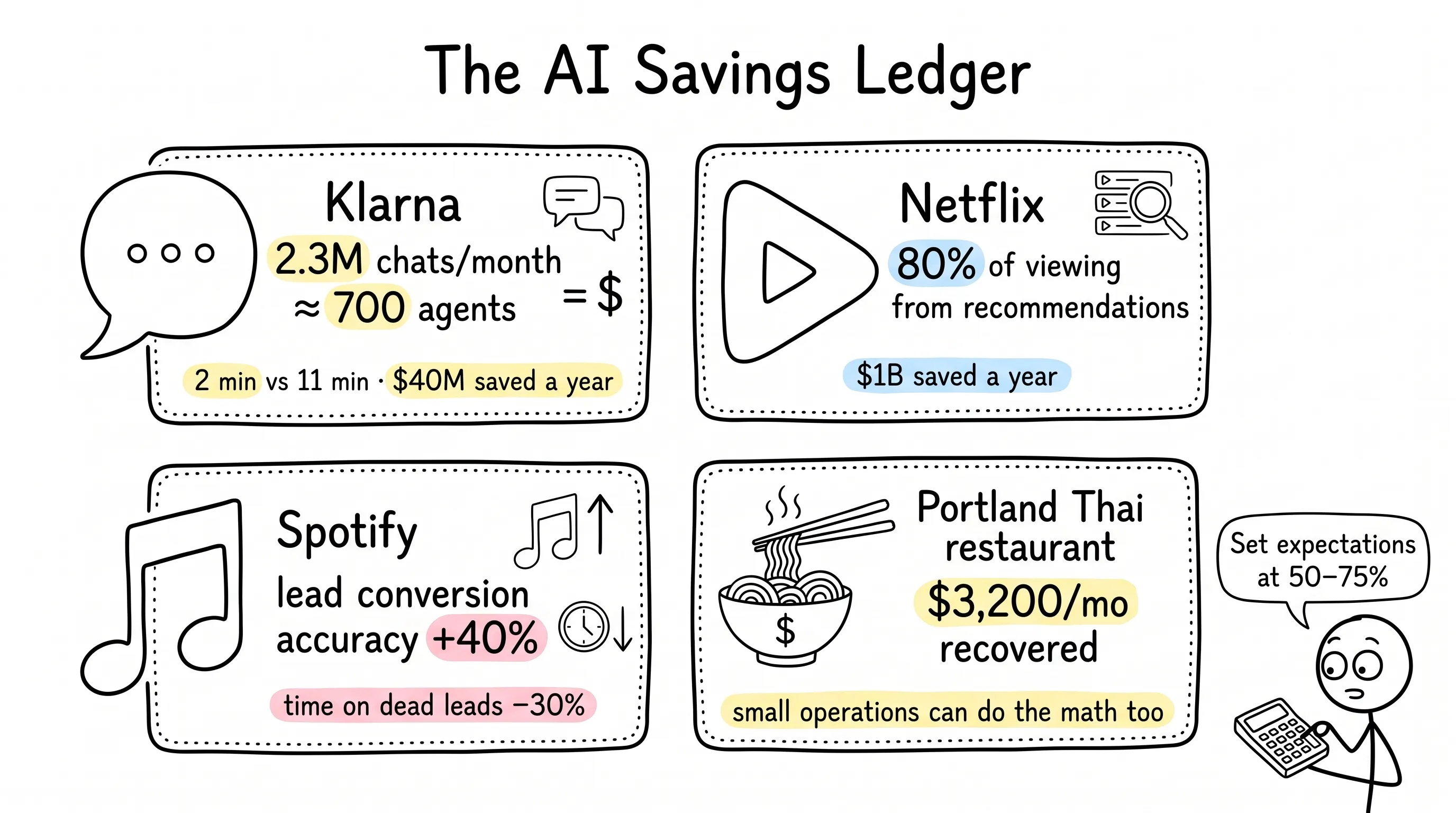
💬 This number bank is ammunition for internal reporting: cite Klarna on entry-point selection, Spotify on the data prerequisite, and the Portland Thai restaurant to show even small operations can make the math work. When setting targets for your own team, apply the 50–75% discount directly — getting one high-frequency process fully working in year one is enough to call it delivered.
🔗 Further reading: Read the full article
Yiwu survey study: AI ads lift engagement, but cross-cultural adaptation is the weak link
A survey study published in July 2024 in the journal Sociology Philosophy and Psychology used Yiwu as its sample to test the effectiveness of AI-driven social commerce advertising. The background first establishes scale: Yiwu's market covers 6.4 million square meters of operating area with 75,000 stalls across 26 major categories, and 2023 imports-plus-exports totaled RMB 566.05 billion — a 21.2-fold increase over RMB 25.5 billion in 2011. The study combined case analysis with a quantitative questionnaire, collecting responses online via stratified sampling from Yiwu sellers and international buyers, measuring four dimensions and processing the data with descriptive and inferential statistics. The results split into two sides. On the strong side: awareness of AI ads averaged 4.2 on a 5-point scale, with respondents generally encountering AI-generated ads frequently; perceived usefulness of personalized recommendations scored 4.0 with a standard deviation of 0.6 — the least divisive measure; perceived quality scored 3.8; recommendation accuracy scored 3.9, with respondents noting recommendations don't always match their needs; scale reliability (Cronbach's alpha) was 0.85. The weak side is cross-cultural: Western consumers' satisfaction with AI ads came in at 4.0, East Asian consumers at only 3.5, South Asian at 3.7, and Middle Eastern at 3.6; the between-group difference was t=5.1 (p<0.01), and the ANOVA across the four cultural backgrounds gave F=6.35 (p<0.001). The regression produced the key coefficient: cultural adaptation explains satisfaction with a weight of 0.8, far above perceived quality. The paper's example is blunt: Muslim users need to avoid religiously prohibited products, Buddhist cultures respond to prayer beads and amulets, and Christian cultures to cross accessories — and models still can't reliably handle such differences on their own; respondents also complained that AI-generated content feels repetitive. Conclusion: AI advertising is strong on engagement and purchase intent, but cross-cultural adaptation requires human layering of local cultural insight — copy, visuals, and context all need to be redone per market. The limitations deserve a clear look too: the sample is mostly Yiwu, the journal's tier is modest, and the data dates to 2024.
💬 This study pours cold water on the AI personalization hype: the satisfaction gap ties directly to cultural adaptation, and the regression coefficients show cultural factors outweighing quality perception. Cross-border teams shouldn't hand cultural judgment entirely to the model — keep a local human review pass after AI drafts, rewrite selling points per market, and never just machine-translate and call it done.
🔗 Further reading: Read the full article
🏷 Policy & Compliance
2026 marketing AI compliance checklist: GDPR's five requirements, four AI governance focal points, five privacy steps
The Marketing Desk maps out the intersection of AI marketing and data privacy. The backdrop: every AI marketing capability is built on consumer data — predictive analytics, personalized content, automated targeting, chatbots, behavioral tracking, none of it escapes — while regulatory and user expectations for responsible AI use are rising in step, and both violation fines and the reputational risk of data breaches keep growing. On the GDPR side, five hard requirements: explicit consent for data collection; users' rights to access, correction, and deletion; automated decisions must be explainable; data collection must follow minimization and purpose limitation; security measures must be in place — and personalization and profiling must comply with this transparency and accountability regime. CCPA and CPRA affect every global business serving US consumers: users can opt out of the sale or sharing of their data, collection purposes must be disclosed, they can access collected information, and they cannot be discriminated against for exercising privacy rights — AI advertising and user segmentation must respect all of these. In 2026, AI-specific regulation focuses on four points: algorithmic transparency, bias detection and mitigation, explainability of AI decisions, and accountability for automated systems — marketing AI tools must satisfy both privacy law and AI governance guidance at once. Consent management is listed as a foundational item of 2026 marketing strategy: prompts must be clear and plain-language, explain how AI uses data, make opt-in and opt-out equally effortless, and privacy policies must stay current. The ethics playbook is worth copying too: collect only necessary data, avoid excessive behavioral tracking, clean out algorithmic bias, keep targeting fair, and be able to explain decisions AI participated in. Five implementation steps: regular data audits, choosing tools built on privacy by design, partnering with compliance platforms, team training, and audit trails for AI decisions. Compliance has to be embedded in the workflow — remediating after the fact costs far more. The article's judgment: privacy compliance is turning from a cost item into a brand differentiator — companies that get there first earn higher trust and retention, lower legal and financial risk, and a more respectable long-term ROI. The source is a multi-author short-form site with no original data — fine as a self-audit checklist, weak to cite as an authority.
💬 Use it as a quarterly self-audit: start with the data audit and AI decision audit trails — lowest cost and most life-saving when something goes wrong. Write AI usage plainly into your consent copy; don't personalize people without their knowledge. That's both a compliance requirement and trust capital you can surface in your marketing materials.
🔗 Further reading: Read the full article
💡 Daily Wrap-Up
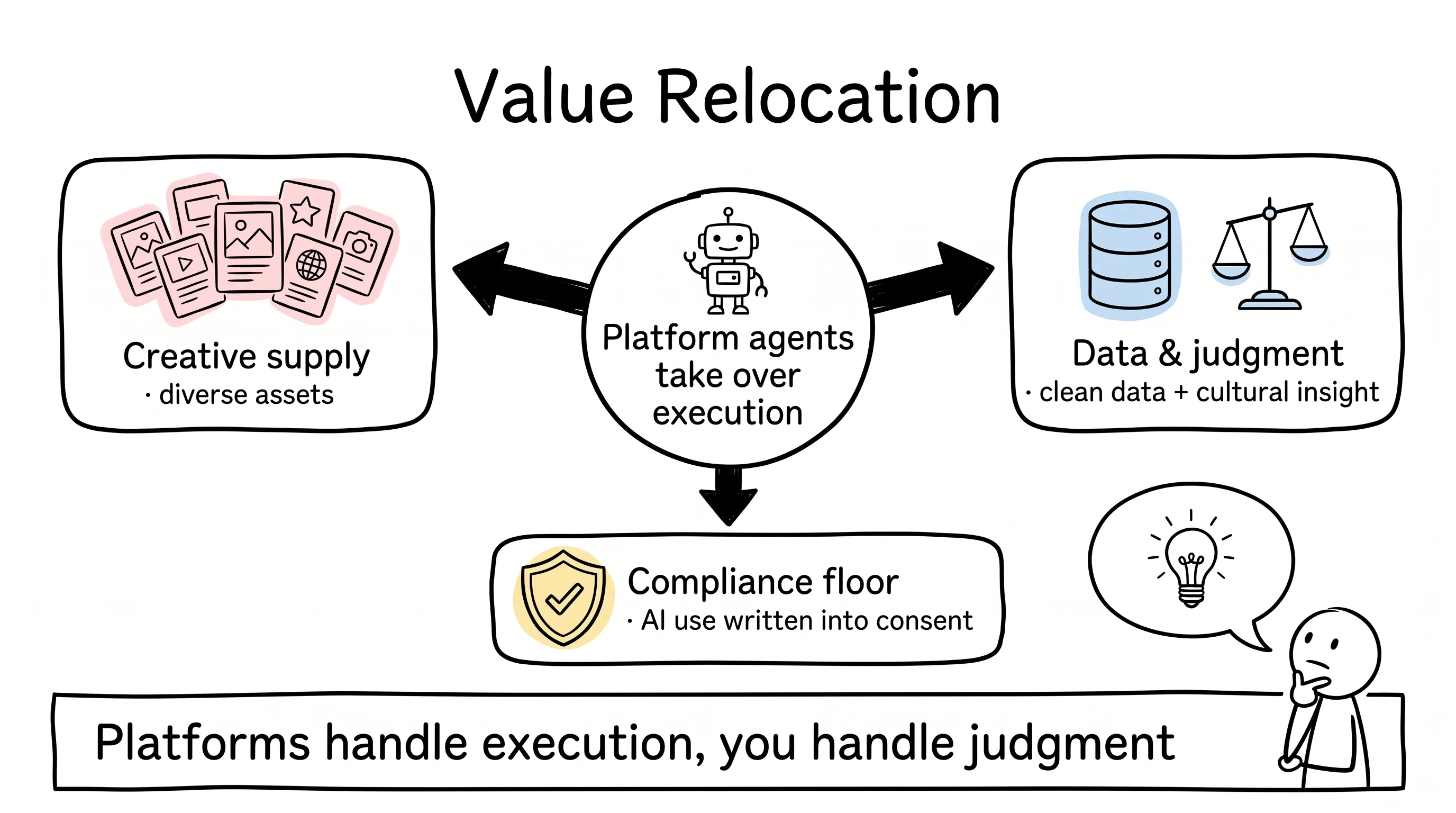
Put today's 9 entries side by side and one positional shift emerges: AI marketing is sliding from the content-generation side of the table to the act-on-your-behalf side. The three ad platforms' MCP interfaces, Meta's conversational ads, and TikTok's GMV Max automated media buying all point at the same thing — platforms are pulling campaign execution into the hands of agents, and the moments when marketers press buttons will keep shrinking. Once execution is taken over, value relocates to three places. First, creative supply: once automated buying becomes table stakes, platforms want creative from diverse angles — the old trick of spinning ten variants off one ad stops working. Second, data and judgment: Spotify's case and the Yiwu study point to the same sentence — clean data plus cultural insight sets AI's ceiling, and where your baseline is weak, AI's boost is bigger. Third, the compliance floor: GDPR's five requirements plus the four AI governance focal points have raised the entry threshold another notch. The accounting voices are getting louder too: Klarna's $40 million and the cross-border seller's 92% gross margin are the gains side; East Asian consumers' 3.5 satisfaction score in the academic data is the caution side; and GEO's swap of CTR for citations marks the moment the measuring stick itself gets replaced. Three guides converge into one action list: restructure content so AI can parse it, run personalization through a data audit first, and write AI usage into your consent copy. The upside of the window period is that none of the moves are heavy; the downside is your competitors are working off the same list. One line to close the day: the platforms handle execution, you handle judgment — and the raw material of judgment is clean data, diverse creative, and clear cultural coordinates.
Continue reading
Related articles
AI Marketing Daily · 2026-10-10
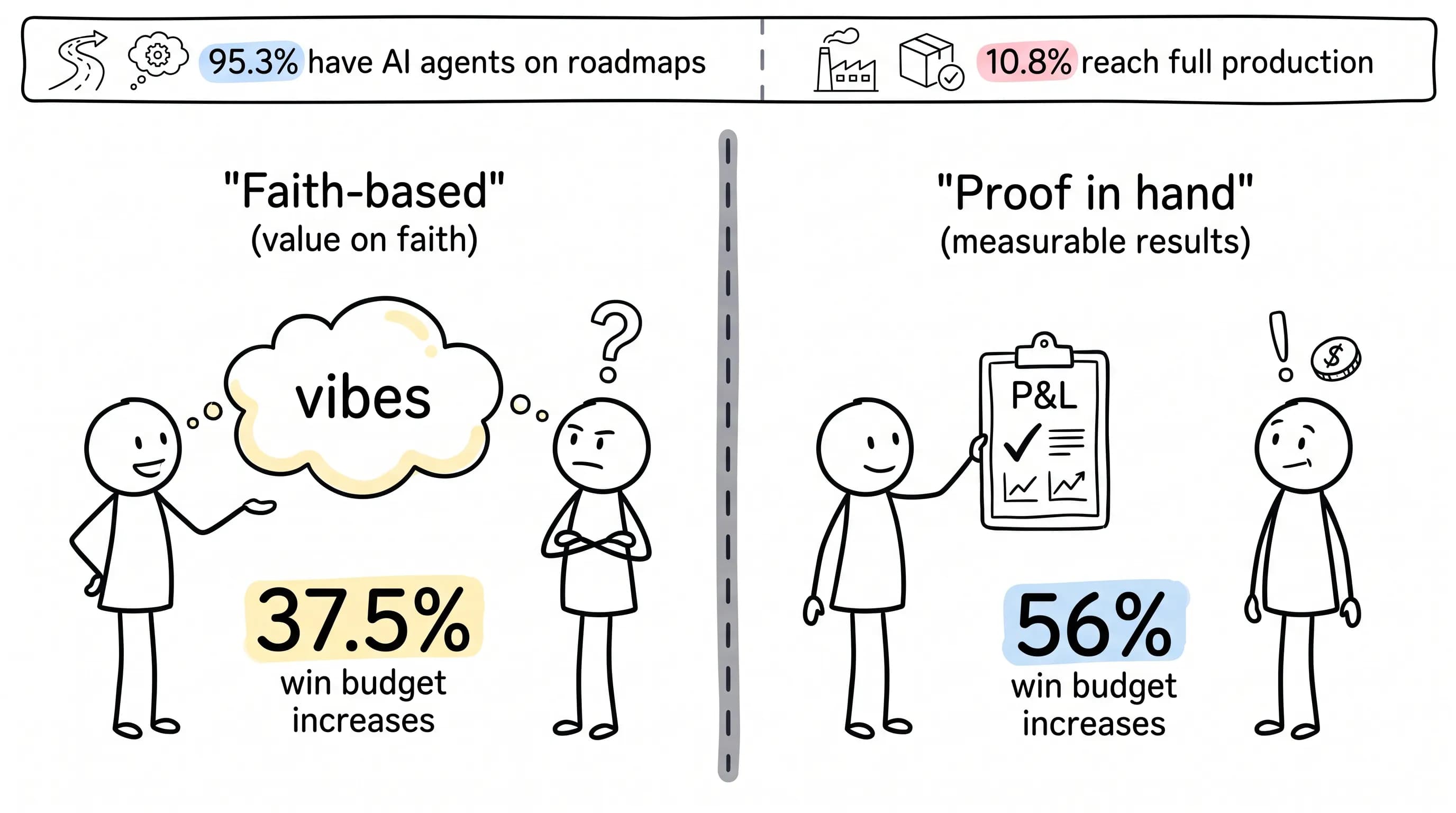
Nine stories today, one clear throughline: AI is already on the budget sheet, while most teams still can't produce the evidence.

AI Marketing Daily · 2026-10-09
AI marketing daily for 2026-10-09 covering 11 items: brand measurement moving from survey panels to search, social, e-commerce, and AI prompt signals; GEO and share of model playbooks; safety guardrails for agentic ad buying; and tool roundups for ad platforms, cross-border tools, and social media uses.

AI Marketing Daily · 2026-10-08
AI Marketing Daily for 2026-10-08 curates 20 items across AI search visibility (GEO), advertising, platform selection, cross-border e-commerce, and ROI measurement. The headline argues that strategic marketing decisions should stay with humans while AI assists execution.