
AI Marketing Daily · 2026-09-30
Daily digest of AI marketing news: a large-scale e-commerce study on AI's sales impact across seven workflows, ad headline results, Canva and WFA survey data, and updates on Braze, Sprout Social, and AEO tool pricing.
Today's lead story deserves a careful read from everyone in e-commerce and paid media. An economics paper conducted in partnership with a leading cross-border e-commerce platform used seven randomized controlled experiments (RCTs) to measure AI's real ability to drive sales across each business workflow — and the spread from zero effect to 16.3% makes one thing clear: AI's payoff depends on how bad the baseline it replaces happens to be. On the same day, surveys from Canva and WFA poured cold water on the hype, while Braze turned AI decisioning into a self-serve product. The content-generation story is over; the story of doing the math has begun.
🎯 Today's Headline
Tested on millions of users: just how much sales lift does AI actually deliver across seven e-commerce workflows
An economics paper on arXiv delivers a rare large-scale answer. Working with a leading cross-border e-commerce platform, the research team wired generative AI into seven consumer-facing business workflows between September 2023 and June 2024: a pre-sales customer-service chatbot, search query rewriting, product description generation, marketing push-notification copy, Google ad headline optimization, chargeback disputes, and real-time customer-service translation. Seven randomized controlled experiments, with samples ranging from thirty thousand to thirteen million, covering millions of users and products. Every experiment ran on the live platform, and the control groups in all cases continued the incumbent practice of the time — search was benchmarked against the old algorithm that only did literal word translation, product descriptions against human-written copy, with prices and conditions held constant. The results diverged dramatically. The pre-sales chatbot lifted sales by 16.3%, the biggest winner of the bunch; query rewriting added 2.9%, product descriptions 2.1%, and marketing pushes 1.6% — that last one failed the statistical significance threshold. Google ad headlines came in at negative 4.5%, likewise not significant. Annualized across the four positive applications, that works out to roughly $4.6 to $5.2 in incremental revenue per user per year, or 5.5% to 6.2% of the per-user growth in global e-commerce revenue over the same period.
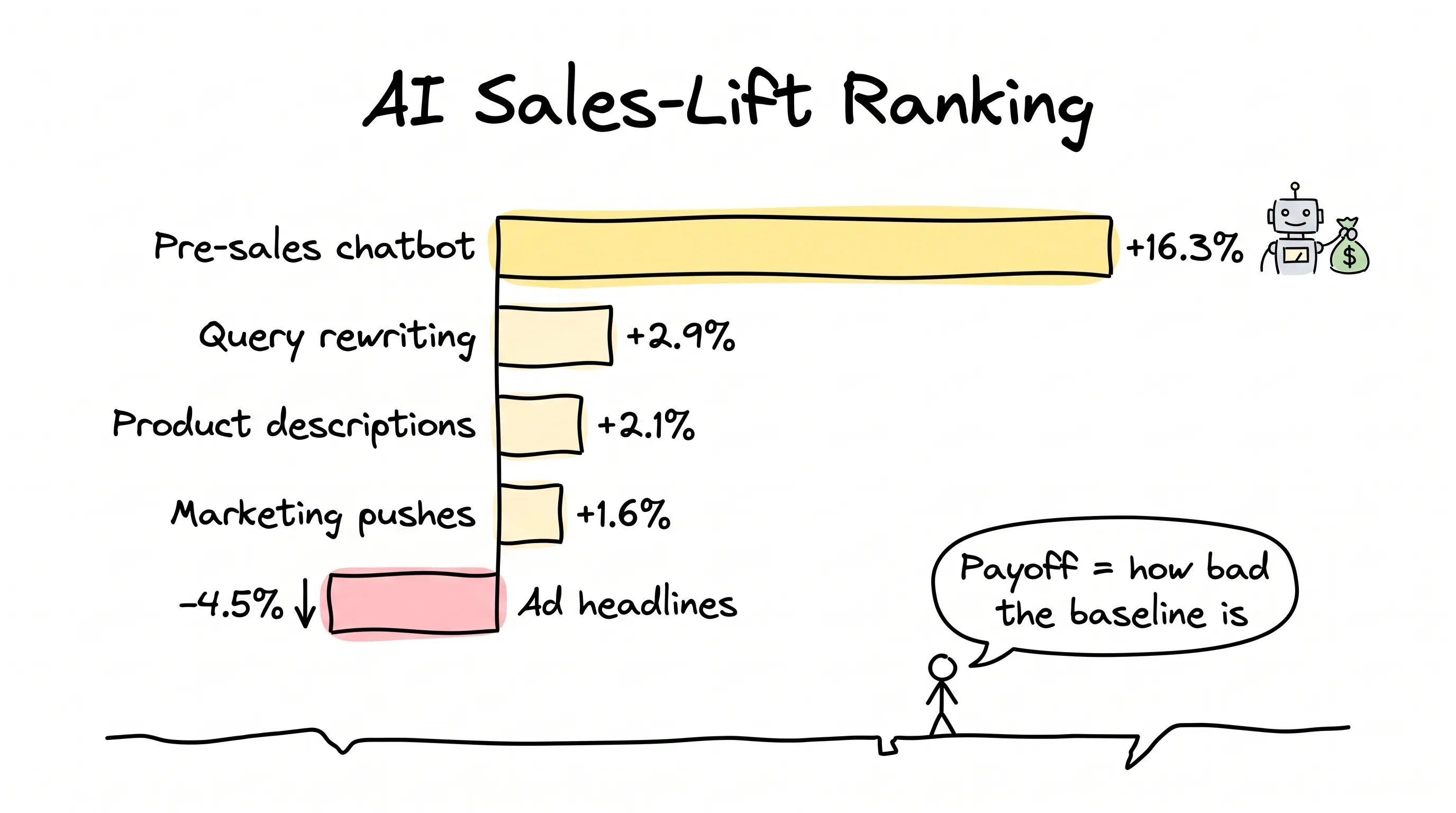
What gives this paper its weight is that it sits in the top tier of GenAI causal field studies in marketing by scale. Previous figures on AI productivity gains were mostly task-level — coding 55% faster, support tickets resolved 15% faster — none of which equals selling. This one speaks directly in sales. The mechanism decomposition matters just as much: nearly all of the growth came from conversion-rate improvements, ranging from 1% to 22%, while average order value (AOV) barely moved. Return rates did not deteriorate — in fact, the product-description and marketing-push workflows saw return rates fall by 3.9% and 11.4% respectively, and positive review rates rose 4.5% in the chatbot scenario. AI brought customers in; it didn't trick them into showing up. The paper also sorts the mechanisms into two types: query rewriting and real-time translation work by reducing friction, while the chatbot, product descriptions, push copy, and ad headlines carry persuasive properties on top of information. There is a technical reason the marketing push missed the significance line: under risk controls, only 40% of the treatment group actually received the AI-written copy — adjusted for that reach rate, the effect is roughly 4%.
For marketers, three findings are worth matching against your own operation. The size of the gain depends on how bad the baseline is: pre-sales support rose 16.3% because the control group had no human agents at all; ad headlines went negative because a general-purpose large model, not fine-tuned for advertising, dropped the keywords the ad algorithm rewards — and both ad impressions and clicks slid. Wherever nobody is minding the store, or minding it poorly, AI's marginal contribution is largest. Novice users benefit far more: new customers, low-frequency shoppers, and low-AOV segments respond most strongly to AI workflows — AI's value lies in lowering the barrier to entry. Human-AI combinations beat AI alone: in a companion experiment, AI customer service with a human escalation path generated 11.5% more spending than human-only service, and 25% more than having no service at all. The supply-side signal points the same way, though less definitively — smaller and newer sellers generally saw larger gains. On measurement, give AI its own experimental slot: five of these seven experiments secured user-level granular data, and without an experiment, any judgment is a guess.
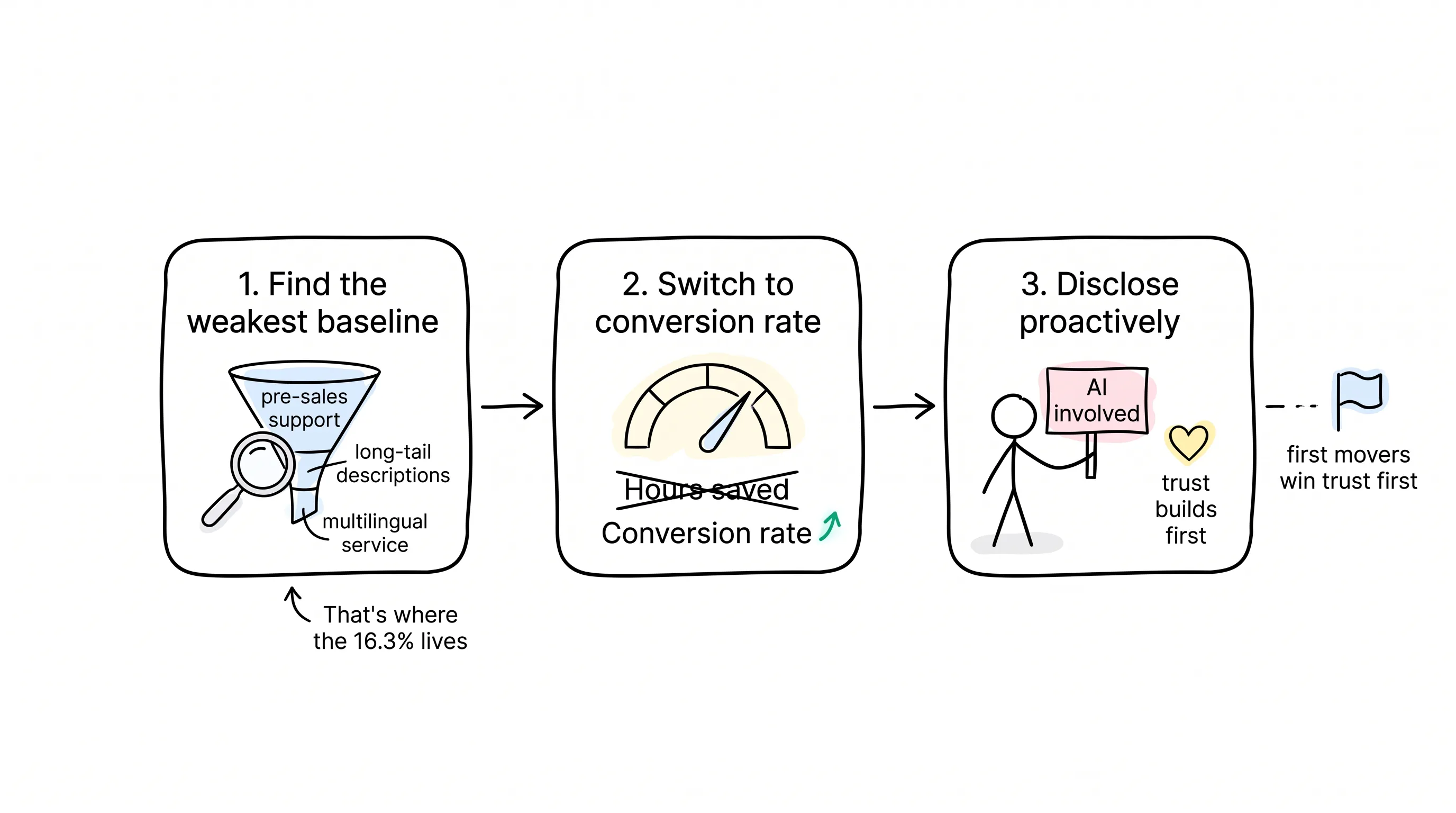
The action checklist comes down to four items. First, find the weakest-baseline stage of your conversion funnel — pre-sales inquiries, long-tail product descriptions, multilingual support. The 16.3% was born in places like these; don't point AI at workflows that are already polished. Second, switch your KPI to conversion rate and stop staring at AOV. Third, don't send a general-purpose model straight into paid ads — this experiment already paid that tuition on your behalf; industry-specific scenarios need fine-tuning or retraining. Fourth, design a human escalation path: AI as the safety net, complex issues routed to humans. Don't expect full automation to run the whole way in one go.
The most valuable line in this paper is actually the least noticed one: the negative 4.5% for ad headlines. It reminds everyone that GenAI's gains are not a universal handout — they are marginal increments relative to the incumbent practice. The platform's own behavior says the same thing: in 2023 it ran only a handful of AI applications, expanded to more than 40 in 2024 and past 60 in 2025, with API call volume up twentyfold in a year. The implementation window is still open — aim where the friction is greatest.
🔗 Further reading: Read the full article
🏷 Marketing Tools & Strategy
Visual Search Enters the Multimodal Discovery Layer: How to Plug Into Google Lens's 25 Billion Monthly Searches
MarTech has published a methodology piece by Benu Aggarwal, founder of Milestone Inc, on how to build a visual SEO strategy for AI search. The argument: visual search has evolved from image matching into a multimodal discovery layer — AI can read an entire scene, identify multiple entities and attributes, and run multi-path retrieval on different parts of an image, known as visual fan-out. Google discloses that Lens now handles over 25 billion visual searches a month, one in five carrying commercial intent. The optimization goal shifts accordingly: from making images understandable to disambiguating them — what the brand means to say, what users see, and what the AI understands must all align. An image is no longer a standalone asset but the entry point for entity signals. The reader's decision path has changed too — from seeing, to "what is this," to "is this for me," to "where do I buy it" — and any of the four steps can be triggered by a single image. The real difficulty for enterprises is scale: when thousands of assets are scattered across your website, product feeds, and third-party platforms, getting every entry point to tell the same story is the hard fight. The article lists five essentials: an entity-consistency layer, so that structured data, feeds, and the knowledge graph corroborate each other; image and attribute depth — shoot material that lets AI recognize fabric, room types, dishes; content and metadata alignment; freshness and multi-location consistency; and governing your DAM (digital asset management) platform as the single source of truth, while reserving content-provenance capabilities such as SynthID and C2PA.
💬 The first thing a marketer can do this week: audit every image's alt text and structured data site-wide — the two cheapest fixes with the fastest payoff. Multi-location brands should focus on whether the same asset carries conflicting entity information across the website, maps, and social platforms. When the signals disagree, the AI decides for itself — and the outcome is out of your hands.
🔗 Further reading: Read the full article
Choosing an AEO Tool: Profound vs. Athena AI — Real Pricing and Capability Limits
On September 29, the HubSpot blog updated its comparison of answer engine optimization (AEO) tools, distinguishing itself by checking every price and feature claim directly against the two vendors' pricing pages and trust centers — and saying so plainly when something couldn't be verified. Profound takes the AI Marketer route: agents billed by credits, paired with a brand-context library plus Answer Engine Insights and Prompt Volumes monitoring. Its pricing has switched to a free trial plus enterprise custom quotes — the previously public $99-to-$399-per-month tiers no longer exist, and every price cited in older articles is now expired. The trial covers only 3 engines, 50 prompts per day, single region and single language; the full set of engines, capped at 9, requires the enterprise plan. Athena AI takes the self-serve execution route: the Starter tier costs $295 a month, or $245 billed annually, including 3,600 credits — 1 credit equals 1 AI response — covering 11 models, plus a $25 one-time tier granting 300 credits. Note that credits are a shared pool: monitoring, Ask Athena Q&A, and content agents all draw from the same pool, so raising your monitoring frequency squeezes the budget elsewhere. Both sides concede that visibility data is probabilistic — judge trends over several weeks and don't make decisions off a single-day snapshot. Multi-region tracking requires the enterprise tier on both platforms. On G2, Profound scores about 4.5 across 1,000+ reviews; AthenaHQ about 4.9, but with only 34.
💬 Run the numbers before you choose: estimate credit burn as the number of prompts you'll actually act on times the number of engines. Tracking 20 prompts a day across 3 engines burns about 1,800 credits on AthenaHQ — the Starter tier holds; 40 prompts across 6 engines blows it up. Heavy on monitoring and intelligence? Pick Profound. Heavy on execution and self-serve? Pick AthenaHQ. Before signing, have both vendors run a same-week snapshot on your own domain — more useful than any feature matrix.
🔗 Further reading: Read the full article
Brand Guidelines Need to Become a Brand System: Consistency's New Answer in the AI Era
On September 29, MarTech ran a column by Julie Zwissler, global CMO of Office Beacon, arguing that brand guidelines need to be upgraded into a brand system. She offers four arguments. Consistency now demands more flexibility: a short video shouldn't read like an annual report, and an executive's social post shouldn't be written like website copy. What must be defended are the constants — positioning, values, visual identity — while format and tone can be delegated. The column calls this the two layers of constants and flex: constants protect recognizability, flex adapts to the context. Teams need judgment, not an instruction manual — the good practice is to give examples: one piece that is clearly us, one that could work with tweaks, one that's well executed but not us. AI raises the bar for brand clarity: tell a model to be "innovative, authentic, and friendly" and it will hand back cookie-cutter output, because every brand says exactly that. Governance must also step out of the marketing department — adding approval layers doesn't control the tempo, and brand leaders need to shift from gatekeeper to teacher. The final distinction is compliance versus fluency: compliance knows what is allowed; fluency knows what sounds like us.
💬 Teams producing content with AI can get results by moving this straight into their prompt library. Instead of writing four adjectives, supply five positive and negative examples with the reasoning behind each verdict. You can start today: paste the yes / maybe / not-us example columns into your brand knowledge base, and the distinctiveness of the AI's output changes immediately. This step costs nothing.
🔗 Further reading: Read the full article
The 2026 Marketing Automation Ledger: 40% of Agentic Projects Will Be Cut, but Three Flows Are Still Making Money
Loudscale's 2026 guide to marketing automation and CRM personalization, published in December 2025 and updated in August 2026, pulls together a set of benchmarks. Gartner expects AI to automate 36% of marketing work by 2028, up from 16% today; the same firm predicts more than 40% of agentic AI projects will be scrapped by 2027, with only 17% of enterprises actually running them in production. The money data is solid: Klaviyo benchmarks show automated flows generating nearly 41% of email revenue from just 5.3% of sends — SMS is even more extreme, with 7.6% of sends contributing 45.2% of revenue. Marketing automation's overall return is $5.44 for every $1 invested, and the per-message economics gap is wider still: automated emails earn $3.41 each versus $0.155 for batch-and-blast — a 22-fold chasm. Welcome emails, cart recovery, and browse abandonment — three flows — account for 87% of automated-email orders, yet only 57.7% of brands even send a welcome email, and of those, four in ten fail to reach the subscriber within 48 hours. In Omnisend benchmarks, welcome emails average a 35.53% open rate and a 2.11% conversion rate, far above batch sends. Data is the foundation: 67% of organizations discover serious data-quality problems midway through a CRM migration. BCG adds a dose of reality — 38% of AI-assisted campaigns still need human re-editing — and per the CMO Survey, only 15.12% of marketing campaigns are truly AI-driven.
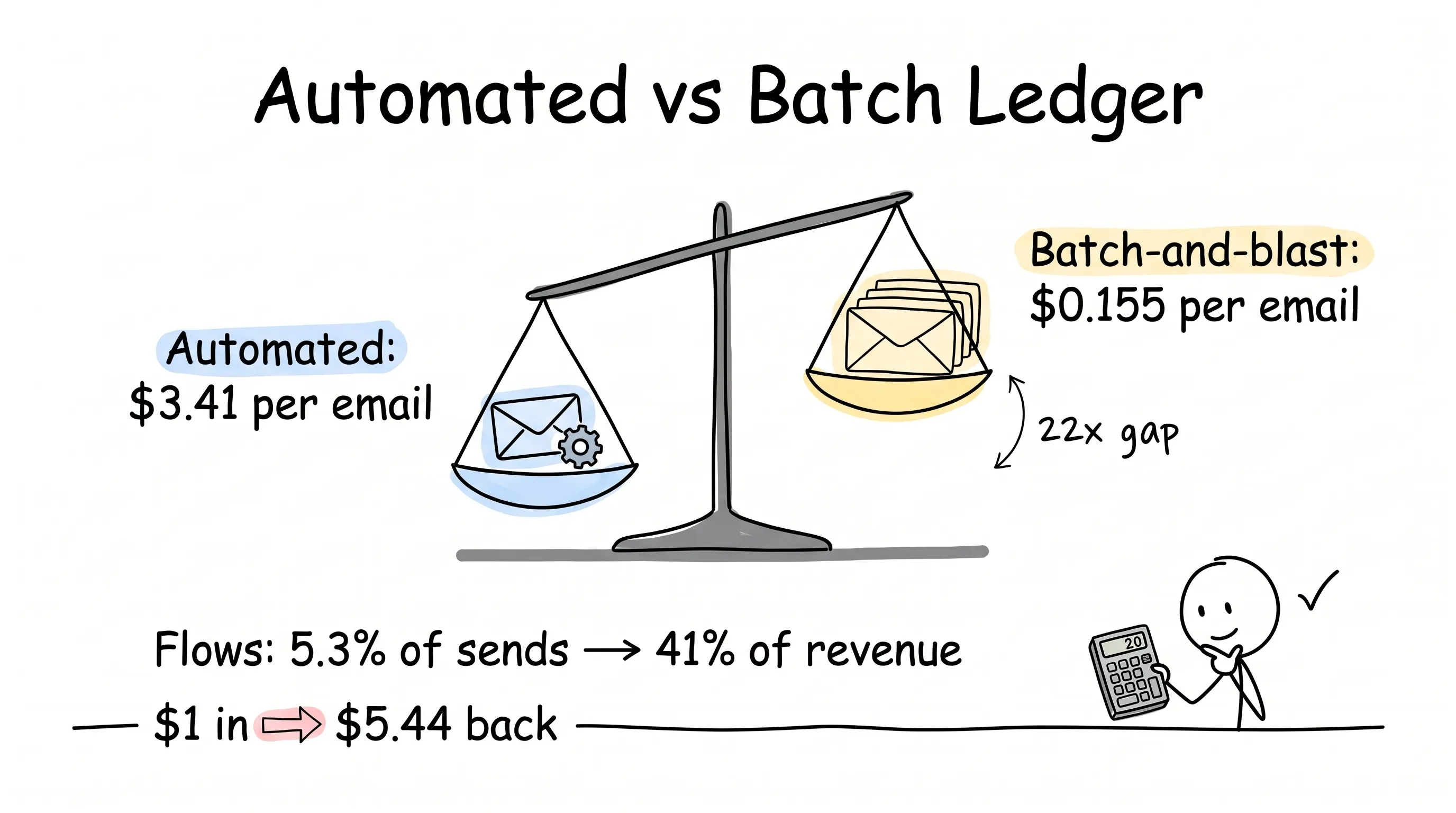
💬 The guide's most valuable conclusion: complete what you have before buying anything new. Check your welcome sequence — a three-email series drives roughly 90% more orders than a single email, and automated emails convert at 19 times the rate of batch sends. Fill in your four core flows first, then talk agent platforms. Get the order backwards and you're spending budget on dirty data — agents amplify garbage in, garbage out.
🔗 Further reading: Read the full article
🏷 Product Launches
Braze's Three New Tools: AI Advances from Writing Content to Running Campaigns
At its Forge conference in Las Vegas, Braze announced three tools that push AI from content generation into campaign operations. BrazeAI Decisioning Studio Go offers self-serve AI decisioning, using reinforcement learning to pick combinations in real time for each recipient; the launch scenario is email click-through rate — 8 base emails, 25 subject lines, 10 CTAs, and 5 images combine into hundreds of thousands of variants for the system to optimize person by person. The enterprise Pro edition requires a data science team to configure; the Go edition drops the barrier to self-serve usability and opens officially on October 14. Agentic Standards hands QA to agents: checking links, validating audience logic, reviewing creative against brand guidelines, producing audit logs, and auto-correcting — also generally available in October. Operator Connect uses the Model Context Protocol to bring Braze capabilities into external workspaces like Claude: marketers write the brief in Claude, direct the assistant to build out the campaign structure inside Braze, and return to the platform only for final review. The product lead called it the headless version of Operator — moving platform capabilities into the workspaces marketers already use, with no context switching.
💬 The product lead put it plainly: this democratizes AI decisioning that previously took a data science team on payroll to use. Email teams on Braze can wait for the October 14 GA, then pilot on one high-traffic campaign — click-through rate is an easy metric to quantify. The QA-agent direction deserves even closer watching: manual review is the real bottleneck for many teams, and the hours saved convert directly into labor cost.
🔗 Further reading: Read the full article
Sprout Social Rebrands Its Influencer Marketing Platform: $1 In, $6.50 Back
Sprout Social has rebranded Tagger Media, which it acquired earlier, as Sprout Social Influencer Marketing, folding it into its social media product line with a focus on AI-driven influencer discovery, partnership management, and ROI optimization. The market figures in the piece can serve as industry benchmarks: nearly half of consumers place at least one order a month because of an influencer post, and 80% of marketers report influencer content converts better. The industry is projected to reach $199 billion by 2032, with an average return of $6.50 per $1 invested. Citing a 2025 Forrester-commissioned study, Sprout says customers save an average of 25% of their time on influencer discovery and management, and the company says more AI features are on the way to streamline influencer screening, vetting, and collaboration. In the case study, the social media manager at grocery retailer Kroger vouches that the platform helped the team find creators aligned with its values and produce content that feels authentic and credible.
💬 Vendor press-release numbers deserve scrutiny, but the 1-to-6.5 industry return benchmark and Forrester's 25% time-savings figure both belong in your evaluation sheet. Influencer marketing teams can use the two as negotiation anchors: if a candidate platform can't even explain where 25% time savings come from, don't advance it to the next round. On budget: the conversion evidence for influencer content is already sufficient — the real lever is management hours.
🔗 Further reading: Read the full article
🏷 Industry Data
Canva's Seven-Country Survey: 92% of UK Marketing Teams Use AI, but 82% of Consumers Still Want Ads Made by Humans
Canva has released a survey covering seven countries; the UK sample includes 200 marketing decision-makers and 509 consumers. The supply side is enthusiastic: 92% of UK marketing leaders already use AI in daily creative work, 98% plan to increase AI budgets, 94% save at least 4 hours a week, 28% save more than 8 hours, and 63% say AI has expanded the business decisions marketing can influence. More than half of respondents treat AI as the team's director; only 31% still see it as a collaborator. The consumer side wears a different face: 82% would rather see ads made by humans, 91% believe the best ads need a human touch, 72% are more willing to buy from purely human-created ads, 70% feel today's AI ads lack a soul, 64% say AI ads look fake at a glance — laughably so — and 76% worry all future ads will look the same. The judgment criterion is telling: 71% of consumers don't mind ads using AI, as long as the result is more useful. 86% believe that within a few years it will be impossible to tell whether an ad was AI-made — unless the brand discloses it itself. More than three-quarters of UK consumers say their acceptance of AI ads would rise if the company had a formal AI-use policy, with the trust boosters clustering around data protection, AI-use disclosure, no-layoff commitments, and opt-out options. Among Gen Z and millennials, 72% care more about an ad's vibe than how it was made; 80% of marketing leaders expect creative roles to grow over the next five years.
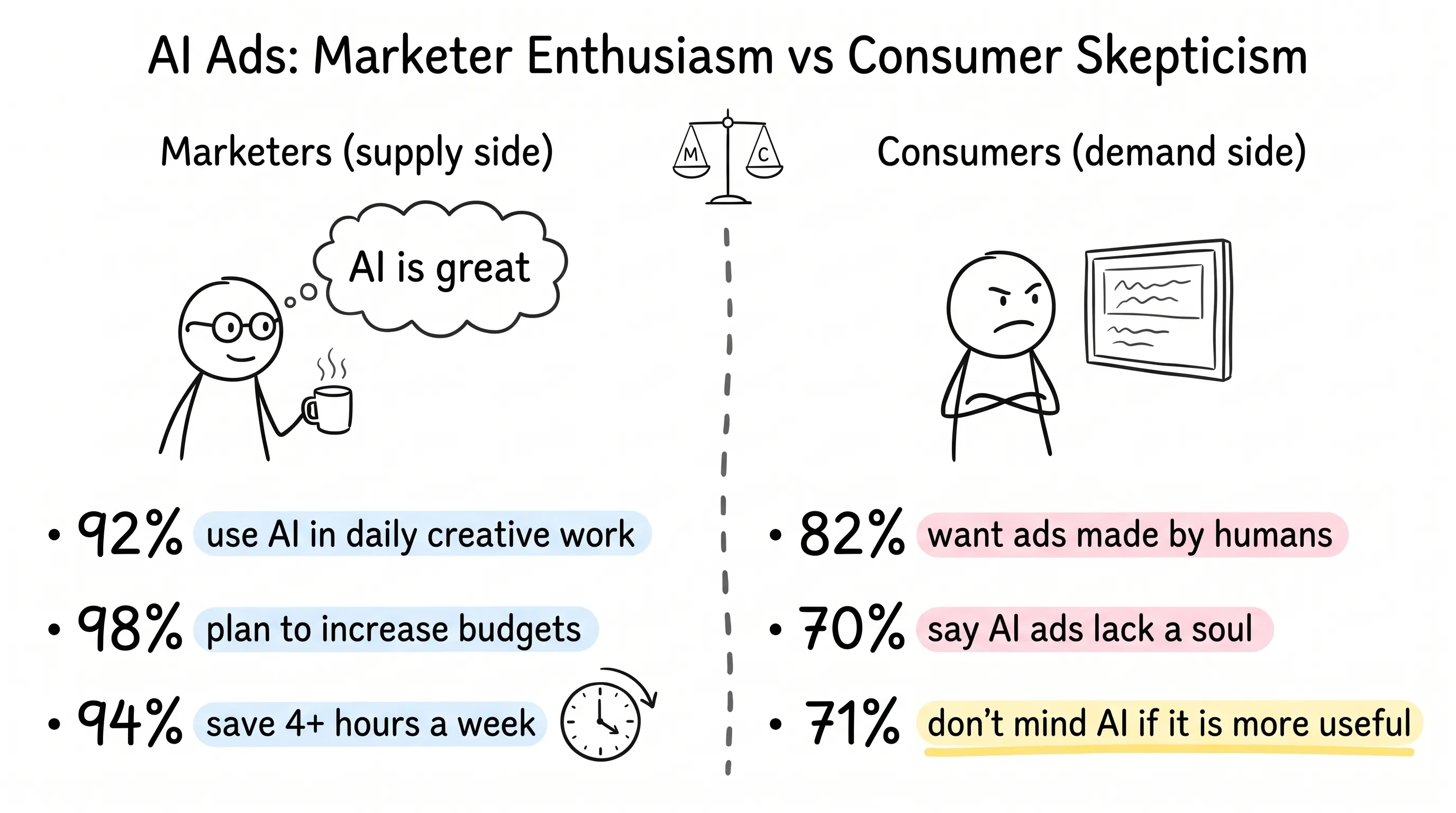
💬 The way to use these numbers is concrete: disclose proactively — don't wait for platforms to force your hand. Set an internal disclosure rule for AI-assisted assets, then reinvest the 4 saved hours in the two directions consumers named: real people on camera and real settings. Younger audiences care about vibe over craft, but 63% resent brands predicting what they want to buy — leave some breathing room in your personalization.
🔗 Further reading: Read the full article
WFA Survey: Only 30% of Teams Can Consistently Deliver Outstanding Creative, and AI Mostly Just Saves Time
WFA and LIONS have released Clients and Creativity 2026, a study built on quantitative research and interviews with 160+ executives, covering 86 brands, 26 industries, and $141 billion in annual ad spend. The verdict is bleak: only 30% of multinational marketing teams say they can consistently deliver outstanding creative, and 53% value creative excellence but execute it inconsistently. The ranked obstacles: short-termism 68%, risk aversion 45%, underinvestment in creative 37%. AI usage skews heavily toward efficiency: only 35% of respondents say AI has genuinely improved creative effectiveness beyond efficiency, and just 13% disagree with the statement that their AI use leans toward efficiency. Only 11% of teams have a shared AI approach, and 58% of respondents fear creative will drown in a sea of sameness. Meanwhile, 57% of brands have handed the problem to their agencies, hoping external partners will prove AI's value. The WFA CEO's advice: get your processes in order first, then discuss how AI embeds — don't evaluate it piece by piece across scattered steps. The positive signals: 74% expect AI to help measure creative's business impact, 78% see AI skill upgrading as key, 55% already use AI for concept testing, and 52% for creative ideation.
💬 The nudge for CMOs is blunt: 64% of respondents say senior leadership is forcing an overly optimistic AI cost-savings target. If your AI KPI only counts hours saved, your team will only use AI to touch up copy. Treat the 35% figure as your benchmark line, and within the year get at least one AI application running on concept testing or insight mining — that's the only way an effectiveness case stands up.
🔗 Further reading: Read the full article
Evidence-Based Creative Becomes the New Baseline: 46% of Marketers Rank Data Analysis the Top Skill
Contentful and Atlantic Insights, The Atlantic's research arm, have jointly released the survey When Machines Make Marketers More Human, covering 425 marketing decision-makers and including a ten-day diary-style field study. 46% of respondents rank data analysis and interpretation as today's most important skill, followed by digital experience design at 40%, personalization strategy at 37%, and writing for AI tools at 37%; 34% of successful marketers define success by ROI and performance metrics. The profile of the full-stack marketer is taking shape: someone who builds AI workflows, writes effective prompts, and collaborates across the tech stack — 49% use productivity copilots and 48% use generative content tools. The gap between optimism and execution persists: 89% of teams already use AI, but only 18% say it has reduced their dependence on engineering or data teams; 74% are investing, and 34% will put in at least $500,000 over the next two and a half years. Regional differences are stark — Europe leans toward compliance and planned rollouts, the US toward rapid experimentation: 58% of European marketers selectively test AI tools within a set plan, and 32% stress governance capabilities; among US teams, 37% focus on campaign optimization, above Europe's 26%.
💬 Use this capability model to allocate team training budget: data analysis first, writing for AI and prompt engineering second. 45% of organizations already offer AI training — skip it and you're falling behind. The personal-level move is even simpler: starting this week, tie your work outcomes to metrics. The 34% who succeed already define success that way.
🔗 Further reading: Read the full article
US–Europe Generative AI Market Scan: America to Exceed $143 Billion by 2031
A knowledge-base article from Antom, the brand under Ant International, maps the generative AI commercialization landscape across the US and Europe. On market size: the US GenAI market is projected to grow from $2.5 billion in 2021 to over $143 billion by 2031, about one-third of the global total; the global market itself grows from $7.69 billion to $442 billion over the same span. Per IDC, Europe's AI market was roughly $47.6 billion in 2024, with a 33.7% compound annual growth rate from 2022 to 2027. On adoption: 91% of US ad agencies and about 67% of European enterprises are already using or exploring AI marketing, with millennials and Gen Z making up more than half of active users. US private AI investment hit $109.1 billion in 2024, roughly three-quarters of the global total; Europe is projected to reach $250 billion by 2029, 90% of it concentrated in Western Europe. The leading cross-border marketing use cases are multilingual content production and video generation, with Runway, Synthesia, and Canva named as the main platforms. A developer-side reference point: an analysis of 80 million GitHub commits found that by the end of 2024, about 30% of the Python functions submitted by US developers were AI-generated — and once AI usage share reached 30%, quarterly commit volume rose an additional 2.4% on average.
💬 Read this one as a background scan — limited standalone depth, but two figures are worth citing in strategy documents: 91% of US agencies already treat AI as table stakes, meaning agencies that don't start the pitch already a step behind; and the most direct landing point for cross-border teams remains multilingual video and image-text content. For tool selection, look first at validated platforms like Runway and Synthesia — don't rush after the new thing.
🔗 Further reading: Read the full article
🏷 Going Global & Governance
AI Rewrites the Cross-Border Seller's Cost Sheet: an AI Pet-Portrait Business Making $30,000 a Month
A feature story in The World of Chinese walks through the real books of several cross-border sellers. Xu Kaijie, born after 1995, from Tongxiang in Zhejiang Province, makes roughly $30,000 a month from his Etsy shop selling AI-generated watercolor-style pet portraits — digital files whose costs are limited almost entirely to subscription fees. In his previous traditional cross-border business, you couldn't get in the game without capital in the hundreds of thousands. He tested roughly 5,000 sample images in Midjourney before dialing in his own style formula; a single image now takes about two minutes, plus a light Photoshop touch-up before delivery. Not speaking English, he has ChatGPT play customer service for different regions to handle replies. After DeepSeek opened up free in early 2025, the barrier to generating multilingual sales copy and promo videos collapsed further, and Chinese-made AI tools like Manus and HeyGen are also aiming at global markets. Per Sensor Tower, two of the top ten AI apps by global downloads in 2024 came from China: ByteDance's Doubao and MiniMax's Talkie. Xu's path was hardly smooth — he started with AI videos, built up 80,000 followers, and earned only about 1,000 yuan in total ad revenue; pivoting to e-commerce is what finally made the numbers work. Today he still spends about 1,000 yuan a month subscribing to new tools, worried that some new model could replace his workflow overnight. The report also flags the boundary problem: Etsy launched an AI-generated labeling feature, and almost no sellers use it voluntarily — while previously, many sellers' listings had been labeled as hand-drawn.
💬 The value here for going-global teams is the cost structure: AI has punched through the capital barriers in content, sales copy, and support translation — one person can run the entire flow. The risk zone is just as clear: platform rules on labeling AI-generated content will tighten sooner or later, and self-auditing your asset disclosure and copyright provenance now is far cheaper than a retroactive takedown. And don't force AI imagery into premium categories — the detail precision can't carry the premium.
🔗 Further reading: Read the full article
Cross-Border E-commerce Weekly: Kaufland Enters Two More Countries, Amazon Opens A+ Content to All
Three items in the Cross-Border Commerce Association's June 19 e-commerce weekly relate to AI and channels. A Merkle report names the Agentic Readiness Gap: plenty of enterprises are pouring serious money into AI yet struggle to convert it into market visibility and operational impact — a link is broken between input and output. On logistics, Rivian CEO RJ Scaringe has founded a humanoid robotics company, Mind Robotics, raising over $1 billion, aimed at automating warehousing and last-mile delivery; easyGroup is entering European last-mile delivery with easyCourier. The channel news is more practical for cross-border sellers: the Kaufland marketplace will enter Spain and the Netherlands by late summer, bringing it to nine countries, with sign-ups now open; Amazon has opened Premium A+ Content pages to all brand-registered sellers free of charge — video, hotspot-image, and comparison-table modules no longer carry revenue thresholds; DHL Germany will strengthen address verification, and all parcels will carry tracking starting next year. Two more background items sellers should note: DHL Globalmail, unprepared for the new customs rules, is suspending parcels from the UK to the EU from July 1 — UK sellers need another route; and sellers are complaining that Amazon's new DD+7 settlement terms were poorly communicated, with cash flow taking a hit.
💬 The term Agentic Readiness Gap will catch on, because it hits the sore spot: money spent, visibility nowhere to be seen. Attach a market-side acceptance metric to every AI investment — AI citation rate or answer exposure, for instance — and don't grade it on cost reduction alone. The seller-side moves are more direct: register on Kaufland's two newly opened markets early to claim your spot, and now that A+ Content is free, fill in the premium detail pages you never built.
🔗 Further reading: Read the full article
💡 Today in Brief
Lay today's 13 items side by side and a dividing line in AI marketing comes into view. The million-user headline experiment delivered the first causal account denominated in conversion rates: AI can drive sales, but the payoff depends entirely on how bad the baseline it replaces happens to be — pre-sales chatbots up 16.3%, ad headlines in the negative. Braze turned AI decisioning into a self-serve product, pushing decision power down into frontline marketers' hands; Canva's and WFA's data remind us the ledger between effectiveness and trust isn't balanced yet — 82% of consumers still want ads made by humans, and only 30% of teams can consistently deliver outstanding creative. On the going-global side, the barriers are collapsing — individual sellers can already run the full flow with AI — even as platform governance tightens. The tooling layer sends the same signal: AEO tool pricing changed shape within a single month, and the quotes in older articles are expired today.
The action plan comes down to three sentences. First, hand your weakest-baseline workflows to AI: pre-sales support, long-tail descriptions, multilingual service. Second, switch the yardstick from hours saved to conversion-rate gains — WFA's 35% and Canva's trust data both warn that an AI strategy measured only in hours doesn't go far. Third, set disclosure rules proactively: 86% of consumers expect soon not to be able to tell human from machine, and the brands that disclose first build trust first. Going-global teams need to cover both ends — building the multilingual content pipeline on one side while watching platforms' labeling requirements for AI assets on the other.
Continue reading
Related articles

AI Marketing Daily · 2026-10-09
AI marketing daily for 2026-10-09 covering 11 items: brand measurement moving from survey panels to search, social, e-commerce, and AI prompt signals; GEO and share of model playbooks; safety guardrails for agentic ad buying; and tool roundups for ad platforms, cross-border tools, and social media uses.

AI Marketing Daily · 2026-10-08
AI Marketing Daily for 2026-10-08 curates 20 items across AI search visibility (GEO), advertising, platform selection, cross-border e-commerce, and ROI measurement. The headline argues that strategic marketing decisions should stay with humans while AI assists execution.

AI Marketing Daily · 2026-10-07
Today's throughline is answer engine optimization (AEO — getting your brand quoted in AI answer engines).