
AI Marketing Daily · 2026-09-29
Daily roundup of 14 AI marketing items spanning hiring trends, GEO tactics such as configuring robots.txt for AI crawlers and citation-ready FAQs, marketing automation platform comparisons, and AI content policies.
Today's theme is capability and judgment. MarTech dissected 60 real marketing job descriptions, and 45 of them list building AI agents as a hard requirement; the same day, another piece reminded you that AI has made marketing faster without making it better. GEO (Generative Engine Optimization) delivered three items in a single burst, from crawler configuration to tearing down content gates; platform selection added two more, with price tiers spanning three orders of magnitude. All 14 items are here, each with a hands-on note that tells you exactly what to do first.
🎯 Today's Headline
60 marketing job descriptions, dissected: employers don't want prompt writers — they want people who can ship agents
On September 28, MarTech ran a first-hand analysis by Margaret Lee, CMO of Devart and TMetric. She read, one by one, 60 live marketing job descriptions — all pulled from the employers' own careers pages, all confirmed as actively hiring, all mentioning AI. She chose them because these roles represent the cutting edge of the market, not the whole picture. The numbers are striking: 45 positions write designing or launching AI agents and automation workflows in as a hard requirement, and only 2 treat it as a nice-to-have. One job description put it bluntly: AI is how this job gets done; what we want is a builder mindset — workflows and agents, not just prompts.
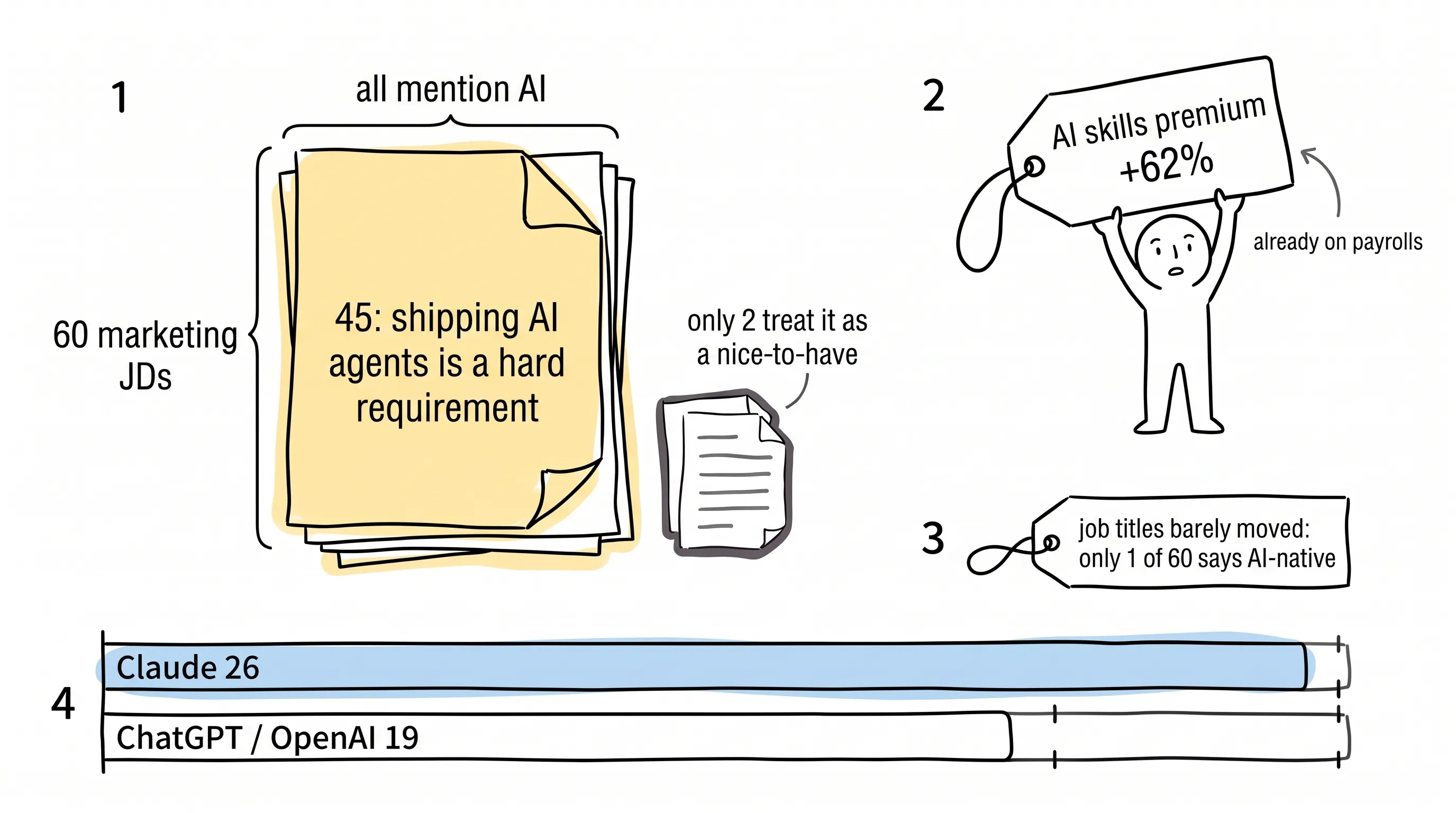
The macro data points the same way. Indeed Hiring Lab found that the share of marketing job ads mentioning AI rose from 8.4% to 14.9% in 2025 — nearly doubling in a single year. PwC's 2026 AI Jobs Barometer, built on more than a billion job ads, pegs a 62% wage premium on AI skills — and that premium isn't a forecast, it's already showing up on payrolls. What's interesting is how little the job titles moved: of the 60, only 1 has "AI-native" in the title, and 33 still say marketing operations specialist. The change is hiding in the list of responsibilities, and it will land on you at your next performance review. If you wait until you see the careers page to start preparing, you're already a round behind.
The tech stacks employers call out by name held a surprise too. 36 positions name at least one specific product; Claude appears 26 times, more than OpenAI and ChatGPT's 19. Among orchestration platforms, n8n, Zapier, and Make each have their fans, and the author estimated the learning cost: 15, 12, and 8 hours respectively — the concepts carry over, all of them built on triggers, steps, conditions, and outputs. Learn one and you can migrate to another in an afternoon. MCP shows up in 8 job descriptions; two years ago the term didn't exist. Add coding assistants (Claude Code, Cursor, Replit), GitHub for code, and platforms like Vercel for deployment. The author warns that half of this list will be obsolete within two years — so don't hoard tools; climb the ladder.
That ladder has five rungs, and the order can't be skipped. The most common mistake, the author says, is heading straight for the top floor: signing up for an agent-building course before you can explain one of your own processes clearly on paper. Rung one, understand the fundamentals: context windows, embeddings, retrieval-augmented generation (RAG), and what an agent, a skill, and MCP (Model Context Protocol) each are. A model has no memory of last month — it only knows what you give it. The standard: you can explain it to your grandmother. Rung two, write your processes down as machine-usable text. The author calls this the cheapest audit: the moment a process hits paper, the approvals nobody can explain and the handoffs that quietly swallow whole days all show up on a single page. Brand guidelines need rewriting too — a 40-page PDF with a mood board can't enter a workflow; it has to be rewritten as rules. Teach voice with real examples plus failure modes — for instance, ban stacking three adjectives in a row, ban that opening line that's nearly worn out — far more useful than adjectives. Product facts, claims you're allowed to make, SEO rules, design systems: the author names five types of documents, each with its own way of being written, one page per type, with a named owner and a review date. Rung three, automate the repetitive: distill prompts into skills, let skills grow into agents — what employers actually want is someone who can build a shared library for the whole team. Rung four, ship one small application end to end with your own hands, from idea to public URL: building teaches you to scope, the repo teaches you version rollback, and shipping makes it concrete — this step changes how you think. Rung five, set up monthly evaluations at 30, 60, and 90 days against business goals, because automation degrades — an agent that ran fine in March is not guaranteed to run in September.
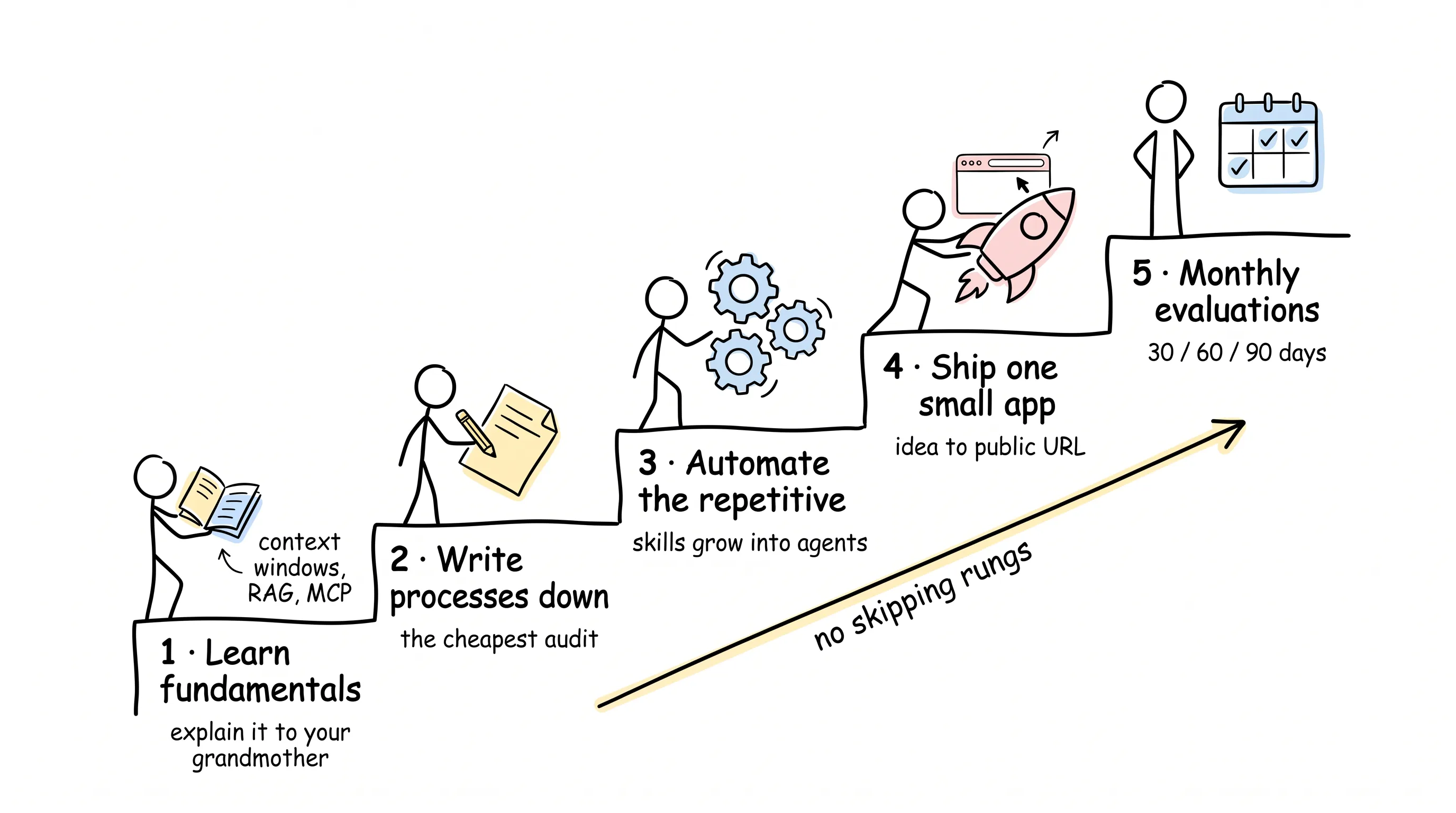
On execution, the author's advice is refreshingly plain: don't wait for a marketing AI course to open; learn by doing. Every week, pick one repetitive process, write it down, measure it honestly once, automate one step, and put the result somewhere the whole team can see — then do it again next month. One working, end-to-end workflow teaches more than any course. An hour a day, banked consistently, beats a boot camp — and for people who take a course and never build, the hour count doesn't move at all.
My take: the agent hype has run for two years, and this is the first time I've seen it written in as a hard requirement in job descriptions. A 62% wage premium means the market has started pricing it in. The detail most worth remembering, though, is that Claude outnumbers ChatGPT in these job descriptions — 26 to 19. Employers have voted with their feet, and it also says something sideways: in workflow scenarios the model is just a component; orchestration skill is the reason you get hired. For marketers, this ladder is worth an annual planning sheet: start by writing down your messiest process as text — that step is free, and it immediately lays the problems bare. Don't hoard tools at rung one; the author's exact words call a tool list perishables. The ones who climb the ladder are the ones who go far.
🔗 Further reading: Read the full article
🏷 Strategy & Workflow
AI Makes Marketing Faster, Not Better
MarTech's September 28 opinion piece comes from Kath Pay, CEO of Holistic Email Marketing. Her argument: the bottleneck was never just writing — it's decision quality. Producing faster actually exposes weak thinking. AI will confidently produce versions of a weak brief, filling the gaps in client insight with generic assumptions, and generate more divergent options for a broken approval process to chew on. The old problems — approval bottlenecks, unclear workflows, cross-team coordination — none of them got fixed by speeding up output. The more you produce, the more versions pile up waiting to be debated or vetoed; she calls it ten versions nobody asked for. AI is an amplifier of decision quality: if the incoming brief, strategy, and measurement plan are weak, the output only gets weaker. AI also can't make the decision nobody has made before, and it won't rescue a vague strategy. Her solution: extend marketing roles upstream and downstream — upstream to define decisions, downstream to verify them. Judgment is the competitive advantage.
💬 This week, don't rush to open yet another AI account. Take your most recent piece of dead output and audit the brief itself for vagueness: goal, audience, success criteria — whatever's missing, fill it in, and while you're at it cut the approval checkpoints down to two. Keep humans on the judgment nodes; let machines run the periphery. Once the inputs are fixed, then use AI — what you save is the entire rework chain's worth of hours.
🔗 Further reading: Read the full article
ABM Leads from Snowflake, Datadog, and Unisys Share 6 Sales-Alignment Plays
MarTech author Steve Armenti moderated a roundtable, and the plays offered by the ABM (account-based marketing) leads of Snowflake, Datadog, and Unisys distilled into six. The starting point is a perception gap: in Forrester's 2024 survey, 65% of frontline sales and marketing staff perceive misalignment, while 82% of executives believe alignment is already there. The six plays: two weeks before launch, reconcile the CRM account list against the marketing target list line by line, specify ICP (ideal customer profile) ownership, and set realignment triggers — a leadership change or a strategy pivot triggers realignment. Turn the MQL (marketing-qualified lead) handoff into a relay: marketing completes every step of its leg, then attaches a recommendation package covering what was done, what state the account is in, and who to contact next — worded as recommendations, not written up as yet another request. The signal layer should return recommended actions, not just raw data; the third-party intent data anyone can buy has become a commodity, while human-level public signals — new roles, new projects, executives speaking in public — drive enterprise-grade outreach far better, and only when multiple signals point at the same account at the same moment is it worth pushing to sales. Sell support, not tiers: first ask sales which two of their 30 accounts must be won, and show tier allocation only to sales leadership. Do enablement in the inbox where sales actually lives — don't make them log into yet another tool — and make account briefs include the things sales actually asks about: partner footprint, whitelisted connections, recent leads. Point AI at workflows and data, and invest the time it frees back into 1:1 human work. Datadog used to run half its campaigns as generic industry pieces; now almost every account has a specific angle. Unisys's ABM campaign launch cycle shrank from three months to a few weeks. Snowflake even built a small tool on its own platform that reads sales call recordings and pushes personalized gift suggestions to the ABM team. The mark of success: sales @-mentions ABM in the win announcements.
💬 The one play here that costs zero budget is the first: in the first two weeks of this quarter, reconcile the accounts sales is actually working in the CRM against the marketing list, line by line. Resolve the differences face to face with the sales lead — not by posting spreadsheets. This is the foundation for the other five; discover the lists don't match only after a campaign launches, and the tuition is an entire quarter. As for the signal layer, don't rush to buy tools either — first agree that the output format must be one sentence of recommended action plus the reason.
🔗 Further reading: Read the full article
🏷 AI Search & Content
Configure robots.txt to Treat Two Classes of AI Crawlers Differently
On September 28, MarTech's MarTechBot Q&A column tackled how to stay visible in answer engines such as ChatGPT, Perplexity, and Gemini. At the technical layer, four moves: configure robots.txt to distinguish training crawlers (like GPTBot) from real-time retrieval crawlers (ChatGPT-User, PerplexityBot) — block the former to protect proprietary content, allow the latter in exchange for being cited in real time. Extend Schema.org markup: vocabularies like Organization, Product, HowTo, and FAQPage give LLM parsers explicit entity relationships. Adjust structure along RAG chunking logic — clear H2/H3 hierarchy, paragraphs that stand alone as blocks — so vector stores can extract and cite cleanly. Guarantee rendering speed and indexability: conversational retrieval tools favor sites that render fast and are structurally clean; if server response drags, real-time retrieval simply times out. The content layer, meanwhile, points to verifiable information density: build dense topic clusters around your brand entity and industry terminology, and use clear subject-verb structures so claims are easy to extract. Original statistics and original research are the priority — AI models prefer citing original data as primary sources to lower their own hallucination risk, and aggregated content loses out. Add descriptive annotations to charts and multimodal assets; once voice and visual queries enter answer engines, this layer gets indexed too.
💬 Two things a technical team can do today: open robots.txt and split the two crawler classes into separate rules, add FAQPage markup to the FAQ and comparison pages, then run Lighthouse over mobile rendering speed. Half a day, total. In the answer-engine era, organic traffic will contract; being cited is the new visibility. Buy this insurance first — by the time the traffic curve turns, it's already too late.
🔗 Further reading: Read the full article
MarOps Veteran Says GEO's First Principle Is Removing Content Gates
Edward Unthank of Etumos, a MarOps agency, laid out the difference between GEO and SEO in a 7-minute video. The G in GEO is generative — it covers every scenario where someone asks an LLM a question, not just Google's list pages; the key is getting your information into chat engines. His sharpest claim: remove content gating. What the form blocks is the LLM's crawling and aggregation; only pages that are publicly readable can be indexed and cited by models. If your product material sits outside the models' field of view, when a user asks, the answer contains no trace of you. He describes it as a credibility game — the logic resembles getting crawlers to index your site back in the day, but the weighting signals differ, and credibility directly decides who gets cited. For B2B teams that trade white papers for leads, this collides head-on: the lead machine and the visibility machine are fighting each other for the first time.
💬 Don't do a blanket teardown. Pick one white paper and A/B it: keep the form on half, publish the full text on the other half, run it for a month, and compare lead volume against AI citation count. Don't forget to add a lightweight conversion entry at the foot of the public version. Let the data decide whether to tear the gates down across the board — the cost of the experiment is nearly zero.
🔗 Further reading: Read the full article
GEO's Goal Shifts from Ranking to Being Cited — Five Strategies You Can Map Against
Ntooitive's explainer makes GEO's shift clear: the goal has moved from fighting for SERP rankings to being cited by AI systems and synthesized into their answers. Five strategies: conversational natural-language content; structured data and semantic markup; topic clusters with answer-first formatting; technical foundations (speed, mobile, HTTPS); and cross-channel consistency of authority. Citation-ready formats like FAQs and summaries raise the odds an LLM accepts and cites you, and tracking AI response patterns lets you iterate continuously — for example, periodically asking procurement-type questions in the major chat engines and recording how often your brand comes up, and which page got cited when it did. Explainers like this are a dime a dozen; what makes this one worth reading is that it also writes out the two continuous-optimization motions: entity recognition and response tracking.
💬 Rebuild your site's FAQ page in citation-ready format: for each question, answer directly within the first 40 characters (about 25–30 words in English), then expand into background. Don't copy the strategy list wholesale — start with your high-intent pages, since those are the assets most likely to be cited. Note the date when you finish, then check the citation sources monthly to see which pages start surfacing in AI answers.
🔗 Further reading: Read the full article
🏷 Tools & Platforms
Choosing a Marketing Automation Platform: Look at Revenue Motions Before Brand Recognition
Consultant Christian Lehman's 2026 selection guide leaves you two ideas worth keeping. First, enterprise automation is at bottom four bundled decisions — CRM fit, data model, attribution model, and operational complexity — and you should match them to your own revenue motion, not to brand recognition. His short-form comparison: need speed, choose HubSpot; heavy segmentation with an ops team, choose Marketo; inside the Salesforce ecosystem, choose SFMC; governance-focused, choose Eloqua; if account prioritization is your real pain point, choose 6sense or Demandbase. Second, he proposes citation architecture: a platform that lacks an editorial-coverage graph will underperform on the AI recommendation surface — a dimension rarely raised in platform selection, and worth adding as a line item in your next procurement evaluation. He offers a six-metric scorecard — time to first campaign launch, number of native CRM objects, attribution coverage, monthly admin hours, share of campaigns run without engineering support, and pipeline impact from automation — and cites Forrester 2026 data showing enterprise platform investment keeps climbing.
💬 You can fill in the six-metric scorecard this week — one column for the current platform, one for each candidate. Start with monthly admin hours and the share of campaigns run without engineering support: those two expose the hidden costs directly, and they're the two most persuasive numbers in the case for switching. Fill the sheet before the selection meeting, and you walk into the negotiation knowing your numbers.
🔗 Further reading: Read the full article
2026 Enterprise AI Marketing Automation Compared: Price Tiers Three Orders of Magnitude Apart
The aimarketingcompare roundup first sets the bar for "enterprise": a contact base above 50,000, native CRM integration, role-based permissions, and genuine AI capability — with a reminder that most self-proclaimed AI platforms are really rules-based automation with an ML scoring layer bolted on. The tiers, concretely: HubSpot Marketing Hub Enterprise starts at $3,600 a month (for 10,000 contacts), with an AI content assistant and predictive scoring — the all-in-one pick for teams of 200 to 2,000. Salesforce Marketing Cloud starts around $400,000 a year, with implementations running 3 to 6 months; Einstein covers send-time optimization and journey analytics, it suits customer bases in the hundreds of thousands and up, and finance and healthcare get dedicated editions. Marketo Engage, powered by Sensei AI, digs deep into B2B prospect lifecycles and ABM; its Growth tier starts at roughly $1,000 a month, with enterprise contracts priced noticeably higher. ActiveCampaign Enterprise gives you 2,500 contacts for $145 to $187 a month, with predictive sending and predictive content. Braze leads with real-time mobile messaging and churn prediction — strongest for high-frequency messaging in gaming, e-commerce, and fintech.
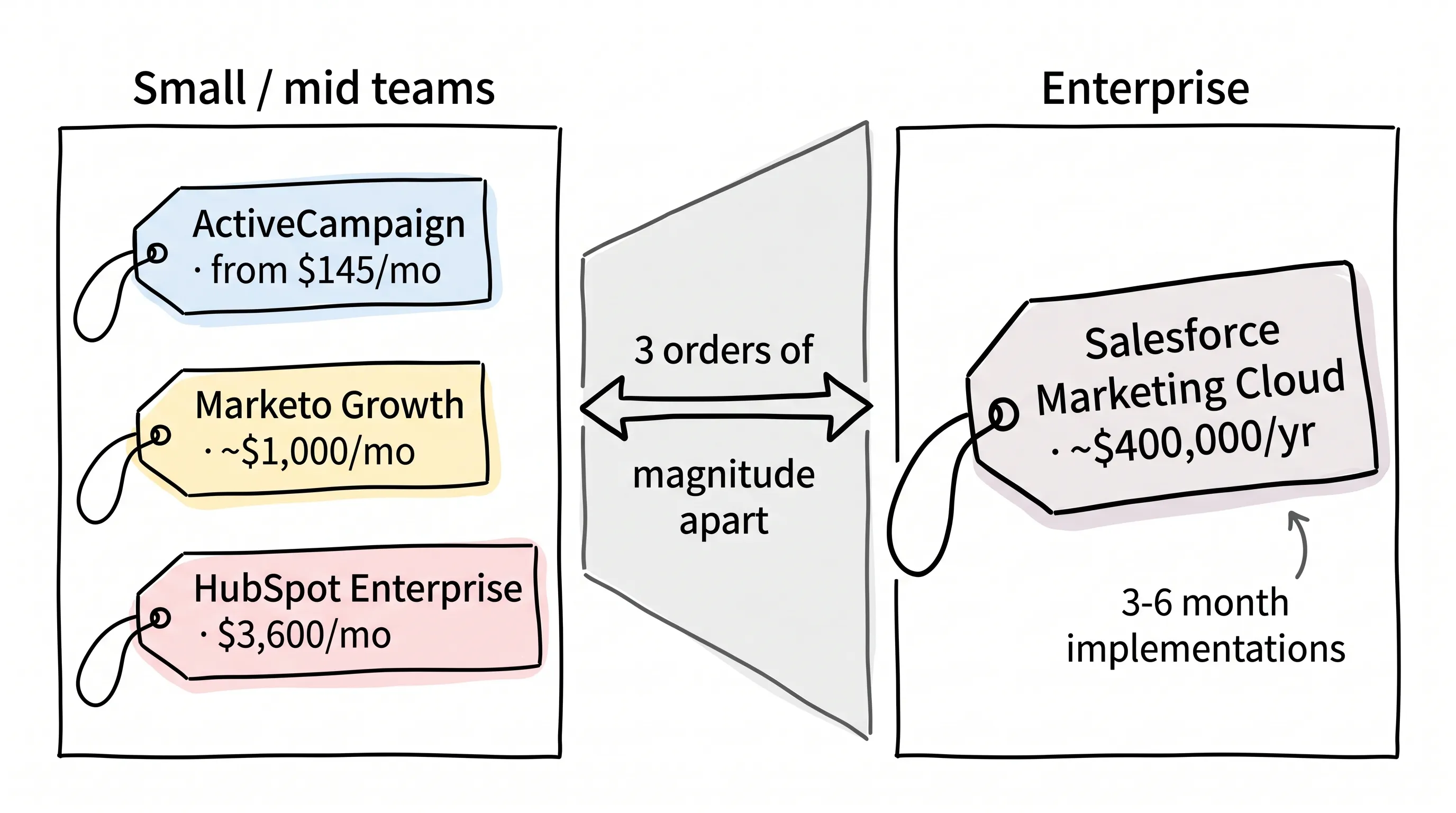
💬 First sort yourself by contact base and budget tier: below 250,000 contacts, look at ActiveCampaign first; for small-to-mid all-in-one, choose HubSpot; if you're already in the Salesforce ecosystem and the budget holds, move up to SFMC; long B2B nurture cycles go to Marketo. Before signing, bring competitor quotes to push down the implementation fees — enterprise contracts have more room than list prices, especially on implementation and contact-tier pricing.
🔗 Further reading: Read the full article
🏷 Content & Creators
Content Strategy Starts in the Sales Calls: AI Owns the Drafts, Humans Own the Arguments
viacon's long-form 2026 content marketing strategy piece settles one thing first: strategy answers who you write for, why you write, and what happens after reading — the calendar is merely the execution layer. The strongest topic ideas start with real customer problems in sales calls and support tickets, then work backward to keywords; run the sequence in reverse and all you get is content that congratulates itself. Topic clusters should cover every stage of the buying journey, and content for the decision and retention stages — pricing pages, implementation guides — often carries more commercial value than the eyeball-chasing awareness content. The report calls this out specifically, yet most teams still pile headlong into awareness content. Its positioning of AI is honest: AI is good at outlines, summaries, title variants, and repurposing drafts; it doesn't know your customers, its judgment can't be trusted, and it doesn't even know when it's wrong. The division of labor: humans own the arguments and the fact-checking, AI handles the peripheral drafts. On AI search versus traditional SEO, four shared signals: topic authority, intent match, entity relationships, and first-hand detail. Invest one piece of content at both ends, and the leverage beats building two separate sets.
💬 Run a topic audit this week: go through your last 20 sales call notes and support tickets, copy down 5 questions in the customer's own words, and turn each one into a piece. These topics will beat any brainstorm, because the problems are real.
🔗 Further reading: Read the full article
Marketing Teams Using AI for Content: Set the Policy First, Then Fix the Brief
Nextiny Marketing's 52-minute webinar covers how content teams should use AI. Generative and predictive AI split by task: lead scoring, personalization, and dynamic pricing go to predictive; content ideation, scripts, and visual assets go to generative. Match the task to the wrong tool and the hours are simply thrown away. One HubSpot 2024 statistic is worth memorizing: 45% of marketers use AI only for inspiration, and just 6% use it to finish drafts — AI still can't carry the heavy lifting. Two actionable moves: write a company AI usage policy covering four elements — purpose, scope, approval workflow, privacy and copyright; and strengthen the creative brief, because a high-quality brief plus a well-tuned prompt is the real quality-control mechanism. Put audience, argument, and banned expressions in the brief, and the AI first draft jumps a tier on its own. Their analogy is the camera obscura: the tool never replaced creativity — the person who steers the tool is the protagonist.
💬 If writing the AI policy into the team wiki has been dragging for six months, land it this week — one paragraph per element is enough, with a legal review as a bonus. While you're at it, add two columns to the creative brief: banned words and must-answer items. One day of work, and quality problems halved at the source.
🔗 Further reading: Read the full article
Peer-Reviewed Paper: Why AI Virtual Influencers Outperform Human Ones
A peer-reviewed paper in Elsevier's journal Technological Forecasting and Social Change (Allal-Chérif et al.) studied three virtual influencers in Brazilian retail — Magazine Luiza's Lu, Casas Bahia's CB, and Natura's Nat — alongside interviews with 16 digital marketing experts. Four conclusions: virtual influencers carry no scandal risk and no image drift, and none of the contract-termination waves that come with signing human celebrities — the paper cites a well-known celebrity wave of brand exits as its cautionary tale. What creates engagement is the storyline and the world-building; looks rank far behind. In consumers' eyes they actually seem more authentic, precisely because there's no human persona waiting to collapse. And Prada, Dior, LVMH, and Samsung have already adopted virtual ambassadors at scale. The paper unfolds across five themes: narrative builds credibility, reliability and trust, return on investment, ways of practicing, and limitations and risks. The limits deserve attention too: some audiences recoil from non-human imagery, empathy has its barriers, and coverage can't reach every demographic. For the brand-safety debate in influencer marketing, this paper supplies the academic backing.
💬 Teams with tight brand-safety budgets can pilot one virtual ambassador on a single campaign and remove scandal risk from the variable list entirely. Evaluate on engagement quality and storyline retention — not follower counts. The source sits behind a paywall; this item is written from the abstract and excerpts only — details pending verification.
🔗 Further reading: Read the full article
🏷 Industry Data & Cases
AI-Driven Campaigns: Three Pillars, Three Risks
National University's faculty-reviewed overview of AI marketing campaigns (June 2026) splits the technology into three pillars: generative AI for creative variants, predictive analytics for optimizing media buying, and agentic AI for orchestrating multi-step customer journeys. In the traditional workflow, manual segmentation, static creative, and cycle-based optimization are being displaced one by one by micro-segmentation, generative creative, and real-time bid optimization. On audience identification, AI replaces third-party cookies with contextual signals — a path whose value only climbs as privacy tightens. The data: McKinsey reports 92% of enterprises plan to invest in generative AI within three years; in SurveyMonkey's survey, 50% of marketing teams use AI to create content and 51% to optimize; PwC's survey shows 66% of enterprises running agentic workflows report productivity gains, 57% report cost savings, and 54% see improved customer experience. Three risks: training-data bias (the piece cites a medical case where AI produced racially biased recommendations), creative homogenization, and AI washing eroding trust. The third is the easiest to trip on — before you write "AI-powered" into your pitch, ask yourself whether it actually is.
💬 Map your own stack against the three pillars and fill whichever one is missing. Before you scale, write bias spot-checks into the launch checklist — one sample a week, an hour of cost, and what it protects is brand trust.
🔗 Further reading: Read the full article
The Money Numbers of Generative AI Marketing: a $350 Billion Market and 11.4 Hours Saved a Week
boderia's overview hands you several quotable magnitudes: the generative AI market is projected to reach $350 billion by 2030, growing 46.47% a year; 92% of the Fortune 500 have already adopted it; marketing teams save about 11.4 hours a week — nearly 600 hours a year. McKinsey estimates GenAI can lift productivity worth 5% to 15% of the marketing budget — about $460 billion a year. The cases are more concrete: Coca-Cola's Create Real Magic plays with user co-creation; Nutella's Unica project used AI to generate 7 million unique jar labels, no two alike, igniting UGC spread directly — the packaging itself became the content; Michaels personalized 95% of its email campaigns and lifted SMS click-through by 41%. The challenges remain the same three: brand voice drift, factual errors, and data privacy — none of them avoid human review, which is why prompt skill has become a hard requirement for the team.
💬 The Michaels number is the one worth copying outright: personalization went from template paragraphs to 95% coverage, and SMS click-through rose 41% — an email team can follow that exact path for its first wave of campaigns this month. First measure how many hours a week your own team saves; talk about bigger budgets only once you have a baseline. No guessing.
🔗 Further reading: Read the full article
Four AI Fixes for Cross-Border E-Commerce — Two of Them Cheap Enough to Do Today
WarpDriven, a cross-border ERP provider, breaks cross-border e-commerce pain points into four problems. Language and cultural localization: multilingual chatbots bring a 15% to 30% conversion lift and cut cart abandonment by 17%; another statistic claims hidden fees cause roughly 60% of carts to be abandoned — buyers discover shipping and taxes at checkout and walk away on the spot. Logistics automation: route optimization and inventory forecasting attack from both ends, squeezing down stockouts and overstock together, cutting operating costs by up to 50%. Compliance and risk: AI-driven customs declaration and real-time tax calculation cut fraud losses by about 25% and the false-positive rate by 50% — and the half you falsely decline is often your regular customers. The fourth problem is personalized marketing and after-sales. The figures come with source links, but the whole piece orbits the provider's own solution — discount its standalone value accordingly.
💬 Cross-border teams should start with the two cheap moves: deploy a multilingual bot to capture that 15% to 30% conversion lift, and state shipping and taxes plainly on the cart page — cutting the largest slice of that 60% abandonment rate, a one-time build with a lasting payoff. Leave ERP-level overhaul for later: pick the low-hanging fruit first, then talk about heavy investment in logistics and risk control.
🔗 Further reading: Read the full article
💡 Today's Takeaways
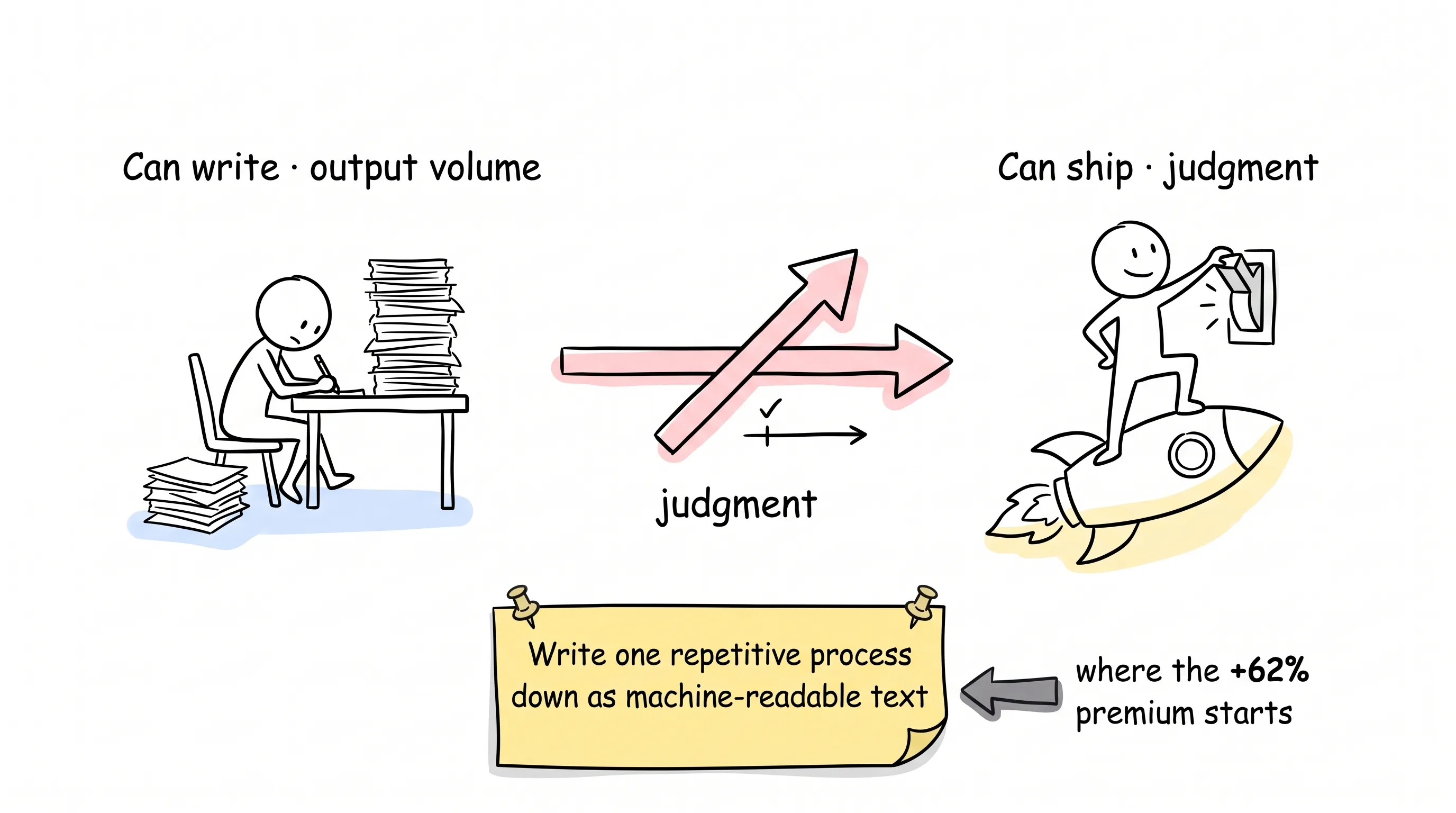
Fourteen items today, and not one is a blockbuster model launch — yet read together, they're the same sentence said fourteen ways: AI in marketing has moved from able to write to able to ship, and the marketer's value coordinate is moving from output volume to judgment. The headline's 60 job descriptions delivered the price signal — a 62% premium on AI skills, with 45 positions demanding you deliver agents outright — while the job titles didn't change by a single word. Kath Pay's piece shows the other side of the coin: producing faster can't rescue decision quality; humans stay on the judgment nodes, and ten versions nobody asked for don't gain owners just because they generated quickly. The ABM roundtable's practitioners have already worked it out: AI runs workflows and data, and the time saved goes back into 1:1 human work. The three GEO items tell the same story from the other side: when AI becomes the traffic entry point, only content that is public, citable, and carries entity authority gets visibility — white papers hidden behind forms are losing their power. Read the two platform roundups together and the conclusion is: don't pay a premium for rules-based automation wearing an AI name tag; the six-metric scorecard and the price tiers have done the reconnaissance for you — from $145 a month to $400,000 a year, what separates them is three orders of magnitude in team shape. The case items drive the point home one more time: Nutella's and Michaels's numbers look great, but the precondition was humans feeding the rules and the assets in clearly. Today's most valuable action costs nothing: take one weekly repetitive process and write it down as machine-readable text. That step makes every problem visible — and it's the starting point of that 62% premium.
Continue reading
Related articles

AI Marketing Daily · 2026-10-09
AI marketing daily for 2026-10-09 covering 11 items: brand measurement moving from survey panels to search, social, e-commerce, and AI prompt signals; GEO and share of model playbooks; safety guardrails for agentic ad buying; and tool roundups for ad platforms, cross-border tools, and social media uses.

AI Marketing Daily · 2026-10-08
AI Marketing Daily for 2026-10-08 curates 20 items across AI search visibility (GEO), advertising, platform selection, cross-border e-commerce, and ROI measurement. The headline argues that strategic marketing decisions should stay with humans while AI assists execution.

AI Marketing Daily · 2026-10-07
Today's throughline is answer engine optimization (AEO — getting your brand quoted in AI answer engines).