
AI Marketing Daily · 2026-09-28
AI Marketing Daily for 2026-09-28 rounds up measured-ROI AI marketing use cases, two GEO methodology guides, an influencer marketing measurement framework, ad platform and tracking news, industry ROI statistics, and global AI regulation compliance resources.
Today's throughline is running the numbers. The headline list of 15 use cases puts measured ROI on the table — yet 51% of marketers still can't say whether the money they spent did anything. Two GEO methodology pieces dropped the same day, covering everything from a six-step playbook to five pillars and a new KPI set; influencer marketing finally gets a measurement framework that sidesteps last-click; and Deloitte pours cold water on personalization with an 18-point perception gap. There's movement on the policy side too — someone has already prepared a self-audit worksheet for global AI regulation. Finish this one issue, and you're caught up on the past 24 hours of AI marketing.
🎯 Today's Headline
15 AI Marketing Use Cases with Real Return Numbers — and the 51% of ROI Nobody Can Track Behind Them
On September 10, a long-form piece by Davis Scott — a writer with a Fortune 50 background — ranked 15 AI marketing use cases already proven inside real companies in 2026, ordered by measured ROI. It opens with a sobering set of numbers: 75% of marketers have adopted AI and 91% say they use it daily, yet 84% are still running generic, cookie-cutter campaigns, and 51% cannot track the returns on their AI investment. The top of the list is content drafting, at an average return of 3.2x; AI personalization comes in at 2.7x, with enterprise teams reaching 3.4x; behavioral segmentation sits at 2.4x. Marketing automation is the powerhouse: every $1 spent returns $5.44 over three years — a 544% ROI — and 76% of adopters see positive returns within 12 months. Individual case studies go further. JPMorgan used Persado to optimize ad copy within a pre-approved language corpus and lifted click-through rate by 450%; lingerie brand Cosabella let Albert AI reallocate budgets in real time across Google, Facebook, and Instagram, pushing ROAS up 336% — without adding a single headcount. The bottom of the list is just as informative: video creation returns only 1.1x, paid social creative 1.2x, lead scoring 1.4x.
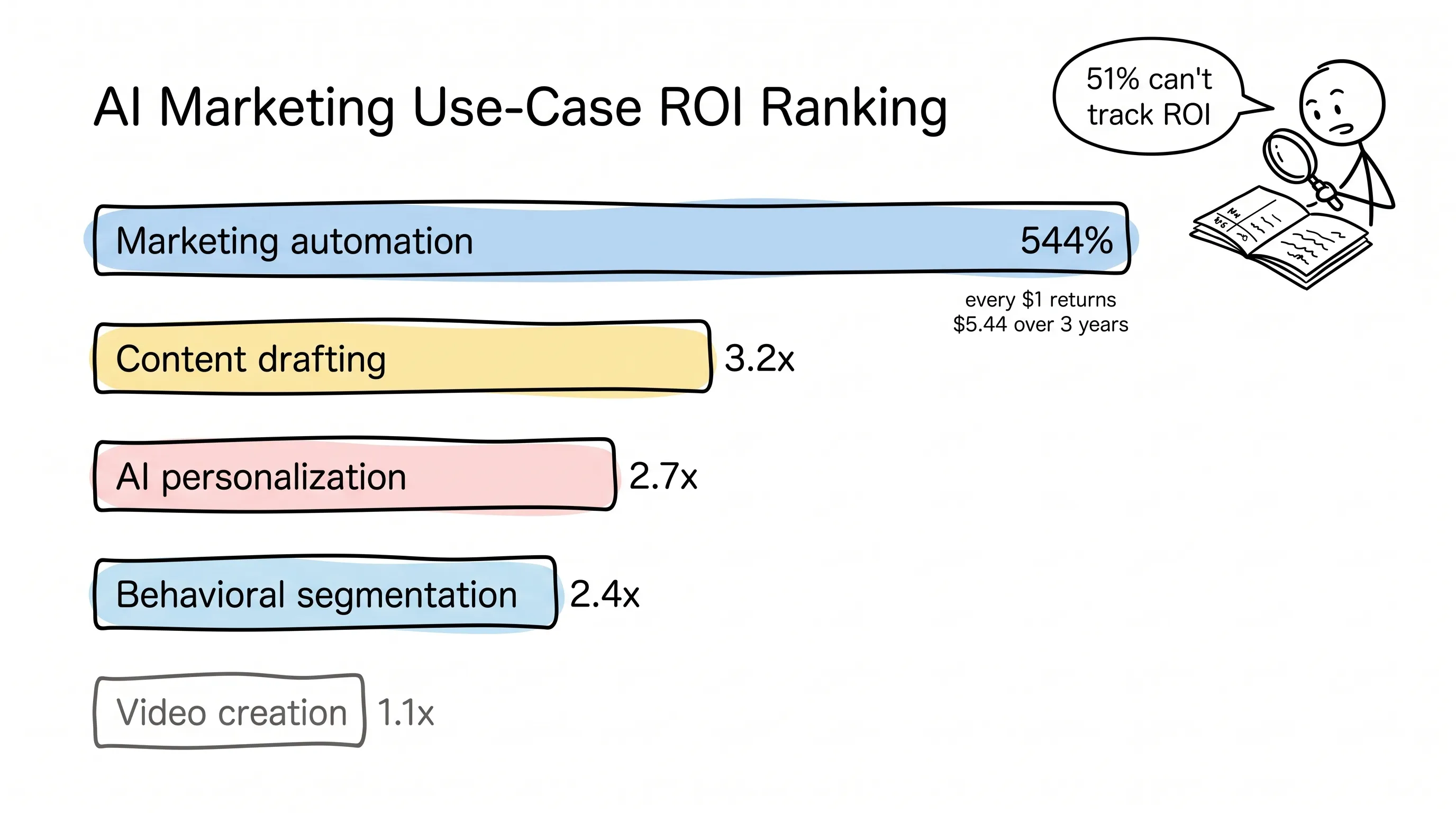
What makes this list valuable is that every number carries a citation — McKinsey's 2026 global AI survey, Salesforce State of Marketing 2026, Gartner's 2026 Agentic AI Hype Cycle, Deloitte's 2026 State of Enterprise AI — not vendor self-certification. One Gartner forecast quoted in the piece deserves its own underline: more than 40% of agentic AI marketing projects will be cut by the end of 2027, because ROI can't be calculated and operating costs keep climbing. In other words, the industry's real question has shifted from "should we adopt AI" to "once we have, how do we prove it was worth it."
The author also offers a diagnosis most vendor content won't give you: what separates high-return use cases from low-return ones isn't model capability — it's the length of the feedback loop. Content drafting earns 3.2x because marketers see the output in seconds and the metrics within days; video creation manages only 1.1x because its output is hard to judge quickly and the data feeding it is messy. The same chasm runs through governance: Deloitte's data shows only one in five companies has built a mature governance framework for autonomous agents, roughly half of deployed agents run in silos, and 86% of IT leaders say those silos create more complexity than value. On the other end, Salesforce's Agentforce already resolves 83% of customer service sessions autonomously, and during the 2025 holiday season agentic commerce captured 20% of global orders — about $262 billion. The ceiling is real, and so are the people who have fallen from it.
The rollout order? Copy it outright. Teams with low AI maturity should start with content drafting and email optimization — the tools are mature and the baseline is easy to measure. Those with clean customer data should make personalization and behavioral segmentation the second step, folding marketing automation into the same wave; leave end-to-end agent execution for last, until governance catches up. And there's one habit that matters more than which use case you pick: set the baseline before you deploy the tool. JPMorgan's 450%, Cosabella's 336%, automation's 544% — all measurable for the same reason: those teams knew what normal looked like before they switched on AI. The 51% who can't track ROI almost all started the other way around: the tool went live first, the baseline never got recorded.
A batch of quietly lucrative middle-of-the-list items often gets overlooked. Product recommendation engines lift conversion rates by up to 150% and average order value by 50% on average — Amazon's recommendation engine alone drives 35% of the company's annual sales. AI-optimized email earns 41% more email revenue, and both HubSpot and Mailchimp confirm that AI-recommended send times and subject lines beat manual scheduling. In predictive analytics, 92% of top marketing teams were already using it to pick customers in 2025. AI-driven CRO platforms continuously test page elements and offer combinations against live traffic, lifting conversion rates by more than 25% — a pace manual A/B testing can't match. The biggest adoption jump actually went to AI measurement and attribution, up 26 percentage points over the past year, as the whole industry scrambles to close that 51% tracking gap. Adoption patterns tell their own story: 78% of marketers use AI weekly for content, 71% to generate ad copy variants, 69% for email subject lines, 64% for image generation.
I'll close with my own read: the hard part of this list was never the list itself. Any company can afford all 15 use cases; what actually separates teams is picking a few, building measurement and governance, then scaling on evidence. That road starts slow, but it compounds. The other road wins the demo and loses the 2027 budget meeting.
🔗 Further reading: Read the full article
🏷 Foundation Model Watch
MarTech Weekly Radar: OpenAI Tests Third-Party Tracking in ChatGPT Ads; 81% of Shoppers Have Been Talked Out of a Purchase by AI
MarTech's marketing-AI topic page has stacked up roughly 20 news items from the first half of September, and a few deserve to be pulled out. On September 23, OpenAI was reported to be testing third-party persistent-identifier tracking inside ChatGPT ads — a change that would meaningfully improve ad measurement while raising new questions around consent mechanisms and data provenance. On September 16, HubSpot announced it is rebuilding its platform around AI agents: the redesigned Breeze assistant orchestrates multiple agents, with a self-updating CRM supplying them business context. Two September 25 pieces are worth reading as a pair: one warns against treating LLMs like people — treating them as a thinking partner only buys you vague prompts and hallucinations; the other argues GTM teams are losing visibility and ownership of their own AI agents, making governance the new bottleneck. On the consumer side, one contrarian data point: 81% of consumers who shop with chatbots have decided not to buy something on the AI's advice. Several management-side threads ran in the same window. September 22 covered how to build a marketing team with AI coworkers — before you deploy an agent, be clear about what it does alone, what needs human review, and who is accountable when things break. The September 23 piece argued that AI's real advantage is what your company already knows: the customer knowledge and past decisions you feed in determine the value of what comes out. September 21 brought two items back to back — one on why a marketing governance framework has to span legal, security, and operations; one asking whether you really need this much marketing content, since every additional asset adds a downstream string of reviews and tests. And a footnote: on September 24, a new Chrome extension shipped that uses AI to spot and hide slop content on LinkedIn — even the human-written kind.
💬 Paid media teams: put ChatGPT ad tracking on the watchlist — attribution methodology may be about to move again. The 81% abandonment stat is the more practical one: AI optimization isn't just about getting models to recommend you, it's also about managing how they talk about you. Contingency plans for negative-AI-recommendation scenarios belong on this quarter's roadmap. While you're at it, inventory the agents you're running and tag each with an owner and a reviewer — that's an afternoon of work, and far better done before an agent goes dark on you.
🔗 Further reading: Read the full article
🏷 Product Launches
KNOREX Launches an Agent-Callable Ads API as Ad Infrastructure Starts Converging on Open Protocols
KNOREX, a programmatic advertising company listed on NYSE American, put out a press release announcing an agentic-AI-ready Ads API that is compatible with both the Amazon Ads MCP Server and the open standard AdCP (Advertising Common Protocol). With it, AI agents can create campaigns, adjust budgets and bids, and pull cross-channel reports across programmatic, Meta, Google, LinkedIn, and TikTok Ads in natural language — eliminating point-to-point integrations and the engineering upkeep they require. Founded in 2009, KNOREX runs its flagship XPO platform across social, search, CTV/OTT, video, audio, display, native, and DOOH advertising, with operations in the United States, Vietnam, India, Malaysia, and Singapore. The API is already live commercially with two strategic partners in the US and one in Southeast Asia. The company's rationale: global digital ad spend is projected to exceed $740 billion in 2026, and agentic workflows need a unified infrastructure layer. Keep your guard up, though — this is a corporate self-promotion release; the numbers and claims are one-sided and the results are unverified.
💬 The product itself can wait; the signal is worth recording: advertising interfaces are heading toward standard protocols that agents can call. When vetting AdTech vendors, add MCP or AdCP compatibility to your evaluation sheet — it will save you a serious chunk of integration engineering hours next year. This is a zero-cost move you can make today.
🔗 Further reading: Read the full article
Think with Google Case Pool Update: Colgate-Palmolive Lands 44x Conversions in South Africa with AI Max (thin entry)
The Think with Google platform has rolled out an AI Excellence case aggregation page, collecting entries for marketing-AI cases from June through August. The most eye-catching: Colgate-Palmolive used Google AI Max to target high-intent audiences with search in South Africa and landed 44x conversions — the case is dated August. Wayfair contributed an interview on how brand visibility works in the AI search era. The page also features DeepMind on a creative future that runs from prompts to directing, and Groupon on how to build an AI-first organization — the latter lines up neatly with today's headline judgment that governance is falling short. One caveat: this page is only an index. Each entry is a one-line teaser plus a jump link, with no expanded body copy; this item is covered in full based on what the index itself offers.
💬 Go read the original 44x case and take it apart — focus on its targeting-keyword structure and bidding approach; search teams can copy the playbook. Official case pages like this fit well into a weekly radar feed: scan the titles first, click through only when a concrete number shows up. It saves time.
🔗 Further reading: Read the full article
🏷 Marketing Toolkit
Six Practical Steps for GEO: 70% of College-Bound Students Start Their School Search with ChatGPT — How Long Until Your Industry Follows?
HEM, a higher-education marketing agency, just refreshed its long-form GEO (Generative Engine Optimization) piece on September 24. It's set on a university campus, but the method transfers as-is. The urgency data it leads with: about 70% of prospective students use tools like ChatGPT for research in the early stages of choosing a school, and nearly 60% of searches end in zero clicks — AI already stands at the admissions funnel's first touchpoint. The playbook gives six steps. Organize content question-first: write around the way people actually ask — say, how much does a given school's nursing program cost. Build canonical fact pages: pull hard information like programs, tuition, and deadlines into authoritative pages. Structure content for AI parsing: key points up front, lists and tables beat long paragraphs, consistent terminology site-wide, schema types like FAQPage and EducationalOccupationalProgram, plus a machine-readable data file — the University of Florida used exactly this to noticeably improve how accurately Google AI Overview (Google's AI-generated search summaries) summarizes it. Optimize per platform: ChatGPT, Google AI Overview, and voice assistants each have their own temperament. Keep information consistent across every platform. Prioritize high-intent pages: program pages, admissions pages, and tuition pages go first. There's a measurement hook too: watch AI referral sources like bard.google.com in GA4, keep a fixed prompt list and periodically log manually where you get cited, backed up with multi-touch attribution.
💬 The method ports to any industry that lives on factual accuracy. Week one: turn your own products, prices, and policies into fact pages with schema — a manageable workload. After that, use a fixed prompt list to log citations once a week. That's the most workable GEO measurement starting point available right now; don't expect to get there in one leap.
🔗 Further reading: Read the full article
GEO's Five Pillars and New KPIs: From Fighting for Rankings to Getting Cited — Reddit Data Is Already in the Models
Brandcamp Digital fills in GEO's mechanics layer. AI search runs as retrieve, rerank, synthesize, cite — your content either gets used during synthesis, gets listed among the citations, or effectively doesn't exist. The methodology boils down to five pillars: clear expression, topic-cluster coverage, structured data, brand authority signals, and consistent updating. The content tactics are plain: question-style headlines, value before product, short paragraphs — all of it raising the odds of being pulled into synthesis and citation. The KPIs have been replaced by a new generation: Citation Share, Visibility Score, AI referral traffic, and AI Overview share; rankings and clicks are no longer the finish line. The off-site ecosystem gets called out once: Google and OpenAI have both licensed Reddit data, and real discussions in those communities are shaping how models judge your brand's authority. The author's conclusion: GEO won't replace SEO — the two complement each other.
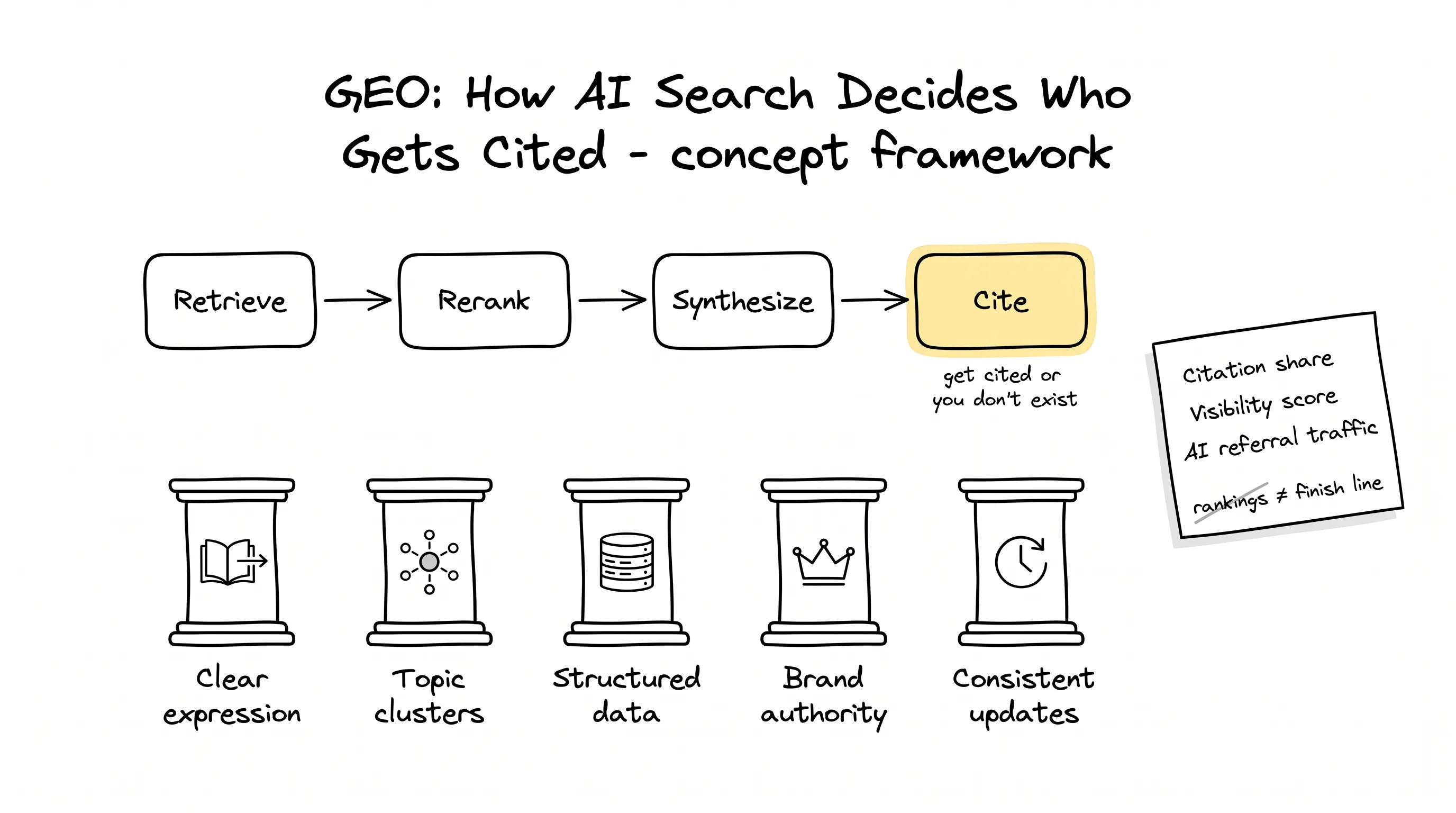
💬 Put Citation Share in your monthly report. The method isn't complicated: fix a list of 20 real customer questions, run them through the mainstream AI tools monthly, count the citations. Reddit operations rise in value accordingly — rather than paying for placements, start by nurturing a few genuine discussion threads. That can start this month.
🔗 Further reading: Read the full article
The Four-Layer Signal Stack for Influencer Marketing ROI: $5.20+ Back per $1 Spent — Stop Reporting Engagement to Your CFO
Social Native's framework piece puts the most painful attribution problem in influencer marketing on the record: under last-click models, creator content seeds demand at the top of the funnel, but the conversion credit gets booked to search or direct traffic — so budgets get slashed year after year. It lays down the industry data first. By Influencer Marketing Hub's figures, every $1 invested returns an average of $5.20 to $5.78, and 83% of marketers consider influencer marketing effective. CreatorIQ's report finds 94% of organizations believe creator content ROI beats traditional digital advertising — a share up 20 percentage points in a year. Nielsen's old line still holds: 92% of consumers trust personal recommendations more. Measurement comes as three layers of signals plus a four-layer signal stack. Incrementality lift tests use a holdout control group and answer the only question a CFO cares about: would these customers have converted anyway without the creator content. Partnership Ads (allowlisting) run the creator's own top-performing hit through their account — the cleanest cost-effectiveness signal available. EMV (earned media value) is fit only for benchmarking comparisons; never make it the primary KPI. The four-layer stack, top to bottom: brand-lift surveys, saves/shares/comments, promo codes and tagged links, with Partnership Ad ROAS as the closing layer. Sprout Social's data props up the middle of the stack: 81% of consumers say social media has triggered an impulse purchase.
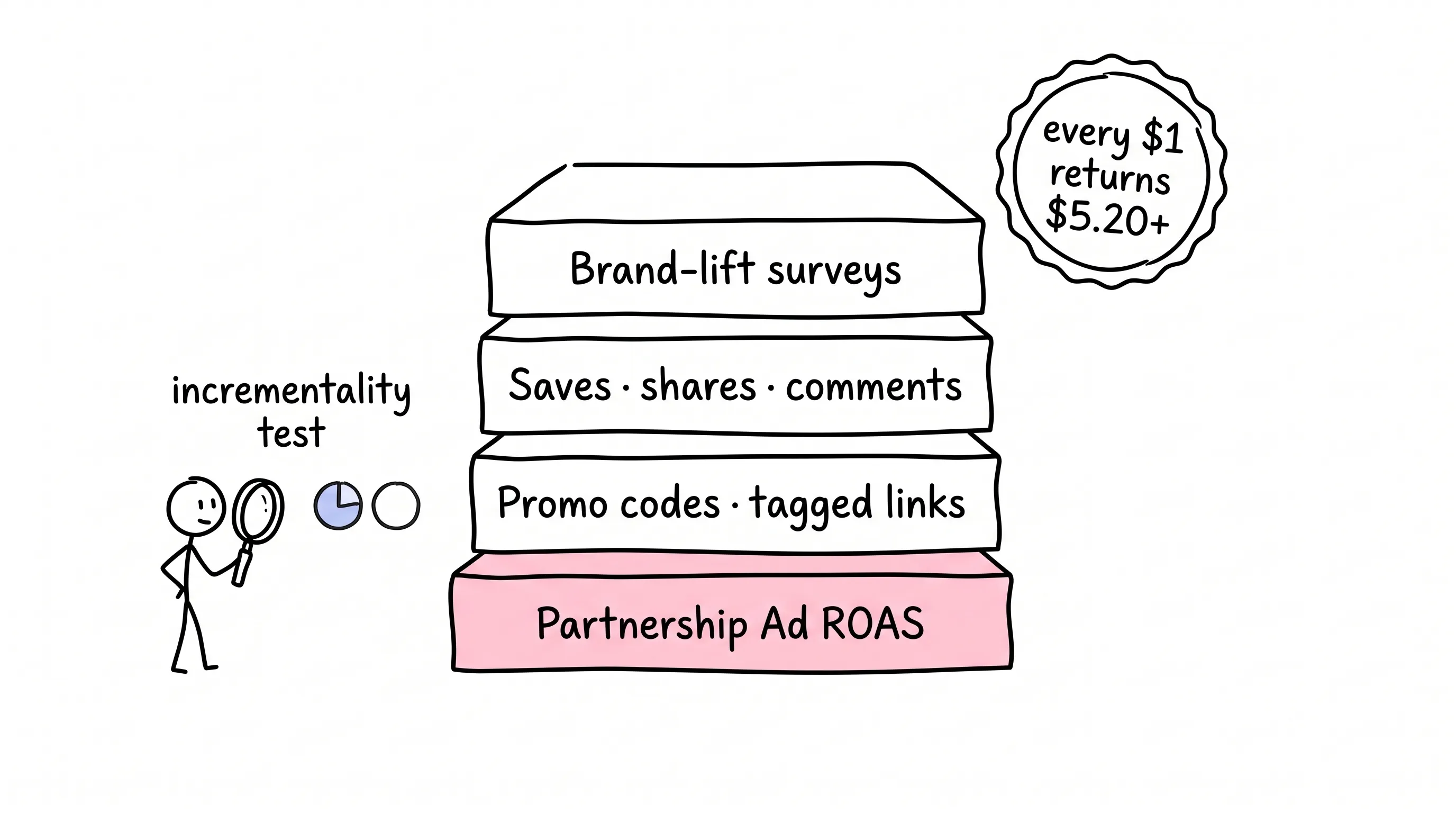
💬 Next reporting cycle, swap engagement metrics for this: carve 10–15% of budget into a holdout group and run one incrementality test, then take your top creators' organic hits straight into allowlisted Partnership Ads. Neither step is hard to land, but you can't fight for your budget without the data in hand.
🔗 Further reading: Read the full article
Three Maturity Tiers for AI in Creator Marketing: Most Teams Are Still Stuck at the Back-Office Layer (thin entry)
TATAM Digital's Instagram short-video script contains one substantive paragraph — flagged as thin. It sorts AI's role in creator marketing into three maturity tiers: the back-office tier handles briefs, email, and operational busywork; the strategy tier handles persona building, lookalikes, and creator vetting; the reporting tier has LLMs predict campaign performance before spend goes live. The tiers are sequential: the higher you climb, the more judgment AI takes over — and the more data it demands. The closing verdict: AI can amplify execution, but the thinking must stay human. The video also plugs an upcoming industry event in Berlin.
💬 Use the three tiers as a team self-assessment: first figure out which tier you're stuck on. Most teams stall at the back-office layer. This quarter, moving creator vetting up to the strategy tier is enough — set vetting criteria from historical campaign data and you'll cut screening hours roughly in half.
🔗 Further reading: Read the full article
Six High-Frequency Failure Points in Cross-Border Advertising: Local Payments Decide Your Conversion Before Translation Does
Meegle's long-form primer on cross-border advertising is broad in coverage and suited to beginners building a foundation. Its six high-frequency failure points: cultural misreads, machine-translated copy, regulatory compliance (GDPR, CCPA), logistics, local payments, and ad fatigue. The best-practices section prescribes an operating sequence: pilot in one or two markets before scaling, go mobile-first, use UGC (user-generated content) as social proof, and pair retargeting with local holiday marketing. The piece singles out local payments: the effect of payment methods like local wallets on conversion rate is direct — harder-hitting than most creative-level optimizations. The trends section lists AI targeting and personalization, voice search, AR try-on, and blockchain transparency; AI targeting and personalization are already standard equipment in cross-border scenarios, not a bonus. The tools section lists the mainstream stack of Google, Meta, Amazon Ads, and Shopify — senior practitioners can skip it outright.
💬 An execution order for cross-border teams: screen markets by local payment availability first, then have a native speaker go over the copy, and only then scale. Machine translation is the cheapest thing to experiment with and the easiest way to wreck conversion — don't pinch pennies on that step.
🔗 Further reading: Read the full article
🏷 Industry Data
20 Machine-Learning Marketing ROI Stats: Automation Leads at 544%, but Only 27% of Companies Have Made It Out of the Pilot Stage
New York agency Amra & Elma has compiled 20 statistics for 2026, with sourcing that's reasonably complete. Marketing automation leads every category at a 544% ROI; Bloomreach customers hit 251% within 12 months by Forrester TEI (Total Economic Impact) methodology, and the same firm puts the lift in purchase intent at 27%. McKinsey's survey of 1,400 executives says enterprise AI deployments lift sales ROI by 10–20% on average, 66% of companies have already seen revenue growth from GenAI, and 87% expect it to keep rising over the next three years — with finance, retail, and B2B tech the three best-returning industries. The most-cited line is BCG's: AI leaders grow revenue 1.5x faster than peers over three years. Salesforce and Adobe both put the annual revenue lift from customer marketing and automation at about 25%. The counterweights are sharper. In Gartner's survey, only 27% of companies have pushed AI marketing projects beyond the pilot stage; the three mountains in the way are data fragmentation (61%), an ML talent shortage (54%), and the absence of executive-level governance frameworks (48%) — with an estimated $200 billion in unrealized ROI globally as a result. Deloitte's tracking of 980 firms shows the payback period for AI marketing investment has been compressed from 22.7 months to 14.2 months, with teams running pretrained large models plus modular pipelines 41% faster than those building their own models. In Forrester's survey of 3,100 CMOs across 18 countries, 53% of AI marketing projects are already profitable, beating 2024 forecasts by an average of 8.4 months. The ML market itself is projected to expand at a 34.8% CAGR from 2026 to 2030. One caution: this is an agency's content marketing, and some sources are credited only to a vague "Industry Research" — trace the original reports before you quote them.
💬 Trace the original reports before any presentation, and keep vaguely sourced numbers off the deck. The 27% stat cuts the other way too: fixing data integration and governance first does more to determine whether you're in the 27% or the 73% than rushing to adopt tool number N.
🔗 Further reading: Read the full article
Deloitte Personalization Research: Brands Claim 61% of Experiences Are Personalized; Consumers Credit Only 43%
Deloitte Digital has distilled six sub-reports from its own personalization research — first-party data you can take straight into an internal pitch. The widest gaps: 73% of consumers want personalized loyalty rewards, but only 45% of brands offer them; brands claim 61% of experiences are personalized while consumers credit only 43% — an 18-point perception gap sitting right there; and the personalization 78% of consumers want is unglamorous — saving money. Brands don't need to hand everyone the standard discount; use the data to set offer depth. The supply-side bottleneck sits in the content pipeline: most brands take more than two weeks to produce and deliver a single piece of personalized content, even as they've already bet 51% of their marketing budget on personalization and 62% have deployed CRM platforms. On channels, 57% of consumers prefer personalized service inside apps, 51% regularly order in-app, and Gen Z and millennials lean hardest into apps. Personalization demand rose 20% from 2022 to 2024, and B2B buyers' expectations are converging on B2C experiences. The research was published in October 2024 — medium timeliness, so mind the date when citing.
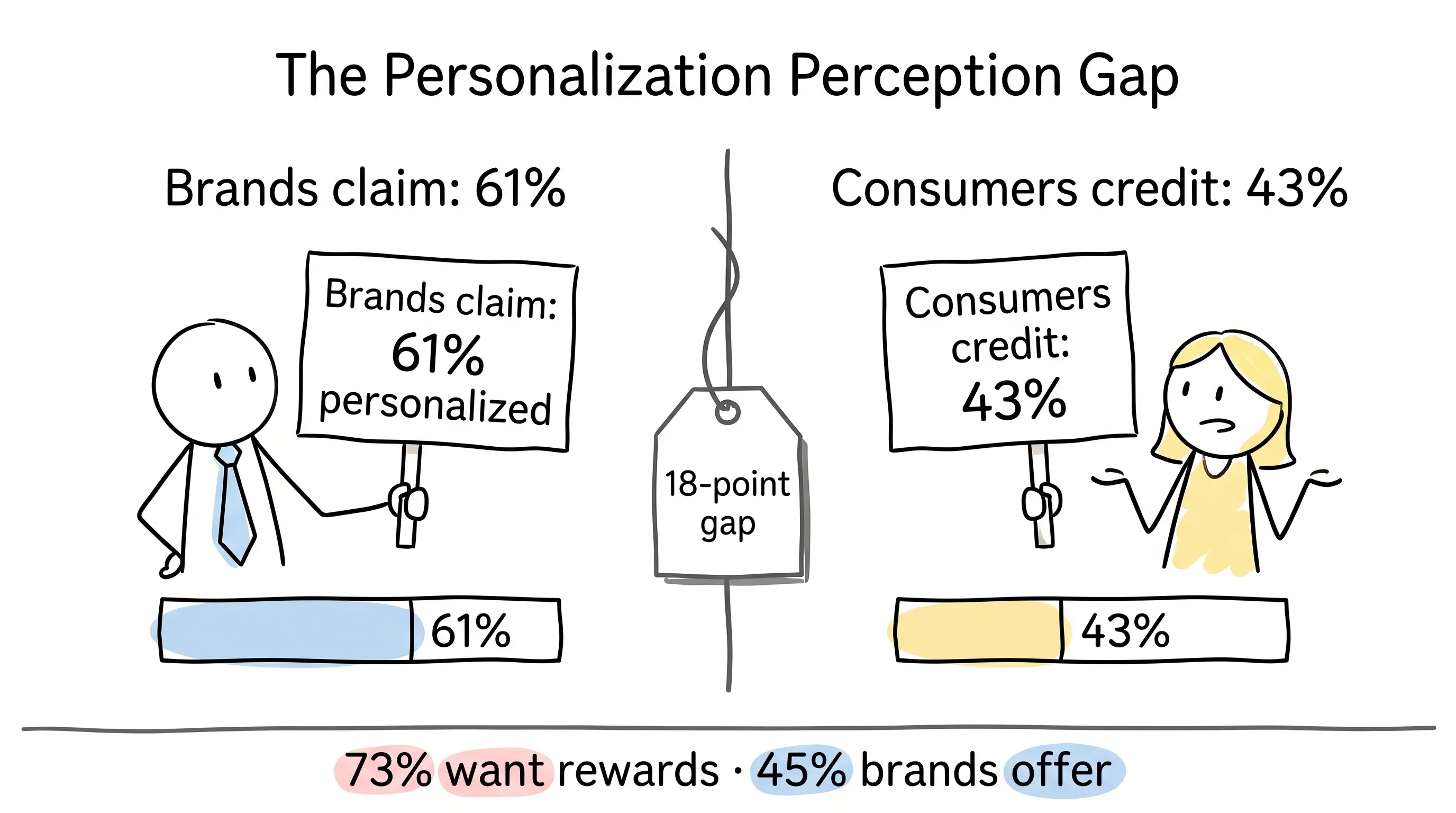
💬 The 18-point perception gap is a ready-made diagnostic entry point: before adding budget, count how many versions of emails and offers you shipped last month. If a team needs two weeks per personalized piece, the bottleneck is almost always the content production pipeline — not the volume of data.
🔗 Further reading: Read the full article
🏷 Policy & Funding
A Global AI Regulation Primer: The EU's Four Risk Tiers Stack on GDPR — Start Marketing Compliance with One Checklist
Law firm Kegler Brown's overview of global AI regulation hands marketing teams a concise base map. The EU AI Act took effect August 1, 2024, regulating along four risk tiers — unacceptable, high, limited, minimal; high-risk applications like biometrics and algorithmic decision-making must meet transparency and accountability requirements, and it applies on top of GDPR. China's framework ranks among the most comprehensive anywhere: PIPL plus algorithm-recommendation rules plus generative-AI rules, three layers stacked. India's DPDP Act is still moving through the process, with enforcement currently fragmented under the IT Act. For marketing scenarios, AI tools sit squarely on five risk categories by default: customer data privacy, cross-border data transfers, consent management, algorithmic bias, and cybersecurity. The six strategies offered skew institutional: stand up an AI use policy, run regular legal audits, train employees, establish an ethics board, conduct third-party vendor due diligence, and re-review contract clauses on data ownership and indemnification. Note it was published in February 2025 — EU AI Act implementation details have since been updated, so verify the latest developments before relying on it.
💬 Marketing teams don't need to queue behind legal: start with an inventory of AI tools in use, marking what data each touches and which countries it flows to. That's the first working paper of your compliance audit. For cross-border campaigns, verify data-localization requirements with extra care — even a single test ad can push data out of the country.
🔗 Further reading: Read the full article
A Risk Checklist for Generative-AI Marketing: The Costliest Traps Are Sameness and Unclear IP Ownership
Digital marketer Vineesh Rohini's 2026 landscape piece works well as a team training base text. Its keynote: generative AI has moved from the experimentation phase into the execution phase, in active use across the full chain of content, personalization, campaign optimization, and customer service. The opportunity side holds no surprises: content at scale, hyper-personalization (dynamic website content, adaptive ad creative, personalized email narratives), rapid A/B experimentation, conversational service, predictive insights. The risk side names five. Homogenization: everyone runs similar tools with no brand constraints, so content loses its distinctness. Hallucinations and misinformation — especially lethal in regulated industries. Data privacy and compliance. Over-automation grinding away strategic thinking. And the intellectual-property ownership of AI output, still a grey zone among brands, platforms, and tool vendors — check a tool's licensing terms before use. The advice is about sequence: set brand guidelines and human review mechanisms first, talk about scaling second, and use AI as an assistant, never a replacement.
💬 Homogenization is the most valuable warning in this item. Set one rule for the team: every AI first draft must pass through a brand rewrite guided by your own selling-point vocabulary. Put IP ownership in the contract — don't wait for the infringement notice to start reading tool license terms.
🔗 Further reading: Read the full article
An Agency-Side Footnote: Your Prompts Are Becoming Someone Else's Training Data
A reflection piece from agency Brandfluence, with viewpoints drawn from industry panels — middling density, but it carries a few reminders rarely voiced from the agency side. Marketers' current embrace of GenAI is driven by practical motives: easing burnout and shifting saved budget into creator content. Advertising has used machine learning for over a decade; GenAI moves content generation into a new phase, but that's no disruption. The article leans on a cooking metaphor — output quality depends on the quality of the input data; bad ingredients, bad dish. The most practical takeaway is prompt hygiene: prompts pasted into public AI tools, and any confidential information they carry, become part of the model's training datasets — never paste client data into them. On brand safety, vendors like Adobe, Google, and Shutterstock are lowering anxiety by pairing tools with indemnification.
💬 Applies to agencies and clients alike: add a prompt-hygiene clause to contracts — client data stays out of public tools — and make it explicit in team training. Ask about indemnification caps: enterprise-grade protection like Adobe's and a free tool's liability disclaimer are worlds apart.
🔗 Further reading: Read the full article
💡 Today's Synthesis
Lay today's 14 items side by side and most of them describe two faces of the same thing: adopting AI has gotten easier, while proving AI is worth it hasn't caught up. The headline: 51% of marketers can't track AI ROI; Gartner projects more than 40% of agentic projects won't survive to 2027; another survey finds only 27% of companies have pushed projects past pilot. Influencer marketing is systematically undercounted by last-click; Deloitte's personalization gap runs 18 points; MarTech flatly reports that GTM teams have already lost track of their own agents. The tool and interface side, meanwhile, marches forward in step — KNOREX opens its Ads API to agent calls, HubSpot rebuilds its platform around agents, GEO methodology and measurement get updated month after month, and someone has even drafted the global-regulation compliance worksheet for you. The gap sits entirely at the measurement-and-governance layer. Today's ranking pattern is telling: the closer an item sits to money and evidence, the higher it scores — the use-case list with measured ROI takes first place, the influencer-marketing measurement framework and the hands-on GEO pieces both make the top ten, while pure risk essays and index pages trail behind. That itself is the market voting: readers no longer want to hear how impressive AI is; they want to hear whether it actually made money. So this week, stop bookmarking tool lists and pick one thing to do: record a baseline number for one use case you're already running, inventory your AI tools and data flows, or push one usage from "feels effective" to a measured test with a holdout. The people who survive next year's budget conversations will be the ones who can produce the evidence.
Continue reading
Related articles

AI Marketing Daily · 2026-10-09
AI marketing daily for 2026-10-09 covering 11 items: brand measurement moving from survey panels to search, social, e-commerce, and AI prompt signals; GEO and share of model playbooks; safety guardrails for agentic ad buying; and tool roundups for ad platforms, cross-border tools, and social media uses.

AI Marketing Daily · 2026-10-08
AI Marketing Daily for 2026-10-08 curates 20 items across AI search visibility (GEO), advertising, platform selection, cross-border e-commerce, and ROI measurement. The headline argues that strategic marketing decisions should stay with humans while AI assists execution.

AI Marketing Daily · 2026-10-07
Today's throughline is answer engine optimization (AEO — getting your brand quoted in AI answer engines).