
AI Marketing Daily · 2026-09-27
91% of B2B teams use AI but only 41% can prove ROI — plus Kellton's hyper-personalization economics and Brunel's seven-step MARK-GEN framework for building your own generative marketing model.
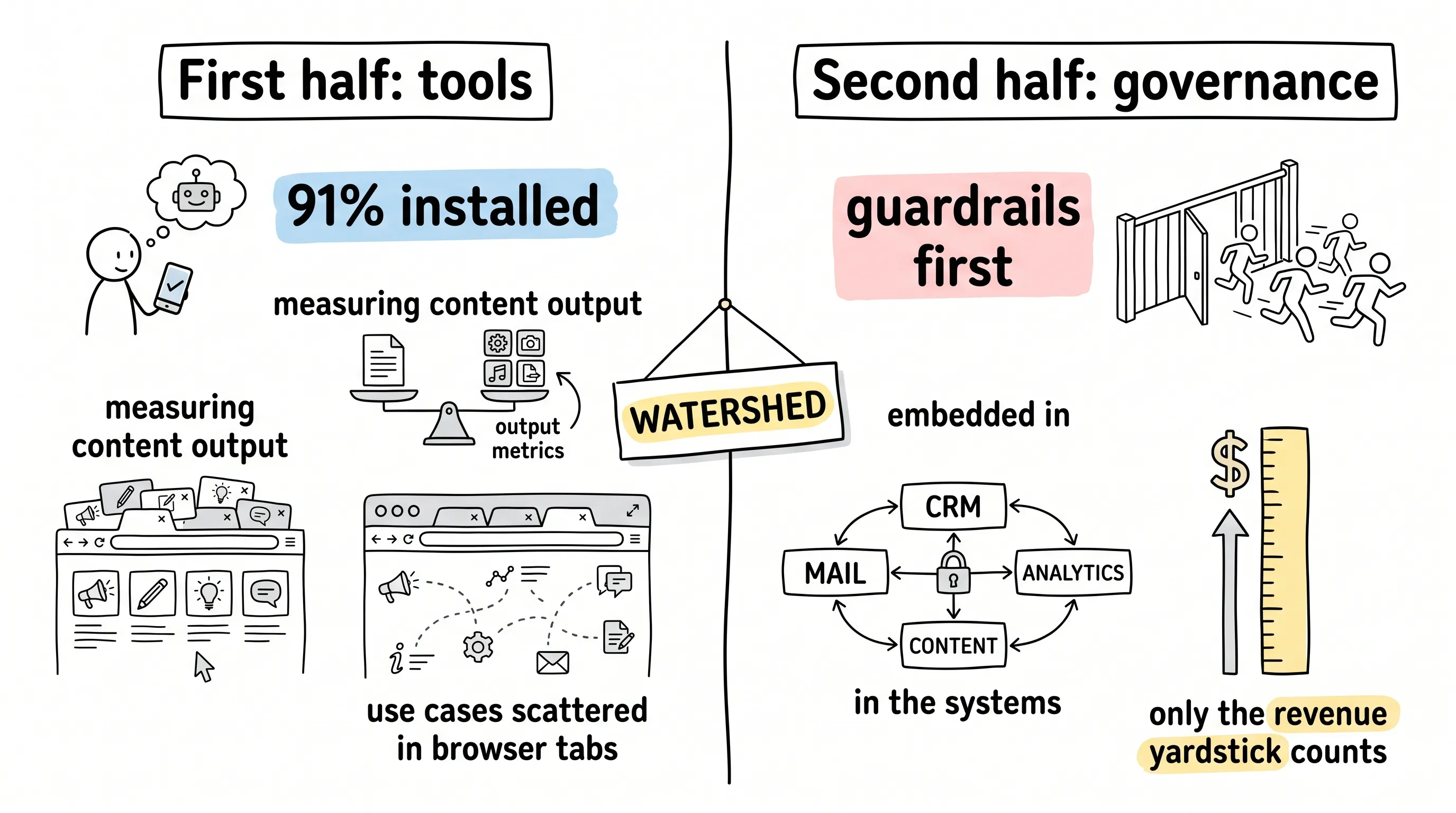
Today's three pieces all point the same way: adopting AI is no longer the open question — the open question has moved to the ledger. The headline MarTech analysis nails the gap: 91% of marketing teams have put AI in the toolbox, but only 41% can compute the return. Kellton lays out the returns and the architecture of hyper-personalization as an open ledger. Brunel's paper dissects the seven steps of building your own generative model, open-source code included. The headline piece also carries a warning: the share that can compute a return is shrinking, which means this is getting harder — an early audit costs less than a late one. Read together, the three draw a clean dividing line: the first half of the game was about who adopted tools first; the second half is about whose discipline and governance hold up.
🎯 Today's Headline
91% of B2B teams have put AI to work; only 41% can do the ROI math
This analysis by MarTech contributing writer Brianna Miller sets up a glaring contrast. Jasper's 2026 State of Marketing AI report shows that 91% of marketing teams have already added AI to the toolbox, yet only 41% of marketers dare claim they can produce evidence of returns from AI — down from a near-50% share a year earlier. The 2025 report from SmarterX and the Marketing AI Institute adds another line: 75% of companies have no formed AI roadmap for the next one to two years. Growth Syndicate's survey shows that more than 70% of B2B organizations plan to increase AI investment again this year. Expectations are rising while the evidence is falling, and the author's diagnosis is blunt: the problem isn't technology, it's maturity.
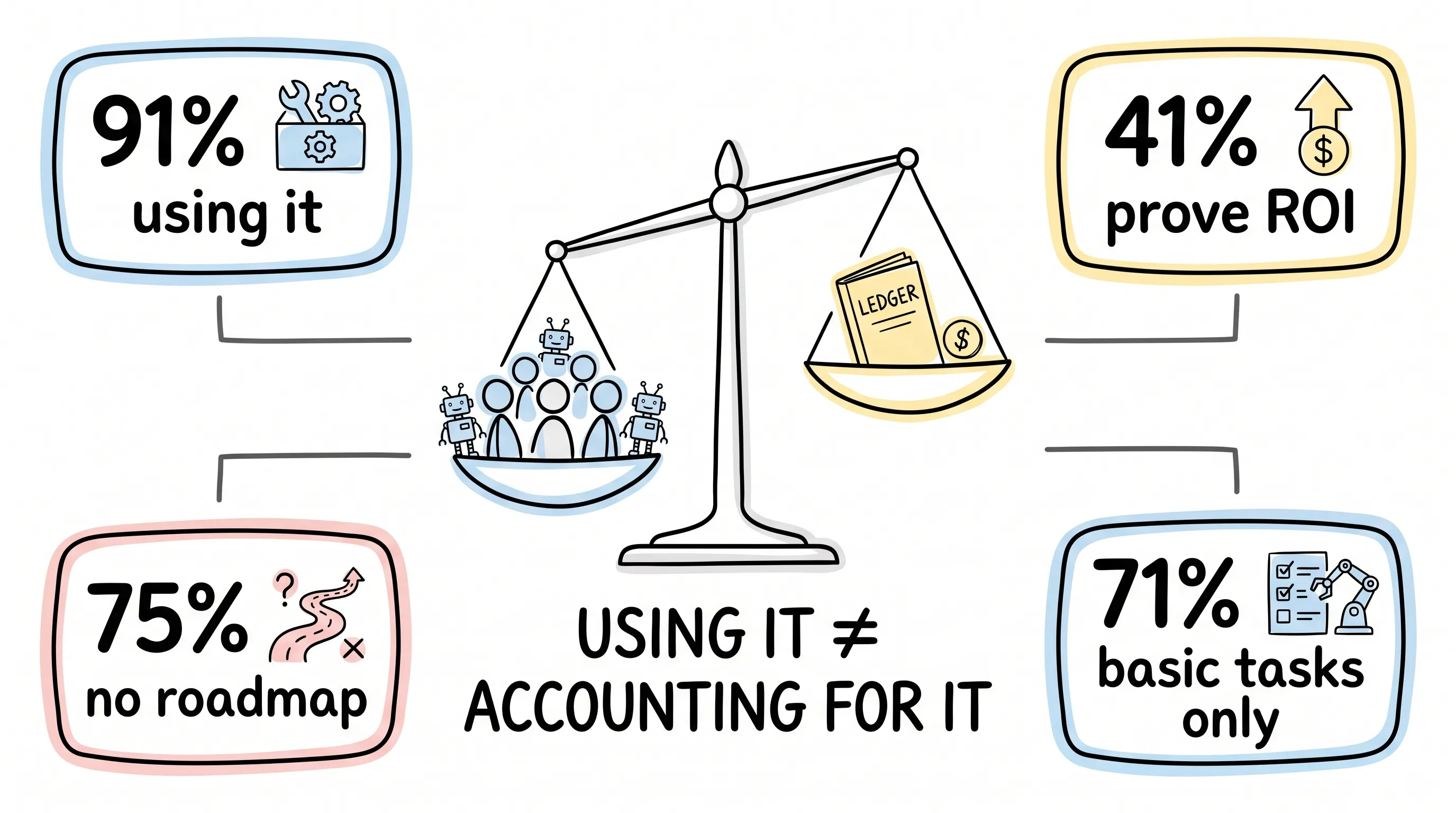
One cold number from the same research: only a quarter of companies have put an AI roadmap in writing, and fewer still have a basic usage policy to go with it. In organizations that lack a sense of direction, AI use cases naturally grow up loose and scattered.
Why does everyone get stuck in the same place? The author calls it the tactical trap. Move Forward Strategies' 2026 report shows 71% of B2B companies use AI to produce content and 56% believe AI's value stops at basic execution. Writing social posts, drafting email subject lines, tidying meeting notes — these jobs are safe, convenient, and the easiest way to manufacture an illusion of progress. Output multiplies several times over while the direction stays the same; if the original route produced no business value to begin with, AI has merely amplified the speed of your inefficiency. Only 6% of leadership teams dare hand high-risk decisions like market positioning to AI, 57% of respondents see strategic thinking as the longest single gap in AI's capabilities, and 88% of people want one more round of human polish on AI output before they dare use it.
Then why would people rather let AI write outlines than let it touch positioning? The article's explanation is trust asymmetry: AI is good at mining data, mixing languages, and surfacing themes; what it lacks is nuance. Why a deal truly fell through, what a buyer is worrying about at midnight — insights like these can only come from frontline scar tissue; the context hides value and risk, and for now humans still hold that edge. So don't let AI write your market-entry strategy solo. Treat it as an on-call sparring partner — it's excellent for war-gaming scenarios and surfacing blind spots — but keep your hands on the wheel.
High-maturity organizations are twice as likely as low-maturity ones to capture real returns; the gap is discipline, not whose tools are newest. The article lists five pieces of real work: aim AI at revenue bottlenecks; embed it into the platforms teams use every day, such as CRM, marketing automation, and attribution systems; write down who is accountable for output quality; put brand, legal, and privacy guardrails in place; and switch the KPI from content volume to business impact. A few places really do quantify returns today: scaled personalization, where 63% of enterprises report significant gains by using first-party behavioral data to tailor content dynamically by role and by industry; the content-reuse engine, which carves whitepapers, research reports, and webinars into posts and emails; and CRM data hygiene plus ABM intent signals, which turn "let's revisit next quarter" leads into real opportunities.
Another layer of evidence for scaled personalization comes from ON24's research: AI-driven customization lifts webinar attendance and content engagement together. B2B buyers are increasingly dismissive of generic blasts, and they respond fast to relevant content handed to them.
Governance is the most counterintuitive stroke in the piece. In Jasper's report, governance concerns rose 3.4× in a year, yet the author's observation runs the other way: the more clearly brand, legal, and privacy guardrails are drawn, the faster teams move, because the boundaries no longer need to be guessed at again and again, and the back-and-forth approvals are saved. The next stop is the agentic workflow, where AI executes slices of marketing operations on its own under rules — triggering nurture flows in real time, adjusting mid-flight messaging, even moving budget. That demands tighter system integration and clearer accountability; whoever reorders their decision processes first collects the dividend first.
For B2B marketers, this piece swaps out the measuring stick. The old way was reporting hours saved and pieces produced to management; now the board only asks about pipeline, deal velocity, and revenue. Reporting styles with content volume as the headline metric can retire. Roles shift accordingly: operations people should move into the systems, burying AI inside CRM and marketing automation instead of letting it float in browser tabs; strategy people hold the last human gate — AI drafts, humans decide.
For teams still testing the waters, the article's reminder is to audit your own path first, shore up the foundation, and only then talk about cross-team alignment.
The roadmap the article leaves for CMOs has four layers. First, aim AI investment at one or two revenue bottlenecks — say, opportunity progression or post-sale upsell — and don't adopt a new tool just to have adopted it. Second, write the operating model down: who approves AI output, who owns training, who catches it when something breaks; run approvals until they become a reflex. Third, treat integration as mandatory — AI must live inside the systems teams inhabit daily, and data must stop shuttling between tabs. Finally, complete AI literacy for everyone: know how to check for hallucinations, verify outputs, and protect data, and keep asking why it's being used this way. One move you can make this week: open your AI use-case inventory and ask, item by item, which revenue link each one serves — stop the ones that can't answer.
My read: the weight of this piece isn't the five-item checklist; it's that it rules the question "are we using AI yet?" obsolete. Competing on who adopted AI first in 2026 is like competing on who got electricity first. The watershed for the coming year is governance and integration: teams that raise their guardrails early get a much shorter trial-and-error stretch. Small and mid-sized teams don't need to copy enterprise playbooks — one step is enough: tag every AI use case with the revenue link it corresponds to, cut the ones that can't be tagged, and the budget saved is more tangible than any new tool.
🔗 Further reading: Read the full article
🏷 Marketing Tools
The economics of hyper-personalization: sales up 20% on average, customer acquisition costs cut by up to half
First, the concept. Traditional personalization segments and tags — lumping mid-market technology buyers into one pile and sending them all the same copy. Hyper-personalization compresses the analytical unit down to a single person, using real-time data to assemble a dynamically changing experience for each individual, while still covering audiences at the scale of millions of users. The "hyper" in the name lives exactly in that contradictory pairing: experiences tailored per person, delivered at blast-to-everyone speed.
This enterprise-grade longread from Kellton pulls hyper-personalization off the slogan and back onto the ledger. The numbers it cites are remarkably complete: BCG calculates that companies using AI for personalization see average sales lift of about 20%, with leading brands taking 40% more revenue than rivals running static playbooks; McKinsey's accounting is a 10% to 30% gain in marketing efficiency, with customer acquisition costs falling by up to half once high-value content and exclusive offers are concentrated on high-response segments; Gartner's figures are a 30% lift in conversion rates and a 28% drop in churn; Accenture's 2025 research delivers the long-term conclusion — brands that genuinely achieve hyper-personalization see customer lifetime value 40% higher. One background number undergirds it all: in Salesforce's survey, 80% of B2B buyers rate the experience a vendor provides as equal in weight to the product itself. Buyer patience is thinning, and generic blasts are turning into a liability on the books.
The arithmetic behind the numbers isn't mysterious. The money personalization saves comes from two places: first, moving budget away from low-response segments so less of it is wasted; second, the right content converts the same traffic into a few more deals. And once experience becomes part of the product's strength, buyers read a vendor's digital performance as a signal of whether the company can be trusted — a layer that's very hard to buy back with discounts.
The one-to-one slogan has been shouted for years — why does it only now have teeth? The article's answer: the data infrastructure finally caught up. The early years were stuck on data that was scattered and slow, with tags maintained by hand and experiences coming apart at the seams. Once the customer data platform (CDP) pulled first-party data together in real time, predictive models and generative content finally had real-time raw material, and personalization upgraded from a first name in an email to an entire website that moves with the visitor.
The article's prescribed approach is a three-layer architecture. The bottom layer is an enterprise-grade CDP plus multi-domain master data management, gathering the signals scattered across ERP, standalone CRMs, regional customer-service records, and web analytics into one place and stitching them into a continuously updated unified customer profile — the article calls it the golden customer profile, with first-party identity resolution pressing the latency down. The master-data half is often overlooked: without it matching one customer's multiple identities together, however fast the profile assembles, it's still several people who don't reconcile. The middle is the intelligence layer: predictive AI feeds on historical purchases, contact timing, and contextual trends to compute churn probability, purchase likelihood, and the next best action in real time; generative and Agentic AI serve as the content engine, no longer fetching ready-made assets out of a library but writing copy and generating visuals on the spot for the user's current intent. The top layer pairs a headless CMS with high-speed APIs: the moment a customer triggers a touchpoint, modular content blocks are injected into web, app, physical terminals, or connected procurement networks at sub-second speed. The article names the top cause of death: data fragmentation — when signals are locked in each system's warehouse, however flashy the front-end personalization, it's just idling.
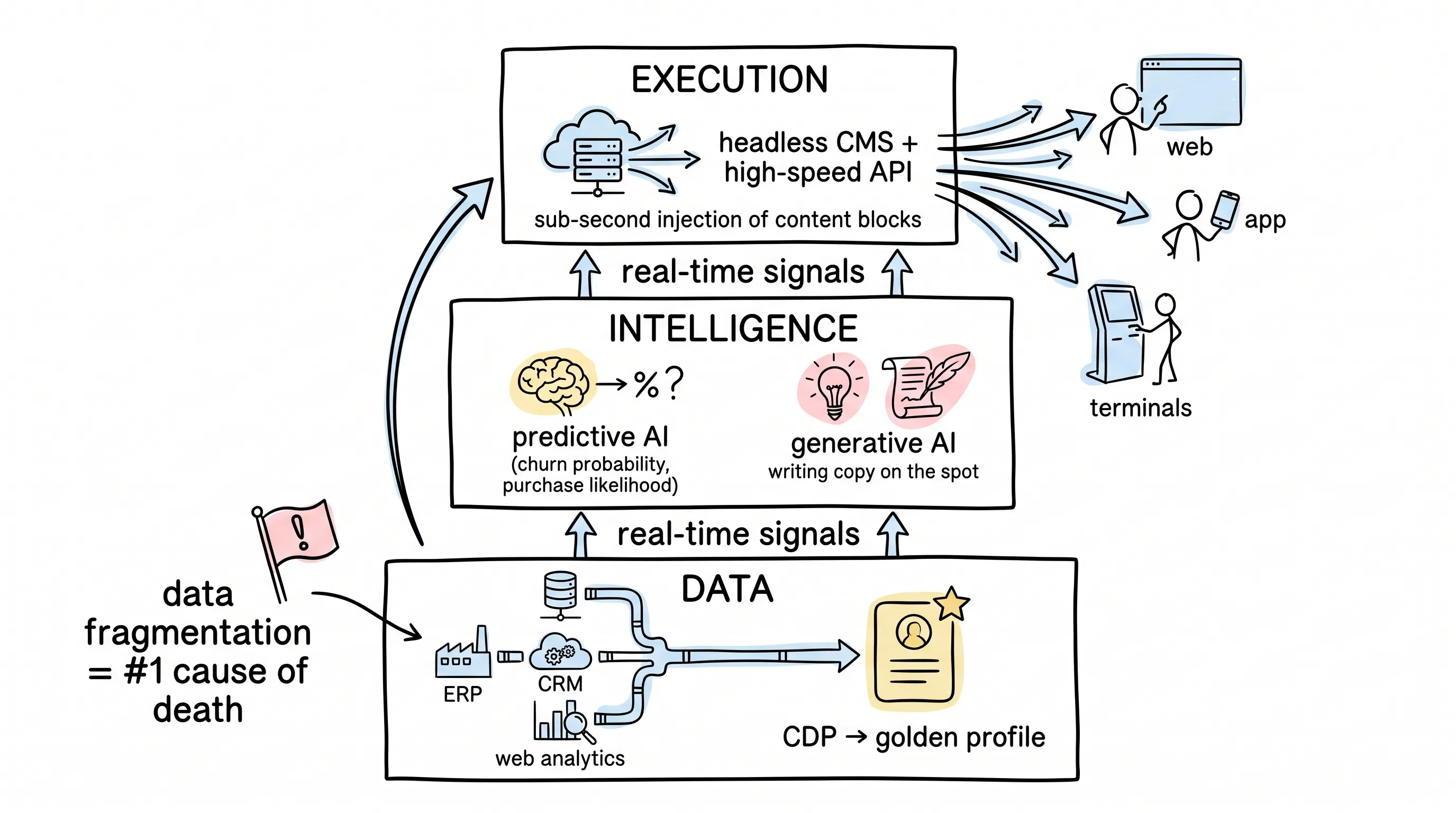
The article calls out latency specifically. For personalization to genuinely work, the judgment must complete within a sub-second; users won't wait for the backend to compute on the spot, and customization that's half a beat late is no different from no customization at all. That's why the top layer ships with a high-speed API gateway: computed means shipped, and the client side only renders.
The B2B section carries the most operational weight. The analytical unit has to shift from the individual user to the account-level buying committee: enterprise purchase decisions are spread across procurement, finance, operations, and information security, and the cycle stretches to months. The engine aggregates behavior from multiple corporate IPs under the same account: an engineer downloads API technical documentation, a financial analyst at the same company browses the pricing page, and AI strings the two signals into a single cross-departmental research loop. On the next visit to the website, hand the finance person the compliance materials and an ROI evaluation matrix, and hand the engineering team the technical docs and a sandbox entrance. B2C personalization plays emotional hooks and high-frequency conversion; B2B personalization plays delivering each committee member's concerns into their hands, while also juggling contract parameters, segmented pricing, and industry compliance constraints — and automation touchpoints have to track the customer's SLA.
The article splits the rollout rhythm into three stages. Phase one is data unification and identity resolution: inventory which systems the customer records are scattered across, deploy a CDP to open real-time pipelines across web, mobile, CRM, and support tickets, and set the identity-merge rules. Phase two brings micro-segmentation and predictive analytics: models feed on real-time intent signals and historical purchases to predict customer lifetime value, score purchase intent, and flag churn risk early. Phase three is the autonomous omnichannel one-to-one: connect an Agentic engine to a composable headless CMS so the system dynamically assembles layouts, writes copy, and adjusts content by real-time intent, then self-corrects through a continuous algorithmic A/B loop. Skipping the first two stages and buying tools outright is the common detour this article implies.
One more difference is easily overlooked: B2C personalization watches the emotion of the moment and the instant close, while B2B runs on long account cycles and deep decision chains — the engine has to connect not only to marketing touchpoints but also to system-level configurations like contract terms and regional pricing, and its automated touchpoints must keep faith with the customer's service-level agreement.
The article supplies a four-piece kit for the privacy layer. Zero-trust data management: full encryption in transit and at rest, with data visibility controlled by role. Consent management embedded directly at the data platform layer: the moment a user changes a privacy preference, tracking updates in sync across every channel. Models trained on aggregated, anonymized, or synthetic data, keeping personal information out of the training set. And an auditable opening left in algorithmic decisions — you can say why a given user was shown a given piece of content — to fence off algorithmic bias. The contradiction of personalization so overdone it annoys is what the article calls the personalization paradox, and the solution hides inside these designs. Global deployments also have to track GDPR, CCPA, and regional AI governance rules; fines and brand damage are paid in real money.
The barrier to entry for this route also needs saying plainly. The article addresses multinational enterprises, performing surgery at the level of ERP, CDP, and content systems — the budget and the organizational change are both heavy investments. The three-phase roadmap is, at bottom, advice to bet in batches: verify the data layer is clean first, then talk about the intelligence layer and the execution layer; going all-in on the full stack in one breath carries a substantial failure rate.
💬 A cold shower first: Kellton is an IT services provider, and the piece comes with built-in lead-generation intent — treat that string of percentages as direction, not as contract numbers. On action, first audit whether your own data actually flows: the top cause of death is signals locked in system warehouses, at which point personalization just idles. Run the sequence in reverse: inventory where your customer data is scattered and whether identities can be matched before you talk about buying a CDP or building an in-house data middle layer — get the order wrong and the budget burns first. Log one more self-check: count how many browser tabs an AI insight passes through between being generated and becoming an outreach action; more than two, and you're accumulating silos. A small B2B step for this week: make same-account multi-role visits a monitored metric, so sales can watch a buying committee move with their own eyes — this step costs almost nothing.
🔗 Further reading: Read the full article
A road sign for building your own marketing generative model: MARK-GEN in seven steps, with two fashion e-commerce case studies
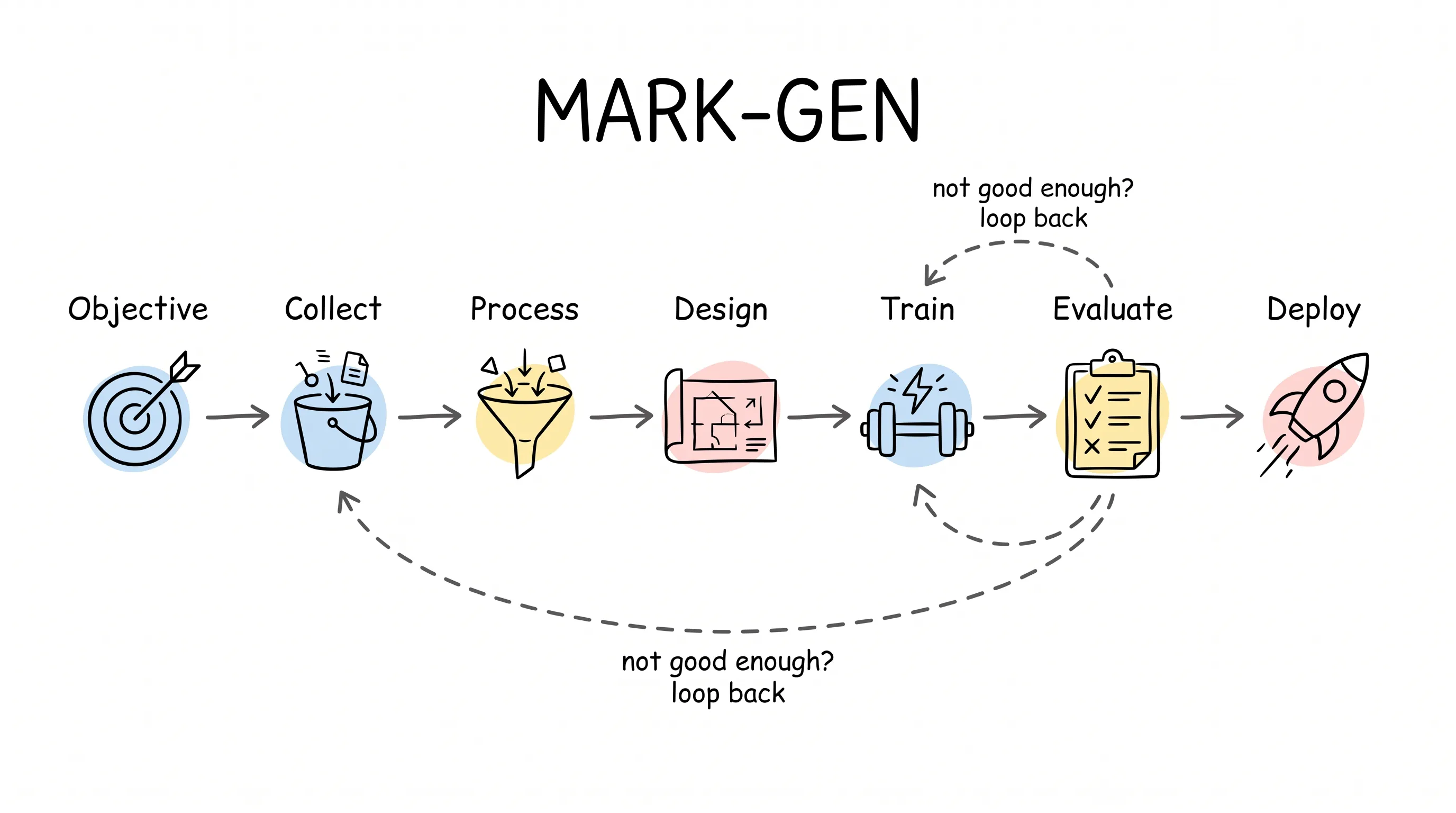
This paper from a Brunel University London team, published in the journal Computers, answers a question that tool-first thinking has buried: without relying on off-the-shelf APIs and subscription tools, how does a company build a generative model for marketing from zero? The framework is named MARK-GEN, and it runs in seven steps: define the marketing objective, collect data, process data, design the model, train, evaluate, deploy. The process is iterative — fall short at any step and you loop back: if the output isn't good enough, return to the training stage; if data diversity is lacking, return to collection. The model menu lists VAEs (variational autoencoders), GANs, Transformers, and diffusion models, each with its temperament described in the paper: a GAN produces convincing images through a generator and a discriminator sparring against each other; a diffusion model starts from a blob of noise and refines its way back step by step; a Transformer uses self-attention to judge which parts of the input matter most. To get started, you can clone an existing repository from GitHub or Hugging Face and modify it, beginning with libraries like PyTorch and TensorFlow.
Both case studies land in fashion e-commerce. The first is the virtual try-on SVTON, trained on the VITON dataset of 16,253 image pairs, with training and testing split 14,221 to 2,032, images uniformly sized 256 by 192. The model has three modules — segmentation, warping, and fusion: the segmentation module outlines the body regions that match the target garment, the warping module applies geometric transforms and then fills in natural folds, and the fusion module composites the person and the garment into a single image. The output can become advertising banners on third-party sites or an in-house fitting room on your own site, with the bottom of the banner offering two alternative garments to switch between — customers engage the moment they try it on. The paper's list of benefits includes higher conversion rates, fewer returns, and the reduced carbon footprint that follows. One practical piece of intelligence along the way: the original VITON dataset has been taken offline over copyright, and the paper names the similarly structured, higher-resolution VITON-HD as the substitute. The second case is image-to-video FashionFlow, which uses a diffusion model to extend a single static model photo into a short multi-angle video — 500 training videos and 100 test videos, each about 350 frames, at 512 by 400 resolution. At generation time the source image anchors the first frame, and cross-attention keeps the following frames faithful to it; customers see a coherent multi-angle presentation and hesitate a little less before ordering. The paper admits its face restoration isn't good enough yet — a lesson queued up for the next round. The code, model weights, and dataset documentation for both projects are open-sourced on GitHub and reproducible.
For choosing among the four model families, the paper maps each one's range of fit. A VAE compresses input into a low-dimensional latent space and samples back out of it, suited to learning compact representations of data; a GAN trains a generator against a discriminator, with output growing more convincing as the sparring continues; a Transformer weighs the parts of the input through self-attention; a diffusion model walks forward and backward — first progressively adding noise to shatter the image, then learning to denoise it back step by step. SVTON's skeleton is a U-Net — encoder, decoder, and skip connections — with a GAN embedded in the warping and fusion modules to synthesize high-quality images. If you truly build it yourself, the hyperparameter gate is unavoidable: for convolutional networks it's the number and size of convolution kernels, stride, padding, and pooling; for recurrent networks it's unit count, whether to use LSTM or GRU, sequence length, and dropout; for a Transformer you set the number of attention heads and the hidden-layer dimensions — the paper lists the checklists in full.
The first step looks like a slogan, but the paper treats it as tone-setting: what do you want the model to produce, and what benefit does it bring the customer? Define the objective vaguely and the remaining six steps all need rework. The data stage is equally make-or-break: the material must resemble the real scenario, or the model will show its cracks the moment it goes live; the processing stage also has to sort out structured versus unstructured data, and supervised learning needs reference answers properly paired — input and standard output appearing together — so the later training has something to measure against.
The training step is written for non-specialists too. Split the dataset into training and test shares of 70/30 or 80/20, run the model through the training set round after round of epochs, with parameters gradually calibrated under optimizers like Adam or SGD — set the learning rate too high and it overshoots, too low and it grinds without converging. More epochs can mean overfitting: the model memorizes the training data but fails on data it has never seen, so the test-set evaluation round must be preserved, checking the realism of generations against unseen combinations of people and clothes. And even after the test passes, don't rush to launch — the paper keeps one subjective checkpoint: could the generated images and videos go directly in front of customers? No machine can pass that gate for you.
The paper also lists adjacent usable models in passing: makeup transfer that moves a makeup look from a reference image onto a portrait, pose transfer that changes the stance to show different angles, and retrieval-style models that find lookalikes and outfit recommendations from casual snapshots. Generative models make the content; the non-generative ones field the demand — only the two assembled together make a complete digital storefront.
For readers without the patience for the full text, the background section holds a few lines worth noting on their own. Personalization faces a two-way bind: moderate personalization makes people willing to click, while over-intrusive or privacy-touching personalization drops clicks and conversions instead — and 72% of users cut ties with a brand outright once they suspect their privacy has been touched. The mechanics per channel are stated plainly: 60% to 80% of search users click organic results, paid placements get only 10% to 40% of clicks; putting the recipient's name in an email is enough to leave an impression; B2B social posts carry a corporate brand name and earn more likes than B2C. These older findings, set in today's context, happen to make a solid delivery chassis for self-generated content.
The paper lays the costs out wide. Training deep models routinely takes weeks or even months, and businesses whose marketing objectives shift fast can't keep pace with that rhythm; GPU time or rented compute is a continuing expense; data collection and processing can eat 80% to 90% of the whole development cycle. The privacy boundaries are written bluntly: training on customer data requires consent first, track GDPR and the EU AI Act closely, delete user data at the appropriate moments — once the page closes, cleanup should follow, and customer-uploaded data and generated content must not sit in your data stores overnight; if you want to save effort you can use public datasets licensed for commercial use, but you accept the workload of supplementing and adapting the data to your own marketing objective. The evaluation stage also gets a handhold: compare pre- and post-deployment sales figures, new-customer counts, website traffic, click-through rates, and customer ratings — if they rose, the model is working; if not, follow the framework back to the training or data stage to troubleshoot.
The paper's positioning is a readable map for non-technical management: MARK-GEN isn't limited to fashion — retail, real estate, travel, and hospitality all fit. It has a line of comfort for small teams too: what generative models save is headcount — no need to hire a photographer, retoucher, and video editor for every marketing asset — so even small merchants can ramp up their content capacity, with the cost swapped for a compute bill. Overall it leans conceptual and academic; as a daily operations manual it doesn't qualify, but every step is solid enough to take to your own technical team as a checklist to compare against.
💬 This seven-step framework suits brands with an in-house technical bench and stable source material; small and mid-sized teams copying it directly are likely to sink into the data-engineering swamp. The pragmatic use: treat the seven steps as an RFI checklist — ask tool vendors and outsourcers which steps their solution covers and where it gets stuck, and the quotes instantly become comparable, your negotiating position instantly different. If you run a visual business, look first at the virtual try-on line — in fashion and home-goods categories, every point of return rate shaved is net profit. If you want to move faster, start directly with their open-source SVTON for a trial run, and only circle back to build the technical bench if it doesn't run.
🔗 Further reading: Read the full article
💡 Today's Overview
Read the three together and today has exactly one through-line: the threshold for AI entering marketing is gone, and the threshold has moved to operations and governance. The headline report supplies the watershed's marker — 91% versus 41%: using it and accounting for it are two different things. Kellton's three-layer architecture and Brunel's seven-step framework represent, respectively, the operating manuals for the enterprise procurement route and the build-it-yourself route; on the surface they discuss technology, underneath they discuss the same thing: without clean data, clear accountability, and compliance boundaries, AI in marketing is just an expensive drafting machine.
One more layer worth recording. All three pieces, without coordination, put governance in the attacking position: the MarTech piece says the clearer the guardrails, the bolder the teams; the flip side of governance concerns rising 3.4× is that guardrails speed things up; Kellton dissolves the personalization paradox with privacy design; Brunel treats compliance as a precondition of the build route. Governance used to be the brake; the current evidence points to the guardrails themselves as the accelerator.
Break it down by reader size. Big companies with data teams: pick one layer of Kellton's three-layer architecture and start there — most likely the data layer, because identity resolution done solidly is what the upper layers stand on. Small and mid-sized teams: don't touch the heavy build-your-own-model route; do the headline's use-case inventory, then use Brunel's seven steps as a bargaining lever, and that's enough. And don't forget the headline's forecast — the next step is from tools to agentic workflows, with AI moving from advising you to executing for you; the gaps in governance and accountability will only glare harder, and the rules you set today become ready-made guardrails then. All three pieces are really dealing the same hole card: keep what you can do the math on, and suspect everything you can't. This week, sweep through your AI use-case inventory once — for each item, tag the revenue link it serves and the data source it feeds on; stop the ones you can't tag, and assign an owner to the ones you can. The teams still holding evidence of returns this time next year will most likely be the ones who did this today.
Continue reading
Related articles

AI Marketing Daily · 2026-10-09
AI marketing daily for 2026-10-09 covering 11 items: brand measurement moving from survey panels to search, social, e-commerce, and AI prompt signals; GEO and share of model playbooks; safety guardrails for agentic ad buying; and tool roundups for ad platforms, cross-border tools, and social media uses.

AI Marketing Daily · 2026-10-08
AI Marketing Daily for 2026-10-08 curates 20 items across AI search visibility (GEO), advertising, platform selection, cross-border e-commerce, and ROI measurement. The headline argues that strategic marketing decisions should stay with humans while AI assists execution.

AI Marketing Daily · 2026-10-07
Today's throughline is answer engine optimization (AEO — getting your brand quoted in AI answer engines).