
AI Marketing Daily · 2026-09-26
AI Marketing Daily for 2026-09-26 rounds up twenty items, led by surveys indicating AI agent adoption is outpacing governance and audit practices in GTM teams. The digest also covers GEO playbooks, AI visibility metrics, ChatGPT ads in Europe, and 2026 industry predictions.
Six of today's twenty items tell the same story: adoption is stalling on governance and measurement, not on model capability. LeanData's survey finds 93% of go-to-market (GTM) teams have already deployed agents, and nearly a third can't say how many agents are touching customer records; Jasper's survey finds governance blockers up 3.4x in a year. Generation is no longer the bottleneck — governing what gets generated is. The 19 items below unfold across five categories, each with a practitioner's take.
🎯 Today's Headline
GTM teams are losing track of their AI agents
MarTech covered LeanData's 2026 GTM AI Readiness Report, which surveyed 157 B2B practitioners in May this year. The sample skews toward operations: RevOps accounts for 36%, MOps for 13%. The numbers sting. 93% of teams have deployed at least one AI agent, and 79% are piloting their first use cases or scaling them out — yet only 8% consider their AI operations fully optimized. Nearly a third of respondents cannot answer how many agents are performing actions on customer records, and 30% have discovered actions with no audit trail. In one sentence: marketing and revenue-operations teams are automating decisions faster than they can track them.
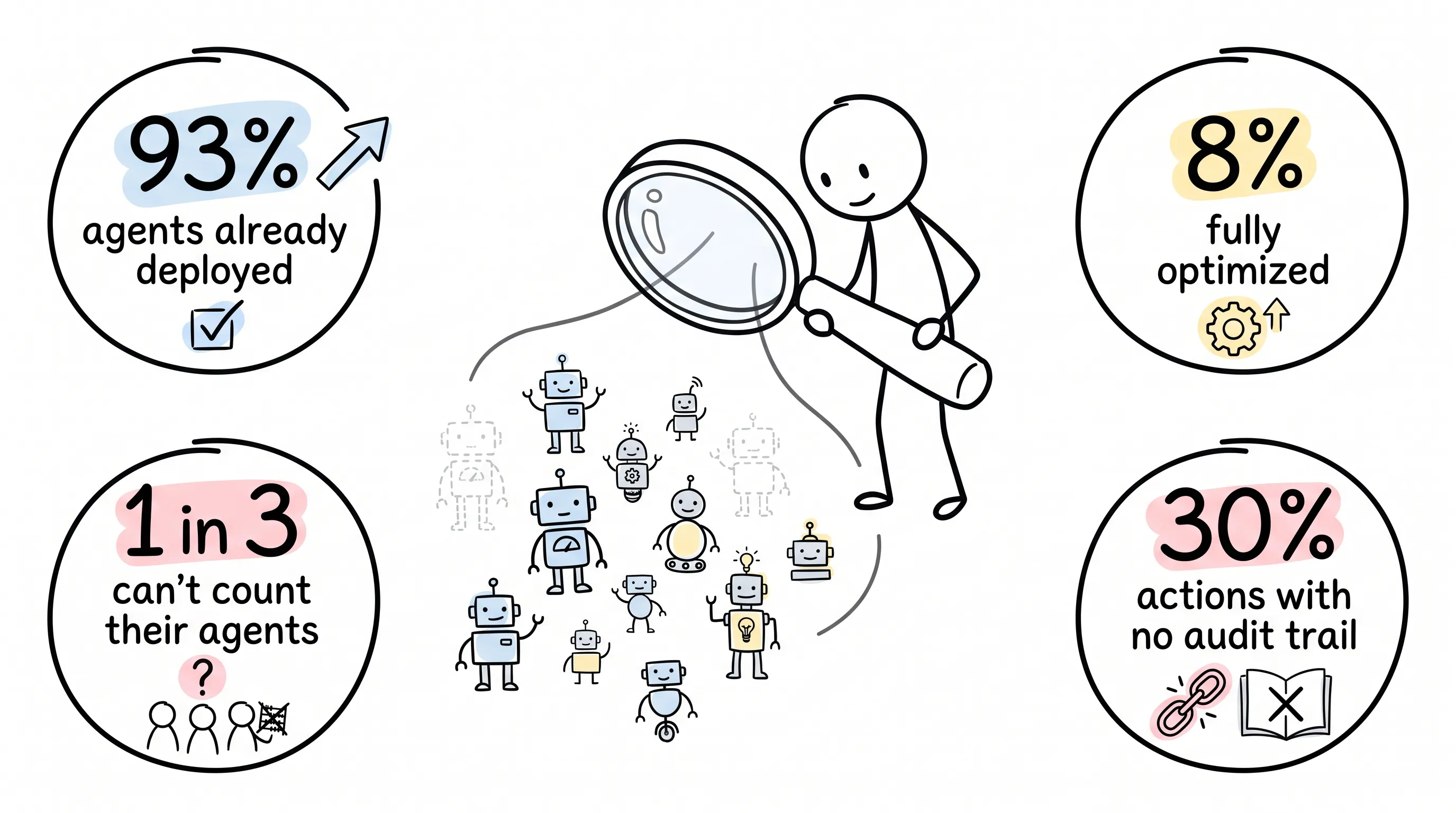
Why does this matter? The report's most expensive numbers all point to old problems on a new amplifier. Data quality tops the list of AI transformation challenges at 55%, and 70% admit that data hygiene is already degrading GTM execution. The reason isn't hard to work out: agents execute automatically, so bad data no longer just makes reports ugly — it turns directly into misdialed calls and misdirected emails. 27% of teams have already caught multiple tools or agents reaching the same lead, and 17% have seen a marketing automation sequence keep messaging a customer while sales was mid-deal. The three biggest reasons AI projects stall are all old debts: bad data at 45%, undocumented processes at 37%, departmental silos at 32%. In other words, agents didn't invent new problems — they're calling in the debt MOps has owed for years, principal and interest, ahead of schedule.
Where the agents come from is worth a look too. 69% of teams use the AI features embedded in their GTM tools — the ones Gong, Outreach, and HubSpot ship with. 62% build their own applications on LLM APIs. 46% use agent platforms like Agentforce, Copilot, and Gemini Enterprise. The most common deployment count is three or four — and the problem lies precisely with the third who can't answer. The agents you can't see are the most expensive ones. The report's lead example is vivid: one system is enriching the data, another is scoring it, a third drops the lead into an automated sequence, and a fourth assigns the person to sales. All four systems run exactly as designed, yet the customer experience still falls apart — because their data, timing, and rules all differ.
For marketers, this means the job itself is changing. The part of your work that configures platforms, agents are taking over; the part that sets the rules, agents are counting on you for. RevOps teams have it even tighter: 66% of GTM operations teams report more work than they can finish, or barely keeping up with daily operations with nothing left for strategic projects; only 8% say they're adequately staffed. Ownership of governance is still up in the air: 42% of organizations hand GTM AI strategy to a cross-functional committee, 19% simply have no one responsible, and only 18% assign it to RevOps. Asked what they want coordination technology to provide, the top request — at 31% — was full audit trails; 21% chose holding agents to the same rules as humans. A committee can round up decision-makers, but the operating rules still need someone maintaining them every day — and most companies haven't created that role yet.
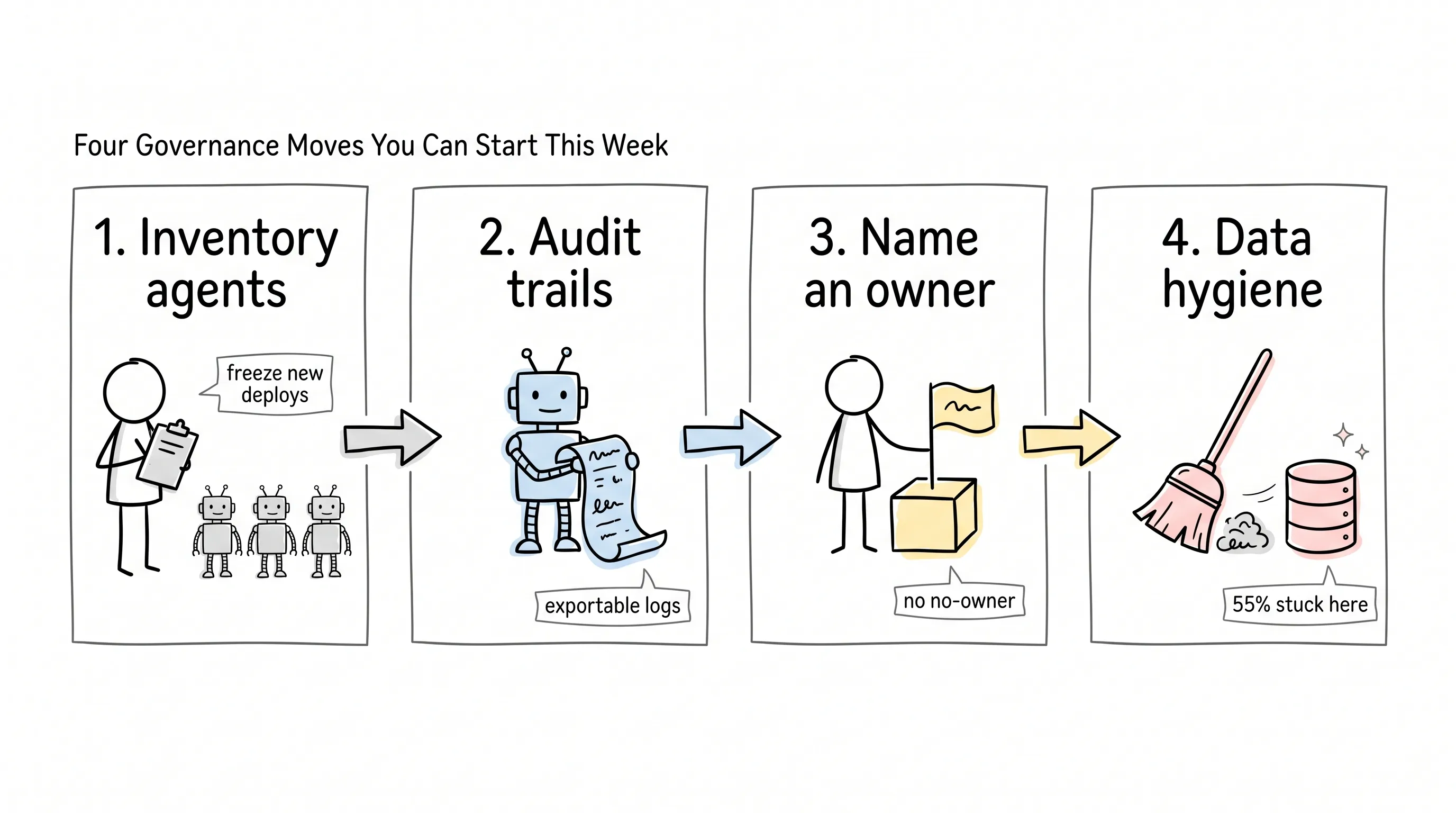
How to use this. Four steps you can start this week. First, inventory before you add: list every agent that can modify a customer or lead record, spell out what data each one uses and what actions it's allowed to take, and freeze new deployments until that table exists. Second, make audit trails a hard selection criterion — 31% of respondents in the report voted for exactly this — and when following up, ask vendors item by item whether logs can be exported and traced back to individual records. Third, find a specific person to own governance: a cross-functional committee setting direction is fine, but the operating rules need someone maintaining them daily — don't let the 19% no-owner scenario become reality at your company. Fourth, reschedule the data hygiene project: 55% of respondents are stuck on data quality, and in the agent era that investment buys more leverage than new tools do.
My verdict: this report's value lies in replacing a war of opinions with numbers. Agent governance isn't a question of whether to do it — it's already happening, just with nobody claiming ownership. I paid special attention to the 8% figure; a fully-optimized rate that low is close to noise, meaning no one has actually run the full loop end to end. Everyone is flying half-blind. For marketing teams, buy certainty with the smallest possible move: spend half a day listing your existing agents in a table and pinning it in the team channel. That one table alone can head off the next incident of customers being reached twice.
🔗 Further reading: Read the full article
🏷 Strategy & Methods
Martech Architecture Thinking Works for Careers Too
Writing in MarTech, Ana Mourão borrows Taleb's framework to sort careers into three tiers: depending on a single platform for your livelihood is fragile; having backups that restore the status quo is resilient; each change making your capabilities stronger is antifragile. She offers a replaceability test: ask yourself whether the skills in your hands could migrate to another platform within a quarter — if you can't answer, you're working for the vendor. A second class of skills doesn't fear platform swaps: the kind that describe the system itself. How customer data is modeled, how decision logic is written so it survives a platform change, how consent flows through the pipeline. The companion advice: accumulate owned reach — things like cross-department relationships and documentation assets — to replace rented exposure; treat constraints like AI mandates as positive friction; the people who volunteer for reviews grow the new capabilities first. Gartner supplies a fitting footnote: organizations with composable architectures ship new features up to 80% faster.
💬 Two things to do this week: split your job duties into two columns — transferable versus vendor-locked — and invest only in the transferable column; and if your company lacks documentation of system connections and data flows, volunteer to write it. This costs zero budget, and the payoff is that every time the parts get swapped, you're at the table.
🔗 Further reading: Read the full article
Don't Treat an LLM Like a Person — Treat It Like a Statistical Engine
In MarTech, Steve Bevilacqua corrects a common habit: use an LLM as a thinking partner and what you often get is vague prompts, hallucinations, and unreliable output. He walks through two famous failure scenes. The model can't count how many e's are in "seventeen," because it sees whole tokens and never touches the letter layer. Correct it, and it argues back — because what it's actually doing is taking the context, errors included, and appending a high-probability continuation; admitting a mistake would break that pattern. Three rules for workflows: don't stuff multi-step reasoning into a single prompt — split it into single steps and validate each one; impose tight constraints — feed in templates, word limits, reference documents; and you can't argue a hallucination into submitting — rewrite the prompt and start a fresh round.
💬 Dig out the AI step that runs worst on your team and check it against these three rules. Most failures come from feeding the model one whole paragraph where a single step was supposed to go. Re-pipeline it, the rework rate drops immediately, and the retrofit costs half a day.
🔗 Further reading: Read the full article
GEO in Ten Practical Steps: From Crawler Rules to Citable Writing
A sponsored Search Engine Journal column (Peec AI) breaks GEO (generative engine optimization) into ten steps. First, split the battlefield in two: influencing base models is nearly hopeless — they're fixed once trained; the winnable fight is influencing RAG (retrieval-augmented generation) retrieval. The hardest-hitting rules: check your CDN's default rules and don't block the OpenAI and Anthropic crawlers; traditional rankings remain the foundation — Google feeds Gemini and AI Overviews, Bing feeds ChatGPT, Brave feeds Claude, Baidu feeds DeepSeek; watch query fanout, where the model appends words like "forums" and a year and searches another round; keep brand descriptions consistent across the whole web — one practitioner changed only that description and saw the effect in ChatGPT and AI Overviews within days; minimize JavaScript rendering, since most LLM crawlers don't execute it; moderated UGC like Reddit and Wikipedia remain the primary sources; write for citability — declarative language plus schema, which Bing's Fabrice Canel confirmed helps; and run plenty of experiments before the playbook converges.
💬 The first move costs nothing: have IT export the CDN's bot-block list and check it line by line for LLM crawlers. For many brands, clearing this one item is effectively unlocking a brand-new channel for free — doable this week.
🔗 Further reading: Read the full article
Five Brand GEO Case Studies, Five Common Threads
ExplainGEO broke down five brands' GEO playbooks. Ramp, in the red-ocean fintech space, leaned on expert education content plus data reports to become the frequently cited brand in expense-management AI answers. HubSpot amplified its existing authority with high-frequency refreshes of old content plus structured clusters. NerdWallet won trust on high-stakes topics through expert bylines and transparent methodology. Zapier bet on a solution-oriented tutorial library; Canva on design education plus digital PR to broaden entity recognition. Boil it down and there are five common threads: topical authority, original research, expert bylines, digital PR, and structured information — measured through citation frequency and visibility scores.
💬 Don't run all five threads; pick one and go deep. For small and mid-size teams, the best-value path is original data: a small industry report carrying your own numbers is GEO material and PR material at once — one cost, two uses, deliverable within a month.
🔗 Further reading: Read the full article
Three Risks of Generative AI Content, Each with Hard Receipts
The Brandsmen warn of three risks of over-relying on generative AI. First, homogenization: models writing about common topics produce lookalike openings, lists, and recommendations, leaving users no reason to remember you. Second, policy risk: Google's official line is that AI content itself isn't a violation — what violates is pages mass-generated without adding value for users, officially termed scaled content abuse. Third, factual errors: AI confidently gets product specs, data citations, and compliance claims wrong, and regulators have already issued fines over unsupported AI claims. The author's advice: five pieces built on real experience and original research beat twenty generic AI articles.
💬 Run an inventory audit of your published AI pages, score each one against the scaled content abuse policy, and merge or retire what deserves it. Don't wait for the algorithm to move first — penalties and ranking drops arrive together.
🔗 Further reading: Read the full article
Twenty AI Campaign Case Studies — Screen Them Through Three Tests First
Digital Agency Network's 2026 AI Campaign Playbook sets three authenticity criteria up front: it must use a machine learning model, have an autonomous decision loop, and drive creative from data — miss any one and it's just riding the buzzword. A few cases worth remembering. Heinz had DALL-E 2 draw ketchup; the training data contained so many Heinz bottles that even drawing blind, the AI produced nothing but Heinz — and the brand turned that into proof of its market dominance. Nutella used an algorithm to generate 7 million unique jar labels and sold out the entire batch. Unilever built a digital twin for Dove on Nvidia Omniverse, landing 3.5 billion social media impressions, with the limited-edition line drawing 52% of its buyers from new customers. There's more: Cadbury ran hyper-personalized ads with SRK, Nike used AI to simulate Serena Williams' evolution arc, and Netflix built El Bot for Stranger Things.
💬 Use those three criteria as a sieve in pitches: when a client asks for an AI campaign, first ask whether a model, a loop, or data is actually being deployed — if nobody can answer, shrink the project. Dove's 3.5 billion impressions and 52% new customers are ready-made persuasion material.
🔗 Further reading: Read the full article
AI Storytelling in Fashion E-commerce: Platforms Own Conversion, Brands Own Consistency (thin piece)
In a November 2025 livestream, Business of Fashion convened three guests — including Matthias Haase, VP of content solutions at Zalando — to discuss how generative AI is reshaping e-commerce storytelling, from product discovery and search to customer service, product background imagery, and brand campaigns. The scale figure cited is McKinsey's estimate: over the next three to five years, generative AI could add up to $275 billion in operating profit to the fashion and luxury industry. The full piece is a video transcript with limited density; this item is written up in full from the summary.
💬 The division of labor in fashion e-commerce is worth copying: platforms handle the AI-ification of discovery and conversion, while brands hold the line on narrative consistency. Creative teams should run product background imagery first — it's the shortest path, and within a week you can verify how many studio hours it saves.
🔗 Further reading: Read the full article
🏷 Industry Data & Forecasts
Jasper Survey: Adoption at 91%, Governance Blockers Up 3.4x
Jasper's 2026 State of AI Marketing report draws on a survey of 1,400 marketers. Adoption rose from 63% last year to 91%, and 97% say AI tool availability shapes their job choices. The biggest bottleneck has changed: blockers of the legal, compliance, and brand-review kind are up 3.4x year over year — governance has replaced generation as the roadblock. ROI is getting harder to prove: the share who can confidently demonstrate returns fell from 49% to 41%, yet among those who persist in tracking ROI, 60% are getting at least 2x back. The confidence gap is widening too: 61% of CMOs believe AI pays off, but only 12% of frontline practitioners think so; 85% of CMOs say AI improved their job satisfaction, while only 56% of individual contributors feel it. The investment itself shows no hesitation: 83% of executives are committed to betting on AI, 95% of teams plan to increase spending in 2026, and 66% will allocate more than a tenth of marketing budget to AI. Job shapes are shifting as well: a third of marketers now have to build AI systems or content pipelines, and another third are defining AI strategy and governance.
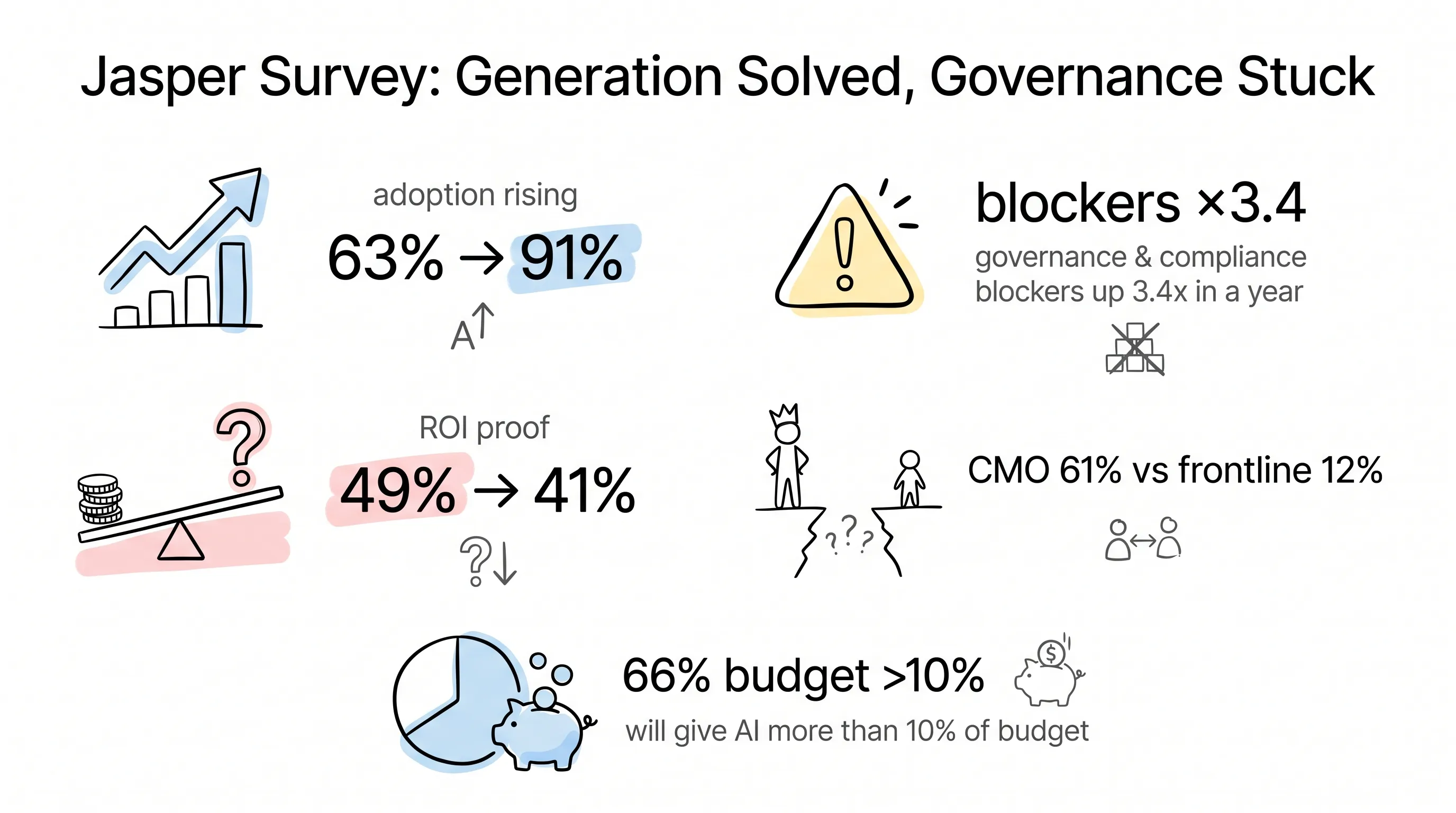
💬 Budgets will rise — carve out a share for governance first: map the approval chain, and clear the choke points with tooling rather than headcount. While you're at it, note a hiring signal: only 19% of teams plan to hire a content engineer (a role that builds and maintains AI content pipelines and governance); whoever hires first pays down the governance debt early.
🔗 Further reading: Read the full article
Gartner's Five 2026 Predictions: GenAI Shopping to Contribute Under 10%
Gartner offers five predictions for 2026. First: brands use agentic AI for one-to-one interactions — notifications, replenishment, personalized guidance all handed to agents; marketing shifts from executing by channel to fluid agent journeys, traditional martech architecture gets unbundled, and the marketer's role moves toward supervising intelligent systems. Second: influencer budgets flow toward creator identity verification and content authenticity — deepfakes and rumors turn credibility into hard currency, and verified creator content is worth more than raw reach. Third: CMO organizations move toward composable, AI-dependent human-machine hybrid structures. Fourth: ambient computing devices become a new channel for brand experience. The fifth is the contrarian one: GenAI shopping tools are expected to contribute less than 10% of e-commerce revenue.
💬 When you plan for next year, copy the "under 10%" line into your deck as a brake: the GenAI shopping narrative is loud — don't let the budget follow the noise. Budget for creator authenticity verification can be scheduled early; that's the more certain direction.
🔗 Further reading: Read the full article
One Page of AI Marketing Stats You Can Quote in Your Next Report
Sci-Tech Today compiled a one-pager of 2026 AI marketing statistics: the global AI marketing market is projected to reach $62.2 billion in 2026, up from $47.3 billion last year; Statista's forecast has it at $107.5 billion by 2028, a compound annual growth rate of roughly 31.4%. On adoption, 75% of marketers are already using AI, 93% use it to accelerate content production, and 60% use it daily; on the social side, 89.7% use it at least weekly; text content creation leads generative use cases at 55.4%; ChatGPT usage sits at 72% and Canva AI at 58%. On the B2B side, 63% say AI has driven revenue growth, and among US chatbot users, 26% have seen lead lifts of 10 to 20%. Salesforce's data shows teams with highly unified data run AI at an 80% usage rate, versus only 67% for fragmented teams; in the same survey, 78% of brands want more personalized content and 75% are already using AI to scale personalization. One more worth noting: AI and agents influenced 20% of global holiday orders — $262 billion in sales.
💬 This page can go straight into a budget presentation. One caution when quoting: secondhand roundups tend to have loose methodology — put the original sources (Statista, Adobe, Salesforce) in the footer so nobody can catch you out on methodology mid-meeting.
🔗 Further reading: Read the full article
🏷 Models & Platform Watch
MarketingProfs Flash Brief: ChatGPT Ads Enter Europe, 13 Agents per Enterprise
Three lines worth underlining in MarketingProfs' August 21 biweekly flash brief. OpenAI is rolling ChatGPT ads out to 31 European markets, starting August 24: agency-group buying first, self-serve later, GDPR adaptation first, and conversation content stays closed to advertisers. CPC buying is now the mainstream format, and the company says about 20% of queries carry direct commercial intent. OpenAI's enterprise revenue has overtaken its consumer business — annualized revenue has reached $40 billion, enterprise customers grew 32% month over month in July, and the ads business is annualizing near $1 billion. Salesforce's Agentic Enterprise Index shows enterprise agent deployments per company rising from 5 to 13, with 70% of support sessions handled autonomously. The measurement item in the brief stings the most: CMOs have bought plenty of AI visibility tracking tools, yet struggle to tie brand appearances in ChatGPT and AI Overviews to sales. Teams have no choice but to patch together AI share, referral traffic, brand search, paid conversion data, and media mix modeling — treating AI search impact as probability rather than directly attributable.
Two corroborating signals came in the same window. Enterprise AI spending is diverging: Ramp's data shows the most aggressive top 1% of US companies at a median of $7,400 in per-employee AI spend for July, while the median company spent just $11.95; even big buyers are pinching pennies, with Anthropic's premium models losing usage share to OpenAI's cheaper GPT-5.6 Sol. On safety: OpenAI is testing a zero-retention safety processing system, while Anthropic is requiring customers of its most advanced models to accept 30-day log retention — privacy-for-security has become the dividing line between vendors.
💬 The European ChatGPT ads deserve a slot in media teams' test queues — 20% commercial intent is high-value traffic. Budget discipline has changed too: CFOs are doing the math on cost per unit of intelligence, and premium models need proof of returns to get renewed.
🔗 Further reading: Read the full article
LinkedIn Ditches Traditional SEO Metrics: Non-Brand Traffic Down 60%
In MarketingProfs' February 20 weekly, LinkedIn's move was the boldest: non-brand B2B traffic dropped by as much as 60% — rankings held steady but the clicks vanished. So LinkedIn is giving up on traditional SEO metrics altogether, shifting to AI visibility measures like mentions and citations, and it formed a cross-functional group to rewrite its optimization guidance. Two numbers from the same period: a study covering 76,000 sites shows substantial ChatGPT query volume but referral traffic far below Google's, with answers often closing the loop inside the interface; and Google launched shopping ads in AI Mode, an entry point that has already passed 75 million daily active users.
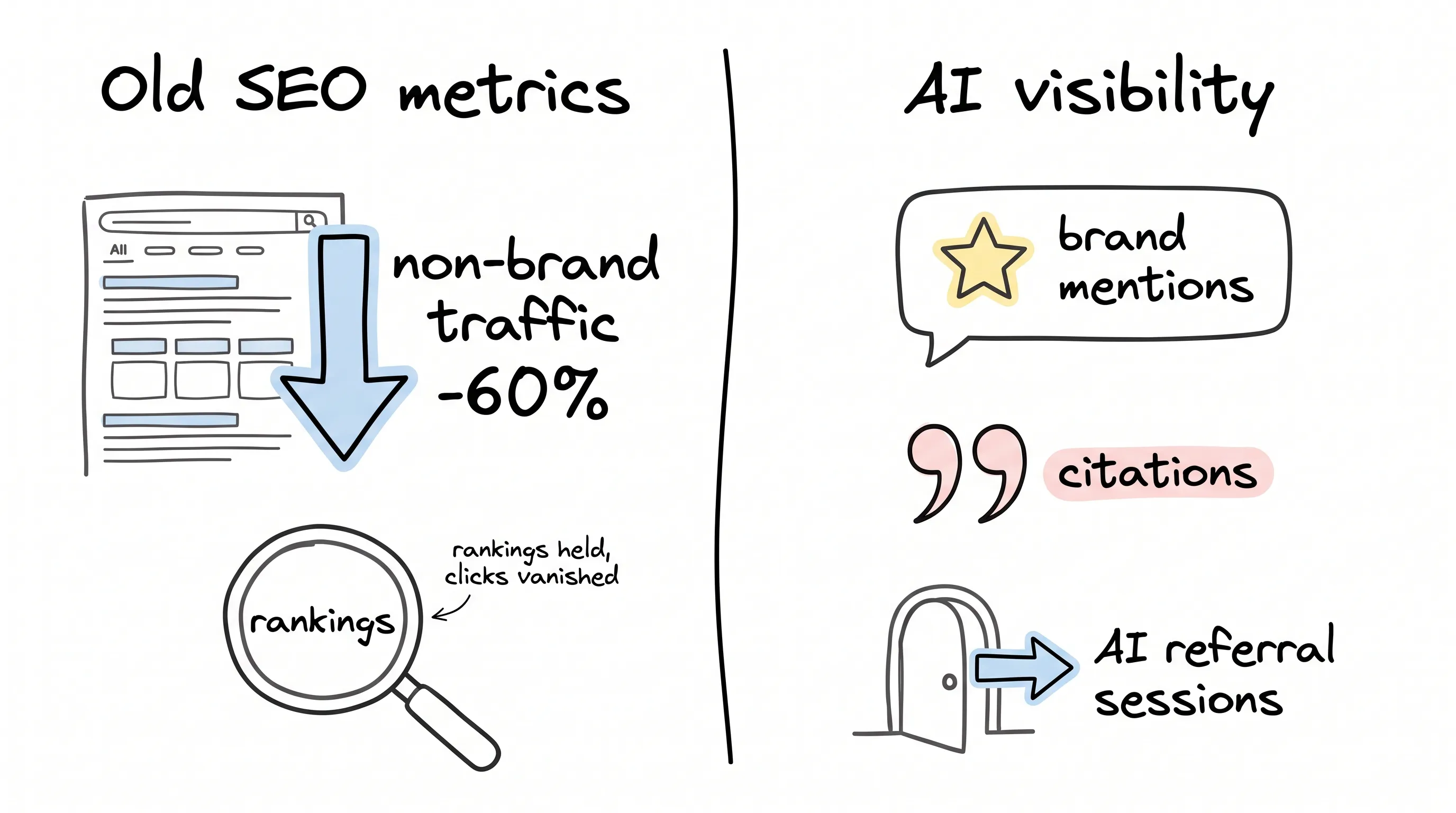
💬 Teams producing SEO weekly reports should add AI visibility metrics this week: brand mentions, citation counts, AI referral sessions. However ugly the traffic curve gets, once the measurement changes, the story you tell upward can change with it.
🔗 Further reading: Read the full article
Adobe Renames Experience Cloud to CX Enterprise, Betting on Resident Agents
MarketingProfs' April 24 weekly recorded several landscape-level martech moves for 2026. Adobe renamed Experience Cloud to CX Enterprise, with the platform making resident AI agents ("Coworkers") its orchestration hub, dispatching creative, marketing, and customer experience tasks, while GenStudio rolled out into multiple products simultaneously. OpenAI released GPT-5.5, positioned as a step toward its super-app vision. ChatGPT Enterprise launched shared-workspace agents that can execute tasks across Slack and Gmail and request approvals. Google restructured its enterprise strategy around Gemini Enterprise, and Microsoft shipped AI Max plus new advertising tools built for the agentic web.
💬 Marketing teams should draw an agent-takeover map: run every existing workflow through three columns — automatable / human-review required / human-only. Adobe has already made agents the product foundation; if your process documentation is still stuck in the human era, the switching cost only gets higher.
🔗 Further reading: Read the full article
OpenAI Adds to Super-App Push at an $852B Valuation, Multi-Model Collaboration Becomes Standard
MarketingProfs' April 3 weekly recorded several waypoints in the race to build agents. OpenAI closed funding at an $852 billion valuation and laid out its ChatGPT super-app strategy: 900 million weekly actives, with chat, coding, search, and agents merged into one interface. Microsoft brought multi-model collaboration to Copilot: Critique has one model generate while another reviews, Model Council supports side-by-side comparison of multiple models, and a Cowork Agent was rolled out alongside. Salesforce upgraded Slackbot into an autonomous work assistant carrying 30 AI capabilities. Anthropic is testing Conway, a resident autonomous agent, and Bluesky launched Attie, built on Claude, letting users tune their feeds in natural language.
💬 Add a line to your procurement list: platforms must support multi-model collaboration — cut any quote that locks you to a single model. The one-model-generates, another-reviews architecture can be assembled in your existing tools today, and the hallucination rate drops immediately.
🔗 Further reading: Read the full article
🏷 Policy & Funding
OpenAI Projects $100B in Ad Revenue by 2030, GEO Rewrites M&A Logic
Two items in MarketingProfs' April 10 weekly speak directly to budgets. OpenAI has spelled out its ad revenue forecast: $2.5 billion in 2026, up to $100 billion by 2030, with the first pilot running $100 million annualized within two months — the logic being that users state their intent explicitly inside a conversation, a kind of high-value traffic that nobody has ever been able to monetize before. GEO, meanwhile, is starting to rewrite M&A logic: AI answers favor credible third-party endorsements, so brands are simply acquiring or binding media assets — HubSpot's acquisition of an AI media network is the template. The ad side supplies a footnote too: Google says AI Max has already helped some retailers lift online revenue by 80%, and it's experimenting with letting brands shape product answers in AI search in their own voice and close transactions in-conversation via the Universal Commerce Protocol — while explicitly keeping ads out of Gemini for now. The contrarian view is also on record: one analysis ran the numbers on the ChatGPT ads pilot — annualized past $100 million with hundreds of advertisers participating, but pricing runs high, daily impressions are limited, and click performance is mediocre; the channel's value hasn't been proven, and B2B and other high-consideration categories should start with small-scale tests. On safety: Anthropic's Mythos model had its release restricted because its vulnerability-hunting capability was too strong (over 80% reproduction exploitation rate); it joined Amazon, Microsoft, Apple, Google, and Nvidia in launching Project Glasswing for defense testing, and Anthropic is offering up to $100 million in usage credits to pull infrastructure partners on board.
💬 The price of earned media needs repricing: third-party authority endorsements have become the hard currency of AI visibility, so shifting content partnership budgets from per-campaign to annual terms is the better deal. AI safety belongs on the vendor evaluation sheet too — the fact that models can hunt for vulnerabilities isn't far removed from marketing data.
🔗 Further reading: Read the full article
AI Marketing Through GDPR: A Four-Step Self-Check
OMNAI Marketing used a LinkedIn post to flag GDPR compliance for AI marketing: per the UK's ICO (Information Commissioner's Office), transparency, consent, and security are not optional add-ons on AI marketing tools — what you're short on isn't just fines, but customer trust and brand reputation. The post offers a four-step self-check: obtain explicit consent for every data use; ensure sensitive data has a lawful basis; keep processing transparent and documented; and periodically audit AI outputs for bias and privacy risks. The landing point is worth noting too: compliance itself is a competitive advantage — trust and loyalty grow from exactly here. The cited case is an EU retailer fined millions over AI profiling without consent; that case cannot be verified and is recorded here as summarized.
💬 Run these four steps against your own tools this week — it costs half a day. And don't ignore the return side of compliance: audit records are themselves a trust selling point to customers, and they're increasingly being asked about in B2B tenders.
🔗 Further reading: Read the full article
🏷 Marketing Tools
A Five-Step Method for E-commerce AI Ad Creative: AI Is the Production Assistant, Not the Creative Director
Geeks360 offers e-commerce brands a five-step method for AI ad creative. It opens with a cold-water reality check: AI is not a creative director — it can't produce brand concepts and can't nail emotional hooks; what it does is turn strong creative into high-quality visuals and video at high speed. It's an execution assistant, not a strategist. Step one: write a strong creative brief first, spelling out tone, lighting, and emotional hooks — the more detailed the brief, the more accurate the output; ChatGPT, Claude, or Kimi can draft the brief itself, with a human closing it out. Step two: choose tools by use case — Fal.ai aggregates Veo, Kling, and Flux Kontext behind a single API, Sora handles motion output, ByteDance's Seedream 3.0 produces 2K bilingual images in three seconds, and Seedance 1.0 turns out coherent short clips of about five seconds. Step three: master each platform's prompt dialect — with Sora, say less; with Midjourney, elaborate. Step four: human polish — AI covers eighty percent of the way, but faces, hands, and brand typography still need a human pass. Finally, run A/B tests at high frequency: their auto-repair-shop example generates 3-to-5-second micro-scenes separately, then stitches them together with unified lighting and characters — the cost that once paid for a single video now tests dozens of variants.
💬 Carve the testing budget out of the production budget: at the same cost you get ten times the variants, and what survives testing is the true creative direction. Faces and hands must get a human pass — those are the two places where users spot AI at a glance.
🔗 Further reading: Read the full article
An AI Social Media Marketing Guide: Fine as a Newbie Checklist (thin piece)
Victorious Digital's 2026 AI social media guide is a beginner's survey: the six areas — content generation, scheduling, social listening, sentiment analysis, chatbots, and ad optimization — each get a paragraph of generic usage advice, the tool table is stocked with familiar names like ChatGPT, Canva AI, Hootsuite, Buffer, Sprout Social, and Jasper, and it closes with reminders about human creativity and data privacy. The piece contains no unique data or case studies.
💬 It works as a new-hire onboarding checklist, but it's thin as a strategy reference. What a team should actually do is pick the two of those six areas with the deepest data stockpile and AI-ify those first — don't spread effort evenly in the guide's order.
🔗 Further reading: Read the full article
Customer Journey AI Tool Ranking: Top Five Credible, Bottom Five Questionable
Aidbase's blog lists 10 AI tools for personalized customer journeys; the top five are real, mainstream platforms: Adobe Target for real-time behavioral targeting, Salesforce Einstein for CRM-connected prediction, Braze for cross-channel orchestration, Mutiny for B2B website personalization, and Omneky for ad creative generation and optimization. The latter entries — FutureTool, PersonaFlow, InsightLens, and others — turn up no public information and look stitched together. The selection criteria, though, are reference-worthy: real-time data processing, predictive analytics, integrability, multi-channel support, and scalability.
💬 Build your shortlist from the top five, matched to the gap: if you lack website personalization, look at Mutiny; if you lack cross-channel, look at Braze. When you see a ranking that includes vendors you can't find any record of, skip it outright — don't spend time verifying authenticity.
🔗 Further reading: Read the full article
💡 Today's Big Picture
Read the twenty items together and today's through-line is just one: adoption is saturated, governance hasn't caught up, and money is moving from the generation side to the governance side. Three evidence lines. First, deployment sits at 93% while 30% of actions go unaudited (LeanData); legal-and-compliance blockers rose 3.4x in a year (Jasper); a GDPR four-step self-check is now on the table (OMNAI); even model vendors are restricting model releases over safety (Anthropic's Mythos). Second, AI search is rewriting the rules of visibility: LinkedIn simply threw out its SEO metrics in favor of AI visibility measures, and both the five-brand GEO cases and the ten-step SOP point at the same phrase — credible third-party endorsement. The ad side is following: Google is already test-running ads in AI search with an 80% revenue-lift case, and OpenAI's European push is underway — a reshuffle of the channel list is only a matter of time. Third, agents inside enterprises have risen from 5 per company to 13, and Adobe has swapped its product foundation to resident agents; another doubling of per-company deployments is only a matter of time.
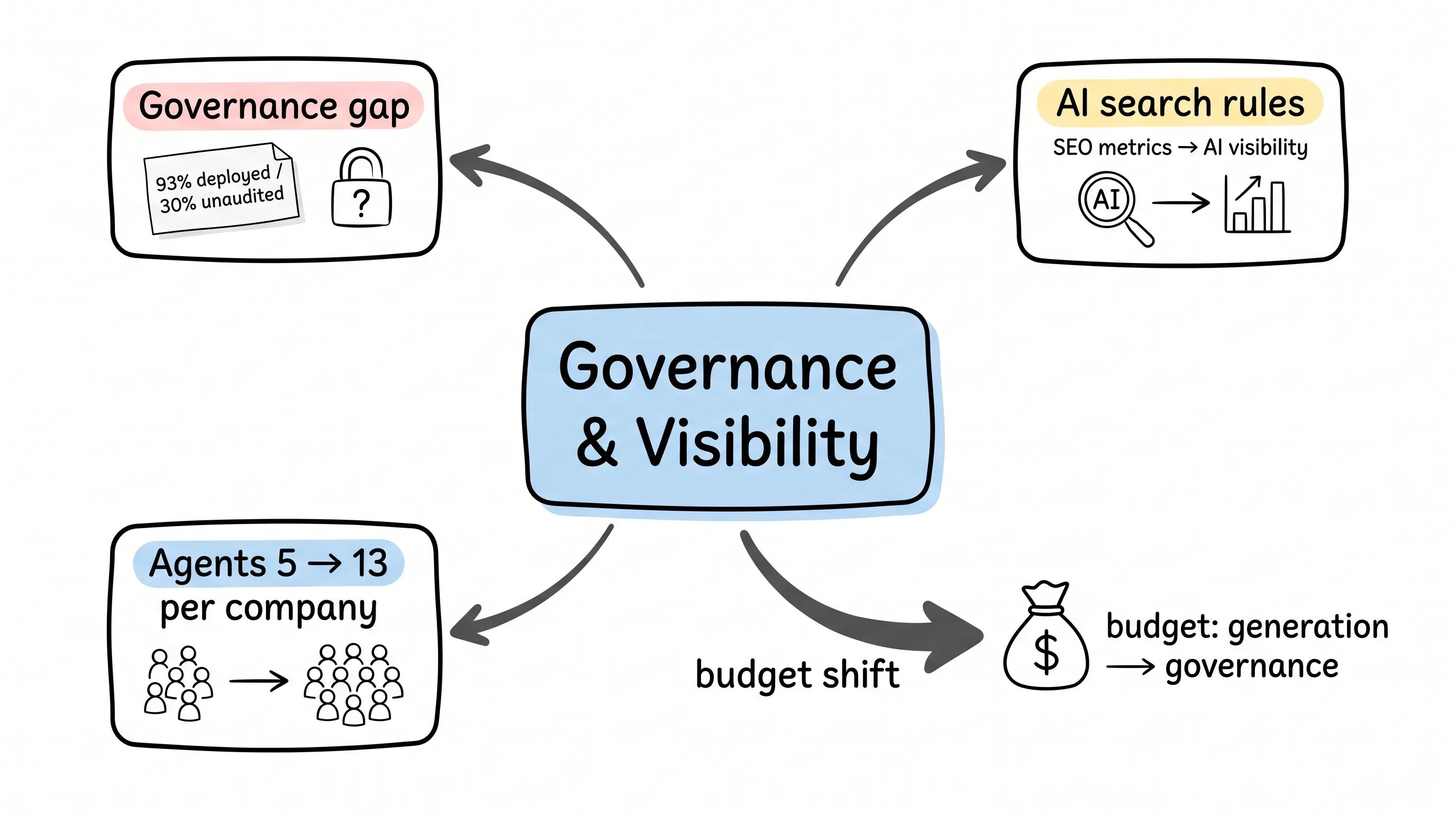
My verdict, in one sentence for marketing teams: in next year's budget, governance and visibility combined will surpass content generation. That's not a misjudgment risk — it's the risk of being half a beat too slow. Today's headline agent inventory table, plus Jasper's approval-chain map, plus OMNAI's four-step GDPR checklist: three sheets of paper are the first investment on the governance side. On the generation side, everyone is spending more, and spending more doesn't differentiate. Only the companies that can govern well get to tell the AI-returns story next year.
Continue reading
Related articles

AI Marketing Daily · 2026-10-09
AI marketing daily for 2026-10-09 covering 11 items: brand measurement moving from survey panels to search, social, e-commerce, and AI prompt signals; GEO and share of model playbooks; safety guardrails for agentic ad buying; and tool roundups for ad platforms, cross-border tools, and social media uses.

AI Marketing Daily · 2026-10-08
AI Marketing Daily for 2026-10-08 curates 20 items across AI search visibility (GEO), advertising, platform selection, cross-border e-commerce, and ROI measurement. The headline argues that strategic marketing decisions should stay with humans while AI assists execution.

AI Marketing Daily · 2026-10-07
Today's throughline is answer engine optimization (AEO — getting your brand quoted in AI answer engines).