
AI Marketing Daily · 2026-09-25
AI Marketing Daily for 2026-09-25 rounds up 20 stories, led by Phave, an AI-native marketing automation platform from Marketo's co-founder. Other items cover Meta Muse shopping agents, agentic ad buying, Search Console's AI data limits, and publishers' falling Google traffic.
Two through-lines run across today's 20 stories. Agents are formally getting the power to close deals: the marketing automation category is being upended by its own founder, Meta is pushing shopping agents into retail networks, and payments and advertising both caught up in the same week. The other line is drawing the human-machine boundary: HBR's large-sample experiment delivers the first hard numbers on AI creativity's effectiveness gap, and publishers' search traffic decline has widened to 40 percent. Today's headline takes a deep look at Phave; the other 19 stories unfold across five categories, each with a hands-on takeaway and a link to the original.
🎯 Today's Headline
Marketo co-founder Jon Miller launches Phave, challenging the category he created 20 years ago with marketing automation that can reason
Phave, founded by Marketo co-founder Jon Miller and former Marketo global product EVP Nick Bonfiglio, came out of stealth this week. The product hit general availability in August and is now publicly unveiled after two years in stealth. Its customer list runs to more than 10 enterprises—SambaNova, SPS Commerce, mabl, Servion, Hypha among them—with investors including FirstMark, Ridge Ventures, and Costanoa Ventures. The positioning in one line: AI-native marketing automation, aimed squarely at Marketo, Pardot, Eloqua, and HubSpot.
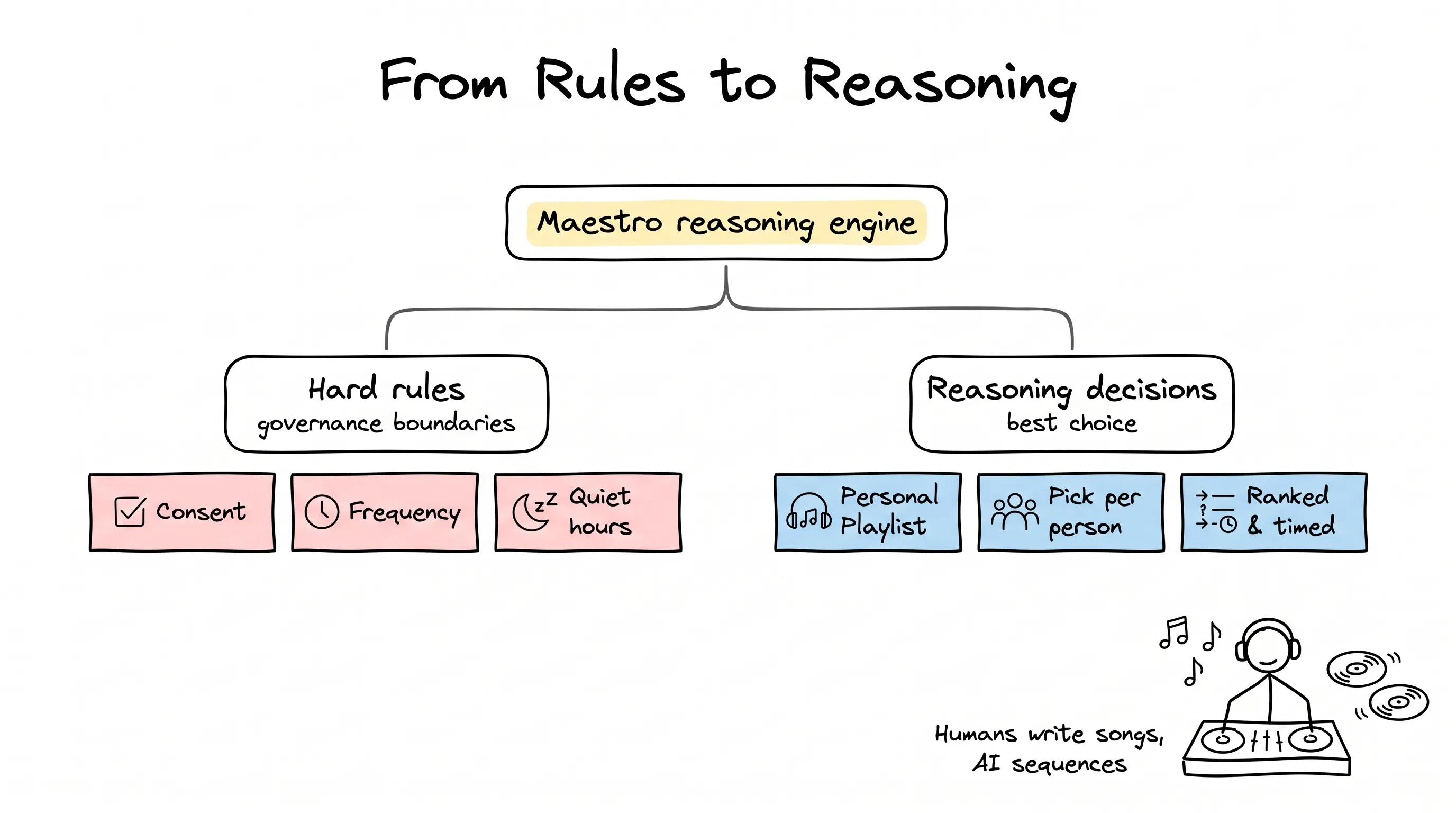
The platform's engine is called Maestro, and its product philosophy is "from rules to reasoning." The older generation of marketing automation ran on prewritten rules: who enters a segment, how many points a lead earns, which email goes out next. Phave splits those rules into two kinds. Consent, frequency, and quiet hours stay hard rules, because they are governance boundaries; optimal decisions like which email to send this person go to AI. Maestro computes a Playlist for each individual, picking, from the marketer-approved campaign assets, the touches most likely to hit the goal, ranked and timed per person. In Miller's words: rules are good at governing what is allowed, but bad at deciding what is best. The analogy comes from Spotify—AI as the DJ, assembling human-made songs into a personal playlist. The songs are written by people; the sequencing is done by the algorithm, listener by listener.
The data model was rebuilt too. Accounts and buying groups are first-class records, each carrying its own scoring and lifecycle stage—echoing Miller's April 2025 judgment: leads are too narrow, accounts too broad, buying groups just right. Three ways to plug in: the native interface, the team's existing AI client, or headless via MCP plus versioned REST APIs. Pricing starts at $36,000 a year, billed by the number of people reached each month, not by database size. Customers like SambaNova and SPS Commerce report execution volume more than doubling, and Servion's head of growth says Phave figured out the thing they could never pin down—when, and in what way, to reach each person.
The significance of this news is timing. In the week before Phave went public, Salesforce launched Campaign Agent at Dreamforce, and HubSpot shipped Breeze and Marketing Studio agents, with early customers seeing an 81% lift in campaign volume; Adobe's Marketo AI is in beta, and Oracle has Fusion agents. All the legacy marketing automation giants pivoted to agentic in the same week. Miller himself has been preparing for this timing for years: in 2014, still at Marketo, he told CMSWire the industry would move from campaigns to continuous conversations; in 2015 he left to found Engagio and pursue ABM; in April 2025 he argued that AI could automate the automation, calling out Marketo's innovation slump under Adobe. Twenty years of public track record give Phave a credibility no other challenger in this lane has—after all, he founded the category himself.
The impact on marketers lands on procurement decisions. When B2B marketing teams evaluate a MAP (marketing automation platform) upgrade or migration, the old option was a tool swap with six rivals to choose from; now it is two routes: stay in the incumbent ecosystem and wait for agentic features to catch up, with no migration; or switch to an AI-native platform, accepting migration costs in exchange for a generational gap in data model and decision engine. Miller has a name for the buyer psychology: the Stockholm syndrome of marketing automation—afraid that migration will break the lead flow and the compliance rules, teams stay on the old platform. The data model is the second variable: buying groups as first-class records mean content and scoring must be rebuilt around buying committees, and the quality of buying-group data in the CRM directly determines whether migration is feasible. For content-operations roles, the center of gravity shifts from building nurture flows to approving assets and governance rules.
How to act—three moves. First, audit your existing rules: separate true governance rules like consent, frequency, and quiet hours from content-selection logic like segmentation and scoring into two lists—keep the former, prepare to hand the latter to a reasoning engine. Second, pilot along a low-risk path: run in parallel on one segment, leave the main flow untouched, and compare the reach of Playlist decisions against human decisions. Third, model cost against your current contract using monthly reach: the $36,000 entry price is pay-per-reach, which may be cheaper for teams with huge databases but sparse touches. At the same time, benchmark against the incumbents' fall releases: Salesforce's agentic features work without migration, and whether migration is worth it depends on whether your pipeline bottleneck is content selection or data governance.
My take: the value of this news goes beyond the narrative. All four incumbents pivoting to agentic within one week shows the generational switch has already happened; the only remaining dispute is pacing. Phave's biggest enemy is the Stockholm syndrome Miller himself named—migration risk is harder to solve than model capability, and what enterprise customers fear is breaking a lead flow that has been running for years. My view: at next year's MAP procurement table, buyers for the first time hold a real choice between switching platforms and waiting for incumbents to catch up, and the evaluation checklist should shift from feature comparison to a comparison of governance boundaries and data models. Whoever explains this framework first at the board level holds the pricing power over the next round of MAP budgets.
🔗 Further reading: Read the full article
🏷 Agentic Commerce
Meta Muse ships a full update: digital avatar, glasses, Mac computer use, and a shopping-payment network
Meta Connect 2026 delivered a full update for the personal AI agent Muse. The digital avatar, Muse Realtime Avatar, supports real-time video conversations; it reaches Meta AI glasses within months, and once activated by a wake word it can coach workouts, log meals, book appointments, and buy what is in front of you; on Mac, agent computer use goes live and can operate any desktop app—official phrasing: you can walk away and it keeps working; Muse will also get its own email address. On the shopping side, it secures payment capability from Stripe, Shopify, and PayPal, with retail connectors covering Best Buy, Gap, Sephora, Walmart, Wayfair, and Expedia, and Instacart coming soon. The developer connector platform took more than 1,500 applications within a week of opening. Zuckerberg set the business model for the first time: lots of tokens free, monetized long term through a cut of transactions. On the hardware side comes the keychain device Muse Charm, shipping in December, squeezing realtime voice and the avatar into a wearable.
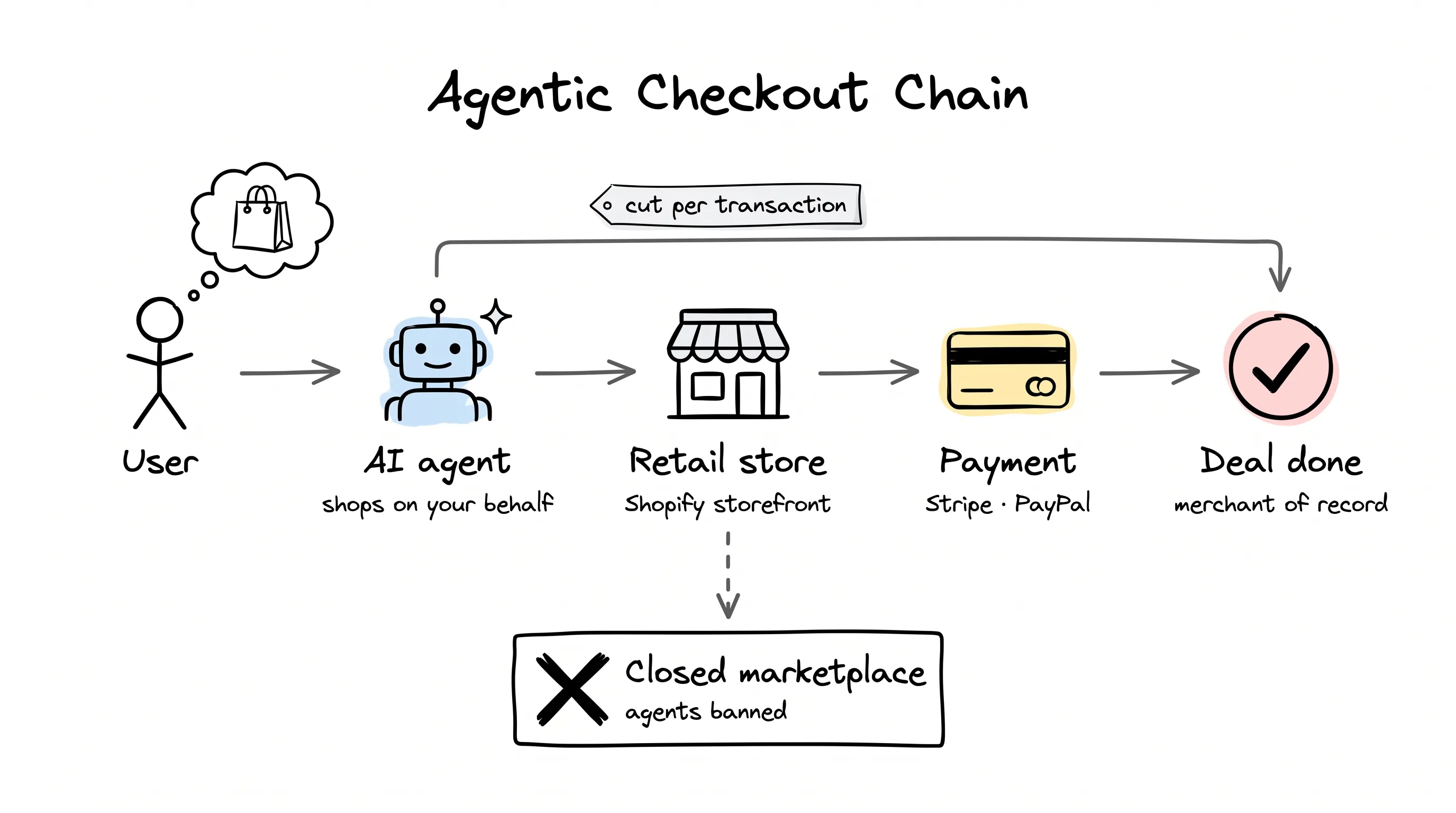
💬 How marketers can use this: ecommerce teams should put their Shopify stores into Muse integration evaluation this week, starting with two things—structuring product data and straightening out inventory and fulfillment interfaces. The agent channel's cost structure is already set: a cut per transaction. Integrating early means calibrating your margin model early; don't wait for a competitor's agent to lock away your consideration set first.
🔗 Further reading: Read the full article
Shopify opens the door to Muse; Amazon slams it shut
The personal AI agent Muse, released by Meta in September, can browse on a user's behalf, fill in forms, and complete purchases with consent. On September 8, Shopify connected Muse into Agentic Storefronts as an AI commerce channel: the merchant remains the seller of record, rates unchanged, no extra agent fee from the platform. Amazon went the other way, banning Muse on the grounds that an unauthorized AI agent violates its terms of service. Practical Ecommerce breaks down the business logic behind the two stances: platform-model Shopify profits when merchants transact, so it can accept agents taking over the interface; marketplace-model Amazon must control the shopping interface, the advertising environment, and the customer relationship, and has no room for a bot in the middle. The piece also flags how agentic commerce rewrites three layers: agents may filter the consideration set before a user ever reaches search ads or retail media; persistent agents will remember sizes, brand preferences, budgets, and purchase history, taking ownership of first-party customer profiles away from retailers.
💬 How to act on it: to decide whether your brand should open an interface to shopping agents, first check whether your business model is platform or marketplace. Running a Shopify storefront? You can try this week—rates and settlement unchanged, risk contained. Running an Amazon store? Don't waste your time; interface control won't open up anytime soon. The real move is guarding your first-party customer data—that's the one thing agents can't take away.
🔗 Further reading: Read the full article
Mastercard exec sizes up agentic commerce: discovery runs ahead of checkout
Gaurang Shah, EVP of global acceptance and merchant solutions at Mastercard, offered a stage assessment in a September 24 interview: agentic commerce is in a transition period where discovery runs ahead of checkout—consumers already use AI heavily to discover, rank, and compare, but they clearly stop at recommendations and won't yet let agents place orders. The tension sits in the trust equation: consumers assume they are protected no matter what, merchants believe liability should sit with the agent brokerage, and identity, authorization, and intent therefore become payments-infrastructure problems. After walking through the channel generations—search, marketplaces, mobile—Shah's judgment is that agents are the first intermediary that can decide which merchant wins the transaction; search engines only decide visibility, marketplaces only decide the arena. Most merchants need a dual track: open the catalog to external agents while building agent experiences in their own channels. The piece flags a sharp conflict: the easiest optimization function for a shopping agent is to find the cheapest acceptable product—and that is precisely the race to the bottom that erodes brand premium and profit.
💬 Practical reminder: if your category's premium rests on brand equity rather than price, you need to answer one question now—on what grounds will an agent judge my product as better? Turning decision factors like service, benefits, and quality into agent-readable structured signals is far cheaper than patching up after the race to the bottom starts. Don't drag this out until agent checkout lands at scale.
🔗 Further reading: Read the full article
Amazon opens its seller console to sellers' operating agents—ad management inside Claude
MediaPost reports that Amazon is opening its seller tools to third-party AI agents. Seller Assistant, rebuilt on Bedrock and Claude, plugs into Anthropic Claude and Amazon Quick, so sellers can check inventory, adjust prices, update listings, and manage ad campaigns from inside Claude without opening the console. Seller Assistant carries persistent memory: each seller's pricing patterns, inventory cycles, and growth goals follow them across platforms. Amazon says 90% of sellers already use Claude models to support decisions, with data kept inside Amazon's infrastructure and never flowing out. The decision chain for advertising scenarios is now connected: spotting competitive signals, matching ad or cross-promotion opportunities, evaluating listing improvements, drafting recommendations. This stands in sharp contrast to banning the shopping agent Muse—Amazon welcomes sellers' operating agents and rejects other parties' shopping agents, because the former help it sell, while the latter bypass its toll booth.
💬 Cross-border sellers can try this as soon as this week: once the Seller Assistant plugin is connected inside Claude, routine operations like ad price adjustments and listing maintenance save most of the console-switching hours. Mind the boundary: opening up to operating agents does not mean shopping agents are allowed in—customer relationships and brand assets remain in Amazon's hands, so don't fully outsource your most sensitive pricing logic. 🔗 Further reading: Read the full article
One digest, three signals: agents shift from assistive tools to transaction executors
ExchangeWire's September 24 digest picked up three signals. First, Shopify and Meta confirmed that Muse can complete purchases across all Shopify stores, running on existing infrastructure: merchants remain the seller of record and settle at standard rates, so agentic commerce can plug seamlessly into existing settlement systems. Second, AppNexus founders Brian O'Kelley and Anne Coghlan renamed Scope3 as Apostra, pivoting from advertising carbon emissions to agentic AI advertising: advertiser agents negotiate directly with media-side agents, eliminating the integration burden of connecting to thousands of publishers, with no adtech-intermediary-style transaction fees—monetization instead comes from value-added services like negotiation support and campaign evaluation. Third, a Microsoft patent application published on September 3 reveals a new in-game advertising format: ads served at natural pause points, where players watch ads in exchange for additional ad-free time.
💬 Media teams should watch Apostra: if agent-to-agent negotiation proves out, the middle layer of programmatic buying gets repriced, and integration-heavy small and mid-size adtech firms feel the most pressure. The in-game ad patent is a reminder for content teams: the watch-for-time mechanism effectively turns ads into in-game currency, and delivery formats aimed at younger audiences may be rewritten as a result. 🔗 Further reading: Read the full article
🏷 Advertising & Media
58% of ad executives expect agentic buying to scale within a year
IAB Europe surveyed 50 European advertising executives: 58% expect agentic buying to reach operations or scale within a year. The gap opens along company size: 86% of large companies with 501+ employees already run human-in-the-loop agentic workflows in production, versus only 48% of companies under 500 people. 47 organizations already use AI internally, 43 for marketing, but in 36 of them agentic systems still need human-led or co-planned operations. The fastest-landing scenarios are reporting and analytics (22 of 29 organizations) and programmatic optimization (59%). 68% of organizations measure AI success by operational efficiency, and 59% are increasing AI marketing technology investment. On specific players: WPP and Omnicom are testing buyer agents, CNN and News UK are building seller agents, and Omnicom's CFO believes AI's improvement in measurability will bring more advertising investment. Skeptics are audible too: agentic buying only automates tiny links in an enormous process, and if it is trained only on historical buying data, real bottlenecks like creative latency will not be solved.
💬 How to calibrate expectations: media buying teams should first locate themselves by company size—large organizations put agentic workflows directly on the schedule, while small and mid-size teams start from the two low-risk scenarios of reporting and programmatic optimization. Don't measure efficiency alone; convert the hours saved into incremental media delivery to make the case for a second round of budget. 🔗 Further reading: Read the full article
The media transparency fight shifts to algorithmic decisions
ExchangeWire carries a signed column by Helen Rose, managing partner at the7stars. With AI embedded deep in media planning, a brief turns into audience definitions and schedules in seconds, and the transparency debate is shifting from rebates and margins (where did the money go) to why the algorithm decided this way. Her three arguments: a decade of data explosion has not produced a matching gain in understanding—platforms define the same consumer differently, insights do not travel across systems, and algorithms sit between data and recommendations; transparency should move upstream to the decision itself—advertisers should be able to interrogate why audiences were defined this way and which data shaped the AI's recommendations, with transparency starting at the decision point, not the transaction point; agencies' moat is shifting from data ownership to making complexity understandable, and the practice of treating complexity as intellectual property will be abandoned. One caveat: the piece ends by plugging its own Gravity Connect platform and a partnership with Samba TV covering the viewing data of 1.8 million UK households—read it with an advertorial discount.
💬 Action for advertisers: at the next agency pitch, ask three questions outright—why were audiences defined this way, which data shaped the AI's recommendations, and can decision logs be exported. Writing algorithmic accountability into procurement terms is cheaper than a post-hoc audit. And that line from the piece—"AI gives planners more to think about"—can go straight into your procurement criteria. 🔗 Further reading: Read the full article
🏷 Creativity & Creators
HBR experiment: consumers can't tell AI ads apart, but effectiveness trails by 14% to 17%
HBR publishes a joint study by the authors with Ipsos, spanning 3,000 US consumers and 20 big-brand video ads, half human-made and half produced end-to-end by AI. The findings come in two layers: consumers struggle to tell which ad is AI-made—but the AI versions on average trail by 14% in short-term sales potential and 17% in long-term brand equity. The real risk mechanism hides inside the organization: the CFO sees cost savings, the CMO sees speed, the system rewards volume and velocity, good-enough mediocre creative passes internal review silently, and bleeds quietly in the market. The article prescribes four disciplines: stop agonizing over whether work can be identified as AI—test memory, trust, conversion, and brand equity instead; measure by effectiveness, not cost efficiency—Chewy's AI version lacked emotional precision, while Cheerios' two versions performed close because the brief was solid; hand routine work (product demos, benefit listings) to AI—Febreze and Herbal Essences are the positive cases; keep emotion, cultural timing, humor, and narrative tension with humans. Disclosure is tightening too: the EU AI Act takes effect in August 2026, New York State requires synthetic-actor disclosure, the IAB has issued a transparency framework, and Heinz's A.I. Ketchup proved that disclosure itself can become creative.
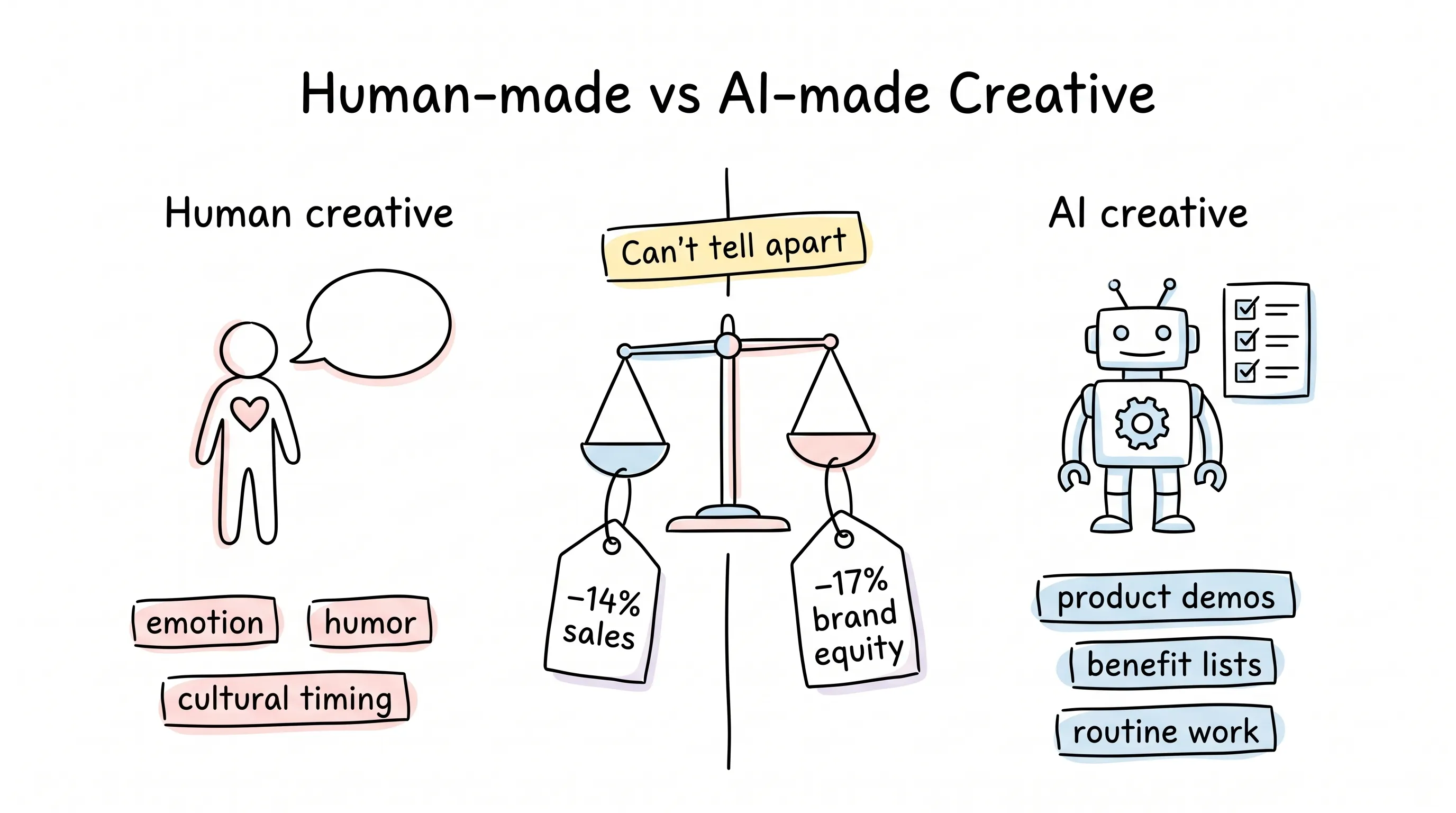
💬 What content teams can do this week: sort existing assets into two columns—routine and emotional. Hand product demos and benefit listings to AI and measure lift with holdouts; don't trim budget on emotional and cultural-timing work. Also set a kill rule: AI assets that miss the test bar come down—don't let "good enough" pass review in silence. 🔗 Further reading: Read the full article
Creators move from collecting fees to holding equity
Digiday reports a structural shift in creator monetization: away from one-off brand fees toward equity ties, along two paths—angel investing, where top creators put in their own money, and sweat equity, where strategic services are exchanged for stock. Signaling events include Cherub hosting an application-only angel-investing salon for 100 creators, the new agency JERi forming a pre-screened creator council to feed talent to startups, and Love X Money Ventures reviewing creators taking equity in the social fashion app Driptail (users up 60x from March to July); the precedent is Alix Earle's 2024 stake in Poppi. Cherub has published the industry's first equity benchmark: advisory only, 0.1% to 0.3% (seed stage, two-year quarterly vesting with a 3-month cliff); advisory plus services, 0.25% to 0.75%; long-term partnership or creative director, 0.75% to 3% (four-year vesting with a 1-year cliff). The five practitioners interviewed expect the model to expand fast, while warning against predatory terms that pair heavy workloads with token equity.
💬 For brands and startups: treat top creators as partners, not media placements. Screen for strategic leverage—can they teach your company creator go-to-market? Don't hand out equity for a handful of posts. In negotiation, price against Cherub's benchmark table: for deals below the floor, either cut the workload or add vesting protections—never sign a naked agreement. 🔗 Further reading: Read the full article
Five directions for social and influencer marketing in 2026
Marketing Week compiles views from Flight Story, We Are Social, IMTB, Billion Dollar Boy, and others into five trends for 2026. First, consumer pushback against AI content—brands emphasize human touch and distinctive brand behavior, with fringe-expert-style content differentiation emerging; McKinsey projects digital avatar technology to grow 60% annually over the next five years, reaching $73.5 billion by 2027. Second, platform diversification—Gen Z and Alpha turn to closed communities like Discord and Substack, brands pivot to owning their audiences, and YouTube long-form gets revalued; GWI analysis shows global social media time peaked in 2022 and has declined since. Third, creator content becomes more intentional—Kolsquare data shows 81% of UK brands plan to increase influencer budgets in 2026 and 61% to double down on long-term partnerships. Fourth, professionalization—the UK APPG is established, and countries including France, Germany, and the Netherlands are rolling out influencer certification. Fifth, measurement goes long-term—IPA research shows influencer marketing ROI beats linear TV and paid social, and brands will make more use of synthetic data and creative pre-testing.
💬 Budget planning move: reallocate the annual influencer budget toward long-term partnerships in line with the industry trend, turning one-off seeding into quarter-level collaborations. Start by building on channels where you can own the audience, like Discord or Substack, and switch the measurement lens outright to a pipeline view of three months or longer—stop settling monthly impressions as the deliverable. 🔗 Further reading: Read the full article
The AI influencer industry by the numbers: market, revenue, and the trust boundary
The Independent takes a deep look at the AI virtual influencer industry. Sample personas: Aitana Lopez, 392,000 followers, earning up to $10,000 a month, created by Barcelona's The Clueless—even a human actor with 5 million followers asked to meet her in person; Granny Spills, 2 million followers, AI-composited photos with celebrities. Thousands of virtual influencers already operate on Instagram and TikTok; the market was worth $6.33 billion in 2024 and is projected to reach $11.78 billion by 2033. Sprout Social research shows 50% of UK consumers accept brands using AI influencers and 41% would follow one. The industry has its own awards now: over 2,000 personas entered, with $90,000 in total prize money. The brand-side appeal is control—no scandals, around-the-clock availability, cross-market reach with no logistics limits. Human creators are embracing it too: Khaby Lame struck a $975 million AI likeness licensing deal, and 62% of North American creators report burnout. The boundary is just as clear: trust-dependent categories like mental health, parenting, and fitness don't suit AI spokespeople.
💬 Which categories to try: for low-trust-threshold categories like product showcases and lifestyle seeding, the AI influencer cost structure is worth a small-scale test—no schedules, no scandal risk, zero logistics across markets. For health, parenting, and personal finance, keep using human experts; the trust gap can't be closed anytime soon, and the cost of a blowup far exceeds the budget saved. 🔗 Further reading: Read the full article
A collection of 25 GenAI marketing cases: use it as an index, not a data source
DigitalDefynd compiles 25 generative AI cases (2026 edition). Coca-Cola's Create Real Magic, with OpenAI and Bain, invited creators from over 100 countries to co-create brand art with ChatGPT and DALL·E 2, with works displayed on Times Square billboards; L'Oréal used GenAI to cut content development cycles by 60% across 25 languages, with its AI beauty assistant driving 35% longer interaction time; Stitch Fix used NLG to generate styling notes, saving stylists 50% of their time with satisfaction on par with human work; Canva Magic Studio logged 1 billion AI operations within months of launch, and 70% of Pro users report faster task completion; BuzzFeed's AI-personalized quizzes lifted share rates by up to 45% and spawned new ad revenue from brand-customized quizzes; Klarna's shopping assistant also makes the list. Each case unfolds in five sections: company, goal, approach, impact, lessons.
💬 How to use it: treat this collection as a directory for finding benchmarks—pick the two or three cases closest to your business model and dig into the playbook. All effect numbers are secondhand with no primary sources; verify against first-hand sources before citing them in a proposal, and don't copy them straight into the deck for management. 🔗 Further reading: Read the full article
🏷 Search & AI Traffic
B2B brands counter AI slop with creator video
MarTech reports that Billo's data shows B2B companies' use of creator video grew 55% in a year—nearly quadruple the 2023 level—driven by the motive of rebuilding credibility amid the flood of AI content. IAB research shows credible creator endorsements make 65% of consumers more confident in AI recommendations. Consumers' criteria for judging creator credibility, ranked: track record 46%, consistency 40%, professional expertise 36%, follower count only 21%. The recommended approach: choose industry experts and real customers over mega-influencers, and build substantive content around procurement-decision scenarios (product demos, solution comparisons, implementation stories, trade-off discussions) that AI systems can retrieve and cite; measure with trials, signups, qualified opportunities, and pipeline—not views and clicks. For contrast, Sprout Social's 2026 report shows two-thirds of consumers have purchased on an influencer's recommendation, yet half of marketers still treat influencer marketing purely as a brand-awareness tool.
💬 B2B teams' rollout order: first list the comparison questions customers ask most often in their decision journey, then find expert-type users among won customers to appear on camera—shoot five comparison videos and post them on product pages and YouTube. Hook measurement directly to the CRM's pipeline field, check qualified-opportunity lift after three months, and stop comforting yourself with view counts. 🔗 Further reading: Read the full article
Google officially confirms Search Console's AI data can't be trusted—time to change your reporting lens
Google Search Advocate John Mueller confirmed on Reddit that Search Console records AI Overviews using block flattening: the entire AI block counts as a single block, and every link inside it—whether a prominent card or an ordinary link buried in the Show More fold—is recorded as position 1. Impression counts are distorted in both directions: default links log an impression on load, while folded links only count once expanded. Author Dan Taylor argues the average position metric has long been broken—positions 1 and 19 averaging out to a fictional 10 is meaningless in heterogeneous SERPs, and even more so in the AI era. He recommends treating AI visibility as a binary question of whether you were cited, shifting to outcome metrics like visits, inquiries, and conversions, and replacing flattened data with live screen checks. Existing research compiled in the piece: AIOs appear on 21% of searches, organic clicks drop 38% when they appear, and cited sites' CTR falls 61%.
💬 SEO leads, change your reports this week: delete the average position column and replace it with two lenses—AI Overview citation rate (binary) and conversions. Also set up a live-screen sampling routine: screenshot key queries weekly to verify what is actually shown, and don't let distorted impression data decide next quarter's budget. 🔗 Further reading: Read the full article
Google pushes query fan-out to sub-second, and AI search citation rules need recalibration
Google Research published the Retrieve-for-Train (R4T) Diffusion framework on September 15. A large model is first trained with reinforcement learning to produce high-quality query fan-out (the mechanism by which AI search expands one query into multiple sub-queries), then knowledge distillation compresses the behavior into a diffusion model of only 53.9M parameters that generates all sub-queries in one parallel pass—12 to 20 times faster than autoregressive approaches, with latency dropping from nearly 50 seconds to sub-second; officially, production-ready. The training reward balances three things: sub-queries must map to genuinely retrievable items (groundedness), semantic diversity (Vendi Score), and anchoring to the original query against drift. The paper came out in March, with the blog post half a year later; SEJ infers it may already be deployed in AI Mode, consistent with community observations of more links appearing in AI Mode. The paper also warns that sensitive domains need bias audits. R4T can also transfer to recommendation systems such as Discover and YouTube.
💬 GEO (generative engine optimization) strategy update: faster, scaled-up query fan-out means AI Mode's sub-query coverage will widen, and content must be able to catch finer sub-questions. The move: split product pages into retrievable sub-topic blocks built around real procurement questions, and set up AI Mode citation monitoring—stop watching only total traffic swings. 🔗 Further reading: Read the full article
Publishers' Google traffic decline widens to 40%
Chartbeat's 2026 Publisher Playbook shows that across its publisher network, Google Search traffic fell 40.2% year over year (July 2025 to July 2026), up from the previous year's 21.9% decline, while Google Discover's decline widened from 6.6% to 34.3%. Google Search's share of pageviews dropped from 9% to 5%. AI referral traffic grew 8x in two years but accounts for just 0.01% of total traffic, and ChatGPT, Claude, Perplexity, and similar channels were all declining in 2026—nowhere near filling the search gap. The growth hedge hides in the dark: dark social rose from 7.1% to 11.3%, direct traffic from 13.5% to 15.9%, and loyal readers (at least 8 visiting days within a 16-day span) kept monthly pageviews stable—the main reason the overall pie has not collapsed. The report advises publishers to treat SEO as one channel among many and pivot to audience assets they control. A caveat on methodology: the report does not say whether the year-over-year figures are pageview-based or share-based, and Chartbeat has a product to sell.
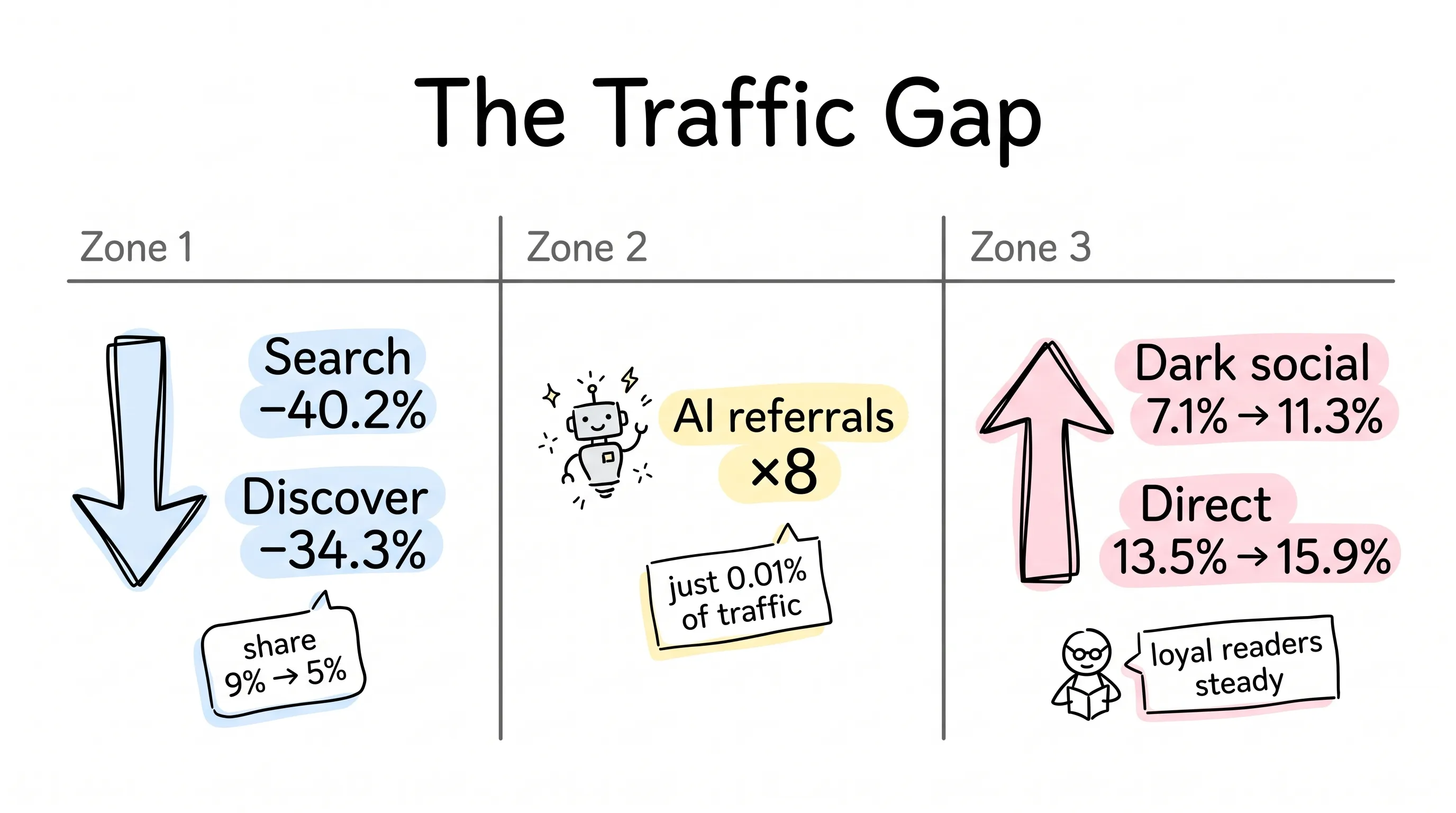
💬 Implication for traffic budgets: don't count on AI channels to plug the search gap—a 0.01% slice cannot absorb a 40% decline. Move budget toward assets you can own: email lists, apps, communities. Loyal-reader value belongs in the report—return-visit days, not new UVs, should sit on the first line of the weekly report. 🔗 Further reading: Read the full article
Search Console splits out multimodal traffic—visual search officially visible for the first time
Google announced on September 24 that Search Console Performance reports add a multimodal filter, covering Google Lens, Android's Circle to Search, image uploads, and Chrome's right-click image search, rolling out globally. Data falls under the Web search type into a text-based versus multimodal split; multimodal traffic provides no query data (searches are image-led) and can only be exported and analyzed at the page level. The split is being extended to the generative AI performance report that reached full rollout at the end of August. For ecommerce sites dense with product images, page traffic from image search versus text search can now be compared by country and device. Google has not said whether historical data is backfilled or whether the new split affects existing Web totals—verify by comparing on your own.
💬 Ecommerce teams, this week's move: build a multimodal traffic baseline for your key product pages, split by country and device—from now on, product image quality has traffic attribution. If image-search clicks exceed 10% of your category's mix, put alt text and hero image updates on the schedule; that's the first dividend of visual SEO. 🔗 Further reading: Read the full article
🏷 Marketing Ops & Data
Bad CRM data costs 62% of marketing teams real money
A diginomica commentary cites Validity's survey of 500 marketers: 62% have suffered direct revenue losses from poor CRM data quality, only 25.6% say their data is 76% to 100% complete and accurate, nearly half spend 2 to 10 hours a week on manual cleaning, and 68% have had performance figures challenged or retracted because of underlying data errors. The more alarming combination: 44.7% of organizations let AI send campaigns, score leads, and reallocate budgets with no human review at all—bad data meeting unsupervised agents amplifies compliance and trust risk. Adobe's 2026 AI and Digital Trends report cross-confirms: 75% name data integration and quality as the top challenge for agentic AI adoption, yet only 32% put data quality among investment priorities. The author's judgment: boards look at dashboards, not databases; bad-data losses accumulate as a hundred small failures, and by the time they surface in a report, they are already hard to contain. Organizational knowledge is another hidden risk surface—wrong product information reaches customers directly through AI assistants.
💬 Ops move: add two human review points to AI outreach flows—a pre-send sampling check on campaigns and a lead-scoring review—live within a week. When reporting to management, lead with the revenue-loss numbers, and move data governance budget from nice-to-have onto next year's must-do list. 🔗 Further reading: Read the full article
AI personalization from concept to execution: the guardrail checklist in a 10-step framework
CRM Experts Online's playbook offers 10 strategies for why personalization fails in complex customer journeys. The starting point is data—enterprise customer data is scattered across 15 to 25 systems, so resolve identities before adding AI. Benchmark figures: segmented campaigns generate 760% more revenue than non-segmented (HubSpot); triggered messages convert 624% better than batch-and-blast; predictive targeting lifts conversion 20% over demographics alone; sessions with AI recommendation modules show 369% higher average order value; and Sandler cut its sales cycle 50% after using CRM-context-aware agents for outbound calls. Klarna uses AI for 80% of its copy, saving $6 million in image production costs; Kroger sends 1.9 billion personalized coupons across 150 million touchpoints. Guardrails should be embedded in the workflow: pause marketing outreach across channels when a service ticket is open, validate consent status in real time with every event, keep audit logs of decisions, and force handoffs to humans on negative sentiment. Measurement shifts to uplift modeling with a standing holdout control group; mature orchestration shops report revenue up 10% to 20% and costs down 15% to 25%.
💬 Lifecycle teams, copy the guardrails before chasing intelligence: write the three rules—service-ticket suppression, consent status propagation, and audit logs—into your automation flows; live within a week. Switch the effectiveness lens to uplift and holdouts at the same time, and stop proving personalization works with impressions and open rates. 🔗 Further reading: Read the full article
💡 Today's Big Picture
Putting today's 20 stories side by side, the main theme is agents acquiring executive power. Phave lets AI decide who gets which email; Muse places orders in Shopify stores on people's behalf; Mastercard is building the payments and trust foundation for agents; Amazon hands its seller console to a Claude plugin; Apostra lets advertisers' agents negotiate directly with media-side agents. Five moves from different lanes point to the same thing: software has shifted from assistive tool to transaction executor, and what marketers compete on next is no longer the acquisition interface but the agent's recommendation function.
The second line is drawing the human-machine boundary. HBR's large-sample experiment puts the effectiveness gap at 14% and 17% with four disciplines; B2B brands counter AI slop with human-expert video; AI influencers fail in low-trust categories; creators start demanding equity instead of fees. The common signal: hand routine, batchable work to AI, and keep trust and emotion with people. Both the upside and the downside on this line have already been priced in concrete numbers.
The third line is measurement reconstruction. Google officially concedes Search Console's AI data is distorted; publishers' search traffic decline widens to 40%; multimodal traffic is split out on its own for the first time. Old reports misread the new world, and position and impression metrics are ceding ground to citation rates and conversions.
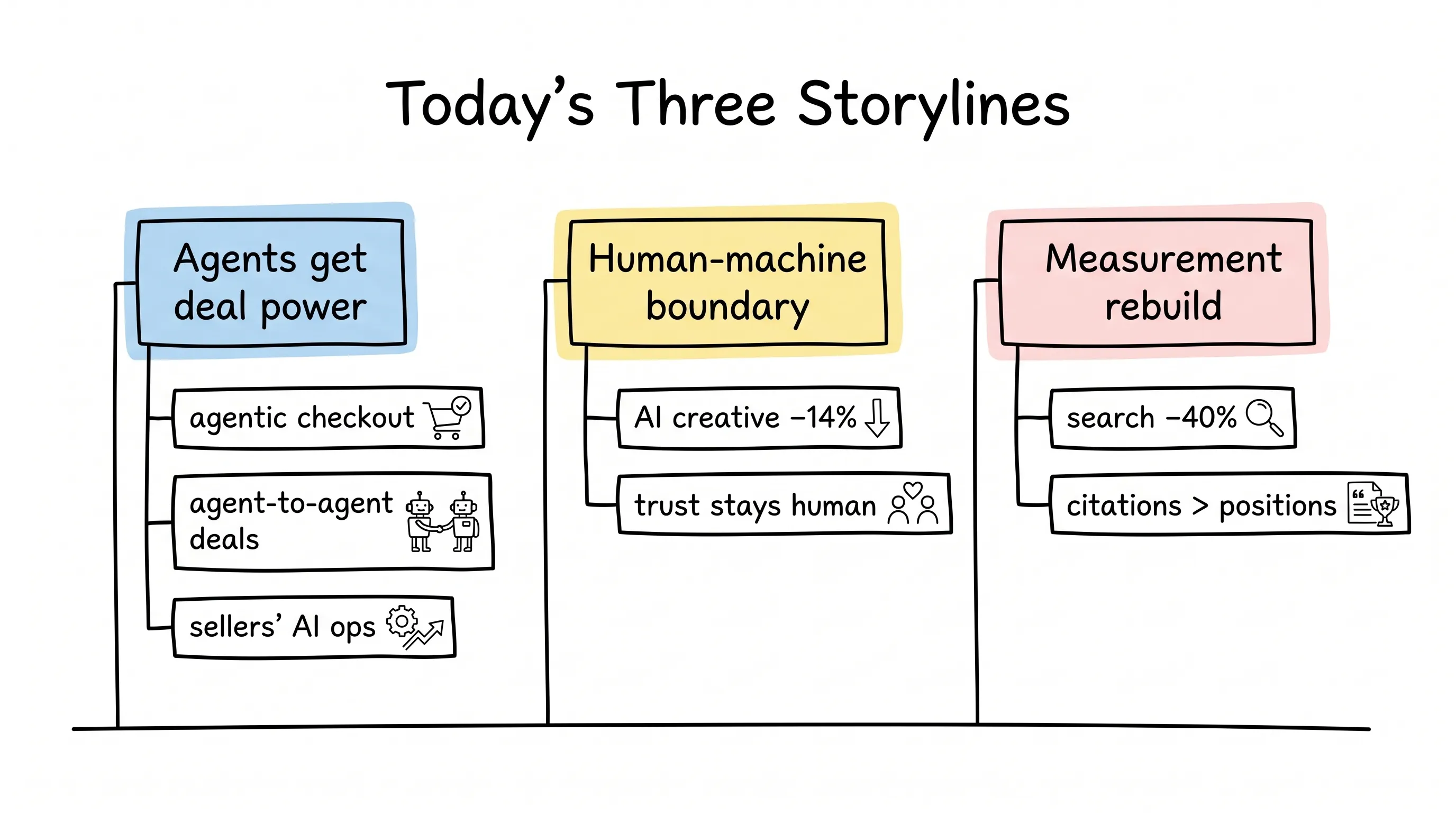
Three things for marketers: audit which automation rules are true governance and which should go to reasoning; turn brand equity into agent-readable structured signals; reset your reporting lens to check outcome metrics before traffic. None of the three needs to wait for budget—work can start this week.
Continue reading
Related articles

AI Marketing Daily · 2026-10-09
AI marketing daily for 2026-10-09 covering 11 items: brand measurement moving from survey panels to search, social, e-commerce, and AI prompt signals; GEO and share of model playbooks; safety guardrails for agentic ad buying; and tool roundups for ad platforms, cross-border tools, and social media uses.

AI Marketing Daily · 2026-10-08
AI Marketing Daily for 2026-10-08 curates 20 items across AI search visibility (GEO), advertising, platform selection, cross-border e-commerce, and ROI measurement. The headline argues that strategic marketing decisions should stay with humans while AI assists execution.

AI Marketing Daily · 2026-10-07
Today's throughline is answer engine optimization (AEO — getting your brand quoted in AI answer engines).