
AI Marketing Daily · 2026-09-24
Daily digest covering organizational memory as a marketing edge, Jon Miller's Phave automation platform, a multi-agent fact-checking workflow, HubSpot's AEO measurement guide, AI search's impact on e-commerce queries and feeds, and reported cross-site tracking in ChatGPT ads.
Today's throughline is old problems rebuilt with AI. MarTech uses three data points from Gartner, Forrester, and IDC to move marketing's moat from tools to organizational memory; Marketo co-founder Jon Miller returns after two years in stealth to rebuild marketing automation with a reasoning engine and playlists; OpenAI carries third-party cookie logic into ChatGPT ads, and compliance questions come to the table with it; the AEO (answer-engine optimization) measurement space gets its first systematic buying guide; and AI search's impact on e-commerce gets quantified as 6 words versus 24. Six of the seven items are rebuilds at the tool, system, and traffic layers; the seventh is a reminder that drags those rebuilds back to the compliance table. Managers should read the top story in full, tools-first readers can jump straight to the marketing tools section, and media buyers should start with the policy item.
🎯 Top Story
The Real Advantage in the AI Era: What Your Company Already Knows
Bylined MarTech columnist Tanya Thorson makes a call: once AI evens out execution speed, a marketing organization's competitive advantage no longer comes from which tools it uses, but from what the organization already knows. She cites three sets of data. Gartner's 2026 CMO Spend Survey shows CMOs have put 15.3% of budget into AI, but only 30% of organizations have mature AI readiness. An August 2026 Forrester report finds 88% of B2B marketing organizations have already adopted AI tools or built their own, while marketing leaders widely complain of unclear strategy, hard-to-measure results, data infrastructure that can't keep up, and an inability to say where AI should actually be used. IDC predicts that by 2028, 62% of traditional demand generation will be AI-led. The three sets of numbers point at the same crack: the pace of tool adoption has outrun the skills and context-building that make tools useful. The money is spent, the capability hasn't caught up, and that missing middle is what Thorson's whole column is about.
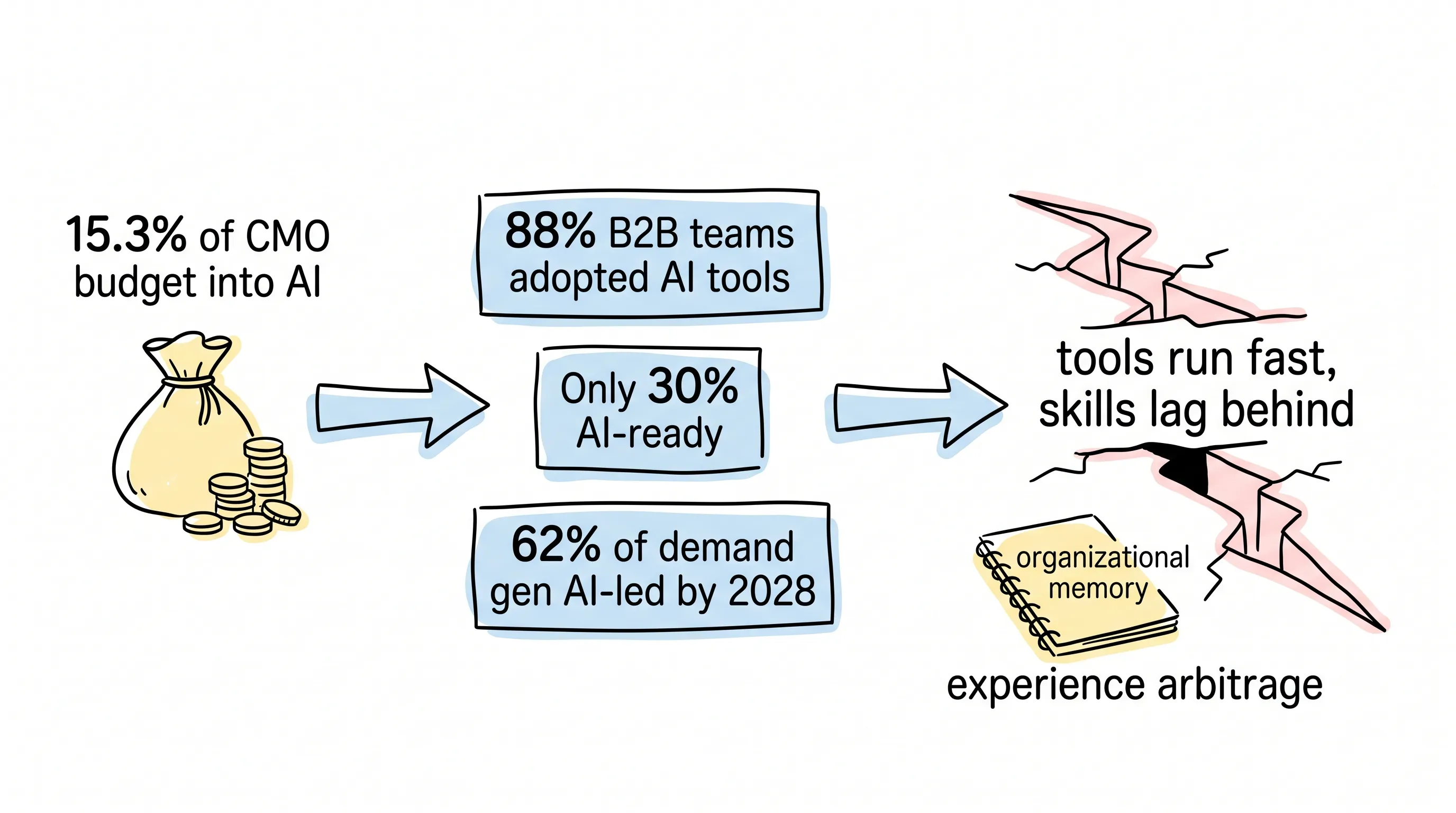
Why do these numbers matter so much more than "yet another company adopted AI"? Prompts get idolized because they're tangible — you can see and touch them. But a prompt is only the last line of a long conversation. Same model, two marketers asking similar questions, both walk away with passable answers. What actually separates them is knowing what to ask next, what information is missing, and which answer will genuinely help the buyer. An answer that is technically correct but strategically wrong can only be spotted by someone who has accumulated category judgment. That kind of context hides in customer conversations, in the objections sales hears most often, in test hypotheses that got disproven, in retrospective meetings. Most companies hold plenty of this knowledge; it's just stuck in people's heads, in Slack threads, in call recordings and old slide decks, never becoming an asset you can call on. AI amplifies exactly what you feed it: a shaky audience assumption, run through an automation pipeline, turns into dozens of assets, a few automated journeys, and a pile of personalized variants — and by the time someone stops to question the premise, the error has already spread at scale.
For marketers, the impact concentrates on management practice. Thorson's fix is to turn decision rationale into a process: at the end of every campaign, press on five questions — what did we believe would happen, what buyer signals backed that judgment, what actually happened, what changed along the way, and what should we change next time. Write the answers down, and organizational memory stops evaporating when the meeting ends or people move on. Once decision logic, customer signals, tests, and results are documented, experience becomes something the organization can retrieve, combine, and reuse. She calls it experience arbitrage. The experience was always there; technology just widens the range where it can create value. The cross-team value compounds too: merchandising's understanding of customer behavior can feed digital journey design, the common objections sales has mapped can shape content strategy, years of customer interviews can become a buyer-language library — product, service, sales, and marketing knowledge start working together instead of each defending its own silo.
For marketing leadership, it lands as a hard requirement: every campaign must produce two outputs — the work itself, and the learning itself. How to put it to work — three things you can start this week. First, give retrospective meetings a fixed template — all five questions, none skipped — and file the output in the team knowledge base rather than the chat history. Second, compile sales's common objections, the complaints that come into support, and the hypotheses disproven by past A/B tests into context documents, and feed them straight into the AI workflows the team uses daily, so there's accumulated substance behind every prompt. Third, check whether your tech stack can remember things: can it capture customer conversations, retain decision rationale, connect sales and product intelligence, and make trusted third-party evidence available on demand. The external pressure is ready-made: another Gartner survey found 49% of US consumers think generative AI has made content quality worse, rising to 57% among Gen Z and millennials — consumer skepticism about the media environment is deepening. Output volume is no longer the differentiator; a recognizable point of view and credible evidence are.
My read: this column ships no new tool, but the question it answers matters more than any new tool. When 62% of demand generation is AI-led by 2028, and the buy side is using machines to filter and compare brands as well, the quality of the context you feed the system becomes the customer experience itself — which is why the rest of today's items are worth reading in sequence. Thorson's closing line deserves a spot on every marketing technology leader's desk: we used to ask what technology can do for marketing; the more useful question now is what marketing has taught technology to know. When managers forward this piece to their teams, attach that question — teams that can't answer it will be left behind at the next budget review by competitors who can.
🔗 Further reading: Read the full article
🏷 Marketing Tools
Marketo Co-founder Returns with New Platform Phave, Rebuilding B2B Marketing Automation Around a Reasoning Engine and Playlists
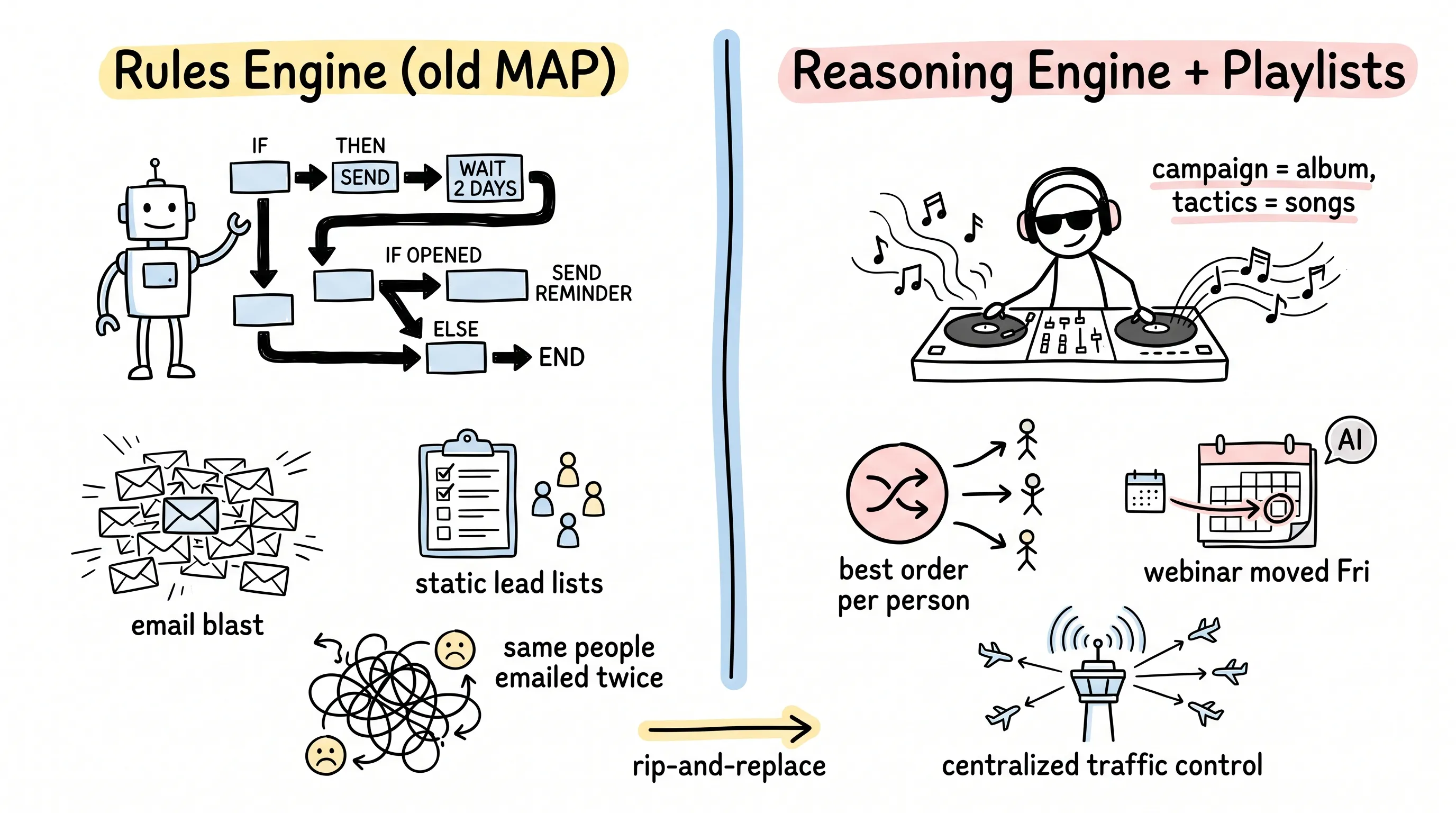
Marketo co-founder Jon Miller is back in the category he helped define, officially launching the new platform Phave on September 23. Two years in stealth, now running marketing operations at 10 companies. This is not another point tool stacked on top of legacy systems — Miller's team built it as an enterprise-grade rip-and-replace. Rules, Miller told MarTech, are good at handling what must be true, but they can't handle ambiguity or judge which option is better — and B2B buying is precisely ambiguous and complex. The traditional MAP (marketing automation platform) is structurally mismatched: group decisions, anonymous research, and post-purchase retention management are now the norm for buyers, while the system stays anchored to static leads, linear campaigns, and hand-built rules. Marketers put up with these outdated assumptions not because they're satisfied, but because there was no decent alternative. Miller's account of the decay is specific: MAPs once promised to help B2B companies identify, nurture, and convert prospective buyers at scale, but over time they degraded into rigid rule systems — marketing teams used them to flood buyers with endless email streams, and the complexity of B2B decision-making got dropped along the way.
Phave's redesign has three parts. Contacts, target accounts, and buying groups are all first-class objects, each carrying an intent score and customized journeys — a thread that carries forward Miller's account-based marketing work at Engagio, which sold to Demandbase in 2020. An AI reasoning engine replaces static rule triggers: teams no longer hand-configure every edge case into a rules engine, and the system reasons from context about what to do next. Campaigns become playlists — Miller's analogy is that a campaign is the album and tactics are the songs; AI doesn't generate a new tactic for each person, it dynamically mixes the existing tactics in the best order for each individual. A buyer who always opens email on Tuesdays and never attends webinars gets remembered, and subsequent touches adjust automatically. Playlists also settle a long-standing marketing-ops headache: multiple teams accidentally emailing the same people twice. Phave acts as centralized traffic control: when a high-priority product launch needs to reach an account on Wednesday, the overlapping webinar invite automatically moves to Friday.
The platform is built for agent interaction, exposing 319 tools through MCP (Model Context Protocol), so external AI agents can call them directly instead of depending on a human clicking through dashboards. Marketing ops can write custom skills to constrain agents to execute per organizational norms — campaign naming rules, UTM structure, standard workflows — and agents comply automatically at execution time; nobody has to enforce the rules by hand every time, and new hires don't have to memorize the naming conventions first. Early users are building campaigns 2 to 3 times faster. The design previews what Miller sees as the next era: the way marketers interact with software shifts from clicking through dashboards by hand to directing agents to do the work.
💬 How marketers can use it: teams being ground down by nurture email streams and rules engines shouldn't rush to buy — first test whether the playlist idea can be imitated by hand inside your current MAP: break campaigns into a tactic library and sequence by account context; that step costs nothing. In procurement evaluation, shortlist it as a next-generation MAP candidate, and focus validation on whether the 319 MCP tools are compatible with your existing agent workflows, and on the decision explainability of the reasoning engine — B2B teams need to know why the system ordered things the way it did.
🔗 Further reading: Read the full article
Marketing AI Institute Opens Up Its Multi-Agent Fact-Checking Workflow: Humans Move from Reading Everything to Reviewing a Checklist
Marketing AI Institute shared the multi-agent fact-checking and proofreading workflow its content team has running — a rare first-hand practice already proven in a real workflow. The process has three layers. Layer one splits a long document by topic and hands the pieces to different agents for parallel checking; Codex, Claude, and similar platforms can all run it, compressing a one-hour solo read-through review down to a few minutes. Layer two has another agent re-review the first round's flags, hunting for two types of problems: missed facts that still need checking, and so-called corrections the evidence can't support — that forms the cross-validation. Layer three outputs a structured list: claims to verify, listed by section with source links attached, with high-confidence typos separated from items that need human judgment.
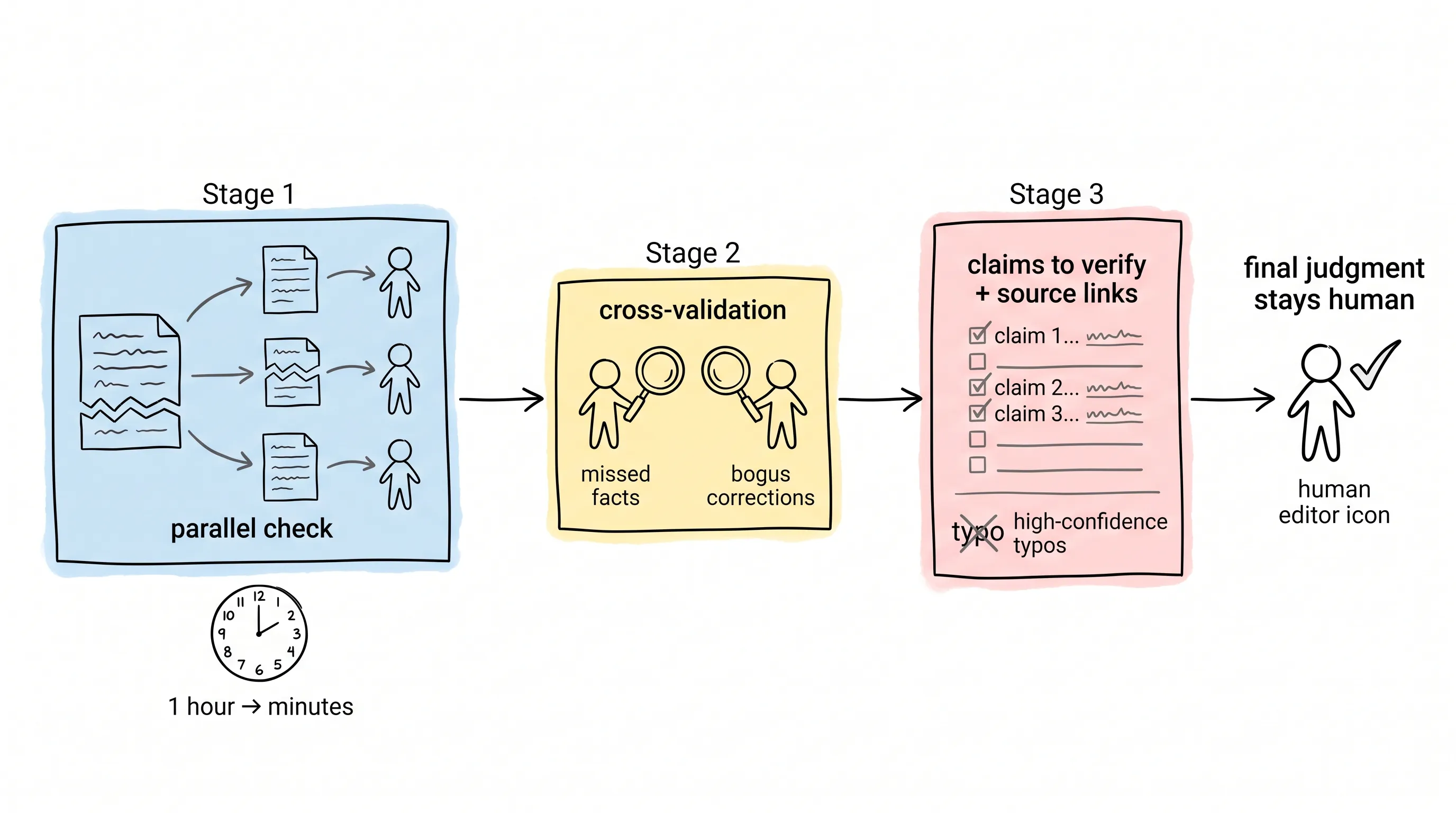
Where this pipeline is truly valuable is the structured output. Human work compresses from reading the whole text to reviewing flagged items: the editor's attention goes only where there's doubt, fact-checking a research report drops from half a day to around half an hour, and every fact pending verification comes with a source link, so reviewers no longer have to hunt down evidence themselves. The article also gives a warning: AI makes mistakes, and multiple agents can be wrong in unison, because their training data shares the same origins — the same hallucination can get endorsed by two agents in sequence, looking like double confirmation when it's the same single error. Cross-validation lowers the error rate but can't bring it to zero; final judgment stays in the human editor's hands, and no AI review layer replaces editorial responsibility. The adoption path is gradual: start with proofreading, where correctness is easy to verify — typos and grammar, where AI's right-or-wrong is visible at a glance; step two adds source verification, with agents attaching provenance to every key figure; step three is where parallel-agent fact-checking comes in. Apply it first to high-stakes content like client reports and research memos; blog posts and social updates can come later — low risk, high tolerance for error.
💬 How marketers can use it: this week you can add two gates to your content SOP. Before publishing, run one agent fact-checking pass that outputs a to-verify list plus source links; the second gate has a human — or another agent — re-review the flagged items, specifically hunting missed flags and bogus corrections. Start with whitepapers and client reports: these carry the highest cost when they blow up, and the rework time saved is the most substantial. Watch the splitting granularity: cutting the document into a few topic-based independent checking blocks inspects more finely than throwing the whole piece at one agent.
🔗 Further reading: Read the full article
Measuring AEO Visibility: HubSpot Offers a Manual Detection SOP Plus a Tool-Buying Framework
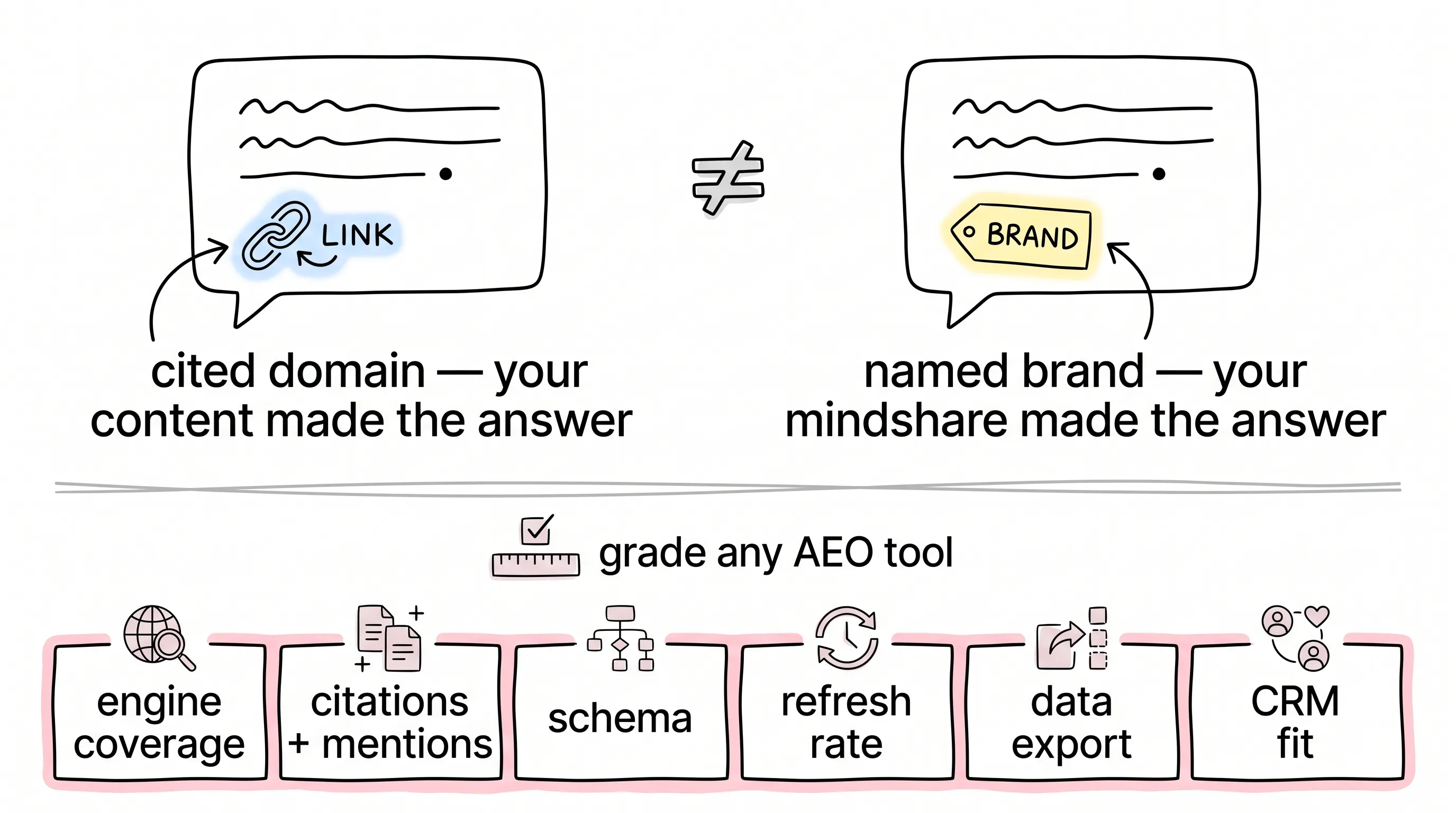
HubSpot's long-form guide, updated for 2026, covers how to measure your brand's visibility inside ChatGPT, Perplexity, Gemini, and Google AI Overviews. It starts with the manual detection method: compile a list of brand terms and buyer questions, run each one through an incognito session, and log whether the AI Overview (AIO) triggered, whether it cited you, what it cited, and how it described you. AIOs fluctuate session by session — a single absence only triggers a recheck, it doesn't constitute a verdict. Search Console still can't isolate AIO data on its own; the dedicated GenAI reports rolling out in batches since June 2026 currently contain impressions only, with no click data. For ChatGPT and Perplexity, detection has to separate two independent signals: the domain that gets cited, and the brand that gets named — two different ways of winning. A cited domain means your content made it into the answer; a named brand means your mindshare made it into the answer. AEO and SEO are complementary: SEO competes for link rankings, AEO competes for mentions and citations inside answers. What an AEO checker actually does is turn your presence across the answer engines into trackable metrics: trigger rate, citation share, brand mentions, and whether the framing is positive or negative.
Then comes the tool-buying framework, six dimensions: engine coverage (ChatGPT has 900M weekly actives and Gemini 1B monthly — coverage directly determines how many answer scenarios you can see), dual detection of citations and mentions, schema validation, refresh frequency, data export, and CRM workflow fit. Those six dimensions are themselves a scorecard — use them to grade any newly emerged AEO tool. On the tool comparison: Ahrefs Brand Radar is based on real search queries, $199 per engine per month; Semrush AI Visibility is $99 per domain per month; HubSpot AEO is $50 per month and strongest on CRM integration; Profound is strongest on citation context and sentiment analysis, suited to studying how brands get evaluated inside answers. One caution: HubSpot has a tendency to push its own tool, so cross-validate pricing and capability claims before entering procurement. The good news is that the measurement methodology of the AEO space itself has stabilized — the combination of manual detection plus tool readings is something teams of any size can assemble.
💬 How marketers can use it: don't buy tools yet. Run the manual detection method for two weeks and build a baseline table of brand terms plus buyer questions — you'll first see which queries have you in the AIO and which don't, and that is your optimization list. Pick tools only after the baseline exists; only then do the differences in the $50–200 monthly range mean anything. In selection, weight CRM integration lower and citation-detection coverage highest, because citations are AEO's most direct source of traffic.
🔗 Further reading: Read the full article
🏷 Industry Trends
AI Search Rewrites E-commerce: Queries Grow from 6 Words to 24, and Feeds Become the New Front Line
MarTech's podcast page recaps the conversation with Opiversal CEO Lucas Tieleman, and the shock AI search delivers to e-commerce comes with several quantifiable points. Traditional Google searches average about 6 words; LLM-driven searches average about 24. Consumers no longer compress their needs into keywords — they ask complete questions that carry their use case: not "running shoes men," but "I run three times a week, my knee has an old injury, my budget's 1,500 — recommend the right shoe." This sets a new bar for whether product content can catch long questions: conversational attributes and use-case descriptions on the page work better than keyword stuffing. Autonomous shopping agents aren't yet actually placing orders on people's behalf, but LLM crawlers have already pushed bot traffic on retail sites up significantly — impression and sales measurement needs recalibration, and if you don't split them apart you'll read the conversion-rate baseline wrong. Tieleman's judgment for retailers is direct: most of the catalogs and product pages online retailers publish today were built for the old era of six-word queries and a page of blue links.
The key to discoverability shifts from pages to feeds: retailers have to feed highly structured data, conversational attributes, and detailed FAQs directly to AI and ad platforms — that's the admission ticket to the new front door, and without it AI simply cannot put your products into answers. Ad platform delivery logic is shifting along with it: feed completeness and freshness are starting to affect distribution priority. The word "forever" in the article's title lands on this judgment: AI pushes the marginal cost of content production to near zero, and batch-generating custom landing pages off social media trends goes from impossible to routine — catch one rising trend and you can put a batch of targeted pages live within days. Tieleman also leaves one contrarian line: marketing's biggest lie is that only one right answer exists. New technology lets teams run trial and error more efficiently — and be wrong more efficiently, too. Failing fast is itself an advantage, provided you write down in the retrospective where it went wrong. Read that line together with the top story and it clicks: the output of trial and error either becomes conversion or becomes organizational memory; only teams that win on both ends dare to experiment at scale.
💬 How marketers can use it: e-commerce teams should audit feed quality first this week. Check whether product structured data carries enough conversational attributes — use cases, fit-for audiences, common questions — which determines your AI-side discoverability; compare one competitor product page's attribute table and the gap becomes obvious. Split bot traffic out and look at it separately; don't let it pollute the conversion-rate baseline. Trend landing pages can be tried in small batches — validate one trend first, then scale up; don't go straight to full-volume generation.
🔗 Further reading: Read the full article
AI Rewrites the Customer Journey: From Funnel to Influence Map, a Three-Layer Mechanism Breakdown (Framework Reference)
This Influize piece is evergreen content updated in January 2026 — the mechanics are explained completely, which makes it suitable as internal team training material. The framework's starting point is BCG and Google research: the consumer journey is no longer a linear funnel but an influence map, crossing 130+ mobile touchpoints per day in repeating loops of streaming, scrolling, searching, and shopping — one person might get seeded by a short video in the morning, search and compare over lunch, and order at night. Traditional attribution models largely fail in this loop. AI steps in at three layers. Intent detection layer: stitches micro-behaviors across touchpoints into purchase signals — lingering on a pricing page, rewatching a product video, adding an item to favorites and deleting it. These micro-moments are the conversion triggers traditional analytics tools miss most easily, and missing them means missing an entire layer of users about to convert. Real-time adaptation layer: triggers win-back within seconds of cart abandonment; response speed is counted in seconds — by the time a next-day recovery email goes out, the moment is long gone, and what competes here is data-pipeline latency. Prediction layer: forecasts churn and purchase probability, adjusting messaging and offers automatically — high-probability buyers get less interruption, wavering customers get one more reason.
The article lists three conditions for brands: full-journey visibility, context-matched content rather than sheer volume, and a tech stack that can respond — not one that only knows how to broadcast. It also breaks down industry differences: e-commerce weights cart-abandonment win-back and recommendations; SaaS weights trial conversion and churn prediction; services weight inquiry response speed; education weights intent capture on enrollment leads. The article also lays out the KPI logic an AI journey should track: micro-moments captured at the intent layer; trigger latency and win-back rate at the response layer; churn-prediction accuracy and incremental revenue from offer adjustments at the prediction layer. For small businesses, the article's path is to start with intent detection on one channel, get it running, then add the second layer — don't lay out the full journey from the start. Worth flagging: this is agency evergreen content whose news value has aged — it works better as a framework reference than as news. The context accumulation discussed in today's top story is exactly the fuel this machinery runs on; without organizational memory, the three-layer mechanism is all castles in the air.
💬 How marketers can use it: apply the three-layer framework directly as a funnel health check. Intent layer: check whether your event tracking can catch micro-moments like pricing-page lingering. Response layer: measure win-back trigger latency after cart abandonment. Prediction layer: see whether a churn model is running. The easiest of the three layers to pick up cheaply is the first — just fill the tracking gaps and it starts paying off. Start there.
🔗 Further reading: Read the full article
🏷 Policy & Compliance
ChatGPT Ads Reported Testing Cross-Site Tracking: __obi Cookie Persists Up to a Year, Consent Language Worth Scrutiny
Independent researcher Buchodi found that the __obi cookie associated with ChatGPT can persist in a user's browser for up to a year. When that browser visits a site using OpenAI's ad pixel, the request sent back to OpenAI carries the same identifier, together with page and conversion data. In essence this is third-party cookie logic reproduced in the ChatGPT ads context — the technology isn't new; what's new is the carrier: this happens on a chat platform. The research did not observe the last step, the server side linking on-ad-site behavior to a specific ChatGPT account. But the path where the same OpenAI identifier sets out from ChatGPT, passes through advertiser sites, and returns to OpenAI has already been proven to work end to end.
For marketers, this means ChatGPT ads may get fuller conversion measurement — in a channel where performance metrics are scarce today, that would be a good thing in itself. For users, the chat scenario exposes far more personal information than search and social: what users write to ChatGPT asking for help often carries their profession, health, and financial situation. Connect chat behavior with off-site behavior, and the consent-and-disclosure dispute gets sharper than with traditional cookies. The same browser act, occurring in a search engine, is a query; occurring in a chat window, it is a self-disclosure — the sensitivity of the two is not on the same level. The categorization deserves scrutiny too: OpenAI labels __obi as an analytics cookie, yet Buchodi found that even when a user rejects marketing cookies and consents only to analytics, this cookie can still be written. A user's reasonable understanding of "analytics" is product measurement, not cross-site ad attribution — the two are a legal category apart. OpenAI had not publicly responded when the research was published. MarTech's judgment is that this means ChatGPT must face personal-information regulators across jurisdictions — most likely not the kind of government attention OpenAI wanted. It is also a caution for the entire AI advertising space: the moment a platform turns model capability into an ad product, it has to accept scrutiny by ad-platform rules — the old boundary between model vendor and ad platform no longer holds under the regulatory lens.
💬 How marketers can use it: before running ChatGPT ads, add two items to the due-diligence list. One: have legal review OpenAI's cookie consent design and assess knock-on compliance risk under GDPR — don't let a channel windfall turn into a fine. Two: plan on the data side in advance — keep ChatGPT-channel conversion attribution on a separate basis from other channels, so the cross-site tracking dispute doesn't spread to your reporting credibility. Teams already running ads should do a one-time check of the consent statement on the pixel deployment page this week.
🔗 Further reading: Read the full article
💡 Today's Big Picture
Read today's seven items together and there is a hidden thread: AI is redoing every link of marketing, but the direction of each redo differs. The top story is about the moat shifting: once execution is evened out, what's valuable is organizational context. Phave is about system rebuilding: when rules engines can't hold the ambiguity of B2B buying, decision power passes to reasoning models. The AEO tools piece is about measurement rebuilding: once answer engines divert search traffic, you have to be able to measure before you know how to optimize. The e-commerce piece is about entrance rebuilding: queries grow from 6 words to 24, and feeds replace pages as the front line of discoverability. The fact-checking workflow is about process rebuilding: humans retreat from reading the full text to reviewing a checklist. The customer journey piece is about response rebuilding: from broadcast to second-level triggers.
One of the seven is a counter-signal: OpenAI's cross-site tracking reminds everyone that every link in the rebuild is collecting more personal data, and compliance due diligence has to come to the table along with it — a channel windfall and a fine can be one regulatory action apart; for teams already running ChatGPT ads, this one is a this-week to-do. There is also a timeline reminder: the customer journey piece is January evergreen content, and the mechanics it describes still hold today — which is exactly the point that journey rebuilding is hardly a new topic; it has been underway for a while, and today is only acceleration. The advice to leadership, compressed into one sentence: this cycle, don't rush to buy new tools — first take stock of what your organization remembers, what it measures accurately, and how clean the data you feed AI is. Tools will keep turning over, generation after generation; these three foundations decide whether a tool swap is an upgrade or a reset. 49% of consumers already say AI content has gotten worse; among younger consumers it's a starker 57%. Next cycle's differentiator truly isn't output volume — it's what you know, and whether you can get technology to remember it. Start this week with the retrospective template: lowest cost, fastest payoff — the retrospective of a single campaign is enough to let the team taste the payoff of organizational memory.
Continue reading
Related articles

AI Marketing Daily · 2026-10-09
AI marketing daily for 2026-10-09 covering 11 items: brand measurement moving from survey panels to search, social, e-commerce, and AI prompt signals; GEO and share of model playbooks; safety guardrails for agentic ad buying; and tool roundups for ad platforms, cross-border tools, and social media uses.

AI Marketing Daily · 2026-10-08
AI Marketing Daily for 2026-10-08 curates 20 items across AI search visibility (GEO), advertising, platform selection, cross-border e-commerce, and ROI measurement. The headline argues that strategic marketing decisions should stay with humans while AI assists execution.

AI Marketing Daily · 2026-10-07
Today's throughline is answer engine optimization (AEO — getting your brand quoted in AI answer engines).