
AI Marketing Daily · 2026-09-23
Daily AI marketing digest for 2026-09-23 covering IAB's agentic ad buying standards, KNOREX's commercial agentic Ads API, a nine-platform ad automation comparison, GEO methodology, genAI marketing risks, and market data on influencer marketing and cross-border e-commerce.
Today's lead story goes to CMOs: budgets are flat while growth targets aren't, and a MarTech column's answer is to deploy AI as a forced cost-reduction lever. On the infrastructure side, two signals landed the same day: IAB is setting standards for agentic ad buying, and KNOREX has pushed its agentic ads API into commercial use. On the tooling side, four selection and monitoring resources dropped at once, while the data side brings three market roundups covering influencer marketing and cross-border e-commerce. Everything below unfolds in four sections — agentic ads & standards, marketing tools, practical methods, and industry data — each item with a hands-on take and an entry point to the source.
🎯 Top Story
Flat Budgets, Growth Still Demanded: MarTech's Three-Step Playbook for CMOs — AI Becomes the Forced Cost-Cutting Lever
On September 22, MarTech ran a column by Mike Ruff, Media+'s director of analytics and technology, and the scene it paints is very concrete: a cohort of CMOs walks into 2027 carrying their 2026 budgets, while the board still expects growth. The author says it plainly: when CPM, CPC, CAC, and inflation are all climbing, a flat budget is in effect a cut. He offers a farming metaphor: once you stop sowing, everything in the field looks normal for a while — crops still grow, harvests still come in — and the trouble only erupts at the next harvest, when there is nothing left in the ground to reap. Holding a flat budget for one year is survivable; string together several years and you have to change your approach. The article lays out three steps: protect the investments that are already working, find bigger efficiencies inside operations, and go ask finance for investment before the debt comes due.
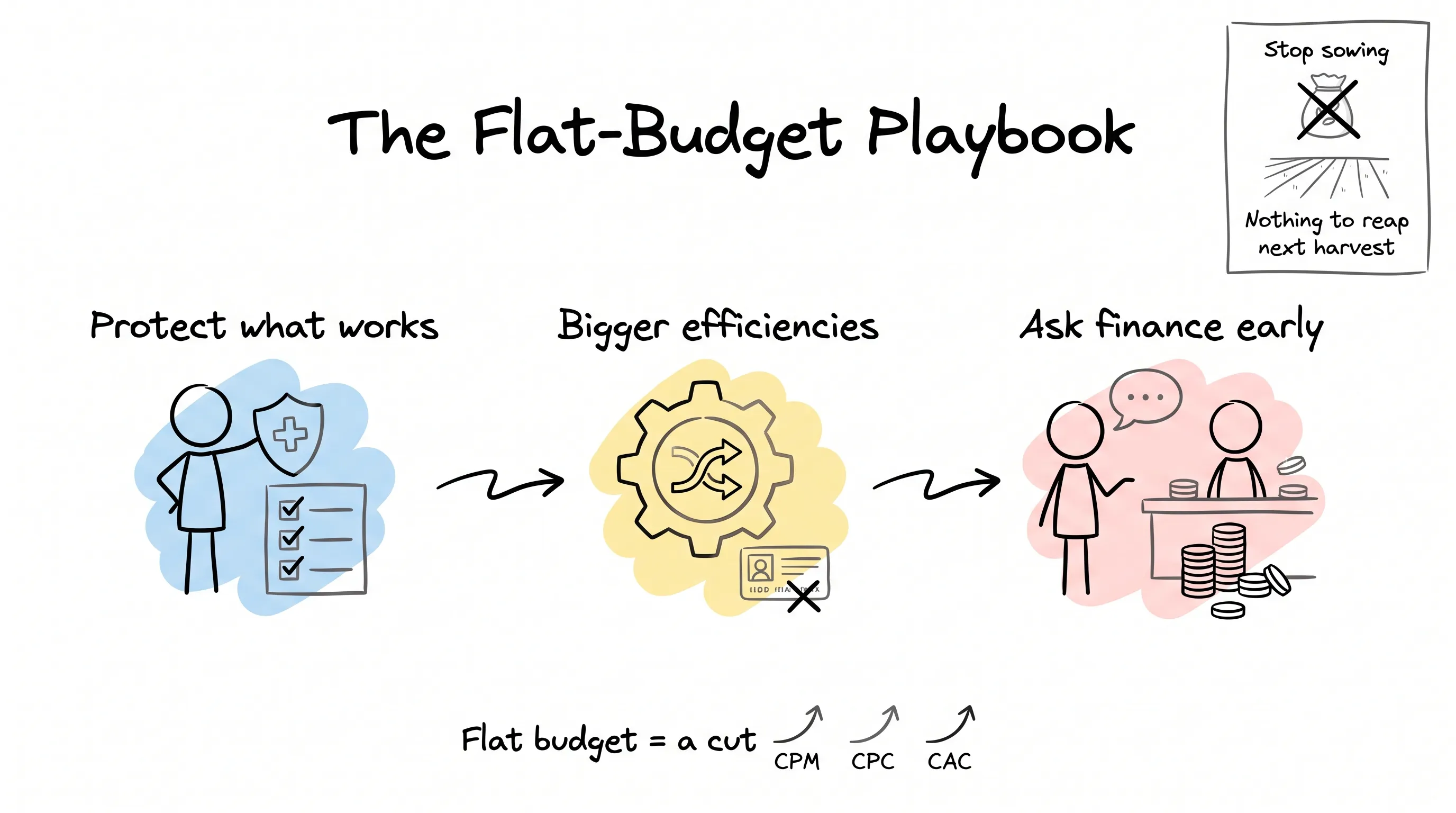
Why is this piece worth a close read? Because it is remarkably blunt about where AI sits during a budget squeeze. In year one of a flat budget, optimization can carry you through: defend the lower- and mid-funnel programs already proven to work, and let the upper funnel take the hit first. The author invokes the Kahneman–Tversky experiment to warn against shutting down experimental campaigns in one sweeping cut driven by loss aversion — in that famous study, on a fifty-fifty $100 bet, participants on average demanded a potential win of $200 before they would take it. The real turning point arrives after multiple flat years. In the author's words, optimization won't save you — the scalpel has to give way to the machete. That is when organizations bet heavily on AI for workflow automation and content production. The organization has little room left to choose; budget stagnation becomes the very hand pushing it to accept AI replacing manual processes.
Getting specific about roles and workflows, this playbook has two layers. In the first flat year, it's protection plus fine-tuning: on the software side, merge platforms with overlapping capabilities, cancel idle licenses, renegotiate expiring contracts; on the staffing side, assess whether work handed over to agents plus AI can be left unbackfilled. After multiple flat years, you restructure: first, drive down operating overhead; second, re-evaluate agency relationships. On that second point the article cites a 2026 ANA report and lands on a restrained conclusion: there is no universal answer between in-housing and outsourcing. You must run a value-to-value, fully loaded cost comparison — monetize the agency's discounted rates, added-value resources, mature teams, and tech stack, then weigh them against what building in-house would cost. Simply axing the agency and switching to in-house is the lazy answer.
How to act on it — three things you can start this week. First, pull a vendor list and answer four questions: can same-capability software be consolidated into one platform, are any licenses sitting idle, which work can be handed to agents plus AI without backfilling the role, and which contracts can be renegotiated. This housekeeping was routinely skipped in the years when budgets only went up — now is exactly the time to catch up on it. Second, set aside a small dedicated pool for experimental campaigns; don't let loss aversion press the kill-everything button for you. These exploration slots are next season's crops. Third, work with your analytics team to quantify how budget shortfalls push CAC up and erode market share, reframing marketing from a cost center into a growth multiplier, and bring that chart to the next budget conversation with your CFO. The author has also written a dedicated piece on aligning with the CFO that pairs well with this one. Teams already two straight years into flat budgets should greenlight two projects outright: an AI workflow automation audit, plus a full-cost review of agency relationships.
My read: the real signal here isn't the playbook itself but the author's tone — there is no retreat from going heavy on AI. In the years when budgets flatten, the marketing organization's default moves are shifting from adding headcount and tools to consolidating, automating, and renegotiating contracts. That is a tailwind for AI efficiency-tool vendors and a headwind for traditional teams that stack delivery on human labor. Run your own efficiency numbers before you walk into finance; get the order wrong, and all you bring to the negotiating table is a request, with no evidence behind it.
🔗 Further reading: Read the full article
🏷 Agentic Ads & Standards
IAB Releases AAMP 3.0 and OpenProposal: Agentic Ad Buying Enters Standardization
IAB Tech Lab released AAMP 3.0 on September 22, the latest version of its Agentic Advertising Management Protocols framework, adding the OpenProposal specification. It targets the stage of media buying that leans most on human handoffs: the exchange and evaluation of proposals between the moment an advertiser issues a brief and the moment both sides commit to the buy. Sellers now have a machine-readable standard format for describing ad products and responding to briefs; buyer-side AI agents can discover media packages on their own, compare proposals against the brief, check availability, and negotiate, then plug into the existing AdCOM, OpenDirect, and Deals APIs for execution and reporting. The spec builds in four categories of safeguards — pricing, orders, agent identity, and duplicate-transaction prevention — and it does not overturn the existing programmatic pipeline. Sellers keep control over how their inventory and products are represented, while the proposals a buyer agent can evaluate far exceed what human planners could cover; the supply side feeding media plans stands to widen. The same day, IAB also released the Measurement Services Addendum v1.0, giving ad measurement, verification, attribution, and analytics services a standard contractual starting point that, together with General Terms v1.1 and the Direct Buy Addendum v1.0, forms a modular legal framework companies can adopt wholesale or fold into existing agreements. Both documents address advertisers, agencies, media sellers, and measurement providers, with public comment open until October 22.
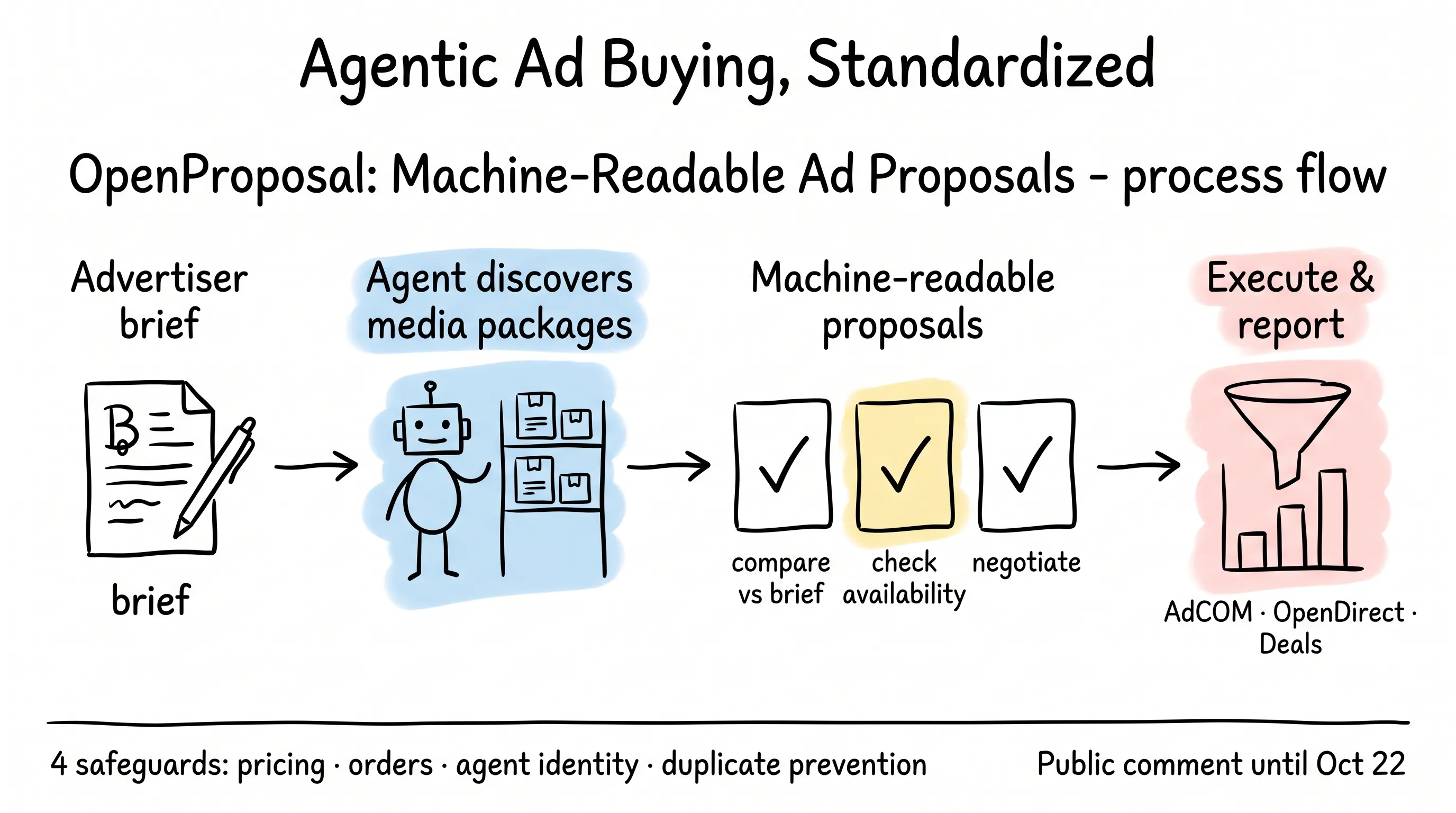
💬 Teams expanding overseas should read both drafts in full and submit feedback before October 22 — input before a standard is finalized carries far more weight than complaints afterward. There is exactly one preparation task that matters: structure your own briefs into a machine-comparable format. Whoever becomes machine-readable first gets their proposals into the agents' evaluation pools that much more easily.
🔗 Further reading: Read the full article
KNOREX Takes Its Agentic Ads API Commercial: The AdCP-plus-MCP Open Protocol Powers First Deployments
KNOREX (NYSE American: KNRX), an advertising technology company, announced the commercial launch of its Ads API built for agentic AI, with first deployments at two US partners and one Southeast Asian partner. The API is compatible with the Amazon Ads MCP Server, letting AI agents connect directly to the advertising capabilities of its XPO platform in natural language and skip point-to-point integrations; it also supports the open standard AdCP (Advertising Common Protocol), unifying ad platforms behind a single interface. Agents can automate across Meta Ads, Google Ads, LinkedIn Ads, TikTok Ads, and programmatic: launching campaigns, pulling cross-channel performance, dynamically adjusting budgets and bids, running cross-channel optimization, and producing reports. The XPO platform itself covers planning, execution, and optimization for social media, search, CTV/OTT, video, audio, display, native, and DOOH advertising, and the company operates in the US, Vietnam, India, Malaysia, and Singapore. The press release cites industry forecasts that global digital ad spend will exceed $740 billion in 2026. Abhishek Kumar, VP of product and engineering, calls agentic AI the next structural evolution of digital advertising.
💬 The announcement dates to February 19 — seven months ago as of today. Don't read it as news; read it as a signal: open protocols plus MCP access for cross-channel campaign delivery have moved from concept into paid deployments. When cross-border teams evaluate campaign tooling, adding "does it support AdCP and MCP" to the scorecard can spare you the manpower of rewriting integrations next year.
🔗 Further reading: Read the full article
Forrester Maps the Enterprise genAI Adoption Landscape: 67% of Decision-Makers Plan to Spend More, Agentic AI Tops the Trends
Forrester's generative AI topic page gives enterprise decision-makers a full inventory of where things stand. The numbers: its May 2024 survey shows 67% of AI decision-makers plan to increase genAI investment within a year; 29% name trust as the biggest adoption barrier; and on the 2023 basis, 36% of employees worry their roles could be replaced by AI. The use cases list seven scenarios: customer service, marketing, HR screening, data analysis, synthetic data for supply chain, code assistance, and knowledge management — with the marketing section calling out Jasper-style platforms that mass-produce blog, social, and email content while holding brand consistency. The industry coverage spans retail and e-commerce, manufacturing, finance, healthcare, and media & entertainment. The risk section covers AI-powered phishing and malware, plus copyright and bias issues around third-party content. Three trends: the dividing line between agentic AI and genAI is that the former doesn't just think — it acts autonomously, able to set its own goals and make real-time decisions; knowledge graphs structure organizational knowledge into AI-usable form; and personalization AI tuned to individual preferences. The page lists five adoption prerequisites: ethics and responsible AI, infrastructure, data strategy, workforce reskilling, and ROI measurement that pilots before scaling.
💬 This page works well as the citation backbone for internal project proposals — putting the 67% willingness to spend more into a budget request beats talking about trends in the abstract. What is truly worth copying is the agentic-versus-genAI framing: when you file a budget, break out autonomous-execution requests as their own line item with a separate ROI yardstick, and approval rates climb a notch.
🔗 Further reading: Read the full article
🏷 Marketing Tools
Medallia Lays Out the State of AI Personalization: 92% of Enterprises Use It, 26% of Consumers Buy It
A Medallia blog post maps how brands run AI personalization for customer experience. The tools stack in three layers: Conversation Intelligence uses text and voice analytics to distill insight from the full volume of interactions; Smart Response uses generative AI to produce personalized replies based on each interaction; and Experience Orchestration curates the next best action from real-time intent and behavior. The use cases list six: data collection and analysis, predictive analytics for interest and churn risk, smart segmentation, personalized product recommendations, next best experience that adjusts on-site interfaces and email content from live data, and generative personalized replies. The data section offers quotable figures: 92% of enterprises say they already use AI-driven personalization (citing VentureBeat), and 82% of consumers say personalized experiences sway their brand choice in at least half of shopping scenarios (Medallia 2023 survey). The gap is just as striking: in the 2024 State of CX Personalization, only 24% of practitioners rate their own personalization as highly mature, and only 26% of consumers feel their most recent interaction was highly personalized. The ROI evidence: teams that self-rate highest on capability are twice as likely to achieve revenue growth above 10%. The case study is BSH Home Appliances, which monitors drop-off points and root causes across 40 touchpoints and computes individual engagement scores in real time — conversion up 106%, add-to-cart conversion up 22%. Note that both the survey and the case are vendor-reported figures, and the page funnels toward a demo.
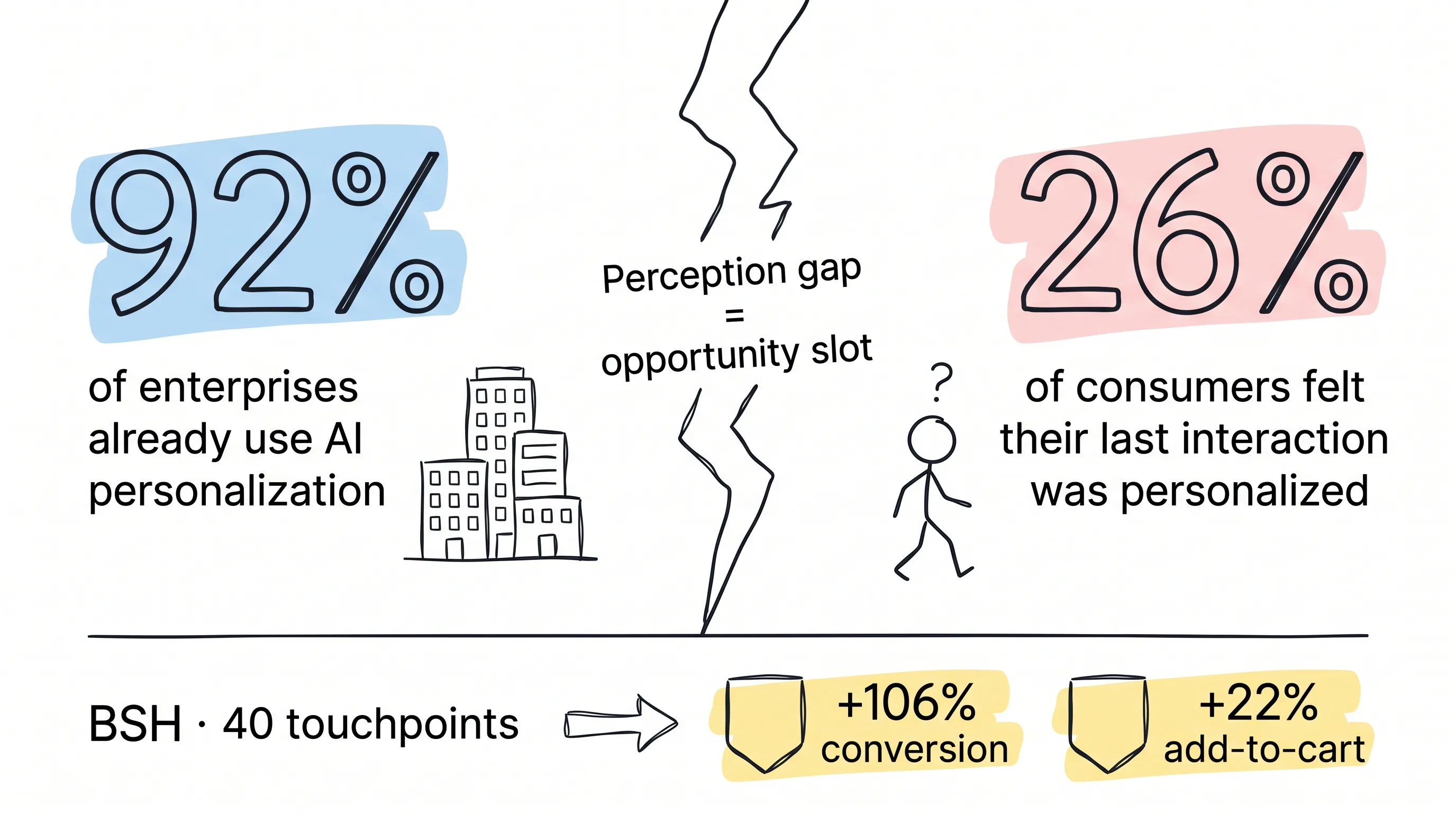
💬 The 92%-versus-26% contrast is ready-made reporting material: supply got built in droves while users never noticed, and the gap in between is your opportunity slot. For rollout order, close the data collection and Conversation Intelligence gaps first, add personalized replies next, and connect the orchestration layer last. BSH's +106% is compound interest after all 40 touchpoints were wired end to end; copying it on a single touchpoint won't reproduce the effect.
🔗 Further reading: Read the full article
Dageno's Three-Layer Evidence Framework: Brand Visibility in the AI Shopping Era Needs Layered Accounting
Dageno's product page, aimed at cross-border e-commerce, DTC, and multi-brand teams, lays out an AI shopping and ads intelligence framework. It splits brand appearance in AI contexts into three mechanically distinct layers: organic AI recommendations ask whether the brand and its products made it into the answer; AI Shopping product cards track price, merchant, citations, and purchasability; AI ad placements track position, intent, and competitor information. The three layers cannot be collapsed into one composite score — you must observe trigger scenarios, positions, sources, and changes for each layer separately, then cross-validate business outcomes against GSC, GA4, CRM, and ad platform data. The page lists three typical failure modes: conflated appearance mechanisms, opaque product information gaps, and ad windows that are hard to evaluate. The common failure is the brand getting name-checked while specific products, prices, reviews, and purchase channels are missing from the answer — a blind spot that needs its own investigation. The operating process is three steps: pick target markets, gather evidence layer by layer, and fix product and channel information. Its data foundation claims 500M-plus ad records, 100M-plus product records, and 12,000-plus market categories, covering ChatGPT, Gemini, Google AI Overview, Perplexity, Grok, and other models; the observable ad placements are currently ChatGPT Ads and Google AI Overview Ads, and it explicitly refuses to do pseudo-precise sales attribution. The fit boundary: teams with overseas standalone sites, product feeds, retail channels, or content foundations, complementary to an existing GA4/GSC data stack.
💬 Cross-border teams can run a zero-cost self-check this week: ask ChatGPT ten purchase-intent questions and see whether your brand only gets name-dropped, or shows up with prices, channels, and reviews attached. Note where the gaps sit, layer by layer — missing product feed or missing citable material — which beats buying a tool first.
🔗 Further reading: Read the full article
Nine Ad Automation Platforms Reviewed: One Spectrum from Rule Engines to Fully Autonomous Agents
Cometly's 2026 list arranges nine automated ad optimization platforms by primary pain point, opening with selection criteria of platform integrations, AI capability, ease of use, and pricing transparency. Attribution accuracy is Cometly's own flagship claim: server-side tracking plus Conversion Sync sends enriched conversion events back to Meta and Google, plugging the signal iOS dropped — its argument being that when attribution is wrong, even the smartest AI makes the wrong decisions. For rule-based automation, look at Revealbot: a no-code if-then engine with bulk management and A/B automation, starting at $99 a month. Adzooma offers a free tier plus a daily opportunities engine; the Pro plan is $99. For creative scale, Smartly.io: dynamic templates mass-produce personalized variants, plus ML-driven predictive budget allocation. Meta specialization goes to Madgicx, starting at $44. Deep PPC players get Optmyzr, $249 and up, with a custom script library. The multi-client agency scenario belongs to Acquisio, the fully autonomous cross-channel agent is Albert.ai, and enterprise-grade unified analytics goes to Marin. The list lays the autonomy spectrum out clearly: humans set rules and machines execute, up through predictive budgets and auto-generated audiences, to fully autonomous creation, testing, and scaling. Note that this is a lead-gen piece in which Cometly ranks itself first — the pricing anchors are usable for reference, but don't take the rankings on faith.
💬 Use it as a selection checklist, not a ranking. Triaging by primary pain point saves the most time: if conversion signals are lost, fix attribution first; if you run many accounts, start with a rule engine; if creative capacity is short, look at dynamic templates. Fully autonomous agents need enough trial-and-error budget to produce learning signals; if your accounts aren't big, start with rule-based automation in the $99 tier.
🔗 Further reading: Read the full article
OptimizeGEO Lays Out the GEO Methodology: In the 69% Zero-Click Era, Citability Isn't Ranking
The blog hub page from OptimizeGEO, a GEO (Generative Engine Optimization) vendor, offers an actionable statistical baseline. Search has shifted from ranking to synthesis: 69% of searches end with zero clicks, and AI-assisted search queries were up 1757% year over year by early 2026; when an AI Overview appears, the top result's click-through rate drops 58% — ranking first no longer guarantees visits. The cost of waiting is spelled out: 47% of brands still have no AI search strategy, while early movers see AI referral traffic convert at 4.4 times the rate. It designates AI Share of Voice as the north-star metric — the share of AI answers in a category that mention your brand — measured through daily prompt scans across five public engines: ChatGPT, Gemini, Perplexity, Claude, and Copilot. Several FAQ items are genuinely practical: high ranking does not mean citability — answers buried in unstructured prose, missing schema, and vague claims all make engines reluctant to cite you; schema feeds the entity knowledge graph during the RAG (retrieval-augmented generation) stage and decides whether engines trust you enough to cite; llms.txt is an emerging standard for declaring consumable content to AI crawlers; and GEO practice does not conflict with traditional Google rankings. The platform also runs an Accuracy Score fact-check that verifies AI engines' claims about your brand against source materials, flagging inaccuracies as hallucinations so you can correct them before misinformation spreads. The statistics carry no listed sources — verify before citing.
💬 Add one checklist item for the content team this week: for every core page, ask a single question — can an LLM cleanly lift me into the answer? The method: pair each major claim with verifiable specific numbers, add entity schema, and add llms.txt. All three are on-site changes at zero budget. For SOV scanning, start by having the team manually run twenty industry prompts a week and log the results; graduate to tooling once the routine works.
🔗 Further reading: Read the full article
🏷 Practical Methods
11 Communications Executives Map the genAI Marketing Minefield: Homogenization, Copyright, and Noise
Eleven members of the Forbes Communications Council list, item by item, the risks of using generative AI in marketing and how to mitigate them. Homogenization gets named most often: AI blends together the internet's collective voice, diluting a brand's distinctive expression — in direct conflict with the differentiation brand building requires. The heaviest legal point comes from Rafael Schwarz: copyright ownership of generated content is murky. His advice for now is to confine generative AI to research, inspiration, and fine-tuning, and not to blindly publish AI-generated text, images, and audio directly. Jeff Marcoux of Bombora delivers the noise-over-value verdict: generative AI makes mass-producing slightly-worse content far too easy, manufacturing noise rather than value the way early email marketing spam did. Bias and inaccuracy demand systematic governance: diverse training data, bias-detection capability, and diverse teams auditing output on a regular cadence. Other members warn that AI personalization in B2B settings easily reads as cold — either tune it or hand it back to a human; still others worry about the loss of personal style, since running every campaign through the same pipeline slowly washes out brand distinctiveness. All 11 points converge on one consensus: human oversight is indispensable — AI output is the starting point, and it gets published only after human perspective, detail, and brand voice are layered back in. The source is a paid-members opinion roundup from April 2024 — experience-based judgment, no empirical data.
💬 The cheapest way to use it is as a team discussion agenda — one hour surfaces every disagreement. Rollout needs only three gates: AI assets don't ship directly, everything passes human review before publishing, and outputs get sampled quarterly to check for homogenization. On the copyright point, take the advice in full and write it into the team SOP; keep direct publishing off the table until case law settles — this conservative stance costs the least.
🔗 Further reading: Read the full article
Brandlab's 2026 ROI Guide: Fix the System Before You Buy Media
Australian agency Brandlab published a long-form piece on August 22 arguing that ROI shortfalls are mostly system problems rather than traffic problems: fix the six spots — measurement, messaging, targeting, creative, automation, and conversion — before adding budget. It widens the modern ROI yardstick from a single formula to CAC, CLV, lead-to-customer conversion rate, sales cycle, channel efficiency, and repeat purchase rate. The six failure types: homogenized positioning, siloed channels and data, optimizing for clicks alone, weak landing-page conversion, idle first-party data, and missing creative testing. The matching action list is quite practical: polish the value proposition first — articulate why anyone should pick you within ten seconds, and back it with proof; prioritize high-intent traffic, pointing SEO and paid search at purchase intent; build content as conversion assets — comparison pages, problem-solution landing pages, case studies with quantifiable results, pricing explainers, objection-handling FAQs; lift conversion rate before buying traffic — headlines, social proof, form fields, mobile-first, checked item by item; align marketing and sales on revenue quality — ICP, lead scoring, follow-up speed, closed-loop reporting, aligned item by item. AI's position is deliberately kept low: segmentation, email personalization, creative variant testing, and predictive budget allocation can all be AI-accelerated, but the article's exact words are that automation without a clear strategy only amplifies noise — strategy first, AI second. Brand strength is positioned as an ROI multiplier, citing IPA effectiveness research and Google brand performance studies in support of the 60/40 split logic. No hard data anywhere in the piece, and it funnels to the agency's own services at the end.
💬 The way to use it is to steal the checklist, not the conclusion. Turn the six failure types into a self-audit sheet, run it with growth and sales every Friday, and if three or more get hit, fix the pages and follow-up speed before talking about more budget. That line about automation without strategy only amplifying noise belongs on the first line of every AI tool procurement request.
🔗 Further reading: Read the full article
Translated Breaks Down the Global Marketing Engine: AI Drafts, Humans Transcreate
A resource piece from localization vendor Translated, aimed at marketing leaders, explains how to build the globalization engine. Its judgment: the failure mode of global marketing has escalated from translation errors to one-size-fits-all campaigns — cultural mismatches in humor, symbols, tone, and imagery leave campaigns present in every market yet connecting with none of them. The framework has four steps. First, separate translation from transcreation; the latter re-imagines the message for a specific market, carrying across the same meaning and emotion. Second, define the human-machine division of labor: language AI like ModernMT and Lara generates context-aware drafts, while human transcreation specialists focus on emotion, cultural alignment, and brand voice. Third, run a centralized localization platform as the command center: glossaries and translation memory keep tone consistent across markets, with progress and ROI visible in real time, replacing the fragmented spreadsheets-plus-email-plus-multiple-vendors process — a mode that produces launch delays, inconsistent tone, invisible progress, and inflated costs. Fourth, at the activation layer: localize keywords and targeting, run subtitles and dubbing through pipelines like MateSub and MateDub, and run multilingual A/B testing — a play validated in one market won't necessarily hold in another, so keep testing across markets. The article positions localization as a growth engine, not a cost line. Note the dense vendor placement: the Airbnb, Google, and Asana cases are names without numbers, and there is no publication date.
💬 Cross-border teams can lift this division of labor directly: AI produces multilingual drafts, humans touch only cultural alignment and emotion — the drafting stage alone saves about half the hours. Before starting, build a unified glossary first; running multiple markets in parallel without one only amplifies tonal chaos. This step comes before tool selection.
🔗 Further reading: Read the full article
🏷 Industry Data
Influencer Marketing Platform Market: $27.5B in 2026, $89.9B Projected for 2034
The summary page of Fortune Business Insights' influencer marketing platform market report is thorough with its figures: $23.59B in 2025, $27.54B in 2026, a forecast of $89.9B by 2034, and a 15.9% CAGR from 2026 to 2034. Regionally, North America holds 37.2%, Europe 27.7%, and Asia-Pacific 21.7% but with the fastest growth, driven by India, China, and ASEAN; by country, the 2026 forecast reads US $6.65B, China $1.86B, UK $1.72B, Germany $1.57B, Japan $1.45B. By segment, software accounts for 75.72% and enterprise end users 47.07%; services, influencer management, e-commerce, and health & fitness are the high-growth segments. Generative AI gets a dedicated chapter: batch content generation plus influencer success prediction are changing the creator-selection logic, and Dreamwell AI claims it can automate 80 to 90 percent of campaign execution; discovery tools are evolving toward predictive analytics, with HypeAuditor's influencer database covering 205M profiles and running fraud detection. The restraining factors are written out too: unstandardized metrics, insufficient data transparency, and fake-follower/fake-engagement fraud remain the biggest obstacle to proving ROI; unified cross-channel analytics is becoming enterprise standard. Twenty major players are listed, from Dentsu and Sprout Social to CreatorIQ and Brandwatch. The estimation methodology is opaque and a few figures contradict each other internally — note the basis when citing.
💬 Citing the market-size numbers in a proposal is fine; just attach one line on methodology — this report's transparency is mediocre. The directly actionable part is the fraud-detection angle: before signing a batch of influencers, run a fake-follower screen first and clear out accounts suspected of inflated engagement. The budget that saves is usually enough to sign two more real creators.
🔗 Further reading: Read the full article
Statista's European Influencer Marketing Page: The Data Is Behind the Paywall, the Leads Are in the Table of Contents
Statista's European influencer marketing topic page was updated by A. Guttmann on December 17, 2025. The free tier offers little: the intro says the global influencer marketing market has more than doubled since 2019 and now stands at about $14 billion, yet the page's metric card separately lists $32.55 billion — the two figures fail to reconcile on either basis or year, so you must go back to the original statistics before citing. The world's leading platform is still marked as Instagram, based on a January 2020 survey — clearly outdated. The real value sits in the table-of-contents entries: influencer marketing platform landscapes for Western European countries (October 2025 edition), global organic social media marketing plans 2026, US social media budget share 2021 to 2031, and the main ways US marketers use AI in influencer marketing (July 2025 edition) — the numbers are all locked behind the Premium paywall. The narrative in one sentence: as the world's largest cluster of digital advertising markets, Europe keeps seeing brands channel a larger share of budgets into creator partnerships.
💬 Treat it as a lead index, not a citable data source. For European numbers, chase the original statistics by their TOC titles; the paywall-free list of titles alone can hold up a market-scan framework. The $14B and $32.55B figures conflict — in a report you can only pick one and note its basis. Never cite them side by side.
🔗 Further reading: Read the full article
Tracxn's Cross-Border E-Commerce Enablers Map: 97 Startups, 26 of Them Chinese
Tracxn's cross-border e-commerce enablement category page was updated on September 5. The space holds 97 startups in total: 44 funded, 20 reaching Series A+; over the past decade it added roughly 4 new entrants a year, and 2026 has seen just 1 newcomer — the space has entered consolidation. By country, Chinese companies lead with 26, followed by the US with 15 and India with 9 — on the supply side of cross-border infrastructure, China's scale is the world's largest. The top tier is two public companies: BigCommerce, out of Austin, founded in 2009, with $233M raised to date and Goldman Sachs among its investors; and Global-e, in London, founded in 2013, $100M raised, helping merchants localize the shopping journey and simplify global transaction operations. The second-tier players each own one segment: Zonos, in Utah, automates international duty and tax compliance — product classification, landed cost, customs paperwork, and restricted-seller screening — with $69M raised; Flow, in New Jersey, handles localized pricing, payments, fulfillment, and fraud compliance — it raised $50M and has been acquired; ANKA, in Abidjan, Côte d'Ivoire, gives emerging-market sellers a single back office combining storefront building and social channels — it raised $13.5M and has been acquired. The full list and the latest funding rounds require registration to view.
💬 When picking vendors for overseas expansion, match needs against this map: storefront and global transactions go to BigCommerce and Global-e, duty and tax automation to Zonos, emerging markets to ANKA. With only about 4 new players entering per year — and just 1 in 2026 — don't gamble on new platforms; committing budget to mature, post-Series A supply is the steadier bet.
🔗 Further reading: Read the full article
💡 Today's Big Picture
Read today's 14 items end to end and only one throughline emerges: AI has moved from optional to infrastructure. The evidence stacks in three layers. At the standards layer, IAB is writing the rules for agentic buying — OpenProposal and the measurement contract addendum are both hanging in public comment windows; the industry is paving roads for AI agents. At the product layer, KNOREX's agentic Ads API has been commercially live for seven months, Forrester lists agentic AI as its number-one trend, and Medallia, Dageno, Cometly, and OptimizeGEO have each turned observation and automation into product slots. At the data layer, the influencer marketing platform market is set to travel from $27.5B to $89.9B within eight years, while the cross-border e-commerce enablement space has stopped expanding and entered consolidation — capital is pricing in the stages that already work.
What this means for marketers hides inside the top story: in an era of flat budgets, efficiency is non-negotiable. Today's tooling material all answers the same question — how to run a bigger operation with fewer people, whether it's Medallia's 40-touchpoint personalization, the rule engines in Cometly's list, or Translated's AI drafts plus human transcreation. The risk side got put on the table today too, and Forbes' 11-point minefield map and Brandlab's noise warning land on the same point: when governance lags, speeding up only amplifies the chaos — the exact opposite of the move-fast-figure-it-out-later default many teams assume.
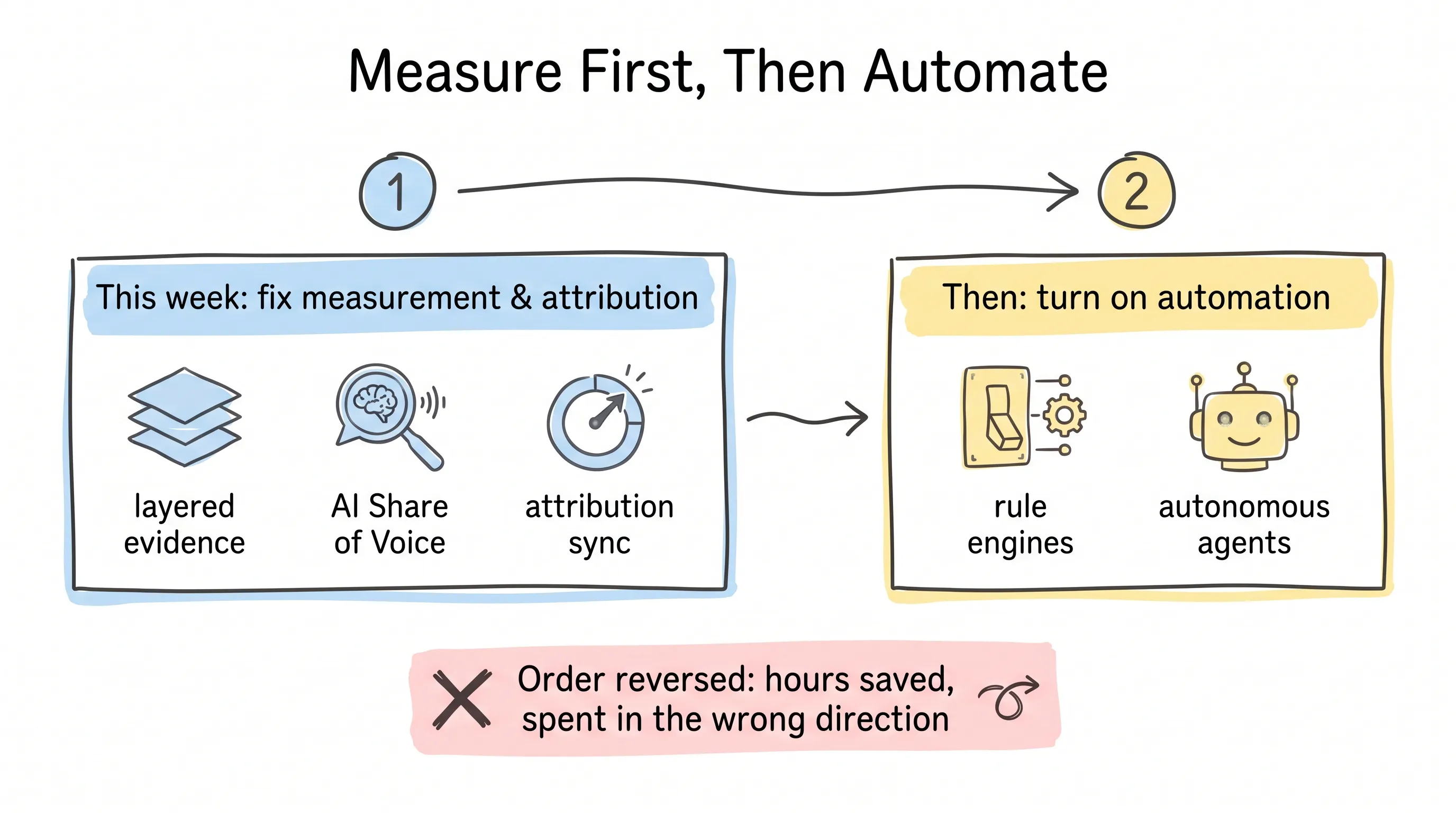
The second signal is measurement getting named again and again. Dageno refuses a single composite score, OptimizeGEO grabs SOV, IAB is standardizing measurement contracts, and Cometly flatly says that with attribution wrong, AI makes the wrong decisions. Four pieces from different sources converge on one judgment: in the AI era, marketing competition is decided first on measurement precision, then on execution speed. The rollout order compresses into one sentence: fix measurement and attribution this week, then turn on automation. Get the order backwards, and every hour saved gets squandered in the wrong direction.
Continue reading
Related articles

AI Marketing Daily · 2026-10-09
AI marketing daily for 2026-10-09 covering 11 items: brand measurement moving from survey panels to search, social, e-commerce, and AI prompt signals; GEO and share of model playbooks; safety guardrails for agentic ad buying; and tool roundups for ad platforms, cross-border tools, and social media uses.

AI Marketing Daily · 2026-10-08
AI Marketing Daily for 2026-10-08 curates 20 items across AI search visibility (GEO), advertising, platform selection, cross-border e-commerce, and ROI measurement. The headline argues that strategic marketing decisions should stay with humans while AI assists execution.

AI Marketing Daily · 2026-10-07
Today's throughline is answer engine optimization (AEO — getting your brand quoted in AI answer engines).