
AI Marketing Daily · 2026-09-22
Today's heaviest item is compliance.
Today's heaviest item is compliance. The EU AI Act's transparency obligations took full effect on August 2, and three IP lawyers at Bird & Bird have worked through the ledger of infringement, labeling, and copyright ownership — brands remain on the hook as end users. Across the rest of the list, the data front says US generative AI users are heading toward 133 million while the trust gap persists, and the practice front keeps pointing at the same thing: output has sped up, while governance, process, and measurement haven't caught up. The items below run across five sections — Large-Model Developments, Industry Data, Practical Playbooks, Marketing Tools, Policy & Investment — each with a practitioner take and a link to the original.
🎯 Today's Top Story
Bird & Bird Breaks Down GenAI Marketing's IP Bill: EU Labeling Obligations Are Live, and Brands Get No Liability Waiver
On April 21, international law firm Bird & Bird published a long-form piece in which three IP partners systematically answered the question marketing teams most often punt to legal: what to watch out for, in IP terms, when creating assets with generative AI. The article has four blocks: infringement risk in output content; the labeling and transparency duties attached to AI-generated content; copyright protection and ownership of generated content; plus six practical recommendations. After publication the authors added an update note: on June 10 the European Commission issued the final Code of Practice on the Transparency of AI-Generated Content, followed by final guidelines on Article 50 on July 20. The infringement section is blunt: if the output reproduces substantial parts of a copyrighted work, or carries a third party's trademark or a celebrity's likeness, the brand that used it is just as liable — the legal risk is identical to purely human creation. What actually changed is the surface area of risk: once AI raised the speed of creation, large amounts of material started going live outside the usual legal-review pipeline, and when something goes wrong, it's the brand they come for.
Why is this worth every marketing team's close reading? Because transparency obligations are past the paper stage. Article 50 of the EU AI Act applies in full from August 2, 2026 — today is the seventh week since it took effect — and it covers any content aimed at EU consumers, no matter where the company is registered. Deep-synthesis content (deepfakes) must be clearly disclosed; short videos generated end-to-end by AI must display the label throughout; and pure audio ads of 30 seconds or less need a spoken declaration at the top, in the same language as the content — something like "generated with AI." The UK has no dedicated statute, but the CAP Code and ASA ad rules still reach misleading content: a missed label can trip both AI regulation and ad regulation at once, and channels beyond X are covered too.
The impact on marketers comes in three layers. Layer one, labeling: the EU Code of Practice proposes a unified AI icon scheme, appearing at first exposure; short videos carry the label throughout; and labeling can't be left fully to automation — keep human oversight and training records. Layer two, ownership: German case law shows even a detailed 1,700-character prompt wasn't deemed the author's own intellectual creation, and technical modifications don't count as creative contribution; the UK government has proposed scrapping the computer-generated works regime with no timeline set, while the EU doesn't recognize such a regime at all. To keep copyright, humans must make substantial edits and additions to the AI output, and keep records of prompts and the revision process. Layer three, contracts: supplier terms can't decide whether copyright arises, but they can decide who gets it when it does — brands should write the copyright assignment into contracts and check the infringement warranties and indemnification clauses.
The six practical recommendations compress into a checklist you can start on this week. First, run due diligence on your AI vendors: check their IP compliance policies and warranty clauses, and search for any adverse IP rulings against them. Next, execute labeling by target market — content aimed at the EU should get its labels now, and the format requirements differ between short video and audio ads. Third, keep prompts, storyboards, and version history for high-exposure assets, both to defend against infringement claims and to prove an independent creation process. Fourth, route everything through internal approval plus plagiarism detection before release, and use governance rules to limit who can use which tools in which scenarios. Fifth, keep tracking UK and EU legislative developments — the rules here shift every few months. For big campaigns where you're unsure, one legal consultation fee is a far better deal than pulling the work and redoing it after the fact.
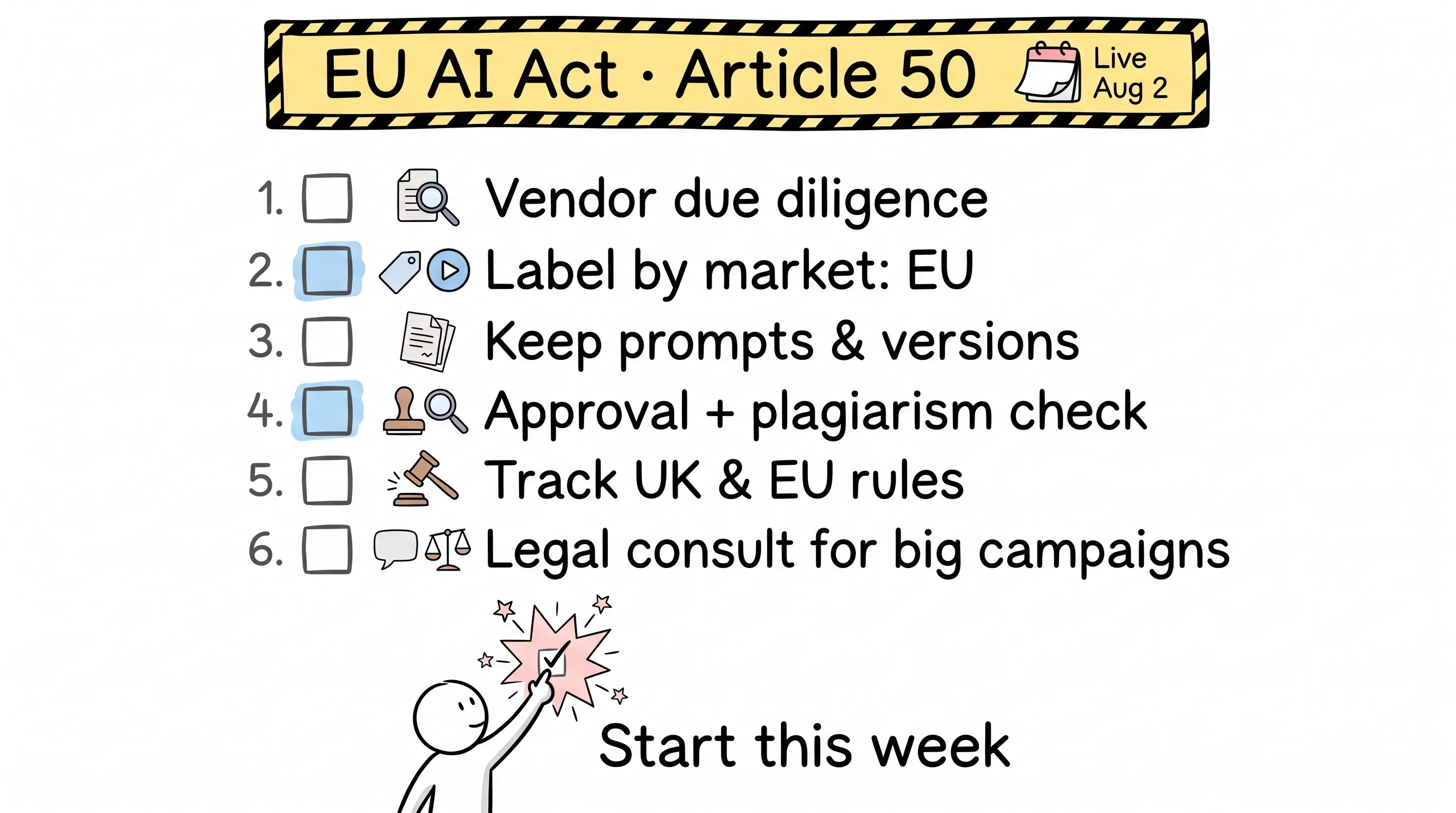
My read: this piece is more time-sensitive than it looks. The August 2 effective date means labeling compliance in the EU market has entered the audit-your-existing-backlog phase, and the first wave of penalties will most likely land on short video and audio ads. Inside a marketing team, the easiest thing to lose control of is individual usage that bypasses the process — which is exactly what governance rules are there to govern. Run the compliance checklist through your own team first; it's far cheaper than waiting for the regulator to come knocking.
🔗 Further reading: Read the full article
🏷 Large-Model Developments
Why ChatGPT & Co. Show You Their Thinking: The Labor Illusion Is the Unspoken Fourth Reason
A piece updated September 21 on the HubSpot marketing blog explains a UI phenomenon: since 2025, answer engines like Claude, ChatGPT, and Gemini have routinely shown users their thinking. Anthropic has given three official reasons — helping users verify answers, exposing inconsistencies between reasoning and conclusions, and the spectacle value of the process itself. Author Phill Agnew adds a fourth: the labor illusion (we value results more when we can see the effort behind them). In a 2011 Harvard experiment published in Management Science, 266 participants searched for flights; the group that could see which airlines were being checked and how fares accumulated rated the value of the results 8.1% higher than those staring at a blank loading screen — and even when it ran 50 seconds slower, they still preferred the site where effort was visible. Two 2022 follow-up experiments, with 306 car-rental-search participants and 294 dating-app participants, confirmed the pattern: with outcomes identical, 7 seconds of calculation animation was enough to raise ratings of recommendation quality.
💬 Marketers can borrow this psychology directly: in AI feature demos, don't cut the loading process — let users see what the system is retrieving and computing. Perceived value comes from effort that is seen, and it banks more trust than raw speed ever will.
🔗 Further reading: Read the full article
Meta Plans to Hand 90% of Content Moderation to LLMs, While TikTok Expands Symphony into End-to-End Creation
Per the Financial Times, Meta is accelerating its replacement of human content moderation with large language models, claiming its models make 13% fewer mistakes than humans when adjudicating violations and catch 10% more of them; the plan is to have AI moderate up to 90% of in-app content and ads by the end of 2026, saving billions of dollars a year. The immediate effect for advertisers is faster reviews — but machines lack the nuance of human judgment, so creative must hew more strictly to ad policy, and appeals channels should be prepared in advance. TikTok, meanwhile, is expanding Symphony Creative Studio: text-to-video, product-image-to-video, digital avatars, and multilingual translation are all in place, and the new Symphony Agent can produce native ads directly from campaign objectives, platform trends, and insights from high-performing ads. For small retailers without dedicated marketing teams, the time and resources needed to produce video just dropped sharply. The author's caveat: AI only gets you to draft — authentic storytelling, product expertise, and customer relationships remain the differentiation cards independent retailers hold.
💬 Small brands without a dedicated team: treat Symphony as your draft room — AI writes the first pass, you add the brand voice. Self-check creative against platform policy before it goes live; it beats getting bounced by AI moderation and walking the whole loop again.
🔗 Further reading: Read the full article
A Springer Academic Entry Puts a Chill on GenAI Marketing: Most Teams Are Buying Competitive Parity
A 17-page academic entry published by Springer in April examines how marketing organizations adopt generative AI through the lens of general-purpose technology and diffusion of innovation, and the conclusions carry a chill: the real economic impact happens at the diffusion stage, whereas most current benefits take the form of speed, scale, and falling costs — paid for by same-root risks like creative homogenization, cultural missteps, privacy, and bias. The author sorts adoption barriers into five types: technical problems such as hallucinations; trust and transparency; unresolved copyright questions; ethical risk in a regulatory vacuum; and organizational obstacles like low ROI and strategic misalignment. The reference list deserves a second pass: BCG research finds 74% of companies struggle to scale AI value; MIT NANDA coined the GenAI divide; and the Air Canada chatbot ruling has become the routinely cited case for liability determination. The author's weightiest judgment: for now, GenAI mostly produces competitive parity, and its long-term value lies in augmenting human judgment and creativity.
💬 In annual planning, treat competitive parity as the default expectation: a tool the whole industry can use confers no advantage, so differentiation has to land on proprietary data and process redesign. Citing BCG's 74% in your report beats gut-feel optimism.
🔗 Further reading: Read the full article
🏷 Industry Data
eMarketer Data Brief: US Generative AI Users to Reach 133 Million, Trust Gap Still Unfilled
eMarketer's 2026 roundup lays out the penetration curve cleanly: 121.1 million US generative AI users in 2025, 35.8% of the population; 133 million projected for 2026, 39.2%, with growth slowing to 9.8% — a shift from breakout growth into mainstream steady state. ChatGPT weekly actives have passed 900 million. The marketing-side numbers are just as dense: audience segmentation is the number-one use case for brands and agencies; half of buy-side marketers are expanding AI use in measurement workflows; and 79% of marketers plan to spend more on genAI creator content this year. Consumer trust hasn't kept up: 68% view generative AI favorably, but 56% of internet users worry AI is making online content less trustworthy, and 57% worry about fake ads made with AI. A little-known nugget on GEO's (Generative Engine Optimization) citation structure: only 8% of ChatGPT's citations come from Google's top ten search results; globally Reddit accounts for 40.1%, Wikipedia 26.3%, YouTube 23.5%. The article also previews the next step — agentic AI will automate marketing workflows end to end, from audience identification and bidding to performance reporting, with protocols like AdCP emerging to standardize it. The author's three strategic pillars are data readiness, AI literacy, and governance frameworks, and the IAB estimates AI will unlock $26.3 billion in media investment through targeting, measurement, and optimization.
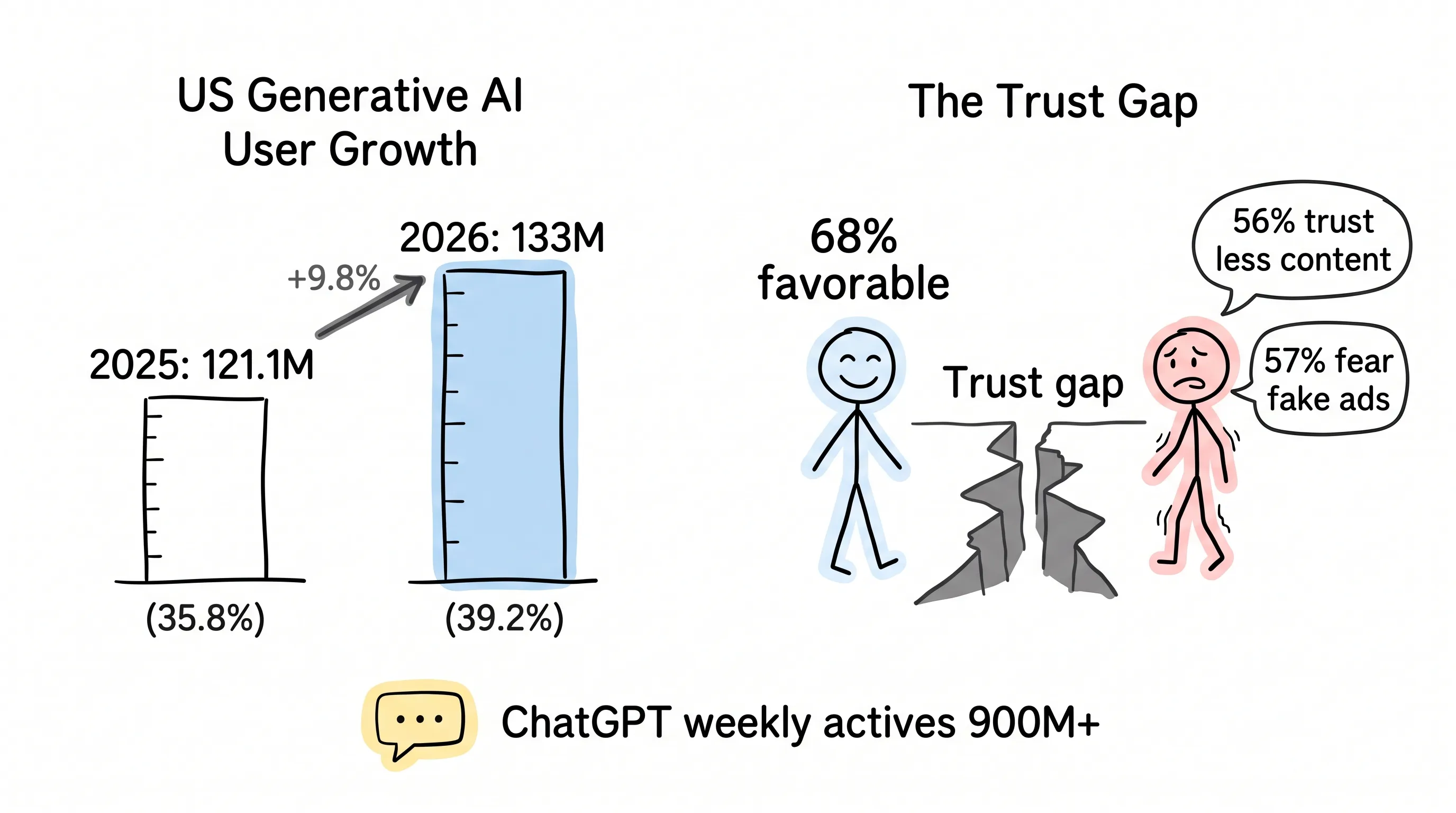
💬 Start with one action: check how your brand is cited inside ChatGPT and Perplexity — that's the new exposure yardstick. Tilt your content mix toward Reddit and YouTube, the two primary granaries feeding AI answers, and put a data audit on next quarter's calendar.
🔗 Further reading: Read the full article
2026 AI Marketing ROI Benchmarks: Median CAC Payback of 16 Months, Measurement Self-Score Just 4.2
A set of 2026 benchmarks compiled by Web Tonic brings the ROI talk back down to earth. Median CAC payback is 16 months, an 11% improvement on last year's 18; the strong quartile sits at 10 months, the weak quartile drags out to 24, and top performers get under 6 months. In the Duke CMO Survey, marketers score themselves 4.5 on generating technical ROI but only 4.2 on proving it — on a 7-point scale, nothing clears 5, flat versus 2024. Adoption, meanwhile, is surging: AI covers 24.2% of marketing activities, and GenAI jumped from 7.0% to 22.4%. Gartner's numbers sting harder: only 9% of marketing tech stacks are fully AI-optimized, while martech already takes 19.4% of budget and 56% of contracts are usage-priced — the cost side is moving ahead of the return side. The budget backdrop is tight too: marketing budgets run 9.0% of revenue, up just 1.7%; seventy percent of leaders are pivoting to short-term results; training budgets are down to 3.8%. The measurable-use-case ranking is there as well: content generation adopted by 73.9%, personalization 65.4%, automation 48.9%, GEO 41.5%. The author's reminder: buy by stage, and a retainer runs 4 to 5 times the cost of a fixed scope.
💬 In vendor talks, hold up the 16-month payback as your comparison benchmark, and ask three questions before signing: which number will move, which published benchmark it's measured against, and what decision follows if it doesn't move. Hard-code usage caps into the contract, never sign an uncapped annual fee — run every deal in negotiation through that sequence this week.
🔗 Further reading: Read the full article
A 388-Person Study: AI Personalization Lifts Purchase Intent Significantly — Privacy Concerns Didn't Stop It This Time
An empirical study posted on ResearchGate uses a PLS-SEM model (a structural equation modeling technique) to test how AI-driven personalization affects purchase intent, on a sample of 388 consumers with digital shopping experience. The path coefficients say it plainly: AI personalization has a significant positive effect on purchase intent, β ≈ 0.241; personalization interaction frequency is the most directly influential variable; and the mediation paths through customer engagement and perceived value hold. The counterintuitive finding hides in the moderation effects: data privacy concerns did not significantly moderate any of the key paths — a tension with the earlier personalization–privacy paradox literature. The customer experience quality and UI design paths are significant too, though their coefficients are weaker than interaction frequency. The author flags the limits as well: purposive sampling, a single market, 388 people, and a few mediation-path statistics abnormally high — treat the conclusions as claims awaiting verification, not settled findings to cite.
💬 The high-leverage move is clear: raising personalization touch frequency and engagement beats swapping algorithms. Keep doing privacy compliance, but don't treat this dataset as a get-out-of-jail-free card — re-test in another market first.
🔗 Further reading: Read the full article
🏷 Practical Playbooks
MarTech Asks Back: Do You Really Need This Much Marketing Content?
Benjamin De Castro, a former senior CMO, writes a contrarian piece in MarTech: AI has delivered on its promise of more, but the organization's absorption capacity hasn't changed. He cites Adobe's survey of 1,600-plus marketers: 89% of content goes through at least three rounds of approval, and 58% of respondents spend more than 40% of their time on review and approval — generate a dozen proposals by noon and the outcome is executives turned into full-time copy reviewers. In McKinsey's 2025 research, the organizational attribute most strongly correlated with genAI gains is workflow redesign. His rework path has three parts: separate creative exploration from creative approval — ideas can be plentiful, but before anything enters the approval queue you must spell out who it's for, what it should achieve, and why it's better; design processes around decisions — settle in advance who makes the call and how disagreements get adjudicated; and fix one workflow first, say a single lifecycle email, run it through a few real cycles, then scale. Do the accounting honestly: show the CFO sales, lead quality, and true cost — asset counts don't count.
💬 Do it this week: pick one lifecycle email, log all the creation, waiting, and rework time, fix it, and run three real cycles. Stuffing another 40 AI versions into a congested process only makes the bottleneck more clogged.
🔗 Further reading: Read the full article
MAICON 2026 Preview: The Tools Went Out, but the Way Work Gets Done Didn't Change
On September 21, the Marketing AI Institute published an interview with AI strategist Pam Boiros to build the run-up to her MAICON 2026 talk, whose theme is the people side of AI adaptation. Her test is crisp: while AI is still treated as a standalone project, that's adoption; only when it starts changing how the work itself gets done is it adaptation — signs include teams re-sequencing workflows around human and machine strengths, and people feeling safe to experiment and to challenge the output. She lays out five pillars — skills, workflows, guardrails, measurement, culture — and culture is the one most often underestimated, because culture lives in the boundaries of what people actually feel safe doing every day. Resistance often disguises itself as no time to learn new tools; underneath is fear about roles and career prospects, so the fix isn't more training but protected learning time that doesn't feel like a second job, anchored in the work people were going to do anyway, with learning made collaborative.
💬 Two things managers can do this week: use AI yourself and talk openly about where you've stumbled, and carve out protected experiment time for the team. Swap the measurement question too — stop asking whether people used it, ask whether the output is better.
🔗 Further reading: Read the full article
Databricks' Two-Track Framework: Predictive Handles Targeting and Timing, Generative Handles Copy and Visuals
Databricks' long-form piece splits marketing AI into two tracks: predictive models handle targeting, segmentation, timing, and optimization; generative models handle copy, visuals, and content variants — with value compounding across three stages: start with generic tools, move to grounding fine-tuned on your own data, then to process-level transformation across the customer lifecycle. The customer numbers in the piece can serve as benchmarks: Pandora sends 65 million personalized emails a year with click-to-open rates 50% above standardized campaigns; Skechers' churn win-back campaigns saw CTR up 324% and CPC down 68%; HP compressed audience building from 5 hours down to 1–2; HSBC's PayMe engagement rose 4.5x and Acxiom cut customer-insight time-to-market by about 30%; Publicis lifted data-team productivity 30% and cut operating costs 22%. The risk list is just as practical: insufficient data quality, model bias, brand-consistency drift, and generated content that looks credible but isn't accurate.
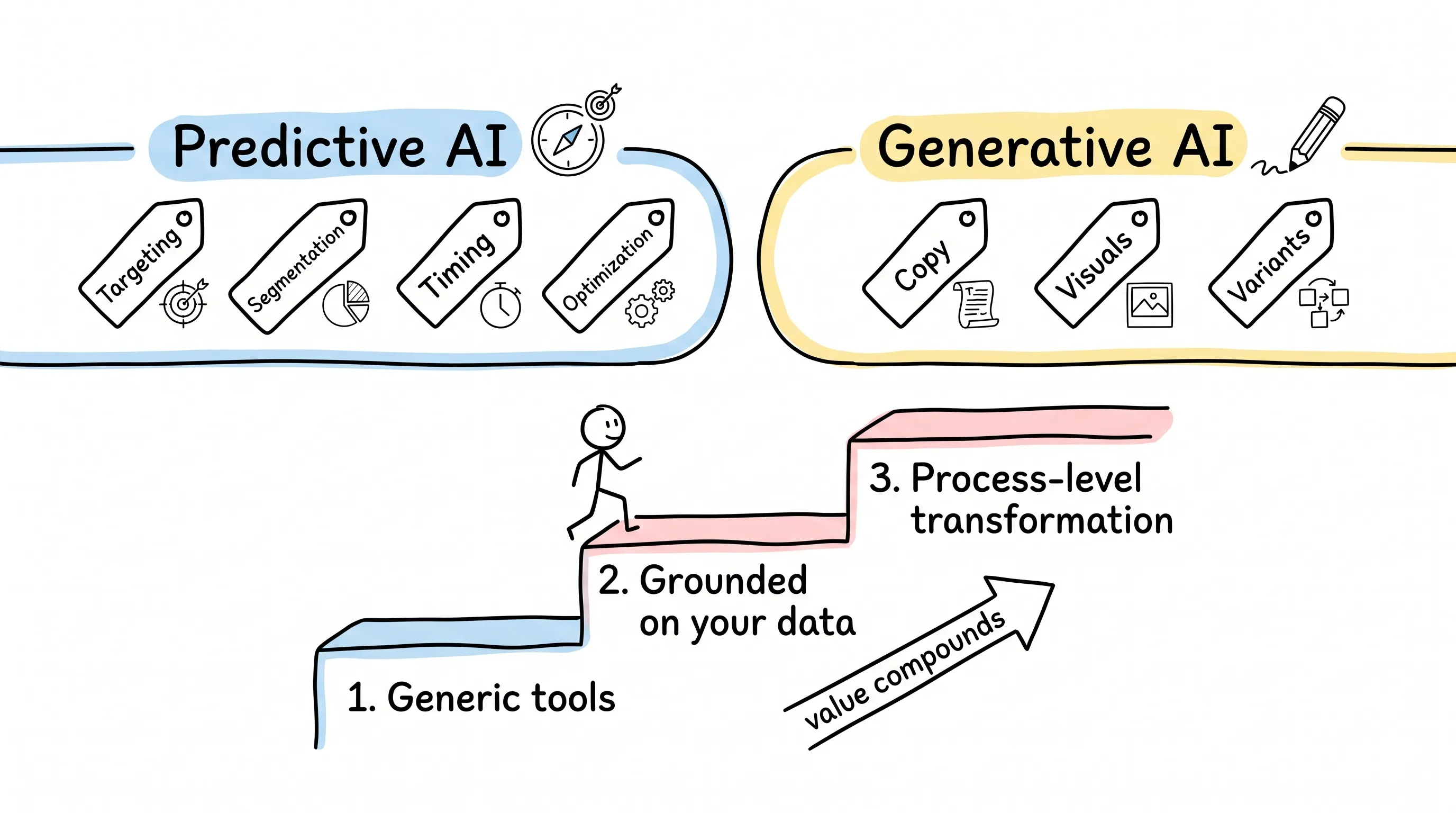
💬 These numbers are fine for internal benchmarking, but note they all come from Databricks' own customers — flag the source's position when citing. Differentiation comes from grounding on proprietary data, so inventory your data assets before choosing tools.
🔗 Further reading: Read the full article
IBM's Baseline Guide: Five Benefits, Nine Use Cases, Seven Steps for AI Marketing
IBM Think's AI marketing guide positions itself as baseline teaching material — drafted in 2023, data current to 2024. It defines AI marketing as using data collection, analytics, and machine learning to deliver customer insights and automate key decisions, citing McKinsey's estimate that generative AI could add up to $4.4 trillion a year to the global economy, and noting enterprise AI adoption rose to 72% in 2024. The structure is complete: five benefits — faster decisions, higher ROI, sharper KPI measurement, enhanced CRM, customer insight; nine use cases — audience segmentation, content generation, intelligent customer service, e-commerce recommendations, predictive analytics, programmatic advertising, SEO, sentiment analysis, and workflow automation; plus best practices covering data quality, infrastructure, task-specific training data, governance and compliance, continuous monitoring, and skills upgrading — wrapped in a seven-step implementation framework. In IBM's own CEO survey, more than 70% of high-performing executives say competitive advantage depends on mastering advanced generative AI.
💬 It works perfectly as a capability map and kickoff checklist for a newly formed team; veterans can skim it as a framework. Get your frontier signals elsewhere, and don't quote 2024 numbers about 2026 reality.
🔗 Further reading: Read the full article
Airtable's Adoption Guide: Five Use Cases and Four Steps for AI in Content Marketing
Airtable's 2026 guide for content teams spreads the use cases across five maps: creation and topic selection, content optimization, personalization and segmentation, distribution and promotion, and performance analysis. In Statista's 2024 survey, about 42% of marketers use AI for writing several times a week; by SurveyMonkey's accounting, 51% use it to optimize content, 50% to create, 45% to brainstorm. The challenges cluster in three places: team resistance, to be framed as skills upgrading; quality, secured by human-in-the-loop editorial review; and ethics and privacy, handled through enterprise-grade platforms and transparent policy. The four-step rollout: audit your process first to find bottlenecks, pick tools against single-point pain, put the AI-versus-human task boundaries in writing, then run a small pilot with success metrics predefined and tied to the business. The case library doubles as pitch material: Netflix's personalized assets, Nike's Serena twin-match ad, Coca-Cola's Create Real Magic co-creation, and The Washington Post's Heliograf mass-producing local briefs.
💬 Use the four-step method as your internal gate, especially the written task-boundary step — most teams' AI chaos stems from nobody being able to say which steps AI is allowed to touch. Note this is Airtable's lead-gen content; discount the vendor conclusions accordingly.
🔗 Further reading: Read the full article
🏷 Marketing Tools
B2B AI Content Platform Roundup: Eight Criteria and an Incremental Attribution Yardstick
AI Growth Agent's roundup covers 8 enterprise AI content marketing platforms and bears heavy self-promotional fingerprints, but the eight selection criteria transfer directly: governance and compliance; brand voice enforced at the generation layer; a security baseline of SOC 2 plus SSO plus exportable audit logs; CRM and CMS integration; content-to-pipeline measurement; scalability for teams of 50 to 1,000; agentic SEO capability; and total cost of ownership including hidden costs — per-article and per-credit pricing models are the hardest to predict at scale. Its incremental visibility attribution is worth writing down: a platform must be able to report the visibility it generates separately from the brand's pre-existing visibility, or you can't show the CEO a defensible ROI. A three-tier measurement framework comes along with it: traditional search performance, AI citations and mentions, and pipeline impact. In the competitive positioning, Writer's Knowledge Graph and its governance maturity for regulated industries are acknowledged as the rival's strengths.
💬 Convert the eight criteria straight into a procurement scorecard, and hard-code the incremental attribution yardstick into the RFP. Platforms that fail the security baseline usually die first in internal security review — this step saves you every demo that follows.
🔗 Further reading: Read the full article
B2B Marketing Automation Selection: Look at Size First, Then the CRM Ecosystem
Abmatic's selection guide (updated May 2026) lists six core capabilities: email nurturing, lead scoring, multi-channel campaign management, ABM support, system integration, and attribution reporting — plus GDPR, CCPA, and SOC 2 compliance thresholds. The selection rule is simple and usable: under 50 people, choose HubSpot or ActiveCampaign; 50 to 500, add Pardot to the mix; over 500, use Marketo or Salesforce Marketing Cloud. Companies deeply bound to Salesforce will find Pardot the natural choice, while those not on Salesforce should steer clear of Pardot and SFMC. The trade-offs are specific too: HubSpot is easy to use but weaker on complex enterprise workflows, with add-ons that push prices up fast; Marketo is the most full-featured but comes with a recommendation of two or more dedicated marketing-ops staff; Braze excels at cross-channel engagement yet leans toward post-sale scenarios. The implementation checklist stresses choosing a platform that scales along your 3-to-5-year growth curve, cleaning CRM data first, running core email nurturing first and layering complexity on after, and building the sales–marketing lead-quality feedback loop at the same time.
💬 Open the selection meeting with two questions: what CRM does the company run today, and where will team size go over the next three years. The answers can cut the candidate list in half — and save you well over two weeks of evaluation.
🔗 Further reading: Read the full article
B2B SaaS Growth Automation Roundup: Choose by Sales Motion; Content Clusters Earn 41% AI Citations
The same vendor's other roundup targets B2B SaaS and gives a framework by sales motion and ARR stage: sales-led, look at HubSpot Marketing Hub, with the enterprise tier starting around $3,600 a month; PLG (product-led growth), look at Customer.io, $300–$1,000, event-driven and natively wired into Segment and Snowflake; hybrid motion, look at ActiveCampaign, $200–$1,500; Salesforce-centric enterprises, look at Marketo, quoted from $1,500 to $6,000-plus, with attribution implementation taking 6 to 12 weeks. Two external data points in the piece can be cited on their own: Backlinko's study of 50 B2B SaaS sites found pillar-based content clusters earn a 41% AI citation rate versus 12% for standalone pages; and Gartner forecasts traditional search volume will fall 25% by 2026 as AI chatbots divert traffic. The evaluation checklist reminds you to confirm the sales motion first, audit the CRM of record, gauge RevOps capacity, and compare on first-year total cost of ownership — hidden costs can run past 2x the subscription price. The author also promotes a standalone content-engine play, self-reporting 10,000-plus new AI citations over 12 weeks on average; the number is unverified by third parties, so take the idea, not the figure.
💬 The 41%-versus-12% citation-rate gap for pillar clusters is good leverage for winning content-team scheduling priority. When comparing platforms, put first-year total cost of ownership on the table — don't read only line one of the quote.
🔗 Further reading: Read the full article
An 11-Tool AI CRM Roundup Reminder: Base Prices Often Exclude AI
Kustomer's roundup puts the selection premise bluntly: "AI-powered" has degenerated into a marketing shorthand — nearly every vendor claims AI, and underneath it may just be automation rules with a fresh coat of paint. It offers a six-capability checklist: unified customer timeline, generative drafting and rewriting, multi-layer predictive analytics, true omnichannel context, real-time sentiment analysis, and next-best-action recommendations. The pricing details are more useful than the ranking itself: Zendesk's Copilot costs an extra $50 per seat per month; Intercom's Fin bills $0.99 per resolution; Gorgias is deeply bound to Shopify e-commerce; Zoho Desk takes the low-price ecosystem route; and Salesforce's Einstein layer spans sales and service, though users report heavy implementation investment. The selection method comes down to total cost of ownership: base prices often exclude AI and integrations, data migration and training during implementation can rival the cost of the software itself, and a plan that works for a 20-person team can spiral out of control at 100.
💬 Make vendors demo on 5 to 10 real ticket scenarios you pick yourself, and define attributable metrics before buying — first-response time, resolution time, ticket deflection rate — or you'll never be able to say whether the AI actually helped.
🔗 Further reading: Read the full article
🏷 Policy & Investment
MarTech Governance Framework: Four Pillars and Three Checklists for a Marketing AI Council
MarTech uses a Q&A format to break marketing AI governance down from slogan into organizational design. Four pillars for the council: charter definition, cross-functional representation, risk tiering, and continuous monitoring; five mandatory seats: marketing operations, legal and compliance, data security and IT, brand and content, and a privacy officer. Before any tool goes live, it must pass three checklists. On data privacy: verify whether the vendor trains public models on your prompts, whether a data opt-out is written into the enterprise SLA, whether personally identifiable information is stripped before sending, and whether a zero-retention policy is honored. On copyright: look at indemnification clauses, output plagiarism and trademark risk, and human-oversight records for public assets. On transparency: high-risk decisions and releases mandate human-in-the-loop, prompt history must be auditable, and automated interactions need a disclosure mechanism. Manage in tiers — low-risk assistive tools versus high-risk autonomous agents — and let governance be an operational enabler, not a process bottleneck.
💬 This week, turn the three checklists into a procurement scorecard — new tools pass the scorecard before anything is signed — and map the five seats onto your company's existing setup. Privacy is the easiest one to miss, especially the opt-out-in-the-SLA clause: raise it during contract negotiation, not after launch.
🔗 Further reading: Read the full article
CB Insights Maps 15 GEO Monitoring Platforms; Adobe and Sitecore Each Score an Acquisition
CB Insights has drawn the map for the GEO monitoring space: these platforms track a brand's mentions, citation frequency, share of voice, and sentiment inside ChatGPT, Perplexity, Google AI Overviews, Claude, and Gemini, with capabilities spanning prompt-level performance tracking, competitive benchmarking, and automated visibility alerts, tying AI search performance to traffic and revenue. The list holds 15 companies, led by Semrush, Similarweb, and Profound (founded 2024); the rest are mostly startups founded between 2023 and 2025, spread across the US, UK, Germany, Spain, and Israel — a mix of traffic-analytics incumbents pivoting in and pure GEO newcomers, serving marketing teams, SEO practitioners, and brand managers. Two acquisitions signal consolidation: Adobe acquired Semrush in April 2026 at a $1.9 billion valuation, and Sitecore picked up Scrunch in June for $225 million. Legacy marketing platforms are using M&A to fill in AI visibility capabilities, and the space is moving from fragmented to consolidated.
💬 Use this list as the starting point for your vendor shortlist. SEO teams should shift what they monitor from SERP rankings to prompt-level performance, and hold a pilot line for AI visibility monitoring in the quarterly budget — don't rush to sign a single-point tool.
🔗 Further reading: Read the full article
Digiday's Warning: Generative AI Has Widened the Brand-Safety Target Surface
Digiday's report drops the old topic of brand safety into the generative AI context. Dude Wipes co-founder Ryan Meegan puts it plainly: everything is a target, and anyone with a subscription to an AI image tool can replicate a brand campaign. Brands losing control of the narrative isn't new — it happened in the UGC and influencer era, and influencer commentary sometimes hits reputation harder than official communications; Opendoor chief commercial officer David Corns argues that successful brands fold generative AI into their own ecosystem and use it to strengthen the connection with consumers. Mastercard's Priceless campaign has been parodied on SNL since the nineties, cited by Ralph Nader — and dragged into a lawsuit over it — and recently riffed on by A24's film Materialists; the brand's executives treat this as earned media: as long as the portrayal is positive, it's acceptable. Agencies are moating themselves with zero-trust architecture, building client-specific agents from brand-owned assets, with input/output audits and legal training — yet usage on employees' personal devices stays out of reach. Alston & Bird attorney David Teske warns that purely AI-generated content, lacking a human creator, carries no copyright protection and can be copied and reused by anyone.
💬 Two things to do right away: find out whether the AI tools your team uses train on your inputs, and list out anti-parody measures for brand visuals and messaging. Don't keep dragging a risk that's 14 months old as if it were a new problem.
🔗 Further reading: Read the full article
Campbell's Crisis Post-Mortem: AI Welded the Negative Narrative into Search Results
Terakeet chief brand officer Shannon Reedy, writing in Marketing Dive, dissects the Campbell's reputational case: after a recording leaked of an executive disparaging the products and employees, negative content got adopted and repeatedly reinforced by Google News slots, People Also Ask, and AI Overviews; the analysis shows negative news sentiment spiked to 70%, the stock fell 7.3%, and market cap evaporated by roughly $684 million. Generative AI didn't help correct the narrative — instead it scraped fragments like "mechanically separated chicken" from the corporate site to muddy perception, and even fired up related searches about 3D-printed meat. Official statements only partially repair the damage; early signals show clarifying content starting to get cited by AI, but once the negative narrative enters the data layer, correcting it after the fact doubles the difficulty. The author argues for pre-emptive defense: publish authoritative clarifying assets in advance, consolidate first-page search results, and continuously monitor how accurately your brand is represented in AI platform outputs.
💬 Add an AI-defense page to your crisis playbook: check monthly how your brand shows up in ChatGPT, Gemini, and Perplexity, and get authoritative clarifying content onto page one in advance. No statement, however fast, outruns AI's fixation — apply for this defense budget now.
🔗 Further reading: Read the full article
💡 Today's Big Picture
Put today's 20 items side by side and the through-line surfaces: AI marketing's competitive axis is shifting from generation capacity to digestion capacity. User scale keeps climbing — US generative AI users are heading toward 133 million, ChatGPT weekly actives are past 900 million, and on the platform side even content moderation is being handed to large models. But the numbers on the other side refuse to flatter: CMOs self-score just 4.2 on proving technical ROI, 89% of content gets stuck in three-deep approval chains, and only 37% of teams have written AI governance terms into vendor contracts. The mismatch between production capacity and organizational absorption deserves the investment more than model capability itself.
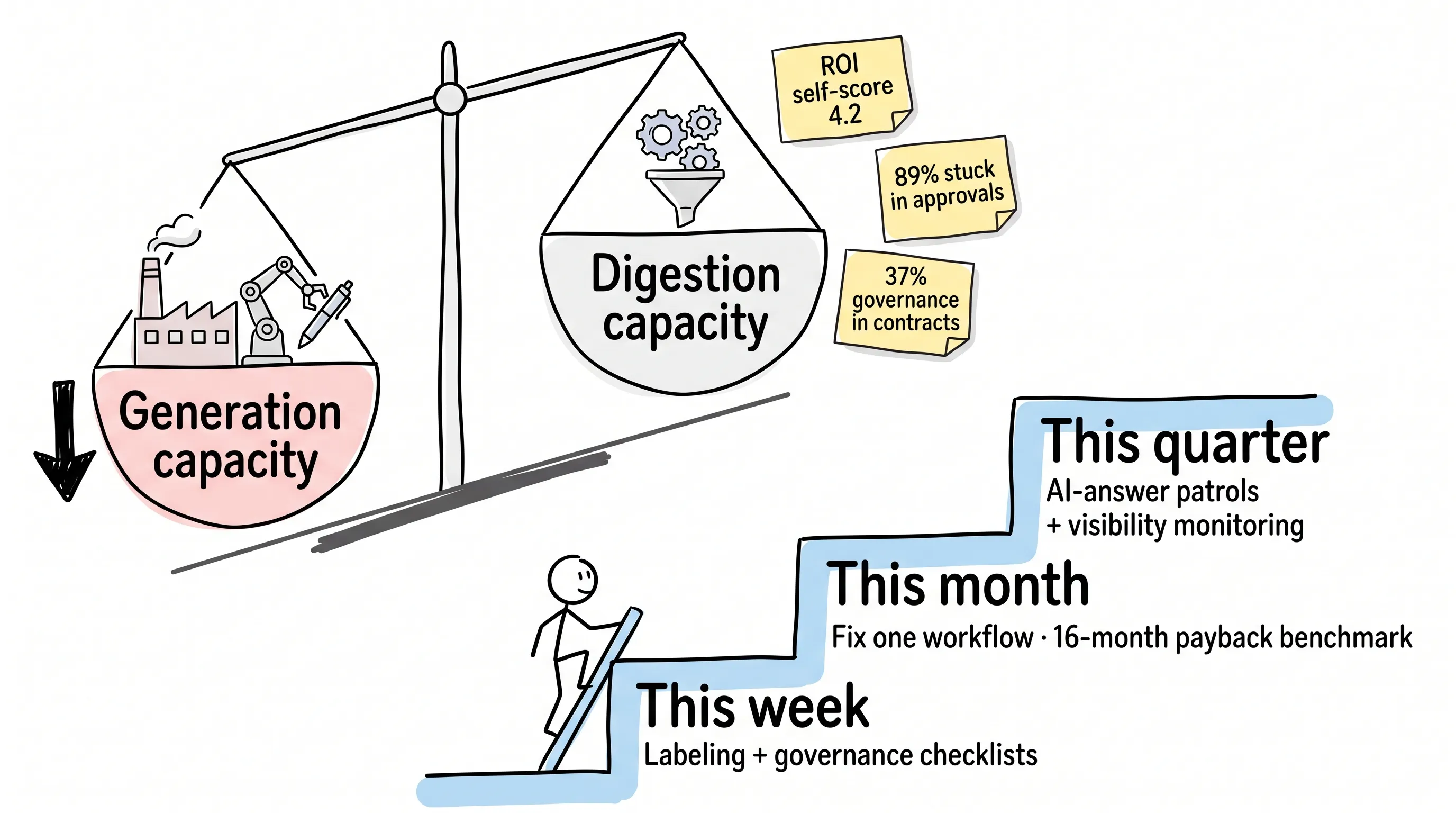
The risk side has entered its payoff period too: the EU labeling obligation took effect on August 2, purely AI content carries no copyright, negative narratives get welded into search results by AI, and every loophole in vendor terms is a bill that comes due later. Even answer engines are managing trust through the labor illusion — a sign this market has gotten competitive all the way down to the perception layer. Making the thing is no longer enough; people have to see how you made it.
The action sequence therefore writes itself: this week, shore up labeling compliance and the governance checklists; this month, fix one workflow and set your payback comparison benchmark; within the quarter, work AI-answer patrols and visibility monitoring into the daily routine. Tools will keep getting cheaper — only teams that have sorted out their data and governance get to talk about advantage.
Continue reading
Related articles

AI Marketing Daily · 2026-10-09
AI marketing daily for 2026-10-09 covering 11 items: brand measurement moving from survey panels to search, social, e-commerce, and AI prompt signals; GEO and share of model playbooks; safety guardrails for agentic ad buying; and tool roundups for ad platforms, cross-border tools, and social media uses.

AI Marketing Daily · 2026-10-08
AI Marketing Daily for 2026-10-08 curates 20 items across AI search visibility (GEO), advertising, platform selection, cross-border e-commerce, and ROI measurement. The headline argues that strategic marketing decisions should stay with humans while AI assists execution.

AI Marketing Daily · 2026-10-07
Today's throughline is answer engine optimization (AEO — getting your brand quoted in AI answer engines).