
AI Marketing Daily · 2026-09-21
Daily briefing for 2026-09-21 with ten AI-marketing items on pricing: Similarweb's ABMV framework for valuing brand mentions in AI answers, adoption and trust data, Braze's vendor-commissioned ROI study, GEO tooling acquisitions, and cross-border AI cases, each with commentary and source links.
Almost all ten of today's items are working the same math: where AI-marketing money comes from, and where it goes. For the first time, Similarweb has turned the opportunity of brands appearing in AI answers into quotable ad inventory; Braze posted a 457% three-year return; and Adobe and Sitecore used two acquisitions to put a price on the GEO (generative engine optimization) tooling category. Beneath the noise sits one cold number: consumer comfort with brands using AI fell 11 percentage points in a year. The lead story walks through how the math is done. Every item comes with hands-on commentary and a link to the source — read it and you can lift the moves straight into your own work.
🎯 Today's Top Story
What an AI brand mention is worth: Similarweb unveils a valuation formula you can take straight to the CMO
Limor Barenholtz, who leads AI search research at Similarweb, has released a valuation framework called ABMV (AI Brand Mention Value), complete with an online calculator. It answers the question everyone is being asked: what is a brand's appearance in a ChatGPT answer actually worth? The starting point is to price an AI mention like ad space — the way you'd buy a TV spot or a billboard at a busy intersection: quote upfront based on reach, and skip that whole last-click attribution process.
The reasoning rests on three points. AI mentions live inside the answer — they occupy no ad slot and leave no trackable last click. Users who get a brand name typically turn straight to search or type in the URL, and the conversion happens days or even weeks later; Brainlabs calls this "research now, buy later." Two correlation lines point the same way: Seer Interactive measured a 0.18 correlation between brand search volume and AI visibility, and Ahrefs, scanning 75,000 brands, measured 0.392 — exposure in AI answers keeps feeding brand search. The framework's formula: monthly value = total category query volume × target visibility share × attention factor × industry AI CPM. Global generative AI platforms handle 40 billion to 70 billion queries a month, and ChatGPT alone accounts for 80%.
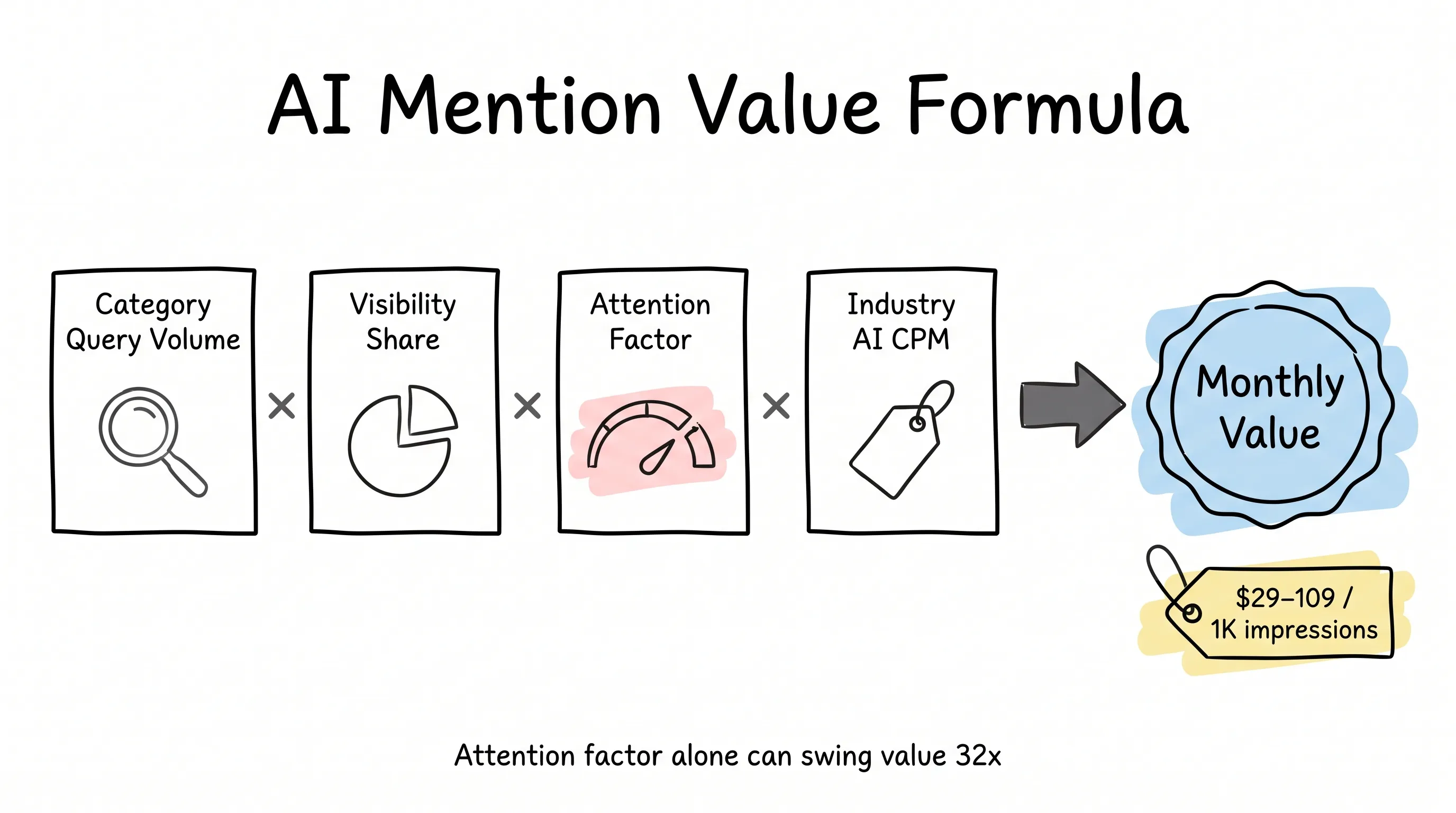
There's one more justification for pricing mentions like ad space: this inventory comes with four built-in properties. It appears inside the answer, so it doesn't interrupt the reading; it carries no ad label, so it never trips the reader's psychological ad defenses; it arrives in a recommending voice — the AI is effectively vouching for you; and it reaches only the high-intent people who asked in the first place. A Super Bowl spot buys reach to 115 million viewers. What an AI mention buys is at least that, and more.
For the past year, every team doing GEO has been stuck on the same question: the CEO asks what the investment brings back, and nobody could answer. ABMV turns the answer into a table. Industry AI CPM is pegged at 3.3x display ad CPM — unpacked as a 2.2x trust premium times a 1.5x intent premium. The trust side leans on Nielsen survey data: 67% of people trust editorial content, while only 37% to 42% trust banner ads. The resulting quotes: $66 per thousand impressions for B2B SaaS, $29 for mass-market e-commerce, $109 for legal services. Similarweb's own data sits underneath: generative AI platforms draw 7 billion monthly visits, up 76% year over year; AI referral traffic converts at roughly 7% on transactional websites; referrals are up 357%.
There are benchmarks to copy for setting visibility targets too. By position: above 80% is category dominance — the treatment Salesforce enjoys in CRM; 50% to 80% is the top-three tier; 15% to 30% counts as a known alternative; 5% to 15% is newcomer territory. The pace of gains decays as share climbs: going from 5% to 15% takes 12 months at $15,000 to $30,000 a month; 15% to 35% demands 18 to 24 months at $30,000 to $50,000 a month; and pushing from 50% to 70% is a two-to-three-year grind. For a new brand with around 8% market share, targeting 20% in year one is realistic — that's contesting share of voice in AI at three times your market share. Platforms also carry a tier coefficient: Perplexity gains 25% in value for its diverse citation sources and high-intent audience; Claude gains 15% for its technical readership; Gemini runs slightly lower; Copilot, owning the enterprise office scenario, gets a modest bump.
The truly valuable variable in this model is the attention factor — it alone can swing the value of the same mention by 32x. Four weights multiply together. Position: an exclusive recommendation counts 1.5x; seventh slot or later, just 0.2x. Context: strong endorsement 1.5x; negative sentiment multiplies straight by −0.5. Source: a citation from The Wall Street Journal or Wikipedia counts 1.3x; an uncited mention, 0.7x. Competitive density: with only one to three competitors in the category you can still charge a 20% premium; at 26 or more, value drops to 0.6x. An AI answer typically carries only three to five brand slots — in categories crowded with competitors, that's the hidden killer. The article draws one red line: if context weight is below 0.7, fix your reputation before you talk about buying visibility. For your budget sheet, that means the same dollars poured into a red ocean of 20-plus competitors automatically lose 40% to 60% of their value.
Implementation comes in three steps. Step one: sample 50 to 100 target queries and, across the four platforms — ChatGPT, Gemini, Perplexity, Claude — log your appearance rate, position, context, and sources, then compute your current attention factor. Step two: set budget against the spend-tier table: $1,500 to $5,000 a month buys a 3 to 8 percentage-point visibility gain; above $30,000 a month buys 20 to 35 points; and the industry cost per point runs $800 to $3,000. There's a split for the budget too: content optimization 35% to 40%, authority building 25% to 30%, technical work 15% to 20%, reputation management 10% to 15%, tooling and monitoring 10% to 15%. Step three: sanity-check the return with the CRM worked example in the piece: visibility from 8% to 20%, monthly spend about $24,800, returned reach value about $51,700 — a 2.08x return, turning positive in 10 to 14 months in most cases. Seasonal categories are a separate calculation: winter apparel queries expand 3.3x in Q4. The author ran the numbers on a category with a baseline monthly value of $80,000: it shrinks to $32,000 in the off-season Q2 and balloons to $264,000 in Q4 — $1.536 million for the full year, and all the money sits in the peak quarter. Sixty to seventy percent of the annual budget should be loaded onto the peak period; seed your content 90 days ahead and wait for the AI to index your updates. B2B and professional services see steady demand all year — no seasonal adjustment needed. There are quarterly signals to watch for validation: brand search volume up 10% to 25% within six months; AI referral traffic converting at two to three times traditional channels; the visibility gap to top competitors narrowing quarter by quarter. Only when all three signals line up has the money been spent right.
The author lists the model's limits at the end: it excludes click value, brand lift, and assisted conversions, and it doesn't handle negative mentions — what it computes is a reach-based estimate. Add that Similarweb is quietly upselling its own AI Search Intelligence, and you should apply a discount as you read. Even so, the value of this thing is that it swaps the gut-feel fights of budget meetings for arithmetic: formula, benchmarks, and worked example, all three present. My advice: run the 50-query audit from step one this week. Map where you actually stand in AI answers — position, context, source weights — before deciding whether to spend. The numbers can be argued over — but take inventory of what you actually have first.
🔗 Further reading: Read the full article
🏷 Industry Data
89.7% of social media marketers use AI daily — yet consumer comfort has slid to 46%
theStacc has compiled 50 statistics on AI in social media marketing for 2026, each with source and year, grouped into eight sets by decision scenario. On the adoption side, the ceiling has been reached: 89.7% of social media marketers use AI daily or several times a week, and 71% of social-media image production pipelines now involve AI. That second number is easy to misread: it means steps like background removal, upscaling, style transfer, and variation generation are now in the pipeline — not that every post is machine-written — and the distinction directly affects how you judge disclosure compliance and platform policy. The penetration figures likewise describe day-to-day use; the competitive question has shifted from whether to use AI to how deeply, with 71% of marketers completing at least half their social media work with AI.
On the performance side there are replicable dividends: 72% of respondents say AI content performs better, engagement rates rise an average of 31% to 32%, and ad creatives made with AI see 47% higher click-through rates. On speed, 93% use AI to accelerate content production, saving 2.5 hours per person per day and lifting monthly posting volume 42%. Personalization is an undervalued monetization lever: purchase frequency up 35%, average order value up 21%. The market grows from $2.96 billion in 2024 toward $48.18 billion by 2033 — a 36.4% compound annual growth rate — with AI influencer marketing already at $11.74 billion in 2026.
The constraint side is just as striking: consumer comfort with brands using AI fell from 57% to 46% in a year; only 4% of marketers fully trust AI output that hasn't been human-reviewed; 18% of technical marketers admit AI has dragged down content quality; and 42% of companies have abandoned most of their generative AI projects within a year. Platform playbooks are diverging too: 15% of the Facebook feed is AI-recommended non-followed content; Instagram rewards visual AI; TikTok rewards AI-edited short video; LinkedIn rewards AI-assisted long-form; X punishes obviously synthetic content. And the efficiency budget being freed up is flowing to real humans — B2B teams' creator collaboration budgets are up 61% on average.
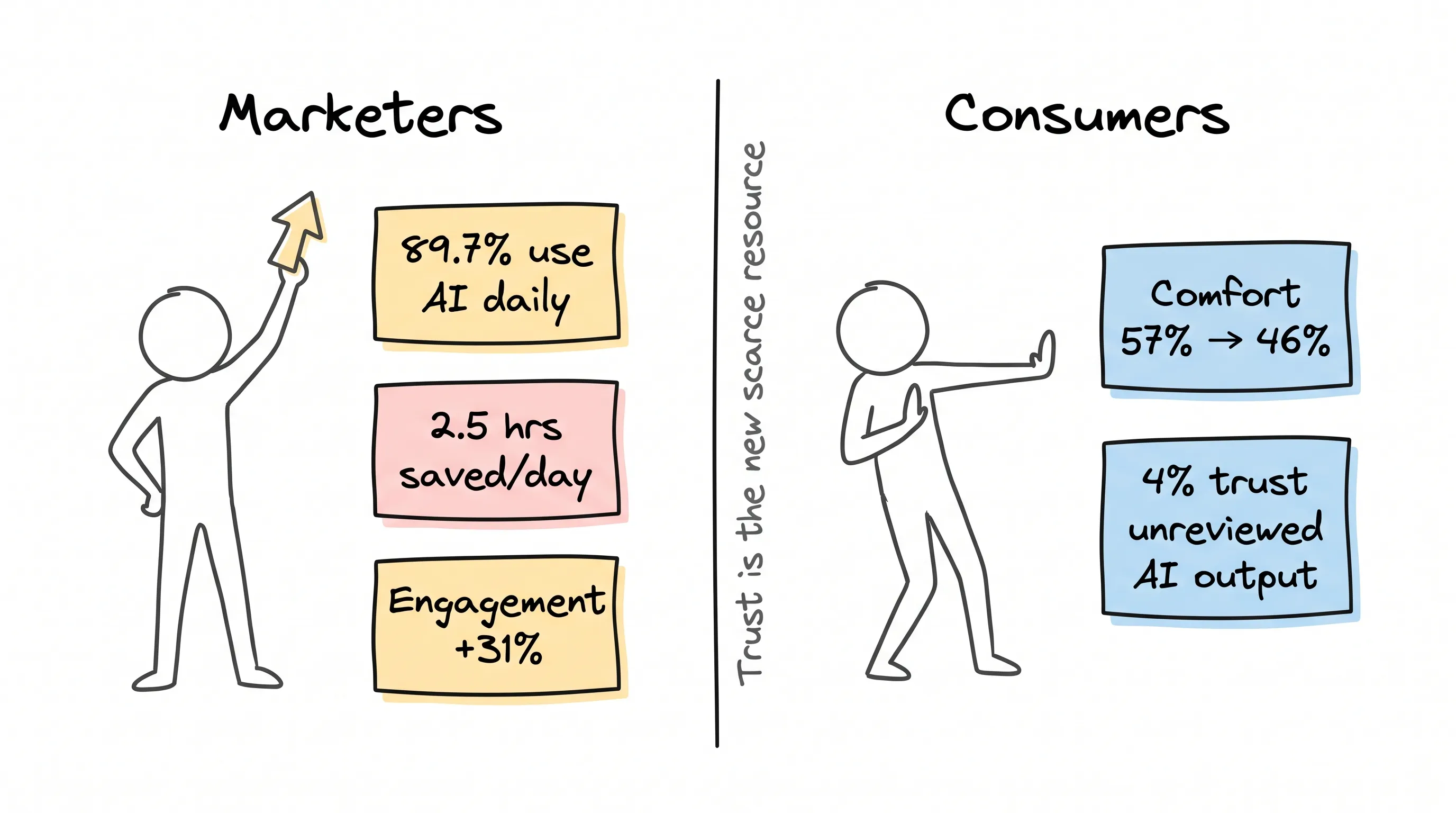
💬 The efficiency dividend is real, and so is the trust discount. Force those saved 2.5 hours back into audience research and creative testing — don't let it become a posting-volume arms race. Spot-check the original sources before citing anything externally; some of this data was republished via secondary blogs. The comfort-level stat belongs directly in your AI disclosure compliance self-check.
🔗 Further reading: Read the full article
Braze posts a 457% three-year ROI: the gap in AI marketing is execution, not adoption
At its City x City event in London, Braze released two studies. A Total Economic Impact study commissioned by Braze from Forrester Consulting models a composite organization: enterprises using both the Braze platform and BrazeAI Decisioning Studio see a 457% return over three years, $23.5 million in net present value, and payback in under 6 months. The data is vendor-commissioned — note that when citing it — but the magnitude is worth benchmarking against your own projects.
A second report, published with the consultancy Cowry, measures how hostile the environment has become: consumers face up to 10,000 commercial messages a day. Piling on volume no longer works; what works is relevance, timing, and response speed to real-time signals. Braze Chief Commercial Officer Astha Malik puts it more bluntly: AI-generated content is near-infinite, attention is finite and loyalty fragile, and every sloppy AI blast is teaching users to tune you out. She is pushing the marketing-technology narrative from productivity to performance.
The research distills four traits of high-performing brands: activating first-party data in real time, embedding the decision engine into real customer journeys, reducing tool fragmentation, and treating every campaign as a continuously learning dynamic system. The action framework is likewise four items: swap batch campaigns for real-time signal-driven interactions; give budget to decisioning orchestration before content production; consolidate tools in one place to cut friction; and measure only conversion, retention, and revenue. The industry's default state, meanwhile: adoption is near-universal while measurable returns are rare — the gap sits in that one step from experiment to execution.
💬 Use these numbers as a negotiation anchor, naming the commissioning party. What's actionable is the sequence: build real-time signal-driven decisioning orchestration first — deciding who gets what message and when — and push content generation down the queue. Something to do this week: count how many non-communicating systems sit in your own tool stack. Your degree of fragmentation directly determines how fast AI returns materialize.
🔗 Further reading: Read the full article
Rihanna sells on a Douyin livestream: three hard lessons for entering China
In a talk at eCommerce Expo, Jack Porus of Tong Global used Rihanna joining Fenty Beauty for a 618 (the June 18 mid-year shopping festival) Douyin (China's TikTok) livestream as his opening hook for how international brands survive entering China. The market structure, in numbers first: Alibaba's share of Chinese e-commerce slid from about 50% five years ago toward an expected 40% this year; Douyin e-commerce went from zero to roughly 15% over the same period — more than 7% of global e-commerce sales on a global basis; Xiaohongshu has accumulated about 300 million users, skewing toward urban, high-income women; and China accounted for 41% of the world's new physical luxury stores opened last year. Shelf-based e-commerce is yielding to social commerce, and attention is being split across WeChat, Xiaohongshu, and Douyin.
Livestreaming is a growth engine, but it's not a tame one. Impulse buying brings cancellation rates of 20% to 30%; when volume explodes, a single minute can sell out three months of inventory, so both pricing and stock need buffers. Third-party hosts take commissions of 25% to 30%, and the traffic belongs to the host personally; running your own livestreams reaches fewer people but yields better margins and lets you keep the customer relationship. Chinese hosts demand certification documents for product claims, and some categories require re-certification in China — without the paperwork in order, you can't even book the slot. The second half of the talk walks through campaign execution for two brands, muuto and Works — from selecting influencers and setting discounts to controlling inventory — usable as a checklist for cross-border projects. The only AI deployment mentioned on-site: real-time Chinese-English captioning for Rihanna's livestream, judged a highly successful rollout.
💬 In China, build brand mindshare before opening a store — never reverse the order. Cross-border teams can budget off three numbers: 30% commission, 30% cancellation rate, and a three-month inventory buffer to start. In year one, run your own livestreams to control pricing and accumulate a customer base; open up influencer distribution only after the model works. The talk comes from an agency, but the commission and cancellation figures are front-line real numbers — solid enough to use.
🔗 Further reading: Read the full article
🏷 Marketing Toolkit
Gartner: only 15% of CMOs are seen by their CEOs as understanding AI — six steps to rewrite your reporting
A post on the Braze blog about how CMOs can prove AI's value to the executive team opens with Gartner data: only 15% of CMOs are considered AI-savvy by their own CEOs, and CEOs openly doubt how fast marketing leaders are embracing AI. For marketing teams, the number is both pressure and leverage — used well, it's the opening line of your case for internal resources.
The article lays out a six-step route. First, tie AI projects to explicit business goals — customer engagement, promo spend optimization, or lead conversion, pick one — to avoid using AI for its own sake; the piece especially calls out marketing leaders at B2C companies as needing this lesson first. Use AI to analyze behavioral data for personalized targeting, then reallocate resources by results. Customize KPIs by industry — a financial institution, a retailer, and a fast-food chain measure entirely different things — and pair the AI setup with the brand's own data and guardrails, monitored and tuned continuously by the service team. Back it up with success cases from your own industry. Build a continuous-learning mechanism for the team. Final step: when reporting to the executive team, speak only the language of growth and company strategy — translate "we did AI" into "AI drove this business result."
💬 In your next report, invert the order: open by dropping the 15% figure to create urgency, then talk about exactly three things — the goal, the change in KPIs, and the money. Don't mention a single model or tool name. This is vendor content; the framework is usable, but swap in your own industry's case library — not the one in the piece.
🔗 Further reading: Read the full article
Pandora started testing its Christmas campaign in May: a Google Ads AI cross-border playbook you can copy
Topkee has put together a hands-on Google Ads AI piece for cross-border e-commerce teams; both cases come from Think with Google and can be traced and verified. Pandora runs holiday marketing on a year-round testing framework: the Christmas campaign kicked off as early as May, leaving a full half year for testing and optimization, and Google Store Sales Measurement connected online-offline attribution — 2023 Google Ads revenue up 77%, offline sales up 220%. Teams that lose holiday marketing at the starting line mostly started testing too late.
Klook used AI Text Ads Generator to auto-generate over 100,000 ad creatives in 14 languages, paired with Responsive Search Ads, with the system automatically combining the best-performing headlines and descriptions to match search intent — conversions up 115%, and half the creatives earned an Ad Strength rating of Excellent or above. The visual side of creatives is backed by design tools like Canva, so localized artwork ships fast. The methodology section is a trio: multi-account data stream integration, to counter cross-border data fragmentation; automatic segmentation of remarketing audiences by engagement depth, with personalized creatives generated for each; and custom TMID-style tracking replacing standard UTM parameters, able to attribute each touchpoint by traffic source and region.
Local keyword mining has a ready example: Indonesian users search earphone bluetooth murah ("cheap bluetooth earphones" in Indonesian) — bidding directly on wireless headphones is money burned. The collaboration model is set as AI generation plus human localization: the Japanese market values craftsmanship and after-sales service; Western markets value price-performance and user reviews.
💬 The testing window for the Q4 peak season is right now — schedule backward from Pandora's timeline: lock your test structure this month, seed creatives 90 days ahead. Let AI drive volume on multilingual creatives; leave cultural adaptation to your local colleagues' sign-off. The market-size figures in the original headline are built on an unclear counting basis — verify before citing.
🔗 Further reading: Read the full article
AI returns are stuck in the seams between tools: 2026 is the year to weave multi-agent systems into workflows
In this essay on 2026 AI ROI, Smartcat offers a diagnosis: the siloed pilots of 2025 — marketing's writing tools, support's ticket routing, HR's FAQ bots — delivered only local efficiency gains. The returns got stuck in the seams between tools: moving files, reformatting across platforms, syncing content across regions, waiting on approvals — work that nobody picked up. The test is plain: whoever weaves AI into the workflow sees returns; whoever stays at single-point pilots stalls at the department level.
The 2026 answer is parallel multi-agent teams: each agent has a defined role, structured inputs, and predictable outputs — rewriting, brand voice, translation, terminology, and layout each take a leg of the relay, covering five stages: creation, QA, localization, formatting, and publishing, with finished work flowing straight into the CMS, LMS, PIM, and DAM. Three named cases: at Smith & Nephew, a policy update triggers automated drafting with parallel localization into 20-plus languages, cutting cross-region training content updates from weeks to days; Kids2 shrank website localization from weeks to hours; Wunderman Thompson lifted output 30% with the same headcount. The verdict sides with buying a platform: most enterprises building this in-house will lose to engineering bandwidth, integration timelines, and governance. The 2026 operating model is called the human-plus-agent pod: humans keep judgment, creativity, and oversight; agents take on execution at scale and consistency. ROI visibility comes from team time shifting from watching the process to making decisions — the added output all comes from stripping away the ring of friction around people.
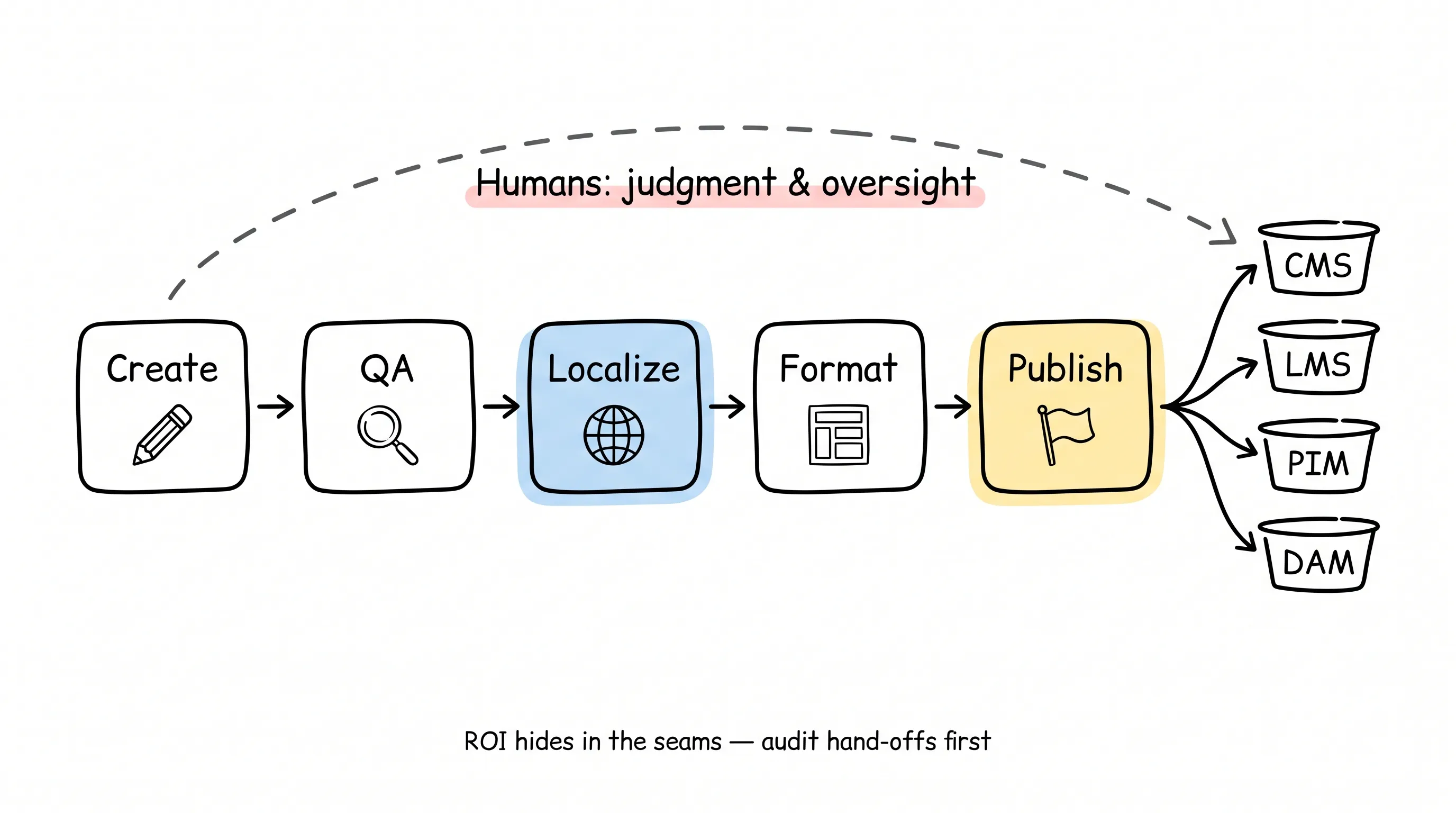
💬 Start with a seam audit: count how many manual hand-offs one piece of content passes through from draft to publish — that's where your ROI is hiding. The localization pipeline is the most agent-worthy first scenario: high repetition, clear decision points. Every number in the piece is vendor-reported; use it as trend evidence, not as a baseline.
🔗 Further reading: Read the full article
An AI checklist for cross-border e-commerce: support bots handle 70% of inquiries
In this roundup, WarpDriven breaks down AI adoption in cross-border e-commerce by pain point. Four big ones: language and culture localization, the many steps of logistics and customs, country-by-country compliance with data-privacy regimes like GDPR, and checkout-page transparency. The logistics section gives concrete handles — route optimization, warehouse automation, and real-time tracking each have solutions; the compliance section points to automated customs declaration and real-time tax calculation. The number the article cites — hidden fees drive 60% of abandoned orders — deserves to be taped to the wall of every team going global.
The quantified claims, stage by stage: multilingual support bots lift conversion rates 15% to 30%, cut cart abandonment 17%, and push customer satisfaction above 85; logistics automation cuts operating costs by up to half; fraud prevention reduces fraud losses 25% and halves the false-positive rate; AI support can handle about 70% of customer inquiries. Three signals at the case level: a beauty brand entering the EU market used AI to shrink its listing cycle from weeks to days; Xiaohongshu launched a Global E-commerce Pioneer Plan, using AI translation to lower the cross-border barrier; and on Alibaba CoCreate, small and mid-sized businesses are using AI to fight international competition. The methodology section delivers a five-dimension readiness assessment, seven vendor-selection criteria, an 11-step integration checklist, and a 12-month ROI roadmap — complete enough to use as a self-audit sheet.
💬 Most of the data is secondhand, linked out, and without original sourcing — treat it as directional. Start deployment with high-impact, low-risk scenarios like support bots, with human review as the backstop. Self-check your checkout page today: are shipping and taxes shown upfront? That six-in-ten abandoned-order figure is scary enough.
🔗 Further reading: Read the full article
🏷 Policy & Funding
CB Insights carves GEO content platforms out as their own category: Adobe buys Semrush for $1.9 billion
CB Insights has formally added GEO content platforms to its enterprise tech landscape, listing them as a standalone category under marketing and advertising technology. The category definition: tools built to raise content's visibility in generative answers from ChatGPT, Google AI Overviews, Perplexity, and the like, covering AI content creation, semantic structuring recommendations, citation gap analysis, technical SEO audits, real-time GEO scoring, and entity optimization. One line in the definition is easy to overlook: these tools must also solve AI crawler accessibility — if the crawler can't reach you, everything after that is moot.
The landscape ranks a Leader array by execution strength and market strength: established players like Semrush (founded in Boston in 2008) and HubSpot, alongside a cohort of newcomers founded between 2021 and 2025 — Berlin's Peec AI, London's Azoma (formerly Ecomtent, now pivoted to agentic commerce optimization), Barcelona's PageMind (specializing in product content for e-commerce AEO (answer engine optimization)), plus Bluefish, daydream, Scrunch, and others. Two acquisitions put a price on the category: in April 2026, Adobe acquired Semrush at a $1.9 billion valuation, and in June 2026, Sitecore acquired Scrunch for $225 million. Marketing-cloud and CMS vendors are folding GEO capabilities into their own suites — consolidation in the category is accelerating.
💬 The lead story covered how to value AI visibility; this one covers who collects the money. Factor acquisition-integration risk into vendor selection: an independent tool may become a module inside someone's suite six months from now — plan the data and workflow migration costs ahead. Reserve a monitoring line in your budget first. E-commerce teams take note: GEO has extended from brand visibility to product purchasability.
🔗 Further reading: Read the full article
The EU AI Act rolls out by risk tier: where's the compliance floor for marketing personalization
This regulatory review from Obsidian Security maps where global AI regulation headed in 2025. The EU AI Act advances by risk tier: high-risk systems must pass conformity assessments, carry CE marking, and run post-market monitoring; the US takes a voluntary path of executive orders plus the NIST framework; and GDPR and AI-specific rules overlap in application — lawful basis, impact assessments, and individual-rights responses are all mandatory. For marketing teams, personalization, profiling, and automated outreach all land squarely in that overlap.
At the framework level, the piece recommends NIST AI RMF paired with ISO 42001 as the governance base, plus the integrated TRiSM approach. The division of labor among the three is laid out clearly: NIST covers the full risk lifecycle, ISO 42001 provides a certifiable management system, and TRiSM merges trust, risk, and security into one lens. A new signal at the organizational level: the AI Governance Officer is emerging as a dedicated role, and board-level accountability is tightening. The division of responsibility is drawn clearly too: the CEO and the board carry accountability, the CISO owns technical controls, legal interprets the clauses, and the newly created governance role coordinates across departments. The article lays out a three-stage maturity route from ad hoc compliance to formal governance — stage two's signature is policy-as-code, stage three relies on automated monitoring plus predictive analytics for continuous compliance. Two numbers in the piece are worth noting — the average data protection fine is $4.4 million, and governance-mature organizations see 40% fewer AI security incidents — but neither carries a cited source. Note: the original article was only partially captured for this item; the summary above is reconstructed from its abstract and key points.
💬 The minimum move on the marketing side: run your personalization and audience-data workflows through a lawful-basis and impact assessment, and if you operate in the EU, check the AI Act's risk-tier list first. The ISO 42001 certification path is worth watching — it's turning into a plus item in major-client procurement. The figures in the piece have no cited source; verify before citing externally.
🔗 Further reading: Read the full article
💡 Today's Big Picture
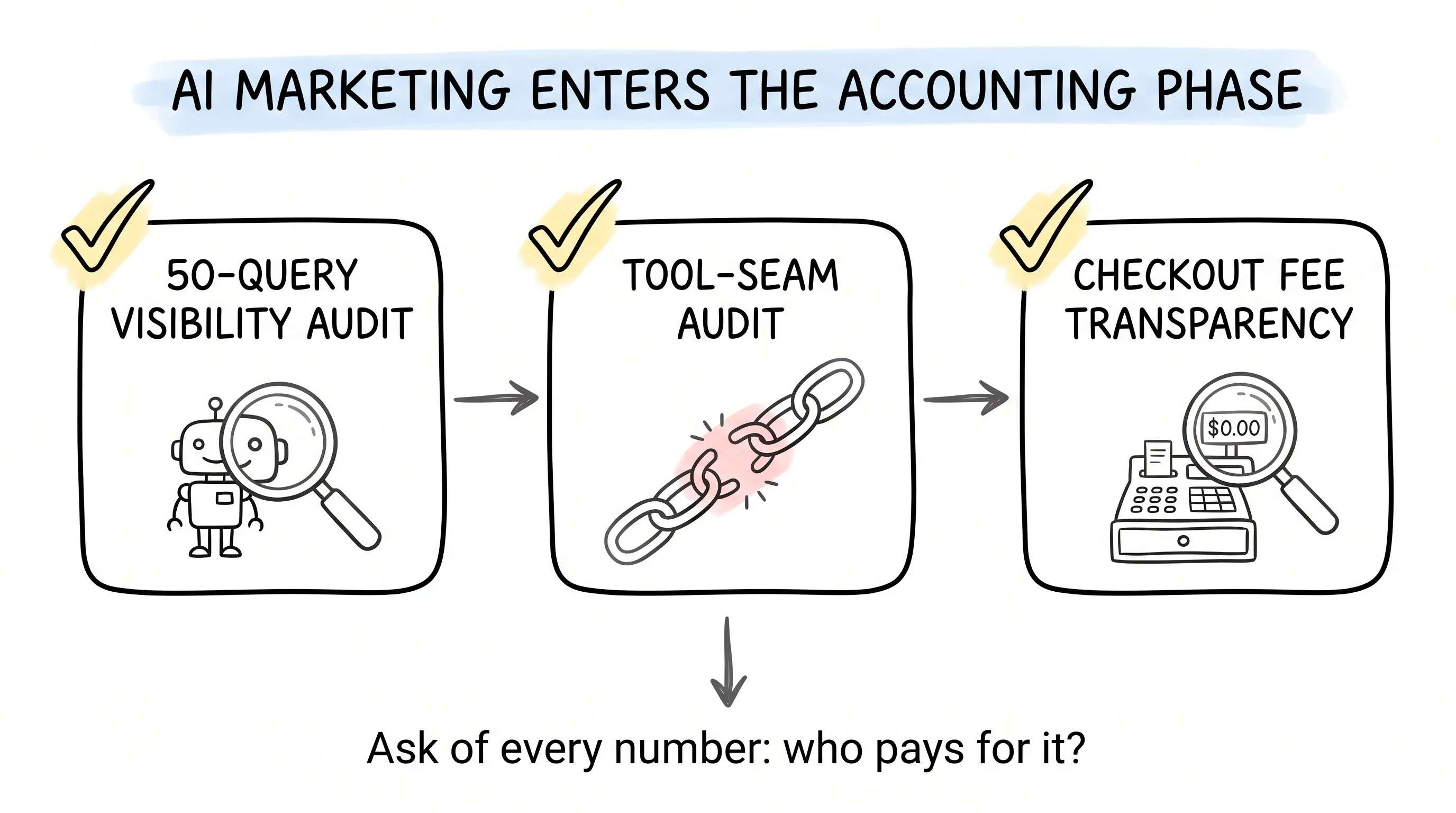
Lay today's ten items side by side and the theme is a single word: pricing. The lead's ABMV framework put a price on AI brand mentions — $29 to $109 per thousand impressions; Braze's research put a price on AI decisioning orchestration — 457% over three years; the CB Insights landscape put a price on the GEO tooling category — Adobe paid $1.9 billion. AI marketing is sliding from the concept phase into the accounting phase, and in this phase, whoever first converts the spend into numbers a CFO accepts is first to the budget.
The second story hides behind the data. Marketers: 89.7% use AI every day. Consumers: comfort has slid to 46%. AI-generated content is in infinite supply; attention only shrinks. Trust has become the new scarce resource — and the steps that can't be fully automated, human review, cultural adaptation, reputation repair, are exactly where the premium lives. The lead's red line — fix your reputation first when context weight is below 0.7 — and Braze's line that every piece of AI slop is teaching users to tune you out are the same lesson: before the machines scale volume, first make sure the machines aren't bad-mouthing you.
A quieter thread runs underneath: cross-border. China livestream commission and cancellation rates, Google Ads multilingual creatives, support bots, Xiaohongshu's going-global support program — four of the ten items are about pushing AI into cross-border business. Language, time zones, and creative volume are the three most labor-hungry parts of going global, and AI happens to be taking them over one by one. Cross-border teams' speed to launch is being repriced.
One last note on how to read all this: more than half of today's ten sources are vendor-produced content — Similarweb sells monitoring, Braze sells a platform, Smartcat sells localization, WarpDriven sells supply chain. The frameworks and the data are all usable; just run every number past one question first: who's paying for it? That's also the question this briefing has already asked for you, in every commentary note.
Pick one thing to start next week: the 50-query AI visibility audit, a tool-seam audit, or a checkout-page fee-transparency check. None of the three costs much, and all of them can show numbers within the month.
Continue reading
Related articles

AI Marketing Daily · 2026-10-09
AI marketing daily for 2026-10-09 covering 11 items: brand measurement moving from survey panels to search, social, e-commerce, and AI prompt signals; GEO and share of model playbooks; safety guardrails for agentic ad buying; and tool roundups for ad platforms, cross-border tools, and social media uses.

AI Marketing Daily · 2026-10-08
AI Marketing Daily for 2026-10-08 curates 20 items across AI search visibility (GEO), advertising, platform selection, cross-border e-commerce, and ROI measurement. The headline argues that strategic marketing decisions should stay with humans while AI assists execution.

AI Marketing Daily · 2026-10-07
Today's throughline is answer engine optimization (AEO — getting your brand quoted in AI answer engines).