
AI Marketing Daily · 2026-09-19
The data on AI talking customers out of buying landed on the table today.
The data on AI talking customers out of buying landed on the table today. Semrush's survey of more than two thousand people puts the downside in plain view: AI both drives and kills sales. The positive playbook has arrived too — a batch of GEO (Generative Engine Optimization) case studies with baselines and timelines that you can lift almost as-is. Adobe's annual report measures the expectation gap between enterprises and consumers, ad APIs are going agent-based en masse, and GDPR's seventh anniversary rings the compliance bell again. Today: 20 hot items, one headline deep-dive, and a quick scan of the rest across five categories.
🎯 Today's Headline
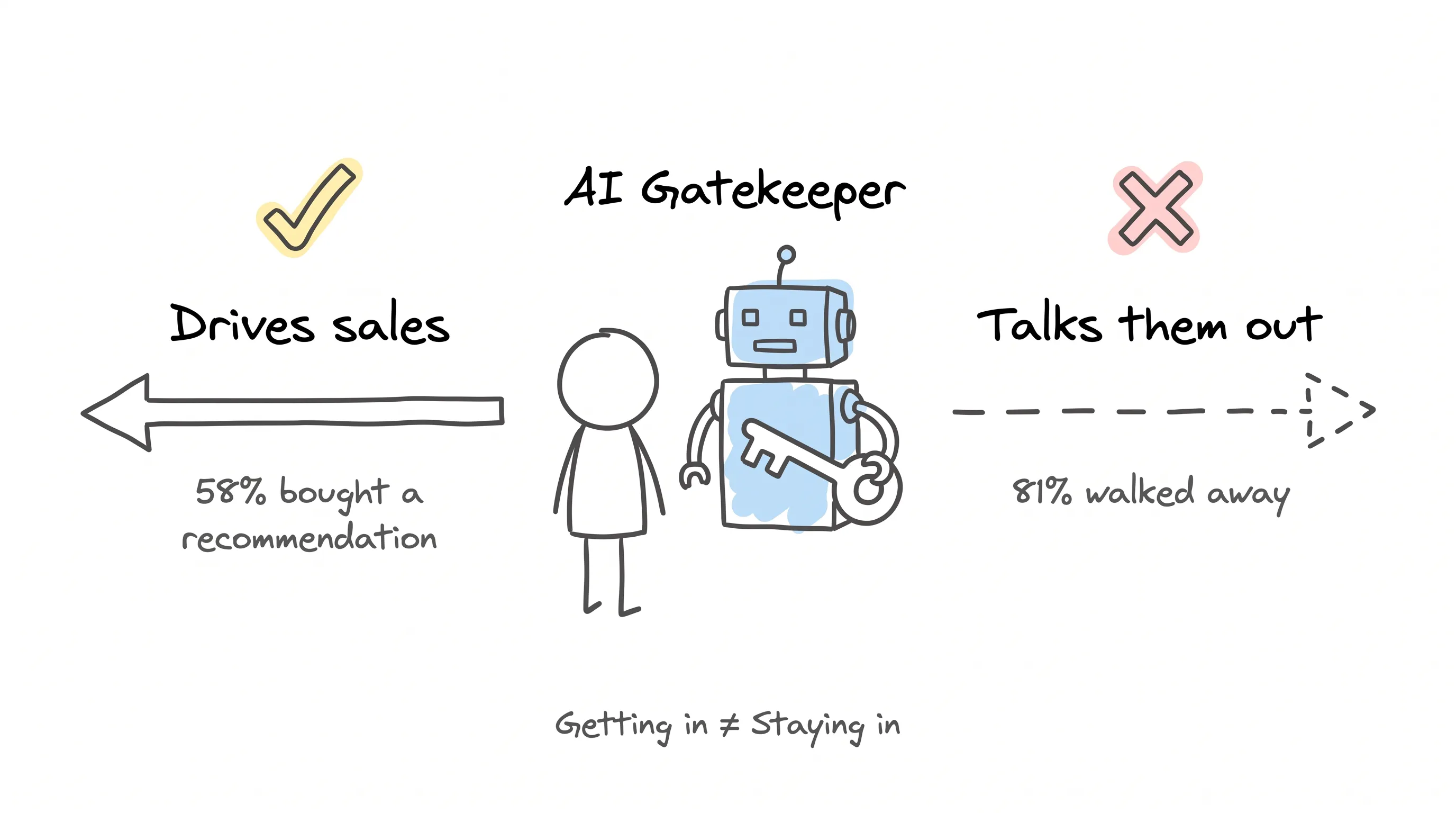
AI Is Talking Your Customers Out of Buying — Add "Don't Get Dropped" to Your GEO Goals
On September 18, MarTech published Semrush's consumer survey — 2,338 US adults — and one number jumps off the page: among consumers who shop online with chatbots, nearly 81% have decided not to buy a product because of information the AI gave them. Turning customers away and driving purchases are two sides of the same coin: 58% of AI users have bought products a chatbot recommended, and an equal 58% have abandoned a purchase over information the AI provided. Among weekly heavy users, more than 80% have bought AI-recommended products. Reviews are the riskiest minefield of all: over 74% of consumers say their willingness to buy drops when a chatbot mentions mixed or negative reviews — and among AI users, that figure tops 85%.
What gives the survey its weight is that it fills in the other side. GEO used to have exactly one goal: wedging your way into the AI answer. This survey says: even if you wedge in, one sentence can kick you out. 59% of AI users have discovered new brands through chatbots, and 71% believe chatbots can recommend the best brands and products — AI can write you onto the shopping list, and cross you off on the spot. The article's author, Constantine von Hoffman, nails the shift: what consumers ask AI has changed from "what should I buy" to "should I be buying from you."
The channel picture holds two counterintuitive findings. First, only 29% of consumers use chatbots for product research — but among people who use AI weekly, that share is 55%, and this group now reaches for chatbots more than for recommendations from friends and family, social media, retail websites, or YouTube; only search engines and review sites still rank ahead. Second, 65% of AI users say chatbots have replaced part of their Google product searches, yet nearly half made no change at all in the total amount of Google-based purchase research over the past year. So don't rush to declare SEO dead — the real picture is channel stacking. Within a single purchase decision, consumers bounce back and forth between Google, reviews, brand sites, and AI. Brands have gained another shelf where they can win points, and another shelf where they can lose them.
For marketers, the impact lands in three places. Content teams now own more than keyword rankings — they own the brand narrative as AI retells it: negative reviews, controversies, and price doubts can all be relayed by the model to the next customer. Media teams need to redo the math: paid placements buy exposure, not conclusions — in the survey, 42% of consumers dislike ads inside chatbots, and among those who do, 66% say the ads make them doubt the fairness of the AI's answers. Brand teams need to build monitoring: how AI talks about you each day is something you should know before anyone else.
How to act on it? Three steps. First, fold review governance into GEO: this week, sweep your own products' negative-review keywords and response times on the major platforms — reviews are high-weight material for AI to cite, and that 85% sensitivity to being talked out of a purchase is your budget justification. Second, rewrite your content so AI can extract it: definitions up front, data in tables, sources credited — feed the model your accurate information and shrink the space it has to improvise. Third, stand up a weekly monitor of 50 purchase-intent prompts: watch how AI evaluates you and whether it is crossing you off the candidate list. When a negative narrative appears, fix the source content first, then consider anything else.
My take: the heaviest word in this survey is "can't buy." Visibility can be bought with money; the AI's conclusion cannot. GEO's moat does not sit in the media budget — it sits in how fast you respond to bad reviews and how accurate your factual content is. One note on conflicts of interest: Semrush is MarTech's parent company and also sells AI visibility tools, so trust the data about seventy percent. But the "talking customers away" side has now been laid on the table by data, and for people who build brands that is a dead-serious reminder: if you get into AI answers and cannot hold the ground, every optimization before it was wasted.
🔗 Further reading: Read the full article
🏷 LLM Watch
Marketing Dive Retrospective: GenAI Moved from Showy Front-of-House to Back-Office Work
This Marketing Dive industry deep-dive was written in January 2025 and still lands on target today. After consumer backlash against Toys R Us's AI-generated ad in 2024, the industry moved generative AI off front-facing advertising and into back-office functions: customer journey branching analysis, synthetic audience testing, cost-efficiency use cases. The practitioner consensus is refreshingly plain — GenAI is precisely good at the work humans don't enjoy — so efficiency gains come first and flashy demos wait their turn. On the price side, pressure comes from low-cost models like DeepSeek R1: as model costs fall, the margin vendors once earned by slapping an AI label on old products gets squeezed out; the piece calls this "sequin syndrome" (sparkle with little substance), and ROI scrutiny will weed those products out. For a 2026 reader, its value is showing you the rhythm: the heat of AI marketing has moved offstage and into the plumbing of the workflow, with applications like synthetic audiences delivering practical value before Sora-style video ever did. Timeliness carries a discount — for fresh 2026 data, turn to annual reports like Adobe's — but the framework of thinking still holds.
💬 Put back-office scenarios first in your queue: journey branching analysis and synthetic audience pre-tests cost an order of magnitude less than front-facing video production, and their results are measurable. Run front-facing AI creative only as small-budget A/B tests — never use your main campaign as the test bed. While you're at it, review your tool list; the ones whose only claim to AI is the label can be lined up for replacement.
🔗 Further reading: Read the full article
An Index of Nine Big-Brand LLM Case Studies: Good for Pulling Material, Short on Insight
A case roundup on HackerNoon under the byline of an executive at data-labeling firm Mindy Support, written in August 2024, collecting nine public cases: Amazon using Lex for customer service, Coca-Cola using GPT-4 for content and consumer insight, JPMorgan using Watson for risk control, the recommender systems of Netflix and Spotify, and The New York Times' advertising personalization. Two threads are worth pulling out. One is the hybrid model of AI plus humans — difficult and emotionally charged questions stay with human agents, a configuration that remains the standard answer for customer service today. The other is that big brands' LLM deployments cluster around service efficiency and data insight, with ad creative the minority play. The limitations are equally obvious: every case is a shallow retelling of old public news, multiple UTM links inside route back to the author's company product pages, the author is a commercial director at a service vendor, and its freshness stops at mid-2024.
💬 Use it directly when you need a big-brand case list for management — it's a ten-minute job. For vendor selection or strategy decisions, go find fresh 2026 cases instead; keep this file's reference cutoff firmly in mind. That said, the human-agent staffing in these older cases still holds up today.
🔗 Further reading: Read the full article
🏷 Product Launches
KNOREX Launches an Agentic AI Ad API: The Campaign Execution Layer Starts Going Agent-Based
In February, KNOREX (NYSE: KNRX) released an ad API built for agentic AI, positioned as the execution layer for cross-channel campaigns — letting AI agents operate placement actions uniformly across Google, Meta, TikTok, and other platforms, with a first batch of three strategic partners split between the US and Southeast Asia. The press release cites an industry forecast of more than $740 billion in global digital ad spend for 2026, with the migration of enterprise operations toward agents as its big backdrop. The item itself is a Business Wire press-release relay, lacking independent verification, and pricing and technical details are undisclosed — treat it as a trend sample rather than a product review. Put it back in the big picture: agent-based campaign infrastructure is where vendors are collectively placing their 2026 bets, and standardization of the execution layer means the contest for the entry point of the AI-agent ecosystem has already started.
💬 Hold off on action for now, but log one thing internally: in your media-handover documents, get API permissions and account structures for each platform cleaned up and documented — when this kind of execution layer matures, whoever's accounts are cleanest benefits first. Verify original sources before citing market figures from press releases.
🔗 Further reading: Read the full article
Rereading TikTok Search Ads: The New Variables in Search Come from Visuals and Voice
A March 2023 Business Insider report that reads today as background puzzle pieces. TikTok search ads ran invitation-only testing from March 2022 and began scaling preparations in 2023 — soliciting case studies from advertisers and recruiting engineers for its large-scale ads systems — eyeing a $112 billion search advertising market, with agencies predicting a full rollout in Q3 that year, in time for the Q4 peak season. The difference from traditional search lies in the signal: targeting draws on video visuals, speech-to-text, captions, and keywords shown on green screens — the case of footwear brand Kane Footwear being found through green-screen text is the sample, delivering a higher degree of personalization than the title-and-description metadata approach. The weak spot is brand safety: agencies at the time judged that it did not yet incorporate full safety controls, leaving negative keywords as the only backstop. Three years on, this line has grown into a genuine shelf, and Gen Z treating TikTok as a search engine is now common ground.
💬 Carve 5-10% of your search budget for TikTok search ads; bake brand terms and scenario terms into green-screen captions — the creative itself becomes the keyword. Backstop brand safety with negative keywords; run a small budget for four weeks, check conversion quality, then talk about scaling.
🔗 Further reading: Read the full article
Dynamics 365 Customer Insights, Taken Apart: A CDP Plus Journey Orchestration Two-Piece Set
A December product explainer from Microsoft partner Alphabold breaks Dynamics 365 Customer Insights into two pieces: Data, a unified customer data platform (CDP), and Journeys, real-time trigger-based journey orchestration. The walkthrough advances through five stages — awareness, consideration, conversion, retention, advocacy — matched to product capabilities like AI segmentation, natural-language-assisted journey building, and multi-channel orchestration. The material's value surface is narrow: useful only as a primer when evaluating the Microsoft marketing technology stack, with no cases, no data, no competitor comparison, and an unmistakable product-funnel slant. Teams selecting a CDP should treat it as a product-structure index; for an actual decision, you still need to benchmark Adobe's and Salesforce's corresponding products. Teams already inside the Dynamics ecosystem can use it as internal briefing material and save themselves a deck. The five-stage framework itself, though, is a universal journey audit method — it works with any vendor's product.
💬 CDP evaluators: use the five stages as your audit framework — write down your own touchpoints and breakpoints at each stage, then test whether a product can handle them. Far more reliable than buying off a vendor demo.
🔗 Further reading: Read the full article
🏷 Marketing Tools
AI Turns Old Workflows into Incidents: Three Client Cases on Fixing the Process Before Buying Tools
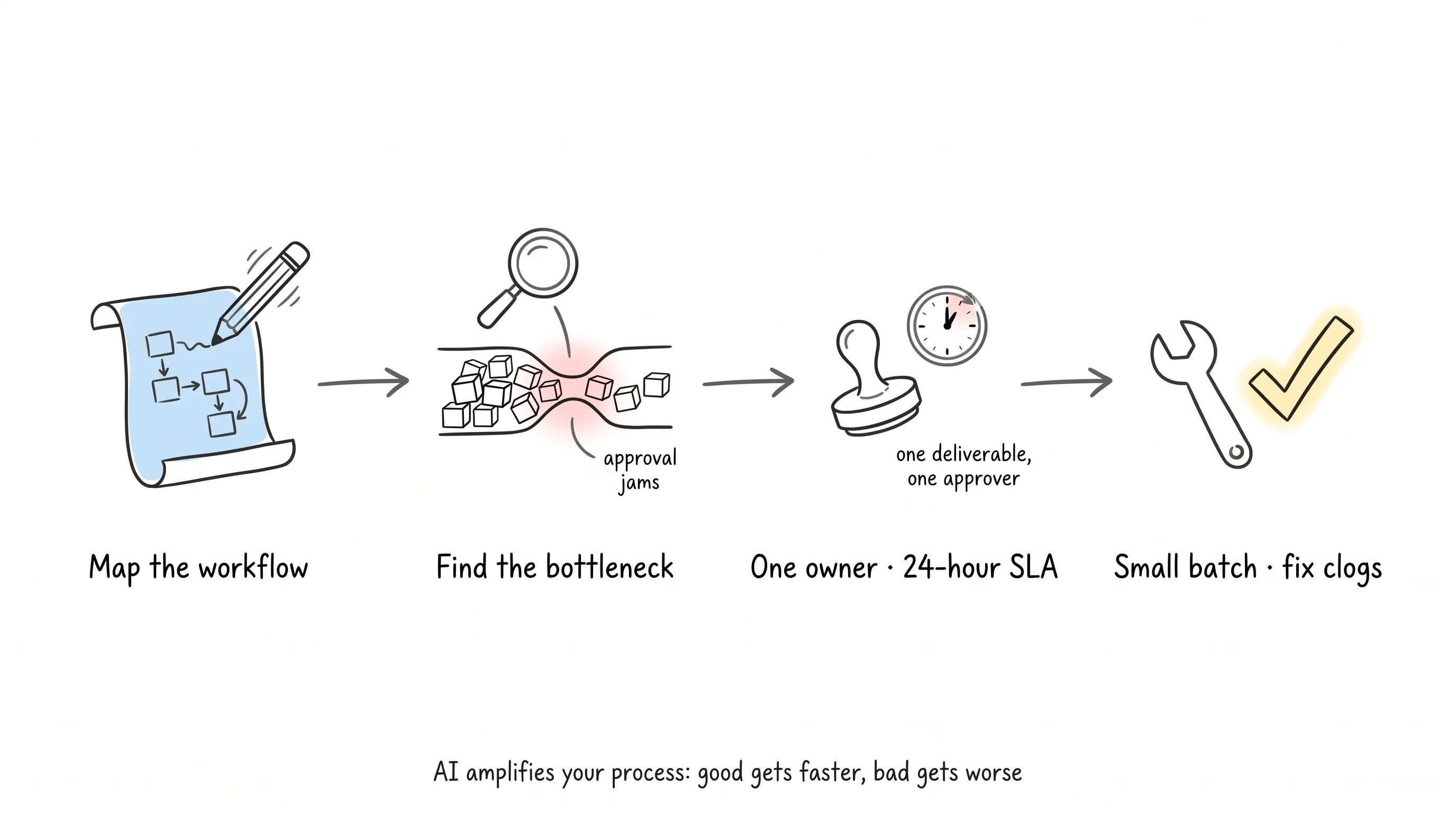
MarTech ran a hands-on observation from consultant Stacey Ackerman on September 18, and her framing is blunt: AI amplifies the workflow you already have — good ones get faster, bad ones turn into disasters. All three cases are recent. An insurance content team bought AI tools expecting half the headcount and five times the output; content did get produced, but everything jammed at approval — reviewer Claudette's reading load quintupled, and delivery actually slowed. After the rework, the team let AI do first-pass review while she spot-checked the finals, and the speed came back. At a homebuilder, go-to-market (GTM) materials for a new development landed in one day — flyers, signage, and social assets all complete — and then nobody could say who was responsible for approval; management went back and forth for three weeks before finally settling on a single approver and a 24-hour turnaround. A healthcare group produced the full kit of new-hospital opening materials with AI in a few days, then blew up in approval over font colors — the root cause was brand standards that had never been written down as a document. The third problem type sits in measurement: a fast-food chain used AI to rush out a back-to-school campaign, leadership asked how the redemption numbers looked, and the whole room went silent; a dedicated marketing analyst role was added afterward. The order Ackerman prescribes: map the end-to-end process first, find the bottleneck, then decide what tools to buy.
💬 Spend half a day mapping your approval chain and measurement ownership — that is worth more than two weeks of vendor evaluations. Set two hard rules for yourself: one approver per deliverable, and a 24-hour turnaround. When you launch AI, start with small-batch content and fix whichever segment clogs — don't let the three-week standoff repeat itself.
🔗 Further reading: Read the full article
11 Workflow Upgrades for AI Social Media Marketing: Chained Together, They Actually Produce
A long guide from Amzsoft Innovexa on September 8 sorts AI's footholds in social media marketing into 11 workflow types: content ideation, copy drafting, repurposing old content, scheduling, audience segmentation, personalization, social listening, report automation, and more. The positioning claim is clear — AI as the productivity layer: hand repetitive execution to it, and keep brand judgment, strategy, and creativity with people. The platform-side example is Meta AI Reels' multilingual translation — one piece of content distributed in many languages, a direct win for cross-border teams. The piece's most memorable reminder is chain thinking: using AI point by point only saves scraps of time; string ideation, generation, repurposing, scheduling, and reporting into one pipeline, and throughput finally starts to move. The shortcomings must be stated plainly too: the piece contains no first-party data and no client cases, and its viewpoints overlap heavily with mainstream guides — right as a team training outline, not enough as a vendor-selection basis.
💬 Pick three workflows to chain first: topic-to-first-draft, long content cut into short-video scripts, and weekly report auto-summaries — worth half a headcount's hours every week. New-hire training can use it as a terminology map, but pair it with an internal SOP, or it never lands.
🔗 Further reading: Read the full article
The AI Content Marketing Survival Guide: Move KPIs from Output Volume to Content ROI
First Movers' 2026-edition long guide pivots on AI as an amplifier of human creativity: drafts, research, and optimization go to AI, while strategy and brand voice stay under human gatekeeping. The external data it cites is McKinsey research: 78% of enterprises use generative AI in at least one function. Its KPI advice cuts to the bone — most teams are still counting output, when they should shift to engagement quality, conversion, and content ROI; volume metrics lose their discriminating power once AI has driven production costs to the floor. The ethics section lists three duties: fact-checking, AI disclosure, and preventing brand-voice homogenization. One caution on stance: the piece steers readers toward booking paid consultations in many places, and the author self-reports that parts were AI-generated, so its independence warrants a discount — treat the viewpoints as restatements of common wisdom, but the KPI thinking is worth borrowing.
💬 Delete hourly output from your content KPI sheet and replace it with two items: per-piece conversion contribution and engagement quality, compared once a quarter. Write the disclosure rule into the publishing checklist — one or two lines of text that buy reader trust.
🔗 Further reading: Read the full article
How Much It Hurts to Integrate 13 Ad APIs: The Integration-Cost Math of AI-Driven Campaign Management
Plushcap relays a blog post from Unified.to, and the math is done clearly: to integrate 13 ad platform APIs — Google Ads, Meta Ads, TikTok Ads, and more — where each one's authentication method, object model, reporting schema, and rate-limit rules are all different, the per-platform maintenance labor cost climbs linearly with the number of platforms. Unified's answer is to build a standardized interface layer: one integration, real-time read/write, supporting multi-platform dashboards and AI-driven campaign management. For SaaS teams, the lesson is to price the integration cost before product planning; for advertisers, the lesson is to ask, when choosing tools, how many platforms it connects and what its maintenance model rests on. Note that this is a meta-summary page whose stance leans toward Unified's own solution — check details against the original. Read it next to today's KNOREX ads API and the signal matches: standardizing the campaign execution layer is already an infrastructure business.
💬 Teams building their own data dashboards: run the integration-cost assessment first — measure the monthly maintenance hours per API — then decide between building in-house and buying a standardization layer. When procuring third-party tools, write API coverage count and maintenance response into the evaluation sheet.
🔗 Further reading: Read the full article
A Local-Business GEO Checklist: Half of Searches End in Zero Clicks — Defend GBP and Reviews First
An agency column in a San Diego local newspaper, and the point it makes is not complicated: more than half of searches now end in zero clicks, and the position local businesses compete for has shifted from the ten blue links on page one to AI summaries, maps, and conversational recommendations. The four-piece combo it prescribes: genuinely localized content, recent review upkeep, consistent Google Business Profile (GBP) information, and short video. The other side to watch: Google is cracking down on manipulative AI SEO and keyword stuffing, so low-quality bulk AI blogs may themselves get penalized — the road of mass AI posting is narrowing. The piece closes with a free website-audit CTA; its advertorial nature is obvious, but for regional businesses it works as a shallow yet correct action draft.
💬 Spend two hours this week auditing your GBP: categories, opening hours, service areas, photo update dates — then set one iron rule: reply to every new review within 48 hours. Spend the local-content budget on real stories and filmed video, not bulk AI blogs; Google has already started handing out penalties on that road.
🔗 Further reading: Read the full article
Ten Maps of AI Remaking Digital Marketing: Fine for Newcomer Onboarding, Skippable for Veterans
Digifyce's February overview lists, for entry-level readers, ten footholds of AI remaking digital marketing: hyper-personalization, predictive analytics, AI content generation, conversational marketing, programmatic buying, visual and voice search, social media AI, email journey automation, tool taxonomies, and real-time decisioning. One formulation is worth repeating: hyper-personalization has evolved past calling you by name to real-time personalization of homepage banners, recommendation slots, and ad creative. The programmatic section gives AI's five optimization levers: targeting, bidding, placement, creative, budget allocation — with lower cost per acquisition (CPA) and higher ROAS (return on ad spend) as the goal. The requirements of visual and voice search land on product image metadata and conversational keywords. The usual shortcomings apply: zero data, zero cases, zero sources, with every viewpoint a restatement of industry common sense. Newcomers can use it as a terminology map; the experienced should scroll right past.
💬 Hand this to new colleagues as first-week reading, then have each person pick one module and write a one-page internal reality check against it — more effective than a cover-to-cover read. Veteran teams skip it and spend the saved time on Adobe's report.
🔗 Further reading: Read the full article
An Agency's Pitch for AI Content Marketing: Logic Worth Borrowing, Scripts to Guard Against
A late-December blog from Canadian agency MacRAE'S argues the value of AI content marketing for three things: in SEO, scaled output while maintaining topic clusters and internal-link structure; in PPC, faster A/B testing of titles and descriptions while keeping landing-page messaging consistent; in multi-platform, centralized strategy with distributed execution. The logic has no hard flaws, but it is all restated consensus — zero data, zero cases, zero tool names — and multiple internal links route to the agency's own AI content service pages, making it keyword-driven advertorial. As positive material its value is limited; as a reverse checklist it is actually useful: when evaluating an AI content agency, press them on these three dimensions. If they cannot answer how they would build the clusters, what the A/B win criterion is, or how they adapt across platforms, the odds are it is reskinned outsourcing.
💬 Use it as the question bank for interviewing agencies — three questions in, agencies that have actually delivered AI content separate themselves from the pitch merchants on the spot. And get your own team's PPC copy A/B running at two tests a week; the cost is nearly zero.
🔗 Further reading: Read the full article
🏷 Industry Data
A GEO Case Collection Delivers the First ROI Benchmarks with Real Numbers
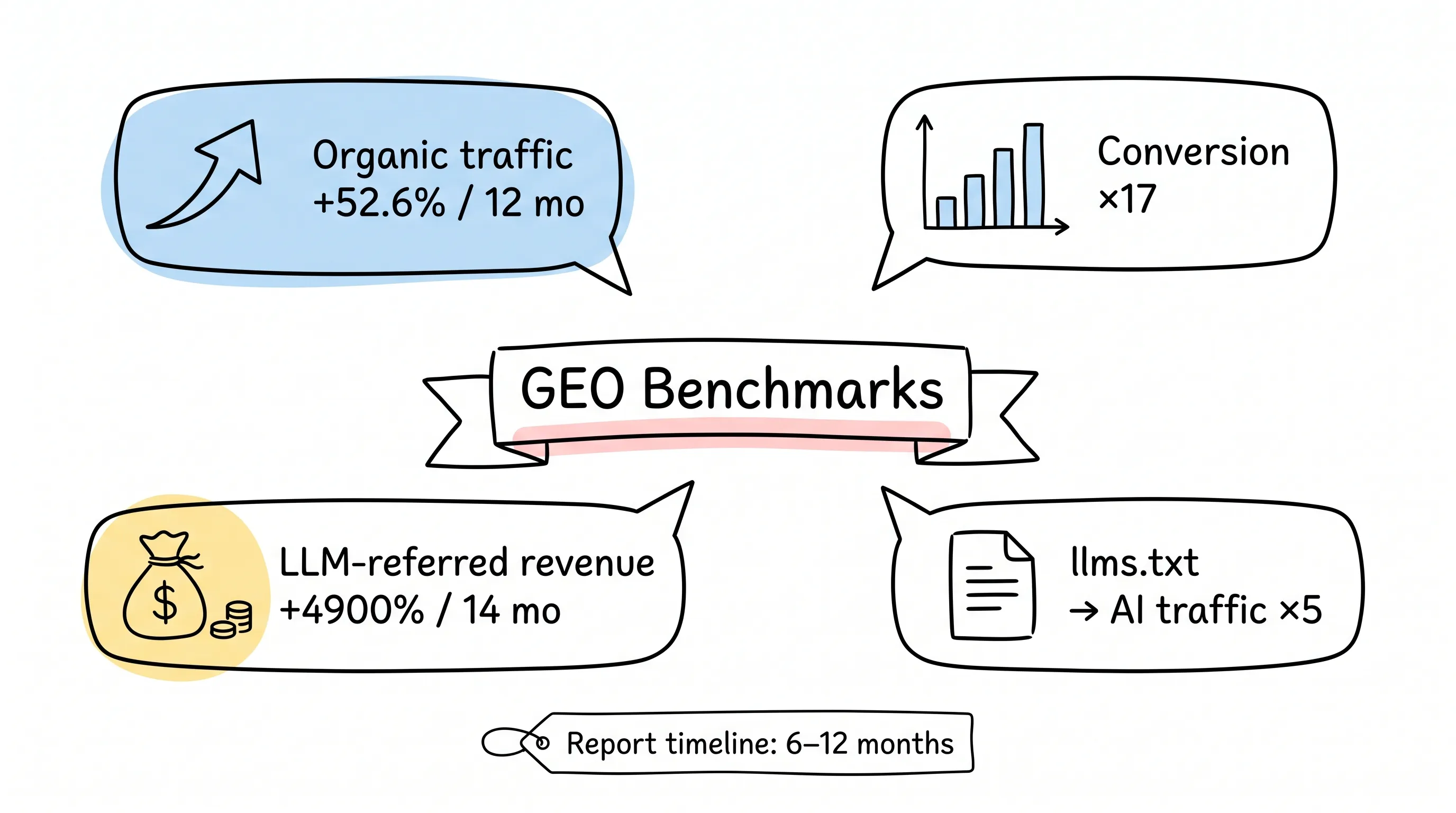
Agency Stackmatix's March collection assembles a batch of GEO cases with baselines and timelines attached — rare material that can currently be used directly as benchmarks. A few sets of numbers to log first. A B2B fintech platform, as recorded by iPullRank, grew organic traffic 52.6% over 12 months and lifted its conversion rate 17x; the moves were restructuring content into AI-extractable formats plus sitewide schema. The Optimist's project for a B2B tech client: over 14 months, LLM-referred revenue up 4900% and traffic up 2622%; the play was self-built first-party research, so that models could cite only your original data. Chemical company Chemours took the route of expert bylines backed by patents and papers, reaching an 82-84% AI citation rate on its target query set, with upwards of $90 million in pipeline attributed. Mentimeter captured 124,000 ChatGPT referral sessions and 3,400 conversions in a single month by putting definitions up front, tabulating data, and occupying comparison and list pages. The single highest-leverage technical move is llms.txt (a plain text file that tells LLM crawlers what they may read): after Concurate deployed it, AI-referred traffic grew 5x. The piece also teaches how to recognize pseudo-cases: no baseline, cherry-picked time windows, and crediting a platform's natural user growth to optimization — all three deserve a discount. One more background set of numbers: e-commerce queries trigger AI Overviews (Google's AI-generated answers) only about 4% of the time, while B2B tech queries run as high as 65-70%, and purchase intent is extremely high at the moment of trigger.
💬 Use this collection as business-case evidence; when reporting a budget, cite other people's 6-to-12-month timelines and never promise results in three months. Deploy llms.txt this week — it's a one-day job — then rework the top 30% of your homepage content into definition-first, table-style writing. The source is an agency blog, so trace cited numbers back to the original research.
🔗 Further reading: Read the full article
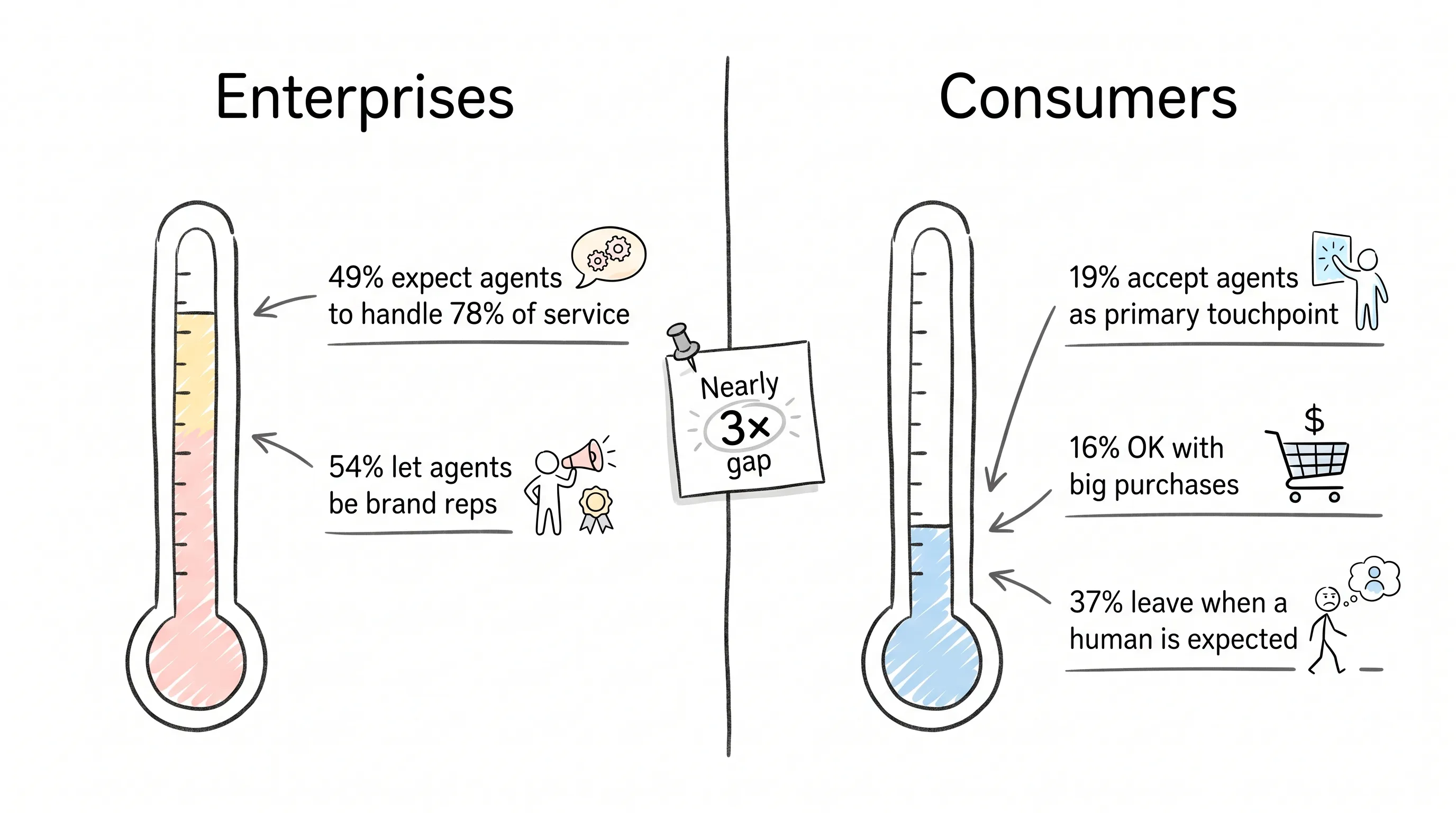
Adobe 2026 Report: Enterprises Overestimate Consumer Acceptance of AI Agents by Nearly Threefold
Adobe's annual report surveyed 3,000 experience executives and practitioners plus 4,000 consumers, and the gap between the two sides is worth copying into your annual planning. Enterprise-side progress is real: 76% say generative AI lifted content output, 70% say non-creative teams can now produce content, and 69% say employee productivity rose. Expectations for agents run hotter: 49% of enterprises expect AI agents to directly handle 78% of customer-service interactions within 18 months, and 54% intend to let agents act as the brand's digital representatives. The consumer side runs at an entirely different temperature: only 19% endorse making AI agents the primary brand touchpoint, only 21% accept agents autonomously completing large-purchase decisions, falling to 16% when major purchases are involved. About three in ten consumers will churn upon discovering that content was AI-generated, and 37% will leave when they expect a human and find an AI on the other side; on-demand human handoff is what consumers list as the primary form of disclosure, and 68% of enterprises likewise rank clear disclosure as the top trust-building move. The implementation-side gaps are just as specific: only 39% have a shared customer data platform that can support agentic AI, 75% list data integration and quality as their biggest implementation challenge, 52% cannot produce proof of experience-side returns on AI investment, and 47% don't even have a measurement framework. And one line for content teams: half of consumers give marketing messages only 2 to 5 seconds of attention.
💬 In annual planning, cut agent-customer-service targets down to realistic levels; disclosure and one-click human handoff come before automation goes live — those two are what consumers actually accept. Put the measurement framework ahead of tool procurement; without baseline data, your AI budget defense will be embarrassing.
🔗 Further reading: Read the full article
A QSR Chain's Personalization Delivers 4x ROI: What to Lift from the ZS Case, and What to Doubt
A ZS client case sets a benchmark for AI personalization in the fast-food setting: a large US QSR (quick-service restaurant) chain with an annual marketing budget above $50 million and more than 100 campaigns a year used to run generalized placements on human experience and intuition, with low engagement. After adopting Personalize.AI, it ran real-time experiments and multivariate testing across five dimensions — offer type, messaging, product selection, creative, pricing — dynamically assigning customers to churn-prevention, upsell, and cross-sell journeys. The self-reported results: over $100 million in cumulative incremental revenue, overall revenue up more than 6%, 4x marketing ROI, and net-new revenue from targeted customers up 70%. The numbers are vendor-reported, the methodological detail is thin, and there is no independent source — fine to read as an order-of-magnitude benchmark, not enough as methodological literature. What is learnable on the mechanism side is the experimental cadence: test offer-and-messaging combinations on small traffic first, and scale up only the winners.
💬 Don't rush to buy a platform; copy its experiment mechanism first: run offer-combination tests across member segments and produce one round of conclusions every two weeks. When you report the 4x ROI up the chain, note that the source is a vendor case — never present it as an industry average.
🔗 Further reading: Read the full article
Tiffany's Five AI Use Cases: Read It as an Inspiration Library, Don't Cite Its Numbers
DigitalDefynd rounds up five AI application directions for Tiffany & Co, with a complete narrative covering the full retail chain: personalized recommendations, inventory forecasting, AR virtual try-on, sentiment analysis of public chatter, and generative design assistance. The numbers in the piece are gorgeous: recommendations lifting conversion 25% and average order value 40%; try-on raising conversion on high-value orders 22% while cutting returns 19%; design-side concept cycles shortened 40%. The provenance must be made plain: none of the outcome figures carries a source, and Tiffany officially has never disclosed them — this is content-farm-style second-hand creation. One design-direction idea is worth taking: train generative models on the brand archive, turning sketches and product images traceable back to the 19th century into a design asset library co-created with designers; the moat of this approach lies in the exclusivity of the archive. The virtual client advisor and the blockchain labeling of human-vs-AI contribution in the roadmap are fine to read as forward-looking signals only.
💬 Luxury teams can lift two directions: archive-trained design models and rapid sentiment response. Cite none of the numbers; when a proposal needs evidence, go check brand financial reports and official disclosures — bringing unsourced data into a pitch is planting a landmine under your own proposal.
🔗 Further reading: Read the full article
🏷 Policy & Funding
A Six-Item Risk List for AI Marketing: Run Through It Before Any Governance Meeting
This Advertising Week overview brings no new data; its strength is a complete framework, sorting the risks of AI in marketing into six categories: privacy and data ethics, job-displacement anxiety, creative homogenization, model bias, missing transparency and accountability, and brand safety and legal risk. Each category comes with matching actions: embed privacy at the product-design stage, build an AI governance framework that specifies who uses it, who supervises, and how review is done, layer a human approval pass over all generated content, and invest in bias detection and diverse datasets. On the jobs question, the author's judgment is that AI changes more roles than it eliminates, with the transition pointing toward strategy, creative, and roles that supervise AI output. The tone is restrained, and the conclusion offered is: move forward with care, don't brake out of fear. For a survey of this kind with no new data, the value is as a discussion outline — don't use it as a decision basis.
💬 Use these six items as the agenda for one internal governance meeting, producing three sheets of paper: an AI usage-scope statement, a review process, and an accountability roster of who to find when something goes wrong. Half a day of work; legal's and risk's doubts cut in half — and the team's nerve for using AI actually grows.
🔗 Further reading: Read the full article
GDPR at Seven Years: A Compliance Gear-Shift Checklist for Email Marketers
dotdigital's retrospective written for GDPR's seventh anniversary lands on the compliance gear shift for email marketing. The penalties first, laid on the table: a cap of €20 million or 4% of global turnover, and Meta was fined €1.2 billion over cross-border data transfers — enforcement is no bluff. With cookie-consent thresholds plus Apple's Mail Privacy Protection, open rates are already distorted; the piece advises moving the primary metric from opens to clicks. The new AI requirements are worth circling: processing personal data with AI requires a lawful basis, automated decisions must be explainable, and a data protection impact assessment (DPIA) must be done before launch. Four practical recommendations: prioritize collecting zero-party and first-party data, strengthen contextual targeting, adopt a consent management system, and treat trust and transparency as brand differentiators. Cross-border teams should design to the convergence logic: the frameworks of CCPA, UK GDPR, and Brazil's LGPD are all drifting toward GDPR, so build global compliance with it as the baseline and make incremental adaptations per market — cheaper than building a separate system country by country.
💬 Change two things this week: in email reports, demote open rate to a reference metric and promote clicks and conversion to primary; and add a DPIA for the AI email features already in use — legal's templates are ready-made, half a day gets it done, and what you're cutting is risk exposure of up to 4% of turnover.
🔗 Further reading: Read the full article
Privacy Compliance in the AI Era Runs on Three Parallel Tracks: How Cross-Border Teams Build a Unified Baseline
An academic paper accepted in December 2024 maps the global privacy compliance landscape of the AI era: GDPR, CCPA, and China's PIPL running as three parallel tracks. The paper sorts out four major pain points: cross-border data transfer is enterprises' biggest compliance risk exposure, and the rest are data minimization, algorithmic bias, and consumer rights behind automated decisions. Four families of countermeasures: privacy-by-design process architecture, technical routes through federated learning and differential privacy, and using AI to feed back into compliance automation. Among the consumer data it cites, one statistic never wears out: 87% of respondents regard data privacy as a fundamental right. The author's implementation advice is to build a unified privacy baseline across jurisdictions, then make incremental adaptations per market. The academic style runs heavy, and it does not cover new enforcement developments from 2025 to 2026 — archive it as a framework reference and follow enforcement through the news, like the €1.2 billion fine from today's GDPR item.
💬 Have cross-border marketing teams run one self-check against this framework: draw out the data exit paths, and verify the transfer mechanisms against all three regimes. Before putting member data into modeling, ask the data team one question — can we run federated learning? Half a day to investigate, long-term compliance payoff.
🔗 Further reading: Read the full article
💡 Today's Big Picture
With all 20 items laid out together, the through-line is a power shift: AI is becoming the gatekeeper of purchase decisions, and most organizations haven't yet figured out how to deal with this gatekeeper. Semrush's survey says it drives sales and turns customers away — 58% and 58% appearing side by side; Adobe's report says enterprises overestimate consumers' willingness to hand over decisions — 49% against 19%; the GEO case collection offers methods for wedging into the answer, while reminding that the real leverage sits in fundamentals like review governance and llms.txt. The gatekeeper is already on duty; the preparation at the table has only just begun.
The tool-side signal is that the execution layer is standardizing. KNOREX's ad API and Unified's unified interface are competing for the same position — when AI agents operate placements in place of people, the interface standard is the entry point. The process-side reminder comes from cases: AI amplifies existing workflows, and if the approval chain and measurement ownership aren't fixed, the more tools you buy, the faster incidents arrive. The compliance-side voices come from both directions: GDPR's seventh anniversary delivered the gear-shift checklist for email marketing, the academic paper mapped a three-track compliance landscape, AI handling personal data must pass a DPIA, and Meta's €1.2 billion fine hangs on the wall.
The consumer-side numbers deserve to be read again and again: half of people give marketing messages only 2 to 5 seconds, about three in ten will churn when they discover content was AI-generated, 37% leave when they expect a human and find an AI on the other side, and 85% are highly sensitive to negative reviews as retold by AI. The tolerance window is narrowing; disclosure and one-click human handoff are the only safety cushion left.
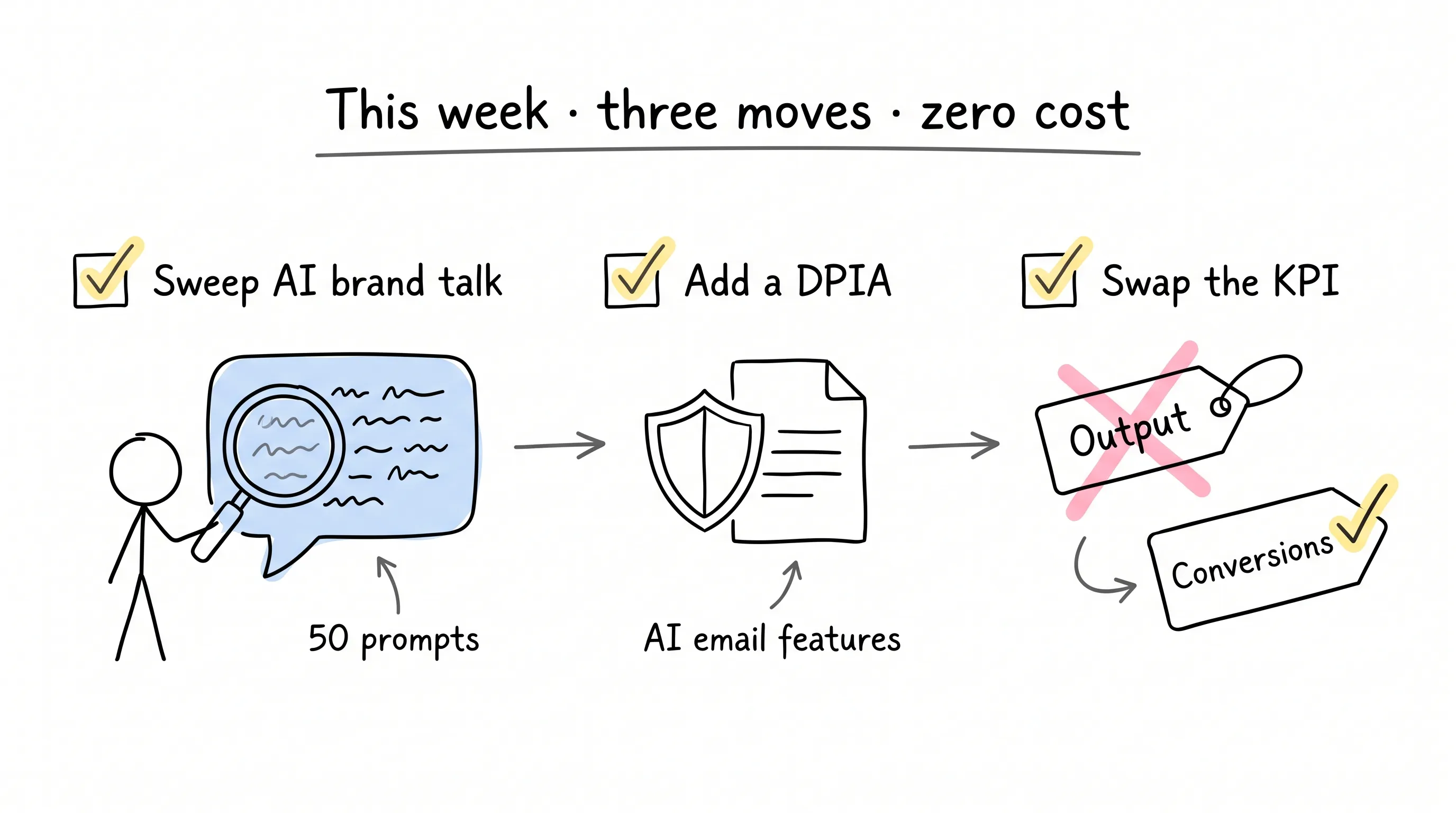
My closing: today's news assembles into one sentence — the speed at which you write AI into your workflows must keep up with the speed at which you keep humans in the critical seats. Three things this week: sweep how AI talks about your own brand, add a DPIA for the AI email features already in use, and swap the content KPI from output volume to conversion contribution. None of the three costs money, and finishing them means you're set up to absorb whatever tomorrow brings.
Continue reading
Related articles

AI Marketing Daily · 2026-10-09
AI marketing daily for 2026-10-09 covering 11 items: brand measurement moving from survey panels to search, social, e-commerce, and AI prompt signals; GEO and share of model playbooks; safety guardrails for agentic ad buying; and tool roundups for ad platforms, cross-border tools, and social media uses.

AI Marketing Daily · 2026-10-08
AI Marketing Daily for 2026-10-08 curates 20 items across AI search visibility (GEO), advertising, platform selection, cross-border e-commerce, and ROI measurement. The headline argues that strategic marketing decisions should stay with humans while AI assists execution.

AI Marketing Daily · 2026-10-07
Today's throughline is answer engine optimization (AEO — getting your brand quoted in AI answer engines).