
AI Marketing Daily · 2026-09-16
AI marketing daily for 2026-09-16: Salesforce launches the CRM-specialized Koa model, ChatGPT Ads is framed as a tactical test budget, McKinsey's survey shows EBIT returns flat at 37%, and 47% of brands still lack a GEO strategy amid privacy enforcement fines.
Today's throughline is division of labor. Salesforce is compressing decades of industry process knowledge into a specialized model, pushing general-purpose models back to the reasoning layer; ChatGPT Ads has been deemed a tactical opportunity, while the core budget stays with Google; and McKinsey's 37% EBIT figure reminds everyone that while tools have spread everywhere, organizational returns haven't kept up. The playbooks for security, compliance, and GEO (generative engine optimization) all arrived in one go today. Read all 11 items and you'll know where to put your money, where to hold your fire, and which task you can start on this week.
🎯 Top Story
Salesforce Launches Koa, a CRM-Specialized Reasoning Model: Two Decades of Industry Experience, Packed Into the Model Itself
What happened
At Dreamforce, Salesforce unveiled Koa, its first reasoning model built specifically for CRM, created with Nvidia and post-trained on Nemotron 3 Super. What it does differs from a chat model: it decides which tools to call and which actions to execute, then carries a deal through to completion. Training used a synthetic dataset Salesforce built in-house, spanning lead generation, opportunity qualification, service-ticket handling, and other workflows across more than 14 industries — every scenario labeled with the exact actions and tool calls needed to finish the task, with no customer data touched. Salesforce controls the model weights itself, and inference runs on its own infrastructure, so customer data never leaves the trust boundary. For enterprises whose agents need to access customer records, modify data, and trigger workflows, this is the first governance hurdle they'll hit. The pilot roster includes Formula 1, UChicago Medicine, Xero, 1-800Accountant, Engine, and others; official availability in the US arrives this winter.
Why it matters
Writing an email is easy. Judging whether a lead is qualified, checking account history, applying company rules, updating the CRM, triggering the downstream sales or nurture workflows — that work requires a model that understands how the business actually runs. Benioff put it bluntly: the most valuable asset Salesforce has accumulated over decades is the operating knowledge of how businesses run, and Koa puts that into the model. When general-purpose models make information cheap and expertise available everywhere, process know-how becomes the harder-to-replicate moat. This is unmistakably a head-on defensive play against OpenAI, Anthropic, and Google: if you can't win on general capability, switch playing fields and compete on who understands how the work actually gets done.
What it means for marketers
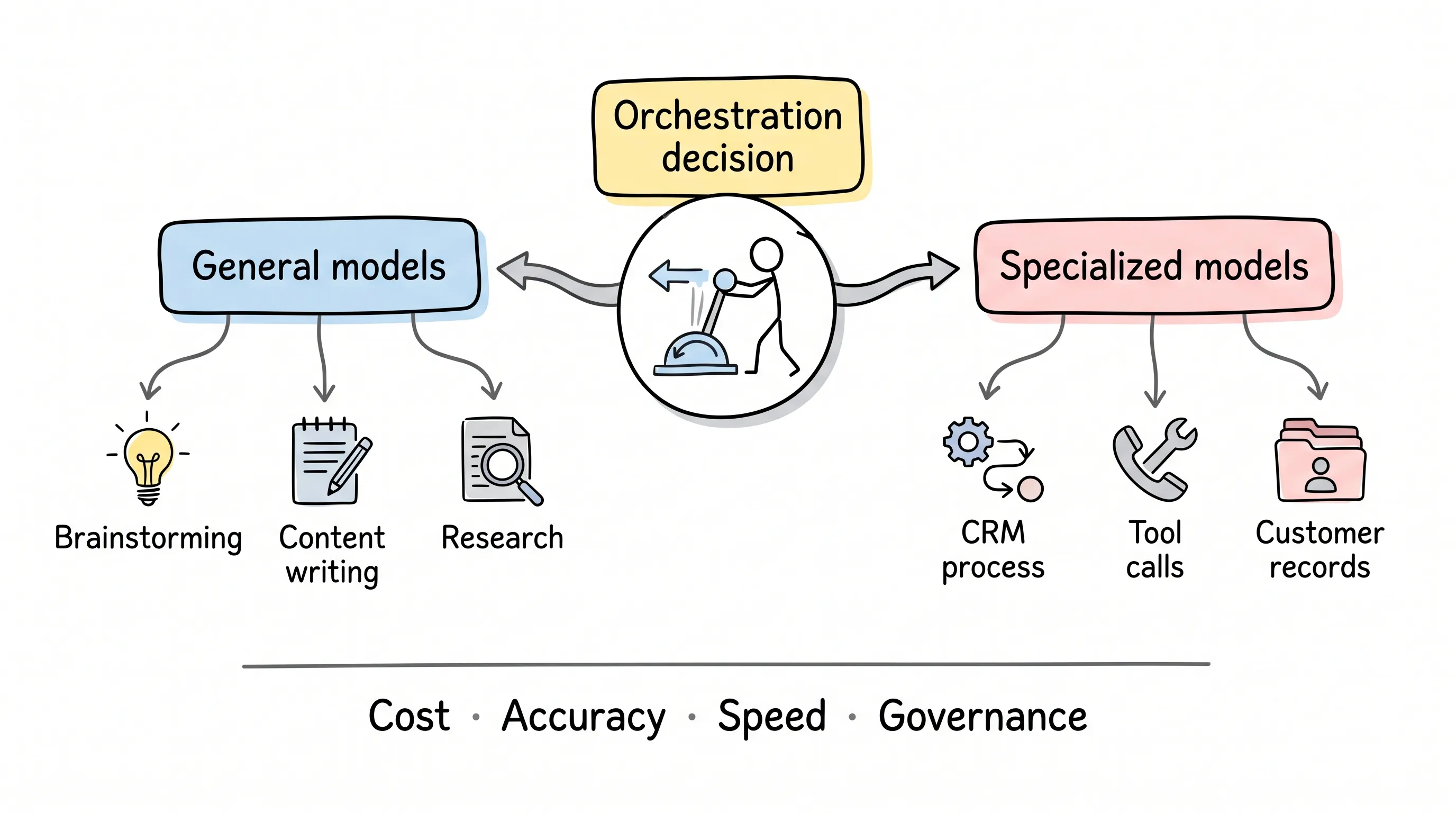
Two storylines are advancing at once. First, model selection is becoming an orchestration decision. General-purpose models suit brainstorming, content writing, and research analysis; specialized models like Koa take over tasks that require understanding CRM processes, company rules, and customer records. Cost, accuracy, speed, data access, governance requirements, and the price of errors — six dimensions that decide which type of work goes to which model. At the same time, Salesforce is broadening the general-purpose options: Gemini is available through Google Cloud, and an AWS integration brings in models from Anthropic, OpenAI, and Nvidia all at once — the idea of one model doing it all can be retired.
The second storyline is the separation of interface and tech stack. Last month's Claudeforce put data and business logic inside Claude, making the Salesforce interface optional for the first time; AIforce, making its formal debut now, goes further — exposing data, workflows, semantics, permissions, governance, and actions entirely as APIs, so external AI interfaces like Gemini and Claude can operate Salesforce directly. The consumer side is changing too: starting this fall, products from Commerce Cloud merchants will surface in Google Search's AI Mode and in Gemini, customers will complete purchases on the Google side via Universal Commerce Protocol, and payments, compliance, and order management stay on the merchant's own Commerce Cloud. From now on, which interface you work in and what technology does the work underneath it are two separate decisions.
How to use it
Marketing operations teams can do three things right now. First, write model assignments into your process documentation: which task classes go to general-purpose models, which must go to specialized ones, with thresholds set by the consequences of error — work that involves customer-record changes and automated triggers stays with models where data never leaves the boundary. Second, check whether your data and permission layers are machine-readable. The AIforce thesis says external AI interfaces will come calling for your data sooner or later; if metadata is dirty and permissions are ambiguous, do the homework before opening up, and unify semantic definitions while you're at it — inconsistent interpretations of the same field across systems are a hotspot for agent errors. Third, watch for Koa's GA (general availability) list this winter, pick one multi-step workflow (lead qualification is a ready-made choice), and run a side-by-side test — log both human hours and model hours, and the data will answer for you whether to expand the scope.
My take
The specialized-versus-general division of labor is the right direction; process knowledge really is hard to copy. But the moat holds only under two conditions: the synthetic data has to cover real process variation across industries, and customers have to accept keeping inference inside the Salesforce ecosystem. Marketers should pay more attention to the second half of the change: when customers complete purchases inside Google's AI interface, the website, the app, and landing pages all recede into an invisible back office, and the rules deciding what customers see and what happens next hide beneath the interface. Over the next few months, getting your data, rules, and permissions into machine-usable shape matters more than signing one more model contract.
🔗 Further reading: Read the full article
🏷 Advertising & Media
ChatGPT Ads Deemed a Tactical Opportunity: Cheap and Lightly Contested, but Keep the Core Budget Where It Is
In a MarTech column, Remi Kerhoas ranks AI assistants using the browser wars: ChatGPT sits where IE did back then, Claude maps to Firefox, and Gemini inherits Chrome's seat, with zero-cost distribution through Search, Android, Workspace, and YouTube. SensorTower's monthly-active-user data shows ChatGPT plateauing since September 2025; SimilarWeb measured user overlap with Google at 95%, with only 5% of users exclusive to ChatGPT — no user base of its own, and barely any erosion of search behavior. Here's an honest benchmark: TikTok's global monthly active users are about 2 billion, double ChatGPT's — whatever budget you give TikTok is exactly the strategic weight ChatGPT Ads deserves today.
OpenAI's organizational signals point to enterprise business too. The leadership stepping into the COO seat comes from Slack and enterprise security — not one of them from ad sales; in Bloomberg's disclosed 2030 revenue projection, only $100 billion of the $280 billion comes from ChatGPT Ads, with the remaining $180 billion from B2B. The Information also reports OpenAI is testing an outcome-based pricing enterprise model — what it sells is tokens and the replacement of work hours; ads are just the bridge, enterprise revenue is the destination.
The testing window, though, is real. ChatGPT Ads expanded to 31 European countries this August, and CPMs and CPCs remain low heading into Q4; in SE Ranking's research, a single advertiser, BestMoney, accounted for 13.56% of all ad volume, with at most one ad slot per prompt, versus up to four on Google's results page. Microsoft earned $24 billion from OpenAI last fiscal year, roughly 70% of its AI business — the platform's survival is not in question for the next two years.
💬 Treat it the way you treated early TikTok Ads: run a small-budget round in Q4, bank the CPM, CPC, and conversion data into your 2027 budget model — awareness is cheapest to build when competition is thin. Keep the core budget on Google and Meta; don't move a dime. Media buyers can open an account and test this week, starting with brand-term defense.
🔗 Further reading: Read the full article
Keeping AI Safe on Real Ad Accounts: Grounding, Guardrails, and Human Review — Three Layers That Each Work on Their Own
Writing in MarTech, Optmyzr tackles a question you can't dodge right now: if agents are going to operate ad accounts that burn money every day, how do you get comfortable with that? The author's fix is to replace "do I trust the AI" with three concrete questions: what can it see, what is it structurally forbidden to do, and who signs off in advance. Nobody evaluates a new agency by saying nothing but "I trust them."
Layer one: grounding. Data blind spots are exactly where models fabricate with total confidence and a flawless tone, so the MCP (Model Context Protocol) data layer needs to cover full GAQL (Google Ads Query Language) queries, GA4 cross-property data, change history including every operator, four-tier consolidated negative keywords, Auction Insights competitor drill-downs, industry benchmark percentiles, and multi-platform data. Layer two: guardrails. The never-cross rules live at the account level, outside the prompt, isolated from the AI so it cannot rewrite them, and they bind agents, scripts, and humans alike: no single bid increase above 10%, certain campaigns untouchable, no bidding on competitor brand terms. Overrides are allowed, but they must be attributed and leave a trail — a guardrail that can be stepped over in silence is just a speed bump with a fresh coat of paint.
Layer three: human review. Every write becomes a change request carrying the policy ruling, the rationale, and a timeline, and nothing takes effect until a human confirms a deterministic preview — if an agent moves a campaign's tROAS (target ROAS) from 200% to 220%, what you see is exactly that number, not the agent's paraphrase of it. The process borrows engineering's old rule: no change review, no code to production. Each layer works on its own; stacked, they reinforce one another.
💬 Copy the rollout order exactly: starting from zero, do grounding first; if agents already touch your accounts, add guardrails this week; once both are in place, switch on the review queue. Don't put the prohibitions in the prompt — that line of defense gets routed around by prompt injection and long-session drift. The change queue has a bonus payoff, too: it quietly becomes your most complete account documentation, good enough for an agency to use as a trust credential.
🔗 Further reading: Read the full article
🏷 Marketing Tools & Ops
The Next-Generation Martech Strategy Starts With the Operating Environment: Weak Metadata Lets AI Publish the Wrong Assets
In a MarTech column, Gareth Chilton introduces a new concept: machine operability. For the past twenty years, the tech stack assumed a human operations layer as the backstop — the veteran knows which of the five assets in the DAM is the approved version, which CRM record is actually six months stale, and which phrasing legal objected to last time. Once AI agents take over selection and execution, that assumption breaks. Bad taxonomy used to just make the DAM hard to search; now it can make a system pick the wrong asset and publish it. Ambiguous approval status used to cost one extra Teams message; now it can be read by the system as permission to publish.
The Gartner 2026 CMO Spend Survey shows CMOs putting an average of 15.3% of budget into AI, yet only 30% are scale-ready, and 70% say internal processes can't support AI deployment. That's an operating-environment problem, not an AI problem. CreativeOps is where the cracks show first: tenfold generation speed does not equal tenfold output — with briefing, rights, approvals, localization, and publishing unchanged, the bottleneck just moves downstream. McKinsey's data echoes this: workflow redesign correlates most strongly with EBIT impact, yet only 21% of organizations have actually rebuilt their workflows. Integration is not operability: an API can expose an asset without the machine knowing whether that asset is approved or cleared for use in a given market. Adobe's Workfront Content Reviewer already participates in approval flows as a user — and it works precisely because brand rules, approval standards, and rights context were long since written down as machine-readable clauses.
💬 Write the 2027 roadmap backward: decide first what humans and intelligent systems should accomplish together, then derive the technology requirements from that. Before buying any new platform, sweep through the unglamorous work — metadata, permissions, approval status. Hooking AI up to a poorly governed DAM just finds and uses the wrong assets faster. Ask one more question in procurement: can the platform's data and actions live inside an environment we control?
🔗 Further reading: Read the full article
Braze Breaks Down AI Content Marketing: Generation Builds the Content Library, Decisioning Runs Person-Level Delivery
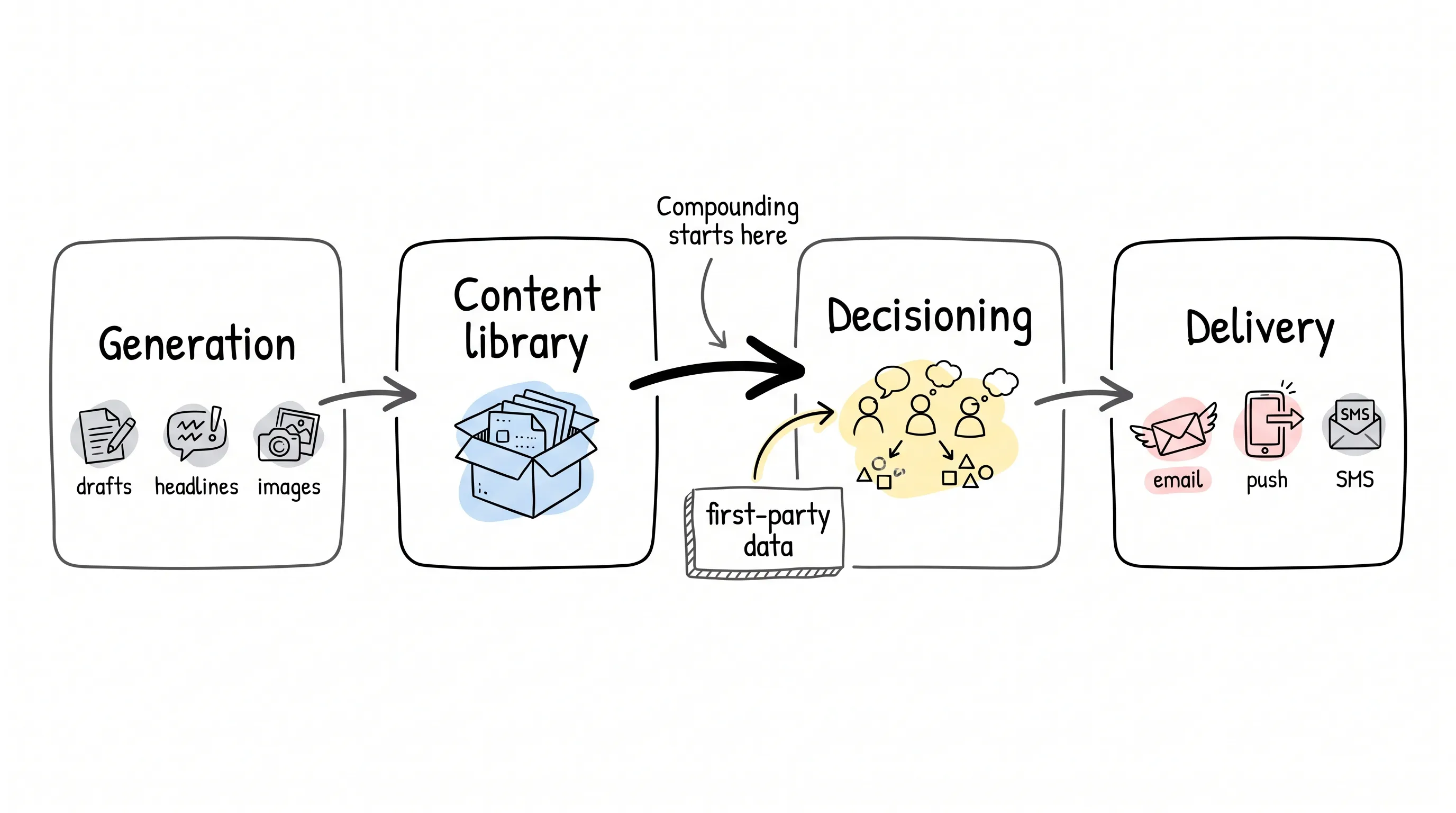
Braze's updated guide splits AI content marketing into three components: generative writing models, data analysis systems, and workflow automation; the process runs in four stages: discovery (topic clustering plus content gap analysis), creation (outlines and first drafts), optimization (semantic SEO plus competitor gaps), and distribution (one draft adapted into multi-channel formats) — at every stage AI does the repetitive labor, and humans own the judgment. The part worth close reading is the division of labor between generative AI and AI decisioning. The former produces a bounded content library: drafts, headlines, images, cross-channel variants. The latter, working from first-party data, decides per person — who sees which piece of content, on which channel, at what moment — across email, push, in-app messaging, and SMS, with the KPI it optimizes entirely your call. The compounding only starts when the two are connected; teams that do only the first half are leaving their content sitting in the warehouse.
The guide cites CMI data: 95% of B2B marketing organizations already use AI applications, and for 89% the first use case is content creation. Four common failure modes each come with a remedy: overreliance producing homogeneous output — require human refinement of every draft; brand voice getting flattened — feed the model brand rules and strong exemplars; hallucination — verify every claim against primary sources; empathy gaps on sensitive topics — keep final review with human editors. Best practices also include a brand-voice constraint library, a team-shared prompt library, two-stage human review, and auditing AI content performance by engagement and conversion, then feeding the conclusions back into the prompts. The guide's end state is a guardrailed agentic system: generation, selection, delivery, and learning fully automated, with humans setting the guardrails, the goals, and the boundaries.
💬 Most teams are stuck at the first half: content libraries piling up while delivery still blasts by audience segment. The next step is wiring up decisioning — pilot one-to-one selection on email alone, then expand channels once it works. Run the four-failure-mode checklist before publishing; on hallucination checks, better a day slower than a hallucination shipped.
🔗 Further reading: Read the full article
Why Customer Journey Maps Always Go to Waste: AI Turns Static Documents Into Living Maps
A Gartner problem from 2019 remains unsolved: 82% of enterprises have built customer journey maps, but only 47% actually put the map data to use. A CMSWire roundup argues that AI's value is precisely turning the map from a static document into a living, continuously refreshed one: machine learning plus data pipelines keep absorbing clicks, transactions, and social signals, surfacing patterns human analysts can't see. Blackhawk Network's CMO puts the direction plainly: the next step is using AI to improve one-to-one customer relationships. Jay Sanderson, product marketing manager for digital experience at Progress, walks through AI Propensity Scoring: predictive analytics scores customers by their probability of taking a specific action, outreach is targeted by tier, and every slice of budget flows toward more predictable outcomes.
Frontline usage is already live. Joosep Seitam, co-founder of e-commerce platform IceCartel, offers specifics: product pages show abandoned-cart items in real time and recommend accessories based on purchase history, all to push the abandoned-cart rate down. Three classic benchmarks to measure against: Starbucks' Deep Brew uses predictive analytics for personalized recommendations while also optimizing inventory and scheduling; Netflix feeds viewing data back into content production decisions; Sephora uses AI plus AR virtual try-ons to reduce the uncertainty of buying makeup. The piece also flags three challenges: data privacy compliance, the cost of integrating with existing systems, and preserving human empathy inside automation.
💬 Journey maps most often die from nobody updating them. Wire a data pipeline into the old map so it refreshes itself before you talk about making it intelligent. Start propensity scoring with the high-probability segments and shift the saved budget toward the top tiers — within a month you'll see the change in budget efficiency.
🔗 Further reading: Read the full article
🏷 Industry Data & Case Studies
McKinsey 2026 AI Report: 44% of Organizations Scaling, EBIT Returns Stuck at 37%
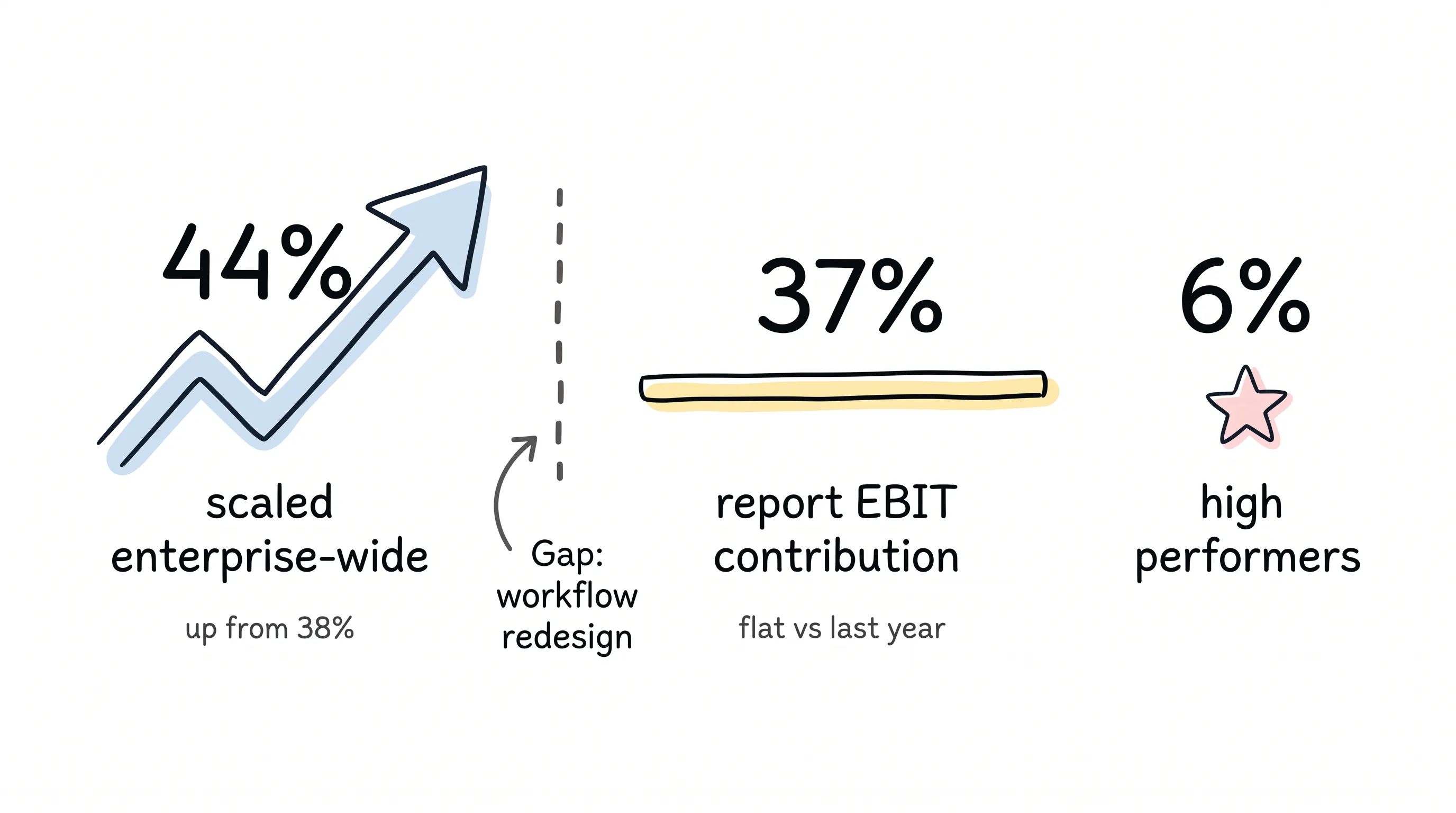
McKinsey's annual global survey, released in August, collected responses from 1,719 respondents across 97 countries between May 4 and June 8. Usage is deepening: nearly nine in ten organizations use AI routinely in at least one function, and 44% have scaled it enterprise-wide, up from 38% the year before; at the individual level, 80% of respondents say AI has boosted their productivity and 50% say it has improved their decision-making. The experience isn't evenly shared: 47% of middle managers and frontline employees report negative pressure from AI, versus only 31% of senior executives.
Organizational financial returns, though, are standing still: 37% report AI contributing to EBIT, flat with last year, and the high-performer share holds steady at 6%. The share of large enterprises scaling AI agents jumped from 27% to 40%, while SMBs sit at 22% — the scale gap is widening. What marketers should watch is this first-party data set: revenue growth is most often attributed to AI use in marketing and sales, ahead of product development and software engineering; consumer goods and retail are the industries most often scaling AI agents in marketing and sales scenarios. Signals on cost and headcount have appeared too: 20% of organizations are constrained by AI operating costs (including tokens), 60% still plan to invest more, 39% expect AI-driven layoffs next year, up from 32% the year before, and 32% of organizations have dropped purchased software because agentic coding tools let them build in-house. The high performers share three traits: pursuing growth and efficiency in tandem, rebuilding workflows around AI, and leadership commitment plus operational discipline — they are more than twice as likely as other organizations to devote over 15% of ICT budgets to AI.
💬 Quote this data directly when pitching AI budget to the boss: marketing and sales is the function where AI's revenue returns concentrate — the ask has evidence behind it. To crack the 6% high-performer club, copy the three traits, especially the second: tear the old process down and rebuild it; don't stuff AI into the old one.
🔗 Further reading: Read the full article
The 2026 AI Marketing Data Map: 88% Adoption, 6% High Performers, GEO Still a 47% White Space
Whitehat's annual compilation gathers 2026's key AI marketing benchmarks onto one map. On adoption: McKinsey data shows 88% of organizations using AI in at least one function and 79% using generative AI, yet only 6% have captured real financial value; nearly half of enterprises with revenue above $5 billion have reached scale, versus only 29% of those below $100 million. The CMO Survey by Duke and Deloitte shows the share of AI-driven marketing activities doubling from 13.1% to 24.2%, with 55.9% expected within three years; martech plus AI takes 19% of marketing budgets, rising to 31.7% within five years, while total marketing budget as a share of revenue is flat at 7.7%, and 59% of CMOs report insufficient budget.
The most dramatic shifts are on the search side. AI Overviews cut organic click-through rates on informational queries from 1.76% to 0.61%, a 61% drop, with zero-click searches at 58% to 69%; yet AI channel traffic converts at roughly 23 times the rate of traditional organic traffic and carries 4.4 times the economic value. The overlap between Google's top rankings and AI citation sources has fallen from 70% to below 20%, nine in ten pages ChatGPT cites rank 21st or lower in traditional results, and 47% of brands still have no GEO strategy. On content: Ahrefs' study of 600,000 pages shows 82% of top-ranking pages contain AI-generated content, and Google doesn't penalize pages for using it; but consumers who notice AI content are 4 times more likely to lose trust than to gain it, and human-AI co-creation outperforms fully automated content by 4.1 times. The outlook section is signal-dense: Gartner predicts 90% of B2B buying will be intermediated by AI agents by 2028, and Forrester warns enterprises will lose over $10 billion to ungoverned generative AI; 51.7% of B2B marketers admit their teams have AI skill gaps, and 68% have had no formal training. On compliance: the EU AI Act becomes fully applicable on August 2, 2026 — AI-generated synthetic content must be labeled, and chatbots must disclose their identity.
💬 47% of brands have no GEO strategy — that's the window. Rework the search-budget math: clicks fell 61%, but conversions are worth 23 times, so the core spend belongs in answer-style content built on proprietary data that AI can easily cite. Before the August compliance milestone, put AI content labeling and bot identity disclosure on the schedule; however tight the budget, don't skimp on team training — it's one of the highest-return investments there is.
🔗 Further reading: Read the full article
Ahrefs Survey of 879 Practitioners: AI Users Publish 47% More Posts a Month, Organic Traffic Growth 5 Points Higher
Eminence, a Geneva-based digital agency, unpacked Ahrefs' survey of 879 marketing and SEO practitioners worldwide, fielded between December 2024 and February 2025. Adoption is nearly flat across company sizes: from 81% at micro companies under 10 people to 87% at enterprises over 1,000, everyone is using AI for content. The output gap, measured: AI users publish a median of 17 posts per month versus 12 for non-users, 47% higher. One counterexample is worth pausing on: large enterprises that skip AI actually produce more, 47.5 posts versus 20 — a sign that big organizations haven't tuned their AI workflows yet.
By content type, blogs dominate outright: 87% of users start there, followed by website copy at 64%, social media at 63%, email at 47%, ad copy at 34%, and image generation at just 19%. On tasks, usage clusters around brainstorming at 76%, outlining at 73%, and improving/rewriting at 67% and 63%. On tools, ChatGPT leads at 44%, with Gemini at 15% and Claude at 10%; respondents mentioned 94 tools in total, and 77% go straight to first-party LLMs, bypassing wrapper products. Perceptions of quality are split: 65% believe human-made content is better, yet 97% of organizations have human review processes and only 3% publish purely AI content; just 16% of companies disclose their AI use externally. The top three concerns are inaccuracy at 60%, plagiarism risk at 57%, and bias at 36%. The algorithmic-penalty truth is counterintuitive: 36% of AI users were hit by Google updates versus 40% of non-users, and manual-penalty rates sit at 3% to 4% for both. The results column is the hardest evidence: AI users' median annual organic traffic growth is 29.08%, about 5 percentage points above non-users' 24.21%. An AI-assisted blog post costs $131 versus $611 for a human-made one; the two groups' total content budgets are almost identical — the savings convert into output.
💬 Set priorities off this survey: get the blog's human-review pipeline running smoothly first; push full automation for ad copy and images further down the list. Don't count on AI to save budget — same budget, more output is the right play, and you can lift monthly publishing targets about 40% from where they stand now.
🔗 Further reading: Read the full article
A Coca-Cola Academic Case: Why the All-AI Ad Backfired and Why the Human-AI Mix Worked
A case study published in June by scholars at Slovakia's Trnava University in a Wolters Kluwer communication studies volume puts three Coca-Cola milestones side by side: 2023's human-AI hybrid Masterpiece project, 2023's co-creation platform Create Real Magic, and 2024's fully AI-generated Christmas ad trilogy. The method blends qualitative case analysis, visual and narrative criticism, neuromarketing data, and sentiment analysis of YouTube comments — far more verifiable than the usual impression-based commentary.
The results split into two camps. Masterpiece was shot with real people in real museum settings, with AI doing style transfer only — it took home the D&AD Yellow Pencil, and its companion digital assets sold $543,000 in 72 hours; neuromarketing analysis found emotional engagement wavered within the two minutes, with the climactic ending pulling the overall impression back. Create Real Magic partnered with OpenAI and Bain to open up brand assets, inviting artists worldwide to co-create, with the best work landing on Times Square's big screens. The 2024 Christmas ad was generated entirely by AI — warped hands and teeth on characters, distorted animal anatomy — triggering the uncanny valley; sentiment analysis showed backlash that was unusually intense and polarized, with a single sarcastic comment collecting more than 32,000 likes. And the criticism wasn't only aesthetic: the public read a hundred-billion-dollar company replacing human actors and crews with AI as ruthless cost-cutting, and said the brand had ruined the magic of Christmas. The study's conclusion: the human-AI augmentation model can reach high aesthetic and emotional validity, while the full-replacement model bleeds away brand authenticity and familiarity.
💬 Draw two lines for AI creative: keep live shooting and human directors for high-emotion scenarios (Christmas, family, nostalgia), with AI retreating to style transfer and scaled variants; functional content can open up to automation. Split next year's holiday campaign along this line now — don't wait for the crash to change course.
🔗 Further reading: Read the full article
🏷 Policy & Compliance
Privacy Enforcement Starts Issuing Fines in 2026: Tractor Supply Fined $1.35 Million Over a Non-Functional Unsubscribe Form
House of MarTech's 2026 marketing data compliance checklist opens with a shift in tone: regulators are no longer issuing guidance — they are issuing fines. The California Privacy Protection Agency began enforcing in 2025 and keeps escalating, and GDPR has made the Article 17 right to erasure a 2026 enforcement priority. The landmark case is Tractor Supply: fined $1.35 million because its unsubscribe form didn't actually work. The problem wasn't tracking itself — it was telling users they had unsubscribed while they hadn't. Formal compliance is not functional compliance; that sentence is worth $1.35 million.
The checklist lays out four pillars. A complete data inventory with a retention plan — a spreadsheet no one has updated in two years isn't a real inventory; it needs owners and a review cadence. Granular consent management — from January 1, 2026, systems must automatically respond to Global Privacy Control (GPC) signals and give users visible confirmation; handling it quietly in the background doesn't count. Vendor DPAs (data processing agreements) that meet GDPR and CCPA standards — your vendor's compliance gap is your gap, and contracts need a no-resale clause. Data-subject rights workflows that can locate and delete data across systems within GDPR's 30-day and CCPA's 45-day deadlines. The eight audit zones also cover data minimization; AI decision risk assessment (a hard requirement once the EU AI Act takes full effect in August — training data, testing methods, and accuracy evaluations all need to be documented); documentation trails (the GDPR-required RoPA — records of processing activities — and the 72-hour data breach notification process); and first-party data strategy (Cisco research shows 95% of enterprises believe the return on privacy investment exceeds its cost). The checklist recommends quarterly reviews of high-risk areas, one full-scale audit per year, and assigning every compliance function to a named person rather than a committee.
💬 You can run this checklist this week: first test the opt-out path end to end — this is exactly where Tractor Supply died; then check whether visible confirmation for GPC signals is live; finally, rescue the data inventory from the old spreadsheet nobody has touched in two years and assign it to an owner. Do those three things and you'll walk into your audit with receipts.
🔗 Further reading: Read the full article
💡 The Big Picture
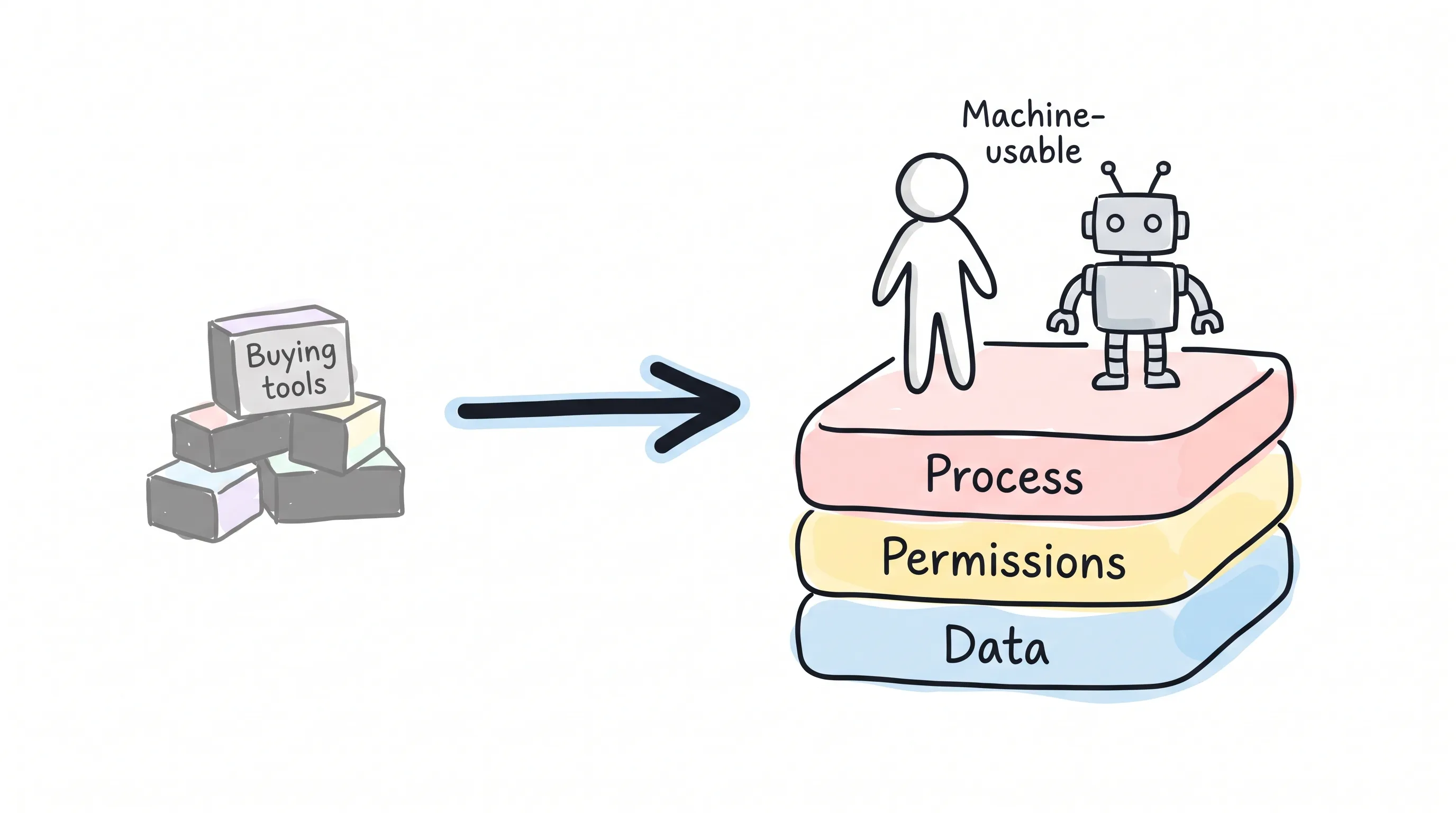
Read today's 11 items together and the throughline is AI marketing shifting from buying tools to building environments. Salesforce bakes process knowledge into the model, Optmyzr erects guardrails around agent operations, Chilton coins machine operability — three stories pointing at the same verdict: model capability is already abundant; what's scarce is the data, rules, and permissions that let models work reliably. McKinsey's 37% EBIT stagnation and 6% high-performer share are the hardest evidence: the individual productivity dividend has not automatically turned into organizational return — the missing step is workflow redesign. In the Ahrefs survey, big enterprises using AI produce less, not more — the same disease, a different symptom.
The direction of the money is clear too. McKinsey confirms marketing and sales is the function where AI's revenue returns concentrate, and its budget share is rising; but ChatGPT Ads deserves only test budgets — the long game belongs to whoever holds the distribution advantage. The risk bells are ringing at both ends at once: on compliance, the EU AI Act's August milestone has passed, visible GPC confirmation is now a hard requirement, and the fines are real; on creative, the academic evidence of full automation backfiring is in, and human-AI co-creation is the double win for both performance and trust.
If you remember only one line from today: what separates the leaders this year isn't who bought more models — it's who got their data, permissions, and processes into shape that both humans and machines can use first. That's exactly the bet Salesforce placed in today's top story, and it's the checklist any ordinary team can start on this week.
Continue reading
Related articles

AI Marketing Daily · 2026-10-09
AI marketing daily for 2026-10-09 covering 11 items: brand measurement moving from survey panels to search, social, e-commerce, and AI prompt signals; GEO and share of model playbooks; safety guardrails for agentic ad buying; and tool roundups for ad platforms, cross-border tools, and social media uses.

AI Marketing Daily · 2026-10-08
AI Marketing Daily for 2026-10-08 curates 20 items across AI search visibility (GEO), advertising, platform selection, cross-border e-commerce, and ROI measurement. The headline argues that strategic marketing decisions should stay with humans while AI assists execution.

AI Marketing Daily · 2026-10-07
Today's throughline is answer engine optimization (AEO — getting your brand quoted in AI answer engines).