
AI Marketing Daily · 2026-09-15
Daily digest of seven AI marketing items on the shift from building AI to governing it: brand guidelines as machine-executable rules, AI agent ownership gaps, survey data on unproven AI ROI, TikTok ad automation, prompts as code, GEO tool comparisons, and machine-readable product catalogs.
Today's 7 items all point to the same thing: the exam in AI marketing has changed. The first half of the year was a contest over who could ship agents first; now it's about who governs them, who proves the results, and where the boundaries sit. Brand guidelines need to be rewritten as rules a machine can execute, nobody is claiming ownership of agents once they're live, 86% of marketers say AI makes them more productive yet only 30% can produce evidence, and the front door to a buyer's shortlist is now the AI chat window. The lead story covers turning brand guidelines into behavioral rules; the other 6 span governance, industry data, tool selection, and AI search — each with concrete, actionable moves.
🎯 Today's Headline
Who are your brand guidelines written for? AI will amplify whatever's left unclear ten thousandfold
What happened
MarTech ran a signed column by Allen Martinez on September 14. He is the chief AI architect of BX-AIOS, a brand-experience AI operating system, whose governance architecture has been included in a NIST (U.S. National Institute of Standards and Technology) reference catalog; he previously grew a Shark Tank championship project to $100 million in revenue. The article's uncomfortable observation is this: nearly every brand guideline on the market is written for human interpreters.
The guidelines are full of adjectives lying around. Premium feel, approachability, customer first. These words used to get put into practice by the tacit judgment of seasoned staff. The author gives that role a name — Sarah — the middleware between brand documents and actual decisions. When Sarah reads "empathetic yet efficient," she knows what to do with a furious customer versus a confused one. She remembers how leadership shot down the last beyond-spec discount request — and the guideline doesn't contain a single word about it.
The mechanism has a built-in flaw. Hand the same "premium feel" to 10 people and by the tenth pass you have 10 interpretations. Training, culture, and veterans used to press the deviations back down; brand drift was always there, just small in scale. The author's math: a confused employee misreading a guideline one Tuesday afternoon affects one customer. A confused AI can misread the same line for ten thousand customers before lunch. One-off accidents become incidents at scale.
Why it matters
AI agents are moving from writing copy to acting on the brand's behalf. They recommend, upgrade, personalize — and in service, billing, and dispute handling they now make decisions directly for customers. These are precisely the zones where brand standards have always been vaguest: rules are crisp where marketing can reach, and the deeper you go into the service chain, the more everything rests on whoever is there in the moment making the call. AI learns the opposite way from people — it has never soaked in five years of leadership meetings, never absorbed a founder's instincts through close proximity, and doesn't know how leadership broke the rules last time in a similar case, or why. With no tacit accumulation to draw on, vagueness flows straight through to the customer.
Brand strategy therefore has to fill in answers to three kinds of behavioral questions: what the AI should do, what the AI refuses to do, and who adjudicates situations the guidelines never anticipated. The author's line deserves a spot above your desk: a brand described only in adjectives cannot answer a machine that must act within 400 milliseconds.
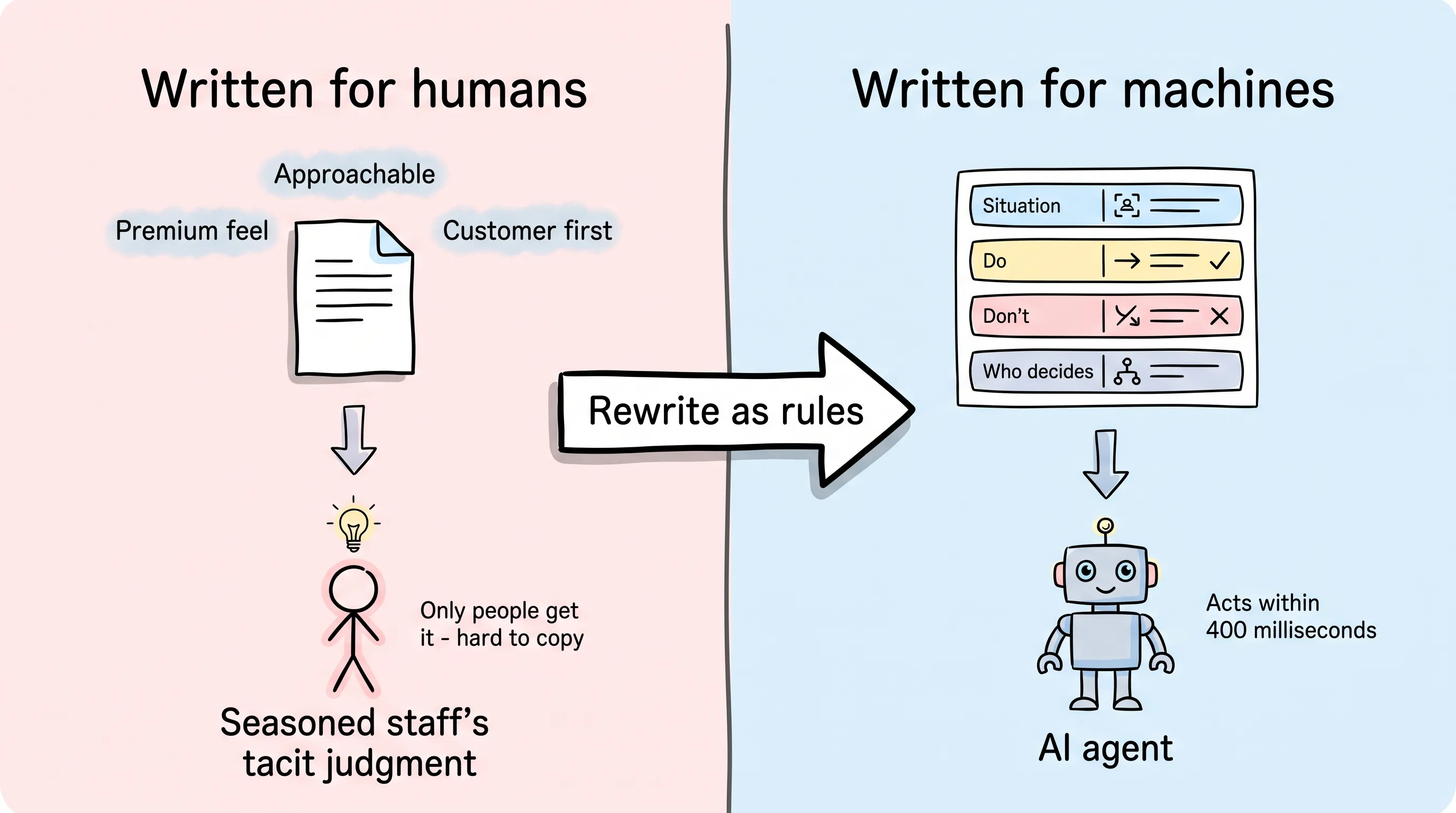
The timing is right too. Canva has already proven that static specs can be put on rails (configure once, and everyone stays compliant automatically): logo, fonts, and palettes set one time, nobody slows down — they actually move faster. The hard part was never colors and fonts; it's tone under pressure and the trade-offs when two values collide. Making that layer of judgment explicit is the real work of brand teams for the next two years.
What it means for marketers
Three roles are directly affected. Brand leads need to start writing a second document — the behavioral-rules layer, running in parallel with the traditional VI (visual identity) manual. Support and CRM leads will find that half the brand experience happens in chains marketing never sees. And teams that have already deployed AI support, AI content, or AI ad-buying agents all owe themselves an inventory of their fuzzy assumptions.
The self-audit is specific. Pull out the brand handbook and count how many adjectives come with no behavioral definition attached. "Transparent" is reassuring in a product update and reckless in a security incident — that contextual difference is something AI cannot intuit. Or take the scenario that keeps getting cited: a claim denial that's technically within policy — should you break the rule and refund $800? Sarah used to make that call. Now it has to be written into the rules.
Marketers who make content don't need to panic. The foundations — positioning, differentiation, values — haven't changed; the execution environment has. Brand judgment has its first real chance to run through the entire decision chain, and the links it can't reach will expose exactly how well the organization actually understands its own brand.
How to use it
Step one: this week, pick the 5 words in your brand guidelines that employees most often ask about, and write each one into a behavioral rule covering the situation, what to do, what not to do, and who decides when rules conflict. Step two: dig out every brand decision of the past 90 days that required a manual special approval — refund exceptions, script drift, visual downgrades included — real cases like these are the best raw material for gray-area rules. Step three: check your AI agents' brand prompts for bare adjectives, and wherever you find them, add counterexamples and an adjudication path.
Control the granularity as you write the rules. The author's advice: extract the judgment living in the heads of a few key people — don't chase exhaustiveness. Canva's experience is worth reusing: once the constraints are on rails, executors actually get faster, because they stop waiting on human review every time.
My take
My call: this piece will be cited again and again over the coming year. It names an industry habit out loud: brand teams have long traded "writing things unclear" for "the flexibility of rule by human discretion," and AI agents have squeezed that space to zero. The opportunity sits in the same place. Teams that can write judgment into rules are effectively encoding senior staff experience into the system, and newcomers and AI benefit at the same time. Whoever moves Sarah's brain into the document first gets a brand that holds its shape at ten-thousandfold speed.
🔗 Further reading: Read the full article
🏷 Marketing Management
Once your AI agents go live, who owns them? 70% of enterprises are running them — with a 43-percentage-point ownership perception gap
Another MarTech column from September 14 takes aim at agent governance. Author Melissa Reeve is the founder of Hyperadaptive Solutions. She cites a colleague at a large utility company: next quarter they'll launch 200 agents, most built in-house by business units like marketing. Ask who owns agent maintenance, who revises the instructions after a model update, or what happens when the agent's builder transfers to another role — the answer is silence.
The data confirms this isn't an isolated case. In May, Kana surveyed 225 senior executives at large U.S. enterprises: 70% are already running custom AI agents in marketing, and only 3% use none at all. "Should we build?" has been answered; the trouble starts "after we build." On ownership, about 40% say the Chief AI Officer should own agentic marketing, and among AI leadership that figure is 52%, while marketing executives lean toward owned or shared ownership models. Each group assumes the other one is holding the wheel. Ivanti's survey of 1,500 IT staff cuts deeper: 85% claim every agent has a named owner, but only 42% say ownership is actually clear — a 43-percentage-point gap. Ownership on paper and ownership in practice are two different things.
The rhythm is misaligned too. 65% of organizations run a review before launch, then supervision slips to a quarterly cadence — while the agents run every single day. Permission risk is planted from day one: agents often inherit CRM access by cloning their creator's human account, and nobody re-checks afterward. Your ad-buying agent may be running batches right now with a former colleague's full data permissions.
The author reaches back into software engineering history for a mirror. The 1968 NATO conference established the software life cycle, and maintenance and retirement entered the textbooks from then on. In 1980, Lientz and Swanson studied 487 organizations and found maintenance consuming roughly half of software budgets — the biggest share being perfective maintenance (changes driven by evolving requirements), while fixing defects was not the main item. Map that onto agents: the offer agent written in March for the spring promotion is still sending emails in June, after the promo ended. The code wasn't wrong; nobody did the maintenance.
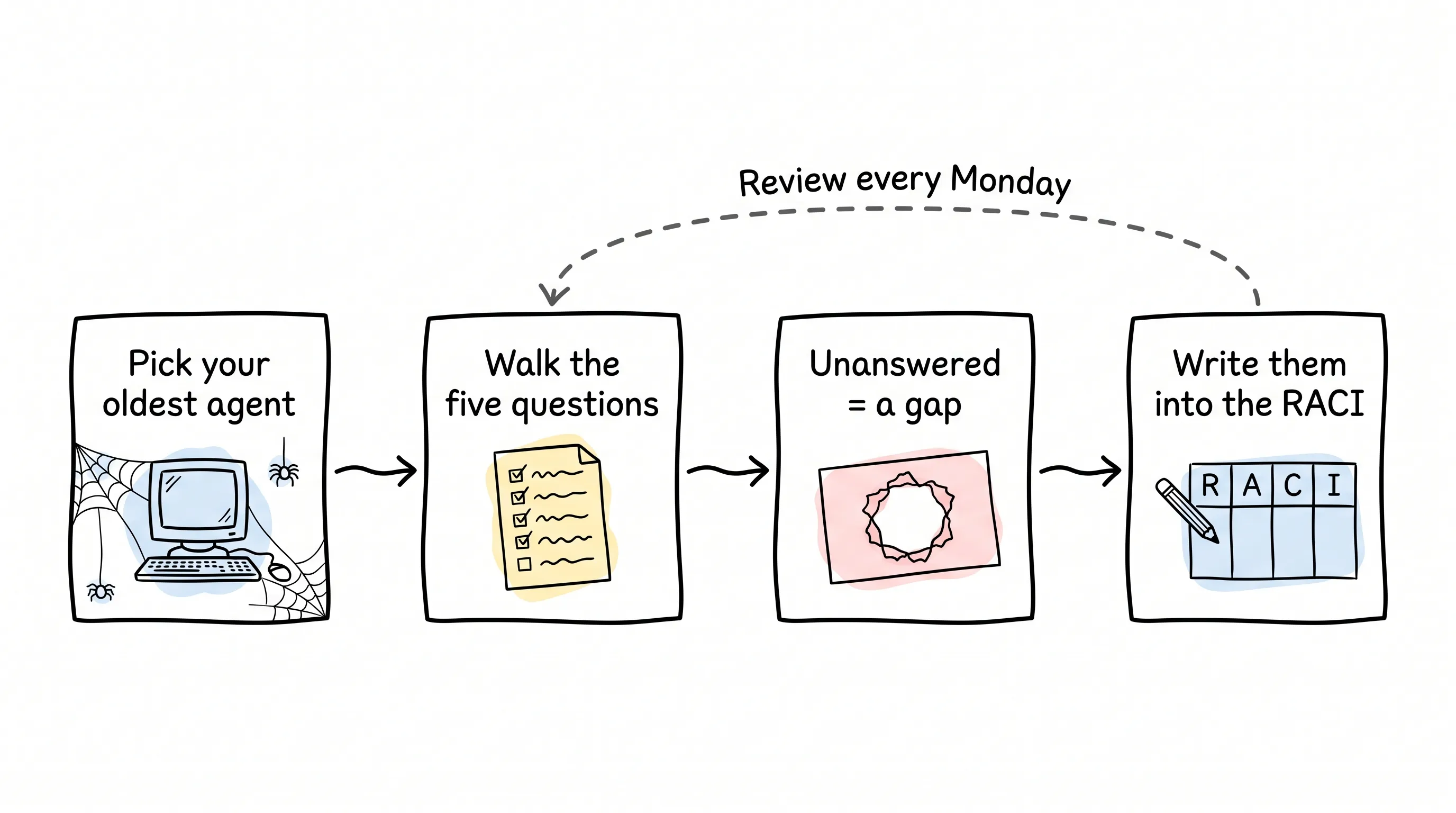
The article closes with a five-question checklist: who writes the instructions, who revises them on what cadence, who watches model releases and translates them into team actions, who monitors output drift against which baseline, and who decides on retirement. Most teams can answer the first question on the spot; the other four come up empty. The author's fix requires no new headcount — assign the five questions to existing seats: marketing operations owns instructions and revision cadence, brand owns drift, the AI or platform team tracks model releases, and retirement goes to the budget owner — they're the only ones who will care that this money is still being spent. You choose the granularity: small teams can put one person per agent, watching down to the individual item; large teams with workflows across the full stack can divide by platform; and drift checks can run on sampling rather than line-by-line review. Salesforce has already shipped an agent development life cycle and an Agent Supervisor role — vendor tooling will come, but the organization design is yours to do. Build the habit at 8 agents; don't wait for 80.
💬 These 5 questions can be this week's management action: pick your oldest agent, walk it through all five questions in a meeting, and every cell you can't fill in is a gap. The cost is nearly zero — no budget approval, no new hires; just write the five questions into the RACI (a responsibility-assignment matrix). Teams still in single-digit agent counts should build the habit now; retrofitting at 80 agents costs ten times more. Walk into next Monday carrying two questions: who manages your oldest agent, and when did anyone last look at what it produces.
🔗 Further reading: Read the full article
🏷 Industry Data
Annual survey of 681 marketers: Claude overtakes ChatGPT for the top spot — yet only 30% can prove AI's impact
On August 26, WhatTheyThink unpacked Social Media Examiner's third AI marketing industry report, based on 681 marketers surveyed in July 2026. The industry is past its experimental phase, and the data holds several reversals worth a close look.
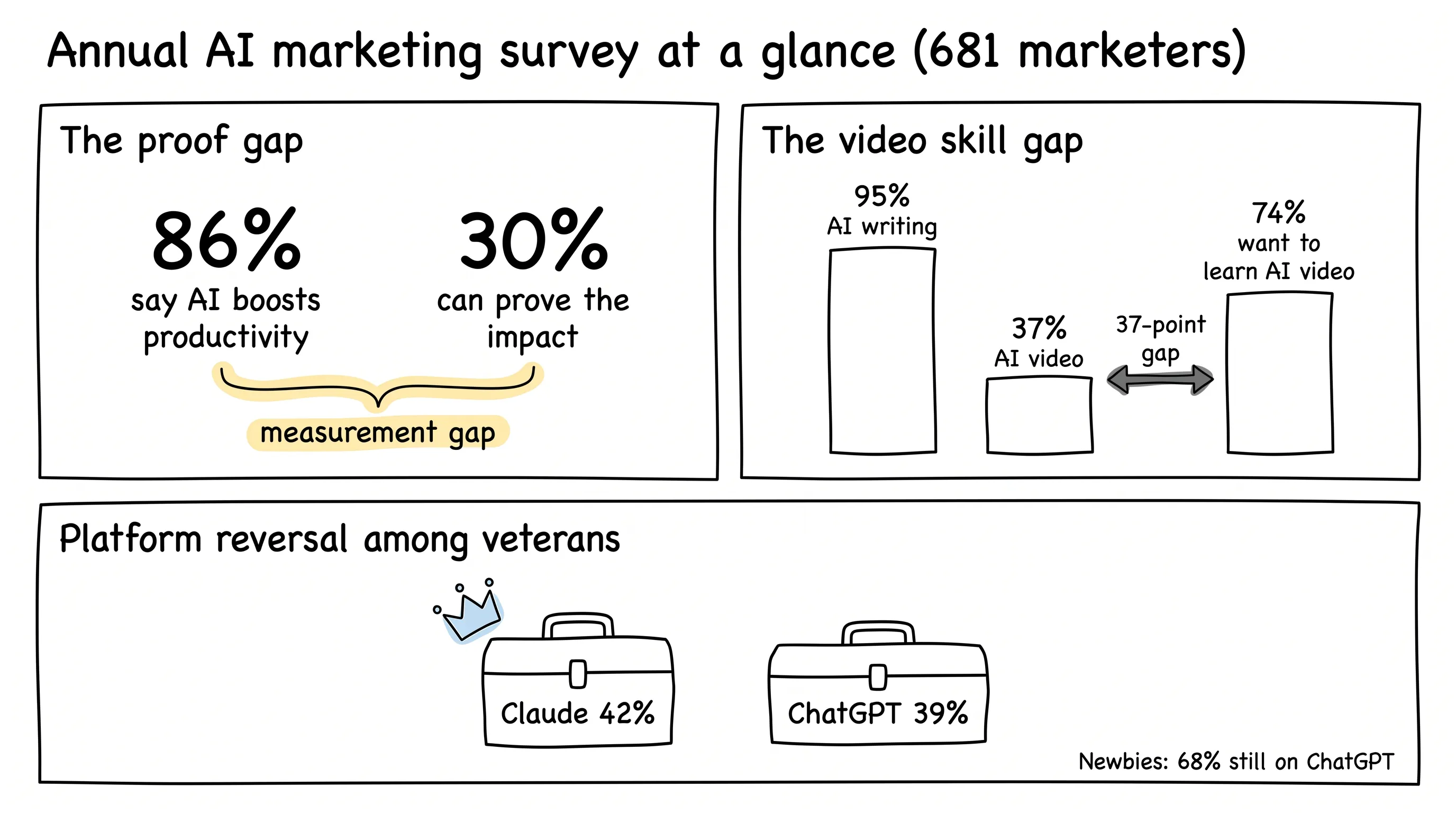
The platform reversal is the biggest surprise. Among senior marketers, Claude has overtaken ChatGPT 42% to 39% to become the most important AI tool. Two years ago, ChatGPT was still crushing the field 68% to 5%. The author cautions against reading this simply as Claude getting stronger — the essence is stratification by experience: among marketers with under a year of experience, 68% still cluster on ChatGPT, while among those with more than three years, Claude adoption reaches 76%. Newbies pile onto the starter tool; veterans diversify their toolkits.
Video has the deepest skill gap. 95% of marketers use AI to write text content, only 37% use it for video, and 74% say AI video creation is what they most want to learn. That 37-percentage-point spread is the largest supply-demand gap in the entire report. Tools aren't missing; confidence and capability are. AI video usage rose from 25% to 37% over two years, and the desire to learn is rising even faster. Written content is the counterexample — adoption at 95% far exceeds the 52% learning demand, because everyone has already figured it out. Video is the acknowledged frontier.
The measurement dilemma is more immediate. 86% agree AI saves time, 86% agree it boosts productivity, but only 30% can produce significant, measurable results; 39% see effects they can't quantify, and 10% simply haven't tried. The report calls this a discipline still waiting to be built. The analysis article also pinpoints a structural problem in the AI search scenario: the attribution chain between an AI search and the customer reaching out on their own is often broken — and wherever it breaks, that stretch of causality becomes hard to prove. The time saved is being eaten back by verification, editing, and personalization; the trust-verification loop is devouring the efficiency. The biggest challenges named in the open-ended question confirm this: the top answers aren't "distrust of AI" but "not knowing how to use it well" and "how to make AI sound like me."
Privacy concern climbed from 67% to 77% within two years, closing in on the accuracy skepticism that has held steady at 78% for three years; 42% strongly agree that data privacy is a risk. What marketers worry about is no longer just whether AI is accurate, but what it does with personal information, who can see it, and whether it puts the company or customers in danger. In B2B settings, that worry becomes compliance constraints first — tool whitelists and approval workflows are coming.
Adoption is still bottom-up: 55% of adoption is driven by individuals, only 11% by leadership, and just 7% have ever received company training. The learning paths are scrappy too — 85% learn by trying things hands-on, 61% watch online tutorials, 55% take courses. This model hums along while the driver is capable, and when that person leaves, the capability walks out with them. Agents are the next wave: only 11% use them routinely today, but add 44% planning to adopt and 24% experimenting, and 79% are already on board or preparing to board; 74% rank "using AI agents" as their number-one learning topic. B2B experimentation sits at 31%, nearly double B2C's 17%.
💬 Fix measurement before talking expansion. The gap between 86% claiming productivity gains and 30% able to prove them is exactly where next year's budget axe lands — build yourself an AI time ledger this week: which process, how many hours saved, worth how many dollars. Video is 2027's biggest personal lever; start practicing with 15-second UGC (user-generated content) style clips. Don't wait for company training — 7% coverage means it isn't coming. Turn the usage you've figured out on your own into team documentation; nothing is more useful than that.
🔗 Further reading: Read the full article
🏷 Marketing Tools
TikTok ad automation in three layers: a rough video complaining about packaging beat polished creative on CPA by 6x
Cotera founder Ibby Syed published a hands-on guide to TikTok ad automation on March 8, and it opens with a study in contrast. Last quarter's best-performing creative was a 14-second video: a user complains while unboxing that the packaging is hard to open, then expresses surprise at how well the product works. That unscripted, negatively-charged, rough piece of content delivered a CPA (cost per acquisition) 6x better than professionally produced creative assets. TikTok's algorithm and its users both punish "anything that looks like an ad" — the more systematized you are and the more polished the creatives, the more you lose out. But managing bidding, budgets, and creative rotation by hand is another full-time job, and there's the tension.
The author's answer is a three-layer architecture. Layer one: platform-native. Smart+'s real strength is real-time budget reallocation across placements and rotation of fatigued creatives — the author has watched Smart+ shift 70% of budget to search placements mid-flight, faster than most human buyers can react. A TikTok creative's life span is only 5 to 7 days, and a machine watching the decline reacts sooner than a human watching dashboards. The real weak spot is transparency: you can't see the converting audience, can't exclude segments, burn money on trial and error during the learning phase, and optimization only happens within the given creative set. If all ten of your assets are polished product demos, it will only pick the best of those demos — it will never suggest you try UGC.
Layer two: third-party tools. Revealbot starts at $99 a month and handles rule execution for the CPA spike at 3 a.m. — say, cut 20% of budget if CPA exceeds $15 for 24 hours straight. Rules are inherently lagging: by the time they trigger, the money is already spent. Smartly is enterprise-priced, from $2,000 a month, serving multi-platform teams spending above $50,000 monthly, producing hundreds of creative combinations from templates, with a steep learning curve, and basically assuming you already have a full media-buying team. TikTok's own bulk features deserve a mention too — free and underrated: bulk-upload hundreds of ad variants from a spreadsheet, CBO (campaign budget optimization) to split budgets automatically, and ACO (automatic creative optimization) to remix your headlines, videos, and assets into new combinations. Below $10,000 in monthly budget, these three cover 80% of the need — max out the free stuff first.
Layer three is the intelligence layer, and it's the gap every tool leaves open: no tool can answer what hooks competitors are testing this week, or what to test next. TikTok Creative Center only shows industry-wide trending ads; it can't see what a specific competitor launched this week or how their strategy is shifting. The author tells the story of a DTC (direct-to-consumer) media buyer who used to spend 3 hours a week scrolling Creative Center, screenshotting competitors and logging patterns — then gave up after six weeks. After switching to agents for brand-mention monitoring and competitor ad analysis, the intelligence became a continuous input: Competitor A has shifted from product demos to creator collaborations, Competitor B is testing 60-second long-form video, and a new entrant is running comparison ads that call brands out by name. The human handles only creative decisions; execution stays with Smart+ as before.
The conclusion is a division-of-labor list: budget allocation, bidding, creative rotation, and reporting go to the machine. Creative strategy, audience understanding, and competitive response stay with people.
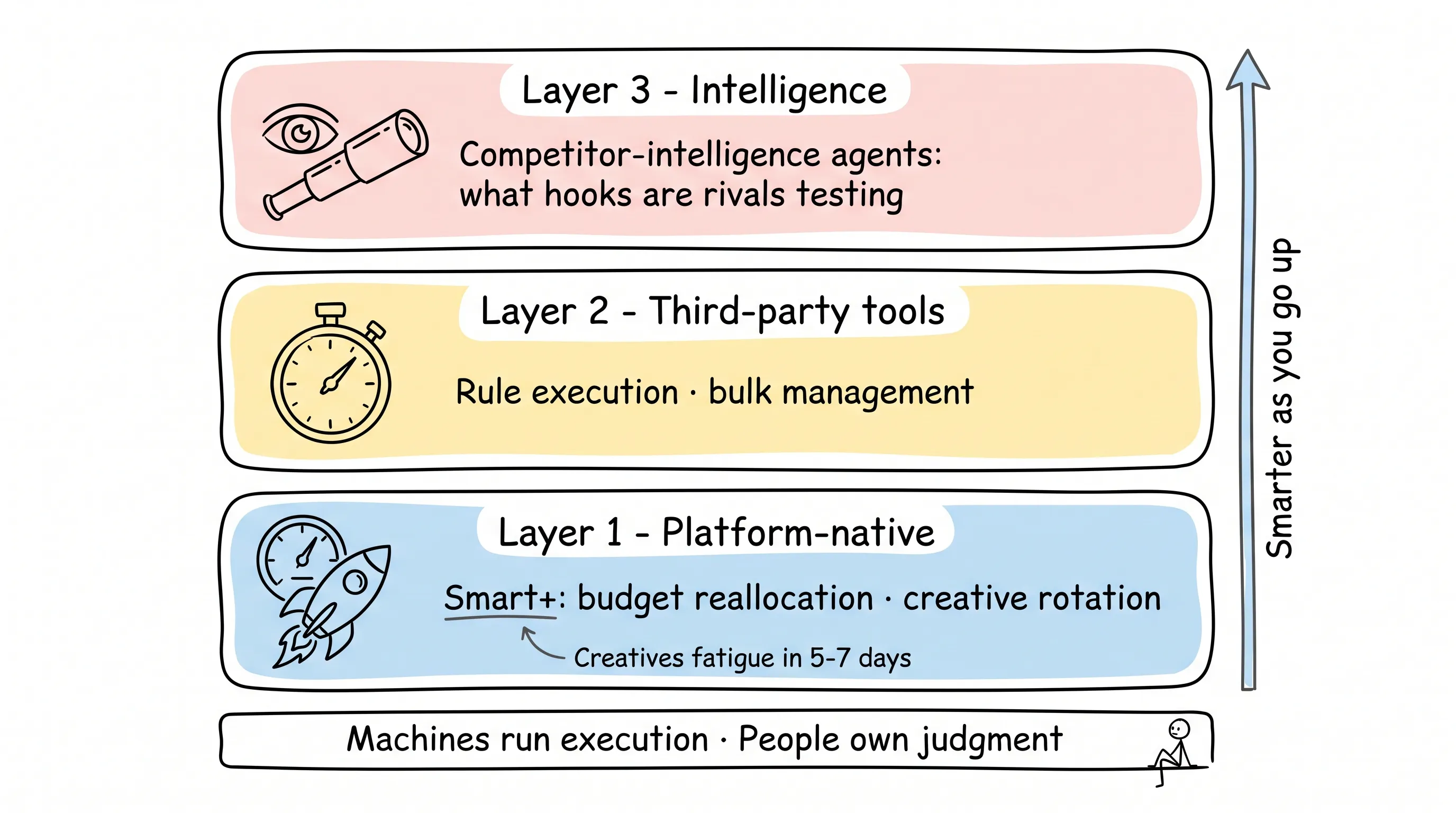
💬 Cross-border ad teams, pick your lane by budget: under $10,000 a month, don't buy third-party tools — max out the native features first; above $10,000, then talk Revealbot. What you can do this week is write "creatives fatigue in 5 to 7 days" into your schedule and prepare the next round of hooks in advance — don't wait for performance to drop before restocking. Hand competitive monitoring to agents and keep creative judgment for yourself; the same boundary applies to China's domestic platforms — Qianchuan and Ocean Engine (both ByteDance ad platforms).
🔗 Further reading: Read the full article
Orbit Media CMO: prompts are code — marketing work should become marketing tools, in order
On September 14, Marketing AI Institute previewed Andy Crestodina's talk at MAICON 2026. He is the co-founder and CMO of Orbit Media, and the talk's title translates literally as "From Process to Prompts to Automation: How Marketing Work Becomes Marketing Tools." It's only a preview, but the framework itself is already complete.
His framework is plain: marketing workflows evolve in a fixed order — from 100% done by human hands, to a hybrid state assisted by prompts, to AI assistants executing with human review. Each step has prerequisites. Don't rush to automate a process you haven't run through by hand. You can't write a better prompt until you've written your thinking into a prompt. Don't build an assistant on top of a prompt you haven't tested. In his words, the strongest assistants are all evolved step by step — nobody can build a capable AI employee in one move. On talk day he'll also bring a working example: a prompt prototype compressed from decades of content-strategy experience, teaching the audience to judge which parts of a job are already mature enough to become prompts.
The second claim: the person best suited to the work is the task's expert. Whoever knows a job best is best able to judge the quality of AI output and keep improving it. AI is the most powerful skill-replication tool in history, and experts should use it to turn their experience into tools that help newcomers do the work — not just to complete their own tasks.
The third point quotes OpenAI co-founder Karpathy: the hottest new programming language is English. Crestodina's inference is that prompts are code — they're functions, they're tools, and they're worth real effort: hunt for new inputs to combine, scrutinize the outputs, test and iterate. When prompts do real work, they should be stored centrally, shared, composed with one another, with workflows built around them. His advice in one sentence: don't look for tools — build them.
💬 This framework is usable today. Have every team member submit the process they know best — document it manually first, compress it into a prompt, then assemble it into an assistant; the order cannot be skipped. Build a prompt library in a shared doc: number them, note the applicable scenario and version, and review once a quarter. You save the hours of repeated trial-and-error, and you accumulate an organizational capability that runs no matter who leaves.
🔗 Further reading: Read the full article
🏷 AI Search & E-commerce
GEO tools roundup of 11: 48% of B2B buyers already use generative AI to find vendors
Leah Nurik, CEO of GEO (generative engine optimization) tool vendor Brandi, has released a 2026 roundup of the 11 major GEO platforms — first published in April, updated in late July. The opening data sets the tone: Capgemini research shows 58% of consumers use generative AI in place of traditional search to get recommendations, and a B2B buyer report shows 48% use GenAI tools to find vendors. Before a buyer ever opens your website, they've already pulled together a vendor shortlist inside ChatGPT, Gemini, or Perplexity. If your brand isn't in the AI answer, you're out before the conversation even starts.
Three selection criteria are offered: how many engines the tool covers (ChatGPT, Gemini, Perplexity, Grok, Claude, AI Overviews), whether it gives executable actions or only scores, and whether price and team shape match. The market falls into clean tiers as a result. Entry-level monitoring: Otterly at $29 a month, Geoptie from $49 a month — Geoptie gives full four-engine coverage and white-label reports at the entry price, with unlimited audit reports and content generation. Mid-market all-in-one: Goodie. Enterprise tier: Profound, BrightEdge, Evertune, Scrunch. HubSpot AI Search Grader produces a baseline diagnosis for free.
Several judgments within the roundup deserve attention. Profound's strengths are AI crawler analytics and Agent Analytics, covering ten-plus engines — the cost is complex deployment and a high price. Semrush and BrightEdge skew their AI visibility toward the Google ecosystem, with multi-LLM coverage the weak spot. The author's conclusion is that native GEO platforms generally beat the retrofitted products from legacy SEO suites with AI features bolted on. Evertune was founded by Trade Desk veterans; its in-house AI Brand Index measures unprompted brand awareness, and its newly added Shopping Intelligence tracks product visibility in ChatGPT shopping results. AthenaHQ comes from former Google Search and DeepMind engineers, its pitch being monitoring paired with recommendations; Scrunch's differentiators are sentiment analysis, GA4 integration, and SOC 2 compliance. One selection criterion is easy to miss: global brands need language and regional coverage — buyers live in ChatGPT and Perplexity, and a tool watching only Google AI Overviews is flying blind on those two channels. The most valuable platform is the one your team will actually open every week; usability and workflow fit matter as much as feature depth. The author's position must be disclosed: Brandi is the publisher of this ranking, ranks itself first, the ordering carries a self-interested tilt, and the cited data hasn't been independently audited.
💬 Start with the free one: use HubSpot AI Search Grader to shoot a baseline for your own brand — see how the five mainstream engines describe you, and whether they get anything wrong. If the budget is tight, start from Otterly or Geoptie, and move up to Profound at the enterprise tier. When you read rankings like this, check the publisher first — a roundup where the maker ranks itself first should be read at a discount. The metrics that genuinely deserve a quarterly review are brand mention volume and error rate inside AI answers.
🔗 Further reading: Read the full article
In the conversational search era, product catalogs must be rebuilt as machine-readable databases
MarTech's September 14 MarTechBot Q&A column answered an MOps (marketing operations) question: when conversational engines aggregate and recommend products for consumers directly in the chat interface, how should marketing teams rework their product catalogs and structured data? First, the fine print: the column is AI-generated and reviewed by human editors, contains no data and no case studies, and should be read as directional reference only.
The thesis is clear: the moment conversational algorithms synthesize product recommendations directly in chat, the traditional web page recedes to secondary. In the past, SEO's keyword density, visual layout, and backlink weight all served the web page and the humans who designed it; now the competition has shifted down to the underlying layer. The product catalog should be built as a high-fidelity database for machine consumption, so that autonomous crawlers can ingest, classify, and recommend your inventory without loss.
Four concrete actions are given. Bury deeply nested product schema markup and microdata in your page source, writing out machine-verifiable attributes in full — material composition, exact dimensions, warranty length, country of origin — so you can match highly specific consumer-constraint filters. Build real-time semantic API feeds for mainstream model repositories, pushing inventory, price, and promotion changes; waiting passively for crawlers introduces lag, causing conversational engines to recommend out-of-stock items. Rewrite product descriptions from keyword stuffing into contextualized copy that answers natural-language questions, spelling out use scenarios, environmental requirements, and the problem solved. Organize first-party reviews, star ratings, and verified-purchase badges into machine-readable review schema — when algorithms aggregate positive attributes for comparison recommendations, your ranking will move up.
The article's closing judgment: winning conversational search visibility comes from turning your website into a highly structured data source, so that the catalog stays discoverable, credible, and recommendable while algorithms take over the shopping journey. Read back-to-back with the GEO roundup above, the two pieces make a complete set of moves: the roundup tells you how to measure visibility, and these four actions tell you what to change.
💬 E-commerce teams, set priorities by the four actions: schema completion pays back fastest — it can go live in a week or two; the real-time data feed depends on engineering scheduling, but out-of-stock recommendations are directly lost orders, worth jumping the queue. Today, run a self-check on how your product pages are being described inside ChatGPT, and fix missing attributes and expired prices immediately. This item is thin, but the four-step list is ready to copy down and walk into a meeting to divide up the work.
🔗 Further reading: Read the full article
💡 Today's Big Picture
Lay today's 7 items side by side and you can see a handoff taking place: the center of gravity in AI marketing is moving from "build" to "manage."
Adoption already has its answer. 70% of enterprises run agents in marketing, and 95% of marketers use AI to write content. The trouble is just beginning: 85% of IT teams claim every agent has an owner, yet only 42% consider ownership clear; 86% say AI lifts productivity, yet only 30% can prove it. On one side, maintenance responsibility nobody claims; on the other, return on investment nobody can prove — these are the two big exam questions of "manage." The headline gives governance's ground-level move: write vague judgment into machine-executable rules. The agent-governance piece gives the organizational move: distribute the five questions to existing seats. And the gap between 30% and 86% reminds every team to build the measurement ledger first — what you can't measure, you can't defend when the budget is decided.
The other half of "manage" is the boundary. The TikTok piece says it bluntly: bidding, budgets, rotation, and reporting go to the machine; creative strategy, audience understanding, and competitive response stay with people. Crestodina's evolution order supplies the method: manual first, then prompts, then assistants — skip a step and the whole thing derails. Put the two together and you get one sentence: machines run execution, people own judgment, and judgment must be crystallized into prompts and rules, not locked inside individual heads.
Demand is pushing things along too. 48% of B2B buyers already use generative AI to pull vendor shortlists, and product catalogs, just like brand guidelines, must be rewritten for that machine that has to act within 400 milliseconds. Whatever you write unclearly, AI won't smooth it over for you — it will only amplify the vagueness ten thousandfold.
Starting next Monday, answer those five questions first: your oldest agent — who is managing it? If you can't answer, you read today's 7 items for nothing.
Continue reading
Related articles

AI Marketing Daily · 2026-10-09
AI marketing daily for 2026-10-09 covering 11 items: brand measurement moving from survey panels to search, social, e-commerce, and AI prompt signals; GEO and share of model playbooks; safety guardrails for agentic ad buying; and tool roundups for ad platforms, cross-border tools, and social media uses.

AI Marketing Daily · 2026-10-08
AI Marketing Daily for 2026-10-08 curates 20 items across AI search visibility (GEO), advertising, platform selection, cross-border e-commerce, and ROI measurement. The headline argues that strategic marketing decisions should stay with humans while AI assists execution.

AI Marketing Daily · 2026-10-07
Today's throughline is answer engine optimization (AEO — getting your brand quoted in AI answer engines).