
AI Marketing Daily · 2026-09-14
Daily AI marketing briefing centered on generative engine optimization: how to become a source AI cites, AEO tool pricing tiers, Google Ads measurement updates, brand AI campaign cases, and compliance checkpoints.
Today's theme is a single word: recommendation. 68% of Google searches no longer produce a click, and a few lines of recommendation inside an AI chat are carving up who wins the business. The lead story explains how to get onto that list. The other 11 items cover what it's worth, which tools to pick, how the ad platforms are wiring in, and where the compliance lines sit. Every item comes with a concrete first move. It's about a 20-minute read.
🎯 Today's Top Story
Get ChatGPT to Recommend You: A Complete Guide That Turns GEO Into a Checklist
Social Media Examiner has published a hands-on guide built with AI strategist Liron Segev, adapted from his interview on the AI Explored podcast. It opens with a number that should stop any marketing team in its tracks: roughly 68% of Google searches no longer end in a click — people now do their research, comparison shopping, and vendor shortlisting inside AI conversations. Segev calls AI the new recommendation gatekeeper, and his analogy is blunt. In the Yellow Pages era, businesses renamed themselves "AAA Locksmith" to climb the listings; then Google took over that gate. Now AI is taking it over from Google.
Four things from the methodology are worth remembering. First, when an AI receives a question it fans out queries — automatically running dozens of related searches — so content that answers a narrow question while covering adjacent topics is far more likely to be retrieved. Second, AI cites only what it can't generate itself: first-hand stories, proprietary data, concrete results. Segev offers a brutal self-test: swap your company's name for a competitor's — if the article still holds up, AI has no reason to cite it. Third, AI works on chunk-extraction logic, pulling self-contained passages out of long pages, answering with them, and attaching sources. So write in a Q&A-style structure and put the answer in the first 100 words of each section. Fourth, newsletter archives are a wasted asset. Once an issue has proven itself, move it onto your site where AI can crawl it — then create a second, machine-retrieval version (new headline, new keywords, new format) so both versions live on the same domain.
The technical layer is a checklist. A legacy configuration in robots.txt can be blocking AI crawlers site-wide — Segev has seen several companies stuck out of recommendations, and the culprit was this file every time. Users have discovered Cloudflare's AI-blocking feature can sit switched on without their knowledge. JS-rendered pages are hostile to crawlers; static HTML parses far more easily. Maintain both XML and HTML sitemaps to give AI two doors in. Schema markup for FAQs and the like still applies as before. His refrain throughout: SEO isn't dead — machines have just been added to the readership list.
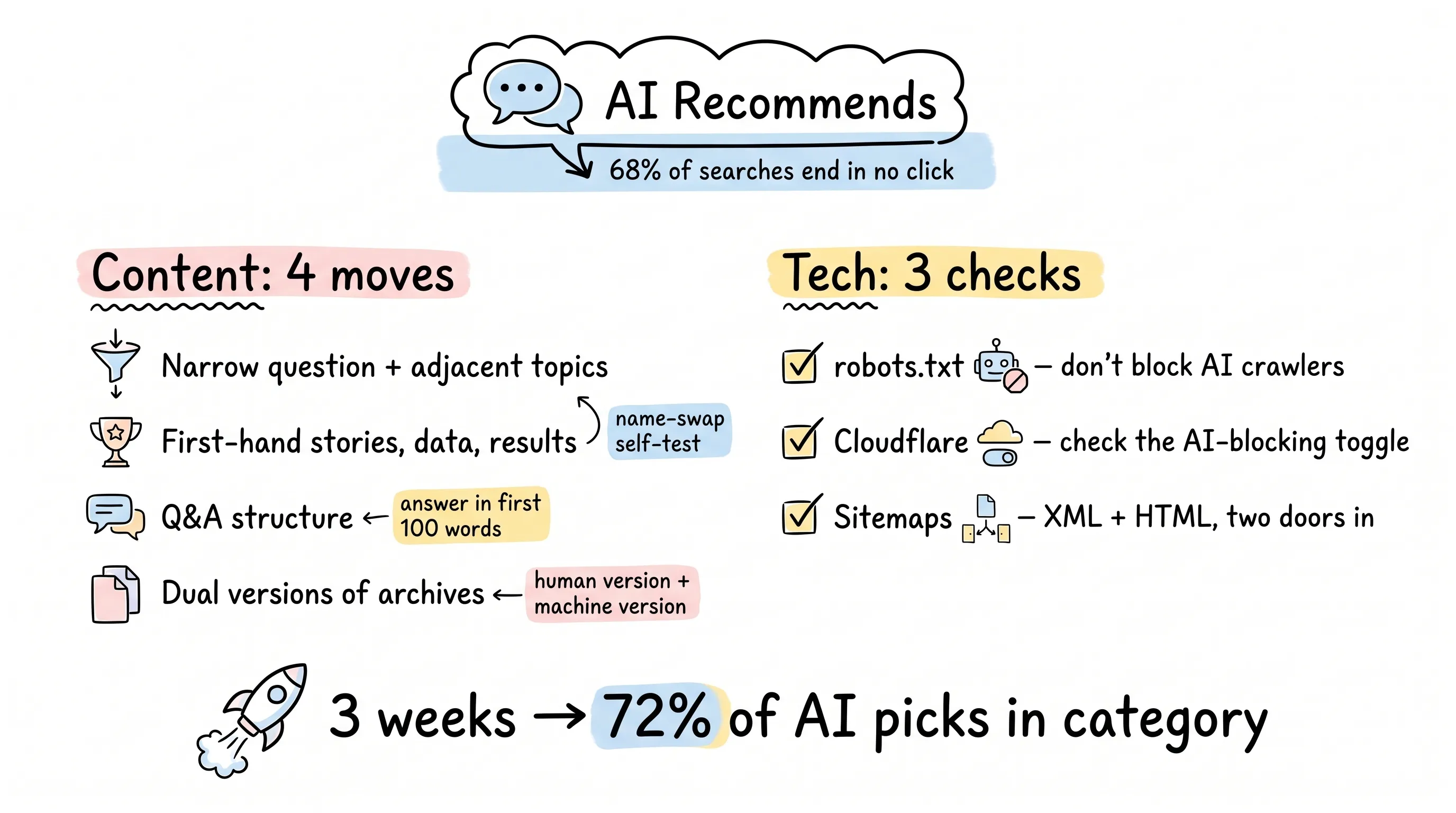
The case behind it comes from the author himself. A consulting firm outgunned by a rival's ad budget simply stopped bidding. The team picked out its best-performing newsletter archives using subscriber engagement data, rebuilt them into AI-friendly formats on the site, then generated machine-retrieval versions from the same material. Within three weeks the firm held 72% of AI recommendations in its category — outmuscling competitors that had published for years and accumulated far bigger followings.
Why does this lead today's issue? Most GEO (Generative Engine Optimization) coverage is single-point tactics; pieces that pair content strategy with a technical audit and back it all with a case study are rare. The cost structure is the other reason it tops the list: the technical checks take minutes, the newsletter reuse draws on material you already own, and the only real outlay is the mental switch. Segev has a metaphor for AI's role: the friend who keeps recommending the same restaurant. When users see the same name across multiple answers, trust grows on its own. He calls it compounding authority, and it's the logic underpinning the entire piece.
The impact, role by role: content teams now ship a second version of everything — narrative for humans, clarity for machines. For SEO specialists, the skill stack snaps back to the same old trio — robots.txt, sitemaps, Schema — except the one to please is now ChatGPT instead of Google. And the budget logic shifts too: advertising rents attention, and traffic drops to zero the day you stop paying. Assets like newsletter archives compound over time; the authority that comes from being repeatedly cited by AI is banked, not bought.
Where to start? Three things you can do Monday morning: open robots.txt and confirm you haven't accidentally blocked AI crawlers; check the Cloudflare AI-blocking toggle; move your best-performing newsletter issues onto the site. On WordPress, publish the archives as pages rather than posts, keep them out of the nav menu, and let the sitemap keep them crawlable. From then on, structure every new piece as Q&A with the answer compressed into the first 100 words, and run the name-swap test before publishing. Don't overlook two topic goldmines: support tickets and sales calls. The questions real customers actually asked are exactly what AI's fan-out queries go looking for.
My verdict, saved for last. The 72% figure comes from the author himself — a single case — so don't paste it into a budget as expected returns. But I buy the direction. The contest for AI recommendation slots has only just begun, and anyone entering now faces ground that's barely been optimized. Two risks to keep in view: the human and machine versions coexist on one domain, so plan for content deduplication over the long haul; and citation logic is still shifting, so don't treat one slot as a permanent asset.
🔗 Further reading: Read the full article
🏷 Marketing Tools & Selection
The AEO Price Sheet: From $30 to $15,000 a Month — What Does the Gap Buy?
HubSpot has broken down the cost structure of AEO (Answer Engine Optimization): the floor is self-serve monitoring tools at roughly $30 a month, the ceiling is full-service agency engagements north of $15,000, and in between sits a vast stretch of market. Three buying models map to three ways of paying: agency-led (one-time audits from about $3,000; ongoing retainers of $9,000–15,000 a month), monitoring-tool subscriptions ($29–489, priced by number of prompts and engines tracked — Otterly.ai runs $29–489, Profound starts at $99 but covers ChatGPT only, and multi-engine coverage requires its $399 Growth tier), and a self-serve build that pairs software with an in-house team. Budgets fall into three tiers: Lean, tens to a few hundred dollars a month, right for small-team pilots; Mid, $1,500–5,000; High, $10,000-plus for fully managed programs. Five things drive the price spread: content volume, Schema and entity-signal maintenance, off-site authority building, monitoring breadth, and reporting depth — with off-site authority the most elastic, spanning review sites, trade media, and Reddit. One trap deserves spelling out: AEO and SEO are complements, not substitutes. Pages that rank well on Google get cited by AI more often, so cutting SEO budget starves AEO at the source. The piece offers one more value anchor: citing Search Engine Land data, AI referral traffic roughly tripled in 2025 yet still accounts for under 2% of total referral traffic.
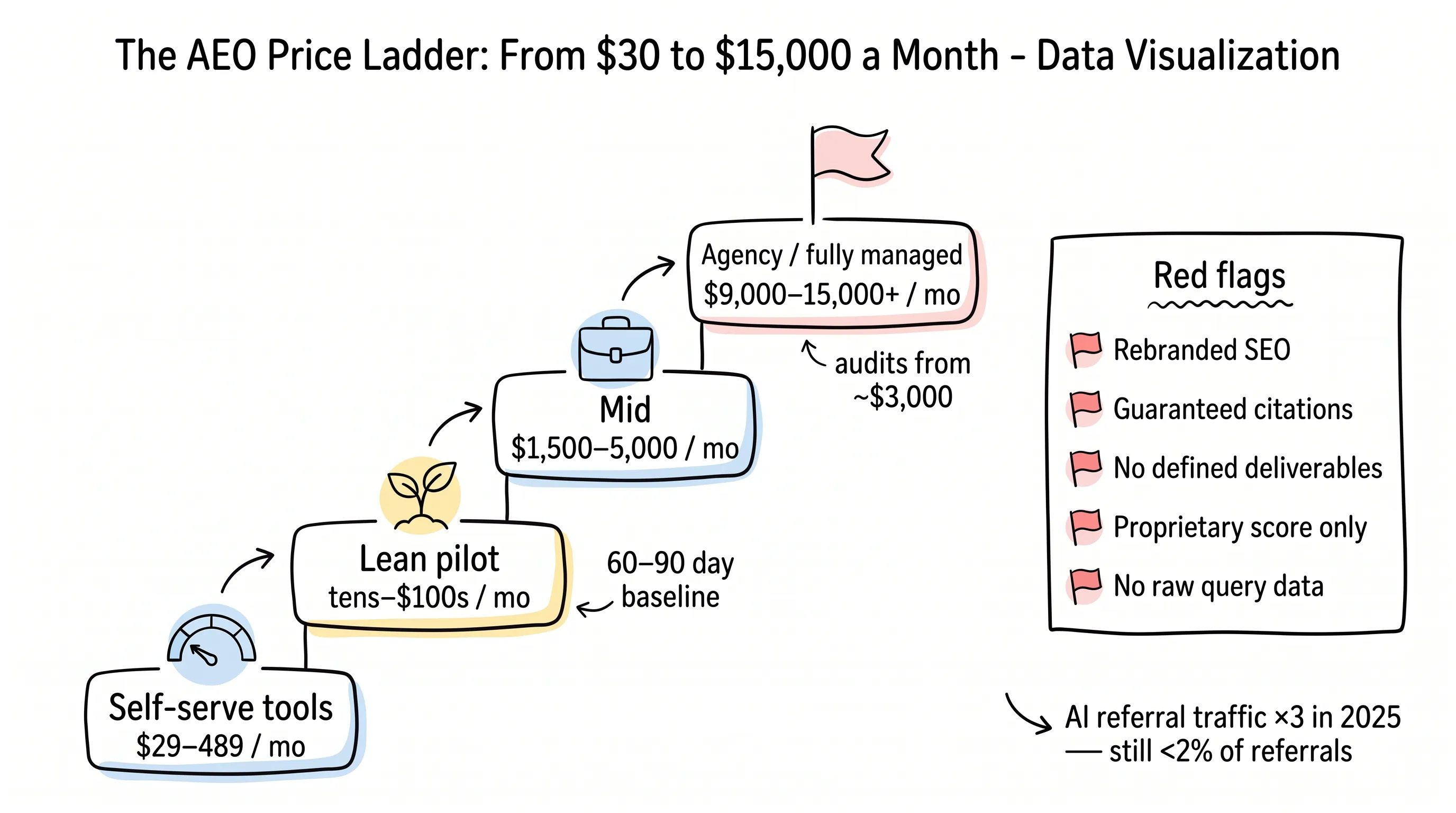
💬 Before buying, use the red-flag list as your acceptance criteria: relabeled SEO pitched as AEO, guaranteed citations promised, scope with no defined deliverables, vendor-proprietary visibility scores as the only metric, no access to raw query data. Hit any one of the five and push the price down. When asking leadership for budget, run a 60-to-90-day Lean pilot to establish a baseline — don't jump straight to fully managed.
🔗 Further reading: Read the full article
AI Customer Journey Orchestration: Turning Behavioral Signals Into Trigger Rules
A long-form piece from M1-Project (the maker of Elsa AI) lays out systematically how to build the AI version of the customer journey. Its first cut lands on the map itself: a traditional journey map is a static document, while an AI-powered one updates in real time, predicts the next step, and adapts to each individual. Six steps to build one: set the map's objective, define the ICP (ideal customer profile), identify touchpoints, walk the journey yourself to find the friction points, optimize the interactions, keep iterating. The tool landscape breaks down into four use cases: behavioral data — GA4, Mixpanel, Amplitude; personalization — HubSpot, Dynamic Yield, Adobe Sensei; conversation automation — Drift, Intercom; predictive insight — Salesforce Einstein, Pecan AI. The second half climbs from mapping to orchestration: two visits to the pricing page within 48 hours, a stall at onboarding step 2, another open of the product email — that micro-pattern should trigger next-best-action routing, not the same nurture flow for everyone. The benchmark numbers in the piece can go straight into a business case: Netflix attributes about 80% of watch time to recommendations; McKinsey puts the revenue lift for personalization leaders at 10–15%; Salesforce says 78% of high-performing organizations already use AI to trigger interactions in real time; Bain finds dynamic journey redesigns speed pipeline cycles by up to 25%. It also names a common dead end: maps that stop at awareness and conversion. In AI's eyes a journey is a loop — a static automation tree goes stale the moment your audience drifts, and AI should be re-sequencing stages in real time — for example, automatically easing sales pressure on well-matched, low-intent leads and feeding them more value content. The signal-side fix is there too: server-side events plus consented first-party data to hedge against browser signal loss.
💬 It's vendor content — apply the usual discount — but take two things at full value: the micro-pattern-to-trigger-rule approach can be copied into your automation setup this week, and those sourced benchmark numbers are ready-made for the business case you take to your boss. Start with the pricing-page revisit signal; it sits closest to the deal.
🔗 Further reading: Read the full article
23 Marketing AI Platforms, Mapped: Agentic Execution and GEO Emerge as the Two Big Storylines
On September 10, Marketing AI Institute published a quick tour of 23 marketing AI platforms — all of them sponsors of MAICON 2026 (October 13–15, Cleveland), a relationship the author discloses up front. The roundup sketches two storylines for 2026. One is agentic: AI graduating from helping you think and write to executing on its own. ActiveCampaign's agents can assemble campaigns, suggest segments, and build automations; SOCi's Genius Agents execute autonomously across locations within brand guidelines; KEN-E positions itself outright above Google, Meta, and HubSpot as a cross-stack orchestrator. The other is AEO/GEO maturing into its own category: Conductor covers the full enterprise AEO lifecycle, and OmniReach's Geo Vibe tracks specifically how brands are mentioned and cited in AI-generated answers. Moves worth flagging separately: Demandbase shipped an AI-first interface with ChatGPT and Claude integrated in April; Hightouch connects directly to data warehouses like Snowflake for real-time personalization instead of spinning up a new marketing database; CallRail Voice Assist has expanded into real-time lead qualification and smart call routing. The rest line up by function: enterprise content and experience platforms — Acquia, Optimizely, Sitefinity, Webflow, Pantheon; real-time personalization and testing — Fibr.ai; conversational website conversion — Navu; multi-account agency execution — NinjaCat; accessibility compliance — Siteimprove; creative production — ENSOR and REHATCH; and Google Cloud moves AI out of the chat box and into business infrastructure.
💬 Don't demo your way down the list. Ask two questions first: do you want to hand execution to agents (that means review workflows), and does your search goal shift from rankings to citations? Use the roundup as a competitive scanning map, shortlist two or three players in your lane, and go deep — far better value than buying across the board.
🔗 Further reading: Read the full article
🏷 Industry Cases & Data
Aim at the Audience, Not the Buyers: A Zero-Ad-Spend YouTube Playbook
Social Media Examiner has published an interview with Derral Eves, author of The YouTube Formula, and his argument starts from the 2013 pivot: YouTube switched from a view-count model to an AI recommendation algorithm whose mission is matching content with the people who want it. For business content the lesson is to aim at the audience, not the customers waiting to be sold to. The proof is strong. One of his students runs a used-office-furniture store and built it on YouTube alone — reviews, comparisons, buying guides, S-to-F tier rankings, plus livestreams — pulling 75–80% of views from recommendations; layered with an email sequence, sales passed $20 million, with zero ad spend. On method: pick topics from psychographic profiles, not demographics. An immunologist's audience clustered at 45–65-plus with health anxiety driving their choices; his video on foods that lower blood pressure hit 1.7 million views, and the follow-up on 5 blood-pressure mistakes did 865,000 in two weeks — YouTube automatically pushed the second to everyone who watched the first. The research method is there too: find outlier videos with unusually high view counts for their small subscriber bases, batch-feed the URLs into Claude or ChatGPT, and mine the comment sections for common threads and questions nobody answers. The extreme case in trust-building is Dry Creek Wrangler School: 1.6 million subscribers, a host in his sixties talking cowboy wisdom by a campfire, weekly experience camps sold out with a three-and-a-half-year waitlist — and not one sales pitch in the entire run. The structural toolkit is practical as well: beginners start with listicles, then graduate to the ABC narrative (what it's about, why the audience should care, the thread that runs through the whole video); TV-screen viewers will sit through an hour; on mobile, keep it short. Retention data will tell you where you're losing people: a drop in the first 10 seconds means the title pulled in the wrong viewers or the opening didn't pay off the curiosity; a drop at minute three means the value arrived too slowly. And one counterintuitive case: a speaker who spent 17 years stuck at 10,000 subscribers placed a monitor behind the camera showing his students on Zoom, recovered his authentic delivery — and his first video did 1.5 million views.
💬 The comment-section research is doable today for the cost of an hour and a few prompts. The real lesson is the reminder: swap the ad copy's sales pitch for a helping hand, pay off the title's promise in the first 5–10 seconds, and once trust is banked, the business follows.
🔗 Further reading: Read the full article
Eight Brand AI Campaigns: What Worked, What Backfired
A case roundup worth bookmarking: eight global brands, all with citable performance numbers. Netflix unveiled AI modular ads at its 2025 Upfront, rendering product images into the visual worlds of shows like Stranger Things; the ad-supported tier counts 94 million monthly actives, brand favorability ran 8x the CTV average, and sales per exposure were 162% higher. Spotify Wrapped is the cautionary tale — the 2024 edition over-AI'd it, positive sentiment fell from 50.5% to 41.5%, and the product has since returned to human-centered design. Maybelline launched virtual influencer May after the LashGate crisis, with L'Oréal's CREAITECH lab using Google Imagen 3 and Veo 2 to compress asset cycles from weeks to hours; across the industry, 58% of Americans follow at least one virtual influencer and 35% have bought something because of one. Nike and AKQA used vid2player to model 1999-era Serena Williams playing her 2017 self, generated 130,000 simulated matches, lifted organic views 1,082%, and took the 2023 Cannes Digital Craft Grand Prix. Heinz used DALL-E 2 to test what AI draws when asked for ketchup — it all comes out looking like Heinz — for 1.15 billion earned impressions and a 2,500% ROI. Coca-Cola went all-in on an AI-produced Christmas ad: five AI specialists replaced a 50-person team and costs fell roughly 90%, but negative-reaction rates stayed stuck at 46–49%. Burger King's Million Dollar Whopper co-creation drove 14 million app visits and 3 million custom burgers; Nutella generated 7 million unique jar labels that sold out in about a month. The piece closes with five meta-lessons: use AI to unlock concepts traditional production can't make, not just to move faster; the human touch in personal stories and cultural moments is non-negotiable; decide disclosure by risk — when to show, when to keep quiet; test and iterate fast with low-cost, high-variant runs; and watch for AI fatigue — today's novelty is tomorrow's laziness.
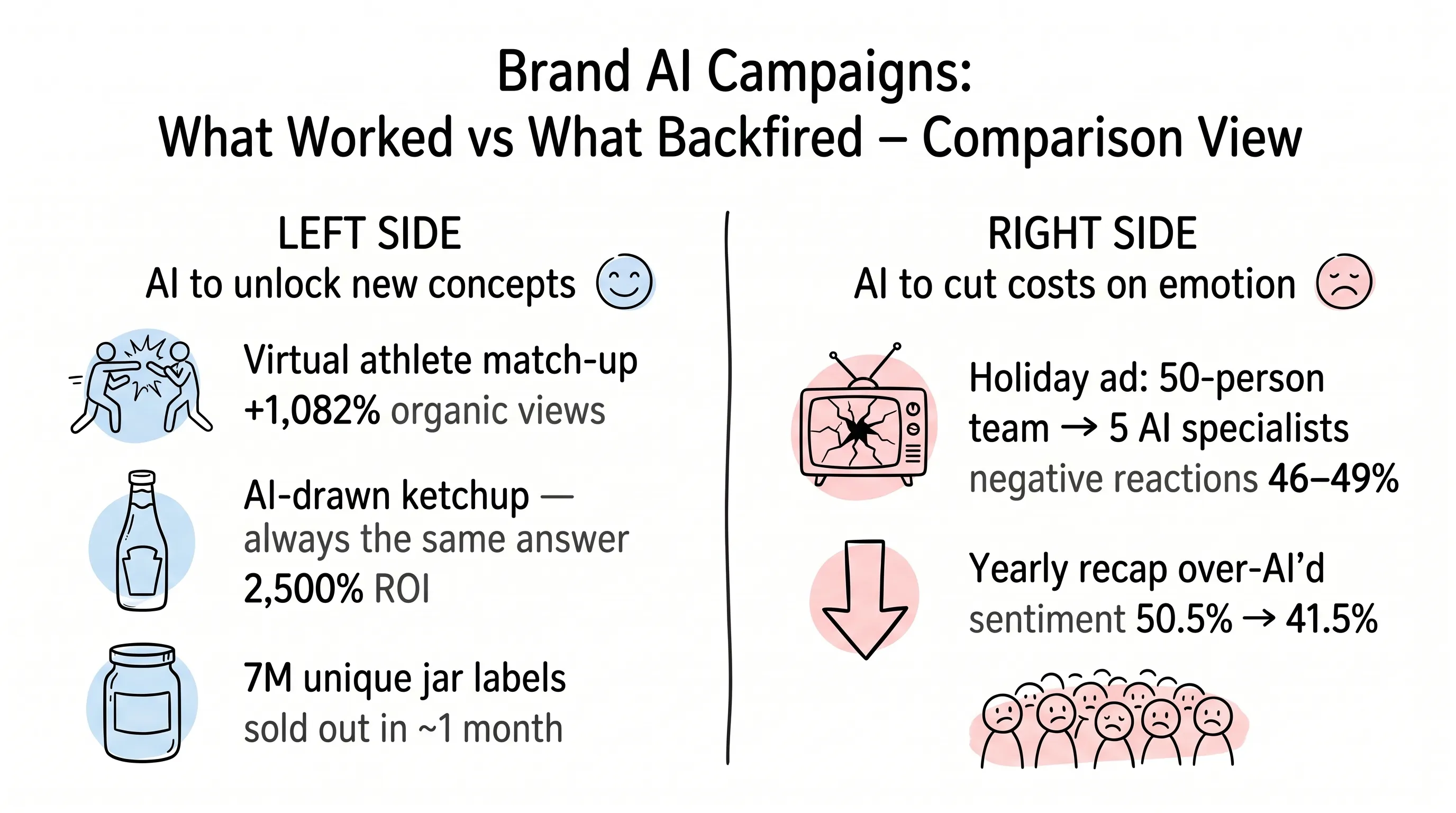
💬 Line up the eight cases and a pattern surfaces: AI deployed to unlock concepts traditional production couldn't make (Nike, Heinz) won nearly every time, while using it purely to cut costs on emotionally loaded storytelling (Coca-Cola, Wrapped 2024) drew the backlash. When you plan the calendar, reserve humans for story and emotion, hand volume production to the model, and when transparency is due, show it.
🔗 Further reading: Read the full article
🏷 Ad Product Launches
Google Ads Rolls Out a Three-Track Measurement Upgrade: First-Party Data and Causal Evidence Complete the Set
The Google Ads blog published a measurement-suite upgrade on September 10, from VP of Ads Analysis Nipoon Malhotra, built around three things: data foundations, multi-signal input, and causal evidence. Track one unifies first-party data: Data Manager is now integrated directly into Google Analytics and DV360, connecting offline and app data, and advertisers who adopted it saw incremental ROAS rise 26% on average (Google-reported, April 2025 through April 2026); enhanced conversions extend to GA and DV360, adding 11% more Search conversions on average; and the Data Manager API — built on the IAB Tech Lab's ECAPI standard — is now generally available, with built-in diagnostics that catch data problems before they affect campaigns. Track two is a new metric, Data Strength Uplift, which quantifies the additional conversions recovered by first-party data configuration: advertisers deploying Google tag gateway gained 14% conversions on average, over 20% on Demand Gen. Track three upgrades Meridian, the open-source MMM: agentic capabilities audit data quality in real time, brand signals (such as branded search volume) can enter the model to measure long-term effects, and the GeoX causal geo-experiment library is now globally available — with experiment results folding back into the MMM for calibration. The backdrop is the vision Google laid out earlier this year: measurement shifting from a passive report card to an active performance engine. Brand signals in the model have a practical use: upper-funnel video and TV spend has always been hard to tie to long-term sales through attribution alone — now signals like branded search volume can be fed into the model to estimate it. GeoX going GA means geo experiments can run standalone; until now this capability was priced for the big agencies only.
💬 Two moves this week: check Data Strength Uplift in Google Ads — it tells you outright how many conversions your first-party data setup is still leaving on the table — and put GeoX on next quarter's incrementality test plan. One caveat: every percentage here is vendor-reported, so attribute the source when you cite them externally.
🔗 Further reading: Read the full article
AI Max Adds Cross-Campaign Testing: You Can Now Experiment With Brand Guardrails On
A short announcement on the Google Ads blog dated August 20 (signed by Brandon Ervin, Director of Product Management for Search Ads — brief post, thin on detail) introduces three test-and-planning capabilities for AI Max. Multi-campaign A/B experiments arrive in September: a single experiment can compare different budgets and ROI targets across multiple Search campaigns, quantifying what scaling spend actually does to revenue. Brand controls and position controls can now stay switched on inside AI Max experiments, retiring the old trade-off where testing AI Max meant dropping your guardrails. An updated Performance Planner can simulate the impact of bid or budget changes on existing campaigns, with recommended changes applied in one click. The announcement builds on the earlier one-click experiments — a continuation of the testing-and-planning track. The causal chain behind it is worth spelling out: AI Max hands matching to the model, so results swing harder than manual bidding, and eyeballing a small sample invites misreads. The value of multi-campaign experiments is treating budget and ROI targets as variables — one experiment returns an interval for how much revenue elasticity you get as you scale. With brand guardrails switchable on, the last standing objection to AI Max — that it rewrites your brand-term matching — is gone.
💬 Teams that wouldn't put AI Max into experiments are down one excuse. Once the September features land, pick a campaign with brand guardrails on and run a small-budget test, use multi-campaign A/B to quantify the scaling effect — and don't scale on gut feel.
🔗 Further reading: Read the full article
🏷 Content Quality & AI Literacy
Type @ and / First: One Universal Trick, One Quality Method, and This Week's Model News
Social Media Examiner's Thursday newsletter, three takes in one. The trick: type @ or a slash into the input box of any new AI tool — most tools hide their feature menus behind those two characters with barely a hint. In ChatGPT, @ summons attachments, web search, Deep Research, and plugin calls; slashes give you conversation branching, mid-chat model switching, adding to a Project, and a shortcut to personalization settings — Claude and Gemini each have their counterparts. The method comes from AI strategist Austin Marchese: AI has driven the marginal cost of adequate content to zero, so a volume race only manufactures intellectual obesity. The real moat is using AI to raise quality, not output. The concrete play: build an AI clone of your boss, your client, and your target audience, run every draft past that review panel before publishing, then assemble a virtual internal focus group to stress-test it from multiple angles — an iterative feedback loop that nudges the AI's responses toward the real thing. The key to the loop is admitting it won't be accurate on day one: the clone's judgments will be off, but push real feedback back in each round to recalibrate, and after a few rounds the AI starts sounding like your actual customer. The budget implication is just as direct: the capacity you save should go into polish, not into ten more mediocre pieces. Four news items: Google released Lyria 3.5 for music generation, with improved vocal and arrangement fidelity, usable for video scoring and brand jingles; Gemini Audio entered Workspace — Gmail Live for conversational inbox queries, Docs Live for dictation-to-draft, Keep Live for voice notes; Gemini 3.8 Flash shipped with better coding and reasoning at the same price as 3.7 Flash, plus a Cyber variant for vetted defenders that finds and auto-patches vulnerabilities; and OpenAI released GPT-6 Astra, its first widely deployed model to reach the Preparedness Framework's Critical cybersecurity threshold, with stronger jailbreak resistance and prompt-injection robustness — though OpenAI itself concedes it's harder to monitor under adversarial conditions.
💬 Typing @ and / is today's cheapest five-minute investment — decent odds you'll surface a feature you didn't know existed. On the AI-clone review: set up a minimal version right now and feed it the draft that got killed last week; you'll be counting the rework rounds you save in no time.
🔗 Further reading: Read the full article
Can Un-Humanized AI Content Beat Human Work? An Empirical Study Awaiting Its Data
An academic monograph by Svilen Ivanov of the University of Economics in Varna, Bulgaria, published in Q3 2025 and indexed in RePEc (a thin entry this time: the page carries only the bibliography and abstract; neither the direction nor the magnitude of the empirical results is disclosed, and citing any conclusion requires downloading the full PDF). The research question is a sharp one: at the time of the study, can generative AI marketing content with no extra refinement or human touch achieve engagement performance equal to — or better than — human work with the same audience? The study runs in four stages: a literature review of AI in marketing communications and AI ethics; designing and conducting an empirical study to collect data; a controlled comparison of human-made versus AI-generated content performance with the same audience; and a discussion of the ethical context of generative AI for marketing content. The deliverables include a risk picture outlining what goes wrong when un-humanized AI content goes straight into use — explicitly flagged as a risk item, implying that raw output may lose to human content on perception.
💬 Don't quote conclusions yet — the data hasn't been laid out. But it turns the human-touch argument content teams have been having for two years into a testable question. When the full paper drops, run your own production workflow against its experimental design as a self-audit — more useful than picking sides.
🔗 Further reading: Read the full article
🏷 Compliance & Regulation
A Seven-Step Operating Sequence and Maturity Matrix for AI Marketing Compliance
A compliance framework piece from The Pedowitz Group (jurisdiction-agnostic, no specific regulation named, no author byline — limited authority, but highly operational). It sorts regulation into four buckets: privacy, consent, and data rights; advertising and consumer protection; AI governance and automated decision-making; and industry- and content-specific rules. Of the six regulatory domains, the two marketing teams most often underestimate are synthetic media disclosure and IP & training data. The operating sequence runs seven steps: first map AI touchpoints and personal-data inflows; classify data sensitivity and set forbidden-use boundaries; wire consent and preference signals into AI audiences and activation; confirm guardrail terms with vendors and models; substantively review ad truthfulness; disclose and label as required; and finally monitor and keep records. The maturity matrix assigns each of six capabilities an owner and a KPI: consent compliance rate to MarOps plus Privacy; claim defect rate to Brand plus Legal; audit-readiness score to Compliance plus Ops. Two positions from the FAQ are worth noting: AI-generated claims still need factual substantiation, and endorsements and testimonials must comply; and training or fine-tuning models on customer data should be treated as high-risk, with a lawful basis, purpose limitation, and an exit mechanism. The minimum compliance starting point is a five-piece baseline: a data inventory, consent enforcement on the activation side, standardized vendor terms, an AI disclosure policy, and an approval workflow for high-risk campaigns.
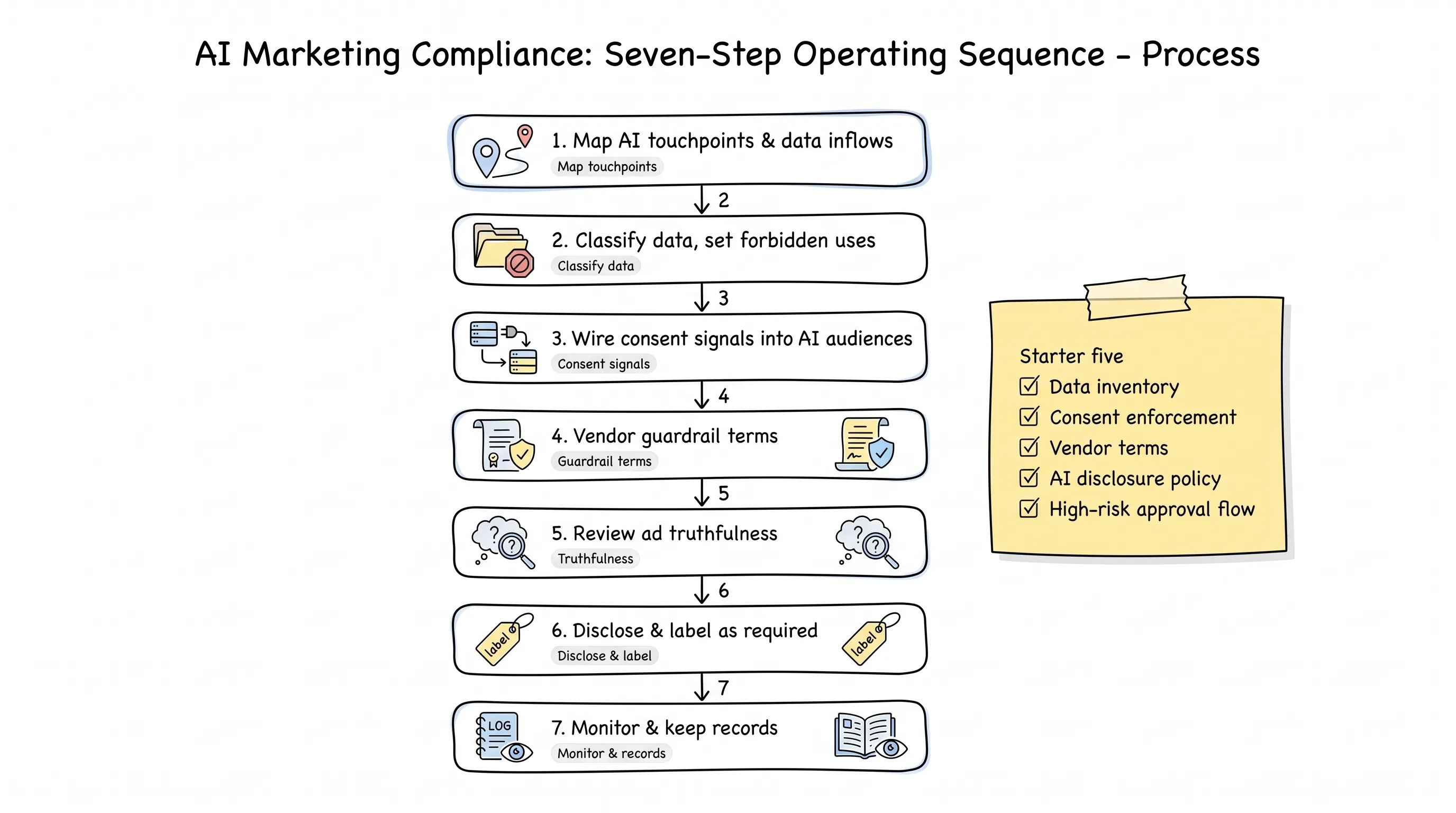
💬 Don't wait for legal's calendar — two items in the five-piece baseline, the data inventory and the AI disclosure policy, can start today. The most overlooked liability is consent signals never wired into AI audiences; once you connect them, previously activated segments may shrink noticeably. Better to know now and adjust.
🔗 Further reading: Read the full article
European Parliament Research: Where GDPR Draws the Line on AI Profiling
A study published by the European Parliament's STOA in June 2020 (PE 641.530, led by Professor Sartor of the European University Institute in Florence) predates AI Act-era enforcement, but it remains a high-quality reference for any global marketing team designing Europe-market compliance. The conclusions come in layers. AI can be deployed in GDPR-compatible ways, but GDPR gives controllers insufficient guidance — it needs extension and specification. Purpose limitation can accommodate data reuse through flexible compatibility interpretation, and reuse for statistical purposes is in principle presumed compatible. The right answer to data minimization isn't mechanically cutting data volume; the work goes into reducing the data's identifiability — pseudonymization done well lowers re-identifiability. The hardest line for marketers is Art. 21(2): data subjects have an unconditional right to object to direct-marketing processing (including related profiling), and controllers cannot defend with overriding legitimate interest. The study also recommends offering a convenient, standardized channel for exercising the right. Art. 22's analysis of the permissible scope of automated decision-making and its safeguards is thorough, but the scope of explanation obligations remains uncertain — European teams should prepare explanation materials to the strictest interpretation before deploying scoring-type logic. The study names the marketing-specific risks: personalized advertising is built on vast troves of personal data, and AI-driven price discrimination can harm consumers and market functioning at the same time.
💬 A 2020 paper that still deserves reading in 2026 — Art. 21(2) remains a hard constraint. Europe-market teams should self-check one thing first: can users exercise the direct-marketing objection in one click? If the channel is clunky, fix it early. This isn't an ethics question; it's a compliance question.
🔗 Further reading: Read the full article
💡 Today's Big Picture
Lay all 12 items side by side and one through-line surfaces: AI is taking over the act of recommendation. On search, the lead story's GEO framework and the AEO price sheet say the same thing — if you're not on AI's recommendation list, half the traffic gate closes on you. On video, YouTube's algorithm has been doing this for years; the zero-ad, $20-million e-commerce store in today's cases is what an early mover looks like. On ads, Google's back-to-back releases complete the measurement and testing toolkit — an official admission that spend decisions are moving to AI, with humans setting the guardrails. The brand-case cluster supplies the other side of the coin: the money AI saves on efficiency won't cover the reputational hit of one failed emotional narrative.
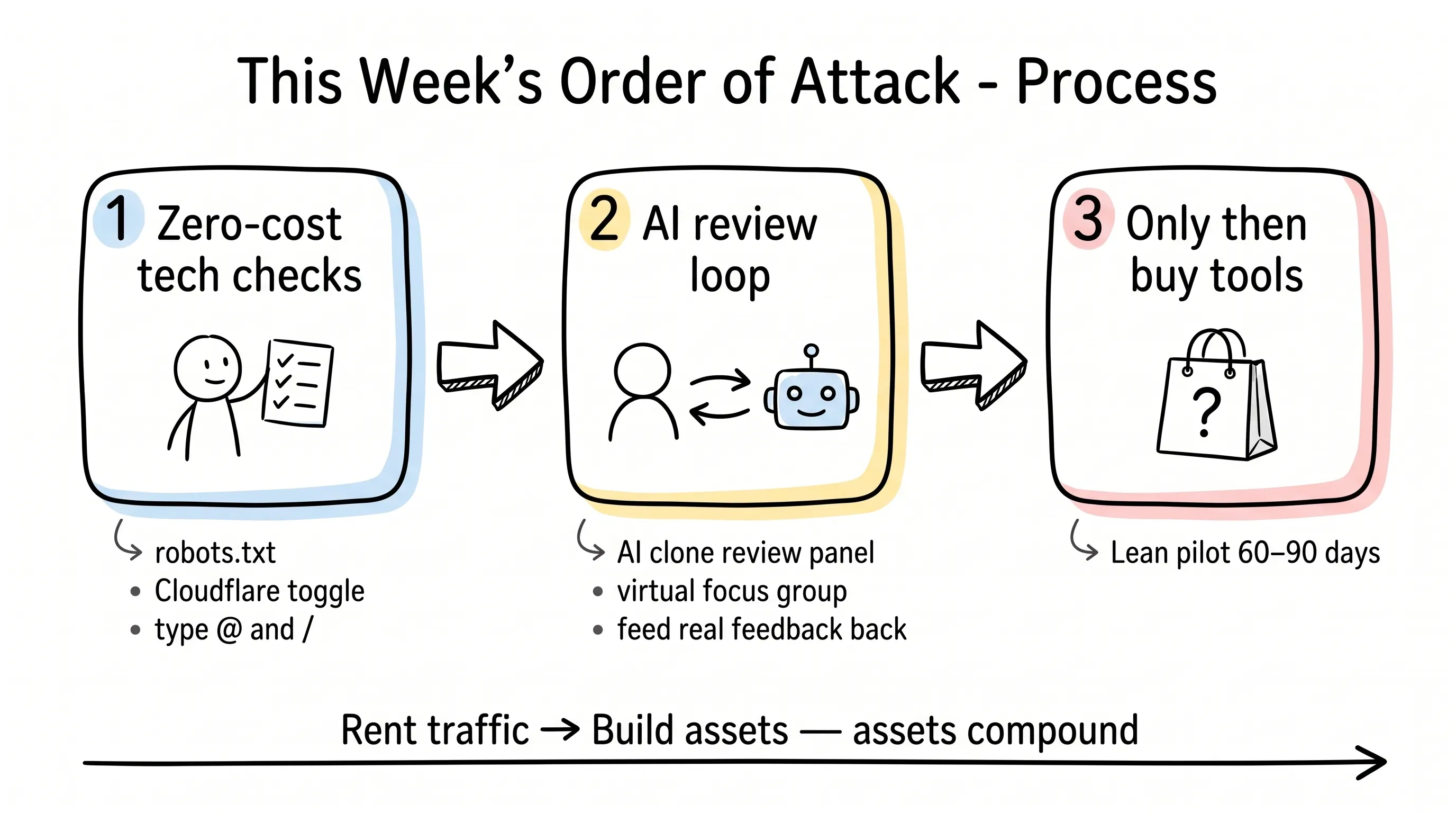
So the judgment worth writing down today: the way money gets spent has changed. It's moving from renting traffic to building assets — newsletter archives, Q&A-style content, behavioral trigger rules are all assets AI will cite and execute on, again and again. And the compliance side is tightening in step: Europe's right to object and AI disclosure mandates everywhere are writing the rulebook for this new game. There's also a hidden echo today: Heinz asked AI to draw ketchup and every drawing came out Heinz — a sample of brand equity so strong the model internalized it. The lead story's GEO, by contrast, teaches you to actively become the source a model wants to cite. One passive, one active, and the difference is the work of turning content into assets. This week's order of attack: run the zero-cost technical checks first (robots.txt, Cloudflare, the @ and / in your input box), then set up an AI review loop for quality, and only then consider paying for tools. Tools will wait. Compounding assets won't.
Continue reading
Related articles

AI Marketing Daily · 2026-10-09
AI marketing daily for 2026-10-09 covering 11 items: brand measurement moving from survey panels to search, social, e-commerce, and AI prompt signals; GEO and share of model playbooks; safety guardrails for agentic ad buying; and tool roundups for ad platforms, cross-border tools, and social media uses.

AI Marketing Daily · 2026-10-08
AI Marketing Daily for 2026-10-08 curates 20 items across AI search visibility (GEO), advertising, platform selection, cross-border e-commerce, and ROI measurement. The headline argues that strategic marketing decisions should stay with humans while AI assists execution.

AI Marketing Daily · 2026-10-07
Today's throughline is answer engine optimization (AEO — getting your brand quoted in AI answer engines).