
AI Marketing Daily · 2026-09-13
Daily roundup of 16 AI marketing items covering AI agents in B2B procurement, GEO and AI search visibility, ad tool comparisons, and a strong governance thread on compliance, copyright, and privacy.
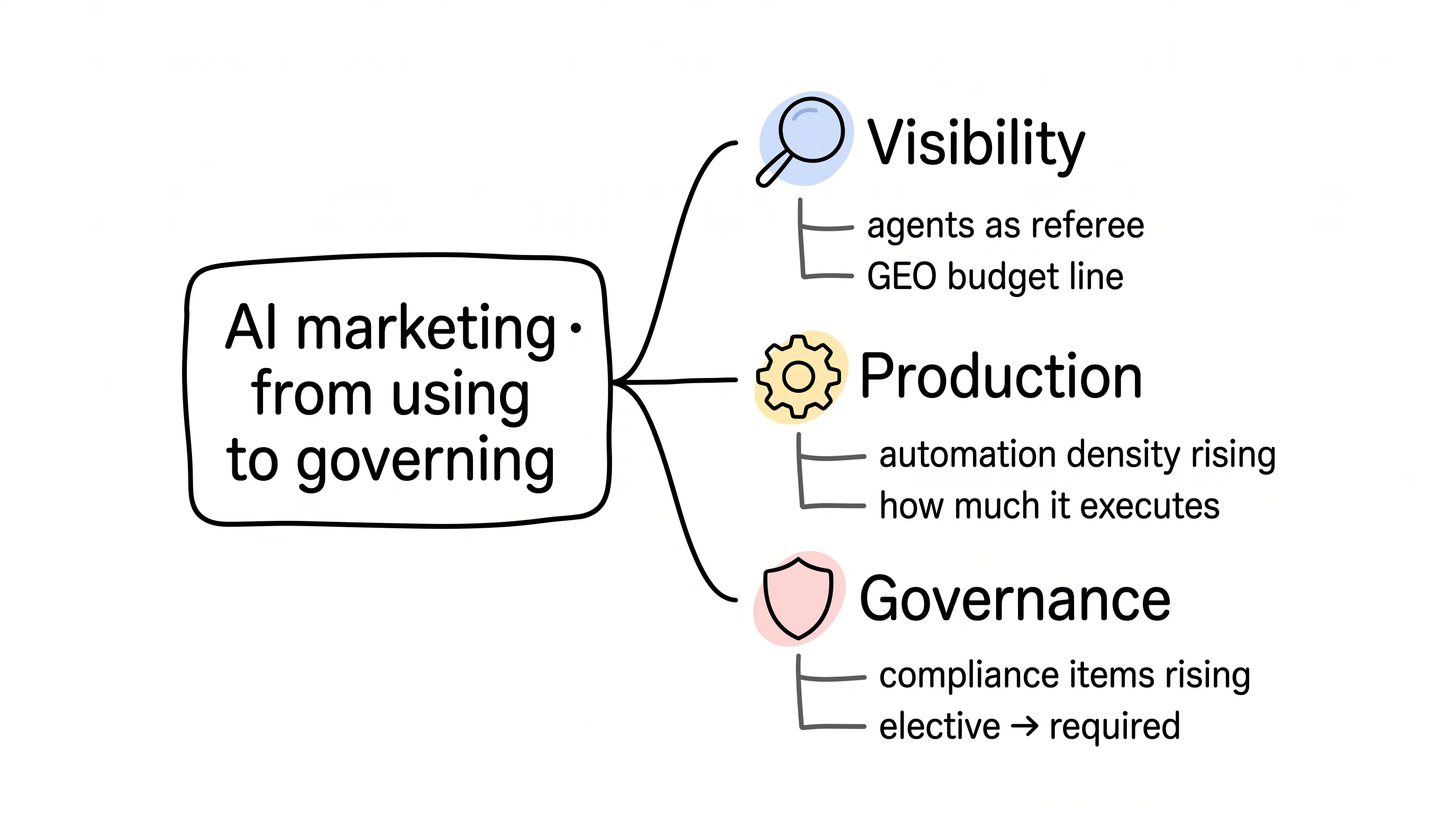
Today's 16 items — the dominant theme has moved from whether to use AI to how to govern it. On the visibility front, AI agents are starting to take over the middle layer from search to procurement, and GEO is becoming a new budget line. On the production front, tool roundups are starting to be graded by "how much they execute for you." Governance is the most striking front: five items touch on compliance, copyright, and privacy. Start with the headline: the referee in B2B buying is being replaced by AI agents.
🎯 Today's Top Story
2026 trend roundup: the referee in B2B buying is being replaced by AI agents
B2B agency Circles Studio has published its 2026 AI marketing trends roundup, first closing the books on 2025: ChatGPT, Perplexity, and DeepSeek have become everyday infrastructure — research partner, writing assistant, and automation engine. Generative AI has matured across text, image, audio, and video, and video tools like Sora have flooded social feeds with synthetic content; being unable to tell real from fake is now the norm. AI agents are starting to leave traces in website traffic and conversion paths, and in the browser, autonomous assistants like OpenAI Astra now do research, price comparison, and execution on the user's behalf. November's Cloudflare outage exposed how tight compute demand has become. Looking ahead, the article lays out five trends: AI agents are becoming the middle layer of B2B procurement; generative AI is moving from experiment to production mainstream; GEO and AI SEO are on the rise; audiences increasingly want content with a real human byline; and AI's value lies in embedding itself in specific workflows rather than generalized automation.
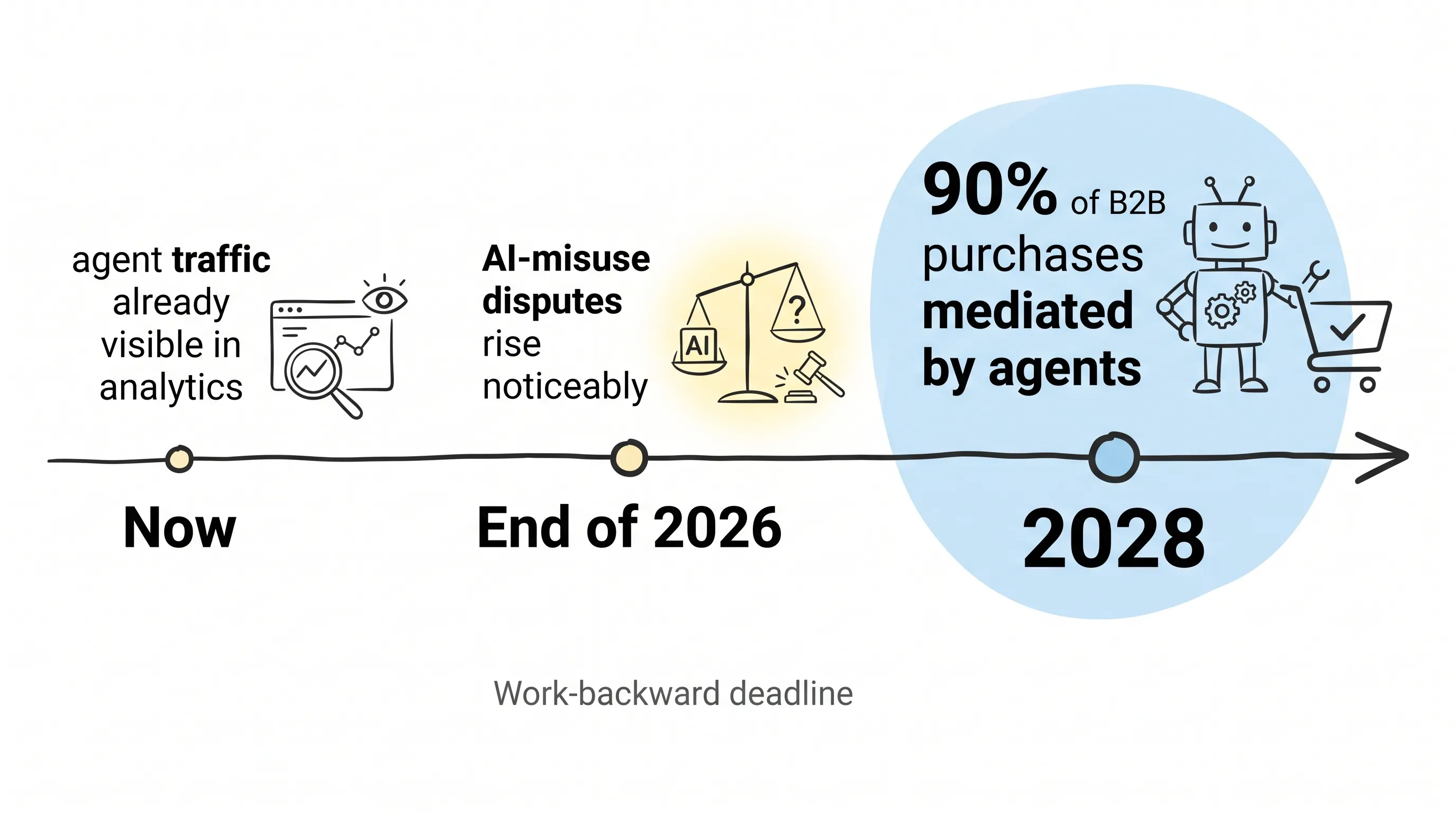
Why this matters. The article cites Gartner's forecast: by 2028, 90% of B2B purchases will be mediated by AI agents, with trillions in spend flowing through agent systems. That means the judge of brand visibility has changed: the first to "read" your website is often no longer the procurement manager — a machine compares the options, interprets the product information, and filters the recommendation list on their behalf, and the human only sees the shortlist that survived. Whether your product makes that list depends on the strength of your digital footprint and on machine-readable signals of authority. In the same passage sits a prediction that's easy to skim past: by the end of 2026, legal disputes over AI misuse or inadequate guardrails will rise noticeably. Opportunity and risk are on the same page. The article also flags the other side: beneath the AI investment sprint sits a bubble question — strained infrastructure, uneven progress across models, questionable Q4 financials — so every assumption you write into your plans deserves a hedge.
For marketers, the impact lands in three specific places. First, the content budget structure: the three GEO principles are taking shape — first-hand human experience and proprietary data now outweigh generic information, long-form authoritative content is more likely to be judged expert-level, and trustworthy external links reinforce machine-readable trust. Second, the production side: one skilled marketer can now deliver what used to take several teams working together, and big brands like Coca-Cola pushed AI-generated holiday ads straight to consumers — but public flops and backlash show up in the coverage too, so results are mixed. Third, the audience side: in AI-saturated feeds, human bylines and recognizable voices have become scarce goods, and the value of micro-creators and niche experts in brand storytelling is rising. The article's toolkit list is fairly blunt: ChatGPT for writing and reasoning, Perplexity for research and real-time retrieval, Surfer SEO, Jasper, and Copy.ai for content optimization, HubSpot AI for CRM insights, and Sora as the direction of travel for video generation.
How to use it. Four actions. First, give your site an agent-perspective checkup this week: are product specs, comparison information, and FAQs structured and machine-readable? Will AI systems get lost while crawling your pages? A signal crawlers can't find is a signal you never published. Second, put the three GEO principles into your 2026 content calendar: prioritize first-party data and long-form authority content, schedule link partnerships alongside it, and down-weight shallow, generic newsflash output. Third, add human bylines and lived-experience detail to your content, and talk to niche experts and micro-creators about collaborations that turn lived experience into citable material. Even faceless channels have audiences who care whether a real human is behind them — adding a byline costs so little there's no reason not to do it. Fourth, embed AI into four specific workflows — research, summarization, drafting, and predictive analytics — and leave judgment, error correction, and strategy to humans. The article's own words are a reminder that AI is still far from a universal tool: teams should map its boundaries and failure modes before scaling up, rather than expecting one-step full automation.
My take: the greatest value of this roundup is that it breaks "marketing to AI systems" down from a slogan into an executable checklist of signals, and Gartner's 90% forecast gives you a deadline to work backward from. 2028 sounds far away, but agent penetration along the procurement decision chain starts this year. Most of the numbers are secondhand citations, and the Coca-Cola case is a big brand's aggressive experiment, so mind the sourcing when you quote them. For the 2026 budget, cut it three ways: agent visibility, human-bylined content, compliance guardrails. Don't wait for 2028 — agent traffic is already showing up in your analytics dashboard.
🔗 Further reading: Read the full article
🏷 Compliance & Law
Marketing compliance automation guide: EU AI Act turns compliance from a cost item into business continuity
OmniFunnel published a long hands-on guide on Jan 8 about using AI to automate marketing compliance. It opens with the penalties: EU AI Act violations can cost up to €35 million or 7% of global revenue, which upgrades marketing compliance from a cost item to a business-continuity issue. Survey data cited: 93% of compliance experts say AI has clearly reduced human error; organizations using automated compliance report 60% confidence, versus 36% for manual processes. AI compliance platforms are broken into four capabilities: NLP scans regulatory changes in real time and maps them to business processes; machine learning predicts violation risk from historical data and intercepts before publication; computer vision reviews image and video assets, covering protected imagery, accessibility, and misleading visuals; and audit evidence is archived automatically. The guide splits the differences by industry — healthcare needs clinical evidence plus HIPAA privacy, finance requires mandatory risk disclosure, e-commerce emphasizes consumer protection, and SaaS has its own playbook. The rollout path comes in five stages: assessment and planning, platform selection, process redesign, training and change management, and continuous optimization. There's also a reusable ROI model: manual compliance runs 56 hours a week, automation cuts that by 70%, saving roughly $150,000 a year in labor; an 80% drop in violation probability multiplied by $500,000 per incident puts annual risk-avoidance value at about $200,000. Note that the figures are an illustrative model, not a measured case.
💬 The four-layer ROI model can drop straight into your project-approval deck — far more persuasive than asking for budget on gut feel. For rollout, start with violation-prediction interception: a gate before publication is the most visible win; put the hours saved in the second layer. Verify the numbers yourself before citing them.
🔗 Further reading: Read the full article
Copyright ruling reminder: competitors can legally copy AI content with no human input
TechCXO contributor Virginie Glaenzen wrote this based on a June 12 webinar. The crux is US copyright law's human-authorship requirement: the Thaler v. Perlmutter case established that purely AI-generated content with no substantial human input cannot be copyrighted. No copyright means competitors can freely reuse your AI copy, slogans, and visuals — being able to use a tool is not the same as owning what it produces. The article lists five pitfalls: training-data infringement liability, AI output imitating other people's trademarks and visuals, missing human authorship, GDPR and CCPA privacy violations, and AI vendor license terms that exclude commercial use. Five protections: keep prompts, edits, and decision records as evidence of ownership; vet your tools' training-data sources and license terms the way you'd audit a supplier; keep an enterprise AI policy continuously updated; proactively disclose AI involvement in regulated industries; and move legal review upstream into the creative workflow. The author's stance is to treat AI as a co-author — human-in-the-loop plus documented human roles is what makes content defensible.
💬 Three things you can land this week: set a prompt-logging standard for the team, run your in-use tools' license terms past legal, and write the AI policy into onboarding materials. What you save is a future round of enforcement lawyers' fees — and you close the door on having your work taken for free.
🔗 Further reading: Read the full article
EU AI Act enforcement begins in early 2026 — compliance focus shifts to whether you can explain your AI
Robotic Marketer's Dec 9 guide for 2026 puts a date on it: the EU AI Act enters its enforcement period in early 2026, with both high-risk and low-risk applications carrying transparency and accountability obligations, while the US, Australia's OAIC, and multiple Asian jurisdictions legislate in parallel. The article breaks compliance into four pillars. Data privacy responsibility: privacy by design, anonymization, fine-grained authorization, and revocable consent. AI transparency: automated marketing decisions must be explainable, logged, and open to user appeal. Governance frameworks: model selection, training data, and output analysis documented end to end, paired with bias audits and remediation mechanisms. Automation ethics: regular algorithm audits, bias detection, content-fairness checks, and protection against manipulation and excessive surveillance. Consumer rights are upgrading too — you must explain the scope of data collection, retention periods, and opt-out mechanisms in non-technical language. The conclusion frames early compliance as a competitive advantage: transparent AI decisions win over privacy-sensitive customers.
💬 Use this as the starting point for a CMO-level self-audit: pick one actionable item from each of the four pillars for this week — say, add logging to your automated decisions — then work backward to finish before the enforcement period. Every section pitches the company's own Dashboard, so strip the ads before you read.
🔗 Further reading: Read the full article
Privacy law is reshaping media buying: a jurisdiction map plus four replacements as the cookie exits
MarTechCube's overview lays out the legal map first: GDPR fines reach up to 4% of global revenue and cover any business targeting EU consumers; CCPA's opt-out, access, and deletion rights are rippling across US states; Brazil's LGPD, Canada's PIPEDA, and Singapore's PDPA each form their own regimes. Five privacy-first principles: transparent communication, explicit consent, data minimization, secure protection, and ethical marketing. The impact lands in four places — personalized advertising, third-party cookies, email CRM, and programmatic buying. Four categories of technical replacements after the cookie exits: contextual targeting, server-side tracking, aggregated audience insights, and consent management platforms (CMPs). The article's judgment: zero-party and first-party data plus AI-driven compliance automation form the mainstream shape of marketing in the post-privacy-law era, with KPIs and measurement systems evolving alongside.
💬 Cross-border teams: paste this jurisdiction map into your media-buying SOP and auto-apply the matching requirements by audience location — stop running one asset set globally. Shift personalization budget from buying third-party data to building first-party, and change the KPI from reach to relevance.
🔗 Further reading: Read the full article
A procurement-angle warning: agencies using AI collide with originality clauses
WB Research wrote this risk briefing for marketing procurement leads — an angle you rarely see in this kind of coverage. Before bringing in an AI tool, first check it against existing contractual obligations: if an agency drafts copy with generative AI, it may breach agreements that promise "content that is original and custom-made for the brand," and delivery ownership and originality commitments need to change with it. Generative AI's hallucinated output can leave a company liable for misleading statements, so human review as the backstop is non-negotiable. On the data-protection side, machine-learning analytics platforms run on personal data, so collection and security protocols must be compliant. The article gives procurement teams a six-step checklist: research current regulations, bring legal into data collection and storage processes, protect user awareness and exit rights, build data-governance agreements with partners, audit AI systems regularly, and keep tracking regulatory and consumer-sentiment shifts. Citations are mostly secondhand takes from 2022–2023, so the freshness is middling — but the procurement angle itself is worth the read.
💬 At your next agency contract renewal, add an AI-usage disclosure clause: which deliverables may involve AI, how much human input goes in, and who owns the copyright. One page of terms that shuts down the messiest ownership disputes down the road.
🔗 Further reading: Read the full article
🏷 Marketing Tools & Media Buying
Cross-border AI SEM selection map: five international tools — all-in-one or specialist?
Topkee evaluated five international tools for cross-border e-commerce teams entering the US market. Semrush is positioned as the aircraft carrier for mid-size and large teams, with the value in competitive intelligence: competitors' keywords, copy variants, and estimated budgets are all visible, plus an AI Copilot for real-time advice. Pro starts at $100 a month; the learning curve is steep, and there's a gap between strategy and execution. Writesonic fills the top of the funnel, producing ad copy and landing pages fast — a fit for high-frequency creative iteration. HubSpot Content Hub embeds content optimization into its inbound marketing system. SellerSprite goes deep on Amazon keyword and PPC analysis, fitting cross-border sellers better than general SEO tools. Blend AI represents the emerging cross-platform buying-automation route. The article's main argument: assembling multiple tools tends to create data silos and workflow breaks; the selection trade-off is between all-in-one and specialist, and you should map capability gaps across the three-link chain of analysis, content, and execution. The ending glides naturally into the company's own all-in-one solution — standard soft-article practice, so take the ending with a grain of salt.
💬 List your gaps before you spend: missing intelligence, get Semrush; missing creative capacity, Writesonic; selling on Amazon, SellerSprite. If budget is tight, fill just one segment of the chain. Treat the in-house solution section as an ad.
🔗 Further reading: Read the full article
Meta ads tool roundup: choose by automation depth, not the feature list
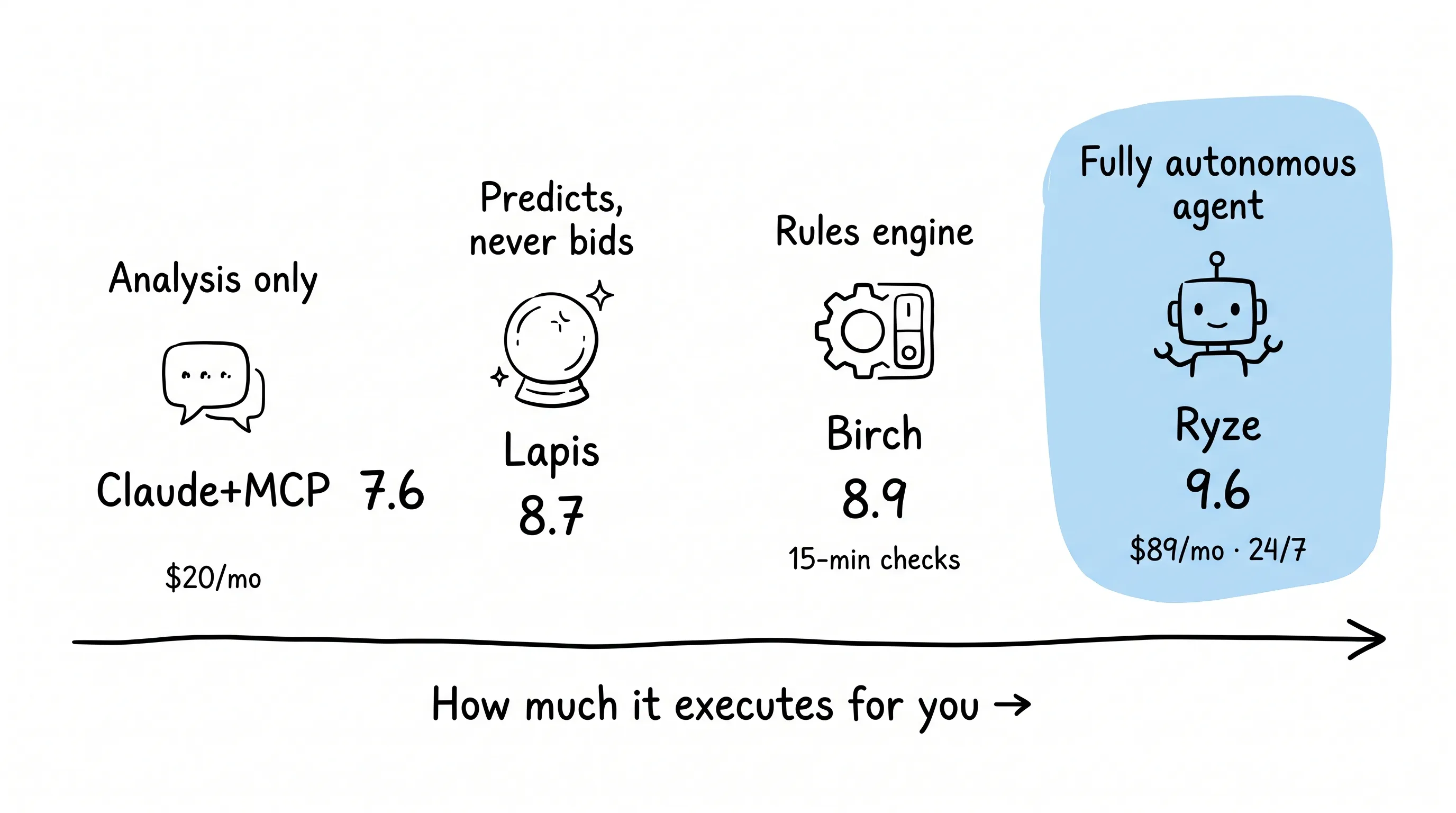
Ryze AI's roundup (published Mar 25, updated Sep 8) scores 10 Meta ads tools by automation depth — the axis is how many account operations the tool actually executes for you, rather than just offering suggestions and waiting for clicks. The company's own Ryze tops the list at 9.6: the only fully autonomous agent, repricing, shifting budgets, and rotating creatives 24/7 at $89 a month, and the price doesn't climb with your budget. Birch (formerly Revealbot) scores 8.9 with the strongest rules engine — a single rule can carry 15+ conditions and checks run every 15 minutes; in a live test on a lead-gen account with a $30,000 monthly budget, it caught 12 inefficient ad sets missed overnight in the first week. Lapis scores 8.7: it attaches a predicted CTR to every creative variant before launch and beat the account's trailing-30-day average in 7 of 9 launches, but never touches bids or budgets. AdEspresso, 8.3: its A/B tests kill underperforming variants two to three days earlier than native CBO (campaign budget optimization), saving about 15% of testing budget. Smartly.io, 8.2: enterprise-grade creative automation, from $2,000. Claude plus MCP (Model Context Protocol) at 7.6 is a $20-a-month DIY analyst — analysis only, no execution. The avoid list has substance too: Madgicx rates just 1.8 on Trustpilot (270 reviews; complaints center on post-trial charges), Qwaya has shut down, Pattern89 was acquired and delisted, and copywriting tools like Jasper and Copy.ai lack account-execution capability. The article's rationale: creative fatigue cycles have shrunk to roughly 72 hours and bidding is too fragmented for manual oversight. Stay alert, though: the publisher ranked itself first, and its own pricing page doesn't quite match the numbers in the roundup.
💬 Use the list as a market map, not a verdict — the publisher's conflict of interest is on full display. Choose by bottleneck: missing execution, go fully autonomous or rules engine; missing creative, get Lapis; budget-sensitive, start with Claude + MCP for account diagnostics. Cross-check prices before paying.
🔗 Further reading: Read the full article
Seven platforms' AI ad products at a glance: automation is now the baseline
360om's overview puts seven platforms' flagship AI buying products on one table. Google's Demand Gen mines cross-ecosystem behavioral and interest signals early in the purchase journey, and Performance Max optimizes bids, targeting, and creative in real time across Search, Display, Video, and Shopping. Meta Advantage+ automates audiences, budgets, and creative, tilting spend toward better-performing combinations in real time. TikTok's GMVValue models high-purchase-probability audiences against GMV targets, and Smart Campaigns auto-optimizes bidding for small businesses. Snapchat's Dynamic Catalogs auto-generates personalized ads from product catalogs and user interests. Amazon Performance Plus, Pinterest Performance+, and Microsoft Performance Max each have their own counterparts. The article's point: AI automation is now the underlying capability of every platform's ad buying, letting advertisers scale across platforms with minimal manual input.
💬 Easiest use: a cross-platform cheat sheet for team training — all seven platforms' positioning in one read. Note that the piece was published in April 2024; platforms have iterated plenty since, so treat each platform's own backend as the source of truth for product boundaries. Don't run new roads off an old map.
🔗 Further reading: Read the full article
🏷 AI Search & GEO
Google's per-user search is down 20%: SEO remains the foundation, GEO stacks on top
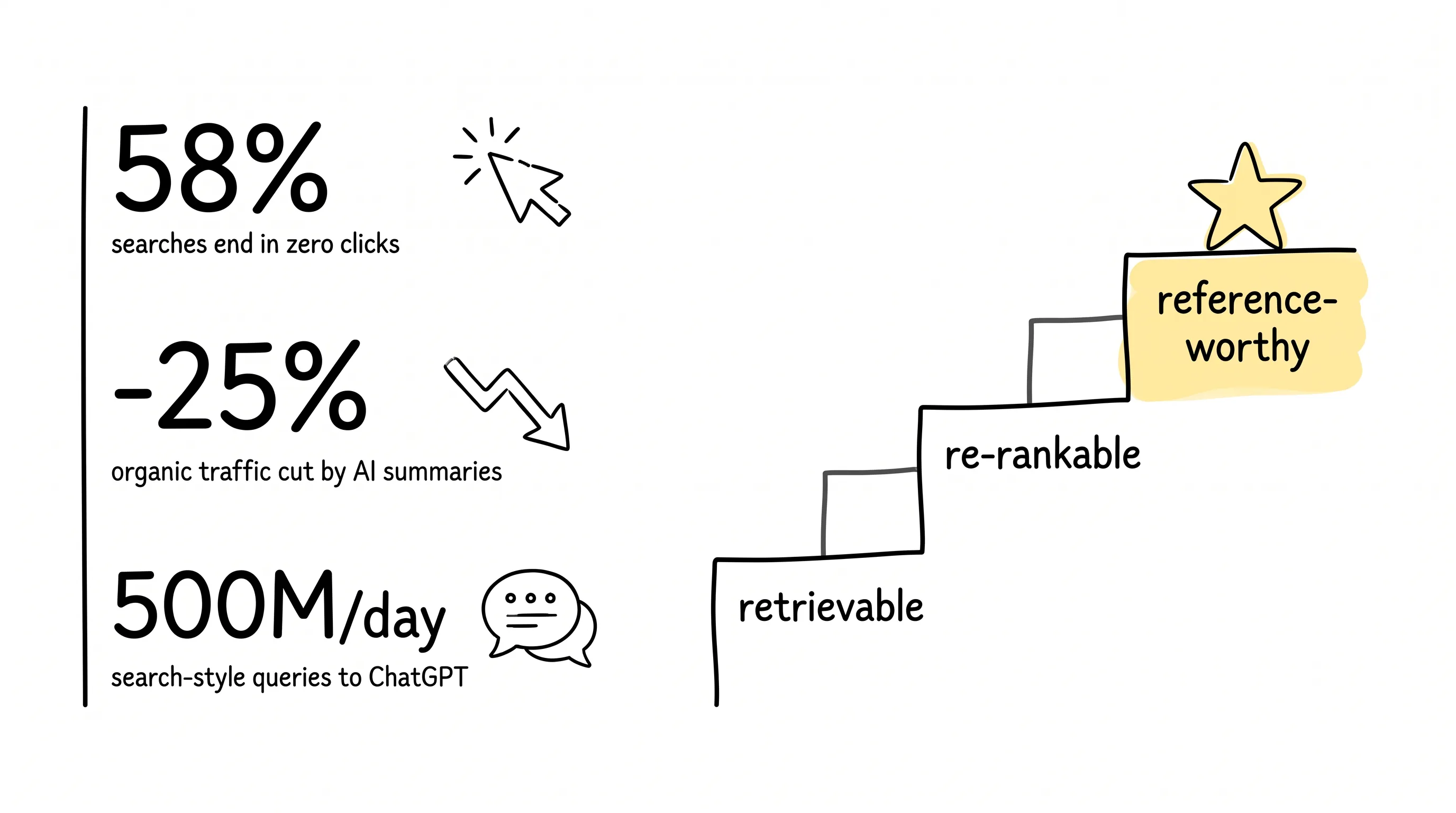
The Deciding Factor unpacks GEO (Generative Engine Optimization) and AEO (AI Engine Optimization). The data first: per-user search volume on Google desktop is down nearly 20% year over year, ChatGPT receives 500 million search-style queries a day, and the top of Google's results page is now an AI Overview — ranking high no longer equals getting clicks. But the other side: ChatGPT's search volume is only about one-thirtieth of Google's, so the conclusion is don't pull SEO, stack GEO on top. Eight practices for an AI-ready site: schema markup and semantic HTML; organizing machine-readable data with lists and tables; direct-answer copy with minimal marketing jargon; structured knowledge; your own comparison content versus competitors; FAQ structures; review and social-media reputation management; and placement in authoritative off-site publications. B2C and B2B playbooks diverge: B2C leans on fast answers, product detail, reviews, and trust signals; B2B leans on thought leadership, whitepapers, and case studies — the deep resources AI can cite. Healthcare, finance and insurance, education and training, e-commerce and retail, and professional services benefit most: being cited by AI brings visibility and an authority endorsement at the same time. One more piece of background: AI systems cross-validate information across datasets, so shallow, generic content increasingly fails to surface in machine-mediated discovery — this reshuffle favors those who go deep.
💬 Of the eight, do the three fastest wins first: add schema, stand up FAQs and comparison tables, and seed off-site citation sources. For B2B, rewrite whitepapers into machine-readable structured versions — that budget line is next year's first priority.
🔗 Further reading: Read the full article
58% of searches end in zero clicks: GEO's goal is to be worth citing
Buried in Go Fish Digital's GEO services page is a usable methodology. The cited numbers: over 58% of US searches end without a click, AI summaries can cut a brand's organic traffic by up to 25%, and plenty of AI users already treat ChatGPT as their product-research entry point. The difference between GEO and traditional SEO is boiled down to three states: making content retrievable, re-rankable, and reference-worthy inside AI systems. It breaks into four modules: a semantic content audit to find entity-coverage and topic-structure gaps; page- and paragraph-level optimization aimed at AI Overview and ChatGPT; traditional SEO foundations oriented toward AI discovery; and digital PR to earn brand citations from AI. The toolbox includes an AI Overview Analyzer and a Similarity Score extension. The keyword in the methodology is fact density (fact-density) — LLMs prefer to cite content with concrete numbers, clear sources, and structured presentation. Read this module list against the three GEO principles in the headline item and they complement each other nicely: one gives you the actions, the other the ranking logic.
💬 The 58% zero-click and 25% traffic-loss numbers belong verbatim in your internal business case. Start with your ten highest-value pages, run them against fact density — add numbers, sources, and structured markup — and you'll see results within two weeks.
🔗 Further reading: Read the full article
🏷 Brand & Measurement
Brand drift is a chronic condition, AI accelerates it — re-up beats rebrand
The Robin Report podcast transcript (posted Sep 11, 27 minutes): host Shelley Kohan in conversation with Karen Tiber Leland, founder of Sterling Marketing Group, author of The Brand Mapping Strategy, who has worked with LinkedIn, Apple, and Google. The topic is brand drift: brands rarely fail overnight — they drift slowly across five dimensions: messaging, visuals, marketing, audience, and product. Starbucks serves as the case study: drift accumulates until it tips into a crisis. AI is accelerating this: AI is already eroding organic search traffic, answer-style presentation strips brands of direct touchpoints, and the easier it is to scale output, the faster you lose focus. The operating thesis: re-up beats rebrand — break the tear-it-down-and-rebuild into continuous small refreshes, where both cost and risk are lower. Diagnosis comes in three tiers: findable, followable, unforgettable — first identify which tier you're stuck on. The two also discuss the risk of drunk marketing: emotion-driven brand decisions tend to leave scars. The guest is a practitioner who serves big brands, so the conclusions are seasoned judgment rather than research findings — but the five-dimension and three-tier checklists are directly actionable as they stand.
💬 Put the five-dimension checkup on the brand team's quarterly agenda — don't wait for sales to drop before acting. Use the three-tier diagnosis to find where you're stuck; most brands stall at findable, and after AI search siphons traffic, that squeeze only gets tighter.
🔗 Further reading: Read the full article
ROI in the AI era: report business outcomes to your CFO, not last-click
Zeta Global's Zeta Live 2025 session (Oct 14, 25-minute video) is about upgrading marketing measurement from attribution to business outcomes: what you prove to your CFO is the contribution to revenue, gross margin, and LTV (lifetime value), beyond last-click and vanity metrics. Four points: the new scorecard ties marketing to revenue, gross margin, and LTV, beyond proxy metrics; predict before you spend — use AI to estimate roughly how a creative-media combination will perform before committing; normalize optimization — budgets, bids, and creative keep learning and running while staying explainable, not a black box; and guard against three traps — dirty data, proxy chasing (optimizing for the metric instead of the business result), and reporting cycles misaligned with business cycles. The page is a bullet list with no cases or argumentation, so it works best as a discussion outline; the publisher, Zeta Global, is a data and marketing technology vendor — a natural beneficiary of measurement upgrades, so mind the leaning.
💬 Next time you report to management, lead with one of your own proxy-chasing examples — far more persuasive than explaining the concept. And keep the order right: build the scorecard first, then add AI prediction; reversed, you're just automating dirty data.
🔗 Further reading: Read the full article
🏷 Content & Personalization
Ten rules for AI content marketing: mine the archive before adding new
StoryChief's listicle covers the full chain from topic selection to distribution; of the ten rules, a few genuinely add value. On topic selection: AI combines search intent, competitor content, and CRM data for gap analysis, instead of pitching topics on gut feel. On production: AI drafts and humans keep the brand voice — build a brand voice library (tone, terminology, audience profiles) so AI first drafts stay consistent across channels while humans add insight and emotion. The existing archive gets its own emphasis: use AI to audit older posts whose performance is sliding, then repurpose them into videos, carousels, or newsletters, or refresh their SEO metadata — cheaper than writing new. On distribution: AI auto-adapts the same asset to each platform's tone. On structure: keyword clusters become pillar-cluster pages. Up front there's AI trend prediction, staking out rising topics before competitors do. Connecting GA4 to watch conversions rather than just traffic gets its own call-out. Every rule ships with how-to steps — but every section loops back to pitching the company's own William AI product.
💬 Of the ten, repurposing the archive has the best cost-benefit: AI-audit your sliding posts into new formats and cut the hours by more than half. Build the voice library first — without it, the brand consistency of AI drafts falls apart within three pieces.
🔗 Further reading: Read the full article
Customer journeys go AI: batch-and-blast gives way to real-time loops
LinkedIn's aggregation page on AI marketing automation collects high-engagement posts from overseas practitioners. One CX executive proposes rebuilding the closed-loop feedback (CLF) model that has run for twenty-plus years: shift from after-the-fact response to real-time interaction management, adjusting the journey before friction points damage the experience; the LLM's evolution points toward the LAM (Large Action Model) — upgrading from analyzing and recommending to directly executing customer-experience actions. An IBM consulting advisor cautions that AI's value goes beyond cost-cutting and efficiency. A founder offers a retail case: the client migrated batch-and-blast email to AI-driven journeys in Salesforce Marketing Cloud, unifying cross-touchpoint profiles and building trigger-based journeys keyed to behavior and purchase history — engagement up 38% and repeat purchase up 22% in three months; the numbers are the author's own and unverified. The page's consensus lands on letting systems self-adapt: hiring more people to close more feedback loops is a road that doesn't work.
💬 Treat 38% and 22% as anchors, not promises to copy. Entry point: email journeys — convert one-off blasts into two or three behavior-triggered flows; retrofits like this go live within a week or two and cost far less than a full site rebuild.
🔗 Further reading: Read the full article
Personalization starter framework: data granularity is the ceiling
Aprimo (a DAM — digital asset management — vendor) blog offers a plain but complete four-step framework. Step one: first-party customer data (browsing, clicks, purchase history) drives segmentation and high-intent identification. Step two: dynamic content across all touchpoints — site recommendations, interactive landing pages, email, and app push all share one profile. Step three: AI's three landing points — predicting preferences from NLP and behavioral data to serve before the search; automating content curation; and real-time tuning against engagement metrics. Step four: marketing automation scales personalization. The four selection criteria double as a scorecard: AI-driven personalization and automation, omnichannel delivery, data insight and contextual targeting, and scalable workflow integration. The closing case is a fictional illustration with no real data — treat it as a process diagram.
💬 The framework works as a starter checklist, but the precondition comes first: if your first-party data is coarse, no tool will save you. Fix data granularity before choosing a platform, and use the four-criteria scorecard directly — it spares you a round of selection bickering.
🔗 Further reading: Read the full article
💡 Today's Synthesis
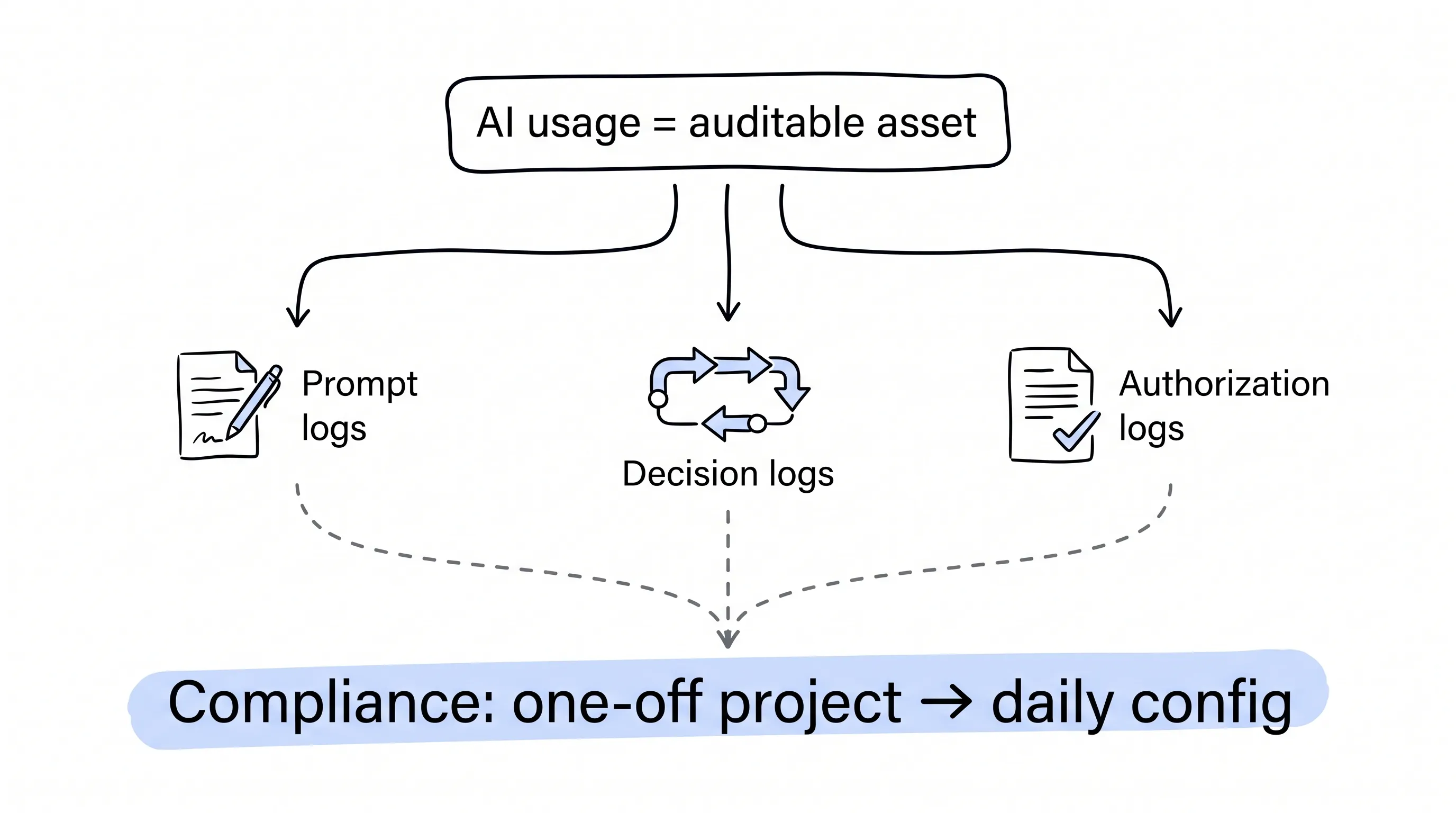
Read today's 16 items together and the center of gravity in AI marketing has shifted wholesale to "how to govern." Three threads. The visibility thread is changing referees: the headline's Gartner forecast and both GEO pieces tell the same story — the customer-acquisition entrance is shifting from human search behavior to agents' retrieval and citation, so your content must serve two readers at once — machine-readable structure and human-readable storytelling each need their own layer. The production thread is scaling up: SEM tool selection, the Meta tool roundup, the seven-platform cheat sheet, the content ten, and the two pieces on journeys and personalization — six items all point to rising automation density; even the roundup's scoring axis has switched to "how much it executes for you." Tool purchasing is becoming a new fixed cost line, and the price of a wrong selection is growing with it. The governance thread is the most striking: compliance and law alone carries five items — the EU AI Act's enforcement timing, a copyright precedent, privacy jurisdictions, and procurement contracts, each given its own story. That's rare in AI marketing roundups from previous years; managing AI has gone from elective to required. One unified action for marketers: turn AI usage into an auditable asset — log prompts, log decisions, log authorizations — and compliance will shift from special project to daily configuration. The day you're actually questioned, those records are your insurance policy. The two measurement pieces (brand drift and ROI) point at the same thing: AI amplifies output capacity, and it amplifies the cost of losing focus and chasing vanity metrics — the easier it is to scale, the more hidden the drift. Upgrade the measurement system before you floor the accelerator; get the order wrong and the faster you run, the further off-course you go.
Continue reading
Related articles

AI Marketing Daily · 2026-10-09
AI marketing daily for 2026-10-09 covering 11 items: brand measurement moving from survey panels to search, social, e-commerce, and AI prompt signals; GEO and share of model playbooks; safety guardrails for agentic ad buying; and tool roundups for ad platforms, cross-border tools, and social media uses.

AI Marketing Daily · 2026-10-08
AI Marketing Daily for 2026-10-08 curates 20 items across AI search visibility (GEO), advertising, platform selection, cross-border e-commerce, and ROI measurement. The headline argues that strategic marketing decisions should stay with humans while AI assists execution.

AI Marketing Daily · 2026-10-07
Today's throughline is answer engine optimization (AEO — getting your brand quoted in AI answer engines).