
AI Marketing Daily · 2026-09-12
Daily AI marketing digest for 2026-09-12: BCG's CMO survey highlights the gap between transformation claims and actual deployment, IAB raises its US ad growth forecast to 12.3%, Jasper reports 91% AI adoption, and five GEO guides cover citation measurement and content refresh.
Today's word is the gap. BCG's annual survey puts 96% of transformation claims and one third of reality into the same report; IAB counts ad budgets climbing to 12.3% and measurement that can't keep up; five GEO (generative engine optimization) guides land on the same day. The industry is accelerating while the ledger and the org chart drag behind. All 18 items below come with hands-on commentary — from measurement baselines to buy-vs-build inventories, every action for today has its landing point marked.
🎯 Today's Headline
BCG 2026 CMO Survey: 96% Claim Transformation, Only 8% Have Multi-Agent Autonomous Campaigns Up and Running
BCG has released its 2026 annual global CMO survey, polling 300 CMOs with in-depth interviews of 50 of them. The most interesting read comes from putting the two sets of numbers side by side: 96% of CMOs claim AI is reshaping the marketing function end to end, while 42% admit generative AI serves only as an assistant for discrete tasks in their shops, and just 8% have run campaigns where multiple agents execute autonomously. BCG sorts respondents into three tiers by actual deployment: Leaders at 32%, already deploying agents across multiple workflows with human-in-the-loop orchestration; Followers at 26%, still pushing one or two pilots outward; At-Risk at 42%, tools bought by the pile while the organization hasn't budged. Money is accelerating in: 43% of CMOs are putting more than $15 million into AI this year, up from 28% last year. The power structure is shifting too — roughly half of CMOs say AI investment decisions for marketing are made by marketing itself, while 72% of enterprise-wide AI decisions still sit with the CEO, a rare functional divergence in who holds the keys.
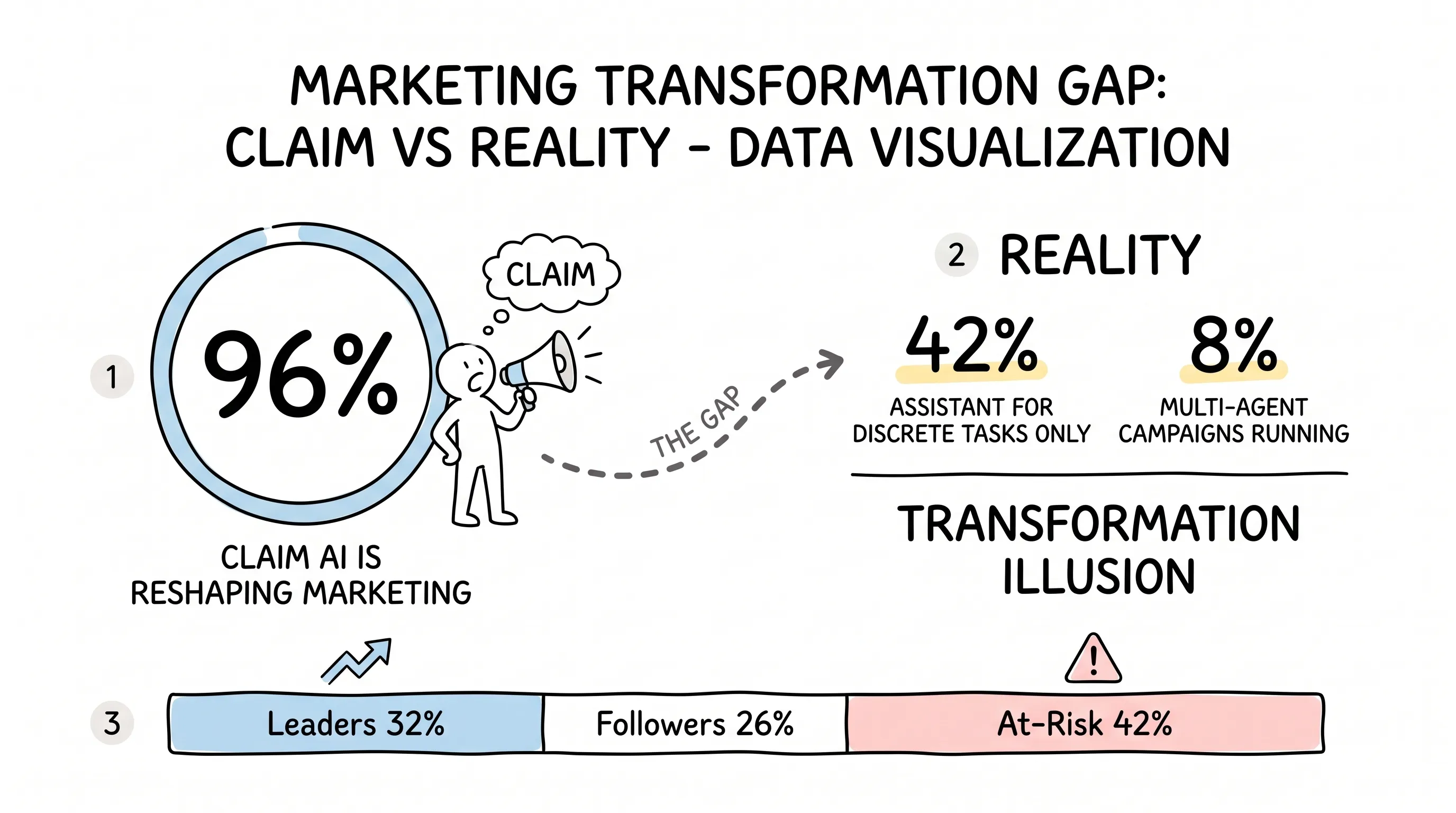
Where this survey earns its value is in pulling the industry from vision-speak to the ledger. The claim-versus-reality gap gets a name — the transformation illusion — which is a reminder to everyone that picking benchmarks by loudness picks the wrong heroes, and only deployment depth shows who is actually ahead. The gap itself is the stratification, and the ending facing the 42% At-Risk cohort is spelled out bluntly: fail to produce defensible results within one or two budget cycles, and the decision authority in your hands quietly drifts away. Investment has entered its third wave as well — from buying point tools, to buying the connective layer, and now buying operating infrastructure. The question leaders ask has changed: they no longer ask which tool to buy, but what operating system can make tools, agents, and workflows work together.
For marketers' daily work, the three tiers map directly onto three situations. Teams sitting in the At-Risk tier are watching their jobs turn into writing postmortem reports for dozens of pilots — the pilots produce output, the business doesn't change; that is the most dangerous position to be in. The contest among Leaders has moved to a four-layer stack: the data foundation, the brand intelligence layer, multi-agent orchestration, and a unified interface for the people doing the marketing. The brand intelligence layer is a new species: encode the brand's rules, KPIs, and trusted sources into it, and the generic agent becomes the company's own agent. BCG believes this layer of infrastructure is what now separates organizations that scale from those still running single-point pilots. The organizational moves are just as concrete: dedicated AEO (answer engine optimization) and GEO teams, AI product owners, and AI governance owners are the new job titles, and 20% of Leaders have already restructured teams around business objectives rather than channels. The flip side of the pressure is written in the numbers too: 94% of CMOs say the CEO's expectations have risen sharply in two years, 40% are still measured mainly on cost efficiency, and the remaining 60% are already balancing growth against execution speed. On the consumer side, 90% of CMOs confirm that generative AI is rewriting how people discover and evaluate brands.
The action list can be copied as-is. First, locate yourself against the three-tier criteria — this week, count how many workflows your agents actually reach and how deep the orchestration goes; don't assign yourself a tier based on gut feeling. Next, shift the budget discussion from "which tool do we buy" to "what operating system makes our existing tools work together," moving money from the tool list toward infrastructure. Talent has to be built in-house: 80% of CMOs are running company-wide AI reskilling, and one B2B leader in the sample went from instructor-led training to hackathons to a standing AI academy, taking a 3,000-person team through the full cycle — compress it into a version you can copy. AEO/GEO teams should stop waiting for headcount and start as virtual squads. The transition org design is in the data as well: 75% of CMOs are still standing up agile squads — use them to unbottleneck people first, then consolidate once agent orchestration matures. The numbers for persuading the CFO are ready-made too: in BCG client cases, cost efficiency improved 20-30%, marketing ROI ran 3×, campaign cycles sped up 10×, and on the B2C side 31% of CMOs are already seeing measurable revenue impact.
My take: that gap table is more useful than any conclusion. The 96-versus-42 illusion spread isn't mockery of peers — it's a self-test for every team, and the answer you fill in today decides which tier you sit in next year. The revenue story is beginning to replace the cost story; marketing leads whose reports contain only efficiency numbers will have a rough time next year. One regional detail worth remembering: the share putting agentic commerce in their top-three priorities is 28% in APAC, 23% in North America, and only 13% in Europe — Asia is running ahead of everyone.
🔗 Further reading: Read the full article
🏷 Foundation Model Watch
Aprimo Sorts Marketing Agents into Five Classes: 62% Are Experimenting, Only a Third Have Reached Scale
The VP of product marketing at Aprimo has published a piece setting the coordinates for agentic marketing in 2026. The dividing line between agents and traditional automation is how decisions get made: from hard-coded if-then rules to multi-factor decisions that combine behavioral data, real-time context, and predicted outcomes, with continued learning on every interaction. The article offers a five-class taxonomy: planning agents own briefs and cross-channel breakdowns; asset agents manage metadata and discoverability; review agents push brand-consistency and SEO quality checks upstream; compliance agents compress approvals in regulated industries from days to hours; production agents handle localized variants. Sequencing sits at the top of the strategy list — restructure the workflow before deploying tools, because layering AI onto a broken process buys only marginal gains. The data citations are all there too: Gartner projects 40% of enterprise applications will embed task-based agents; PwC says 79% of enterprises are using them but must restructure workflows; the average expected return on agentic AI is 171%; and one case swapped in 150 personalized audience segments for a 40% lift in response rate and 25% lower deployment costs. 62% of organizations are experimenting; only about a third have reached scale — the bottleneck is the operating architecture.
💬 Don't roll out all five classes at once. Start by piloting the compliance class — approvals going from days to hours is the benefit leadership sees most easily; use it to buy budget and patience, then push toward the production class. Before launch, write down two things: the boundary of what the agent may decide autonomously, and who it escalates to when something goes wrong.
🔗 Further reading: Read the full article
Forbes's Take: After the Search-Entry Migration, AI Negotiating with AI Is the Next Match
A Forbes column breaks AI's restructuring of marketing into three layers. The first layer is the migration of the entry point: the generative engine's answer is the destination, being cited replaces ranking for clicks, and GEO was born of that. The second layer is more radical: the user's agent negotiates, compares prices, and closes deals directly with the brand's agent; marketing content must be machine-readable and reachable through interfaces, and the era of pages built only for human eyes is drawing to a close. The third layer lands on the organization: marketing, sales, and service will link into one chain in the agent era, and budgets and team structures must be rearranged to follow. The author's conclusion is blunt: media-buying craft is no longer a moat; brand equity and first-party data are the only differentiation left. Drawing on IDC and PwC, the piece cautions that the productivity gains all compute on paper — organizational readiness and the skills gap are the real bottleneck.
💬 Machine-readability is something you can start on this week. First check whether your product pages can be cleanly crawled for structured data; then confirm whether price, inventory, and logistics information have APIs. If you wait until agent-negotiated pricing becomes the norm before catching up, the data that plays your hand at the negotiating table will have been written by someone else.
🔗 Further reading: Read the full article
🏷 Industry Data
IAB September Pulse: US Ad Growth Forecast Raised to 12.3%, Measurement Left Behind
IAB has released the September update of its 2026 outlook study, covering 211 US brand and agency decision-makers. The big numbers first: IAB raised its forecast for US ad-spend growth this year from January's 9.5% to 12.3%, with the commerce media growth expectation lifted in step to 13.6%. The finer detail of money flowing into AI channels makes the better read: 76% of marketers list optimizing content for AI-generated answers as their next focus, 72% are watching the underlying AI models, while attention to using generative AI in media activities actually fell from January's 78% to 69% — attention is shifting from using AI to make ads toward being cited by AI. Measurement is the biggest hole: 86% of advertisers are changing or will change how they measure within 12 months because of AI and agents; 48% are measuring brand visibility and citations inside AI tools, 35% can't get consistent citation data, 30% lack AI-referral data, and 45% find comparing AI-driven journeys with traditional ones the hardest. Agent traffic muddies the water further: 27% worry bot traffic will exceed human traffic, 28% can't tell humans from legitimate agents, and 33% can't tell legitimate agents from fraud traffic. Only 26% have lowered the weight of website traffic metrics.
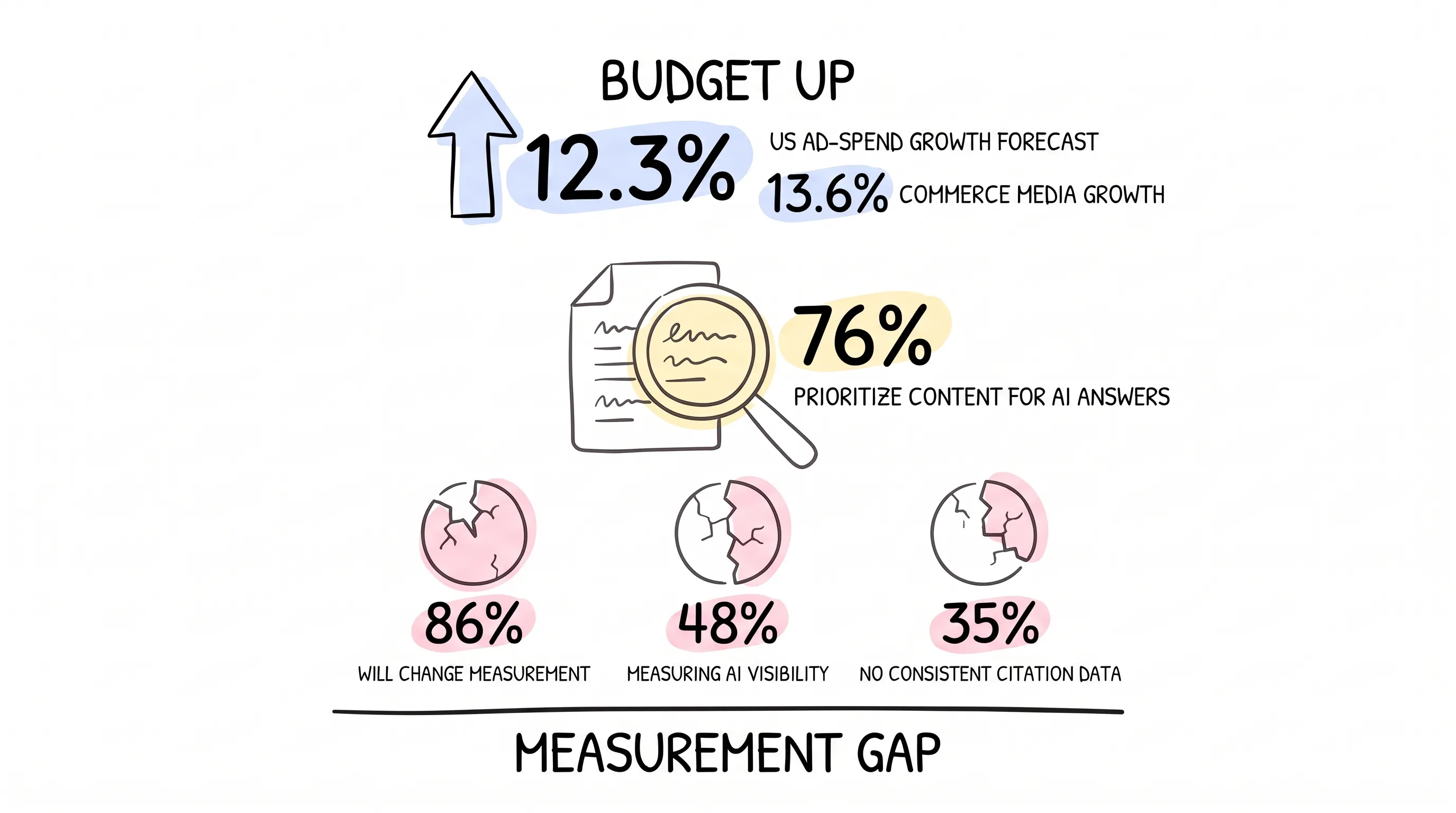
💬 Two things to do this month. Add an AI visibility tracking line to the monthly report — manually sample the major LLMs' answers about your brand and record the citations; meanwhile, keep the legacy metrics for now — AI measurement is running layered on top of the existing system, so run dual-track for a quarter before deciding what stays.
🔗 Further reading: Read the full article
70-Plus Sourced AI Marketing Statistics: 93% ROI and 23% Performance Improvement Clash on Methodology
The Rank Masters has updated its 2026 AI marketing statistics compilation — 70-plus numbers with the strictest editorial discipline in the category: every entry carries a clickable original source, and the editors state they deleted data they could not verify. Its most citable feature is the active presentation of conflicting methodologies: in SAS's survey, 93% of CMOs say generative AI has delivered clear ROI, while in the same volume Gartner's numbers show 23% seeing clearly improved campaign performance and 27% with limited adoption. The money figures come from Menlo Ventures: enterprise GenAI application-layer spending jumped from $11.5 billion to $37 billion in one year. On the creative side, 77% list creative development as generative AI's number-one use case, 86% of video ad buyers are using or preparing to use AI to produce video creative, and IAB expects AI creative to make up 40% of video advertising this year. The inversion on the risk side is the most glaring: over 70% of marketers have encountered incidents like hallucinations and bias, yet fewer than 35% plan to increase governance investment.
💬 Make this compilation your first stop for pulling numbers; before citing any ROI figure, verify the methodology — between 93% and 23% lies the question of how you ask. In your annual report, lay out the methodology differences proactively; that buys far more credibility than spotlighting one big number.
🔗 Further reading: Read the full article
Jasper's Annual Survey: 91% Use AI, Yet Those Who Can Prove ROI Fell from 49% to 41%
Jasper has released year two of its State of AI in Marketing, with a sample of 1,400 marketers. Adoption leapt from 63% the prior year to 91%, and the report's keynote is that the experimentation phase is over and the operations era has begun. The on-the-ground numbers look good: 50% get to market faster, 75% of AI users report higher job satisfaction, and 45% have lowered operating costs. The anomaly is that the ROI proof rate fell from 49% to 41% — not because results got worse, but because leadership's expectations switched from "how much labor did we save" to measurable business outcomes; among teams that adjusted how they measure, 60% report returns of two to three times or more. The blockers to scale have changed hands: brand-legal-compliance review ranks first, output quality second, data privacy third, with budget and skills dropping behind. 65% of teams have created dedicated AI roles, and a third of marketers have folded AI policy into their existing duties.
💬 Governance ranking as the top blocker is today's most screenshot-worthy conclusion. Don't wait for legal to come knocking — draft a one-page AI content review rule this week specifying which scenarios require human sign-off, and embed it into the workflow instead of auditing after the fact. Adjust measurement along Jasper's path: convert hours saved into business results before taking it to the meeting.
🔗 Further reading: Read the full article
Quarterly Benchmark Book: AI Teams Save 11 Hours a Week, Only 17% Have Systematic Training
Loopex Digital's 2026 statistics book updates quarterly, and this edition's data skeleton is built from three forces. On productivity: AI teams improved efficiency 44%, saving 11 hours per person each week. On budget: marketing budgets hold steady at 7.7% of company revenue, AI spending's share of the marketing budget rose from 7% in 2024 to 9% — the fastest-growing category — and martech overall takes 22% of the marketing budget. On skills: only 17% of marketers have received systematic AI training, and 32% have had no formal training at all. Where the money goes comes itemized too: content intelligence platform spending up 28% year over year, automated media buying up 22%, customer insight analytics up 19%. The channel-level numbers drop straight into a plan deck: e-commerce AI recommendations deliver a 26% conversion lift with cart abandonment down 38%; personalized email lifts open rates 29% and click rates 41%; 52% of customer interactions are already handled by chatbots at 84% satisfaction. By industry: 61% of B2B SaaS use AI for lead scoring with 2.8× demo conversion, and finance compliance processes save 30% of the time.
💬 The right use of the 11 saved hours is trading them for training, not for a line on a layoffs spreadsheet. At a 17% trained rate, odds are your team is missing a proper AI bootcamp — schedule courses for the highest-repetition roles first, and it pays for itself within two months.
🔗 Further reading: Read the full article
🏷 Marketing Tools
Frase's GEO Manual: AI Citations Have a Half-Life of About 13 Weeks, Content Needs Quarterly Renewal
Frase's 2026 GEO guide takes this craft all the way down to the measurement layer. The base formula: SEO optimizes pages to win clicks, GEO optimizes extractable facts to win citations — and citations expire, with a half-life of about 13 weeks; content left unrefreshed for three months starts vanishing from the answers. Self-assessment comes as a five-dimension Citation Index — extractability, fact density, authority signals, freshness, and structured metadata, 20 points each — and below 60 you basically don't make it into the answer. Writing benchmarks include giving the direct answer in the first 40 to 60 words, making every H2 self-contained, placing one statistic every 150 to 200 words, adding 5 to 8 authoritative outbound links, plus Article and FAQ schema; the research-backed tactics together lift citation rates by roughly 40%. Platform playbooks have clearly diverged: ChatGPT leans encyclopedic, with Wikipedia at 47.9% of its citations; Perplexity leans on fresh content and Reddit community sources, at 46.7%; Google AI Overviews still relies on existing rankings, but that dependence fell from 76% to 38%. When citations drop, run the seven-step recovery — refresh data first, then add FAQs — and watch for recovery within eight weeks.
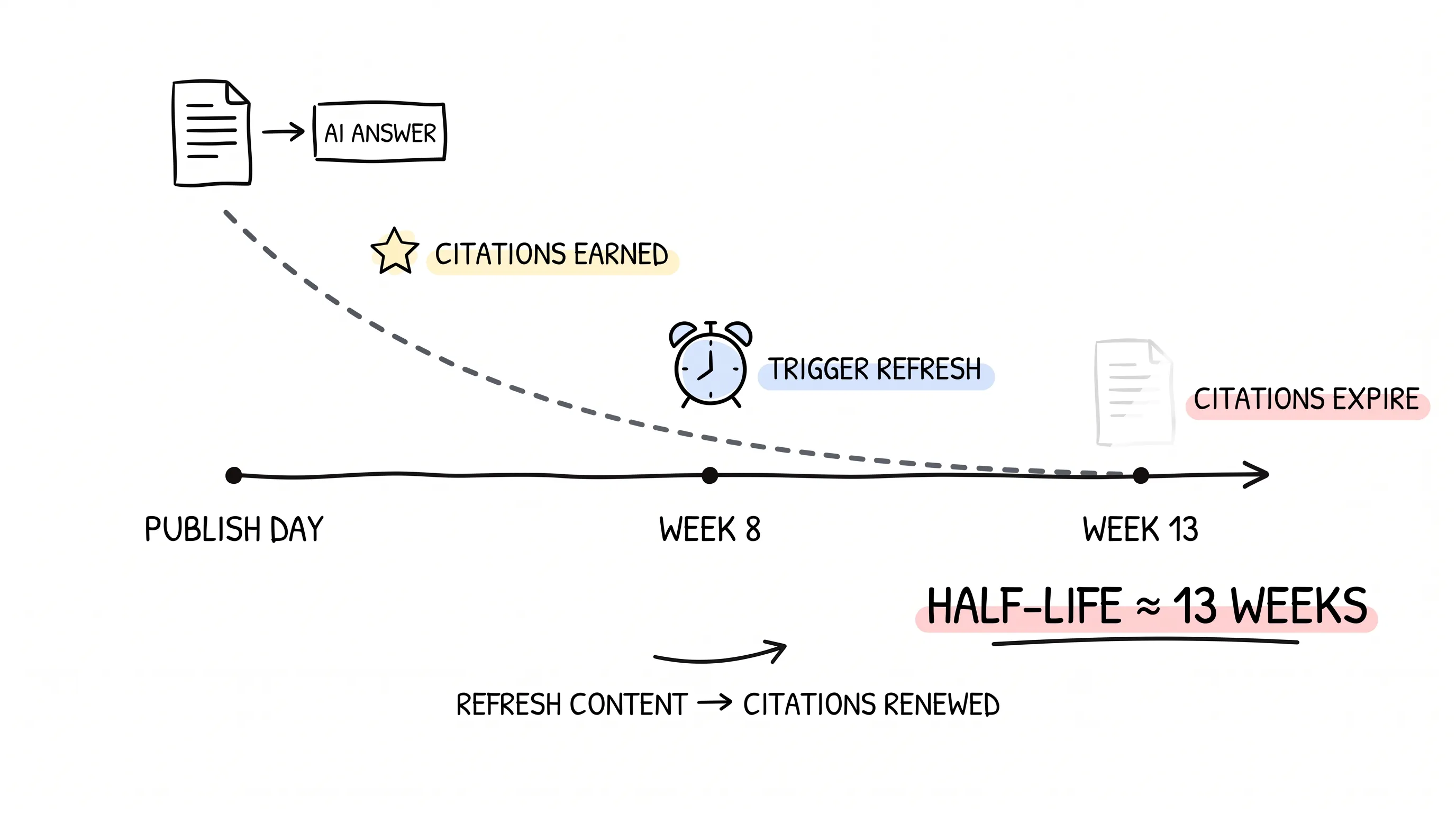
💬 Put a citation audit on the content calendar: once a month, manually ask the major LLMs and record the citation changes; when decay reaches week eight, trigger a refresh — don't wait for the traffic report to raise the alarm. When capacity is limited, split by platform: feed ChatGPT the evidence-type content, feed Perplexity the cases and fresh content.
🔗 Further reading: Read the full article
Reply's Five-Step Method: Trade Keyword Thinking for Prompt Thinking
Reply's GEO field guide compresses the writing process into five steps, opening by reframing the goal: from squeezing into rankings to becoming the answer itself — you only count when the generative engine cites you directly. Step one, set the target: start from the complete prompts users would actually ask, with a single question covering informational, comparative, and transactional intent, replacing keyword stuffing. Step two, build the structure: a clean H1-to-H3 hierarchy, with lists, tables, and summary boxes in place, and FAQs that directly match how users phrase their questions. Step three, change the writing style: give the answer first, then expand — marketing boilerplate deleted. Step four, stack trust signals: a clear last-updated date, citations of authoritative external research, and a clear author byline. Step five, lay the technical base: Article, FAQPage, and Author schema, plus performance optimization. The piece ends with a 7-item pre-publication checklist, running from prompt-style headlines all the way to validating citation performance on real AI platforms.
💬 You can wire this checklist into your publishing process this week at almost zero cost. Suggest carving out item seven as a weekly routine: one team member on rotation tests your target questions on the major AI platforms — screenshot and archive every citation, and in two weeks you'll have your own baseline.
🔗 Further reading: Read the full article
Storyblok's Five-Minute GEO: Do the Two Cheap Things First — LLMs.txt and One Brand Voice
Storyblok condenses GEO into a five-minute tactical checklist. On the structure side, feed structured data with JSON-LD, then add an LLMs.txt telling crawlers which content is worth reading. On the content side, raise the density of citable statistics, keep brand names and descriptions consistent across the web, and let multi-platform content corroborate one another so the engines cross-confirm you as a credible source. On the measurement side, swap the success metric from click-through rate to citation rate and share rate, and monitor the major LLMs' answers through manual sampling; the piece also notes that content structure directly affects how accurately an LLM can extract and restate it. The zero-click era stance is explicit: even when a brand can't get the click, it should still appear in the answers and recommendation lists. The barrier to this playbook is low — small and mid-size teams without dedicated SEO engineering can start from the list as written.
💬 Two items on the list deliver the best value for effort: add an LLMs.txt, and unify every brand description across the web into one set of messaging — an afternoon's work. For citation-rate monitoring, go manual before tooling up: half an hour of sampling each week is enough to ground the first three months of judgment.
🔗 Further reading: Read the full article
Profound's Ten-Step Framework: An LLM Cites Only 2 to 7 Domains per Answer, Budget Tiers Start at $75,000
Profound's ten-step GEO framework offers several rarely seen benchmarks. Visibility is scarcer than it used to be: an LLM cites only 2 to 7 domains on average per answer — far fewer than Google's ten blue links on page one — and visibility scores replace rankings as the primary metric. KPIs must hang off business outcomes: AI-attributed leads up 20% year over year, visibility inside the top three positions, and positive brand sentiment in answers no lower than 90%. The corpus-building method is worth learning: build prompt-funnel mapping from real user questions mined from sales calls and Reddit listening — far more accurate than brainstorming term lists off the top of your head. The technical baseline is site-wide HTTPS, mobile loading under 1.8 seconds, and monitoring the visibility gap in AI bot crawler traffic; on the operations side, track 20 to 30 prompts daily for each major topic and refresh the set every 90 days. The budget tiers are on the table too: mid-market at $75,000 to $150,000 a year, enterprise starting at $250,000.
💬 The budget tiers help you decide between buying a platform and building first. If the annual budget can't reach $75,000, skip the platform — get moving with manual sampling plus a spreadsheet. Don't copy visibility scores as your KPI; anchor them to leads and revenue, or GEO easily becomes the new vanity metric.
🔗 Further reading: Read the full article
Conductor Academy: Stop Arguing GEO versus SEO — Convergence Is the Direction
The Conductor Academy page defines GEO with restraint. It stresses that the two produce different artifacts — SEO's output is a list of links plus clicks, GEO's output is favorable presentation and citations inside a synthesized answer — while the underlying capabilities are the same set: clear content, factual accuracy, structure, and authority signals, converging as search goes AI-first, which the author sums up as "search everywhere optimization." The piece advises against getting tangled in terminology: GEO and AEO share roots, the strategies reinforce each other, and fighting over the name has no practical meaning. The implication for marketing organizations is just as direct: the two skill sets can share one content team, split by output — one aimed at rankings and clicks, the other at citations and the accuracy of restatements. The real warning comes down to a single sentence: content must survive AI restatement — facts written unclearly are easily misquoted or ignored outright by LLMs.
💬 For teams still arguing GEO versus SEO: set up a 30-day comparison experiment directly — optimize half of the same batch of pages against each standard, then look at changes in citations and rankings at month's end. The data will end the argument for you.
🔗 Further reading: Read the full article
🏷 Strategy & Organization
Microsoft's B2B MarTech Lead: Vendors Are Absorbing the Generic Capabilities — Build Only Where You're the Exception
MarTech has published a column by Talisha Padgett, Microsoft's lead for B2B MarTech platform and AI, elevating buy-versus-build into an operating-model question. The starting point for judgment is that vendors are converging: the agent products from Salesforce, Adobe, and Oracle are rapidly absorbing the horizontal, generic capabilities — audience segmentation, campaign summaries, content drafts, workflow orchestration — and rebuilding those holds no strategic value. The room for differentiation lies in the exceptions, the dependencies, and the institutional knowledge — say, an internal SEO verification process, template accessibility issues, or reviews of account overlap across multiple teams — the things that will never appear on a vendor roadmap. The author observes that plenty of organizations are keeping a crowd of useful-but-orphaned agents, stuck between pilot and production, and she lays out a three-gate promotion path: first prove business value, then validate reliability, and finally clear governance review — data ownership, security, and accountability each passing before the agent joins the formal operating architecture. She frames governance as growth strategy: organizations that answer early the questions of who owns the outcome, what data sources are used, and how it's measured will bring in new capabilities more smoothly. The most important meeting this quarter isn't the vendor-selection meeting — it's marketing, operations, IT, security, and finance sitting down to align on buy-vs-build criteria.
💬 Run an agent inventory this week: line up your in-flight self-built projects against the feature lists of these three vendors, retire the duplicates outright, and invest the saved maintenance hours into the workflows that truly grow out of your own data. Don't let IT shoulder the buy-vs-build alignment meeting alone — with finance in the room, budget decisions actually move.
🔗 Further reading: Read the full article
A Global CMO Coins "Trust Debt": AI Amplifies the Promise, Delivery Lags Half a Beat
Another global CMO uses a MarTech column to caution teams mass-producing AI content. AI lets a brand make promises faster and more widely — more content, more touchpoints — but trust accumulates only by delivering on those promises, slowly; the speed gap between the two is trust debt. She cites Adobe's 2026 digital trends research: 45% of customers stop engaging with a brand when they receive too many promotions, even when the content is relevant. Existing dashboards count only the cost of winning attention this time, not whether the next interaction becomes easier to win; to judge whether trust is accumulating, watch the intensity of follow-up after deals close, and whether brand searches and direct traffic rise in step with paid campaigns. The piece closes with four publishing disciplines: every piece of content must answer a real customer pain point; the material must come from the company's real experience — lost deals, complaints, hard-to-solve problems; every outbound message must have a named accountable owner; and before publishing, stress-test whether the organization could deliver on its promises in the hardest week.
💬 Of the four disciplines, accountability is the easiest to land first: attach a name to every piece of AI output, so someone is there to catch it when things go wrong. Make the pre-publication stress test a ten-minute stand-up — one person each from marketing, customer support, and supply chain — answering only one question: why should anyone trust you this week?
🔗 Further reading: Read the full article
🏷 Cases & Implementation
Use-Case Library Tour: Apollo Sends 5 Million AI Emails a Month, Meetings at 1.35×
GoGloby has compiled 20-plus production-grade AI marketing use cases, organized into five categories: generative content and campaign creation, sales and outreach automation, marketing analytics and optimization, brand and advertising automation, and social and community growth. The numbers from the named cases can be borrowed straight into internal proposals. Apollo uses Claude to send 5 million personalized emails a month, with meeting bookings at 1.35× the original, prospecting time cut 40%, and retention up 15%. Clay's Claygent runs 500,000 agent tasks a day, 30% of its customers use it every day, and the company grew 10× in two years. Epsilon used H2O.ai to auto-generate hundreds of thousands of predictive models, lifting direct-mail response rates by 3 to 5 percentage points and bringing a single customer $9 million in incremental revenue. Copy.ai used Claude to quadruple content output and cut costs 75%. The compilation also cites McKinsey's estimate that GenAI could unlock $463 billion in annual productivity for marketing, concluding that the biggest gains come from human-in-the-loop systems, not full automation.
💬 Before borrowing the playbook, match the scenario: teams with heavy outreach volumes will feel the Apollo template most — learn its email bucketing logic before talking volume. When reporting to your boss, use cases with auditable numbers like the $9 million one, and cite fewer of the compilation page's own service-promotion figures.
🔗 Further reading: Read the full article
Three APAC Cases: Size-Chart Costs Down 90%, Weekly New-Release Capacity Up 20×
Muse has reviewed how three APAC companies run AI content operations. A fashion brand turned templated batch visual production into infrastructure, lifting weekly new-release capacity 20× and cutting the size-chart workflow's cost by 90%. A tech hardware company used proportional grouping plus CSV data injection to speed up production of multi-market banners — 13 sizes times 9 languages — by 3×. A beauty brand replaced quarterly research with real-time sentiment, competitor tracking, and AI audience simulation, wiring market signals directly into creative briefs. The reusable patterns reduce to three: infrastructure first, research and creation joined into one loop, and brand governance embedded inside the production pipeline rather than relying on after-the-fact review. The piece's verdict line is solid: speed without intelligence is just faster noise.
💬 Don't start by learning from the flagship campaign — start from high-repetition tasks like size charts: results show in two weeks, and it's the easiest sell to finance. Multi-market teams should split variables following the CSV-injection architecture — once language pricing and creative structure are separated, the marginal cost of adding a market approaches zero.
🔗 Further reading: Read the full article
China AIGC Report: A RMB 25.7 Billion Market, 53.1% of Advertisers Already Using AI in Creative
The AI CMO research team has released its annual case report, dissecting 15 homegrown Chinese campaigns. See the size of the pond first: China's AIGC (AI-generated content) market reached RMB 25.7 billion in 2025, AIGC advertising and marketing applications are projected to hit RMB 150 billion by 2030, 53.1% of advertisers already use AIGC in creative production, and for nearly 20% of them AI covers more than half of the video production process. The cases are grouped by three paradigms — predictive, generative, and agentic. The generative representatives are Walmart's generative shelf and Estée Lauder's personalization workshop; the agentic representatives are Kuaishou's ROI-driven campaign buying and Douyin's AI digital-human livestreaming — agentic cases are already in live combat but depend heavily on platform data interfaces and compliance constraints. The report sorts failures into three modes: visually distorted uncanny valley, factually false hallucinated content, and value-misaligned offensive content — all of which need human review as the backstop.
💬 China's ecosystem is running agentic practice ahead of the world; media-buying teams should read the ROI logic in the Kuaishou cases closely. When adapting, turn the three failure modes into pre-launch checklist items — pass a visual gate, a factual gate, and a values gate before scaling.
🔗 Further reading: Read the full article
Cross-Border Reminder: A German Site with Passing Translation Still Sees 40% Higher Return Rates
Jasmine Directory's long read draws the line between translation and localization clearly. Technically, neural machine translation now handles 100-plus language pairs, with BLEU scores of 0.4-plus usable and 0.6-plus excellent — but automatic metrics and commercial outcomes have decoupled; the case in the piece is a German site whose translation passed on technical merit while return rates ran 40% higher. The localization checklist goes far beyond language: payment methods are the first gate — Germans default to bank transfer, the Nordics trust Klarna, India runs on UPI, Brazil wants boleto installments — plus customer-service expectations, color symbolism, and differences in how long decisions take. On architecture, it offers a hybrid scheme: cached translation for stable product content, real-time translation for comment sections and other UGC, with a brand glossary as the backstop for consistency. On attribution, the advice is to skip last-click and use marketing mix modeling for market-level channel evaluation.
💬 If you do cross-border, audit payment coverage first — it sits at the very front of the conversion funnel and is the cheapest fix available. Don't accept translations by BLEU score; set hard thresholds for return rates and conversion rates by language, and send anything over the line back for a rewrite.
🔗 Further reading: Read the full article
💡 Today's Big Picture
18 items laid side by side, and the throughline is capability and the ledger pulling out of sync. BCG counts 96% of claims set against 42% assist-only usage; Jasper counts 91% adoption set against a 41% ROI proof rate; IAB counts 12.3% ad growth set against citation measurement that can't produce consistent data. Three gaps point at the same thing: money is moving far faster than the ability to turn spending into verifiable results.
The second signal is that GEO has gone from concept to construction schedule. Five hands-on guides published within a single day, plus the 76% priority shift inside IAB's numbers — AI search optimization is now on the calendar, and the dividend belongs to whoever builds the measurement baseline first. The money line is tightening too: GenAI application-layer spending jumped from $11.5 billion to $37 billion in a year, and marketing has won the authority to call its own shots; authority maps to accountability, and BCG's warning belongs in next week's meeting minutes — produce no defensible results within one or two budget cycles, and the decision authority gets taken back.
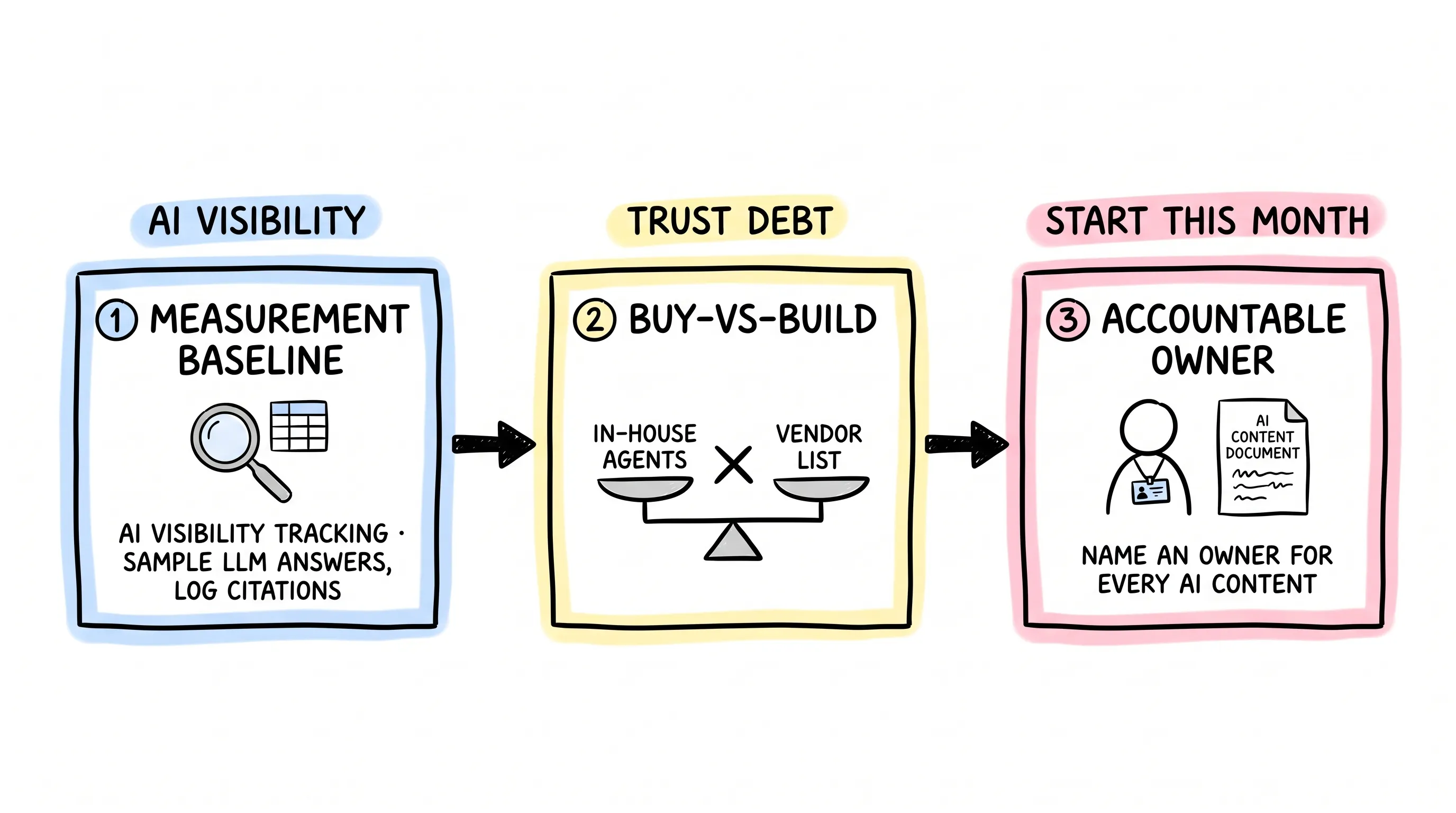
The action ordering is clear as well. First build the measurement baseline for AI visibility and citations — something you can start this month; then run one buy-vs-build inventory of agents and retire the duplicated builds; finally, attach an accountable name to every piece of AI content and keep trust debt contained before compounding takes off. The antidote to the transformation illusion isn't louder noise — it's a finer ledger.
Continue reading
Related articles

AI Marketing Daily · 2026-10-09
AI marketing daily for 2026-10-09 covering 11 items: brand measurement moving from survey panels to search, social, e-commerce, and AI prompt signals; GEO and share of model playbooks; safety guardrails for agentic ad buying; and tool roundups for ad platforms, cross-border tools, and social media uses.

AI Marketing Daily · 2026-10-08
AI Marketing Daily for 2026-10-08 curates 20 items across AI search visibility (GEO), advertising, platform selection, cross-border e-commerce, and ROI measurement. The headline argues that strategic marketing decisions should stay with humans while AI assists execution.

AI Marketing Daily · 2026-10-07
Today's throughline is answer engine optimization (AEO — getting your brand quoted in AI answer engines).