
AI Marketing Daily · 2026-09-11
AI Marketing Daily for 2026-09-11 rounds up five stories on B2B reference assets, in-house performance proof, AI influencer marketing, AI search tool selection, and GEO basics. The common thread is proving content value as AI drives production costs toward zero.
Today's five stories point at the same thing: once AI pushes the cost of content production close to zero, competition in marketing shifts from "who can produce more" to "who can prove value, get reused, and get cited by AI." The headline deep-dive covers B2B content's pivot toward "reference assets" — the single most worth-your-time piece today. Then come, in order, the performance-proof crisis facing in-house teams, a data panorama of AI influencer marketing, a framework for choosing AI search tools, and a beginner's methodology for GEO. Among the five you'll find data, frameworks, and moves you can copy outright; the full read takes about fifteen minutes.
🎯 Today's Headline: The New Answer for B2B Content: Stop Treating Publishing as the Finish Line — Build "Reference Assets" Buyers Keep Coming Back To
1. What happened
On September 10, MarTech ran a long-form piece by Brianna Miller arguing a point AI is actively rewriting: the bottleneck in B2B content marketing has moved from capacity to judgment. Teams can now produce content fast and in volume, so the truly scarce question becomes: which assets deserve an investment of time, expertise, and ongoing maintenance?
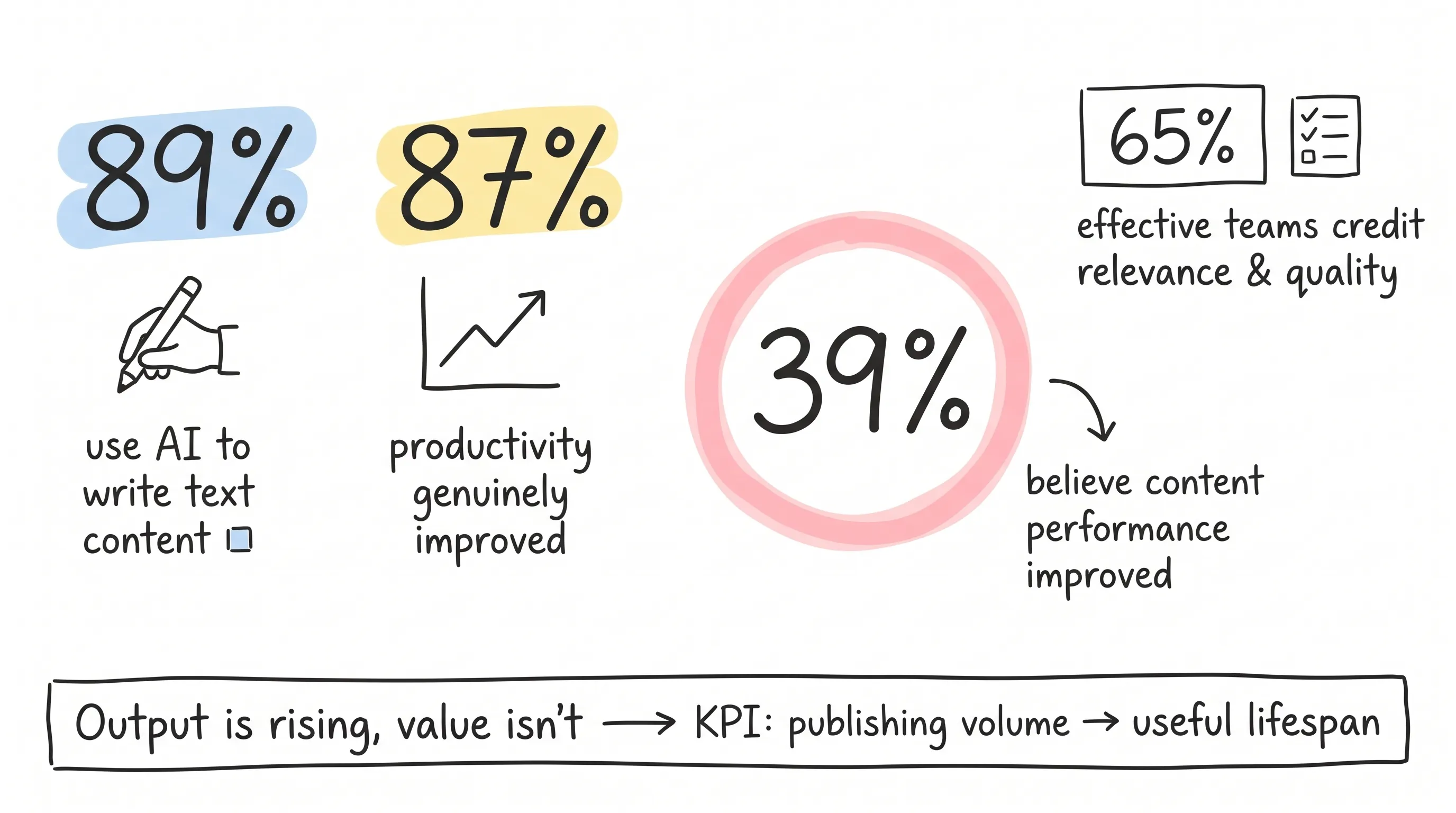
The article grounds this "productivity paradox" in data from CMI's 2026 B2B research: 89% of marketers using AI rely on it to write text content, 87% say productivity has genuinely improved — but only 39% believe content performance has improved as a result. Output is rising; value isn't keeping pace. The same study contains an easily overlooked number: among marketers who rate their content efforts as "effective," 65% attribute success to relevance and quality, not volume.
The author diagnoses the root cause as the "publish-and-done mindset": find a topic, create the content, publish, promote, glance at early metrics, move on. That rhythm works fine for time-sensitive articles and campaign assets; the problem is that every resource gets treated as a finished product whose life ends at publication. A full calendar gives the team a sense of security, but a resource that's supposed to help buyers solve problems again and again may be abandoned the day after it goes live.
The proposed alternative is called "reference assets": calculators, benchmarking tools, templates, playbooks, assessment frameworks. The test isn't format — it's whether people have a reason to come back to it, share it, and use it to make decisions. A 50-page white paper might be read once and discarded; a simple calculator could carry buyers through the entire purchasing process.
2. Why it matters
This framework answers the most practical resource-allocation question in content marketing today. When production approaches zero cost and 56% of buyers already feel drowned by information overload (Demand Gen Report), piling on more information just adds noise. What's genuinely scarce is the thing that "helps people move a decision forward."
The article pulls together a set of buyer-side data showing how structural this is: 72% of buyers share content with their team members; first contact with sales happens about 61% of the way through the buying journey (6sense), and vendors buyers already prefer before ever talking to sales win roughly 80% of the time; Forrester's 2026 research says an average B2B purchase involves 13 internal stakeholders and 9 external participants; and Gartner finds that 74% of buying teams experience unhealthy internal disagreement during the decision process.
In other words, content's real job isn't "providing information" — it's helping whoever finds it explain the problem to finance, IT, and procurement, defend a recommendation, and build consensus. That's a rewrite of the content team's topic-selection standard: stop asking "have we covered this topic?" and start asking "who can this resource help accomplish what?"
3. What it means for marketers
The article breaks down four validated reference-asset patterns, each of which you can slot your own team into. The first is solving recurring problems: Procore's asphalt calculator and daily construction report templates aren't sophisticated, but contractors need them on every single project. The second is turning proprietary knowledge into decision tools: Carta used data from roughly 20,000 US startup funding rounds to build a round-benchmarking tool, where a founder picks stage, industry, and geography and gets an answer to "what does a company like mine look like right now" — value AI can't replicate in five minutes. The third is helping people put knowledge into practice: Atlassian's Team Playbook turns recurring scenarios like retrospectives, project kickoffs, and role clarification into Plays you can open and run directly in a meeting. The fourth is guiding buyers through high-stakes decisions: Trilliant Health's healthcare strategy Field Guide and SimilarityIndex let hospital executives use data to answer "who are our true peers, and how do we compare?"
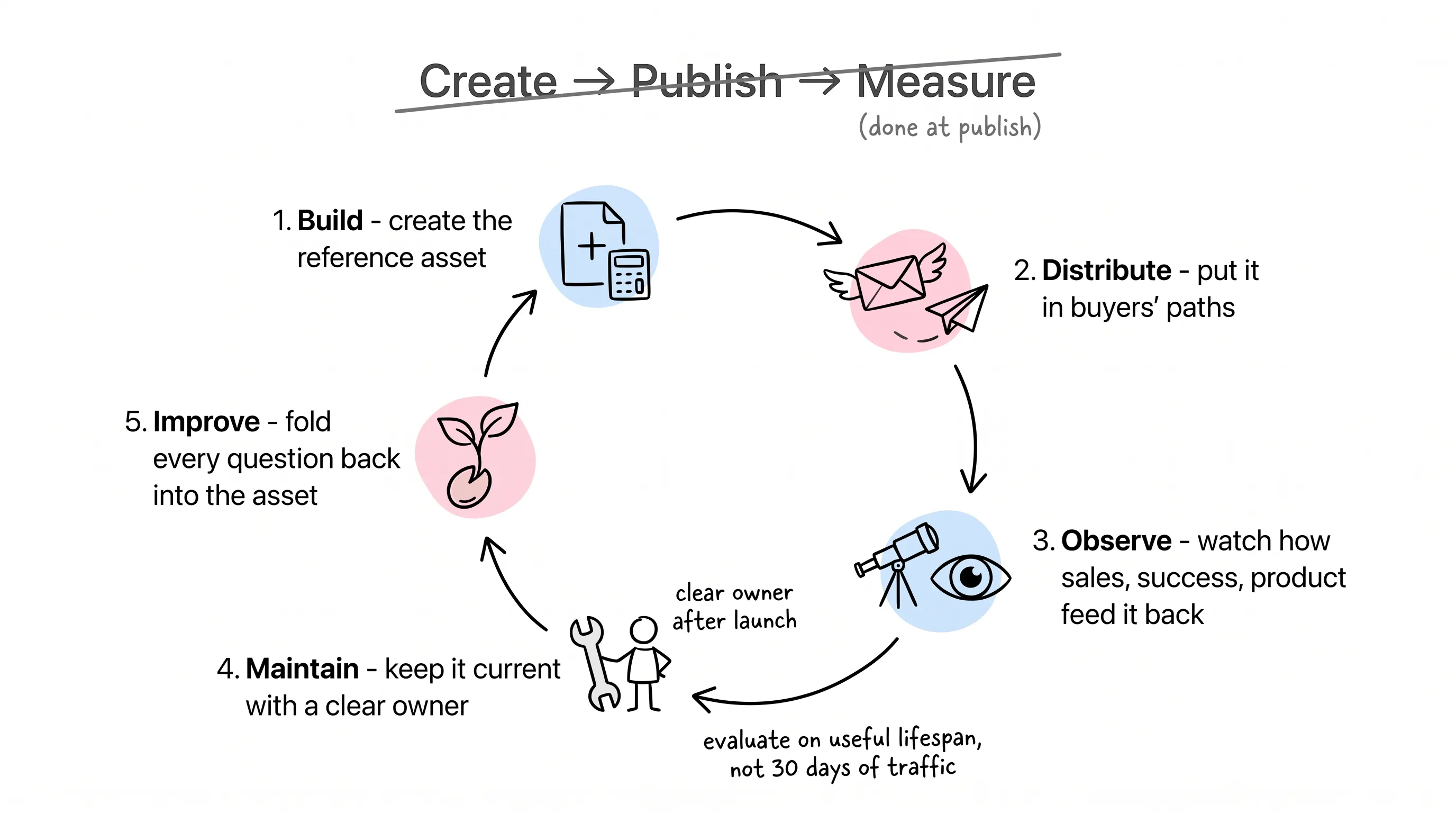
The impact on content teams lies in how you measure and operate. The article argues for swapping "Create, Publish, Measure" for "Build, Distribute, Observe, Maintain, Improve": after launch there must be a clear owner, and questions sales hears that the resource doesn't answer, unexpected usage patterns customer success spots, new technical positioning from product — all of it should flow back into the asset. The evaluation cycle has to change too: a resource designed to be used for a year should be evaluated on a one-year horizon, not on 30 days of post-launch traffic.
4. How to use it
Implementation comes in three steps. Step one: audit what you already have. Which articles still draw return visits months after publication, get repeatedly forwarded by sales to customers, and keep generating backlinks and follow-up questions? The article's example is concrete: if a piece called "10 Questions to Ask Before Choosing a CRM" performs well and sales loves using it, the right move isn't writing "12 Questions" — it's upgrading it into a customizable vendor scorecard with role-specific question sets for finance, IT, and procurement, structured as a weighted evaluation framework or an internal project-approval template. Your next reference asset probably already exists.
Step two: screen new investments against four criteria. Does the need recur? How high are the decision stakes? Can the organization contribute unique value AI can't replicate in five minutes — proprietary data, implementation experience, methodology, customer insight all count? And does the team have the capacity to maintain it long term? Of the four, maintenance is the most underestimated; if you can't sustain updates, don't start.
Step three: small before big. Not every topic needs a calculator. This month, pick one question buyers keep asking and sales keeps answering, upgrade it from an article into a template or scorecard, run it for a quarter, and only then decide whether to double down.
5. My take
The most valuable thing in this article isn't the term "reference assets" — it's that it moves the content team's KPI from "publishing volume" to "useful lifespan." For teams working on 2026–2027 content plans, it's a playbook you can lift directly: cut next year's topic list by a third and redirect the saved energy into two or three assets you can maintain for a couple of years. AI lets everyone produce, so "worth existing" itself becomes the scarce commodity. Whoever completes this shift first gets content that lives inside buyers' decision processes instead of evaporating from the feed in a day.
🔗 Further reading: Read the full article
🏷 Industry Watch: Marketing's Third Wave of In-Housing Is Here — This Time the Board Wants "Proof"
Writing in MarTech, Scott Gillum warns that marketing is entering a third wave of in-housing, and the lessons of the first two both point to the same phrase: hidden costs. The first wave came with the 2008–2009 financial crisis, when companies like Intel pulled media services in-house to protect budgets; the second came with the mid-2010s digital wave, when controversies over data and programmatic advertising transparency heated up and the share of ANA members with an in-house agency climbed from 42% to 78% by 2018.
Both waves paid tuition. Creatives lured in with high salaries got bored doing internal work — the agency variety of serving a startup one week and a major brand rebrand the next is something the inside of a company can't offer — and many flowed back out within a year. In-house teams lacked a seat at the executive table and were reduced to order-taking execution departments. And there was cost: software licenses and tech stacks an agency amortized across dozens of clients now had to be shouldered by one company alone.
AI is handing CMOs a third reason to in-house: generative tools let content, ABM programs, and creative work all be done internally, while agentic AI absorbs process-driven tasks. But this time's exam question is different — "prove performance." Put three sets of numbers side by side and it gets ugly fast. In Duke's 2026 CMO Survey, marketing leaders were asked to grade their own martech activities on a 7-point scale, and not one item scored above 5 — including "generating ROI from marketing technology." Comviva's 2026 global CMO study found 86% of marketing leaders are being asked by their boards to justify AI spending, but only 16% feel confident defending it with clear business evidence. Most brutal of all is MIT NANDA's "GenAI Divide" report: 95% of enterprises see no measurable return from GenAI investments — and sales and marketing, which absorbed the largest share of that budget, have the weakest evidence to show for it, while operations and finance, with less money, are seeing better returns from their pilots.
The article's conclusion: this isn't 2009's talent problem, nor 2016's vendor-trust problem — it's a proof problem. CMOs once asked agencies "where's your value?" Now the board is asking CMOs the same question.
Worth unpacking are the three concrete lessons the first two waves left behind; they still apply to in-housing decisions today. Lesson one: creative culture doesn't transfer. An agency's value goes beyond execution — cross-industry projects fuel creative stimulation, and B2B companies especially struggle to replicate that, so highly paid hires don't stay and capability-building resets to zero. Lesson two: organizational status determines work quality. Without an executive seat, in-house teams get handed repetitive production tasks, and over time the best people leave first — a negative spiral. Lesson three: true total cost is systematically underestimated. A CMO looks at agency hourly rates and thinks millions in savings, while ignoring the software licenses, data tools, training, and management overhead an internal department must carry alone — costs an agency spread across its entire client portfolio. AI hasn't changed that arithmetic; it's only raised the stakes: the faster the efficiency promise is cashed in, the sooner the performance-proof gap gets exposed. The author's line is worth remembering: move capability in-house without solving culture, status, and true total cost, and you've simply relocated the same failure to a new address.
💬 Practitioner take: One thing you can do this week — translate your AI efficiency gains into a chain of result evidence. Stop reporting "how much efficiency improved, how many hours saved"; that's the efficiency story, and the board has stopped buying it. Pick two or three AI-assisted campaigns and go one step further on attribution: where did the saved time go, and did the output have a measurable impact on pipeline or conversion? Even a small sample counts as hard evidence. At the same time, watch for one trap: if you're pulling work in-house, calculate the full cost of the tech stack before you sign — don't relive the first two waves' accounting. Set yourself a deadline: have a one-page "AI spend mapped to results" evidence table ready before the quarterly board meeting. It may be the most career-saving slide you prepare all year.
🔗 Further reading: Read the full article
🏷 Industry Data: AI Is Reshaping Influencer Marketing: $4.8 Billion a Year Eaten by Fake Followers — AI Verification Is Now Table Stakes
5WPR has systematically mapped how AI is reshaping influencer marketing, a business now worth over $40 billion a year. First, the core tension: the industry is projected to grow from $32.55 billion in 2025 to over $40 billion in 2026, yet fraud costs roughly $4.8 billion annually — 12% to 15% of total spend; 37% to 42% of Instagram influencers have fake followers making up at least a third of their audience, and among mid-tier influencers (100K–500K followers) the fake-follower rate runs as high as about 48%. With that big a gap between budget and real reach, AI has gone from experiment to operational necessity.
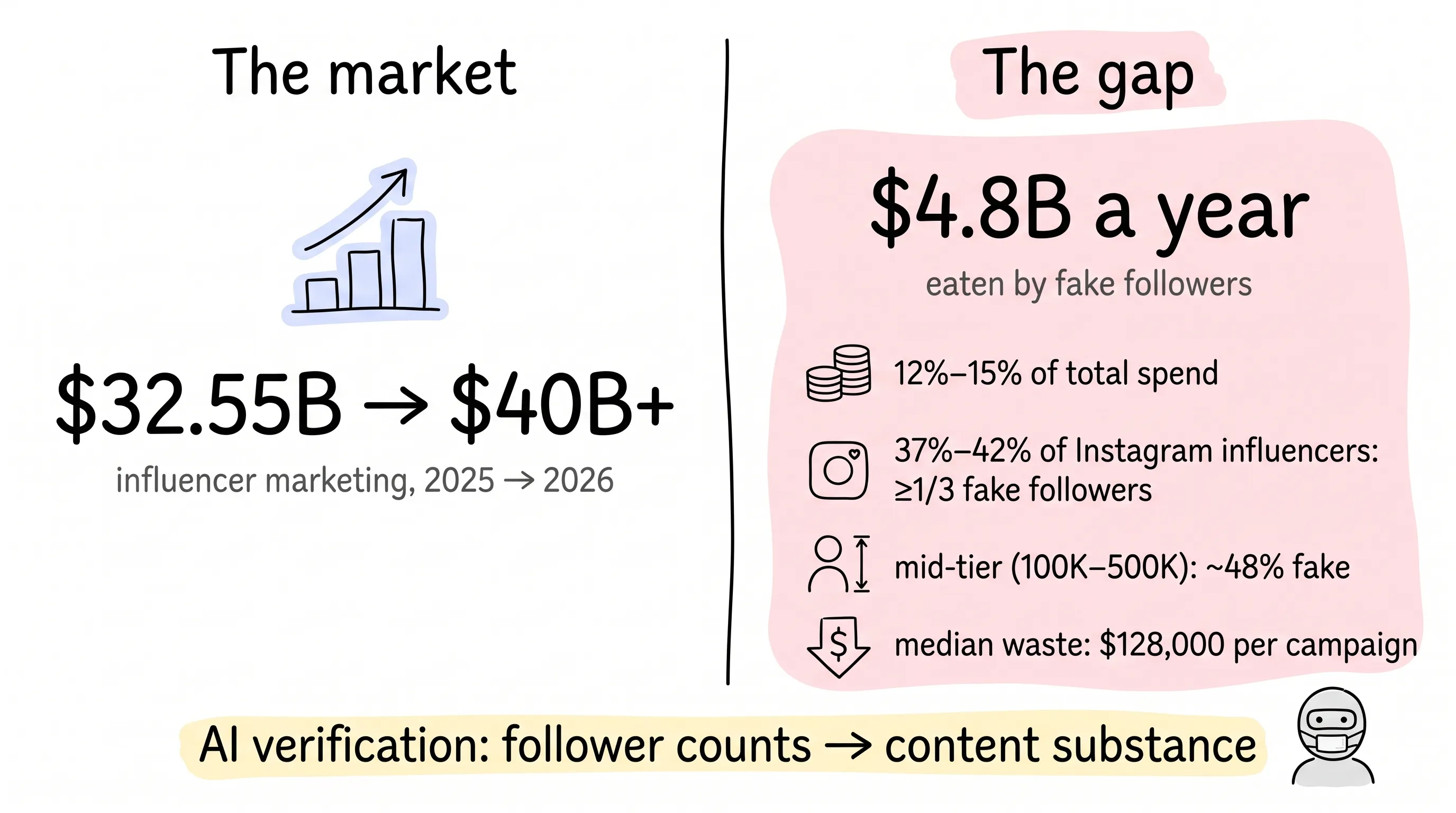
The first front is authenticity. WFA research shows 81% of marketers encountered influencer fraud in the past 12 months, with median waste per campaign at $128,000. AI verification shifts selection criteria from follower counts to content substance: NLP analyzes language patterns and topic consistency; video analytics flags engagement anomalies — likes suddenly spiking after a long dormant stretch, or comment sections filled with bot-like repetitive phrasing.
The second front is predictive analytics. The industry benchmark ROI is $5.78 back per $1 spent, with top operators reaching $11–$18; 63% of marketers have already put AI into their workflows; and 73% of brands prefer micro-influencers for conversion-focused campaigns, where engagement rates run about 3x those of mega-influencers. Unilever Dove's AI-driven campaign delivered 3.5 billion impressions with 52% of buyers being new customers — a benchmark worth studying. The real value of predictive analytics is pre-flight: using historical engagement data, audience overlap, and conversion trajectories to estimate what a candidate influencer can deliver, turning selection from résumé-checking into model-predicting — and squeezing most of the water out of a campaign before it ever goes live.
The third front is virtual humans. Gartner estimates AI virtual influencers can cost roughly 30% less; Lil Miquela has already landed deals with Calvin Klein, Prada, and BMW. But in trust-sensitive categories — beauty, health, food, finance — consumer trust in virtual humans is significantly lower. Hence 2026's dominant model is hybrid: AI handles discovery, verification, and creative, while humans front the campaign.
The compliance floor has already been drawn. The FTC's August 2024 final rule bans fake reviews and purchased social media influence; AI involvement requires clear disclosure; Meta, TikTok, and YouTube all have platform-level AI labeling requirements, and violations can trigger liability for both brands and agencies. That means disclosure clauses in procurement contracts are no longer legal's elective course — they're the brand's own direct risk exposure.
The article also flags a shift in selection logic worth recording on its own: AI authenticity verification moves the standard from vanity metrics to content substance. An account with an impressive follower count — but erratic language patterns and topic consistency, an engagement curve showing "dormant for months, then a sudden like spike," and comment sections full of bot-style repetitive phrasing — should not make the list, no matter how big. Conversely, a niche account with just tens of thousands of followers, if its audience profile overlaps strongly with the brand and its comments carry real discussion, may convert far better than a mega-account.
On the tool stack, the piece closes with CreatorIQ, Tagger, Modash, TikTok Symphony, and other mainstream options, covering data management, discovery and screening, and content production. The rollout advice is refreshingly practical: start with fraud detection and authenticity verification (avoiding one fake influencer often pays for a full year of tools), then predictive analytics, then AI-assisted content and real-time optimization — with human review kept in the loop throughout.
💬 Practitioner take: If you're still choosing KOLs by follower count and rate cards this year, stop right there. This week, pull your current roster and run a fake-follower audit — macro-influencers first, since that tier has the highest fake rates. Rebalance your budget: shift some of the money going to one mega-influencer over to three micro-influencers as a controlled test; engagement cost will most likely look better. Add two clauses to your contract template: a minimum real-follower-percentage clause and an AI-content disclosure obligation clause — that's compliance and loss prevention in one. On tooling, don't get greedy: solve "picking the right people" first. The $128,000 median waste you avoid will pay for several years of detection tools.
🔗 Further reading: Read the full article
🏷 Marketing Tools: How to Choose AI Search Tools? First, Get the Three Categories Straight
HubSpot's blog updated its guide to AI search tools on September 10, and its biggest contribution is splitting the lumped-together category of "AI search tools" into three types. Type one: answer engines — ChatGPT, Perplexity, Gemini — where users ask questions in natural language and get synthesized answers; buyers use them for research. Type two: on-site AI search — Algolia, Coveo, Elasticsearch — embedded in your own website and knowledge base, managing conversion and experience. Type three: AEO optimization tools, aimed at marketers, that track how your brand shows up in AI answers and recommend improvements, such as HubSpot AEO and Semrush. The three serve different audiences and goals; picking while conflating them means picking the wrong tool.
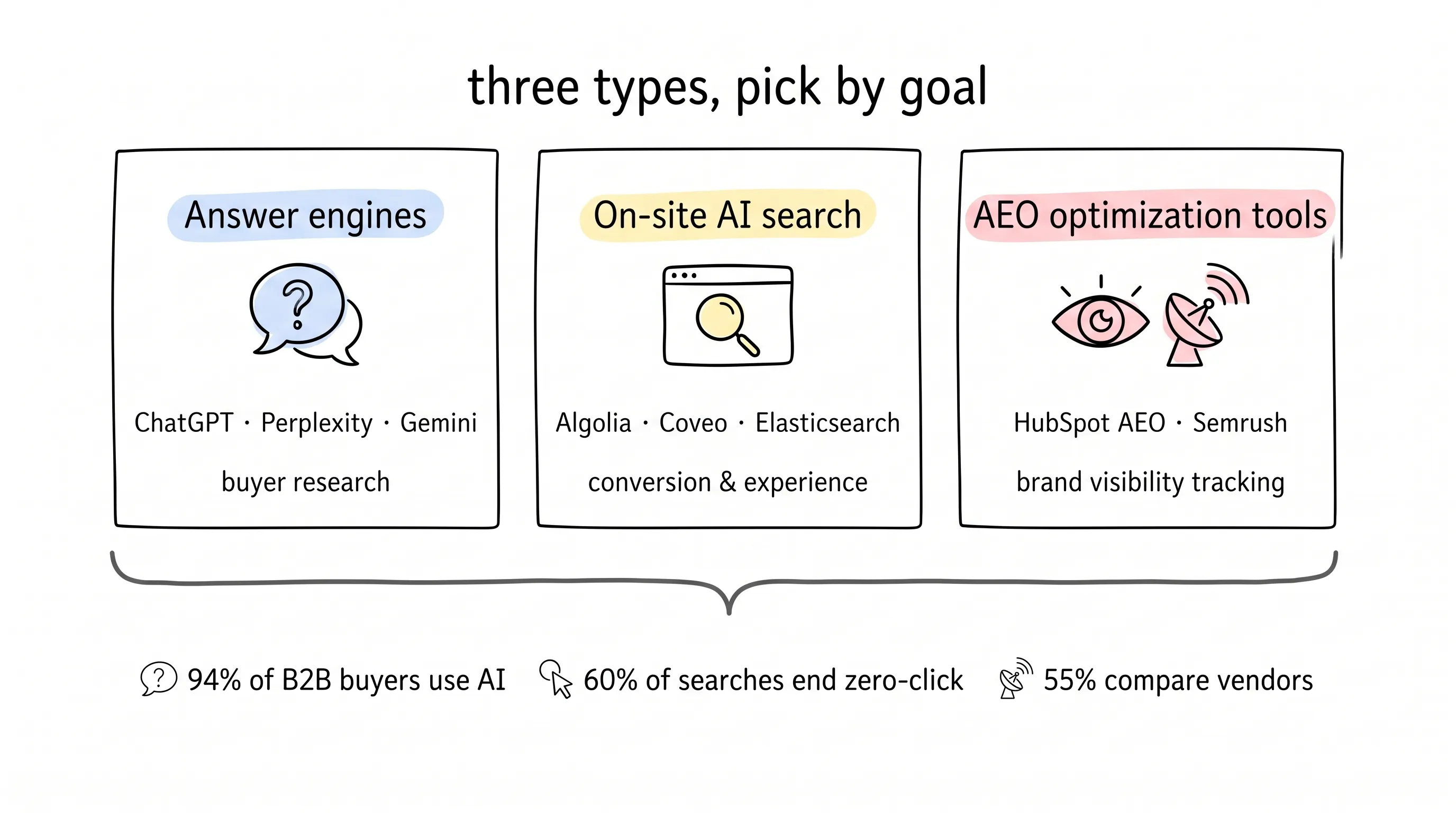
Buyer-behavior data gives the choice urgency. Forrester found 94% of B2B buyers use AI during the purchasing process — 55% use it to compare vendors, 54% to research products, 47% to build internal business cases — all before ever contacting sales; answer engines have now surpassed vendor websites, salespeople, and product experts as the number-one source for vendor research. The consumer side is migrating too: McKinsey says about half of consumers use AI search for purchase decisions, and Adobe data shows 56% of US consumers used generative AI during the 2025 holiday season, up 45% year over year. Bain's number is the harshest: 60% of searches now end with zero clicks, with AI summaries the main cause.
The use-case recommendations come with reference prices. For brand visibility tracking: HubSpot AEO, $50/month, whose distinctive feature is using CRM data to predict what real buyers will actually type; its beta customers who prioritized answer-engine optimization saw AI referral traffic rise 20% — while their overall organic traffic fell 27% over the same period. For daily research: ChatGPT, used by 88% of marketers, processing over 2.5 billion prompts a day; Bain's data says 68% of LLM users rely on it for research and synthesis, 42% for shopping advice. For trustworthy answers with citations: Perplexity, which processed 780 million queries in May 2025 alone, growing over 20% month over month, especially popular with B2B buyers doing deep vendor evaluation — and in Columbia Journalism Review's citation-accuracy test of eight tools it had the lowest error rate (37%, though note no tool's error rate was low). On-site and enterprise search belong to Algolia or Coveo, a fit for SaaS, e-commerce, and large enterprises with vast content libraries.
The article also flags an easily overlooked supporting issue: the engine decides the answer. Marketers can't control what it tells consumers, but they can influence it by consistently publishing well-sourced, credible content. When evaluating any AEO tool, the article offers six dimensions: citation transparency, accuracy, privacy compliance, platform-level rather than aggregated reporting granularity, integrations, and actionability of recommendations. Of the six, "platform-level reporting" is the most practical: aggregated numbers can't show you the difference between your visibility on ChatGPT versus Perplexity — and buyer profiles and citation habits differ across those two channels.
💬 Practitioner take: Three things you can do this week. First, run your own brand through a free diagnostic (something like HubSpot's AI Search Grader) to see how you show up on ChatGPT, Perplexity, and Gemini — get a baseline before committing budget. Second, don't rush to buy an AEO platform; first confirm you haven't fallen behind on on-site search. That's doubly true for e-commerce and SaaS: if visitors can't find it on your site, they'll go ask an answer engine — effectively handing that traffic to competitors for free. Third, treat numbers like "37% citation error rate" with care: answer engines can misquote you, so spot-check regularly how AI describes your products and pricing — a wrong description hurts more than not showing up at all. One more caveat: this piece embeds recommendations for HubSpot's own products throughout, so discount its self-assessments accordingly — but the three-type taxonomy and the buyer data are solid. For tool budget, start with $50-a-month visibility tracking; don't jump straight to enterprise-grade.
🔗 Further reading: Read the full article
🏷 Marketing Tools: GEO 101: Get Your Content Cited by AI, Not Just Ranked on the SERP
This GEO (generative engine optimization) primer from AMA's Baltimore chapter puts the goal shift plainly: the contest used to be SERP rankings; now it's "getting your content included in AI-generated answers themselves" — whether that's Google AI Overviews, Bing AI results, or ChatGPT's responses. To get there, content must satisfy three conditions simultaneously: discoverable by AI crawlers, citable, and structurally credible.
The new reality is that zero-click becomes the norm. An AI summary may cite only 3 to 5 sources; your content can drive the answer while earning no visits, conversions, or even attribution. If you're not among the cited few, you're invisible on that channel. The article puts it bluntly: search has moved out of the "keywords plus rankings" era — what's contested now is relevance, trust, and whether AI leans on you as a source when generating answers.
So the KPIs need rebuilding too: expanding from CTR and rankings to three new metric families — AI citation visibility, brand mentions in zero-click environments, and AI attribution summaries. One useful judgment in the piece: even if clicks decline, rising impressions still signal that content is being used — just differently. For teams accustomed to reporting on sessions and conversion rates, this is a conversation to align with leadership on early; otherwise, when the numbers dip, you'll have no defense ready.
The hands-on section gives five executable moves. One: feed E-E-A-T properly — author bios and credentials, citations of credible sources, and schema structured data to reinforce authority (WordPress sites can automate this with Yoast or Rank Math; non-WordPress sites can use Google's Structured Data Markup Helper). Two: write to intent, not keyword-stuffing — answer the questions your audience genuinely asks, in clear conversational language; on the tool side, Frase uses NLP to identify search intent and generate question-style headlines. Three: earn high-quality backlinks with original, data-driven content — research reports and case studies are natural link magnets; AI and search engines alike trust "content that others also trust." Four: format for scannability — hierarchical headings mapped to common questions, generous use of lists and tables so AI can parse easily; SurferSEO can suggest structure based on top-performing pages. Five: track mentions, not just clicks — Google Alerts, Semrush, and Brand24 all monitor brand citations in AI summaries; treat brand visibility as a GEO KPI while also watching how brand strength trends over time.
The article's closing line works as an elevator pitch to leadership: GEO doesn't replace SEO — it's SEO's next layer. Think like a search engine, write like a human, structure like a machine.
💬 Practitioner take: This piece is enough material to run your team's GEO kickoff meeting — just don't stop at the meeting. Three things this week: add author credentials and schema markup to your five best-performing pages (the cheapest step); rewrite those five pieces' titles and openings as the questions users actually ask, so AI engines can match them more easily; set up Google Alerts for your brand terms plus a free tier of an AI-mention tracking tool — you can't optimize what you don't monitor. Then run a monthly "AI check": take 20 questions buyers would ask and pose them to the major answer engines, recording who gets cited and where you rank. That data is more persuasive than any report. Note that this piece has no exclusive data — its methodology is all consensus, so execution depth is where you'll differentiate.
🔗 Further reading: Read the full article
💡 The Day in Brief
Read the five stories together and there's only one through-line: once the marginal cost of content production hits zero, the standard for judging value moves comprehensively upstream.
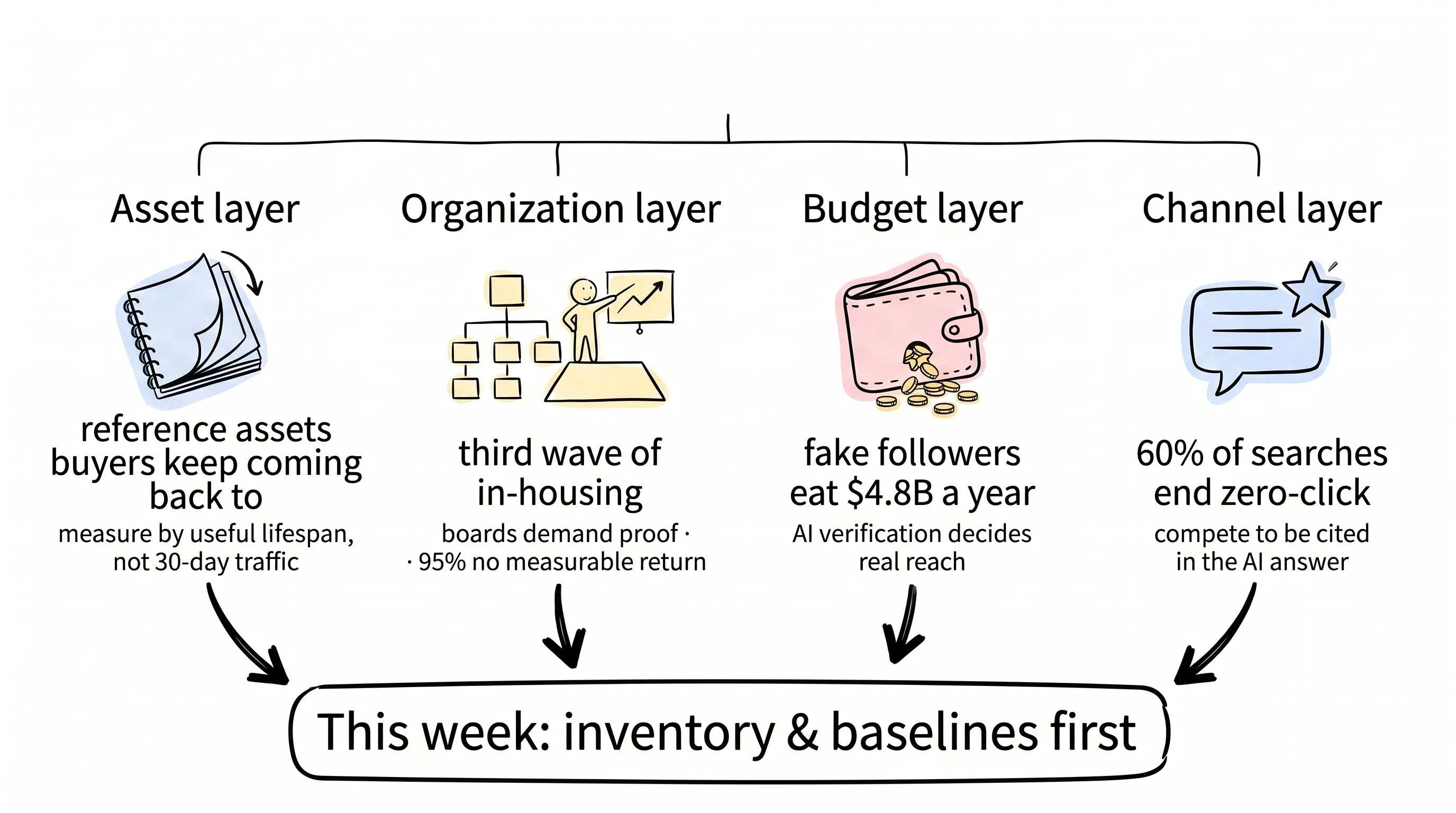
The headline's "reference assets" is the asset layer: stop producing more content, build things buyers keep coming back to, and measure by useful lifespan rather than 30 days post-launch. The in-housing story is the organization layer: AI makes everything doable internally, but 95% of GenAI investment shows no measurable return and boards have started demanding evidence — teams that can't produce a chain of result evidence will get called to account. The influencer-marketing story is the budget layer: $4.8 billion a year eaten by fake followers, with AI verification and predictive analytics deciding whether your money buys real reach or pretty vanity metrics. The AI search tools and GEO stories are the channel layer: 60% of searches end with zero clicks, and the main arena for being discovered is moving from the search results page into the AI answer itself — if you're not among the three to five cited sources, you're invisible.
Put the four layers together and the action is consistent: this week, run inventory and baselines first (which existing content has asset potential, how visible you are in AI answer engines, the real-follower rate of your current influencer roster, the results evidence behind your AI marketing spend), then pick one or two high-value links in the chain for deep investment. A side note: of today's five stories, three come from MarTech, one from HubSpot, one from a PR firm — evidence that "how AI marketing proves itself" has become the dominant theme of the industry's content supply. Nearly every guide you read carries its author's own angle, so cross-checking is basic hygiene. AI lets everyone produce, so "worth existing" and "provable" become the new scarcities. Every item today is teaching you how to bet your resources on those two phrases.
Continue reading
Related articles

AI Marketing Daily · 2026-10-09
AI marketing daily for 2026-10-09 covering 11 items: brand measurement moving from survey panels to search, social, e-commerce, and AI prompt signals; GEO and share of model playbooks; safety guardrails for agentic ad buying; and tool roundups for ad platforms, cross-border tools, and social media uses.

AI Marketing Daily · 2026-10-08
AI Marketing Daily for 2026-10-08 curates 20 items across AI search visibility (GEO), advertising, platform selection, cross-border e-commerce, and ROI measurement. The headline argues that strategic marketing decisions should stay with humans while AI assists execution.

AI Marketing Daily · 2026-10-07
Today's throughline is answer engine optimization (AEO — getting your brand quoted in AI answer engines).