
AI Marketing Daily · 2026-09-09
AI Marketing Daily for 2026-09-09: Similarweb's GEO 2026 guide on zero-click and AI citations, GEO agency and tool pricing, Knak's survey on AI production bottlenecks, and ChatGPT ads passing $1B annualized revenue.
Today, 8 of the 20 items point to the same story: AI answers are taking over the top of the customer-acquisition funnel. The headline is Similarweb's complete GEO guide — zero-click, the AI citation mechanism, and eight tactics, all explained in one place. Alongside it come two pricing references: seven GEO agencies and a ten-tool price sheet. The implementation side has its own meaty material: a Knak survey puncturing the illusion that AI saves time, and ChatGPT's ad business crossing $1 billion in annualized revenue. Read this one, and the last 24 hours of AI marketing are in your hands.
🎯 Today's Top Story
Similarweb releases its GEO 2026 complete guide: after zero-click hits 69%, being cited by AI becomes the new conversion event
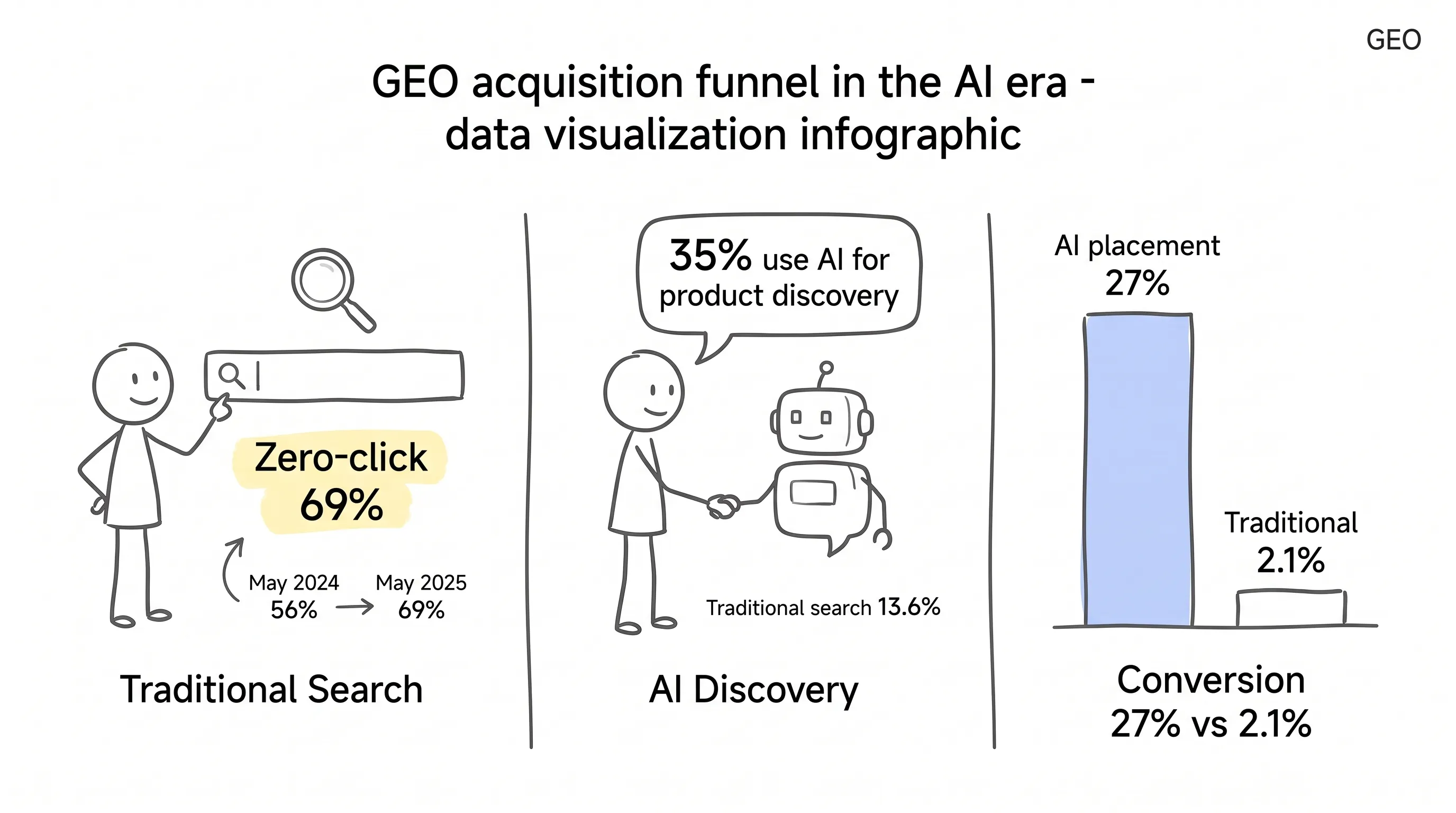
Similarweb's AI search team has published the GEO (Generative Engine Optimization) 2026 complete guide, authored by Limor Barenholtz — a 24-minute read that gathers a year's worth of scattered AI search data into a single methodology. Two numbers are worth memorizing first. Zero-click share on US news-related Google searches climbed from 56% in May 2024 to 69% in May 2025, and the 13-point gain lands precisely in the year after AI Overviews rolled out at full scale. The other comes from Similarweb's consumer funnel research: 35% of US consumers now use AI during product discovery, while only 13.6% still use traditional search. The shortlist gets set by AI before you even open a search box. The guide adds one more detail: ChatGPT users type about 60 words per query on average, versus just 3.4 words on Google Search. People who use AI arrive with full context — and are more willing to act on the answer.
The guide's credibility comes from mechanism breakdown plus experimental data. It starts by explaining the two-stage process of RAG (retrieval-augmented generation): candidate documents are retrieved from an index, then a large language model synthesizes them into one answer — who gets cited, who gets emphasized, all decided at generation time. So being indexed is only a necessary condition; the content also has to be clearly structured and authoritative enough for the model to cite it. A 2024 paper from Princeton and IIT Delhi supplied real-world measurements: adding statistics and first-party citations to content lifts visibility in AI answers by 30-40%, while keyword stuffing actually performs below baseline. That finding draws a hard line between GEO and old-school SEO tactics. The guide also pushes back on the popular claim that GEO will replace SEO: Google AI Mode draws exclusively from Google's own index, so a page that doesn't rank on Google won't be cited in AI Mode. Traditional rankings are still the entry ticket to AI citations.
A few data points on the citation side deserve attention. Yext's research shows that 86% of citations in AI answers come from brand-owned or brand-affiliated sources; Seer Interactive found a 65% correlation between how often a brand is mentioned across the web and how often it appears in AI answers. That explains why third-party lists and rankings carry more leverage than your own blog. The guide includes a travel brand's field test: across 180 tracked relevant prompts, the brand appeared only 13 times — a Share of Model of 7.2%. The most-cited sources were Cvent's conference-hotel rankings (22 times), Wikipedia (11), and TripAdvisor (9) — not a single citation pointed to any hotel brand's own site. On purchase-intent questions that match the business exactly, this brand simply does not exist in AI answers. Set expectations for citation swings, too: AirOps analyzed 45,000 citations and found only 30% of brands stay visible across two consecutive AI answers; just 20% hold visibility five times in a row. The model reassembles its answer every time, so citation share is inherently unstable.
Of the eight tactics, three things can be done this week. First, check robots.txt: if crawlers like GPTBot, PerplexityBot, ClaudeBot, or Google-Extended are blocked, you effectively don't exist on those platforms. Cloudflare has blocked AI crawlers by default since 2024, and many sites were hit unintentionally by the default configuration — a quick scan of server logs for these user agents will tell you. Second, roll out BLUF (bottom line up front) structure across key pages: make the first sentence of every H2 section a direct answer that can stand alone as a citation. Content that buries the answer in the third paragraph loses to a version that opens with it in 30-60 words. Third, close content gaps across seven question types: definitions, comparisons, how-tos, use cases, objections, entities, and metrics. AI splits a broad question into multiple parallel sub-queries — coverage determines citation surface. Beyond that, run the guide's five-step TRACE diagnostic: measure your Share of Model baseline, find the prompts where you're not mentioned, audit who those answers cite, then go get onto those lists, and re-test monthly.
Platform differences dictate the playbook, and the guide's comparison table is refreshingly blunt. Google AI Overviews is essentially an SEO problem — it eats only its own index, with rankings, E-E-A-T, and structured data as the levers. Perplexity has the highest citation density and favors recency — technical accessibility and content freshness are the main levers. ChatGPT's search mode mixes Bing's index, Google results, and its own crawling. Claude cites the least and is pickiest about authoritative sources — domain authority and signals like llms.txt are what win. On measurement, the guide offers six KPIs: brand visibility score, share of brand mentions, topic-level visibility, prompt-level visibility, domain influence and citation share, and sentiment distribution, with AI traffic and conversions as optional extras. It also calls out an attribution blind spot: a user asks ChatGPT first, then two days later searches the brand name and buys — all the credit lands on branded search, and that original AI mention leaves no trace in Google Analytics. That, too, is why the GEO tooling category exists.
My take: GEO is a layer stacked on top of SEO — anyone telling you to cut SEO and go all-in on GEO, don't listen. Heavy citation swings sound scary but are actually the latecomer's window of opportunity; models redistribute citations every week. And that 7.2% is the real alarm: being absent on questions that match your business exactly means losing customers on the eve of their decision. Measure your baseline first, then talk investment.
🔗 Further reading: Read the full article
🏷 AI Search & GEO
Pew data sounds another alarm: only 8% of users who see an AI summary click through to traditional results
KBBFocus columnist Katrina Bell writes about retail customer acquisition for the kitchen-and-bath industry, but the judgments here transfer to most industries. She strings three signals into a single narrative of SEO ebbing. A 2025 Pew Research Center study found that only 8% of users who see an AI summary click on traditional search results. Appearance rates for AI Overviews vary by methodology: Pew measured about one in five, while Xponent21's June 2025 report claims coverage of more than half of searches. The piece also notes that Google has started treating social media content as a more important ranking signal — even the phone number in a Google Business Profile may be getting de-emphasized. On the commercial side, ChatGPT Atlas's desktop browser now connects to Shopify's product catalog, so a transaction can be completed inside the conversation without ever touching the website. The author's conclusion: AEO will take over the narrative, and this is a shift in the content distribution hierarchy, not just a technology swap — content must answer questions directly and be easy to repackage for social media.
💬 Don't rush to write SEO's obituary. Google AI Mode draws only from its own index, and rankings remain the entry ticket to AI citations — that hasn't changed. What needs work is content shape: every page's opening paragraph should answer a question on its own, and FAQ and comparison pages deserve rework before brand-story pages.
🔗 Further reading: Read the full article
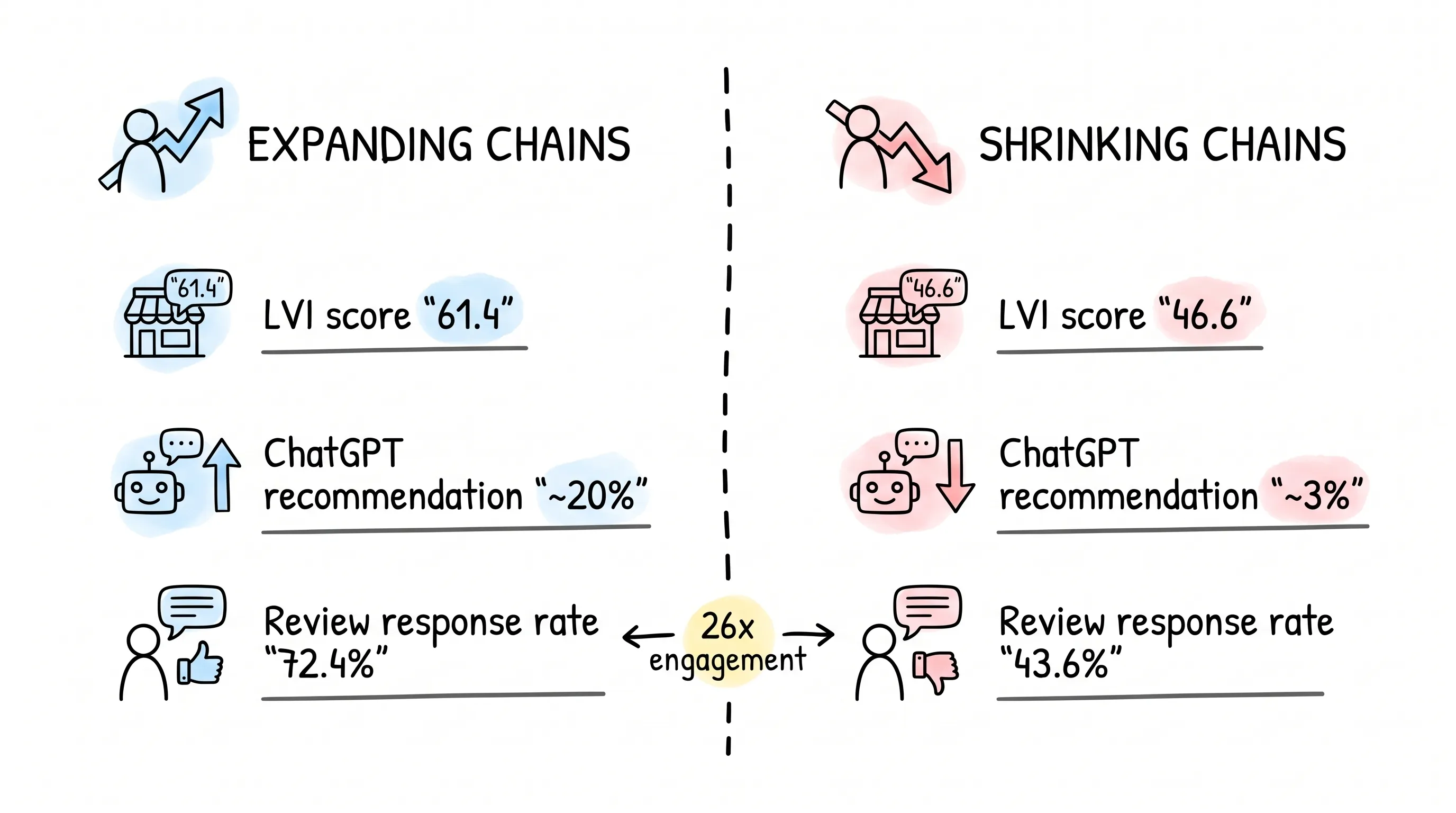
Expanding restaurant chains are 6x more likely to be recommended in ChatGPT than shrinking ones
This research, published by MarTech and produced by local-marketing platform SOCi, builds its LVI index on four underlying channels: search, reviews, social, and AI. The article is flagged as sponsored views at the end, with limited methodology disclosure — bear that in mind when citing. The study compares 8 continuously expanding and 8 shrinking restaurant chains, and it's the first empirical comparison to fold AI recommendations into a local-visibility scorecard. The composite LVI scores were 61.4 versus 46.6 — a 14.8-point gap, consistent across every underlying channel. The widest gap was in AI recommendations: on ChatGPT test queries, roughly 20% of expanding brands got recommended versus about 3% of shrinking ones, with Gemini and Perplexity showing the same pattern. AI recommendations overall are extremely picky — only 1-11% of locations on the three generative platforms earned a recommendation, while the Google 3-Pack came in at 35.9%; data accuracy is the first thing AI platforms verify. The levers to pull are equally clear: expanding brands had a 72.4% review response rate versus 43.6% for shrinking ones, and localized social engagement of 3.45% versus 0.13% — a 26x difference.
💬 This data hands multi-location brands their priority list. Review response speed and coverage can be closed within weeks, and switching from headquarters' one-size-fits-all posting to store-localized content is the main driver of that 26x engagement gap. Do these two things first; talk AI visibility after.
🔗 Further reading: Read the full article
Seer Interactive's founder: organic traffic is falling hard, yet pipeline is growing
This is a talk preview from Marketing AI Institute for MAICON 2026. The headliner is Seer Interactive founder Wil Reynolds, who started the agency in 2002 and grew it past 200 people — a familiar face in the SEO and AI search world. The talk is titled Seen. Believed. Chosen. He shared his own company's counterintuitive numbers: organic traffic down sharply, pipeline up — traditional KPIs and AI-era business results have decoupled. By his observation, ChatGPT's and Gemini's citation logic has changed: they first shortlist brands already considered strongly relevant to the topic, then search for supporting signals around those brands — brands that game visibility through shortcuts will find it much harder to win. He also called KPIs the number-one problem in AI visibility today: everyone wants ROI attribution, but measurement methods are nowhere near settled. In the talk he drew his own boundaries for AI use: AI for thinking, challenging, and connecting the dots; no AI for outbound email or video editing.
💬 Traffic down, pipeline up — your conversion path has already bypassed the metrics you've been measuring for years. Add two columns to this week's report: branded search volume and direct traffic. Don't let last-click eat all the credit. Credibility-building comes before visibility.
🔗 Further reading: Read the full article
AI recommendation placements convert at 27% versus 2.1% for traditional search — data points from a GEO service provider
Percepture is an enterprise-focused SEO agency, and its GEO services page lists standard service modules: citation optimization for ChatGPT and other LLMs, structuring for Google AI Overviews, entity and knowledge-graph building, Schema and FAQ markup, digital PR for authoritative citations, and AI visibility tracking reports. The page cites two data points worth recording: a 2025 Backlinko analysis put conversion for brand recommendation placements in AI answers at roughly 27% versus about 2.1% for traditional search; and companies (Lemma is named among them) that implemented GEO strategy saw LLM-sourced traffic grow 800% year over year. The entity-building path points to Wikipedia, Wikidata, and structured databases — get AI engines to know who you are first — with the Schema section explicitly covering both FAQ and HowTo markup. The four modules roughly match the four-layer framework used by GEO tools on the market — essentially a self-serve work list. The whole page is a services pitch, so verify both data points against their original sources before using them.
💬 Even at half the claim, 27% versus 2.1% points the same direction as Similarweb's finding: visitors from AI recommendation placements arrive with clear intent. Entity building is the cheapest item on the list — complete your Wikidata entry and Schema markup this week.
🔗 Further reading: Read the full article
🏷 Marketing Tools & Selection
TikTok ships a three-piece AI ad toolkit; Reddit opens Max Campaigns to everyone
Social Media Examiner's September 8 industry newsletter is dense with platform news. TikTok's wave of AI tools comes in three tiers: connect your ad account and you can manage campaigns conversationally — pull reports, discuss strategy; a downloadable AI skill pack works like a junior media buyer, from surfacing winning creative patterns to suggesting budget allocation; and an upgraded Creative Studio turns briefs into edit-ready video ads per brand guidelines. Researcher Melissa Laurie, meanwhile, reminds us that native rough-cut videos still outperform polished ads. Instagram's content research method is worth stealing: search in-app by listing words the way your audience thinks, use reshare counts as the strongest growth signal, and do it weekly. Other moves: Instagram will label accounts posting unlabeled AI-generated personas and limit their reach; Reddit's 15-second Engaged Video Views entered public beta and Max Campaigns is now fully open, with beta customers seeing lower acquisition costs; Snap Unified Attribution launched globally, connected to AppsFlyer and Adjust; YouTube is testing affiliate products that auto-switch retailers.
💬 Try the TikTok tool chain this week: connect your account for conversational management, and start the skill pack with creative-pattern analysis. Don't go all-in on AI-generated creative: what drives volume today is still a rough cut that hooks in the first 3 seconds. AI-polished pieces suit supplemental tests — they can't replace native-style.
🔗 Further reading: Read the full article
Seven GEO agencies reviewed: pricing ranges and revenue-attribution standards all laid on the table
Optimist is a GEO agency, and this roundup covers seven peers — the author opens by admitting their own shop made the list at No. 1 — confessing it in a single word: "Guilty." What's rare is that all seven are judged on the same criteria: are there publicly verifiable case studies, can AI visibility be attributed to revenue rather than visibility scores, and do GEO and SEO operate as one integrated practice. The intelligence value sits in pricing and cases: Optimist self-reports $3,000-4,000 per month and delivered 49x growth in LLM recommendation revenue and 26x in traffic for a B2B tech client over 14 months; Siege Media runs about $11,000 monthly on a data-journalism-plus-digital-PR route, though its metrics still stop at traffic value estimated by third-party tools; Animalz runs roughly $8,000-10,000; iPullRank specializes in relevance engineering at the level of embeddings, passage retrieval, and query fan-out — a fit for large sites with deep page structures. The article closes with a reminder: most "best GEO agency" lists are written and ranked by the agencies on them — use them with that structural bias in mind.
💬 When choosing an agency, ask one question: can you attribute LLM recommendations to revenue and pipeline? If they can't answer, they're just reporting visibility scores. Use the price ranges in the piece as a negotiation baseline — anyone quoting well above Siege should first explain where the premium goes.
🔗 Further reading: Read the full article
Ten GEO tools priced head-to-head: from €20 to $299 a month
This SitePoint comparison claims a year of testing, then filtered ten tools on five criteria: monitoring real AI outputs, covering multiple models, prompt-level granularity, competitive benchmarking, and linkage to business performance. The price band spreads wide: Rankscale €20/month, Frase $49, Peec €89, Profound $99, SE Ranking from $103.20, Writesonic $249, AthenaHQ $295, with GetCito and Alli AI at $299 each — enterprise plans on request. The four-layer framework the article offers is worth archiving: prompt intelligence, visibility monitoring, content and authority optimization, performance linkage. The vetting standard is blunt: many so-called GEO tools are just SEO features with a new label — true GEO must monitor real model outputs, not simulated visibility scores. Another line worth copying down: generative engines compress web pages into answers, and if you're not cited you're invisible — even while your SERP ranking holds steady. Worth noting: this is SitePoint-sponsored content, and the testing method isn't reproducible.
💬 Start by buying the monitoring layer — on a budget around $100 a month, Profound and Peec are the options. Judge on one thing: does the tool report real model answers line by line? No raw output in the screenshots, straight elimination.
🔗 Further reading: Read the full article
A category map of ten GEO platforms: the enterprise vs. lightweight-monitoring split is now clear
Bluefish is a GEO platform vendor, and this comparison, updated September 7, arranges ten platforms into a category map that it says was reviewed by practitioners with 40 years of combined experience. Bluefish ranks itself first, and its self-reported metrics carry no third-party validation — for instance, variance below the median across 600-plus tests, and source-influence analysis included in 90% of evaluations. Fine as a map; discount it as a ranking. The tiers are clear: Bluefish and Profound are positioned enterprise-grade, emphasizing compliance configurations like SOC 2, SSO, and RBAC; Peec and Otterly are lightweight mention monitoring; AthenaHQ leads on narrative and tone monitoring; Scrunch analyzes influencer signals; Writesonic plays the content generator in this picture; and the traditional SEO crowd — Conductor, Semrush, Surfer — is classified as SEO with AI bolted on, not native GEO. The four factors the article offers make a good acceptance checklist: consistency of brand appearance, the sources being cited, positioning relative to competitors, and how accurately the models describe the brand.
💬 Pick your tier before comparing prices: enterprise has to pass the compliance gate, while lightweight monitoring starts at a two-digit monthly fee. Take the four-factor list as a RFP appendix — far more useful than watching vendor demos — and start by asking whether it can produce raw, line-by-line model answers.
🔗 Further reading: Read the full article
47% of ad agencies' billable hours are being automated: a 90-day roadmap
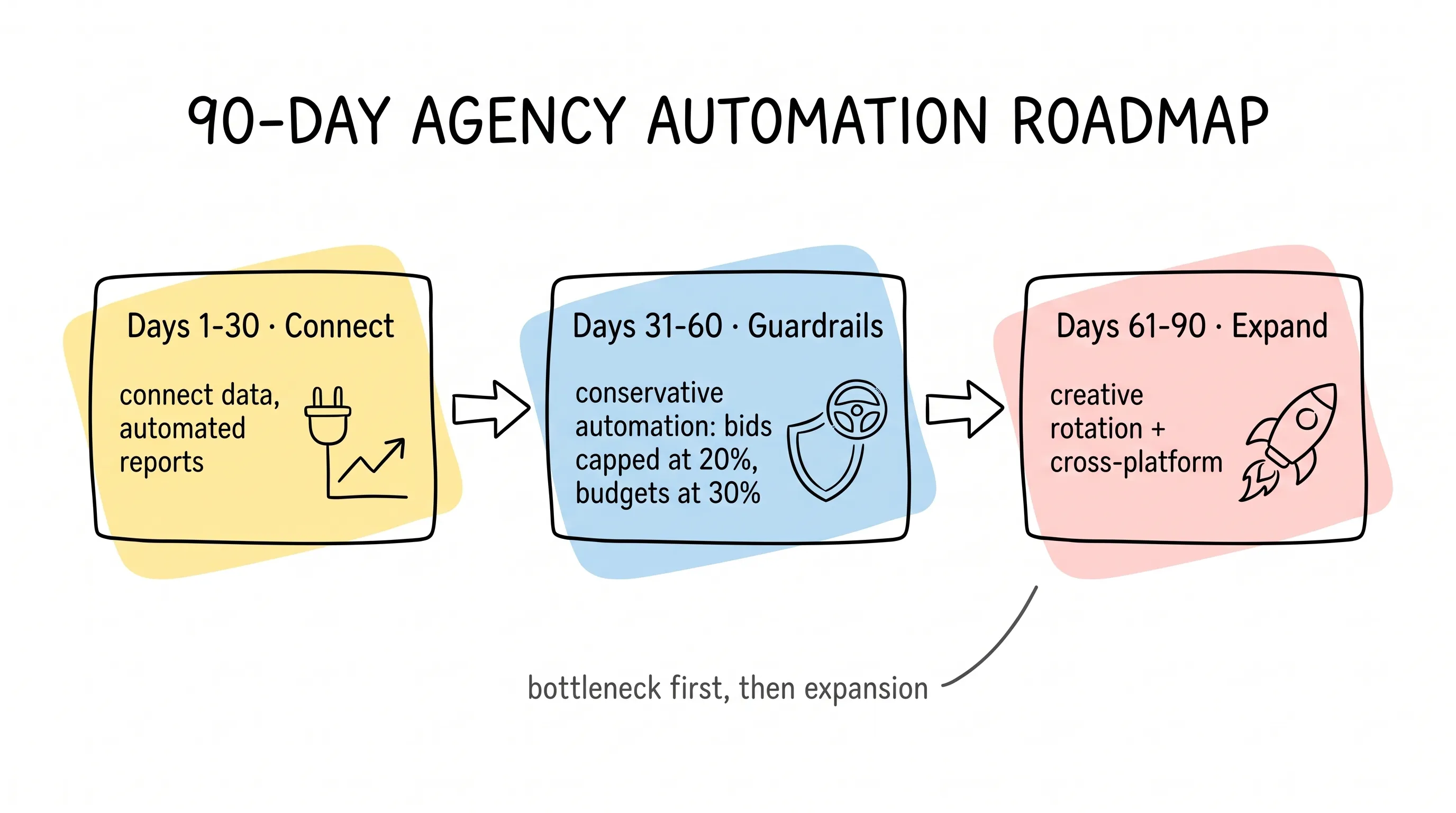
Ryze AI is an ad-automation vendor, and this guide breaks manual management at Meta and Google Ads agencies into seven automatable areas: automatic bid adjustments every 15 minutes (manual is roughly 2-3 times a day), hourly cross-campaign budget reallocation, creative-fatigue monitoring and rotation, micro-tests of audiences on small budgets, negative-keyword and placement cleanup, anomaly alerts on 50-plus metrics, and automated client reporting. Industry data shows agencies spend 47% of billable hours on exactly this kind of routine optimization. Creative fatigue is estimated to swallow 30-50% of potential performance; the monitoring window tracks CTR over 7, 14, and 30 days, with automatic rotation when the drop exceeds 20%. The three-phase 90-day roadmap has direct operational value: days 1-30, connect data and produce automated reports; days 31-60, switch on conservative guardrails (daily bid changes capped at 20%, budget moves capped at 30%); days 61-90, layer on creative and cross-platform expansion. Discount the vendor's self-reported numbers: first-month CPA down 25-35% and ROAS up 40-60% — neither independently verified.
💬 Copy the roadmap, not the numbers — the sequence is right: reports first, then bidding, then expansion. The client-education playbook is a good template too: let the AI produce only advisory reports on what it would do, run that for two weeks, then open up automation permissions.
🔗 Further reading: Read the full article
B2B marketing automation selection: most platforms' tracking dead-ends at the lead
Cometly is an attribution-tool vendor, and this platform guide offers an archivable five-factor selection checklist: enterprise-size fit, total cost of ownership over sticker price, depth of CRM and ad-platform integration, attribution granularity, and extensible customization. The platforms tier like this: small teams should look at HubSpot or ActiveCampaign — easy to use with a strong education ecosystem, complete with certifications, tutorials, and community resources; mid-size and large teams should look at Marketo or Pardot, the former strongest in heavy lead-management scenarios with predictive content and ABM capabilities, the latter natively fused with Salesforce CRM, with lead scoring and ROI reporting out of the box. The article also flags data migration as the commonly underestimated cost — the pain of switching platforms mostly lives in the migration phase, where documentation and support are thin. The honest talk is on tracking limits: most automation platforms' tracking stops at the lead level and can't answer which campaign generated revenue, so you need a separate attribution layer to fill the gap — and post-iOS Conversion API support is a hard requirement.
💬 Ask platform sales one question: can you point at a report and tell me which campaign brought in revenue? If not, this platform is an execution tool — attribution gets bought separately. In selection, integration depth is worth more than the feature list.
🔗 Further reading: Read the full article
Six platform categories in B2B marketing automation: a stocktake with the sales pitch stripped out
This Analytics Insight guide, bylined IndustryTrends and published in December 2024, is in fact an advertorial for HCL Unica — the closing paragraphs push the vendor's own product, so read past that layer. Two things are worth archiving. First, market scale: the enterprise marketing automation software market is projected to exceed $11 billion by 2031. Second, the framework: four big roadblocks — system integration, data quality, personalization at scale, and sales-marketing KPI alignment; three value scenarios listed — lead nurturing, event-triggered campaigns, and dormant-lead reactivation; and platforms bucketed into six categories — CRM-integrated, enterprise-grade, mobile-only, AI-driven, CDP-integrated, and privacy-compliant — a ready-made blank grid for your own selection stocktake. The article's sequencing carries advice of its own: straighten out integration and data quality first, then scale personalization. Each category maps to a starting point: already have a CRM, look at CRM-integrated; heavily regulated industry, look at privacy-compliant; customer data scattered across systems, start with CDP-integrated.
💬 The way to use this: steal the framework, discard the conclusions. Fill the six categories against your own stack, patch wherever you're missing one — the category list is free, but the judgment is yours to supply. And re-verify the advertorial's numbers against original sources before citing them.
🔗 Further reading: Read the full article
🏷 AI in Production
Five GenAI use cases already in production: architecture stacks and pitfall checklists included
Intuz co-founder Pratik K Rupareliya reviews two years of delivery experience, and the backdrop is a cold shower: Deloitte's 2025 survey found 72% of enterprises have GenAI projects, yet only 15-20% of pilots make it to production. Five use cases, each with its architecture stack. Intelligent medical-document processing compressed a 3-5 day pre-authorization cycle down to hours. Hyper-personalized e-commerce recommendations show real gains: Lenskart lifted conversions 20% and Sephora lifted sales 13% — with the caveat that you must add a layer of structured constraints anchoring LLM output to the real product catalog; otherwise hallucinated product attributes will destroy trust on contact. For workflow orchestration, pick n8n and self-host it — data sovereignty over anything touching finances, medical records, or PII is non-negotiable. A private LLM plus RAG knowledge base answers the reality that 72% of SMEs rank internal data security as their number-one barrier. And an MCP (Model Context Protocol) cross-session-memory customer-service deployment achieved 68% of tickets resolved without human handoff — the banking benchmark is Bank of America's Erica, past 1 billion interactions.
💬 The pilot-to-production divide: five items that double as a self-audit — clearly scoped problem, compliant data pipeline, right-sized model, day-one measurable ROI, and integration before tool selection. E-commerce teams should copy the constraint-layer section outright; hallucination governance is the make-or-break line for recommendation systems.
🔗 Further reading: Read the full article
The Washington Post generated 850 election briefs in a year: five cases of AI content marketing
A Sprinklr blog post sorts AI's reshaping of content marketing into four uses — topic discovery, generative creation, personalization at scale, and cross-channel distribution — with five brand cases attached. Corning used AI Smart Bidding plus Automated Pacing: a two-week pilot lifted site visits 124% and cut CPA 55%. The Washington Post's Heliograf auto-generated roughly 850 election data briefs in its first year, drawing more than 500,000 clicks. Trivago localized a single ad into more than ten languages. Starbucks' Deep Brew blends preference, weather, and location data for recommendations — reported ROI up 30% and engagement up 15%. Booking.com used AI to label sentiment and intent across more than 9,500 TikTok comments within 60 days, saving 17 hours of manual work and feeding the conclusions back into creative decisions. Ahrefs estimates that over 70% of new web pages now contain AI-generated content, and that high-quality AI content performs on par with human content in SERPs. Most cases are old news, and the piece funnels to its own products repeatedly.
💬 The case numbers are dated, but the structures are still worth copying. The pipeline from comment sentiment analysis back into creative is something a small or mid-size brand can assemble in a week with off-the-shelf social listening tools — spend the saved hours on topic selection instead.
🔗 Further reading: Read the full article
A four-layer map of AI social media marketing: creation, scheduling, paid media, conversation
This overview from agency Riithink has no data or cases — its strength is complete structure, and it works as a self-check list. The four layers: creation covers copy and visuals, with ChatGPT, Jasper, and Copy.ai writing copy and Runway and DALL·E producing visuals; scheduling and insights handles smart posting times, comment sentiment scanning, and trend prediction, catching hot topics before competitors do; paid media is dynamic creative optimization plus predictive analytics, iterating creative, headlines, and formats automatically toward individual preferences; conversation is chatbots — context understanding, lead scoring and ranking by value, and around-the-clock customer service. Influencer marketing gets its own section: AI matches influencers on engagement rate, audience profile, and brand fit, spots fake followers, and tracks ROI. The ethics section sets three boundaries: deepfake and misinformation risk, algorithmic bias, and over-automation diluting the brand's unique human voice.
💬 Hold your team up against the four layers and fill whichever one is missing. Scheduling-and-insights is the layer most often skipped, yet it costs the least and pays back fastest — build that one before talking paid-media automation. Keep a human review pass before anything publishes; don't let the assembly line sand away the human voice.
🔗 Further reading: Read the full article
🏷 CRM & Personalization
Hyper-personalized email transacts at 6x the rate of generic email — provided the database is clean first
ClickDimensions is a marketing automation vendor in Microsoft's Dynamics ecosystem, and this Spanish-language blog post covers email hyper-personalization driven by AI plus CRM data — positioned as a beginner framework. The article draws its line first: basic personalization stops at names and tags, while hyper-personalization feeds on the full context in the CRM — purchase cycles, preferences, pain points — replacing one-size-fits-all blasts. AI handles four jobs: predictive analytics to pick cross-sell and upsell targets, send-time optimization per recipient, real-time dynamic content generation, and continuous tracking of the customer journey with adjustments on the fly. The data point cited: hyper-personalized email transacts at 6x the rate of generic email, per Amra & Elma's statistics. The go-live prerequisites are stated bluntly: GDPR and consent management must pass first — stale contacts carry compliance risk and send personalization off the rails.
💬 Clean your database before launching dynamic content. If consent status and contact validity aren't clean, the 6x transaction rate won't be yours — the compliance fine arrives first. Send-time optimization is the easiest one to run first.
🔗 Further reading: Read the full article
AI CRM enters the store: Android POS moves personalization to the checkout counter
A guest post on the IndiaAI portal by the founder of POS vendor QueueBuster — no first-party case data anywhere in it, treat the views as reference only. The backdrop: the CRM market grows from $71 billion in 2023 toward roughly $157 billion by 2030, and in offline retail personalization has shifted from bonus feature to table stakes. The article sketches four touchpoints once AI CRM fuses with Android POS: real-time recommendations combining transaction history, browsing behavior, and in-store foot-traffic paths; personalized promotions triggered at checkout based on purchase history; churn alerts that intervene at the register in the moment, giving store staff a chance to win the customer back on the spot; and product discovery extended from online to in-store customer screens. The article's through-line: POS is turning from a payment tool into a data gateway, and CRM's value only reaches the store floor through that gateway. Side benefits on operations: automated data capture cuts manual errors, and foot-traffic forecasts guide staff scheduling.
💬 Churn alerts are a ready-made testing ground for brick-and-mortar stores. Run churn scoring inside the POS, pair it with staff talk tracks, and one quarter tells you whether it's worth it. Vendor guest post — reference the direction, don't cite the numbers.
🔗 Further reading: Read the full article
A top Shopify agency doubles down on CRM and lifecycle marketing
MarTech Cube news brief: Domaine, a design and development firm that leads in scale within the Shopify ecosystem, announced an expanded CRM and Lifecycle Marketing service line led by Stacy Storm, who brings 15 years of agency experience — more than five of them at Tinuiti — and joined Domaine over six months ago; the team is hiring. Domaine president Marko Bon frames it as a new playbook for CRM and lifecycle marketing: personalization across the full customer journey that drives incremental conversion. The service line's positioning: unify the marketing calendar, creative campaigns, and customer data into one integrated whole; per the announcement, the hiring push responds to market demand. Domaine has long been a Klaviyo Platinum Advisor Partner, and this deepened partnership connects the commerce platform with marketing channels for cross-channel personalization — Klaviyo's SVP of Global Partners Eddie O'Brien lent his endorsement, saying the two companies see the full customer journey the same way. In essence it's a press-release republication — the industry signal outweighs the news itself.
💬 Agency moves are a demand bellwether. When choosing agencies in 2026, Shopify brands should put CRM and lifecycle marketing capability on the scorecard — standalone web design or paid-media buying is depreciating. Watch who agencies are hiring and you'll know what clients are asking for.
🔗 Further reading: Read the full article
🏷 Industry Data, Policy & Funding
Knak survey: AI hasn't given marketers their time back — the bottleneck is approvals, not first drafts
MarTech columnist Kath Pay cites Knak's Marketing Production in the Age of AI survey to dismantle the promise that AI saves time. The numbers make uncomfortable reading all the way down: 85% of marketing teams missed at least one campaign launch date last year; 82% still spend more than half their time on production rather than strategy. The delay leaderboard: approval sign-offs 47%, design and production 38%, cross-team coordination 36% — all workflow problems. AI adoption is already widespread: 64% generate first drafts, 56% use it for image or performance analysis, 48% generate headline variants, and 70% of teams have deployed it. But 88% say AI output still needs moderate-to-heavy human editing. The article pins down the choice-overload mechanism: where a team once produced two headlines, ten variants now arrive in minutes — every generation adds work to the approval chain. The fast teams that finish an email within 4 hours share two traits: fewer people involved, and strategic use of AI.
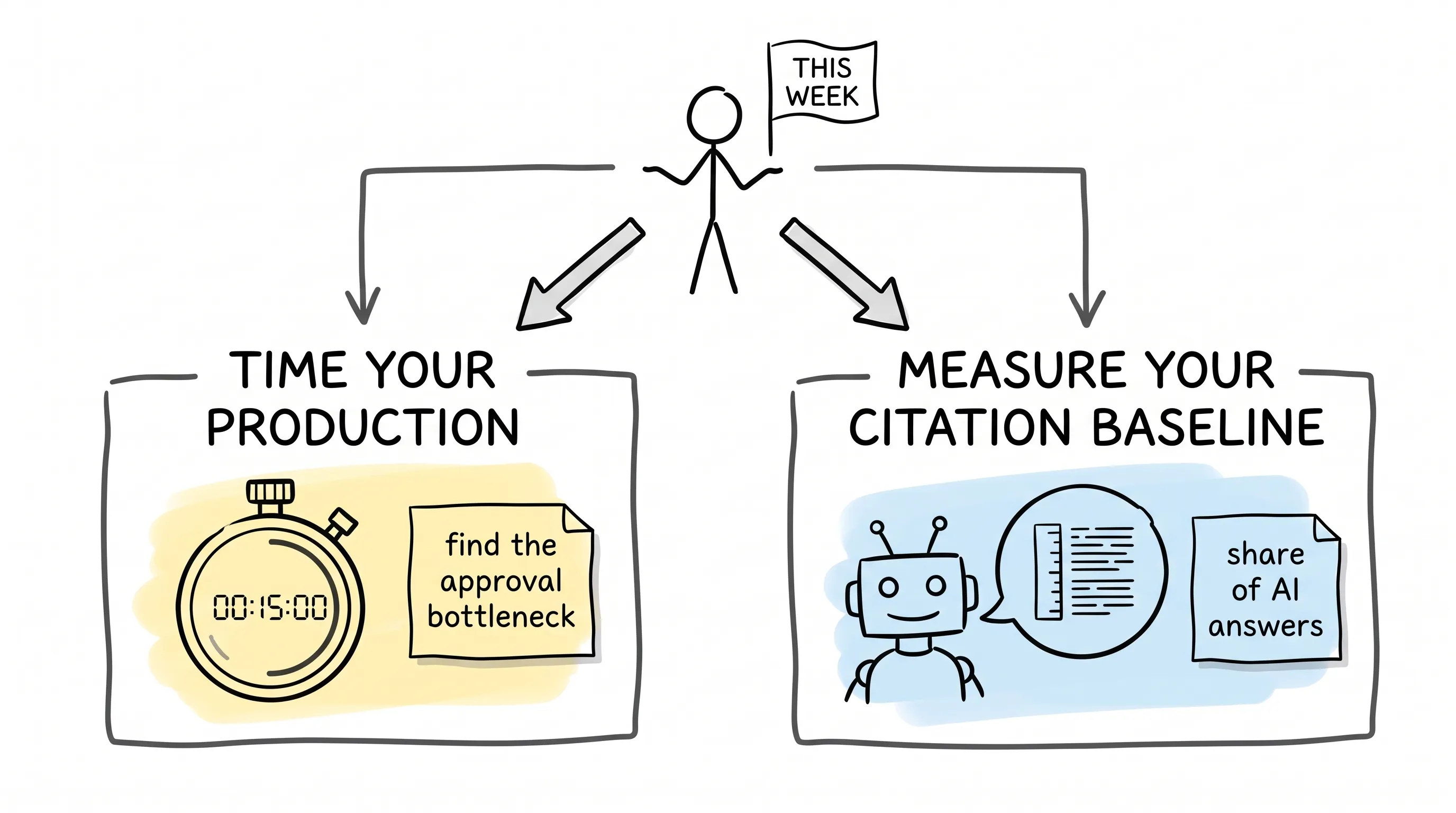
💬 Audit the process before buying tools. This week, break down the production time of your last campaign: who approves, where it stalls, what can be templated. AI delivers a time dividend only when it's attached to the bottleneck — attach it to first drafts and you just produce more marketing.
🔗 Further reading: Read the full article
Adweek AI news in brief: ChatGPT's ad revenue passes $1 billion annualized
An Adweek Artificial Intelligence category-page snapshot covering AI advertising from late August into early September — the headlines and deck copy already carry the hard facts. OpenAI: ChatGPT's ad business passed $1 billion in annualized revenue per an August 31 report — ad monetization is entering its scale-up phase. Capital: Nvidia confirmed acquiring Hugging Face for nearly $13 billion, its second-largest acquisition, a bet on open-source AI. Regulation: Google's ads antitrust case avoided a breakup, but the industry is split on whether behavioral remedies can restore competition. Deployment: Zocdoc partnered with Gemini so users can find and book medical services inside the conversation — another example of transactions and services moving into answer engines. Talent: Hightouch, valued at $2.75 billion, poached Google agency-relations executive Jitendra Kumar. One more observation: the honeymoon between AI and advertisers is cooling — performance, control, and accountability are the flashpoints ahead.
💬 Two items bear directly on budgets. ChatGPT's ad business is past $1 billion — time to stand up a test budget, starting small and proving attribution first. Service businesses should watch the Zocdoc deal: booking completed inside an answer engine is a pattern that will spread to more industries next year.
🔗 Further reading: Read the full article
💡 Today's Big Picture
Lay today's 20 items side by side and there's one through-line: the power to decide who wins customers is moving from the search results page into AI answers. The evidence chain is complete — zero-click up to 69%, 35% of consumers using AI for product discovery, AI recommendation placements converting at 27%, and even local restaurants' odds of a ChatGPT recommendation spread 6x apart. Brand-side response has split into two layers: on content, BLUF structure, statistical citations, and entity building; on monitoring, a tool shelf running from €20 a month to enterprise pricing, and agency services that now come with published price tags.
The counterpoint is the sober side of AI adoption. Knak's survey pins the bottleneck on approvals and choice overload, with 88% of AI output still needing human editing; in Adweek's snapshot, the advertiser–AI honeymoon is starting to cool and the argument is turning to performance and accountability. That both ran the same day is no coincidence: after the hype, the industry has started answering the harder question — what counts as success in production. The tools are in place and traffic is switching tracks; what's stuck for most teams is process and measurement.
Two things worth doing this week: time the production of your last campaign piece by piece, and measure your brand's citation baseline across the major AI platforms. Those two numbers decide where you'll stand in the first half of next year.
Continue reading
Related articles

AI Marketing Daily · 2026-10-09
AI marketing daily for 2026-10-09 covering 11 items: brand measurement moving from survey panels to search, social, e-commerce, and AI prompt signals; GEO and share of model playbooks; safety guardrails for agentic ad buying; and tool roundups for ad platforms, cross-border tools, and social media uses.

AI Marketing Daily · 2026-10-08
AI Marketing Daily for 2026-10-08 curates 20 items across AI search visibility (GEO), advertising, platform selection, cross-border e-commerce, and ROI measurement. The headline argues that strategic marketing decisions should stay with humans while AI assists execution.

AI Marketing Daily · 2026-10-07
Today's throughline is answer engine optimization (AEO — getting your brand quoted in AI answer engines).