
AI Marketing Daily · 2026-09-08
A daily AI marketing digest covering ten brand GenAI case studies, an ROI case library, field tests of five AI ad tools, B2B automation cost notes, and global privacy updates on tracking pixels and AI targeting consent.
Six of today's eight items come packed with material you can act on directly: a field record of ten brands running GenAI in customer experience, a one-page ROI case library with public sources cited, an in-the-trenches comparison of five AI ad tools, and two cost ledgers on B2B automation. On the regulatory side, May's global privacy roundup pulled email tracking pixels and AI targeting into the consent net, and California handed GM a $12.75 million settlement. Budget hunters and tool pickers both have ready-made levers today; on the compliance front, the landmines have their positions marked too. The ten-brand headline case deserves a solid block of time for a close read; the rest you can skim on your commute.
🎯 Today's Headline
10 Brands' GenAI Field Notes: Billboards That Lifted Visits 60%, an AI Coach That Lifted Sales 20%
CX Today rounded up ten brands putting generative AI into production, spanning four industries: travel, retail, finance, and food service. Travel is the heavyweight. After the pandemic, tourism spent years rebuilding consumer trust, and Booking.com's answer was to bake AI into the main path: Smart Filter scans inventory against user preferences to generate destination shortlists, while Property Q&A acts as a travel advisor on call 24 hours a day, answering questions about a listing instantly. Puma used Imagen 2 on Vertex AI to drop the same shoe into a Berlin street scene or onto a tropical beach, setting the scene by mood and skipping round after round of product photography, and site engagement, click-through rate, and conversions moved up with it. Coca-Cola moved earlier still: its Create Real Magic campaign opened brand assets plus DALL-E to fan co-creation, pulling in thousands of pieces of UGC, community growth, and social share of voice, and it has kept iterating on AI video ads ever since. PODS went the furthest: it trained Gemini, mounted it on truck billboards, fed it project briefs, brand guidelines, and interview transcripts, then wired in Google Cloud's real-time weather, traffic, and time-of-day data, so the copy changes as the truck rolls into different neighborhoods. Its agency, Tombras, calls it the world's smartest billboard. Also on the list: Intuit, which stitched Gemini, Doc AI, and visual recognition into its own GenOS so tax filing auto-fills forms and saves labor; and Klarna, whose single assistant took over two-thirds of customer service conversations, before it later walked back the louder talk of rebuilding its tech stack.
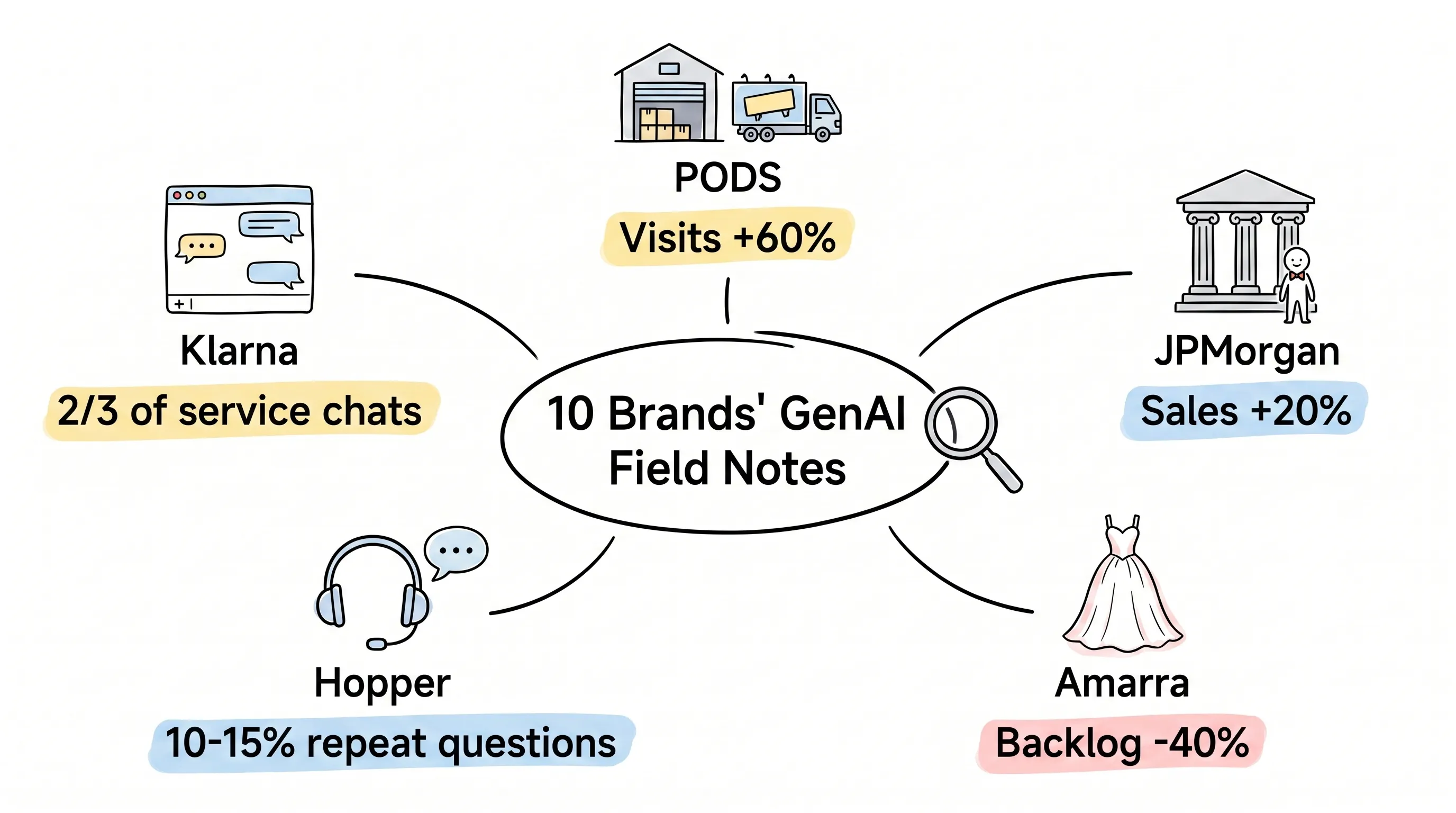
What these cases share is a willingness to show the numbers. PODS saw online visits jump 60% in a week and quote requests rise 33%. JPMorgan's Coach AI helps financial advisors pull research on demand, draft recommendations, and prep meetings; from 2023 to 2024 it drove a 20% increase in total sales, and AI tooling for fraud prevention and decision support saved the bank $1.5 billion on top of that. Hopper's voice-AI customer service was trained on real support calls, fine-tuned on the highest-frequency questions, and launched with explicit guardrails; it now absorbs 10–15% of repeat questions, starting with the high-volume grind of refunds, cancellations, and rebookings, with humans taking over at agreed handoff points. Amarra sells wedding dresses and formalwear; AI produces SEO-friendly product descriptions in seconds, and excess inventory dropped 40%. The value of Intuit's tax pipeline goes beyond auto-filled forms: it also lowers the odds of human error. The proof-of-concept era is long over; the math is on the table.
For marketers, the impact lands on three levels. Budget: Puma's and Amarra's math is the most direct. The production cost of scene images and product copy comes down, freeing up studio time and copywriter hours, which makes the marketing cadence more flexible. Experience: Booking and Delta put AI in the main path. Delta's in-app AI concierge serves real-time updates, personalized suggestions, even personalized quotes; it digests the routine questions, wait times shrink, and service staff shift to complex cases. Delta also plans to use Amazon Bedrock to connect the experience end to end, extending AI into dynamic pricing and revenue management. Organization: JPMorgan's approach is worth retelling internally. Coach AI works as a three-in-one helper for advisors: researcher, assistant, and strategist. The real win is that advisors arrive better prepared and more strategic, and customers can feel the difference. Hopper has published its methodology: start by targeting the five question types with the highest demand, and don't chase full handover in one step. Swap your metrics too; they've already moved past the old pair of containment rate and human-handoff rate, looking instead at true resolution rate and repeat usage.
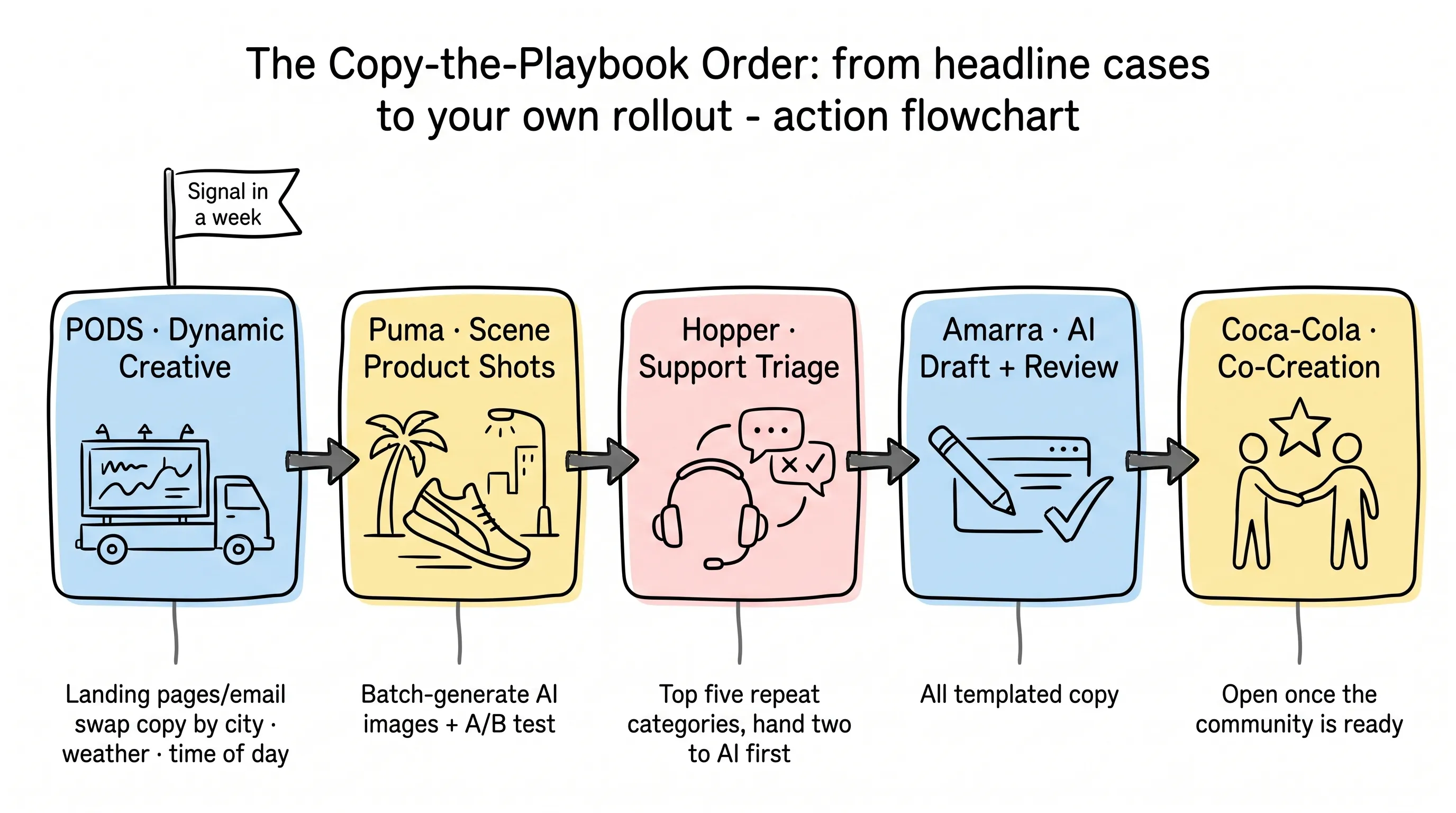
Here's the order to copy the playbook in. Step one: borrow the dynamic-creative idea from PODS. You may not own a billboard, but landing pages and email campaigns can absolutely swap copy by city, weather, and time of day. Pick one variable to test first and you'll see a signal within a week. Step two: learn from Puma and put your product shots into real scenes. Batch-generate images with Imagen or a similar tool, run an A/B against the plain white-background shots, and the click-through gap is your first win; log the photography budget you saved into the AI project's internal account while you're at it. Step three: on customer service, follow Hopper's path. Export the last three months of tickets, count out the five categories with the highest repeat rate, let AI take two of them first, and write the human-intervention points into the workflow up front rather than patching them in after a complaint. Step four: on content, take a page from Amarra. Move templated writing like product descriptions and landing-page copy to AI drafts with human review; the company even has AI watch inventory and return trends to decide what to stock and which styles to push, a layer e-commerce can borrow outright. Step five: keep Coca-Cola's co-creation play in your back pocket until your brand community has a base. The asset-plus-generative-tools combo has hard evidence behind its pull on UGC.
My take: this roundup was published in June 2025, the numbers are as of that date, but the playbook hasn't expired. Eight of the ten cases use hosted models from major providers fine-tuned on their own data; not one is showing off technology. Everything orbits cost savings and more conversions, with customer wait time cut along the way. I also buy the closing judgment: the next leg is agentic, and AI will work its way into every stage of marketing, sales, and after-sales. Teams that get their own scenarios and data sorted out first will be the ones in a position to catch it. Even Klarna, the benchmark case, later walked back its tech-stack-rebuild claims, so apply a discount to the hype when you copy. Small teams should start with Amarra's product copy: lowest cost, fastest payoff. Those with accumulated data should head the way of PODS and JPMorgan. The homework has been handed in — the only question left is how deeply you copy it.
🔗 Further reading: Read the full article
🏷 Industry Data
A One-Page ROI Arsenal: Wayfair's Conversions Up 33%, Allstate Drafts 50,000 Claims Messages a Day
Velocity AI Insights maintains a case index that keeps growing: every entry cites a public source, a press release or an earnings call, with a new batch added every two weeks. In e-commerce, Wayfair's personalization engine Muse, built on Gemini plus Vertex AI, delivered a 33% conversion lift. The home-goods retailer books $12.5 billion in annual revenue and $7.43 billion in adjusted EBITDA, roughly 14,000 employees are authorized to use generative AI, and the personalization modules rolled out in phases over 12–18 months from 2024 into 2025. In real estate, Redfin runs conversational home search on the Sierra platform: listing views roughly doubled and tour requests rose 47%, backed by its in-house Redeye machine-learning platform. In restaurants, Wendy's FreshAI drive-thru cut per-car service time by 22 seconds, automatically handles 86% of orders at roughly 99% effective accuracy, and added 80 basis points of margin, provided the digital menu boards are installed to brand standards. In insurance, Allstate's ALLIE large-model ecosystem drafts 50,000 claims messages a day, cutting email drafting time by 70% and billing-related inquiries by 45%; the claims-communication line has been in full operation since February 2025. In healthcare, Kaiser Permanente deployed ambient listening AI across 40 hospitals; 7,260 physicians adopted it and 16,000 hours of documentation time were saved, in what's called the fastest technology rollout at the organization in more than two decades. Auto dealer group Lithia cut fraud losses 80% and fraudulent transactions 65%; law firm Wilson Sonsini slashed contract review time 75% with 95% first-pass contract accuracy; tax advisory firm RSM announced an added $1 billion in AI investment for 2025–2028; and Lemonade settles claims in 2 seconds, 55% fully automated.
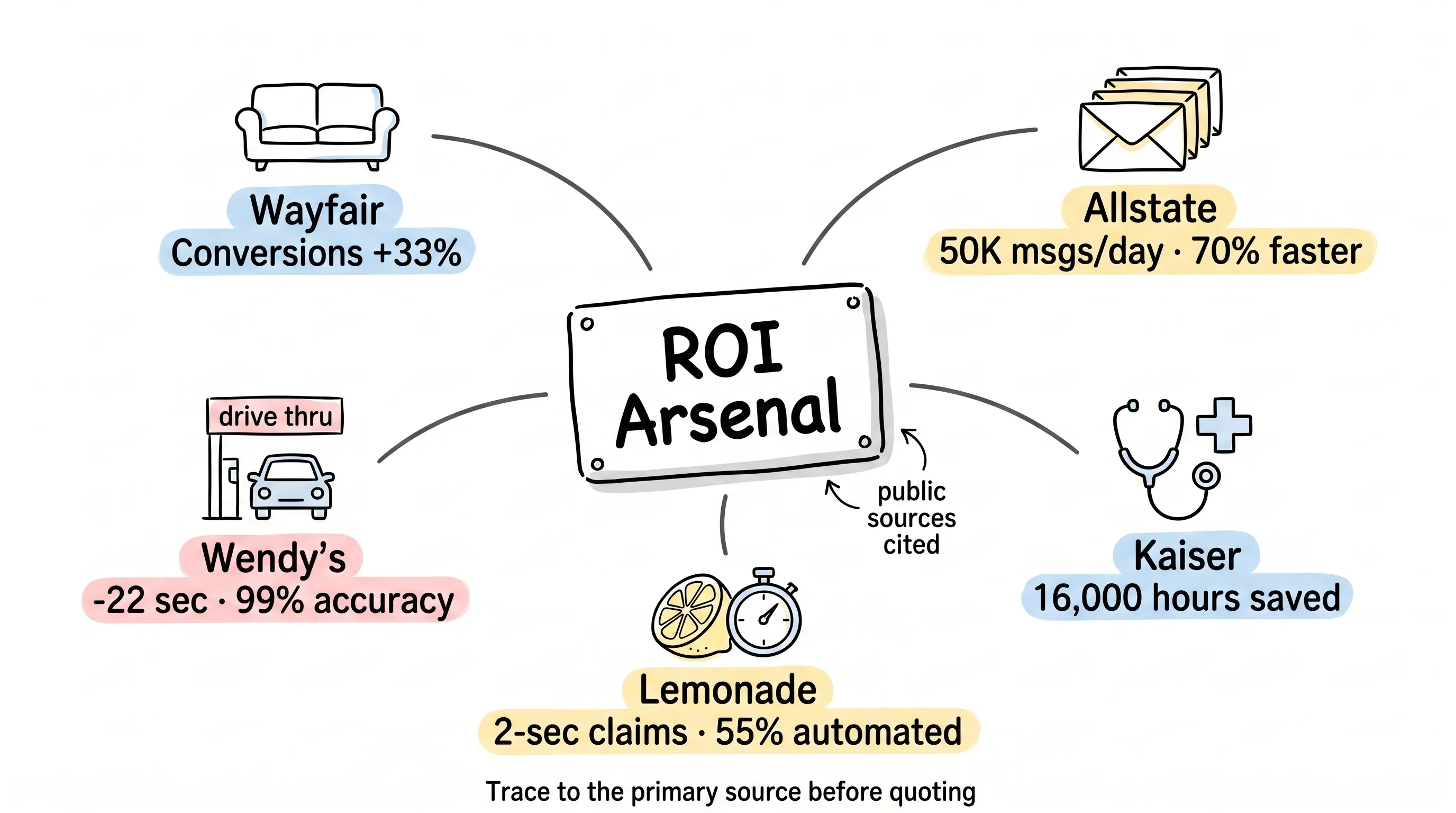
💬 Use this page as an arsenal. When you ask leadership for budget, pick two or three entries from your own industry, trace them back to the original press release or earnings-call wording to verify, then quote directly. It beats explaining concepts, and a peer's number carries different weight. Note that this is a secondhand compilation that also funnels traffic to the compiler's own services, so always go back to the primary source before citing; don't let the numbers mutate in retelling.
🔗 Further reading: Read the full article
The Ad Budget Scales Keep Tipping Toward Social: 82.4% of Spend Will Be Digital by 2030
A late-July Inc. column puts digital advertising's two main arenas side by side: paid social owns brand awareness and product discovery, paid search catches the demand. Statista estimates that by 2030, 82.4% of global ad spend will be digital. Being present is no longer an advantage; how you play is the dividing line. The shift is happening at the product-discovery entrance: stack the two survey datasets and more than half of social media users actively search for things to buy on the platforms. 26.7% are hunting new campaigns or new products, 26.1% are searching for products outright, and some practitioners put the figure at 60%. Do the conversion: one in every two people scrolling social is carrying buying intent. On the other side, Google search traffic is under pressure, and ChatGPT and Claude are changing how consumers research products, except that adoption of AI tools in e-commerce shopping hasn't caught up; the migration of consumer habits is running faster than the tool rollout. Columnist Joel Comm's conclusion: paid social's standing keeps climbing in the AI era, while most marketers' media-buying playbook hasn't caught up with this migration.
💬 You can give your budget allocation an audit this week: pull last quarter's spend and attributed conversions for paid social and paid search, check them against the trend line, and decide whether to rebalance. Don't wait until 2030 to concede the point. Catch the traffic shift to AI search entrances too: your review and comparison pages need to be quotable by AI tools, and a batch of that content is worth building now.
🔗 Further reading: Read the full article
73% of Marketers Already Use Generative AI — and the Three Old Problems Haven't Budged
GlobalFocus magazine's marketing industry survey came out in June 2023, yet its findings are still quoted all the time. 73% of respondents were actively using generative AI, with ChatGPT overwhelmingly dominant; usage concentrated on headlines and short ad copy, and three-quarters of respondents were small-business owners or independents, people who can make the call themselves. The benefits list was consistent: time saved, speed gained, cost cut, volume up. Some described workflows running hours faster; others said their teams redirected time from writing simple content toward opinion and thought-leadership pieces. The pain points were just as consistent. On accuracy, models invent nonexistent article headlines and pin them on real journalists; references get fabricated out of thin air. The thing was never a search engine, so using it as one is the wrong tool for the job. Out-of-the-box proved an illusion: generated text still needs heavy editing, and many had assumed the editing workload would shrink far more. The copyright dispute remains unresolved. Copyrighted material in the training data was used without permission or payment, respondents worry their own output could constitute plagiarism, and the plagiarism-check burden falls back on the creator. The piece also keeps two ledgers: training GPT-3 consumed 1.287 GWh, about a year of electricity for 120 average US households; and the lesson of Samsung employees pasting confidential source code into ChatGPT is called out by name. The extended worries haven't aged either: outsource your thinking to the model, and does your creativity atrophy like an unused muscle? A tech marketer in Cairo complains that content production frequency is rising so fast that quality and depth of thought are being left behind; training data skews English and Western, and non-English voices get diluted. The advice to managers is blunt: a small team using AI to patch a design gap is fine, but large organizations shouldn't rush to cut design teams. Human taste still beats the model. The accountability passage deserves to be copied into internal training: AI scholar Gary Marcus's position is that marketers remain accountable for the output, and shouldn't ship model-produced content that no one will stand behind; the CEO of the ethics organization Ethically Aligned AI argues that practitioners are obligated to tell clients the degree to which AI participated in the output.
💬 The 2023 observations still hit today, which makes them ready-made team ground rules. Write three into policy: human fact-checking before any AI output ships; every generated text run through a search engine for duplicate checks; client data and unpublished material banned from public models. Companies are still breaking the third rule today. Don't let your team make that list.
🔗 Further reading: Read the full article
🏷 Marketing Tools
B2B Marketing Automation Changes Paradigms: From if/then to Predict-and-Execute
A late-February long-form piece from gomega.ai runs the numbers on B2B marketing automation. Traditional MAPs (marketing automation platforms) have three structural weaknesses. Heavy setup: a proper Marketo or HubSpot build takes 3–6 months, plus a dedicated operator on an $80,000–$120,000 salary. Companies under $50 million in annual revenue can't afford to keep one. Rigid rules: if/then workflows don't adapt on their own, so when a campaign underperforms, a human has to diagnose, rebuild, and rerun. Channel silos: beyond email and landing pages, SEO, content, and paid ads each fight their own corner, with four to six tools each holding its own data. AI automation replaces the logic with goals plus constraints: the system predicts which actions bring revenue and executes them. Nurture sequences follow real engagement instead of a hardcoded schedule; lead scoring reads behavior plus firmographic data instead of only counting form submissions; high-intent prospects surfacing in on-site behavior get bumped to the front of the sales queue automatically, and cold leads are automatically reawakened when a new signal appears. Once the content pipeline is running, monthly output can climb from 2–4 pieces to 10–20 or more; its SEO agent claims to replace $3,000–$10,000 a month in agency retainers, with technical audits, keywords, internal linking, and rank monitoring fully automated. Attribution reporting is covered too: multi-touch attribution, revenue tracking from first touch to closed deal, and ROI reports at channel and content granularity, all handed to the system. The piece includes a price comparison: full-featured Marketo easily tops $5,000 a month, HubSpot Professional is $890, and the article's recommended MEGA all-in-one plan runs $2,099, with single-channel plans starting at $699. The common-mistakes list is practical, too: stop piling on email nurture, because buyers are already drowning in automated email; don't skip SEO because it's slow to show results, the most expensive mistake in B2B marketing, since the compounding pays out after year two; don't pick a platform on brand fame; and if you can't compute channel-level ROI, you'll never optimize. The KPI list: CPL, marketing-influenced pipeline, organic traffic growing 10–20% monthly, ROAS, and content publishing velocity. One caution: this is a vendor blog that spends the whole piece paving the way for its own product, so read the product comparisons at a discount.
💬 You don't have to believe the numbers, but the cost structure is real. Do a stack audit this week: total each tool's monthly fee plus the labor it takes to keep it fed, then follow the piece's three steps. Prioritize by revenue impact, automate one channel first, expand only after it produces results; don't roll everything out at once. The SEO warning is the most valuable line: for a compounding channel, every year of delayed launch forfeits future volume. And if your team has no dedicated operator, that $80,000–$120,000 salary figure is your reference point when you negotiate budget with your boss.
🔗 Further reading: Read the full article
A Frontline Buyer Field-Tests Five AI Ad Tools: Scores and Pitfalls Included
On Reddit's r/DigitalMarketing, an agency practitioner field-tested five Google and Meta ad management tools against three criteria: time saved per dollar of cost, support quality, and how steep the learning curve is for newcomers. Blobr scored 8: best at surfacing wasted spend sitting on out-of-stock or low-margin products, with natural-language interaction so you never have to memorize jargon. The weakness is that support is nearly unreachable, and removing the "Powered by Blobr" watermark on reports costs extra. Ryze AI scored 7.5: chat with your data to find out why spend spiked, predict month-end spend, and move budget across platforms toward the best-performing channel. Integrations are smooth; the trade-off is pricing that jumps from $5 per ad to a $49 monthly fee for the full-auto tier. PPC.io scored 7: you can see which negative keywords competitors have set and clone Google's winning campaigns to Bing and Facebook, the poster's favorite feature, but it assumes a PPC foundation, and its recommendations lose accuracy at low conversion volumes. Optmyzr scored 8: the most professional reporting, presentable enough to take straight to client meetings. A sales dip can be attributed precisely to a keyword or a city, but at $249 a month it's pricey, the interface is unfriendly, and the features barely look beyond Google. Revealbot scored 7.5: the moment an ad is paused or a budget caps out, an alert lands in team chat, and you can write rules like "if ROI > X and conversion rate > Y, add 10% budget automatically," with percentage-of-spend billing that swells as you scale. The upvoted additions in the comments are worth more than the post itself. One user flags suspected fake engagement in this batch of tools. A founder points out that the real failure mode of agency AI is automation quietly editing the wrong account; his discipline is a separate workspace per client, a timestamp on every change, and a confirmation step on every write action. And a veteran's usage is AI for alerts and waste detection rather than full delegation, capping automated budget changes at 10–15% and watching one North Star metric per client. Rule-based alerts alone, he reports, measurably cut waste by 10–12%. His summary: AI supports good media-buying fundamentals; it can't replace them.
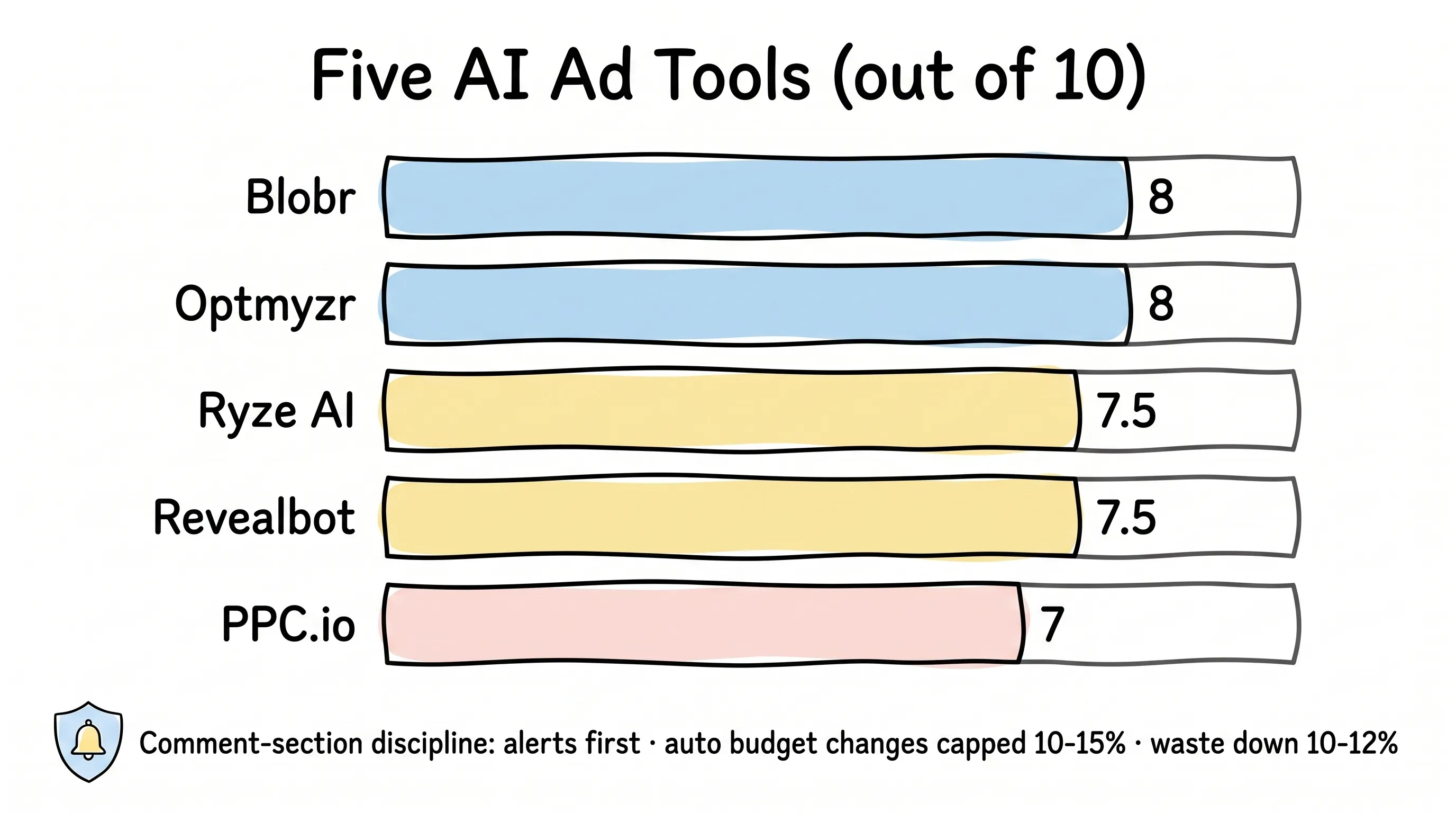
💬 This post went up seven months ago. Prices and versions will change; the selection method won't. Build your own scorecard on its three criteria, and in trials, test the weak spots specifically: support response time, advice quality at low conversion volume, and how the billing growth curve scales. Follow the comments section for onboarding order: turn alerts on first, and talk about handing over control once things run steady.
🔗 Further reading: Read the full article
Four Levers to Shorten the B2B Sales Cycle: Complete Logic, Not a Single Number
An early-April short piece from ReadITQuik on how marketing automation shortens the B2B sales cycle reads in two minutes and contains not a single concrete number, so this entry is logged as a thin one. The logic chain is complete: the marketing-to-sales handoff is where deals bleed out most. Leads left in spreadsheets, follow-up half a beat late, and revenue turns unpredictable. Automated lead nurture plus ABM keeps high-value accounts engaged until sales takes over, the platform interacting continuously until the prospect is ready to buy, without waiting around for sales to make the first move. Multichannel orchestration lets email, social, and ads speak at the same time, and customer-journey mapping keeps the story consistent across touchpoints: a prospect on LinkedIn and on your website's case-study page should be seeing the same story. The proof path for ROI is tracking engagement metrics all the way to closed-won revenue; the labor saved plus the conversions that rise, and the platform's books balance themselves. The 2026 trends section mentions AI predicting churn, personalized content at scale, and recommending next actions to sales. The closing lands on RevOps: loose piles of tools don't build growth. When sales and marketing pull as one, efficiency finally climbs.
💬 Thin material, but there's one action you can take away: get the attribution report from marketing engagement to won-deal revenue running end to end. While that report is missing, the time automation saves will never convert into the next budget line. That line about marketing and sales sharing data and goals, done for real, means a unified dashboard plus a single source of truth; start by aligning one report. If you want the cost ledger, go read the first entry in this category; the two pieces complement each other read side by side.
🔗 Further reading: Read the full article
🏷 Policy & Funding
May's Global Privacy Monthly: Tracking Pixels Need Separate Consent, AI Targeting Needs Prior Authorization
Securiti AI's May global privacy monthly is dense: 34 developments across the Americas, Europe & Africa, and Asia. Start with what bears directly on marketing. Italy's Garante requires tracking pixels in email to obtain free and specific consent, so the invisible pixels in email campaigns are no longer legal by default. Italy's competition authority AGCM closed its investigations into DeepSeek, Nova AI, and Mistral, with all three committing to clear warnings about AI hallucination risks. The UK ICO advised the government to reform online advertising rules, letting low-risk ads escape one-size-fits-all consent to ease consent fatigue; then it turned around and declared it has no confidence at all in TikTok's and X's age verification, and gave businesses one final month to stand up formal data protection complaint procedures. The regulator's posture is shifting from gentle engagement to active enforcement. The rest of Europe moved just as densely: the European Commission is pressing member states to roll out privacy-safe age verification tools by year-end; France's CNIL set a roadmap for AI credit scoring and expressly banned social media data; Latvia's guidance classifies making it hard to refuse cookies as an infringement of user freedom; Germany's federal information security agency launched the C3A framework to protect digital sovereignty; the European Data Protection Board issued a unified opinion on the credentials of Finland's certification body; and Hamburg's data protection commissioner used an EU Court of Justice ruling to classify online services as data controllers. On the US side, the California attorney general reached a $12.75 million settlement with GM over selling drivers' geolocation data; Texas barred LG from collecting TV viewing data without explicit consent; Connecticut is investigating Roblox's age verification; California separately sued the companies involved in a genetic data breach; and in Congress, the Secure Data Act drew an objection letter from California's privacy protection agency as soon as it was introduced. Asia moved thickest: China set rules for online marketing of financial products, and using data for AI targeting now requires prior customer authorization, with the Ministry of Industry and Information Technology flagging 31 apps and SDKs the same month; South Korea's PIPA amendment changes the fine base to the higher of a company's annual revenue or its three-year average, and the regulator issued two million-dollar-scale fines this month, one against a credit card company for weak encryption; Bangladesh passed its 2026 personal data protection act, with fines up to 5 million taka; the Philippines compressed the deadline for complete breach reports to 5 days; Vietnam issued two laws back to back, on digital identity and e-commerce; New Zealand's 3A principles took effect, and even third-party data collected indirectly must have its origin clearly stated; and Australia's regulator followed with data minimization guidance. Belgium's DPA also issued two fines, €176,000 and €120,000. Still in the queue: South Korea is mulling heavier penalties plus whistleblower rewards; NOYB is challenging LinkedIn for locking personal data access behind a paywall; California's SB 923 is expanding deletion rights; and Louisiana's privacy law is one step away from taking effect.
💬 Two landmines you can defuse this week. The first is email tracking pixels: pull your live email templates and consent copy, walk them through the Italian standard, and fix cross-border sends first. The second is AI targeting authorization: anywhere behavioral data feeds a model for targeting, backfill the authorization chain into explicit upfront consent. Fines routinely start in the millions of dollars; changing a template costs far less.
🔗 Further reading: Read the full article
💡 Today's Synthesis
Put the eight items side by side and the throughline is clear: AI marketing has moved from storytelling to handing in homework. In the headline item, PODS reported a 60% visit increase in a week; in the case library, Wayfair reported a 33% conversion lift; the tool field test even spells out a $249 monthly fee; and on the regulatory side, a $12.75 million penalty landed directly on the books. In today's list, five items hand you plays you can copy outright, one gives you team ground rules, one gives you a compliance self-check, and even the thin one comes with the attribution action filled in. Numbers have become the currency of public discussion. Tell the smoothest story you like, but without numbers there's no seat at the table.
The second observation: the sources of those numbers are moving closer to the ground. Firsthand material no longer comes only from big-vendor press releases. Practitioners on Reddit show up with scorecards and pitfall logs, and the discipline offered in the comments is more reliable than any product homepage. For small teams on tight budgets, that's good news: other people's battle records are a free consultant. The flip-side lesson is just as clear: two of today's eight items come from vendor blogs or secondhand compilations, with ad slots for the publisher's own product buried in the content. Tracing every quote back to its original source before citing is turning from a bonus into table stakes.
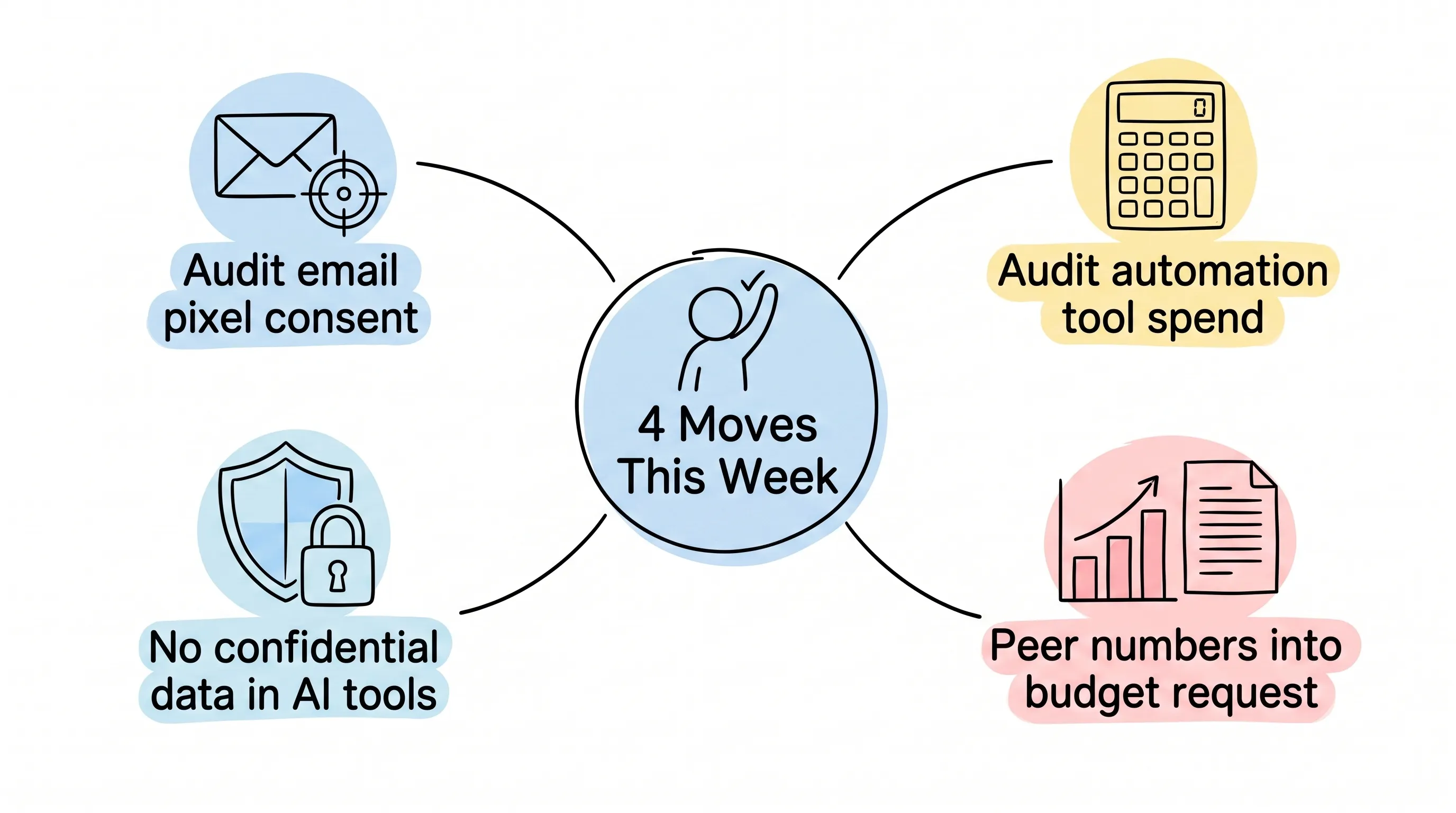
The third reminder I read in today's pile is the speed gap between efficiency and compliance. On the tool side, new plays arrive within a week; pixel consent and AI targeting authorization tightened in that same week. Every hour you grab on the efficiency side can be paid back on the compliance side, and with the fine amount and the cost of editing a template laid side by side, you don't need a calculator for that one. Four actions for this week: audit pixel consent wording across your email templates; take stock of what your automation tools actually cost in fees and labor; write two peer numbers from the case library into your next budget request; and add a "no pasting confidential data" clause to your team's AI ground rules. The homework is all on the table, and how deeply you copy it decides the gap.
Continue reading
Related articles

AI Marketing Daily · 2026-10-09
AI marketing daily for 2026-10-09 covering 11 items: brand measurement moving from survey panels to search, social, e-commerce, and AI prompt signals; GEO and share of model playbooks; safety guardrails for agentic ad buying; and tool roundups for ad platforms, cross-border tools, and social media uses.

AI Marketing Daily · 2026-10-08
AI Marketing Daily for 2026-10-08 curates 20 items across AI search visibility (GEO), advertising, platform selection, cross-border e-commerce, and ROI measurement. The headline argues that strategic marketing decisions should stay with humans while AI assists execution.

AI Marketing Daily · 2026-10-07
Today's throughline is answer engine optimization (AEO — getting your brand quoted in AI answer engines).