
AI Marketing Daily · 2026-09-07
A daily AI marketing digest centered on Google's AI Max migration for Search ads, covering reporting changes, the migration timeline, experiments, and official performance data. It also tracks ChatGPT's reduced Reddit citations, AI disclosure guidance, and AI tool selection for multi-location brands.
Google is pushing AI Max toward becoming the default state of Search ads, and the September migration window is already running — four of today's nine items orbit around it. Report fields, landing URLs, the migration timeline, and official performance data all landed in the same news cycle, and search teams can't get around it this week. The other thread runs through AI search entry points: two weeks ago, ChatGPT's rate of citing Reddit plummeted 86%, and brand entity lists now appear before the search itself. Disclosure data, tool selection, and failure post-mortems round out today's list.
🎯 Today's Headline
Google Ads AI Max Migration Is Underway: Reporting Takes the First Hit — Five Actions to Complete Within September
From September 1 to 30, Google is automatically upgrading two types of Search campaigns: those with campaign-level broad match enabled, and those using automatically created assets (ACA). DSA (Dynamic Search Ads) has been pushed to February 2027 — Q4 plans built around the old dates actually gain a few months of breathing room. On September 2, Improvado checked the upgrade line by line against Google's official documentation, taking the data-pipeline perspective — a contrast to the flood of UI how-to guides. Two key facts to pin down first: AI Max is a settings layer on existing Search campaigns, not a new campaign type, and campaign IDs and account structure carry over untouched; and since August 3, Google has frozen the creation of these two legacy configurations, so the set of affected campaigns is fixed and enumerable today. On how historical data rows are handled, the official documentation offers no guarantees — only a first-week-of-October check against your own exports will settle it.
Why does reporting take the first hit? The upgrade adds three reporting surfaces to the API. segments.search_term_match_source labels the origin of every search term, with three possible values: keywords provided by the advertiser, AI Max broad match expansion, and AI Max keywordless matching. That third value puts keyword-free traffic on the books for the first time — spend models built around keywords will start receiving an "other" bucket that keeps filling up. ai_max_search_term_ad_combination_view breaks the combination of search term, landing page, and headline down to its finest grain — the layer where AI Max's decisions actually happen. expanded_landing_page_view, carrying expanded_final_url, exposes the URL that was actually served. And the campaign.ai_max_setting.enable_ai_max field turns "which campaigns got upgraded?" into a one-query answer. Google also warns that the search terms report and the AI Max combination view overlap — never sum metrics across the two views — and that privacy filtering leaves some keyword-level rows missing. Reconciliation can only anchor on campaign-level totals.
For marketers, the impact concentrates on final URL expansion, the silent breaker. It routes traffic to pages on your site more likely to convert — which means the URL visitors actually land on no longer matches the URL configured in the ad. Most marketing data models lean heavily on that assumption: landing page URLs get parsed for UTM parameters, grouped by path into content categories, joined with CMS exports to enrich page details, and stitched with on-site analytics into sessions. When the assumption breaks, there is no error. Rows don't vanish — they fall into the "other" bucket or get attached to the wrong page group, and a category's measured performance quietly sags. The UI has its own trap: filtering AI Max by match type undercounts, because that filter excludes Other search terms — UI numbers will never reconcile with API segment data. The measurement break lands the same day the migration does; if cross-channel attribution sits on distorted landing page data, October's reports could ship a whole batch of false signals.
The interface side has its own set of counterparts — sync your team first if anyone reconciles from screenshots: the search terms report gains a Search terms and landing pages from AI Max view, the match type filter gains AI Max values, and the source column has to be added manually; the keywords report gains two summary rows at the bottom, totaling AI Max expanded matches and landing page matches; the landing pages report gains a Selected by column showing whether AI Max chose the URL; and the assets report gains an expanded final URL assets tab, where Google-generated text assets are labeled Google AI under Added by.
How to act. Five steps, all doable within September. Step one: immediately snapshot the enable_ai_max field for every campaign in every account — without a pre-migration snapshot, you'll never be able to say later which changes Google made and which were made by humans. Step two: re-pull the same field weekly; the diff is your migration log. Step three: segment the search terms report by match_source from day one, so keyword-free traffic gets quantified the moment it appears — don't wait for the quarterly review to find out. Step four: record expanded_final_url side by side with the configured URL, monitor the discrepancy rate per campaign, and re-anchor your page-grouping logic to the URL actually served. Step five: make your opt-out call campaign by campaign before the end of September, and document it. Mind the switch hierarchy: search term matching must be enabled at the campaign level before it can be narrowed at the ad group level — switching it off only at the ad group level is the same as not switching it off; text customization and final URL expansion can be turned off independently. For the query skeleton, use the official shape: select campaign ID and name, search term, match_source, impressions, clicks, and conversions from search_term_view, with WHERE conditions limiting to the two AI Max sources and the last 30 days; once it runs clean, pipe it into your own stack.
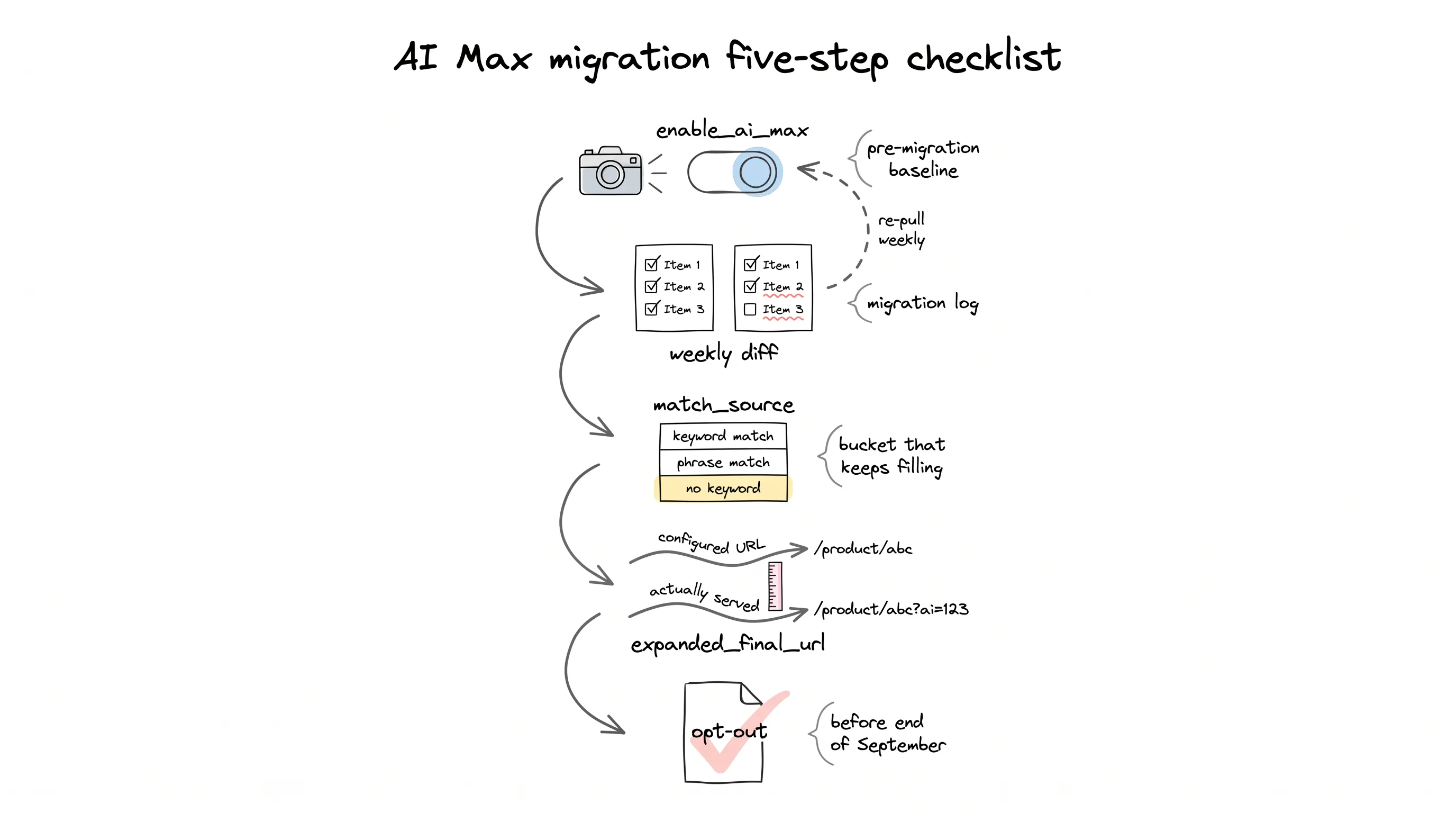
My take: the easiest piece of homework to skip in a migration month — and the last you should skip — is the measurement side. Performance data needs weeks before it says anything; the measurement break is effective that very day. Secure measurement before chasing performance: once the pipeline is stable, your A/B tests stand on clean ground whether you run all three features or keep only search term matching. One more note on sourcing: this piece comes from a data-warehouse vendor's blog and carries the usual funnel toward its own product — but the five-step checklist and the query shape don't depend on that product; copy them as-is. Don't let opt-out happen by default. Three months from now, someone will inevitably ask: was this our choice, or something we passively accepted?
🔗 Further reading: Read the full article
🏷 Product Launches
AI Max Experiments Add Brand Controls: Teams That Should Test Can Start This Week
Google's August 20 announcement bundled three things into one message, but they sit in two different states. Multi-campaign A/B testing (testing budget and ROI targets across multiple Search campaigns) is explicitly flagged for a September rollout; the brand and location controls inside experiments, plus Performance Planner's forecasted impact with one-click apply, are written in the present tense with no rollout qualifier attached. Digital Applied verified each item against the official help documentation: brand inclusions and exclusions live in step 5 of experiment setup, and the page carries no beta label; guardrails apply symmetrically to the control and experiment arms; and if the experiment isn't applied, all AI Max settings roll back automatically and the base campaign returns to its original state. Location control is a documentation gap — the blog sentence mentions it, but the experiment workflow help page has no corresponding step, so only what your account UI actually shows counts. Flash coverage published the same day flattened all of these timing differences. Also, this experiment mechanism differs from old-style custom experiments: it splits traffic within the original campaign instead of duplicating it. But six settings will block an experiment from being created: text customization already enabled, serving on the Display Network, using portfolio bidding strategies, shared budgets, bidding exploration, and an experiment already in progress.
The announcement also carries a layer of time pressure worth writing into your plans: campaigns with ACA or campaign-level broad match start auto-upgrading on September 1, and rather than passively inheriting the default guardrails, use a voluntary experiment to choose your settings first. Google Ads API v25.1 added two fields on August 19 — aca_migration_date_time and broad_match_migration_date_time — and Google hasn't said whether they'll be populated before migration. Treat empty values as unresolved, re-query on a schedule, and don't read them as reassurance. Manual language targeting will also be removed from Search and AI Max in late September — this month's change list runs longer than this one announcement.
For teams that refused to test AI Max over brand safety, this documentation dismantles the objection: guardrails set once, symmetric across both arms, roll back if not applied — the risk is contained. The sequence is clear. First, screen your campaigns against the six blockers to see which are even eligible — shared budgets and portfolio bidding are the most common blockers in large accounts. Then launch the experiment, configuring brand inclusions and exclusions in one pass in setup. Run Performance Planner in parallel, with changes reversible anytime via Bulk actions — practice on existing campaigns first, and note that its one-click apply covers only bidding and budget targets, so don't extrapolate it to assets and targeting. As for that half-sentence on location control: if the step doesn't show up in your account, don't write it into your test plan.
🔗 Further reading: Read the full article
The Full Migration Timeline: Don't Miss the Developer-Side API Sunset
On August 14, Search Engine Land strung the migration's complete set of dates into a single line. August 3: the UI, Editor, and API all stopped allowing new legacy configurations — the side effect being that the set of affected campaigns is frozen from that day on, countable today. September 1 to 30: campaign-level broad match and ACA migrate automatically, in place, with equivalent settings mirroring the old configuration to minimize disruption, and brand inclusions and exclusions inherited automatically. From September, DSA users see a voluntary upgrade prompt in their accounts. January 15, 2027: a second reminder. February 1 to 28, 2027: DSA auto-migrates, and creating new DSA ad groups is permanently shut off. The developer-side dates are what most coverage left out: new versions of the Google Ads API released after September 1 will remove the legacy broad match and ACA entities, with older versions supported until their sunset around September 2027 — per the migration announcement on Google's developer blog. Google recommends auditing your scripts and tools now and replacing whatever still references legacy structures.
The API sunset item is for the technical team: September 2027 looks far away, but an unowned old script will drift right up to the deadline. Go through the reference surface of every script under your MCC (your Google Ads manager account) now and flag which ones still read legacy fields; on the account side, set your audit cadence to this timeline — once the migration wraps at the end of September, verify campaign by campaign that mirrored settings match expectations, and never mistake defaults for configuration.
🔗 Further reading: Read the full article
Official Benchmark: Running All Three Features Averages 7% More Conversions
Google's official blog has supplied the performance anchor for this migration. First published April 15 and updated June 11, the post marks AI Max formally exiting beta, with hundreds of thousands of advertisers worldwide already using it. Official internal data shows that running all three features (search term matching, text customization, final URL expansion) delivers on average 7% more conversions or conversion value than search term matching alone, at flat CPA and ROAS; a footnote specifies that the sample is non-retail advertisers. The migration uses a mirroring mechanism to keep performance stable: DSA users' active ad groups convert to standard ad groups, with the upgrade tool carrying over historical settings and data wholesale, and legacy URL controls stay in place; ACA campaigns default to search term matching and text customization; broad match campaigns default to search term matching only. Google's posture is equally clear: don't wait for the automatic upgrade — migrate proactively with the upgrade tool to keep control of your settings, then use one-click experiments to assess the performance impact, and the update's callout outright recommends turning all three on. The upgrade tool becomes available to DSA users this week; ACA and broad match users should watch for the UI banner entry, with all upgrades expected to wrap by the end of September.
Use 7% as a baseline, not a promise — the sample is non-retail and the number comes from the platform itself. Two things to do: since the migration is unavoidable anyway, migrating proactively at least preserves your say over settings; and set aside baseline data from before and after the migration, then use a one-click experiment to test whether 7% holds in your account before deciding between all-in and conservative enablement. For the reporting side, lift the five steps from the lead story directly.
🔗 Further reading: Read the full article
🏷 AI Model Updates
ChatGPT's Reddit Citations Plummet 86% — It Names Brands Before It Searches
Two Octobers' September monthly report (published September 1) strings together several shifts worth examining on their own. The EU AI Act's transparency obligations took effect August 2: new businesses comply immediately, incumbents get a four-month grace period, and any synthetic text, image, audio, or video made to pass as real must carry visible labeling and digital watermarks — The Guardian's coverage frames this as targeting deepfake-style disinformation. Anthropic then disclosed how Claude's watermarking works: particular words are picked from outputs so that each looks random on its own but together they form a machine-detectable pattern, applied equally to generated content inside and outside the EU. Some practitioners worry this will deepen content homogenization; the author judges the impact on Google rankings limited, since Google doesn't penalize AI content with unique value — the blast zone is low-effort content published as-is. Promptwatch's data shows that from mid-August, the share of ChatGPT replies citing Reddit plummeted 86% and has held steady for about two weeks. Suganthan Mohanadasan found an earlier change in ChatGPT's conversation source code: before crawling web results, ChatGPT first generates a shortlist of known brand entities from its training data to search against — ask it for the best AI note-taking app and it searched Granola, Notion, and Otterly first. The author himself flags this as correlation, not causation; other factors may be at play. On the paid media side, Display retires within the year and merges into Demand Gen — the migration itself isn't hard, and YouTube placements aren't mandatory, but Demand Gen becomes the only campaign type that keeps similar (lookalike) audiences; the budget threshold drops from $100/day or 20× tCPA (target cost per action) to 10× tCPA, effectively lowering the entry bar for smaller advertisers into the auction; Google also added a branded search conversion type, measuring the branded search lift from video over a 7-day window. Offline conversion uploads later than 7 days still make it into reports but no longer participate in data-driven attribution. Meta AI has connected Meta ad accounts with Google Workspace, producing paid-social creative opportunities, budget optimization, and reporting insights inside Gmail, Docs, Slides, and Sheets.
GEO's playbook is due for a change of tracks. The payoff from visibility tricks like stacking Reddit exposure is shrinking: the model recognizes brands before it searches, and small brands outside the entity list get fewer chances to be recommended at all. The countermeasure is slow work, but the compounding is real: shift budget and headcount up a notch toward brand building. Three small moves you can make this week: EU-facing operations should wire AI labeling and watermarking into the publishing workflow; ride the halved Demand Gen budget threshold to get your structure running smoothly on small budgets first; and close the loop on offline conversion uploads within 7 days of the conversion — later than that, the upload is wasted.
🔗 Further reading: Read the full article
2025 Brand AI Failures, Reviewed: What Deloitte's Two Citation Incidents Cost
In May, Admind reviewed a batch of 2025's brand AI incidents — cases that still hold up as reference points today. Paramount's AI promo video was panned as lifeless; comments were shut off, the video quietly pulled, and the story spread even wider. Glasgow's Willy Wonka experience sold tickets on AI dreamscapes and delivered an empty warehouse; the actor playing Wonka was handed a 15-page script of AI-generated gibberish, police showed up, and families demanded refunds. Coca-Cola used AI for its Christmas ad a second straight year, got called soulless — viewers caught the shifting truck outlines and wheels and the plastic-looking animals — and an executive's response that the genie was already out of the bottle lit another round of backlash. Large holiday productions typically run $1–3 million, and AI can cut 60–70% of that, but two straight years of negative headlines rewrote the math. McDonald's Christmas ad in the Netherlands backfired the same way: a surreal winter scene slammed as soulless, comments closed, the whole thing pulled — which only amplified the spread. Deloitte's bill was more concrete: the Australia branch produced a $290,000 government report in which researchers found fabricated citations — including a real professor attached to a nonexistent book; the institution confirmed it and issued a partial refund plus a rewrite. Then the Canadian government's roughly C$1.6 million, 526-page report surfaced invented papers too, with researchers who had never collaborated grouped together as co-authors. Meta's AI personas came under joint pressure from 44 state attorneys general after internal safety standards were found to allow boundary-crossing conversations with minors. The positive contrasts are just as clear: H&M built digital twins for 30 real models, with licensing controlled by the models themselves; Nutella generated 7 million one-of-a-kind jar labels within defined color and composition rules, winning sales and buzz together; Heinz had AI draw its ketchup — whatever the prompt, the output looked like its own product — earning 1.15 billion earned impressions, 38% higher engagement than past campaigns, and 2500% media ROI.
The post-mortem draws a straight dividing line: AI as the execution engine with humans guarding strategy and facts produces results; AI setting strategy with unchecked publishing produces incidents. The handoff for your team: write five gates into the process — cultural review, independent fact verification, ethics around real-person material, emotional tone, and disclosure compliance. Block citation-type errors with mandatory verification; keep human final review for holiday and emotionally driven creative — that's the zone where the uncanny valley bites hardest. Take part of the production budget AI saves and spend it on review hours first.
🔗 Further reading: Read the full article
🏷 Industry Data
IAB's First AI Disclosure Framework: A 37-Point Gap Between Advertiser Optimism and Consumer Coolness
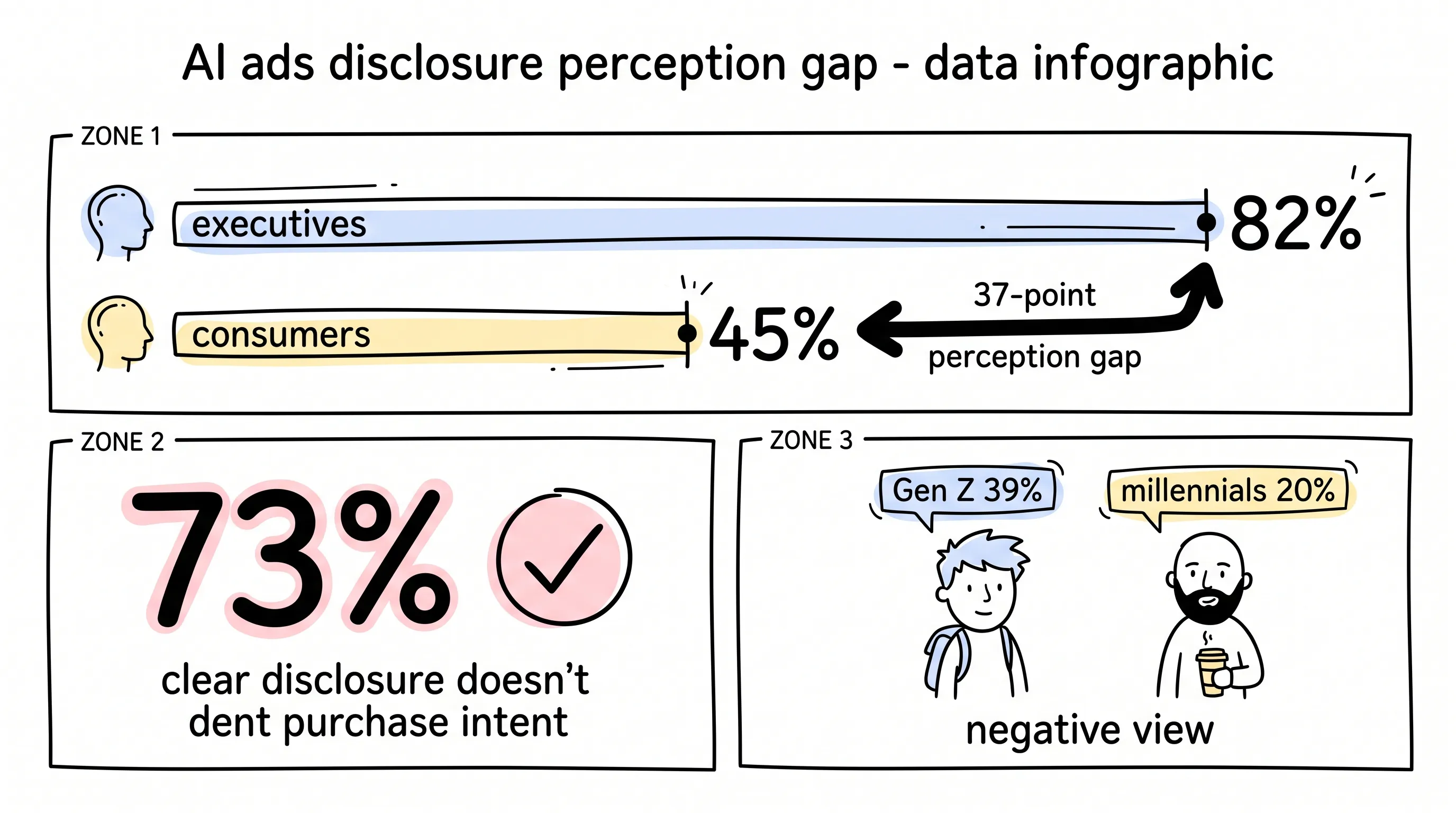
In January this year, IAB released the industry's first AI transparency and disclosure framework, built on risk tiering — no blanket labeling of all AI content, to avoid disclosure fatigue. Mandatory disclosure kicks in only when AI materially affects authenticity, identity, or presentation and could mislead consumers; six situations are listed: images or video generated from prompts; a deceased person's voice saying things they never said; a living person's voice discussing events that never happened; digital twins of the deceased; digital twins of living people performing fictional scenarios; and synthetic avatars and conversational ad assistants that simulate real-person interaction. The mechanism has two layers: on the consumer side, standardized labels, badges, or hover prompts placed next to the asset rather than on top of it; on the machine side, C2PA metadata (the content-provenance standard) for technical compliance. The companion Sonata Insights survey, fielded between October 2025 and January 2026, polled 505 Gen Z and millennial consumers and 104 executives from companies spending a million dollars a year or more: 82% of executives believe young people feel positively about AI ads, when only 45% actually do — a perception gap that widened from 32 points in 2024 to 37 points; 39% of Gen Z hold a negative view, versus 20% of millennials, who describe brands using AI as inauthentic, out of touch, or unethical; consumers lean toward manipulative (20% vs 10%) and unethical (16% vs 7%) to describe AI-using brands, while executives prefer words like innovative (46%) and unique (44%); more than half of respondents want brands to state whether an ad is fully AI-generated; and 73% said clear disclosure would raise or leave unchanged their willingness to buy. IAB's position: get transparency wrong and what you lose is the trust the entire value exchange rests on; organizations that adopt the framework early are banking trust and regulatory readiness at the same time — and it invites advertisers, agencies, media, and platforms to publicly commit to four principles: transparency, proportionality, consistency, and clarity.
The 73% figure belongs on the meeting-room wall: disclosure doesn't dent purchase intent — it is trust-building, at a cost far below post-hoc PR. Doable this week: copy the six mandatory disclosure situations into your creative approval checklist — anything involving synthetic humans or photoreal assets gets labeled and written into C2PA metadata; and with regulatory momentum building behind the EU AI Act and US state laws, aligning early is cheaper than remediating late. When you report to management, put the 82-vs-45 perception gap on the table: executives' gut feel is no substitute for consumers' felt experience.
🔗 Further reading: Read the full article
🏷 Marketing Tools
How Multi-Location Brands Should Pick AI Tools: Integration Comes First — Get the Order Wrong and the Money's Wasted
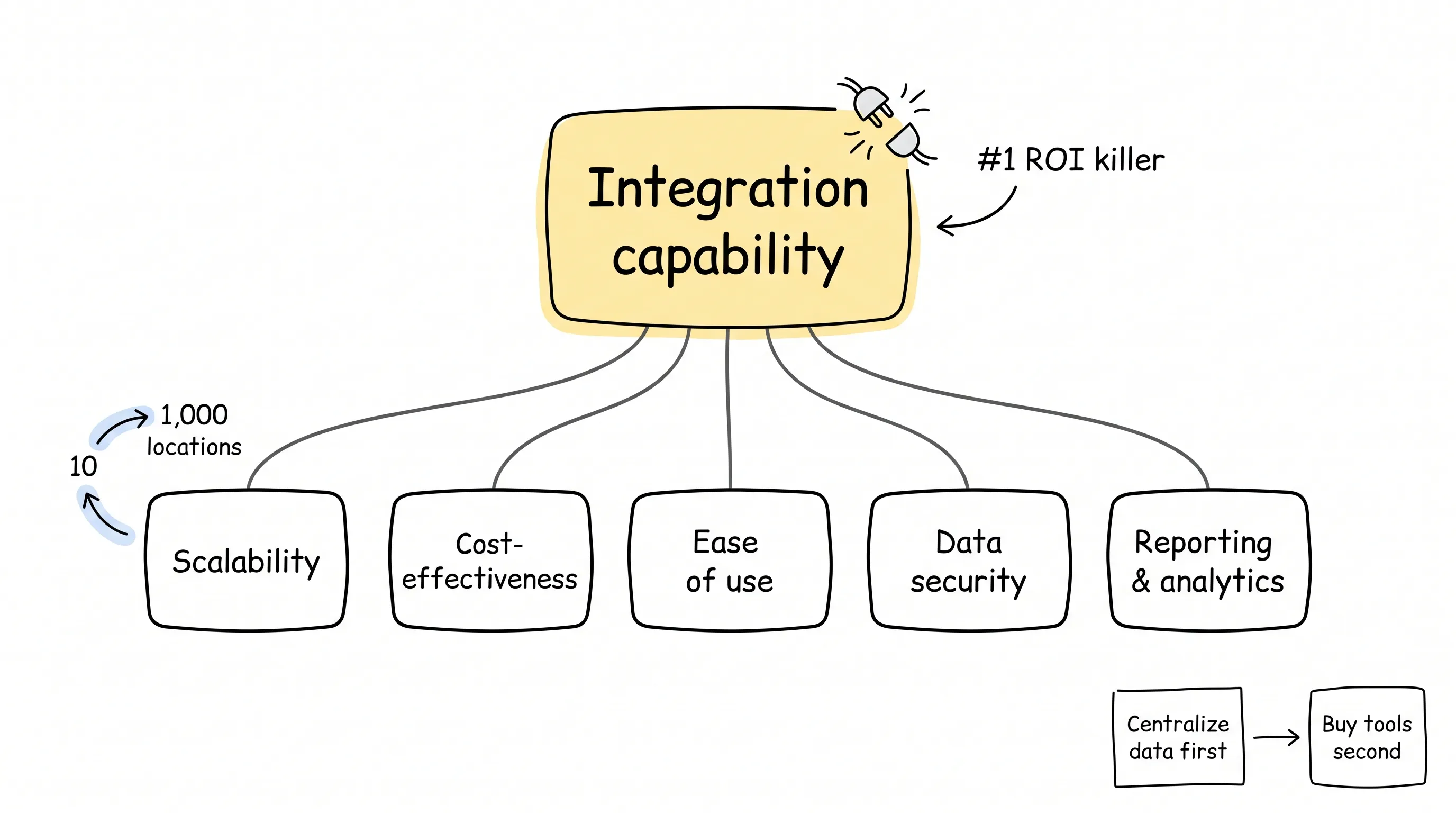
Michelle Hummel's August 22 selection guide targets multi-location and chain brands. She starts with six pain points: cross-location brand consistency, data silos, scale that outstrips staffing, localized optimization, budget allocation, and performance tracking. Her evaluation framework has six dimensions — integration capability, scalability, cost-effectiveness, ease of use, data security and compliance, and reporting and analytics — with integration called out as the number-one ROI killer: manually shuttling data eats every gain automation delivers, and the tool must scale from 10 locations to 1,000 without a rip-and-replace. The tools come in four categories. For local SEO and reputation management, look at Yext, BrightLocal, and Podium — covering automated Google Business Profile optimization and posting, AI review responses (with human oversight), cross-location sentiment analysis, local keyword tracking, and duplicate listing cleanup, with Podium's AI assistant also triaging inquiries and drafting replies. For content generation and personalization, look at Jasper, Copy.ai, Optimove, and Braze — the focus being location-aware copy generation and journey-level personalization. For ad optimization, look at Marin and Skai, which layer third-party platforms on top of Google Smart Bidding for a cross-channel view, localized customization, and fraud detection on anomalous spend. For CRM and customer service, look at Salesforce Einstein, Zendesk, and HubSpot — service bots answering 24/7, complex questions routed to local stores, churn prediction and lead scoring assigned by location. The rollout path comes in five steps: small-scale pilot, data centralization, training, human review, and continuous optimization.
Franchise and chain teams should move in this order: centralize data first, buy tools second — reverse the order and ROI zeroes out. In scoring tools, put the ability to connect to your existing CRM and POS ahead of feature richness; circle 3 to 5 locations for the first pilot, with review-response tools first in line — that's where ROI is most direct; keep sensitive complaints and brand voice human. When persuading franchisees, lead with hours saved and lead lift — it works better than a feature-by-feature pitch. The list applies to single-location businesses and small operations too: local SEO, content, and ad optimization tools hit small operations most directly, and most of them offer scale-based pricing tiers.
🔗 Further reading: Read the full article
AI Content Marketing: A Foundational Checklist of Opportunities and Risks
A late-March overview from Kinetik Agency — consensus content, no exclusive data. On the opportunity side, four items: efficiency and productivity, cost-controlled scaling, personalization at scale, and data-driven insight. On the risk side, four: diluted brand voice, where output reads smoothly but is really generic; factual errors, because models generate from patterns with no real-time verification; copyright and compliance gray zones — the piece recommends proactively disclosing AI use to build trust; and over-reliance on automation, which erodes the team's creative thinking. Three balancing strategies: humans own the strategic direction, every piece gets a human editorial review before publishing, and the team keeps training. Four use cases are circled: outline drafts for blog and SEO content, e-commerce SKU descriptions, social media and ad copy variants, and segment-level email personalization. The article's premise is that content demand spans website, social, email, and paid advertising, and the team has to hold the publishing cadence without adding headcount. Its judgments line up with practical experience: the most effective use cases are fast-turnaround, high-variant content types, while long-form and in-depth content still depend on human polish. The outlook names voice search optimization, predictive content generation, and AI-assisted video as the next growth slots — while consumer expectations for authenticity and transparency only climb higher.
This one works well as an onboarding framework for a new team, and it gets one often-missed thing right: once AI compresses first-draft time to minutes, human hours should move toward strategy and message refinement — not toward writing more. Set rollout priorities by scenario: feed the high-variant short content first — ad headline variants and SKU copy — and leave blog long-form for later; make fact-checking and tone review hard gates before anything publishes; and in the copyright gray zone, proactively disclosing AI use is the cheapest trust-building move there is.
🔗 Further reading: Read the full article
💡 Today's Big Picture
Four of today's nine items tell the same story: Google has moved AI Max from an option to the default state of Search ads. One covers how reporting changes, one how to open experiments, one lays out the complete dates, one gives the official performance framing — only together do they form the full migration picture, and any single item on its own easily misses the silent parts. The biggest risk inside the migration window isn't performance, it's measurement. Report fields change, landing URLs change, the join assumptions in attribution pipelines fail — the numbers distort first, then decisions lose their footing. The lead story's five actions are worth assigning today; they cost a few queries. Skip them, and the price is October's batch of false signals.
The other thread hides in the remaining items. ChatGPT now recognizes brand entities before it searches, the EU mandates AI content labeling, and IAB uses a 37-point perception gap to remind the industry what disclosure is worth — all three point the same direction: visibility and trust in AI channels increasingly feed on brand equity, that slow-moving variable. The window for tactic-driven playbooks is closing; the payoff curve for Reddit hacks and quick-trick presence plays has already turned down.
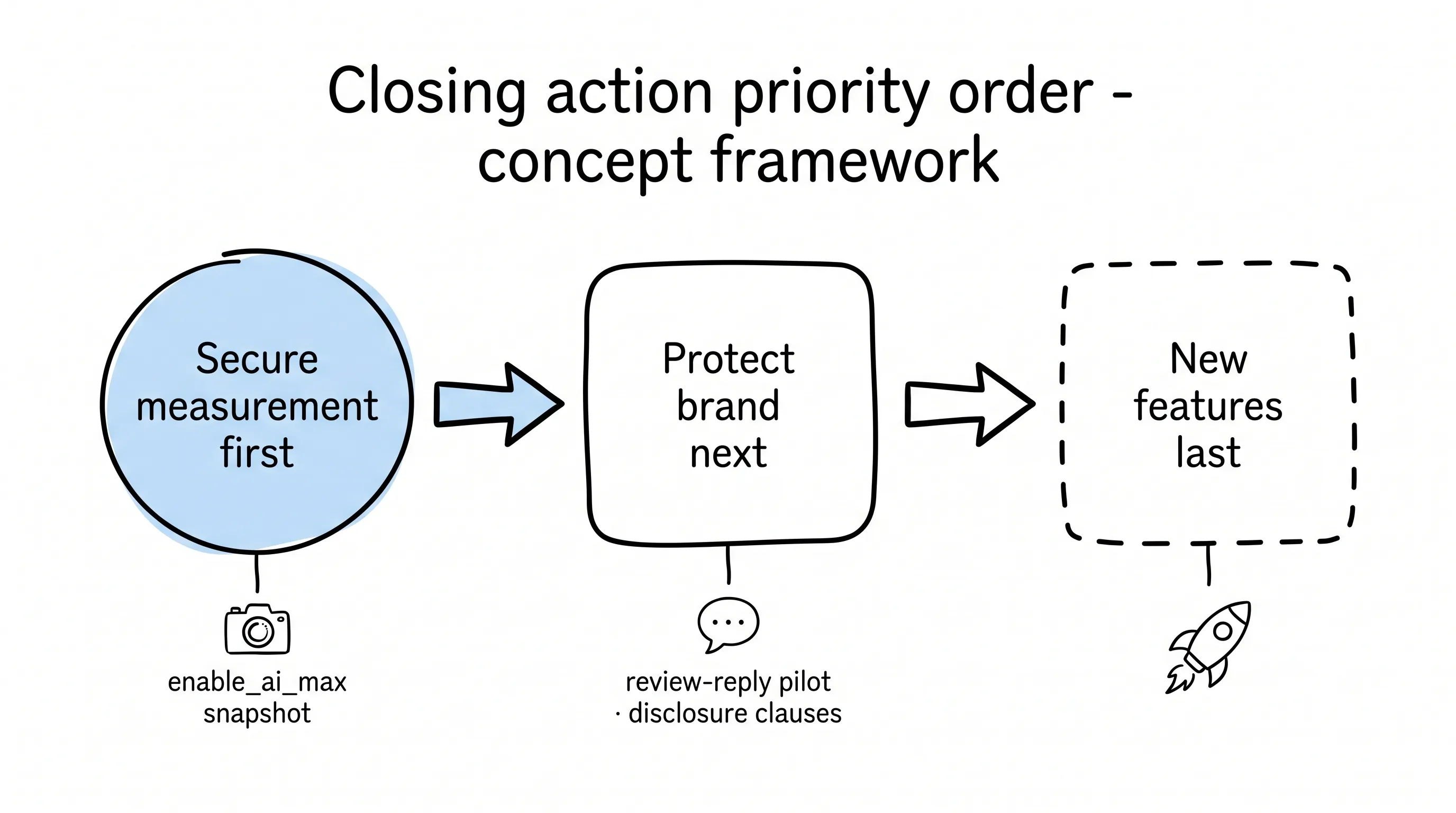
The execution divide is now on the table. Same set of capabilities: Heinz turned it into 2500% media ROI; Deloitte paid two government-report refunds for it. The only difference is where human oversight was installed. If you have time for just three things: get the enable_ai_max snapshot running, connect AI review responses in one or two store pilots, and add disclosure clauses to the creative approval checklist. Measurement first, brand second, new features last. Run the order in reverse and the rework gets expensive.
Continue reading
Related articles

AI Marketing Daily · 2026-10-09
AI marketing daily for 2026-10-09 covering 11 items: brand measurement moving from survey panels to search, social, e-commerce, and AI prompt signals; GEO and share of model playbooks; safety guardrails for agentic ad buying; and tool roundups for ad platforms, cross-border tools, and social media uses.

AI Marketing Daily · 2026-10-08
AI Marketing Daily for 2026-10-08 curates 20 items across AI search visibility (GEO), advertising, platform selection, cross-border e-commerce, and ROI measurement. The headline argues that strategic marketing decisions should stay with humans while AI assists execution.

AI Marketing Daily · 2026-10-07
Today's throughline is answer engine optimization (AEO — getting your brand quoted in AI answer engines).