
AI Marketing Daily · 2026-09-06
AI Marketing Daily roundup covering three tool comparison articles, enterprise agentic platform updates, five brand GenAI case studies, GenAI marketing risk guidelines, and a Europe social media AI market report. It frames AI marketing automation procurement season with a focus on data cleanup before tool selection.
Today's raw material packs in three tool roundups, one European market report, a set of risk ground rules, and five big-company case studies. The theme can be said in one sentence: AI marketing automation has entered a concentrated procurement season, and the watershed has shifted from which platform sends email smoothly to whether AI has a seat at the decision-making table. Start with the headline roundup of 12 platforms, then cross-check it against data foundations, enterprise agentic moves, risk bottom lines, and the size of the European market — one day to complete your platform-selection homework.
🎯 Top Story
The 2026 Roundup of 12 AI Marketing Automation Platforms: AI Has Moved from the Writing Button to the Decision Layer
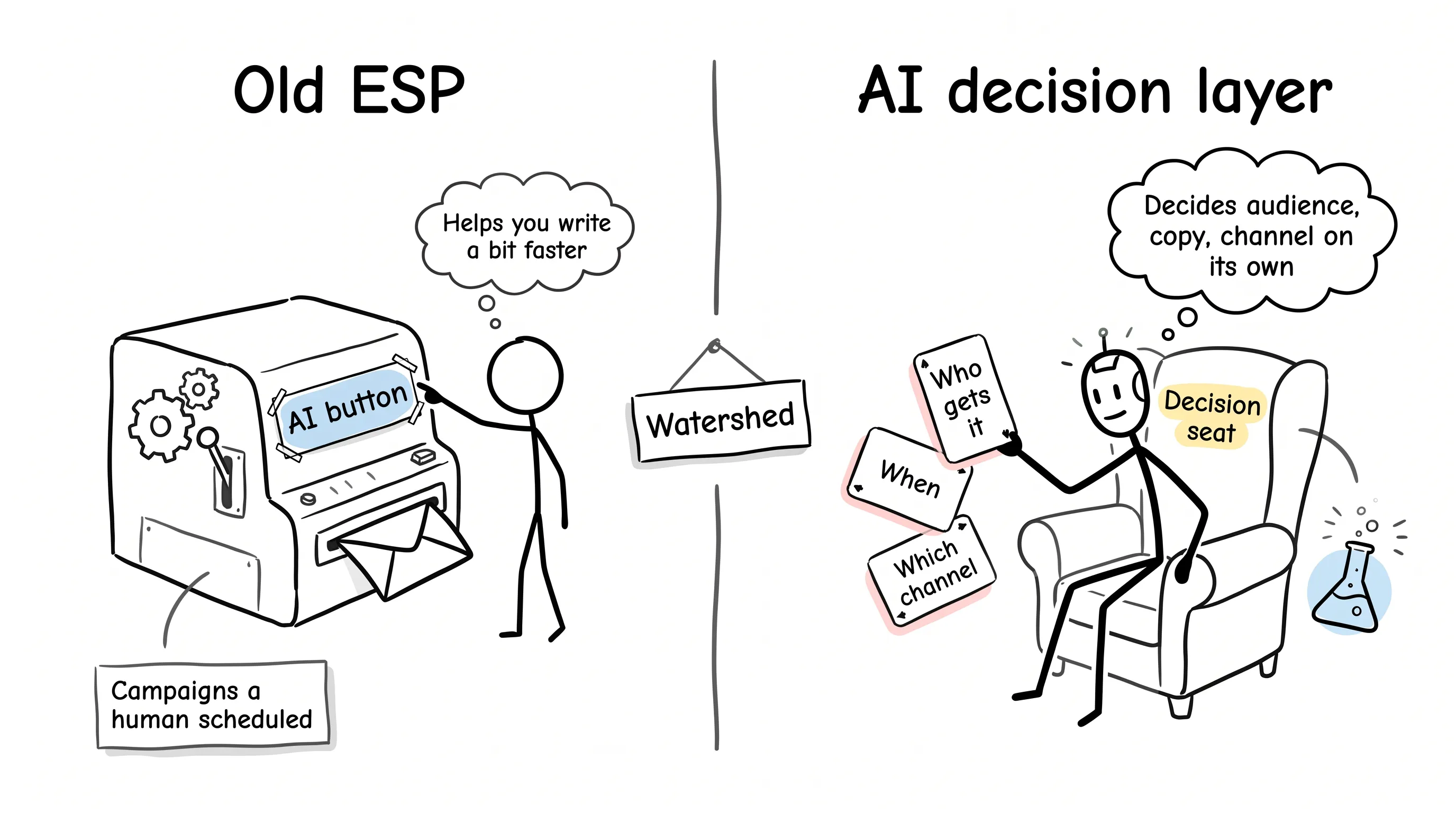
Ayautomate has published a comparative review of 12 AI marketing automation platforms for 2026, and its opening judgment is blunt: by 2026, the question has become which platform lets AI autonomously decide the audience, the copy, and the channel — and see experiments through to the end, with no one babysitting the process. The article sorts the tools on the market into three categories. The first category is prediction engines built around customer data: Klaviyo leans on the naturally tidy shape of e-commerce data to serve up customer lifetime value, churn risk, and next-order date, then feeds those predictions back into workflows, segmentation, and variant-level copy — and the AI can also, on the side, generate subject lines and SMS copy in your brand voice. The second category is pure generative copy assistants; Jasper survived the shakeout after 2023 on the strength of brand voice and knowledge bases. The third category is cross-channel orchestration platforms with AI wired into the plumbing: Iterable's AI Optimization Suite tunes send times, channels, and content variants per person, while Braze's Sage AI covers Canvas journey generation and intelligent channel selection.
The roundup's answers for specific scenarios are equally concrete. HubSpot Breeze is the all-in-one default for small-to-midsize teams: Breeze Copilot sits inside every Hub — marketing, sales, service — drafting content and summarizing deals, while Breeze Agents handle prospecting, content, support triage, and social media; Marketing Hub Professional starts at about $890 a month. Customer.io is the first choice for PLG (product-led growth) event-driven messaging — Notion and Linear both use it — where every trigger starts from a product event rather than a marketing list, and email, in-app, push, SMS, and webhooks all run along the same journey. Adobe Marketo with Sensei targets enterprise B2B ABM (account-based marketing): annual contracts typically run $30,000 to $250,000 or more, and the depth of its smart lists and scoring models comes with real operational overhead — most Marketo customers keep dedicated marketing-ops staff on payroll. Mailchimp, rebuilt under Intuit into a small-business marketing platform, offers Intuit Assist, which can spin up an entire campaign from a single prompt; the Standard tier starts at $13 a month. Drift has been folded into Salesloft and handles conversational marketing on the website side, with AI agents taking care of qualification, meeting booking, and routing. Persado does message optimization with its own language-performance dataset; its customers cluster in regulated industries like banking, insurance, retail, and telecom, every variant must pass governance, every lift must be measurable — in banking, a one-percentage-point lift is a seven-figure business.
This roundup is worth keeping as a procurement shortlist, because it spells out the easiest traps to step into. Marketing pages blur the boundaries between the three tool categories, and procurement teams often end up paying for three overlapping tools that fight each other. There is only one litmus test: does the AI actually change who gets messaged and what gets sent? If it just helps a marketer finish an email a little faster, that's an old ESP (email service provider) with an AI button stuck on it; if it can decide whom to message, when, and on which channel, only then has it entered the decision layer. The price bands stretch wide, too. Brevo starts at $9 a month, billed by send volume, with a free tier of 300 emails a day; ActiveCampaign's marketing plan starts at $19 a month, and Jasper Creator is $39 a month; Klaviyo is free up to 250 contacts, with mid-size customers paying $500 to $5,000 a month; Iterable runs $50,000 to $200,000 a year for mid-market; Braze, Marketo, and Persado are six-figure annual contracts. Pick from the wrong tier and the cost gap is a hundredfold.
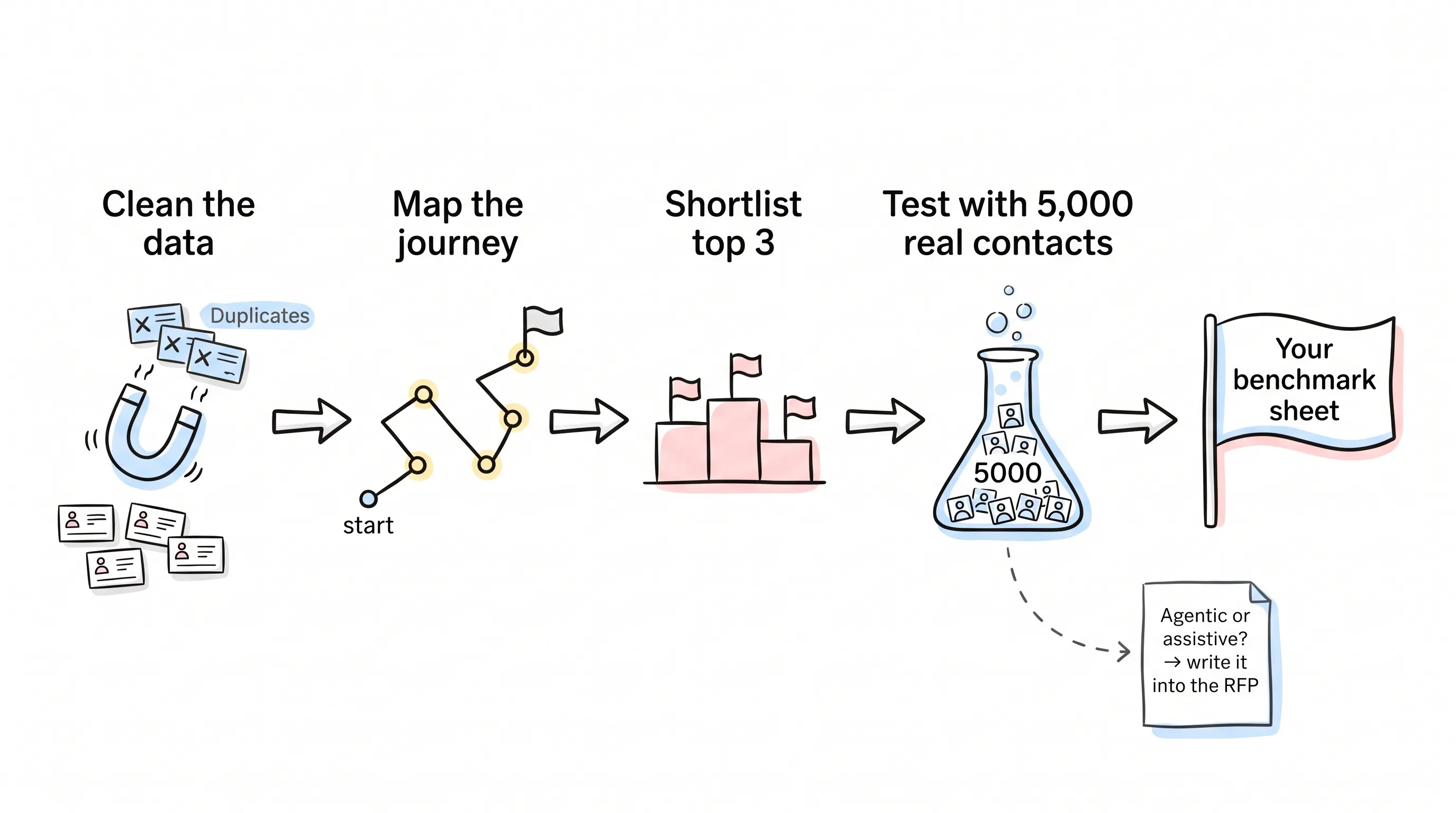
The selection framework comes down to four questions, and the first two sting the most. Question one is your business model: e-commerce DTC (direct-to-consumer) brands look at Klaviyo first, and move up to Iterable or Braze once scale and channel complexity outgrow it; enterprise B2B pairs Marketo, HubSpot Enterprise, and Drift; PLG SaaS almost always lands on Customer.io or Braze. Question two is engineering resources — the article calls it the most underestimated filter. Customer.io, Braze, Iterable, and Persado assume you can emit events from your product, plug into a CDP (customer data platform), and staff a lifecycle-ops function; if your team is one growth marketer and zero engineers, don't touch Braze; conversely, teams with a real platform organization shouldn't settle for Mailchimp. Question three is the decision-layer test described above. Question four concedes that you still need an orchestration layer above the platform: workflow tools like n8n and Make handle cross-tool sync, data enrichment, and custom AI agents. The article's own words: pick the right platform but ignore the orchestration layer, and you'll still be shipping in the wrong system. It even offers a trial recipe: import 5,000 real contacts, build a three-step journey with branching, use the AI layer to generate the copy, then look at deliverability, segmentation accuracy, and reporting depth. Demos are theater; real campaigns are where the truth comes out. It also gives one-line answers to two common questions. How is AI marketing automation different from an ordinary ESP? An ordinary ESP sends campaigns a human has scheduled, while an automation platform takes part in deciding segmentation, generating variants, and choosing send times and channels — the line is blurring, but the test doesn't change. Should you add a workflow layer like n8n on top of the platform? Past a complexity threshold, almost always yes — platforms are strong within their own walls, and cross-tool orchestration, data enrichment, and custom agents are their weak spots.
Three things you can do this week. First, lay your current tech stack out on a single sheet, sort every tool into the three categories, and mark overlaps in red — that's your justification for cutting budget. Second, shortlist your top three by business model and book demos only with those, handing each vendor's sales team the 5,000-contact trial recipe verbatim to see who can actually run with it. Third, filter yourself with the engineering-resources question: no engineers means locking in the engineering-free options — HubSpot, Mailchimp, Brevo, and ActiveCampaign. A few budget anchors are all you need: SMB teams spend $20 to $1,000 a month, mid-market $1,000 to $10,000, enterprise five to six figures monthly — if a quote lands outside that band, ask why.
The roundup comes from an agency blog, its recommendations carry a lead-gen motive, and a few platform descriptions are embellished — keep that filter on as you read. But the trend it calls out is real: the AI writing button bolted onto an old product is no longer a selling point; a seat in the decision layer is the competitive high ground of 2026. What I value more is that most underestimated filter: engineering resources. Most teams overpay because they overestimate the data and staffing they can feed the platform with — a line worth pinning to the front page of every purchase request.
🔗 Further reading: Read the full article
🏷 Marketing Tools
GetResponse's B2B Automation Roundup: Fix the Data First, Then Talk Tools
GetResponse has published a 2026 marketing automation tools roundup aimed at B2B teams, and it opens with a cold shower: automation only amplifies the status quo — for teams with dirty data and siloed systems, no tool purchase will help. It cites a set of numbers from Salesforce's 2026 State of Sales report. 40% of marketers say isolated, trapped data seriously drags down AI capabilities; 38% say data silos visibly reduce revenue opportunities; among marketers who have already put AI agents into their workflows, 46% admit data quality problems have hurt sales. Tool fragmentation is the direct source of data silos: Marketing Charts research shows 44% of B2B respondents carry 5 to 10 tools in their tech stacks, and another 30% have stacked up to 20. The cost of duplicate records is concrete: the same lead walks the same campaign twice, the experience suffers, and over time deliverability takes a hit and complaints pile up.
The article says to do two things before buying any tool. First, unify customer data and scrub out duplicate, erroneous, and missing records — platforms with CDP (customer data platform) capabilities like HubSpot and Customer.io can help. Second, map the customer journey with a quantitative-plus-qualitative approach: stitch together data from your CRM, product analytics, and marketing platform, then go talk to sales, support, and customer success — their feel for the ground hides objections, pain points, and decision triggers, and those determine which touchpoints automation should cover. Don't try to automate everything. Each of the five reviewed tools has something to offer. HubSpot Marketing Hub's Breeze assistant can generate workflows from CRM data, build custom agents, and do AI segmentation; it ships with ready-made flows like welcome sequences, nurture, and win-back, adds points when a visitor opens the pricing page, and pushes hot leads straight to Slack to alert sales. But AI usage runs on credits: executing one action in a workflow costs 10 credits, and the prospecting agent costs 100 credits per outreach suggestion. Professional is $800 a month with three included primary seats and 3,000 credits; if you run short, top-ups cost $9 per 1,000 credits, and multi-touch revenue attribution and journey analytics require Enterprise at $3,600 a month. Customer.io takes the data-unification route: Essentials starts at $100 a month for 5,000 profiles, it runs an MCP server so you can query and build campaigns directly inside ChatGPT and Claude, and you can embed LLM actions in workflows for lead qualification; HIPAA compliance stays in the Premium tier at $1,000 a month, and B2B companies that have raised less than $10 million can apply for 12 months free. ActiveCampaign's Active Intelligence recommends sequences by drawing on campaign data from other anonymous merchants, and at signup it reads your website to understand your product lines; but conditional content and predictive sending require the Pro tier at $79 a month, paid integrations with Salesforce and Dynamics are enterprise-only, and SMS, WhatsApp, and transactional emails are all billed separately. Zoho's Professional tier at $22 a month is the budget pick — basic moves like tag-based triggers only unlock at this tier — and WhatsApp messaging costs $4 per 1,000 messages. GetResponse itself made the list: the Marketing plan at $48.38 a month covers 1,000 contacts, with a claimed 99% deliverability and up to 5 million sends per hour; SMS and mobile push require Enterprise.
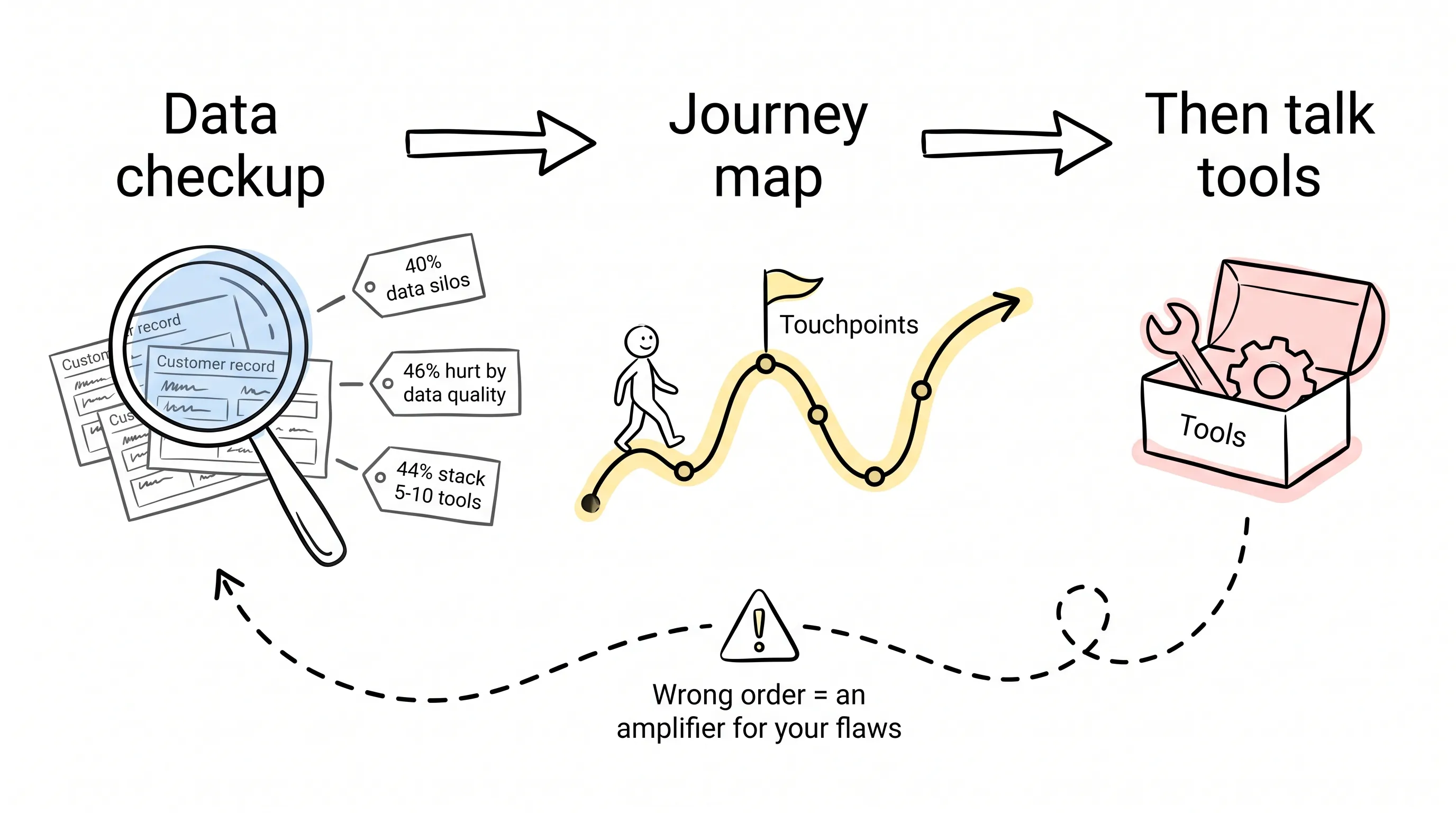
💬 How marketers can use this: Put the 40% and 46% figures straight into your internal business case — they beat any persuasive pitch. The order of operations is data cleanup and a journey map first, vendor demos second; flip that order and you're buying an amplifier for your flaws. HubSpot users should pull up their credits consumption table while they're at it — that's where a lot of bill shock lurks.
🔗 Further reading: Read the full article
Enterprise Platforms Enter the Agentic Race: Eloqua Ships 16 AI Agents at Once
The story in the enterprise market today is the agentic shift. A 2026 enterprise roundup from zaytrics sums up the latest moves from the major platforms. Oracle Eloqua launched 16 role-based AI agents in February 2026, covering campaign planning and the briefing stage, aimed at large-scale ABM, under the Fusion Cloud CX umbrella. Salesforce folded the Einstein brand into Agentforce, with the product line called Marketing Cloud Next, built around autonomous agents orchestrating full-funnel personalization; it lists marketing organizations of 100-plus people as its ideal fit. Adobe Marketo's GenStudio uses agentic AI to generate content and enforces brand guardrails automatically, no longer relying entirely on human review. HubSpot Breeze's selling point is the lowest implementation complexity — the Copilot, Agents, and Intelligence trio works out of the box, so teams of any size can get moving quickly. Acoustic, formerly IBM's Watson marketing assets, offers an agentic teammate with real-time behavioral intent scoring as an independent vendor — an option for enterprises that want to steer clear of the big-vendor ecosystems. ActiveCampaign's Active Intelligence does predictive sending and segmentation, a fit for lean teams.
The article sets AI marketing automation beside traditional automation: traditional platforms execute preset rules, while AI platforms learn from behavioral data, predict the next step, adjust in real time, and also generate content while enforcing brand standards automatically. It ranks the six platforms by implementation complexity: Agentforce and Marketo are both high-complexity; Eloqua targets enterprise ABM teams; HubSpot is rated low-to-medium and the fastest to get started; ActiveCampaign suits lean teams; Acoustic sits in the middle, a fit for buyers who want an independent option outside the big-vendor camp. For vendor selection there is only one new question to ask: is the platform's AI agentic autonomous execution, or assistive ride-along suggestions? The rollout section lays out six steps: audit your infrastructure, define use cases, choose a platform, connect your CRM and data warehouse, train the team, keep optimizing. The use-case section names three directions: email personalization, dynamic ad targeting, and predictive lead prioritization. Steps one and four are singled out as the make-or-break lines — AI needs clean, centralized customer data to work — and the training step carries its own reminder: global teams must learn to use agentic tools without surrendering creative control. The article closes by looking ahead to the next wave: agent systems that run an entire campaign autonomously, voice and conversational marketing, real-time hyper-personalization down to the individual, and closing the loop with sales and product. One caveat: this piece comes from a low-authority personal blog, with no pricing and no hands-on testing, and some phrasing shows signs of AI generation — verify against vendor websites before citing.
💬 How marketers can use this: Write the agentic-or-assistive question into your RFP template, and make every vendor demonstrate, live, one complete workflow step that runs autonomously — no screen recordings. Eloqua's 16 agents and GenStudio's brand guardrails are both worth booking hands-on sessions for, but treat vendor websites as the source of truth on feature details; use this piece as an intelligence index, nothing more.
🔗 Further reading: Read the full article
🏷 Case Studies
How Five Major Brands Play GenAI: From Collaborative Filtering to 130,000 Deep-Synthesis Ads
GoodFirms has rounded up five company-level generative AI marketing cases, each played differently — together they make a ready-made inspiration library. The article first groups the basic uses into four types: customer segmentation and journey orchestration, localized messaging, personalized product discovery, and omnichannel reach optimization. Take its own example: a customer lingers long in the activewear section but doesn't buy. The traditional play is a blast email about new arrivals; the GenAI play is to analyze the behavior first, slot her into the leggings-interest segment, then set up a targeted email, an on-site popup, and a social ad — each with its own variant — plus a push notification to catch the promotion at just the right moment. The localized-messaging use case is just as straightforward: to enter the French or Spanish market, translate the whole website and app in one click, and messaging follows in the local register. Product discovery stitches user intent to browsing behavior — the page where someone shops for hiking boots helpfully suggests socks and tent poles.
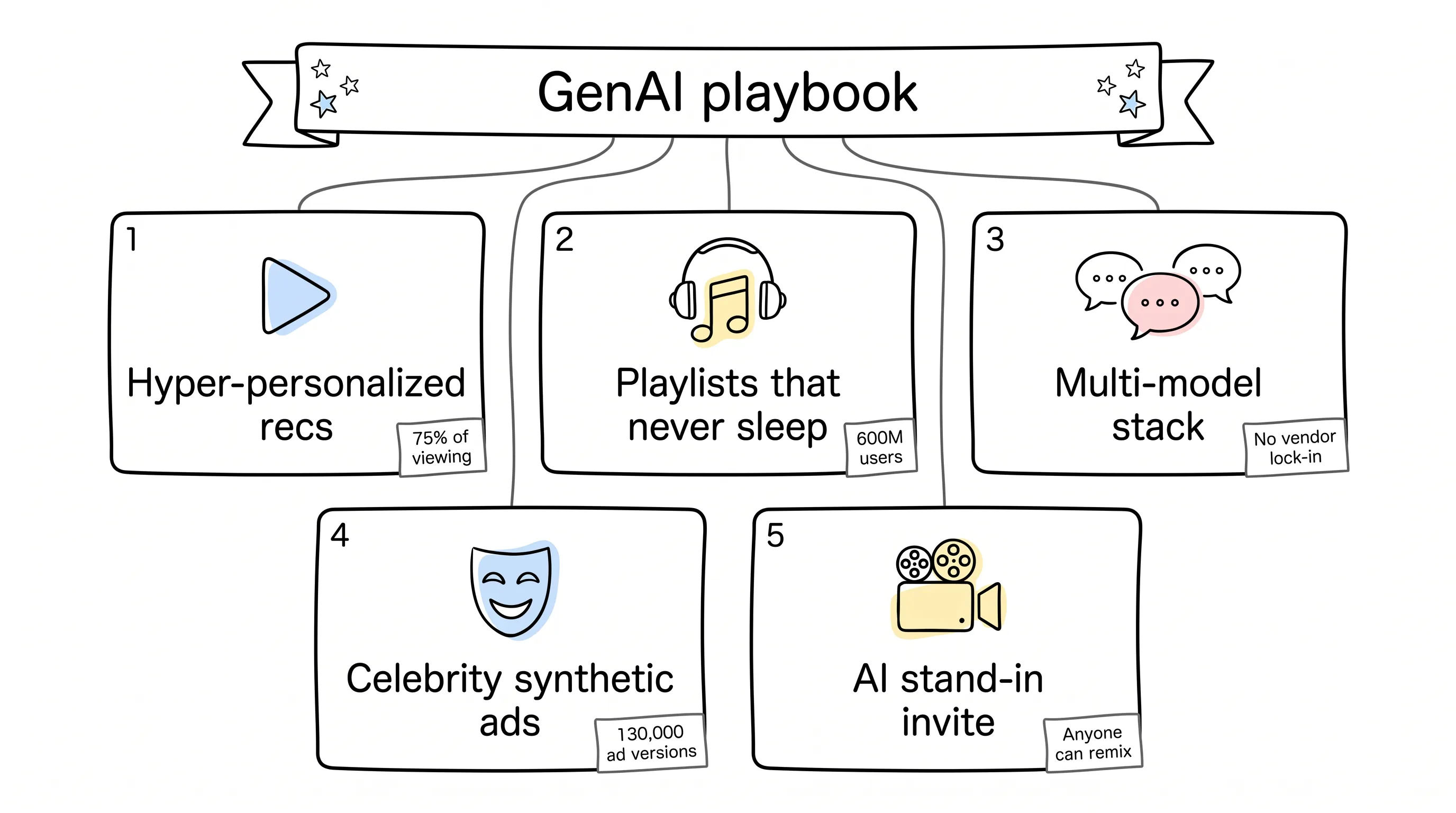
Each of the five cases has its hook. Netflix runs hyper-personalized recommendations on user-level plus item-level collaborative filtering, over a catalog exceeding 3,600 movies and 1,800 series; user homepages are sliced into ultra-short customized previews, and public sources say about 75% of viewing is driven by recommendations, with the recommendation system valued at more than $1 billion a year. Beyond recommendations, Netflix also applies AI to content creation, custom clips, image analysis, and data center operations. Spotify, holding more than 100 million tracks and 600 million users, fights playlist overload with the combination of Discover Weekly, Blend, Daylist, and AI DJ, balancing the familiar against the fresh; AI DJ uses generative voice to push listeners out of their comfort-zone playlists — one tap on the DJ button returns a brand-new playlist tuned exactly to their taste. The system has been iterating for over a decade; the long-termism itself is part of its moat. The Washington Post's approach is worth stealing outright: it trials multiple models at once — ChatGPT, Gemini, and open-source Llama among them — for summarization, headline suggestions, multilingual rewriting, and distribution makeovers, recasting stories for TikTok or Facebook audiences and feeding the models snippets of its own articles to keep facts accurate, all so it never gets locked to a single vendor. In their plans, every reporter will have an AI assistant to help gather, analyze, and summarize material, and the AI will even converse with readers in a journalist's voice, bringing the information it collects back in.
The last two cases are both deep synthesis (AI-generated synthetic media). Cadbury moved at the hardest moment for small merchants in 2021 — that year local corner shops accounted for more than 85% of Celebration sales even as business slid overall — and, together with Rephrase.ai and Delta X, generated more than 130,000 versions of a Shah Rukh Khan ad, each one able to name the local Kirana corner store, timed to the Diwali season. That season alone can contribute 45% of annual Celebration sales; the campaign lifted both sales and brand goodwill, and the brand positioned itself on the community's side. Rephrase's CEO, an engineer by training, puts it this way: if everyone can express themselves with high-quality video, the way we communicate will leap a whole generation ahead. Virgin Voyages and Flaunt Digital built Jen AI, a Jennifer Lopez lookalike persona: the video opens with what you take for the star herself talking on a chaise lounge, and only after a while do you realize it's an AI stand-in; anyone who receives the invitation can keep reworking it into their own version of the invite video. Branson joined in personally to stoke the buzz — the celebrity effect paid off in memorability and booking intent.
💬 How marketers can use this: The Washington Post's multi-model parallelism plus feeding it your own material is the easiest to steal — you can try it in your content pipeline this week at near-zero cost. Cadbury-style personalization at scale has two prerequisites to clear first, celebrity licensing and synthetic-media compliance; brands with budget can negotiate on that framework. Small and mid-size teams should start with recommendations and segmentation — don't reach for deep synthesis out of the gate.
🔗 Further reading: Read the full article
🏷 Risk & Governance
McKinsey Expert Lists Five Risks and Eight Ground Rules for GenAI Marketing
McKinsey senior expert manager Eva Dong, in issue 9 of her Smart AI Marketing Newsletter, has put together a set of generative AI ground rules for marketers and media agencies. She spent ten years on the front lines of AI and digital marketing and runs her own DTC marketing startup, and the article's stance is clear: AI isn't just influencing decisions — in many cases it is already making them on people's behalf. Marketers have gained unprecedented new ground, but left unmanaged it will erode the very value it creates. She lists five major risks. Content convergence: when training data is too narrow or varies too little, the model learns only a handful of patterns, so the output can't help blending together — and as peers run similar models on similar data, creative work will increasingly look the same. Missing human intuition: AI can analyze data and produce content at scale, but emotion, intuition, and creativity don't come along for the ride, so campaigns can easily feel cold. Drifting off-brand: unsupervised output wanders outside the brand tone and values; consumers get confused, and trust wears away bit by bit. Ethics and privacy: overusing customer data directly damages trust and loyalty. Regulatory risk: data protection rules keep tightening, and non-compliance costs legal liability and fines.
Eight ground rules correspond to those risks: train on diverse, high-quality data; keep humans in the loop, so human oversight and input stay inside the content generation process; regularly audit AI output for consistency with the brand voice and feed the problems you find back into the model or training data; hand the efficiency stretches from design to copy over to GenAI but keep human creativity in the brainstorm; tune parameters to increase output diversity; use AI's personalization capabilities to avoid one-size-fits-all; make sure AI-generated images and content comply with advertising law; and set up an ethical review process to block discriminatory or inappropriate content. Her overall posture: explore the capabilities boldly, apply them prudently — don't fixate on short-term gains while leaving long-term brand impact off the table. One caveat: the article was published in 2024, it is a general-knowledge framework with no new data behind it, and reading it today, its value is as a checklist, not as news.
💬 How marketers can use this: Don't swallow the whole list — pick two and put them on the calendar. Run a fixed monthly spot-check of AI output against brand voice, run an ethics and compliance pass before every new campaign launch, and remember to write the spot-check findings back into your prompts and asset library. Building these two processes now is far cheaper than patching after something breaks. The content-convergence item pairs well with the Top Story's decision-layer framework: the more the tools look alike, the more your data and distinctive voice are worth.
🔗 Further reading: Read the full article
🏷 Industry Data
Europe's Social Media AI Market: $1.29B in 2026, Tenfold in Eight Years
Market Data Forecast has updated the public summary of its Europe social media AI market report. Here is how the pie is drawn: about $960 million in 2025, $1.29 billion in 2026, projected to reach $13.29 billion by 2034 — a 33.85% CAGR from 2026 to 2034. The primary growth driver is the EU's Digital Services Act (DSA). The DSA requires platforms to detect, remove, and block the spread of illegal content, run periodic risk assessments, respond quickly to trusted flaggers, and — for very large platforms — publish transparency information about their algorithmic systems; in Europe, AI has shifted from an optional efficiency tool to mandatory compliance infrastructure, a growth logic unique to this market. Disinformation volume climbs noticeably during election periods, further pushing up investment in detection and moderation technology, with explainable AI riding along. Generative AI underpins multilingual content production across 24 official languages, letting brands spread across language markets without building local teams, and research shows consumers are significantly more likely to complete a purchase when facing a website in their native language.
The constraints are just as clear. GDPR sets a hard gate on training data, with fines capped at €20 million or 4% of global turnover; obtaining valid consent is hard in itself, and the data minimization principle is pushing vendors toward privacy-preserving approaches like federated learning — cost and technical difficulty both ratchet up a notch. Deepfakes are another speed bump: the arms race between generation and detection has never paused, and platform liability boundaries remain unsettled. On segment data, sales and marketing applications lead by share at 38.1%, pulled by precision targeting and programmatic advertising; customer experience management leads on growth at a 22.4% CAGR; on the technology side, machine learning and deep learning hold 55.3%, NLP leads growth at 24.1% — multilingual sentiment analysis across Europe's 24 official languages is a hard requirement; among verticals, retail and e-commerce hold 32.8%, media and advertising grow at 23.8%, with ROI measurement for influencer marketing the main driver of the latter — identifying and evaluating micro-influencers especially leans on AI. By country, Germany holds 21.5% and the UK 19.4%; Germany's edge stacks a manufacturing base on top of a data-compliance tradition, France's cultural attachment to language and content quality breeds NLP demand, and tourism retail in Italy and Spain is pulling growth. On the user base, Eurostat figures put EU residents' internet penetration at 93% in 2024, with video calls and instant messaging still the bulk of online activity; Denmark is at 98.5% and the Netherlands at 96% — nearly saturated — while Romania sits at just 25.3%, a stark gap. The EU counts 577 million active social media users, YouTube 450 million and Facebook 260 million; overall annual growth is just 1.5% — a mature market by any measure. Yet in 2024 only 13% of EU enterprises were genuinely using AI, and cloud adoption stood at 45.2% — a huge implementation gap — with the European Investment Bank calling out financing difficulties for SMEs in Southern and Eastern Europe. The report also lists real-time social listening as an opportunity: AI monitors massive conversation streams and catches sentiment shifts early, so organizations can step in before a crisis gains momentum. Consumer attitudes deserve a note too: in BEUC's survey, 90% of online shoppers worry about being precisely targeted by ads, are willing to trade data for membership perks, but recoil at algorithmically discriminatory personalized pricing. One reminder: this is the sales page of a paid report — the public portion is only an executive summary, the methodology is opaque, cite third-party forecast numbers with care, and don't treat them as an investment basis.
💬 How marketers can use this: Teams expanding into Europe should treat the DSA as a mandatory question — audit how automated your content moderation and risk assessment are first, because that decides whether you can enter the field at all. The 13% enterprise adoption rate says competitive density is far lower than back home; the window of opportunity is real. Stay wary of third-party forecast numbers: fine for reading the direction, useless for building financial models.
🔗 Further reading: Read the full article
💡 Today's Big Picture
Three tool roundups appearing in a single day is itself a signal. The procurement decisions around AI marketing automation have multiplied to the point of sustaining an entire content category — and they show that a great many teams are standing at the door of a platform switch. Read today's material as one connected story and the lesson is that sequence matters more than choice, and pacing matters more than posture. Salesforce's numbers are right there: 40% of teams have their AI capabilities jammed by data silos, and 46% of agent users are dragged down by data quality — which explains why most selection failures have nothing to do with the tool. The Top Story roundup delivers the watershed judgment: whether AI sits in the decision layer decides whether a platform is worth buying; the enterprise agentic race pushes that standard harder still — Eloqua shipped 16 agents in one go, and the window for assistive, ride-along AI is closing. The risk ground rules and the European market report add the other two boundaries: brand consistency and compliance are the floor beneath all automation, and Europe's 13% enterprise adoption hints that the compliance bar itself is a filter — teams that clear it start with a win already banked. The five big-brand cases corroborate this logic from the other side: Netflix's and Spotify's recommendation systems iterated for a decade to build today's moats, and behind Cadbury's 130,000 ad versions lay the complete groundwork of licensing and compliance. The practices worth taking away today: clean the data first, map the journey second, and only then let vendors in; use 5,000 real contacts to test what a platform is actually made of; and from today on, write the agentic-or-assistive question into every RFP. The procurement season will run through the whole second half of the year — today's briefing can serve as the first edition of your benchmark sheet.
Continue reading
Related articles

AI Marketing Daily · 2026-10-09
AI marketing daily for 2026-10-09 covering 11 items: brand measurement moving from survey panels to search, social, e-commerce, and AI prompt signals; GEO and share of model playbooks; safety guardrails for agentic ad buying; and tool roundups for ad platforms, cross-border tools, and social media uses.

AI Marketing Daily · 2026-10-08
AI Marketing Daily for 2026-10-08 curates 20 items across AI search visibility (GEO), advertising, platform selection, cross-border e-commerce, and ROI measurement. The headline argues that strategic marketing decisions should stay with humans while AI assists execution.

AI Marketing Daily · 2026-10-07
Today's throughline is answer engine optimization (AEO — getting your brand quoted in AI answer engines).