
AI Marketing Daily · 2026-09-05
AI Marketing Daily for 2026-09-05 rounds up 11 items on recovering AI marketing investment, led by a consultancy operator guide with ROI ranges for 12 use cases and a 90-day roadmap, plus buyer-behavior data, a GEO versus SEO guide, and tool cost comparisons.
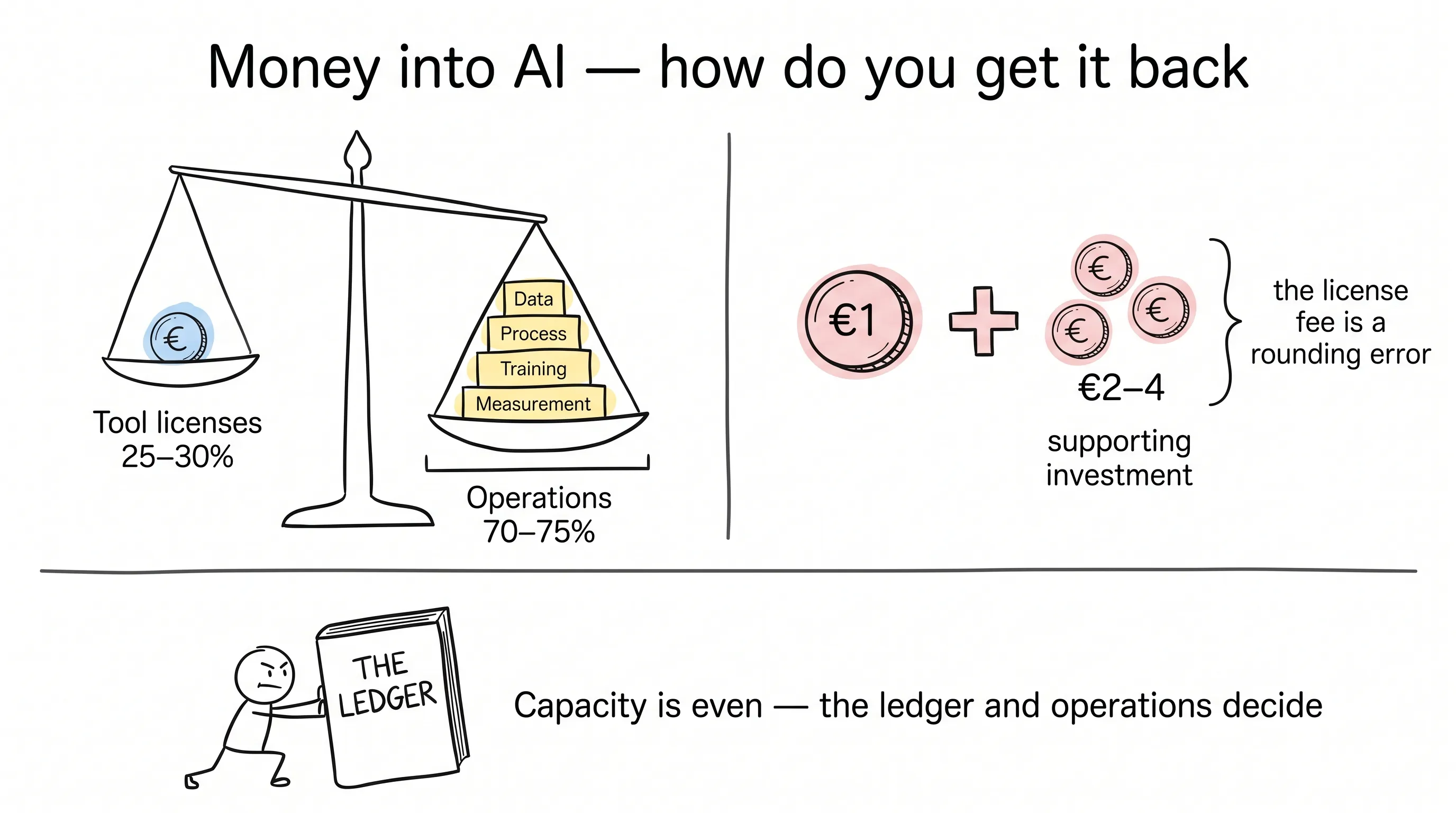
All 11 items today are working the same math problem: once the money goes into AI, how do you get it back. The headline is a 68-minute operator's guide from a German consultancy that puts it bluntly with ROI ranges for 12 use cases and a 90-day roadmap: tools are only a quarter of the investment, and the rest is operations. G2 data says 80% of buyers already let AI assemble their shortlists — miss the list and you never even get to be compared. Three tool comparisons lay out the price ledgers: the license fee is a rounding error of first-year spend. There is also a GEO playbook and two looks back at older pieces — predictions from two years ago are now consensus. The issue unfolds as one headline plus three sections, each item closing with a hands-on take.
🎯 Today's Headline
A German consultancy turns AI marketing into an operations manual: ROI ranges for 12 use cases, a 90-day starting path
German consultancy MaibornWolff has released the 2026 edition of its AI marketing operator's guide. The author, Yusuf Agirdas, leads the firm's RevOps (revenue operations) team, and the piece is sized at a 68-minute read — close to a small handbook. The opening hands down a damning verdict on the popular listicle format: a team buys twelve AI tools and runs three pilots in parallel, yet at quarter-end cannot say which euro of revenue or which hour of work time came from any of it. The problem rarely sits with the tools; it sits with the absence of anyone answering, from an operator's perspective, who decides, who builds, who reviews, who measures, and who is accountable. The guide offers a definition you could write straight into board materials: AI marketing is the use of learning or generative models to drive marketing decisions at scale from customer and market data, across six categories — content, audience, channel, timing, pricing, and messaging. Rule-based if-then automation, dashboards wearing the AI label, and a stash of saved prompts do not count. Run your own projects through this filter and roughly 80% of so-called AI investments fall out. The four types of AI also come with a rollout order: predictive first, for lead scoring and churn prediction; generative next, with content production paired with governance; decision-optimization activated in parallel on mainstream ad platforms — Smart Bidding and Advantage+ belong to this class; agentic workflows last, and only with human approval gates built in.
Where the guide earns its keep is in codifying five failure modes drawn from the traps German-speaking mid-market companies have already stepped in: buying tools before defining use cases; team shadow AI feeding customer data through personal accounts; missing data foundations; use cases with no single accountable owner; and ROI flying blind — counting output, not impact. The five modes also reinforce one another: a team without goals buys tools for a sense of security, and once the tools are bought, no one is accountable for the value. The cost structure is laid out bluntly: tool spending is only 25% to 30% of total investment, and every €1 of licensing needs another €2 to 4 behind it, spent on data, process, training, and measurement. For mid-size marketing teams, tool fees commonly run €30,000 to €150,000 a year, with supporting investment another two to four times that. Teams that budget on license price alone are systematically underestimating the investment from day one.
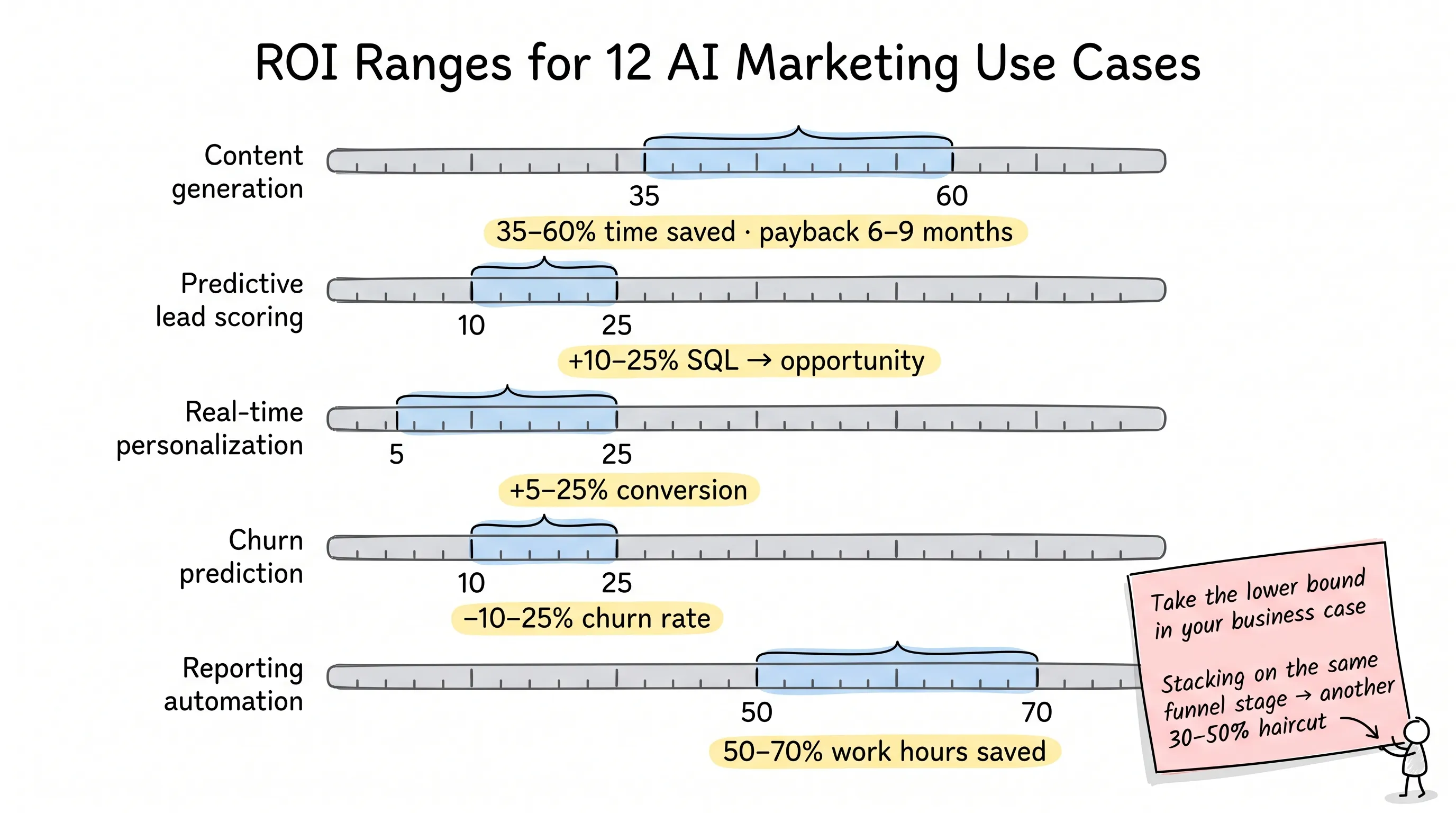
The most practical part for marketers is the realistic ROI ranges for the 12 use cases. Content generation saves 35% to 60% of time and pays back in 6 to 9 months; predictive lead scoring lifts the conversion from SQL (sales-qualified lead) to opportunity by 10% to 25% and cuts handling time by 20% to 40%; real-time personalization lifts conversion by 5% to 25%; churn prediction cuts churn rates by 10% to 25%; reporting automation saves 50% to 70% of work hours. The author warns to take the lower bound of each range when building business cases, and to take another 30% to 50% haircut when stacking multiple use cases on the same funnel stage, because the effects cannibalize one another. Compliance is no longer a backdrop: the EU AI Act's transparency obligations took effect on August 2, 2026 — AI-generated content must carry machine-readable labels, deepfakes must be disclosed, and chatbots must identify themselves. On the GDPR side there are five high-frequency traps: fine-tuning opens a new processing purpose that needs its own legal basis; Article 22 fully automated decisions must retain a human intervention point; connecting to model vendors through consumer-grade accounts will not pass a DPA (data processing agreement); cross-border transfers and data residency need to be arranged in advance; and Lookalike targeting counts as profiling under GDPR. The org side names five new roles — AI Lead, Prompt Ops, a gatekeeping content editor, a marketing data owner, and a compliance liaison — staffed at 1.2 to 2.0 FTE (full-time equivalent) for SMEs and 4 to 7 for large enterprises.
The implementation moves can be copied straight off the 90-day roadmap. For tool decisions, use the embedded-first matrix: platform-native AI like HubSpot Breeze, Salesforce Einstein, and Adobe Sensei already covers 60% to 80% of standard use cases — inventory the AI capabilities inside your own platforms first, and talk about buying specialist tools after. Only reusable use cases with annual licenses above €100,000 justify building on foundation-model APIs, and that comes with 0.5 engineering FTE plus 0.3 prompt ops. The five-piece measurement discipline is non-negotiable: a written hypothesis with numbers and a deadline before launch; a holdout control group of at least 20%; 60 to 90 days of measurement for transactional use cases and 6 to 12 months for retention ones; written stop criteria; and explicit reinvestment of efficiency gains. Run no more than 4 to 6 use cases in parallel in year one. In the nine-stage RACI, stage 6's pilot Go/No-Go and stage 8's model maintenance get skipped most often — the former decides whether a pilot goes permanent or shuts down, and if the latter is left unattended, performance decays silently within 12 to 18 months. Four to eight hours of model review per use case per quarter is the floor.
Apply the full discount: the piece closes with a 45-minute free-consultation conversion CTA (call to action), and the ROI ranges are consulting heuristics without published-research backing. But the skeleton — recasting the tools conversation as an operations conversation — is worth carrying whole into your quarterly plan. Bottlenecks, use cases, requirements list, shortlist, pilot, decision: invert that order into "buy tools first, find uses later," and every step after pays for the first step's mistake. L3-maturity organizations hold a 30% to 50% cost-per-unit-output advantage over L1 and L2, plus a 10% to 25% conversion advantage — on a €5 million marketing budget, that compounds to a gap of millions of euros a year. My advice: treat it as a health checklist. Self-audit against the five failure modes first, then pick the two use cases with the most solid ROI ranges and take them into a 90-day pilot.
🔗 Further reading: Read the full article
🏷 Buyer Behavior & Customer Experience
80% of B2B buyers asked AI what to buy: miss the AI shortlist and your win rate trails by 15 percentage points
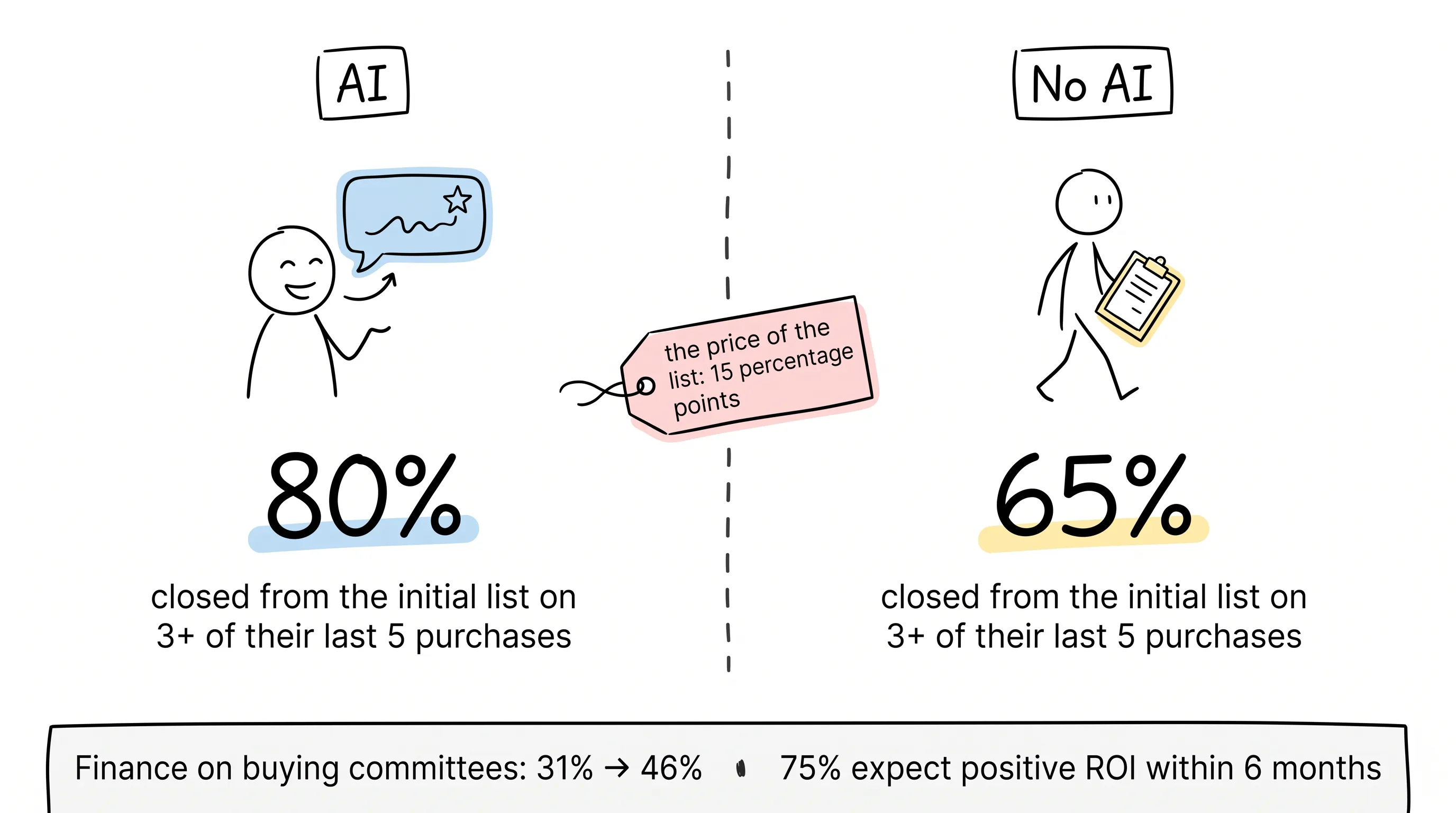
MarTech senior editor Constantine von Hoffman published a piece on September 4 that merges G2's 2026 buyer behavior report with Cleverbridge's seller-side cost research — two datasets that assemble into one complete picture. On the buyer side, over 80% of buyers have used AI chatbots for software recommendations in the past two years, and nearly half say AI has its biggest impact at the shortlisting and evaluation stage. Among AI-using buyers, 80% closed from the initial list on at least three of their last five purchases; among those not using AI, only 65% did — a 15-percentage-point gap that is the price of the list. The bottleneck has moved from discovery to evaluation and closing: evaluation now takes 40% of the procurement cycle, up from 36% a year earlier, and post-selection delays come from security review at 39%, budget approval at 32%, and implementation planning at 25%. Finance gets another chair at the table every year: finance participation on buying committees rose from 31% to 46%, 49% of buyers have had a team-approved purchase overturned by the CFO, and 75% expect positive ROI within 6 months of signature. The closing side of the funnel looks uglier: 73% of purchases are significantly delayed or even abandoned over internal approvals or wrangling with sellers, 36% stuck waiting for quotes, and 30% stuck in term negotiations. Self-service appetite is out of sync with reality: 96% of sellers agree routine transactions should shift to self-service, but only 17% have actually launched it; 93% of buyers will do self-service checkout, more than half will for routine purchases above $25,000, and 17% will accept it above $100,000. The internal cost of handling one routine transaction tops $1,000 in more than half of cases, and a third take over 6 hours. The self-service appetite extends across the lifecycle — two-thirds of buyers will self-serve renewals and upgrades, 54% expansions, and even 44% for brand-new purchases. Human sales has not been retired, just reassigned: buyers only want people for large multi-year contracts, security and compliance review, complex configuration, and custom quotes — more than half of complex configurations and nearly half of custom quotes still require sales involvement. The author's bottom line is blunt: closing friction is already a marketing problem. Companies that only solve acquisition are just delivering their buyers faster to the next bottleneck.
💬 Action sequence: first ask ChatGPT and Perplexity the questions for your category and see whether you make the recommendation list — if not, go back to GEO for remedial work. Move pricing tables, ROI calculators, and security docs to the front of the evaluation stage; your materials must include the math for positive ROI within 6 months, because that page is written for the CFO. Slot self-service channels for renewals and upgrades into this quarter's backlog: $1,000 plus 6 hours saved per transaction is pure profit.
🔗 Further reading: Read the full article
Journey analytics has an ordering problem: stitch identity first, talk AI second — the answers to churn hide in customer-service records
A long-form piece on journey analytics runs under the byline of Priya Roy, VP at data services firm Straive. Credibility check first: the site date contradicts the body date, the text carries three injected outbound links unrelated to the topic — classic SEO fingerprints — and the piece contains not a single number. The framework itself still transfers. AI brings three shifts to journey analytics: real-time anomaly detection, where page-drop anomalies surface within minutes; behavioral prediction and intervention, where signals such as declining logins or repeated visits to broken pages generate risk scores that trigger retention plays, and high-intent signals such as repeated comparison shopping trigger conversion prompts; and personalization driven by behavioral context instead of demographic attributes. The prerequisite engineering is identity stitching: cookies, email addresses, device IDs, and membership accounts must first be aligned into a single timeline, otherwise the attribution of early touchpoints' influence on later outcomes cannot even be discussed. The underrated signal source is unstructured data: topic clustering over agent notes, chat logs, long surveys, and reviews can explain why churn actually happens — manual analysis cannot cover interactions in the thousands. Implementation comes in six steps: unify data, focus on high-value high-friction journeys, use AI to locate friction points, deploy real-time personalization only as far as it solves problems, share metrics across teams, and keep testing.
💬 Use the six steps as a CX (customer experience) self-audit checklist: do the first two — identity stitching and friction-point location — and put AI after step three. Borrow the framework only; do not cite a single number from this piece externally, and the link and date problems suggest a questionable content pipeline — citing it would damage your own credibility.
🔗 Further reading: Read the full article
An academic review banks three citable cases: Domino's cuts ordering time by 30%, L'Oréal lifts online sales by 25%
A literature review by Tran Minh Tung and Duong Hoai Lan of Swinburne's Vietnam campus, published in April 2024 in the Journal of Electrical Systems — 9 databases searched, roughly 30 papers from the past five years included, plus three case studies. The four-theme framework: personalized service; interactive engagement (chatbots, affective computing, gamification); data-driven insight (sentiment analysis capturing the voice of the customer); and intelligent decision-making (recommender systems plus human-machine collaboration). The case numbers are all concrete: Domino's AI voice-ordering assistant built with Microsoft cut average ordering time by 30% and grew online orders by 25%; L'Oréal's personalization engine added 25% to online sales, alongside Makeup Genius AR try-on, a sensor-equipped smart hairbrush, and a Messenger bot; Stanford Health Care's chatbot handled routine inquiries, cutting call-center volume by 20% and freeing human agents for complex care questions. The governance section lists six mitigating practices: testing and validation, transparent communication, continuous monitoring, human oversight, ethical constraints, and continuous learning. The e-commerce section lists ten action points, from personalized recommendations and intelligent support triage to dynamic pricing and fraud detection; future directions call out emotional intelligence and explainable AI.
💬 The three case numbers can go straight into internal decks — note the source and the 2024 publication date. Copy the six governance practices into an AI customer-service launch checklist; if any one is missing, hold off on scaling. The journal's tier is limited and it does not cover agentic or GEO — use it as a framework and material bank, not as frontier news.
🔗 Further reading: Read the full article
🏷 AI Search & Content Strategy
Jasper's GEO guide: first-position clicks cut by 58%, yet LLM visitors convert 4.4x better than search
A guide published April 17 by Jasper senior content manager Megan Dubin lays out GEO (Generative Engine Optimization) against SEO and AEO (Answer Engine Optimization) with a high density of external data. The baseline numbers come from Ahrefs and Semrush: AI Overviews have cut the CTR (click-through rate) of Google's first-position results by 58%, versus 34.5% on the same basis a year earlier; ChatGPT processes 2.5 billion prompts a day, 65% of them with search intent, but its CTR runs 96% below Google's — search is heading toward zero clicks. The strategy splits into three layers. SEO is the foundational visibility layer: Ahrefs' study of 863,000 SERPs (search engine results pages) found that 38% to 40% of pages cited in AI Overviews come from the organic top 10, and nearly 70% from the top 100 — traditional rankings are still the ticket in. AEO governs extractability: direct answers first, with FAQ, tables, and lists as the format-friendly structures, written in plain unambiguous language. GEO is about earning citations from large models, through original research and verifiable statistics, structured schema metadata, and clear attribution with citation sourcing. Each platform has its own taste: ChatGPT often lifts bullet-style FAQs verbatim; Perplexity always attaches citations and prefers authoritative sources and original data; Google AI Overviews recognizes FAQ and HowTo schema plus short definitions; Bing Copilot likes step-by-step guides and comparison pieces; Claude favors long, coherent stretches of argumentation. Community platforms are feeding the models too: Reddit, YouTube, and LinkedIn are the most-cited platforms, with per-model preferences — ChatGPT leans toward Reddit and Wikipedia, Perplexity toward Reddit, LinkedIn, and G2, and Google toward Facebook and Yelp. Ahrefs also found that ChatGPT prefers citing newer pages — refreshing content is a weekly operating task. On the payoff side, Semrush measured LLM-referred visitors converting at 4.4x the rate of traditional search: traffic falls but conversion quality rises — that is the argument for investing in GEO.
💬 Three moves this week: add FAQ and HowTo schema plus a short definition to your ten best-converting pages; turn one proprietary dataset into a citable statistics page — original data is what models most want to cite; place one community-native piece on Reddit or LinkedIn. Swap your measurement framework at the same time: beyond rankings and traffic, start tracking AI citation rate and the conversion of AI-referred visitors. One caution: Jasper is a GEO tool vendor — trace the key numbers back to the original Ahrefs and Semrush research before citing them externally.
🔗 Further reading: Read the full article
Seven predictions from two years ago — half of them now written into today's briefing
Search Engine Land ran Julia McCoy's bylined column in September 2024; she runs AI consultancy FirstMovers.ai. The piece inventoried the six application areas of the day: content intelligence platforms, generative bulk content, hyper-personalization, predictive analytics, AI customer service, and voice plus AR experiences, then made 7 predictions: media decentralizes further; AI raises the content quality bar; generative AI diverts traffic from traditional search; AR and VR marketing go mainstream; chatbots and social bots scale up; real-time personalization arrives on mobile; and marketing roles shift toward strategy, creativity, and ethical judgment. The only hard number in the piece is an O'Reilly survey: 67% of marketing teams were already actively using AI, and 26% planned to adopt soon. The case material reads as classic today: Amazon's Frequently Bought Together recommendation module, Dollar Shave Club's AI customer service, and Coca-Cola Zero Sugar's TakeATaste Now campaign, which used AR to turn Tesco stores into redemption points. Two years on, the search-diversion prediction has become industry consensus — today's buyers go straight to ChatGPT and demand answers; the role-shift prediction is landing too, with execution tasks being taken over by systems. The value of this piece is not incremental information; it is the hit rate of the predictions.
💬 The use is calibration: score your own team against the 7 predictions — how many caught, how many still on the fence — and the gap is your distance from the industry. The role-shift line belongs in your personal development plan now: strategy and ethical judgment are what is left after AI takes over execution. Mark the publication date when citing this older piece — do not pass it off as news.
🔗 Further reading: Read the full article
A 2023 review left behind one field test that still holds: the longer the generated content, the worse the quality
A generative AI marketing review published in October 2023 by Austrian digital commerce consultancy NETCONOMY carries dual bylines and unfolds in three parts: benefits, use cases, and challenges. Four benefits: efficiency and speed; scalability; precise personalization built on first-party data; and a helping hand for human creativity (positioned as an assistant, not a replacement). Three use cases: content generation — text, images, speech, video, and conversions among them, with long posts split into social media posts; personalized campaigns — instant multilingual translation lowering the barrier to entering new markets; and automated outbound — LLMs simulating human voices to execute outbound calls. Three risks: hallucinations amplified in brand and paid-product scenarios; copyright with a hard precedent — Stable Diffusion generating Getty-watermarked images triggered a lawsuit; and cases of models being induced into leaking secrets. McKinsey's positioning anchors the argument: marketing and sales are among the departments benefiting most from the AI revolution. Two retail use cases still carry reference value: tailoring product descriptions and images to each visitor, and using instant translation to open markets that were previously hard to reach. What still stands today are two first-hand field tests: generated content degrades in quality as it gets longer — better suited at the time to short posts and drafts; and automated outbound calls must keep human review on the messaging. Three years later, these two serve a dual purpose: one, re-run them to measure how far tool generations have actually come; two, they remain a standing reminder of the boundary.
💬 Treat it as a baseline exam: give today's models the same brief to write a 2,000-word article, compare against the 2023 experience, and the gap is the true measure of two years of tool progress. Keep the division of labor: short posts and drafts to AI; long-form pieces and external-facing messaging stay human. The benefits-and-use-cases framework is now industry common knowledge — the citation value concentrates in the two field tests and the Getty lawsuit precedent.
🔗 Further reading: Read the full article
🏷 Marketing Tools & Selection
10 B2B sales AI platforms compared: the competitor price table is worth more than the conclusions
monday.com's official blog published an enterprise-grade comparison on February 3, authored by the site's SEO lead — the stance comes first, but the hard data on competitors is complete. The prices and limitations can be copied straight into your requirements list: Gong starts at $1,200 per person per year, with its Ask Anything conversation intelligence capped at 60 calls and 500 emails of retrieval; Salesforce's Agentforce 1 Sales runs $550 per person per month, takes months to implement plus dedicated consultants, and Einstein conversation insights add another $50 per person per month; HubSpot's Professional and Enterprise tiers force a $3,500 onboarding fee, and the Breeze Prospecting Agent claims double the response rate of traditional sequences; Demandbase's ABM (account-based marketing) intent data is listed on AWS Marketplace at $215,000 a year, with G2 showing buyers negotiating an average 13% off; Piper by Qualified only serves Salesforce customers, an AI SDR (AI sales development rep) in 17 languages; Relevance AI has a free tier with 200 actions per month, and its model-agnostic architecture suits technical teams building in-house; Outreach's Kaia claims a 36% lift in meetings booked, with the voice add-on at $300 per month for 10,000 minutes. The quick-match guide has four main routes: high inbound plus the Salesforce ecosystem → look at Piper; call analytics first → Gong; long-cycle ABM → Demandbase and 6sense, the latter processing over 1 trillion buying signals a day; high-volume outbound sequences → Outreach. The background numbers come on Gartner's 2023 basis: 51% of enterprise AI projects fail, and data audits routinely turn up 30% to 40% of records in error; professional services fees typically run 50% to 200% of license fees. The four-step selection method transfers: run a full-stack tool and data audit first, then aim AI capabilities at specific pain points, then calculate full ROI, and finally launch in phases over 12 weeks.
💬 Read it the hard way: copy the starting prices, billing models, and known limitations from the comparison table into your RFP (request for proposal), while skipping every self-reported monday CRM number — the 90% adoption rate and the 2-to-4-week go-live are both unverified by third parties. Run a data audit before selecting: a 30% to 40% dirty-data rate is normal, and on a dirty foundation, no platform however expensive will produce results.
🔗 Further reading: Read the full article
7 marketing automation platforms compared: pick the wrong billing model and the bill for 50,000 contacts can differ by 3x
A comparison published by AI Growth Agent's editorial desk in May and updated August 22 maps 7 platforms to business models. For Shopify e-commerce, Klaviyo — its real-time event processing drives 60% to 80% of automation revenue for mature e-commerce operations, with abandoned-cart recovery emails averaging 50.5% open rate and 3.33% conversion (the platform's 2023 benchmarks). B2B at $1M to $25M ARR (annual recurring revenue) → HubSpot: Professional starts at $890 per month with a mandatory $3,000 onboarding, and as contacts grow from 2,000 to 100,000, the monthly fee climbs from $890 to $5,890. Budget-sensitive SMBs → Brevo and ActiveCampaign, the latter from $15 per month with over 900 automation recipes. Enterprises on the Salesforce ecosystem → Marketo: from $895 per month, implementation fees of $10,000 to $50,000, and 60 to 90 days to go live. The billing models diverge the most: contact-based pricing (HubSpot, Klaviyo, ActiveCampaign) climbs steeply as the list grows, while send-based pricing (Brevo) is far cheaper for teams with large lists and low frequency — the same 50,000 contacts, mailed twice a month, cost about $69 on Brevo versus over $250 on contact-based platforms. The hidden-cost pattern: TCO (total cost of ownership) typically runs 20% to 50% above license fees. The market: $8.16 billion in 2026, reaching $14.98 billion by 2031, a 12.92% compound annual growth rate, per Mordor Intelligence. AI capability comes in three layers — content assistance, predictive modeling, agentic decisioning — and the last is the least mature; in 2026, most teams still use AI only for content.
💬 Do the math on two questions before you choose: with over 20,000 contacts and fewer than two sends a week, send-based pricing saves thousands of dollars a year — enough to hire half a content intern. For e-commerce, pick platforms on behavioral-trigger accuracy, not feature breadth — that accuracy decides 80% of your automation revenue. Don't be greedy at the start: run the welcome flow and re-engagement, two proven workflows, and expand only after validating messaging and steady inbound on two channels. Vendor CTAs skipped as usual.
🔗 Further reading: Read the full article
Infobip's omnichannel comparison: email open rates are only 20–30%, and single-channel platforms miss most of the audience
A platform comparison on Infobip's official blog dated March 2 ranks the company's own offering first — take the stance with a grain of salt, but the framework and the description of competitors' weak spots still hold up. The six-factor evaluation framework can serve as a scoring sheet: unified customer-journey orchestration; multichannel coverage (email, SMS, WhatsApp, RCS, push, social media); segmentation and dynamic content built on behavior plus attributes; real-time dashboards with revenue attribution; AI capability; and native integration with CRM and order systems. The competitors' weak spots are described relatively candidly: HubSpot is weak on SMS and WhatsApp, with pricing that climbs noticeably with contact scale; Salesforce MC has Einstein and Journey Builder but is complex and expensive to implement; Marketo is strong for B2B long cycles but pricey with an aged interface; Braze is mobile-first but leans on development resources. Of the quantified evidence, the channel comparison stings the most: email open rates average only 20% to 30% while SMS reaches 98% — going single-channel means missing most of your audience; customers engaged across multiple channels show 30% higher LTV (lifetime value), per the AMA (American Marketing Association); companies using automation analytics see sales productivity up 14.5% and marketing overhead down 12.2%, per Salesforce. Of the five selection pitfalls, the most expensive is choosing for current needs without looking 18 to 24 months of growth ahead — migration costs are high; another common error is building a complex workflow with 20-plus touchpoints on day one, when the right opening move is the proven flows: welcome, abandoned-cart recovery, and re-engagement; launching without KPI baselines and continuous A/B testing is a trap too.
💬 Print the six factors as a selection scorecard and score each item before hearing any quote. Audit your own workflow list: if entry one is still a ten-plus-touchpoint mega-project, cut back to three mature flows first. Slot the SMS and WhatsApp channel gap into next quarter's backlog — the justification is that 98%-vs-30% contrast.
🔗 Further reading: Read the full article
The real ledger of enterprise marketing automation: first-year TCO often tops $300,000, and the median deployment takes 18 months to hit its stride
An enterprise-grade comparison updated August 6 by AI Growth Agent — two-thirds of it on the procurement reality of traditional suites, with background data mostly carrying external sources. The money: first-year TCO for enterprise deployments often exceeds $300,000 — licenses, mandatory onboarding, consulting, and internal labor combined; HubSpot Enterprise is about $117,000 a year on subscriptions alone (list price), and Salesforce MC implementation and professional services start at $4,500 to $15,000; overage fees, implementation fees, and mandatory premium support often double the first-year bill. The time: The Starr Conspiracy's analysis of over 150 deployments found a median of 18 months from selection to optimization; a full Salesforce MC deployment takes 6 to 12 months, and HubSpot, faster, still takes 8 to 12 weeks; platform migration means 3 to 6 months of dual systems running in parallel, dragging along the data debt of split contact records and broken attribution; team certification takes 29 to 80 hours of learning. The org: you need a Marketing Automation Owner with cross-functional authority — a permanent headcount; enterprise teams use only about 20% of platform features on average — six-figure annual spend paying for capabilities never switched on. Another set of numbers explains why these projects stall out: 70% to 85% of AI projects fall short of expectations because of data fragmentation and manual processes. The scenario-based decision framework also gives exclusions: Pardot's Growth tier starts at $1,250 per month and still requires buying Salesforce licenses separately. On the AI side: traditional platforms' built-in segmentation only acts on known audiences; a Twilio Segment case shows a 27% conversion lift or a 20% open-rate lift; Gartner predicts 40% of enterprise applications will have task-specific agents built in by the end of 2026, up from under 5% the year before.
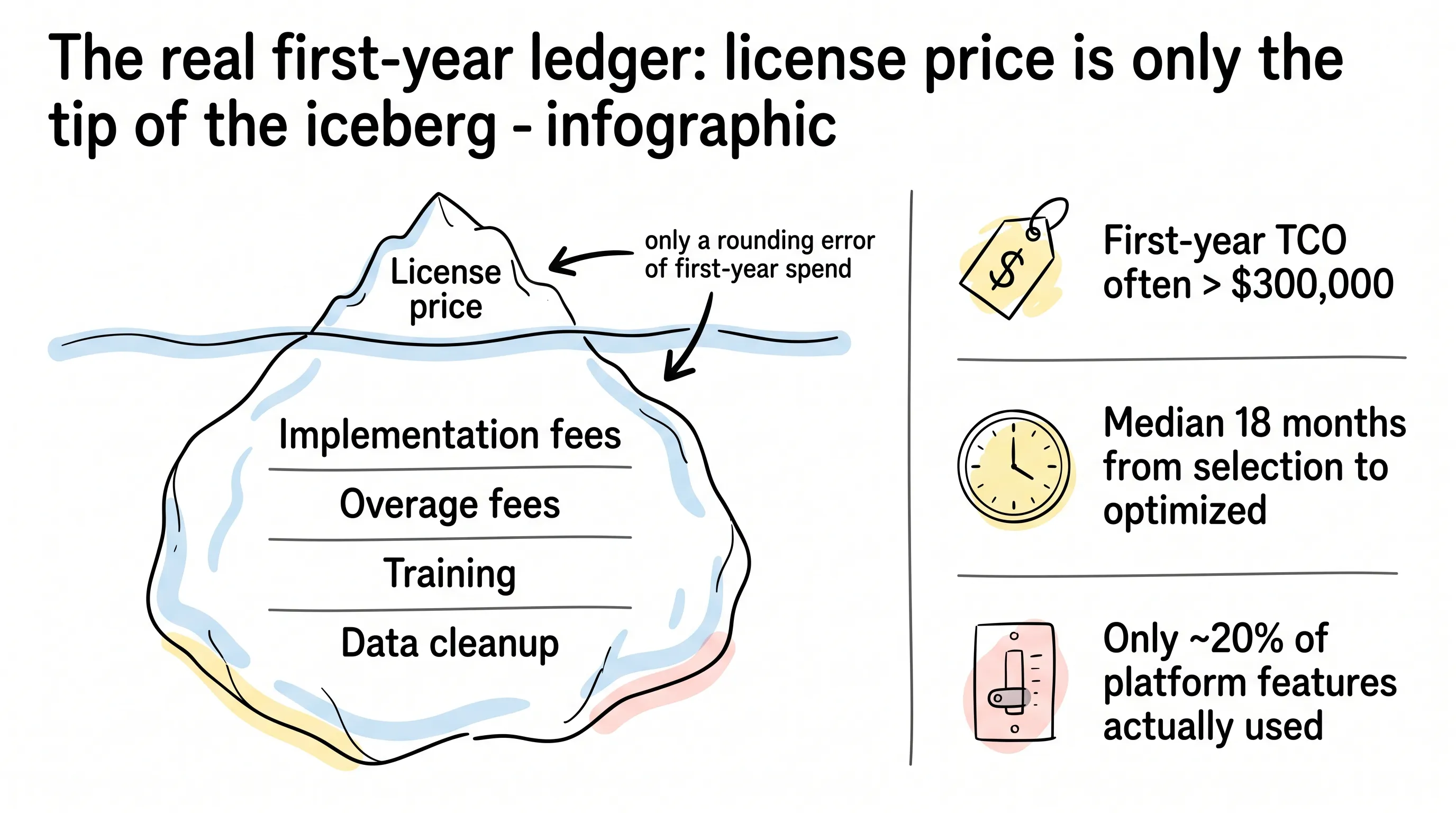
💬 When you budget to the CFO, report first-year TCO, never license price alone — spread out the overage and implementation fees in advance. Appoint the Marketing Automation Owner when the project starts; settle the headcount before signing the contract. Ninety days after launch, run a feature-utilization audit and cut or downsize the modules that were never activated — that money comes back every year.
🔗 Further reading: Read the full article
💡 Today's Overview
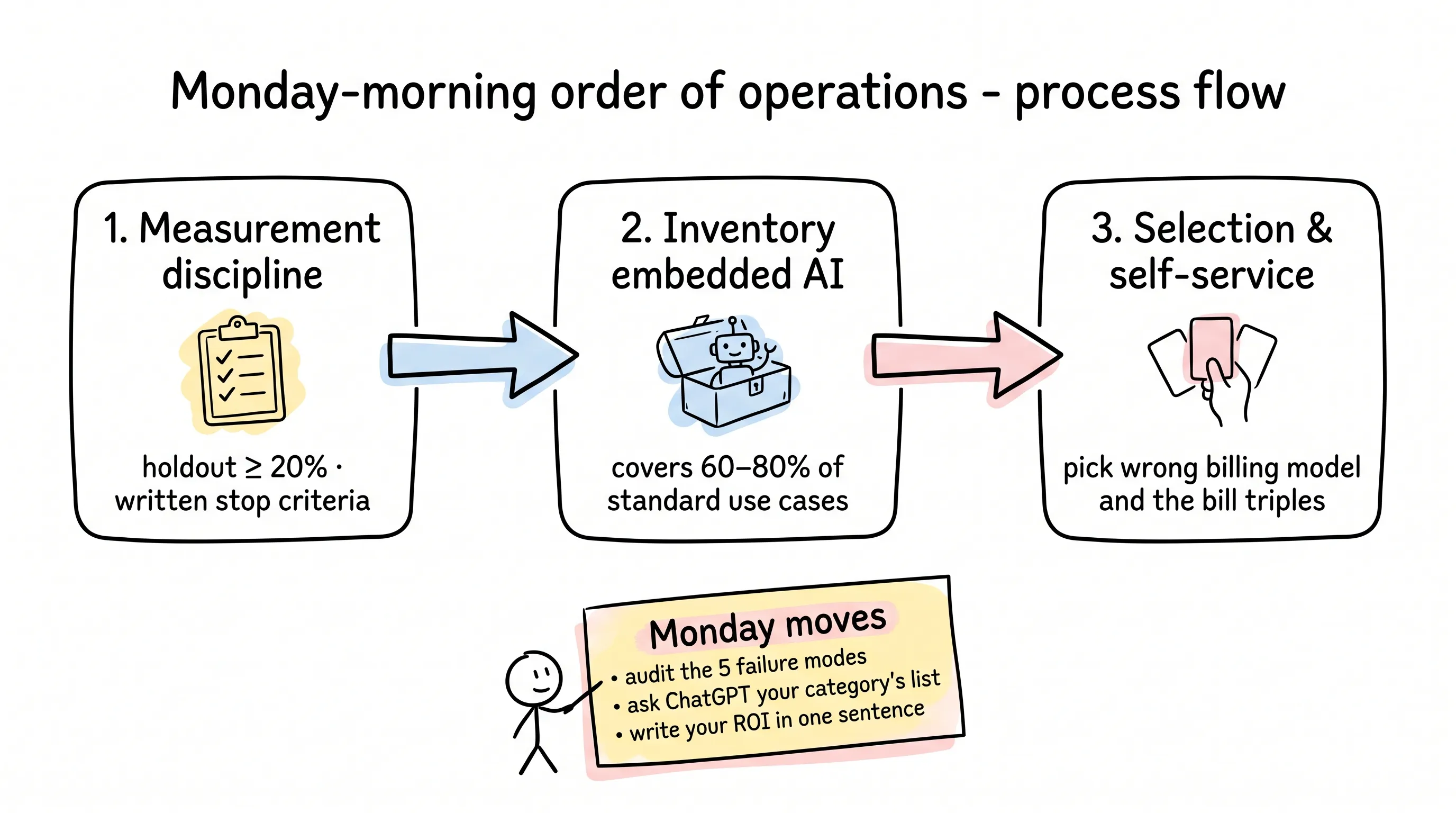
Read as one story, today's 11 items share a one-line throughline: AI capacity has been democratized, and the contest has moved to the ledger and to operations. The headline's 68-minute operator's guide puts it bluntly: tool spending is only a quarter of total investment, and four of the five failure modes are money-related; G2's buyer data confirms it from the demand side — finance's seat on buying committees rose 15 percentage points in a year, and 75% of buyers give you only 6 months to show positive ROI; the three tool comparisons open the same kind of ledger — license price is a rounding error of first-year spend, with the hidden costs in implementation, data, and people; Jasper's GEO guide and the two retrospectives mark out the time dimension — predictions from two years ago are today's consensus, and the window is measured in months. A second layer of warning hides in the two older pieces: 2023 said long-form quality drops, and 2024 said roles will shift — both are being validated today; judgment has to be updated with each tool generation; discipline does not. Suggested order of operations: first establish measurement discipline — holdout control groups plus written stop criteria, the hardest line the headline delivers; then inventory your own platforms' embedded AI coverage, and you can skip most specialist tool purchases; only then come selection and the self-service overhaul. Monday-morning moves: run one self-audit against the five failure modes, ask ChatGPT for your category's recommendation list, and write your ROI assumption as a single sentence. Once capacity is universal, what is scarce is the discipline that separates effect cleanly from background noise.
Continue reading
Related articles

AI Marketing Daily · 2026-10-09
AI marketing daily for 2026-10-09 covering 11 items: brand measurement moving from survey panels to search, social, e-commerce, and AI prompt signals; GEO and share of model playbooks; safety guardrails for agentic ad buying; and tool roundups for ad platforms, cross-border tools, and social media uses.

AI Marketing Daily · 2026-10-08
AI Marketing Daily for 2026-10-08 curates 20 items across AI search visibility (GEO), advertising, platform selection, cross-border e-commerce, and ROI measurement. The headline argues that strategic marketing decisions should stay with humans while AI assists execution.

AI Marketing Daily · 2026-10-07
Today's throughline is answer engine optimization (AEO — getting your brand quoted in AI answer engines).