
AI Marketing Daily · 2026-09-04
Daily digest of eight AI marketing items on moving from pilots to systems: McKinsey's five-pillar growth framework, TikTok and Meta ad automation playbooks, Starfish's audit of cited AI case metrics, organizational readiness findings, and Sprinklr's GEO guidance.
Not one of today's eight items is a new model release — they all orbit the same question: how does AI grow from pilot into system? McKinsey lays out a five-pillar panoramic framework, while Starfish coolly puts the industry's most-cited AI case studies on trial, one by one. On the tools side, TikTok and Meta both dropped copyable homework for ad-delivery automation on the very same day. Capacity keeps getting cheaper; evidence and organizational readiness have become the new bottlenecks. That both threads surfaced the same day is no coincidence: once tools are democratized, the deciding move shifts back to measurement and organization. Eight items unfold under a headline and three categories, each with hands-on commentary.
🎯 Today's Headline
McKinsey: Campaign-based marketing has crossed the tipping point — five pillars take over growth
McKinsey's Growth, Marketing & Sales practice published a long-form piece in June, written by Eli Stein, Julien Boudet, and three other partners; the title translates literally as "From Campaigns to Continuous Growth." The article delivers a blunt verdict on today's marketing model: running marketing to the rhythm of campaigns has crossed a structural tipping point, and there is no going back. The data is laid out plainly. 90% of CMOs are experimenting with AI use cases, yet fewer than 10% have scaled them or captured real value; only 28% of organizations are fundamentally rearranging teams and workflows, while the rest remain stuck with bolt-on add-ons — the main reason value capture fails. The article uses a day in the life of a consumer named Alex to show the demand-side shift: she has her AI assistant build a running training plan, pick shoes, and compare prices; the assistant filters out the irrelevant promotional emails brands send her; in the end it completes the order on her behalf, screening out sellers with poor return policies in advance. Once AI agents take over shopping decisions, the old playbook of switching campaigns on and off naturally stops working. The replacement: rebuild marketing as a continuous growth engine, held up by five capability pillars.
The value range comes with hard numbers: done right, that is 4 to 7 percentage points of revenue growth, 2–3x productivity gains, and 60% to 70% cost savings on execution-type tasks; the AI opportunity in global B2C retail is estimated at $3–5 trillion. The consumer side makes the point even more sharply: nearly half of consumers already use AI search to support purchase decisions, and shoppers now use twice as many channels as they did a decade ago. McKinsey compresses the shift into one sentence: the attention economy is giving way to the trust economy, and recommendation systems decide which brands get chosen. That also explains why 86% of marketers are excited about AI yet see mixed results: everyone has the tools — not everyone has the system.
Each of the five pillars has its own bar to clear. Continuous insight replaces traditional focus groups with digital twins and synthetic personas, running price tests, creative tests, and ad-response tests on virtual populations first — and underneath it all, first- and third-party data streams plus governance and security protocols must stay online year-round. Creative at scale requires codifying brand voice, visuals, and guardrails into a system and treating creative as infrastructure to be cultivated; surveyed senior marketers already rate gen AI content production as their most mature AI capability, with precedents showing 2–5x creative productivity gains, 10% to 30% cost reductions, and campaign cycles compressed from six-to-ten weeks to same-day execution. Hyperpersonalization leans on real-time decision engines and reinforcement learning to lift satisfaction 15% to 20%, grow revenue 5% to 8%, and cut service costs by as much as 30%. The fourth pillar is the most eye-catching: marketing to AI agents — that is, agentic commerce. More than half of consumers already use AI to assist their purchases, so brands must be machine-consumable, building trust signals machines can read and verify: content that answers customer questions directly, detailed product specifications, verifiable reviews, and expert endorsements — and this is exactly the area where surveyed executives rate their own readiness lowest. The fifth pillar, always-on orchestration, replaces the campaign beat with continuous real-time management; in McKinsey's experience, once it is properly set up it lifts marketing ROI by roughly 30% and cuts the share of marketers' time spent on execution work from 60–70% to just over 10%. McKinsey also supplies a roster of new roles — Customer Wayfinder, Creative Guru, Hyperpersonalization Architect, Agent Whisperer, Full-funnel Navigator — and not one of the five is called AI engineer. Organizations will be smaller and faster, restructured around end-to-end workflows; skill development is ranked the number-one adoption barrier, and fewer than a quarter of respondents have a clear transformation roadmap.
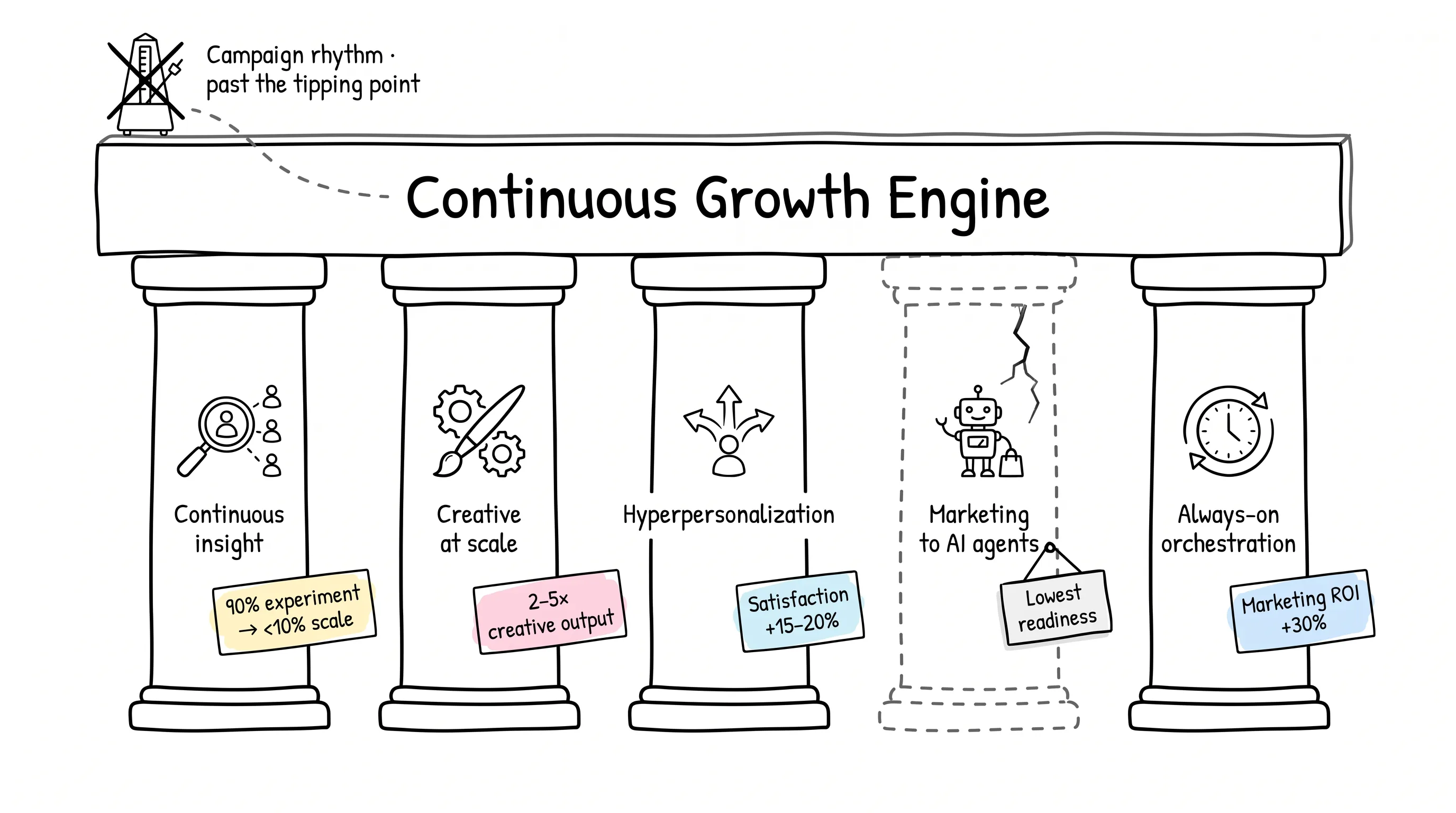
Four levers put this on the ground: rearrange high-value workflows, build human-machine hybrid organizations, invest in the technology and data foundation, and use a Dynamic Transformation Office to track and reinvest the capacity that gets freed up. The getting-started advice is more practical: first feel out the maturity of your own capabilities and data, and don't overestimate your starting point; pick the entry point where AI can most quickly improve speed, cost, or performance, measure by value, and watch it daily; build feedback loops into every model and workflow so each interaction feeds the next; and the most easily overlooked step — define how the five capabilities connect from day one, unifying the data model and the identifiers for customers, products, and intent, so you don't end up building island pilots that never get a sequel. Workflow rearrangement has preconditions too: a unified data and identity layer, KPIs governing end-to-end performance, and cross-functional teams that own the entire workflow — missing any one of them, nothing moves. The Dynamic Transformation Office has its own fine print: the traditional rhythm of milestones plus quarterly reviews can't keep up with AI systems; set explicit value targets from day one, watch whether value actually lands on the P&L, and recalibrate when it drifts. Three cases to benchmark against: a consumer tech company cut campaign activation time by 35% to 50% and external spend by about 20%, compressing content and audience generation from ten-to-twelve weeks down to minutes; a financial institution invested in structured data and machine-readable knowledge engines so search engines and LLMs could accurately interpret and cite its content — after rearranging workflows, organic traffic grew sixfold in nine months, and acquisition costs fell; a global food company used an AI content supply chain to cut campaign costs by roughly 80%, speed up production by about 90%, and lift asset output by 15% to 20%.
The most valuable thing in this framework is not the five-pillar list — it is the counterintuitive reminder: if AI automation saves you 20% of your time but you don't reinvest that time in high-growth moves, the value is zero. Most teams are stuck exactly there: what they bought was capacity, not growth. My advice: treat the five pillars as a health-check sheet rather than a procurement list, and test pillar four's readiness first — can an AI agent read your product information, specifications, and reviews and feel confident citing them? This is the window with the shortest shelf life; once a competitor gets machine-picked first, the catch-up tuition gets expensive.
🔗 Further reading: Read the full article
🏷 Marketing Tools
TikTok completes its ads AI toolchain: natural language plugs straight into Ads Manager, 100 videos a week becomes the norm
TikTok filled in its ad-side AI toolkit in one sweep. Agentic Hub is positioned as a marketplace of AI ad tools, and the underlying TikTok for Business MCP (Model Context Protocol) lets ChatGPT and Claude connect directly to Ads Manager — pulling reports, diagnosing accounts, and building campaigns entirely in natural language, with no API credentials and no developer resources required. By the analogy of short-form video expert Melissa Laurie: Ads Manager is the restaurant, MCP is the waiter, and Claude or ChatGPT is the menu. For small merchants who have never opened an ads backend, this means AI can explain the data, suggest optimizations, and walk them through setup — a path that used to require first hiring a developer to write API integrations. The official skills library ships alongside: Viral Video Creator distills viral-video structures from the million-plus videos the platform processes daily, and Laurie estimates it gets you to about 70% creative completion, with the remaining 30% requiring a human hand on the selling points. Skills are essentially files — editable, copyable, and usable across platforms: TikTok's copywriting skill can be carried over to write Meta creatives, and vice versa; platform lock-in has been pried open. Symphony Creative Studio takes a different route, generating product videos from a brief with one click; a furniture brand uses it to produce 100 videos a week, each focused on a single piece of furniture, with no live actors anywhere. AI avatars are not usable yet — the consensus Laurie heard after talking with multiple leading brands is that they are still not believable; live-action footage plus AI enhancement (her team overlaid animated bacteria onto 3M's mop content) and actor-free product renders are the two viable routes at the moment. Content Suite's new AI search is like a better Facebook Ads Library, filtering competitors' live creatives by industry, timeframe, campaign objective, and region — newcomers should do their homework with it before spending. Laurie also left two hard-won lessons: when the platform's AI suggests pausing a creative after only a few days, don't take it at face value — new campaigns carry cold-start weighting, and a questioned AI will often reverse itself; and the life or death of short-form video is decided on the first frame, not the first three seconds. Viewers are scrolling on the subway, and you are competing with every top creator on the platform for the same swipe — talking-while-doing content does more to hold attention than polished ads, and subtitles are mandatory because many users scroll on mute.
💬 Two things advertisers can do this week: first, spend one coffee's worth of time scrolling Content Suite to see what competitors are running — a free starting point for research; then wire up two automations, daily performance reports and creative fatigue monitoring. Symphony's 100-videos-a-week capacity suits categories that don't need live actors; used well, it can replace your entire outsourced video budget — but the hours saved should go into hook testing, because capacity is only the entry ticket.
🔗 Further reading: Read the full article
The Meta ads agent playbook: the bar has dropped, delegate in seven steps
Superscale's 2026 handbook treats handing Meta media buying to AI agents as an engineering problem. The timing is set by two changes: Meta lowered the Marketing API write-access threshold from 1,500 calls over 15 days to just 500, so the pipeline for third-party agents to obtain account write access is now open; and Andromeda, the delivery system fully launched in October 2025, turns creative supply volume into the number-one performance lever — accounts maintaining 15 to 20 active, differentiated creatives see ROAS 20% to 35% higher than those running only 3, a volume that cannot be produced by hand. The handbook lays out a seven-step delegation method: connect an app approved by Meta; set guardrails (account daily spend cap, a $5,000 cap alert on any single campaign, a ROAS or MER floor, attribution window); first run 72 hours of read-only mode benchmarked against human decisions; then open budget pacing only within CBO (campaign budget optimization), keeping every single change below 20% or the learning phase gets reset — a cost of roughly 50 conversions plus a week of stabilization; after that, progressively open creative rotation and a 24-hour variant-generation loop, with a one-click kill switch retained throughout. The human-machine division of labor is drawn cleanly: agents take over competitor creative research, variant generation, A/B rotation, fatigue pausing (once frequency exceeds the 3.5–4.0 band and CTR is down 20% from peak), and Advantage+ entry/exit judgment; humans keep account structure, offer and pricing, spend caps, final review of sensitive categories, and incrementality testing. It also clarifies the relationship between in-platform automation and the external agent layer: Advantage+ shopping campaigns tested at ROAS 3.14 versus 2.70 manual — usable, and it can automatically test up to 150 creative combinations, but it optimizes only inside its own walls, blind to your true gross margin and blended MER; the agent layer's job is precisely to judge when to hand campaigns over to it and when to pull them out, and to handle the inflated new-customer CAC problem it has had since 2024. The author backs this with his own operating data: 18 months of unattended overnight runs on a $200K/month account, kill switch pulled only twice, both traced to upstream data-source issues. The risk list is equally specific: after iOS's double opt-in, available IDFA is down to 25% to 30%, so agents must triangulate with CAPI, GA4, and MMM (marketing mix modeling), and escalate to humans once platform-reported numbers and model-reported numbers drift more than 15% apart.
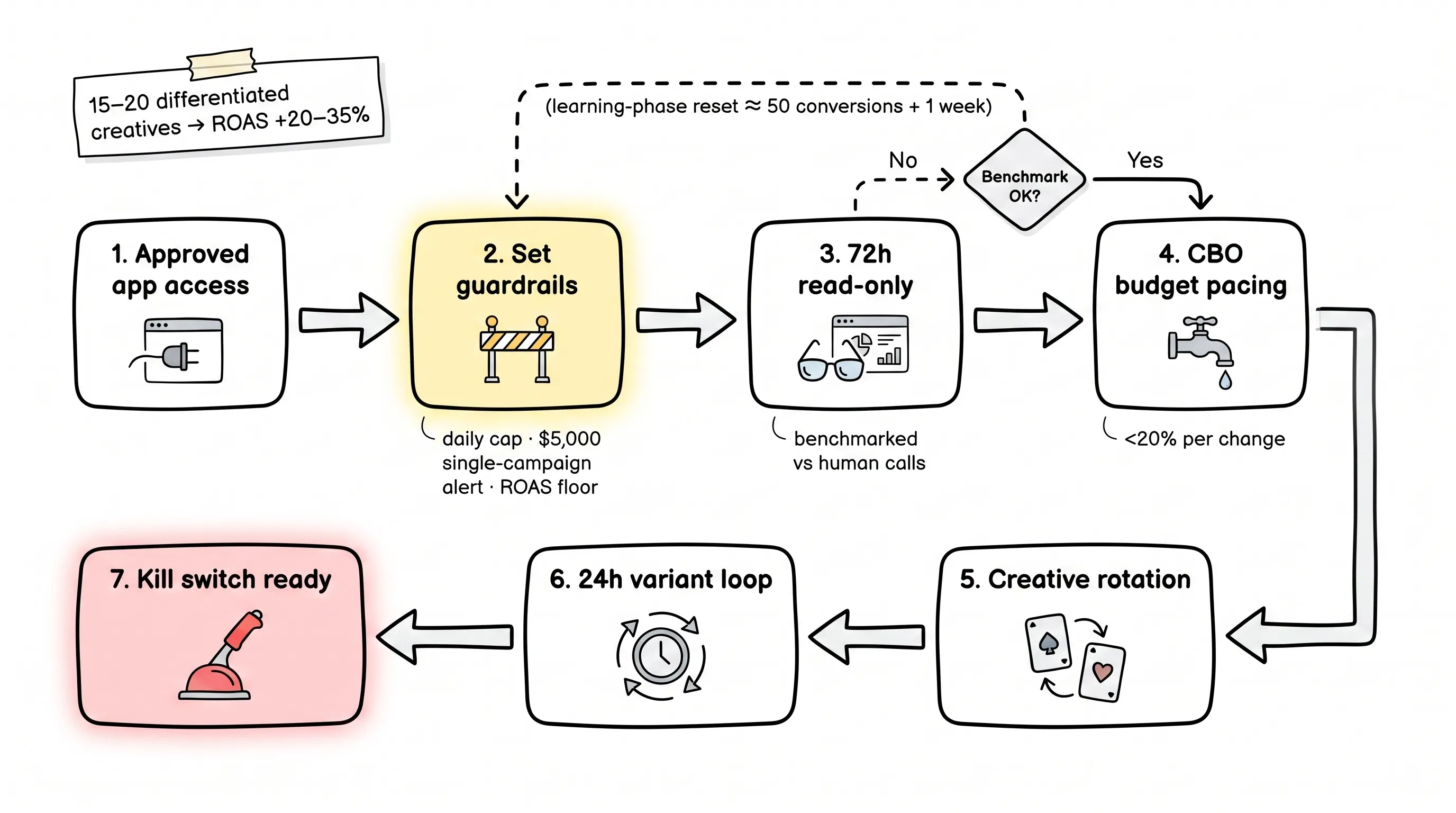
💬 How media buyers should use it: accounts spending $25K or more per month are worth running through the seven steps; below that, start with a rules engine. Before signing with any platform, press on two questions: how is the 20% rule handled, and are changes batch-merged so the learning phase doesn't get reset over and over. The mature end state is one buyer running 20+ accounts — what gets saved is the overnight shift of watching fatigue loops; strategy and offers still cannot do without a human.
🔗 Further reading: Read the full article
The B2B growth stack ledger: full-stack ABM runs $40K–$130K a year — don't buy duplicates
aigrowthagent's enterprise growth-platform selection guide, updated in late August, draws its value from auditable cost data and an anti-pattern list. The selection framework: fix the growth motion first — sales-led, product-led, or hybrid — then map platforms by CRM ecosystem: Salesforce paired with Marketo fits complex GTM above $50M ARR, the full HubSpot suite fits the mid-market, and PLG motions look to Customer.io. The ledger section is the hardest data: mid-market full-stack ABM (account-based marketing) costs roughly $40K–$130K a year, covering the main platform, data enrichment, sales engagement, advertising, and creative; 6sense's median annual contract comes to about $55K–$63K, with actual deals ranging from $12K to over $300K, deployments often stretching weeks to months, total cost of ownership routinely double the initial budget — and it requires a clearly defined target-account list of 200 to 2,000; Demandbase One starts at about $24K a year with 6-to-12-week implementations, fitting teams running more than $500K a year in programmatic spend. One tier cheaper, options exist too: the attribution tool HockeyStack's legacy plan runs about $1,400–$2,200 a month, LinkedIn-heavy teams should look at Factors.ai, whose base plan starts at $399 a month. The most common anti-pattern is buying 6sense and Demandbase together: both pull third-party intent data from overlapping sources, each runs its own scoring on the same batch of accounts, and they push mutually conflicting signals into the same CRM — the budget doubles, the coverage doesn't. The correct architecture is one of each of four layers: one intent orchestration layer, one automation platform matched to your CRM and growth motion, one attribution engine, one data enrichment source — and every added layer needs a governance owner and conflict-resolution rules. One more number in the piece is worth memorizing: Gartner estimates poor data costs organizations an average of $12.9M a year; failed deployments and doubled costs are traced to dirty CRM data, field mapping without a contract, and no RevOps owner.
💬 How to use it: before making the 2027 budget, take this ledger to align with your CFO — ABM quotes routinely start at $50K, and all the negotiating room is in module choices. Teams already running 6sense should stop stacking same-source intent data, and move the duplicate budget (Demandbase starts at $24K a year) into attribution and data cleaning — the latter aims directly at that $12.9M annual loss.
🔗 Further reading: Read the full article
🏷 Industry Data
Starfish audits AI marketing's most-cited cases: the numbers you're quoting are mostly factory metrics
The agency Starfish did what its peers are unwilling to do: it put the most-cited AI marketing cases on trial one by one. The article first names the structural bias: the metrics that are clean and countable are all operational ones — asset volume, cost per asset, days from brief to launch — while brand equity builds slowly and resists attribution, so the industry passes factory metrics off as proof of brand building. Unilever's digital twins are the genuine article: the beauty and health divisions build 3D product replicas on Nvidia Omniverse, cutting costs 55% and speeding content by 65%, with some assets produced at double speed and half price. But they are all production metrics — the only number with any brand relevance, a lift in purchase intent, comes without a figure, and the chief growth officer says it himself: this was never about producing more content. The most widely misread number comes from Chase and Persado's 450% CTR lift: that was a click metric comparing single-sentence AI copy against human copy, most results fell in the 50% to 200% range, the project began in 2016 — before generative AI — and it is now being repurposed as brand evidence in 2026 decks. The positive sample is Airbnb: in 2021 it cut roughly $541M from performance channels and moved it into brand; 2022 revenue grew 40% to $8.4B with a first-ever annual profit of $1.9B; about 90% of traffic comes from direct visits and free channels — and the entire case study does not contain a single production-speed metric. The article offers five tests: does the metric measure demand creation or demand capture; are there business results rather than only marketing results; is there a counterfactual baseline; is the time window honest (brand effects lag and compound); and were AI generation and human decisions kept separate. The author admits his own agency cannot produce item-by-item quantified business results either, and says almost no case survives the fifth test. The article lands a deeper cut: using a demand-capture measurement framework to adjudicate disputes over brand is itself a structural trap. The background data stings: NIQ's 2026 CMO Outlook shows the share of CMOs who believe their CEO and CFO trust brand's long-term value fell from 80% to 69% within one year, and 84% use ROI as their top budget metric; in McKinsey's European survey of 500 respondents, brand ranks first among 2026 priorities while generative and agentic AI ranks only 17th of 20.
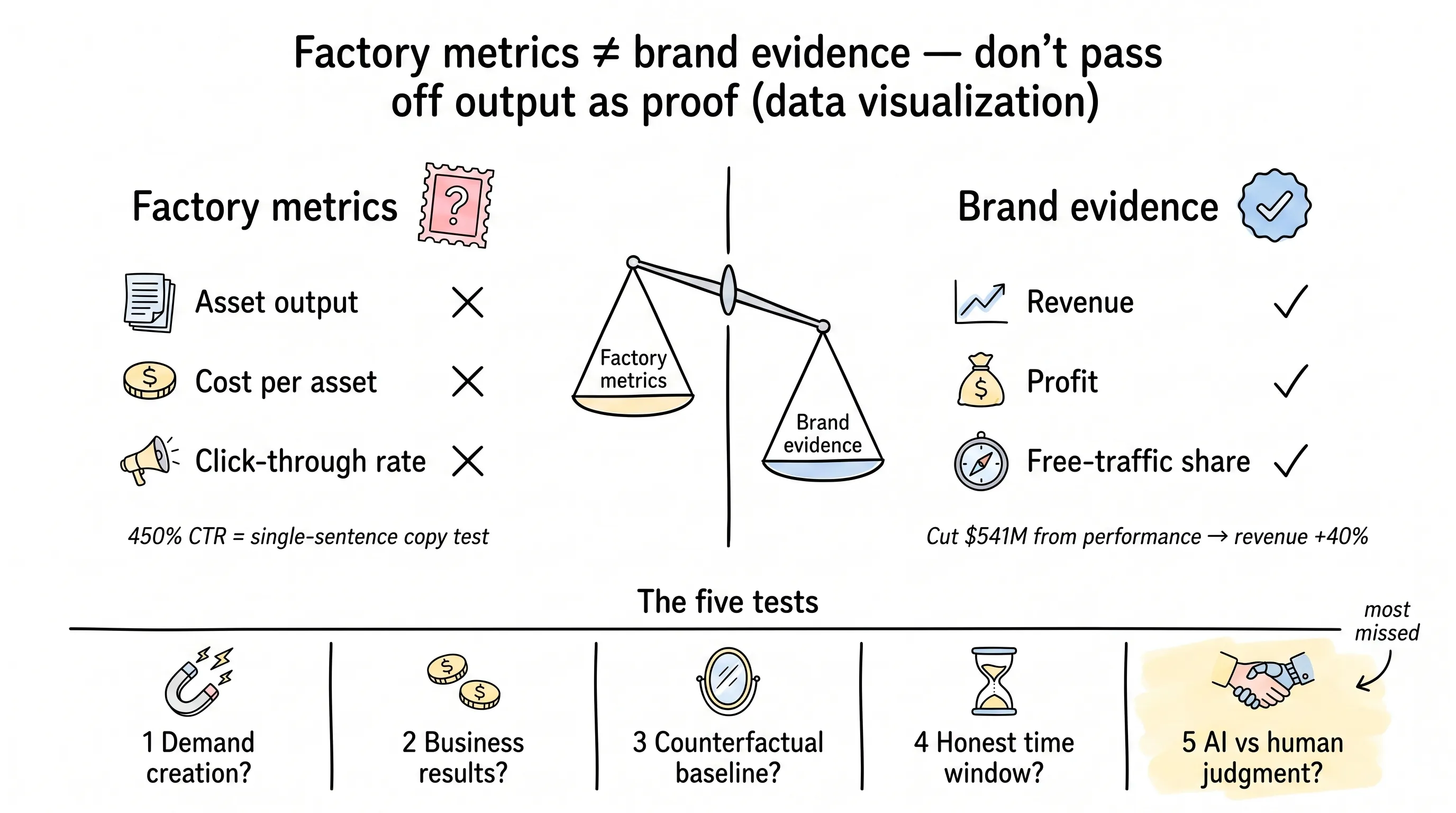
💬 How to use it: copy the five tests into your criteria for reviewing agency case studies and internal AI projects — the fifth question is the one most often missed: the machine produced the assets, but what judgments did the humans make? Cases that can't answer get downweighted. When asking the CFO for brand budget, borrow Airbnb's framing: report revenue, profit, and free-traffic share — don't use asset output and CTR as evidence, because that measurement framework is inherently tilted toward demand capture, and using it to adjudicate brand is a losing game.
🔗 Further reading: Read the full article
Six AI questions for marketing organizations: employees are out in front, only 29% of organizations have a roadmap
On September 3 the Marketing AI Institute published a piece that overturns the usual verdict on AI adoption's bottleneck — swapping employee resistance for organizational readiness. The evidence is its 2026 State of AI report: more than half of practitioners have already moved past the experimentation stage, yet only 29% of organizations have a formal AI roadmap; the organization lags behind its own employees, who are already stuffing AI into their daily roles — what's missing is the supporting structure at the organizational level. The article hands leadership a six-question self-audit: Is strategy anchored to concrete business problems, with success criteria defined uniformly? Does the team have baseline skills and clear usage expectations — are the tool whitelist, resource channels, and role evolution spelled out, and does every key function have champions driving AI adoption? Can the data hold up — where is it, how accurate, what is sensitive, and are there baseline metrics and a defined ROI methodology? Are governance and guardrails in place — are policies, sensitive-information boundaries, and a designated risk owner explicit, with governance positioned to give teams the confidence to use AI responsibly rather than to block them? Can the existing tech stack support the ambition — inventory the AI capabilities and gaps already in the stack, set a secure onboarding process for new platforms, then talk procurement? And are workflows ready to be rebuilt — the biggest opportunity lies in redesigning the work itself, evaluating old and new processes by business impact, validating at small scale before rolling out, rather than automating the old process as-is. Every question maps to a corresponding MAICON 2026 session, and the ads hands-on lab includes delivery debriefs from Kroger, AT&T, General Motors, Shell, and Home Depot. The article itself carries an obvious conference-marketing slant, but the framework and data stand on their own.
💬 How to use it: print the six questions as a quarterly self-check, and answer them with RevOps and legal in the room — most teams will come up short on the data and governance questions, so shore up those two before talking about expanding use cases. The 29% figure belongs in your next internal briefing: an organization's readiness lagging behind its own employees is a budget argument in itself.
🔗 Further reading: Read the full article
🏷 Practical Playbooks
Sprinklr's 2026 content marketing playbook: how to survive when 96.55% of pages get zero traffic
Sprinklr's 2026 content marketing guide opens with a verdict: the "publish more, rank more" logic has failed. Two data points prop it up: 96.55% of pages get zero organic traffic from Google, and AI Overviews have dropped the average CTR of the first organic result by 58%; 81% of marketers already use AI for content tasks, yet only 19% have woven it into their daily workflows — and when 87% use AI in creation, output itself is no longer a differentiator. In the Content Marketing Institute's 2025 B2B survey, 58% of marketers rated their own content strategy only moderately effective. The guide's five-step method: define audience and job-to-be-done first; then map content to funnel stages and business results; build topic clusters around entity-based authority; in production, let AI draft and keep humans at the gate (opinions, fact-checking, and brand voice stay human); finally adopt dual-panel measurement — alongside the traditional search panel, add an LLM visibility panel tracking citation frequency, mention consistency, and prompt coverage. GEO (generative engine optimization) goes beyond changing page structure — it also includes measurement and governance: continuously track how the brand shows up in AI answers, the sentiment around it, and where it sits relative to competitors. Enterprise-grade operations come with five additional capabilities: a unified calendar, centralized briefs (locking audience, intent, message, and success metrics), automated approvals, integrated distribution, and full-funnel attribution — the benchmark is cutting content production costs by 30% to 50% while speeding up time-to-market. Among the six GEO moves, the weightiest is investing in original data: original research and benchmark data are what analysts and AI systems most want to cite — content that only repeats what others have said builds no authority. In the case section, Vaseline Verified is the most instructive: the brand fact-checked claims from over 6,000 user tips about alternative uses, stamping the ones that worked with Vaseline Verified and debunking the harmful ones, presented in laboratory-style video — it took the Cannes Social & Creator Grand Prix, harvesting 63.3M engagements and 87% positive sentiment. In LinkedIn and Sprinklr's joint survey (a 613-person sample), companies deeply integrated with LinkedIn reported a higher probability of ROAS gains of 2.7x, and brand-building's standing in reporting still remains a weak point for most teams. Rare Beauty's scratch-and-sniff billboard demonstrated another thing: the offline experience used a QR code to plug directly into Shopify sample requests, compressing the distance between curiosity and action to a single step.
💬 Two things you can act on this week: list the 20 questions customers would take to AI, then check one by one whether you are cited in ChatGPT's and Gemini's answers, and log the gaps; and reserve one slot for original data in next quarter's content plan — the citation life of one piece of proprietary research is far longer than ten trend-chasing posts. For the dual panel, set up the recording format before talking tools; logging citation frequency once a week is enough.
🔗 Further reading: Read the full article
Canada's official bank for small and mid-size businesses: AI slop is social media's spam
The Business Development Bank of Canada (BDC) published its AI social-media marketing guide for SMEs on August 17 — a government-backed institution stepping onto the field to set the tone, and the framing deserves attention. Senior business advisor Louis-Daniel Bernier runs the saturation math: in the pre-digital era a person encountered 500 to 1,500 ads a day; in the 2010-to-2020 social-media era that rose to 4,000 to 10,000 exposures; in the AI era it exceeds 10,000 — the collapse in content-generation costs has pushed the battle for attention to a white heat. The guide maps AI's five major uses on social media: content generation, audience segmentation and personalization, post-timing optimization, social listening and sentiment monitoring, and paid-media bid optimization. The three biggest AI-agent applications: interaction management at scale — answering comments and DMs around the clock — auto-adapting a single creative into each platform's custom version for TikTok, Instagram, and LinkedIn, and recommending content priorities based on engagement data. The most quotable point is its definition of AI slop. Bernier's exact words: AI slop is to social media what spam is to the inbox — low-quality content mass-generated to farm engagement, grabbing attention through exaggeration, sensationalism, and fear, eroding trust and grinding brand differences flat. The three countermeasures all land on people: protect and cultivate authenticity, don't skimp on human verification, and anchor content in real customer and employee stories. Bernier's phrasing of the human-machine boundary is more direct: enterprises and frontline teams know their customers best — positioning and placement strategy must not be outsourced to a model. The guide also lists the costs: over-reliance on AI makes brands' content converge and weakens positioning; systems may reproduce bias and cause inappropriate expression; and once capacity scales up, oversight gets difficult — without guidelines and review processes, off-message external statements easily slip out. Bernier's bottom-line judgment in one sentence: AI can optimize execution, but it cannot replace strategic judgment or market intuition.
💬 How small teams set boundaries: let AI take on mass production and adaptation; humans hold brand voice, high-value interactions, and placement strategy. Write one hard rule for the team: every week, at least one piece of content must come from a real customer story — that rule holds its value better than any AI efficiency trick. And when writing scripts, replace the generic selling-point words with details from your own books — the boundary between slop and the real thing runs exactly through those details.
🔗 Further reading: Read the full article
💡 Daily Wrap-up
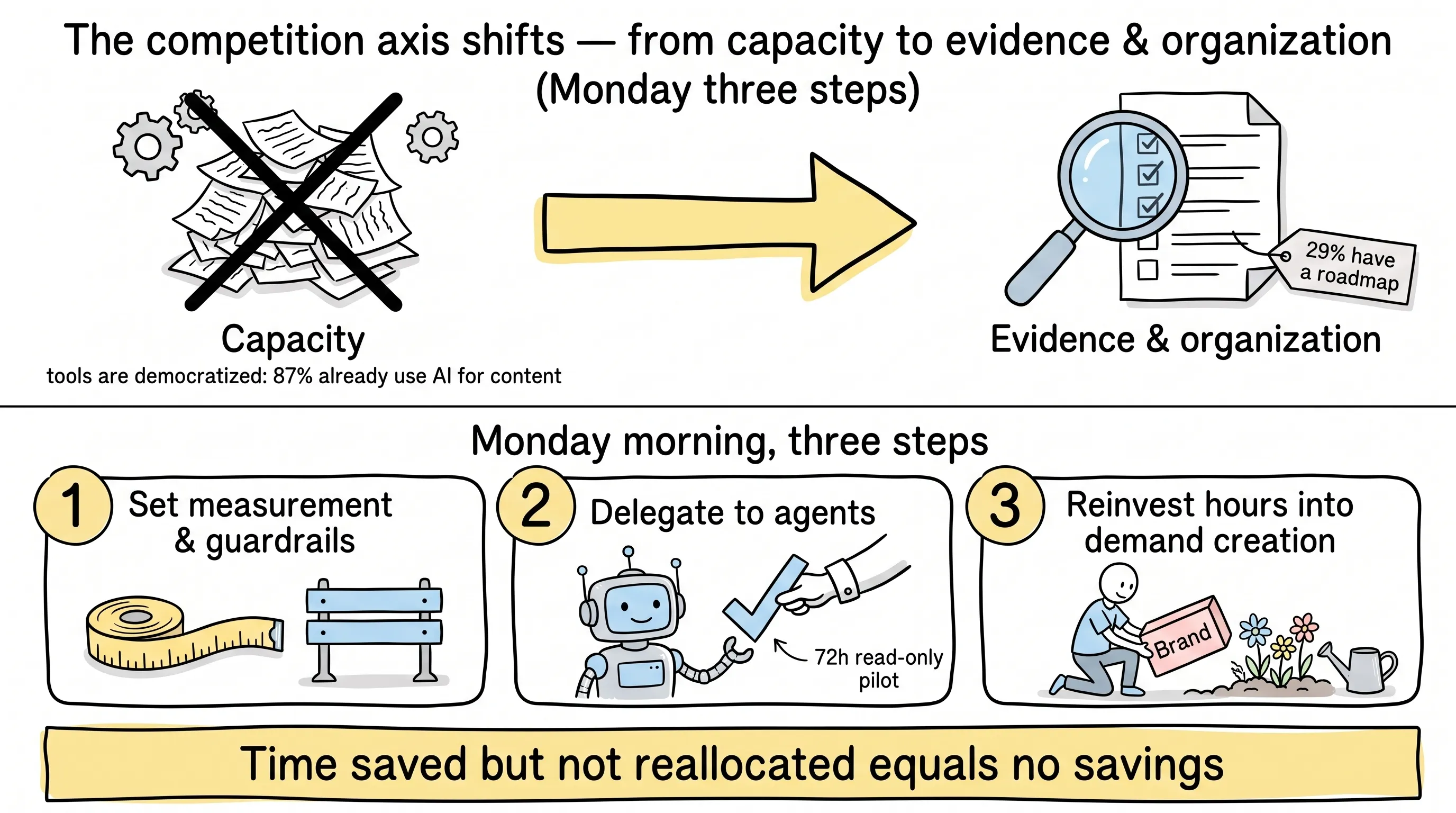
Reading today's eight items together, the through-line is clearer than usual: AI marketing's axis of competition is shifting from capacity to evidence and organization. On the capacity side, the evidence is that TikTok has completed its ads toolchain to the point where natural language can drive it, Meta's agent handbook compresses the delivery loop to a 24-hour cycle, and BDC says outright that content capacity is no longer a moat. On the evidence-and-organization side, Starfish audits the industry's most-cited AI cases and finds a heap of factory metrics, McKinsey measures the gulf between experimenting and scaling, and Marketing AI Institute supplies the organizational numbers — 29% of organizations have an AI roadmap. The three sets of numbers interlock: tools run faster than organizations, measurement runs slower than tools, and what falls into the gap in between is budget. For readers, the suggested order of operations: first establish measurement and guardrails — Starfish's five tests plus the Meta handbook's kill-switch thinking are ready-made — then delegate to agents, and finally reinvest the hours saved back into demand creation and brand instead of continuing to pile up capacity. As for Monday-morning moves: run the six-question self-audit first, then put last quarter's AI cases through the five tests, then open a 72-hour read-only pilot on the ad account that has hit the spend threshold. One more reminder hides in the seams of today's guides: Sprinklr says 87% are using AI for content, and BDC says slop has become a public nuisance — which means what's been democratized is the tool; what remains scarce is judgment. And the McKinsey line deserves to be copied onto the first page of your quarterly plan: time that is saved but not reallocated equals no savings at all.
Continue reading
Related articles

AI Marketing Daily · 2026-10-09
AI marketing daily for 2026-10-09 covering 11 items: brand measurement moving from survey panels to search, social, e-commerce, and AI prompt signals; GEO and share of model playbooks; safety guardrails for agentic ad buying; and tool roundups for ad platforms, cross-border tools, and social media uses.

AI Marketing Daily · 2026-10-08
AI Marketing Daily for 2026-10-08 curates 20 items across AI search visibility (GEO), advertising, platform selection, cross-border e-commerce, and ROI measurement. The headline argues that strategic marketing decisions should stay with humans while AI assists execution.

AI Marketing Daily · 2026-10-07
Today's throughline is answer engine optimization (AEO — getting your brand quoted in AI answer engines).