
AI Marketing Daily · 2026-09-03
A daily briefing on AI marketing covering AEO citation tactics, a LinkedIn visibility experiment, OpenAI and Meta ad developments, and an AI agent for interviewing internal experts.
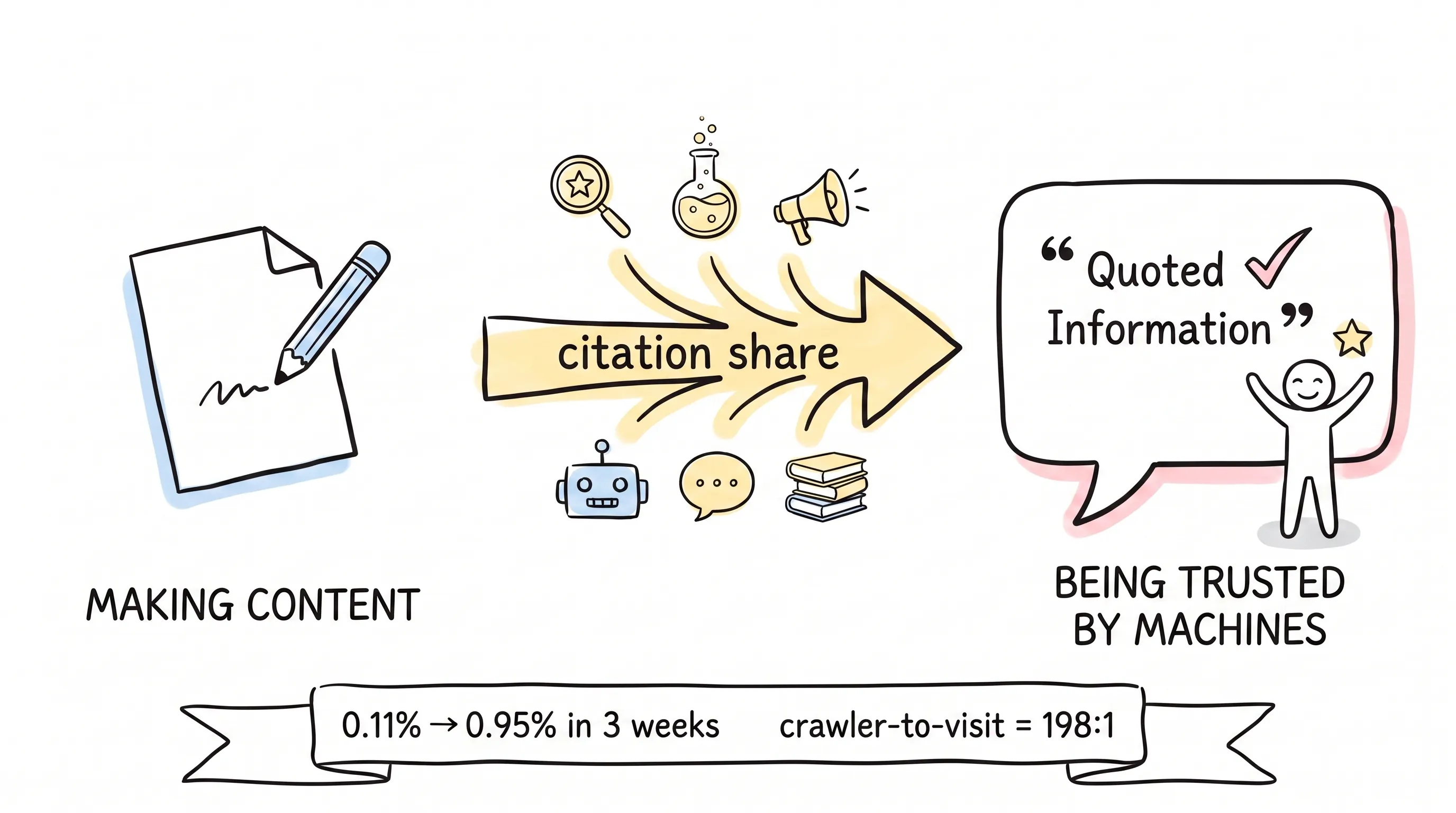
Today's six stories all point to the same thesis: the center of gravity in AI marketing is shifting from making content to being trusted by machines. HubSpot mined thousands of citation data points to break down what AI-search winners consistently do, and one freelancer used LinkedIn to take her AI visibility from 0.11% to 0.95% in three weeks; OpenAI and Meta are both staking claims on the ad side — one touting $1 billion in annualized revenue within 200 days, the other splitting ad buying across five types of agents. Berkeley lays out an organizational roadmap, and SmarterX simply sends an agent to interview its own experts. By the end of this briefing, you'll know what to fix first, what to pilot next, and what not to trust.
🎯 Top Story
HubSpot's 2026 AEO playbook: the five things highly cited brands do right
HubSpot's blog published a long-form piece on September 2; author Cassie Wilson Clark spent the second half of last year researching answer-engine citation data. The data foundation is HubSpot's State of AEO report: thousands of citation data points across six-plus answer engines, a survey of more than 4,000 marketers worldwide, layered with case-study breakdowns of highly cited brands such as Monday.com, Wix, and Adobe. The conclusions contain no magic tricks — only patterns: brands cited at scale behave in strikingly consistent ways.
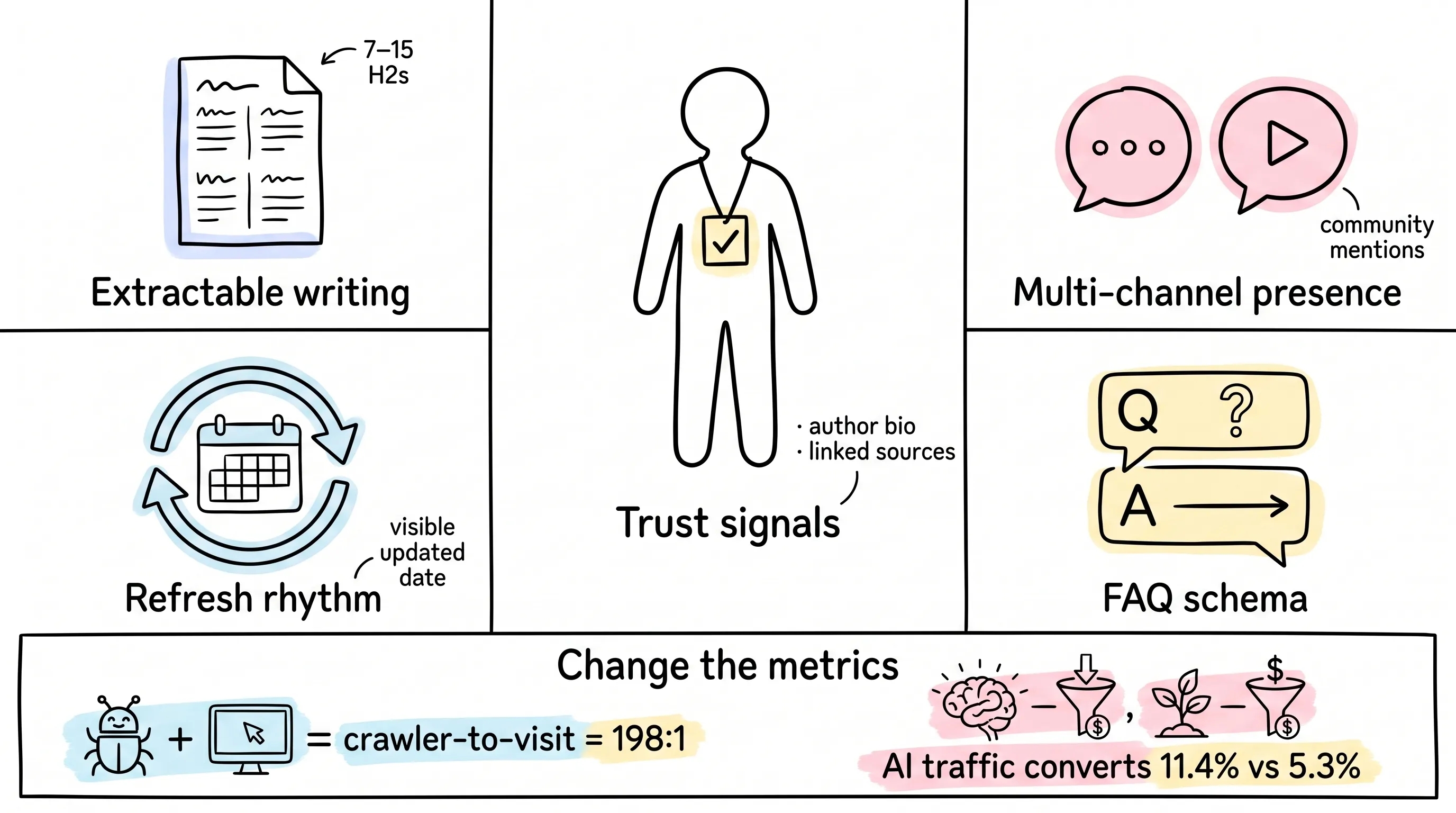
Five shared moves. First, write content so it can be extracted: citation rates peak on pages carrying 7 to 15 H2s, and the deeper the H3 and H4 hierarchy, the better; put definitions up front and pair short paragraphs with lists, so an engine can lift a self-contained answer cleanly. Second, E-E-A-T (Experience, Expertise, Authoritativeness, Trust) signals: real author bios, linked data sources, original research — before an engine stakes its reputation on citing you, it effectively asks, "Would I vouch for this source?" On-page signals make a page citable; off-page mentions make a brand citable. You need both. Third, show up across formats and channels: LinkedIn and YouTube are the most-cited social sources — LinkedIn proves practitioner authority, YouTube proves hands-on capability. Mentions in niche industry communities carry more weight for B2B retrieval than generic backlinks; Slack community recaps turned into blog posts and vertical Substacks getting indexed are all evidence handed to the engine. Fourth, publish on a rhythm and refresh: years in the H1 and titles, a visible updated date on the page. Heavily cited brands treat strong pages as living assets; when a page has gone too long without a substantive update, they add a short "as of [year]" note. Fifth, schema (structured markup that labels page content for machines): the correlation between FAQ schema and citation rate is the most visible in the data. Descriptive FAQ headings paired with schema amount to handing the engine a pre-packaged set of question-and-answer pairs.
Why this matters more now. AEO (answer engine optimization) has shifted in essence from being found to being cited: traditional SEO rewards pages that can be searched; AEO rewards pages that can be extracted — an engine needs to be able to lift a passage that is correct and attributable, cleanly. AJ Ghergich of Botify puts it bluntly: AI rankings are random; you don't rank inside a generated answer — you become the kind of source an engine reaches for when a question comes in. State of AEO also found that B2B brands get cited far more often than B2C: Monday.com has racked up more than 106,000 citations through its blog, Wix leans mainly on listicles, Adobe on product pages — and the most-cited B2B brands are almost all overweight on definition pages and comparison pages. Citations aren't luck; they're an asset operated into existence around category-specific search habits. By page type, definition pages, guides, comparison pages, listicles, and original research are the easiest to cite — and the last one is the hardest currency: data nobody else has upgrades a brand straight into the source.
For marketers, the implications cluster in three places. One: stop talking about AI optimization generically — engine tastes diverge enough that you have to allocate content formats by engine. Comparison pages earn the highest citation rate across the board in ChatGPT, which also favors user reviews, PR, and content with clear provenance. Bet definition-style content on AI Overviews and Gemini: AI Overviews correlates most strongly with Google organic rankings, so traditional SEO investment cashes out most directly there. Gemini takes blogs, product pages, and lists, and prefers content that can hold up under multiple rounds of follow-up questions. Fresh, niche content belongs on Perplexity, which links out aggressively and converts citations straight into referral traffic. Question intent reshuffles the citation landscape too: informational queries feed on definitions and guides, commercial queries on comparisons, lists, and reviews, transactional queries on product pages — and navigational queries demand that the owned page be uniquely yours. B2C is a different picture: reviews, forums, and trusted editorial sources weigh heavier, and consumers routinely cross-check AI claims against traditional search. Run both kinds of business and you're effectively running two playbooks under one roof. Two: your measurement dashboards are lying to you. OpenAI's crawler-to-real-visit ratio is roughly 198 to 1; Google's is about 6 to 1. Impressions inflate, conversion rates distort — measuring AEO with click-era metrics is nostalgia. What to watch instead: brand visibility scores, citation analysis, and assisted conversions from AI-driven traffic. A visibility score is the answer-engine era's ranking position; sentiment scores from -100 to +100 get stamped on every mention, and one badly framed citation hurts more than no citation at all. Some reference numbers: global e-commerce conversion from AI-driven traffic is 11.4%, against 5.3% for organic search, and 44% of marketers admit they've bought from a brand they first discovered in an AI answer. Three: allowing or blocking AI crawlers shouldn't be IT's call to make alone. How brand data gets scraped and represented by AI deserves a joint answer from marketing, IT, and legal.
For execution, the article lays out a 90-day plan. Week 1: build the baseline — find out which pages are already being cited by which engines, list 10 to 20 money prompts real buyers would actually ask, and put monitoring in place. Weeks 2 to 6: rework priority pages — keyword in the H1, H2 count in the 7-to-15 range, FAQ sections added with FAQ schema attached, real author bios and linked sources, and a current-year updated date on the page. Sequence matters: refresh old pages before building new ones; an aged URL with authority gets cited faster than a fresh address starting from zero. Weeks 7 to 12: distribution — publish hands-on content on LinkedIn to establish practitioner authority, demo-style content on YouTube to establish proof of expertise, then enter the niche communities where buyers actually hang out and track third-party mentions. After that, watch visibility-score movements and citations won or lost each week, and reconcile competitor share of voice, sentiment, and pipeline-attributed conversions monthly.
My take: this is the most operationally dense AEO piece of the year, but it's HubSpot's own report, carrying a vested interest in selling AEO tools, and the citation data has had no third-party audit. HubSpot says its own AI-channel leads grew 1,850% on this playbook — take self-reported numbers with half a grain of salt. The structure section, though, is genuinely reproducible: H2 counts, FAQ schema, updated dates — all small moves you can make today. And winning citations is one thing; keeping them is another. Engines recrawl and reshuffle constantly — a page cited today can quietly fall out of the answers next month; schema breaks, data goes stale, and someone has to inspect on a schedule. Close the article and do two things: run your own ten key pages through the checklist, and write the 198-to-1 ratio into the measurement guidance for leadership, so impressions never fool you again.
🔗 Further reading: Read the full article
🏷 AEO in Practice
A Three-Week LinkedIn Experiment: Taking AI Visibility to 0.95% from a Personal Account
HubSpot blog author Mandy Bray has made public a personal experiment on using LinkedIn for AEO — complete with a baseline, a methodology, and the failures. Her motivation was concrete: search a B2B report in Perplexity and the source list is usually Gartner, McKinsey, and academic papers — and then a regular practitioner's LinkedIn post pops up. Small names can wedge their way in among big institutions. Her own ledger added up, too: three of her last four new clients came from LinkedIn, while in traditional search she couldn't compete with large agencies at all; consistent blogging costs real capacity, organic traffic was sliding, and moving the effort to LinkedIn paid off. The macro case first: SEMrush research shows LinkedIn is the second-most-cited domain in generative AI, behind only YouTube — 11% of pages cited by ChatGPT, Perplexity, and Google AI Mode come from LinkedIn, and Google AI Mode is more aggressive still, with 14.3% of answers citing LinkedIn. Meltwater's data leaves the door open for small names: 75% of LinkedIn citations come from personal pages rather than company pages, and 51% come from accounts with fewer than 10,000 followers. The content that gets cited is dominated by long-form articles of 500 to 2,000 words and mid-length posts of 50 to 299 words, mostly educational and advisory. There's one more layer to the is-it-worth-it math: data she cites puts AI search conversion at 5.1 times that of Google organic search, and separate research says 73% of B2B buyers already use AI tools for purchase research.
Her experiment design follows the textbook. Her last LinkedIn long-form post was back in 2016; this time she gave herself a niche positioning — case study writer — and first measured a baseline with AEO tools: 0.11% visibility across ChatGPT, Perplexity, and Gemini. Three things over three weeks: fill in the case-study-writer signals on her profile so the professional label appears across multiple sections; publish 2 long-form articles plus 2 posts, all hand-written from first-hand experience with cover images and author bios, replying to every comment after publishing; and manually re-test each engine weekly in incognito mode, tracking both branded and non-branded prompts — the former asking who to recommend for the job, the latter asking about case-study methodology. For the first two weeks, citations didn't budge. In week three, they moved: Gemini visibility climbed to 0.95%, citation share for brand mentions and her own domain rose from 2% to 5.3%, and Google AI Mode listed her as the single featured writer for branded queries. The knock-on gains were even more tangible: profile views up 200% in 28 days, post impressions up 237%, engagement up 340% — and prospects reaching out on their own to ask about case-study writing.
Two pitfalls, logged. Claude flat-out refuses to recommend freelancers, returning only a list of platforms plus hiring advice — that channel is closed for now. Three weeks is still short: SEMrush data shows three-quarters of authors cited by AI posted at least 5 times in their first four weeks, while the average lifespan of an AI citation is only 11 to 15 days — stop publishing and you drop out of the answers. Her follow-up plan is worth watching as well: keep publishing, study the peers ranking well in AI search one by one, then extend the AEO thinking to her own website with dedicated pages by service and by industry. Her attitude toward non-branded mentions is practical, too: being named by an engine is the gold medal, but an awareness-stage reader who searches for methodology, stumbles onto her article, and drops a follow along the way — neither side loses on that trade. AI can propose topics; the viewpoint on the page must be her own. First-hand perspective is the most valuable thing there is.
💬 This works from a personal account — the lowest-cost AEO experiment available today. Copy her minimal loop: pick a niche, fix your profile, publish two articles and two posts, re-test weekly in incognito mode; that's about half a day a week for one person. Manage expectations: 0.95% is still a small number, and the Claude channel is outright closed. Treat this as a byproduct of LinkedIn operating discipline — picking up citations along the way — not a main battlefield to bet budget on. Citation lifespan is only around two weeks; what actually belongs on the calendar is posting frequency itself.
🔗 Further reading: Read the full article
🏷 Foundation Model News
OpenAI Claims ChatGPT Ads Hit $1 Billion Annualized in 200 Days — and MarTech Pokes Holes in the Math
On September 2, MarTech broke down two new developments in OpenAI's ad business. On the product side, a new onboarding flow cuts the threshold for building a campaign down to 60 seconds: enter a URL, and the AI automatically analyzes the business, products, and target customers, recommends conversational contexts where ads can be placed, and generates creative and copy — add geo, bidding, and billing details and it goes live. You can also build campaigns through the agent inside the ChatGPT Ads Manager plugin. New advertisers spend $500 and get $500 in matching credit — a number with no appeal for big brands; it's aimed at small and mid-size advertisers. OpenAI's longer-term self-image is the AI performance marketer: give the agent a goal and a budget, and it runs the campaign end to end. MarTech stays cool about it: the 60-second campaign solves the friction from an advertiser's first impulse to payment; it does nothing for the harder question — whether marketers can actually find enough value here.
On the revenue side, OpenAI claims ChatGPT Ads crossed $1 billion in annualized revenue (ARR) less than 200 days after launch, with daily ad revenue up 25% since August. MarTech has two reality checks ready. First, ARR is growth-rate extrapolation, not booked revenue, and as a private company's figure there's no way to verify it. Set it against OpenAI's own projections to investors — $2.5 billion in 2026, $11 billion in 2027, $100 billion in 2030, premised on 2.75 billion weekly users by 2030 — and then eMarketer's counter-forecast: the entire US standalone chatbot advertising market will fall short of $1 billion in 2026. Analyst Nate Elliott calls the $100 billion target nearly impossible: it would take explosive user growth, dominance of the consumer AI market, aggressive pricing, and a heavy ad load to all hold at once. Even if the $1 billion ARR is true, it only shows advertisers are willing to give ChatGPT a try; the $100 billion projection bets on growing into a major global ad platform within four years — two things separated by an order of magnitude. Second, performance data is far from settled: one agency measured CTR of about 0.6% on a campaign in Canada, below search-ad norms; some buyers report clearly improved CTR and costs after switching to Max Results bidding. The product side is still catching up — CPC bidding, Conversions API, and pixel measurement were all added only recently, with more formats and measurement capabilities on the way.
A massive user base doesn't automatically equal an ad business, either. ChatGPT has over 1 billion weekly users, and many conversations genuinely happen at the moment of researching products and comparing options — advertising has never stood this close to purchase intent. But sitting next to intent isn't the same as collecting ad fees. To make ad spending reliably profitable, OpenAI still has to prove that matching is accurate, targeting and attribution are usable, ads drive incremental sales, advertisers stick around after the novelty fades, and monetization doesn't wreck the experience that drew users in — MarTech's framing is that these hard problems together are the better part of an ad business. An Ipsos survey twists the knife: 63% of consumers say ads would lower their trust in AI output. Keeping ads separate from answers is the lifeline of OpenAI's model.
💬 The $1 billion ARR is fine as a story; as a budget basis it's dangerous. Two executable moves: use that $500 credit to run a small test, judged on CTR and real conversions — not the platform's promotional framing; and in your reports, break out AI channels as a separate line item so they don't contaminate the organic-search baseline. Keep a watching brief as well: how long OpenAI holds the line of ads-not-polluting-answers determines whether this channel is worth a long-term bet.
🔗 Further reading: Read the full article
🏷 Marketing Tools
Meta's Ad Agent Landscape: Five Agent Types and an 8-Week Migration Path
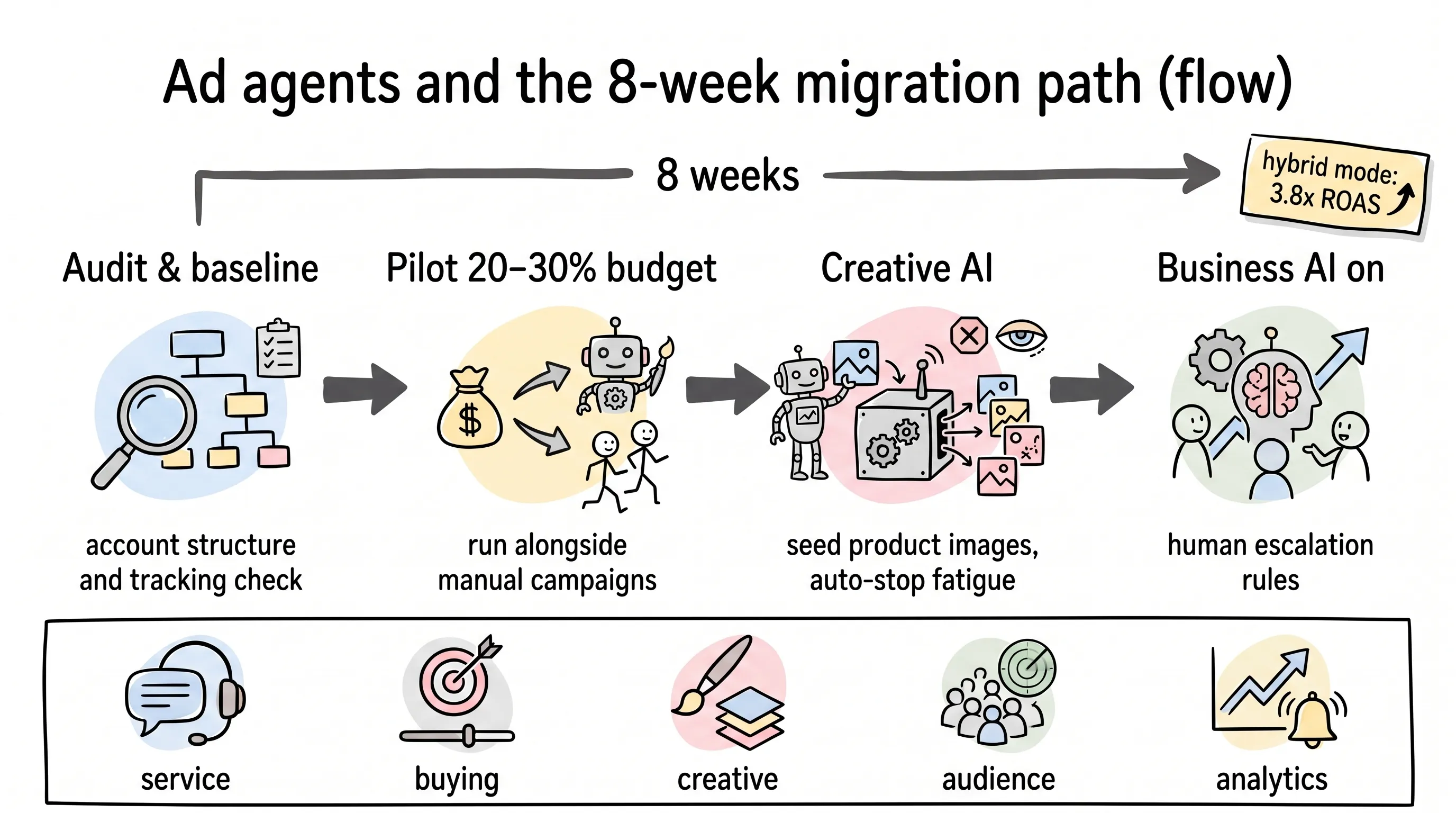
Ryze AI's 2026-edition guide to Meta advertising automation breaks Meta's agent system — covering 4 million advertisers — into five layers. Business AI acts as a 24/7 salesperson, handling customer service plus deal-closing in Messenger, Instagram DMs, and WhatsApp, connected directly to product catalogs and processing orders and returns; early beta conversion rates ran 34% higher than traditional chatbots, and the official expectation is that by Q4 2026 it will handle 40% of service interactions for eligible US merchants. Advantage+ manages the buying: officially, it manages more than $12 billion a year, makes 150-plus daily optimizations per campaign, delivers a CPA 23% lower than manual with ROAS 43% higher, and analyzes more than 11,000 signals per interaction. Creative AI had generated 2.3 billion ad variants in 2026, produces 50-plus variants from a single product input, supports auto-dubbing and localization in 46 languages for video, and cuts creative production costs by an average of 67%. The audience agent processes 4.2 trillion interactions a month and can predict purchase intent 14 days in advance. The analytics agent's anomaly detection runs 72% faster than manual. Meta's signature advantage is the integrated data across Facebook, Instagram, Messenger, WhatsApp, and Threads: cross-platform signals lift conversion-prediction accuracy by about 34%, and Zuckerberg's endgame gets written as "URL to conversion" — the advertiser enters only a URL and a budget, and AI takes care of the rest.
The piece closes with an 8-week migration roadmap: weeks 1–2, audit account structure, merge overlapping audiences, verify the Conversions API; weeks 3–4, put 20% to 30% of budget behind Advantage+ pilots on top categories, running alongside manual campaigns to build a baseline — many advertisers treat a 3.0x ROAS as the trigger to scale; weeks 5–6, plug in creative AI — upload 10 to 15 high-quality product images as seed assets and set fatigue detection to auto-stop declining variants; weeks 7–8, switch on Business AI with human escalation rules; after that, move step by step to full automation plus cross-campaign budget optimization. The three-mode comparison table in the piece is worth a look: hybrid mode delivers CPA 31% lower at 3.8x ROAS, against 2.1x for fully manual and 3.0x for full AI; weekly management time drops from 15 to 20 hours manual to 4 to 6 hours hybrid; and the creative-iteration gap is wider still — 75-plus per month for hybrid against only 5 to 10 for manual. The implications for agencies are spelled out even more bluntly: clients manageable per team up 200% to 300%, senior operators going from 5 to 8 accounts to 15 to 20, roles shifting from tactical execution toward strategic oversight, the escape route written as AI strategy consulting and cross-platform orchestration, and client communication moving from tactical reporting to strategic insight.
One necessary caveat: Ryze sells ad-automation services, and this is customer-acquisition content; most figures in the piece are Meta's official marketing framing and cannot be independently verified — discount them before trusting. Its self-reported 2,000-plus marketing clients, coverage of 23 countries, and management of more than $500 million in spend likewise come from its own mouth.
💬 The roadmap itself is worth copying; halve the numbers before using them. The zero-budget move a media team can make this week: put an account-structure audit plus a Conversions API check on the schedule. Start budget migration at 20%, run it in parallel with manual campaigns for a full two weeks before adding more. The cell to compete for is hybrid mode — let AI run execution and optimization, while humans hold the line on brand boundaries, spend caps, and strategic direction.
🔗 Further reading: Read the full article
SmarterX Uses an AI Agent to Interview Internal Experts, Cracking the Expert-Time Bottleneck
SmarterX, the company behind Marketing AI Institute, posted a retrospective on September 2 of an experiment run by its own content team: building an AI interviewer agent, purpose-built for internal experts who have no time for interviews. The starting point is that the logic of content has changed: after AI drives the cost of mass production down to nearly zero, original quotes, first-hand experience, and strong opinions become the scarcest resources for differentiation — and the bottleneck is expert time and availability. The scenario is concrete: the content team has five articles on the calendar in one week, three of them meant to carry expert viewpoints, and booking time becomes three rounds of scheduling tug-of-war. SmarterX already runs an expert-first content playbook, sourcing material from across the organization — verbatim lines from the weekly podcast, framings from AI Academy courses, findings from original research, plus cross-team Q&As — assembling the things AI can't replicate. The Q&A step, though, has long been stuck on never being able to book anyone.
The agent runs as an MVP inside ChatGPT, in a three-step flow. Step one is parallel research: dig into the topic, the audience, and what the expert has said recently on the podcast, so the interview enters with real context. Step two is adaptive questioning, one question at a time: each answer generates the next follow-up, aimed at forcing out specific, only-someone-who-was-there viewpoints and squeezing out the pleasantries. Step three produces a structured brief: key points, standout quotes, full minutes, plus fact-checking of the expert's statements — experts misspeak too, and building verification into the flow saves the team a step. The experience design for experts is the key selling point: the interview can be completed on a phone during a walk or a commute, no meeting slot required.
The limitations are disclosed as well: a human still has to start the process for now — telling the agent the topic and launching the interview — and the team is evolving toward automatic triggering when a task in the project management system gets tagged. The walkthrough comes from the AI Use Case Spotlight segment of its podcast, episode 233. As for whether the brief can reliably produce better content, the team is still testing.
💬 This workflow is narrow enough to copy directly: from parallel research to adaptive questioning, ending in a brief with fact-checking built in — you can put a first version together in ChatGPT in an afternoon. Start with the one or two topics each week most starved of expert viewpoints, and compare brief quality against human interviews. What it saves you is the two days of scheduling back-and-forth; the insight still has to come from people, so don't expect the agent to ghostwrite viewpoints.
🔗 Further reading: Read the full article
🏷 Marketing Strategy
Berkeley Management Journal Maps a Three-Layer Path for GenAI in Marketing: Semantic Layer First
California Management Review, the journal of UC Berkeley's Haas School of Business, has published a long-form piece that splits the road for generative AI into marketing into three layers; author Seojoon Oh is a product manager working on data products. The piece opens with a splash of cold water: Heinz's DALL·E meme play won 850 million social impressions, and Coca-Cola's platform gathered 120,000 user-created assets — viral cases like these manufacture an illusion of transformation, while the real returns hide in embedding AI into the data and systems of everyday marketing. Earlier still, Nutella used an algorithm to generate 7 million one-of-a-kind packaging labels that sold out within a month — a scale no human workforce could ever produce.
Layer one is the data foundation: deploy a semantic layer (a unified definition layer for business metrics) and unify metric definitions, so AI knows which fields actually count as revenue and how conversion is calculated. Without this layer, ask AI for last quarter's total revenue and it will dutifully add up every number in sight and produce a wrong total. Google's field testing found the Looker semantic layer reduces generative AI query errors by about two-thirds, and Snowflake, Databricks, and dbt are all investing in the same direction. Layer two is the AI analyst: agentic analytics built on top of the semantic layer reasons in multiple steps. The example in the piece: AI notices conversion down 10%, drills down on its own to find Europe down 25%, then pins it to organic search and recent SEO ranking shifts — delivering a root-cause narrative in minutes that would take a human hours of digging. Monitoring agents can raise real-time alerts, too: for example, an ad's click cost in the 25-to-34 female segment jumps 20% in a single day, with suspected causes attached; ask why email open rates are sliding and the answer comes straight back: mainly among mobile iOS users on Wednesdays and Thursdays, likely because a new subject line performs poorly on phones. In AMA research, 71% of marketers use GenAI weekly, and 85% of them report significant productivity gains. Layer three is AI autopilot: agents orchestrate budget and creative across channels under brand guardrails — Adobe's AI Agent Orchestrator and IBM's Watson Campaign Automation are already in place. Case numbers: Klarna's AI copilot cut agency spend by 25%, roughly $10 million saved; Headway used AI advertising to take 3.3 billion impressions in 6 months, with video ad ROI up 40%.
The author's stance is augmented marketing: AI is the autopilot, humans remain the pilot — speed limits, no-go zones, and brakes are all set by people; an agent without guardrails will write clickbait for clicks and burn through budget on audiences that merely look like a bargain. The usual team practice is to A/B AI-run campaigns against human-run ones — measure it, then scale what works — while training the team to read AI recommendations, push follow-ups where they matter, and catch anomalies. The global marketing lead at Coca-Cola is quoted in endorsement: "For humans, human intelligence matters just as much as AI." The author also paints a near-term scene: you arrive at the morning meeting carrying insights from AI that dug through all the data overnight, an AI-assisted creative list, and a first-draft media plan; the team makes the call by noon, the campaign goes live by evening, AI tunes it as it runs, and at month-end you review what it changed and why. On the organizational level it's written concretely: junior analysts shift toward interpreting AI insights, media buyers transform into campaign architects, and collaboration between marketing, data, and IT is a precondition. The piece closes with a reminder to managers: today's frontier capabilities may be the norm in a year or two — don't chase hype; making AI produce real value in your own context is the real work.
💬 The three-layer order is the implementation priority — most teams die from skipping layer one and buying tools directly. This week's move: write the definitions of conversion, revenue, and leads into a single alignment document for the whole team, and start the semantic layer from one table. For automation pilots, set spend caps and brand red lines first; run one AI-managed campaign against a human-managed one, and only release more budget once the data wins.
🔗 Further reading: Read the full article
💡 Today's Big Picture
Read together, the six items are really about one thing: the center of gravity in AI marketing has moved from making content to being trusted by machines. HubSpot's citation data, the LinkedIn personal experiment, OpenAI's ad revenue, Meta's buying agents — all contending for the same spot: becoming the name that gets cited, recommended, and clicked inside AI answers. The rules of the game have switched from search rankings to citation share: pages need to be liftable cleanly by engines, people need to be mentioned repeatedly in communities, brands need to be named in answers. The entry tickets aren't evenly distributed either: 75% of LinkedIn citations come from personal pages rather than company pages, and B2B brands get cited far more than B2C — expert individuals and B2B teams are sitting better in this reshuffle than they might think.
Sequencing matters more than the tool list. First, reshape your own pages and profiles into structures machines can easily extract — H2 range, FAQ schema, author bios, updated dates; that's the zero-budget work, and it can start today. Then open the smallest possible test bed in each of ChatGPT ads and Advantage+, deciding on real conversion numbers rather than platform framing alone. On the organizational layer, follow the Berkeley piece's path: unify metric definitions first, then talk agent automation — with the order wrong, everything else is wasted. Put the timelines from the three materials side by side and the picture is neat: the LinkedIn experiment shows results in three weeks, the Meta migration completes in eight, and the AEO playbook runs ninety days. Different tempos — but all of them start from measuring a baseline.
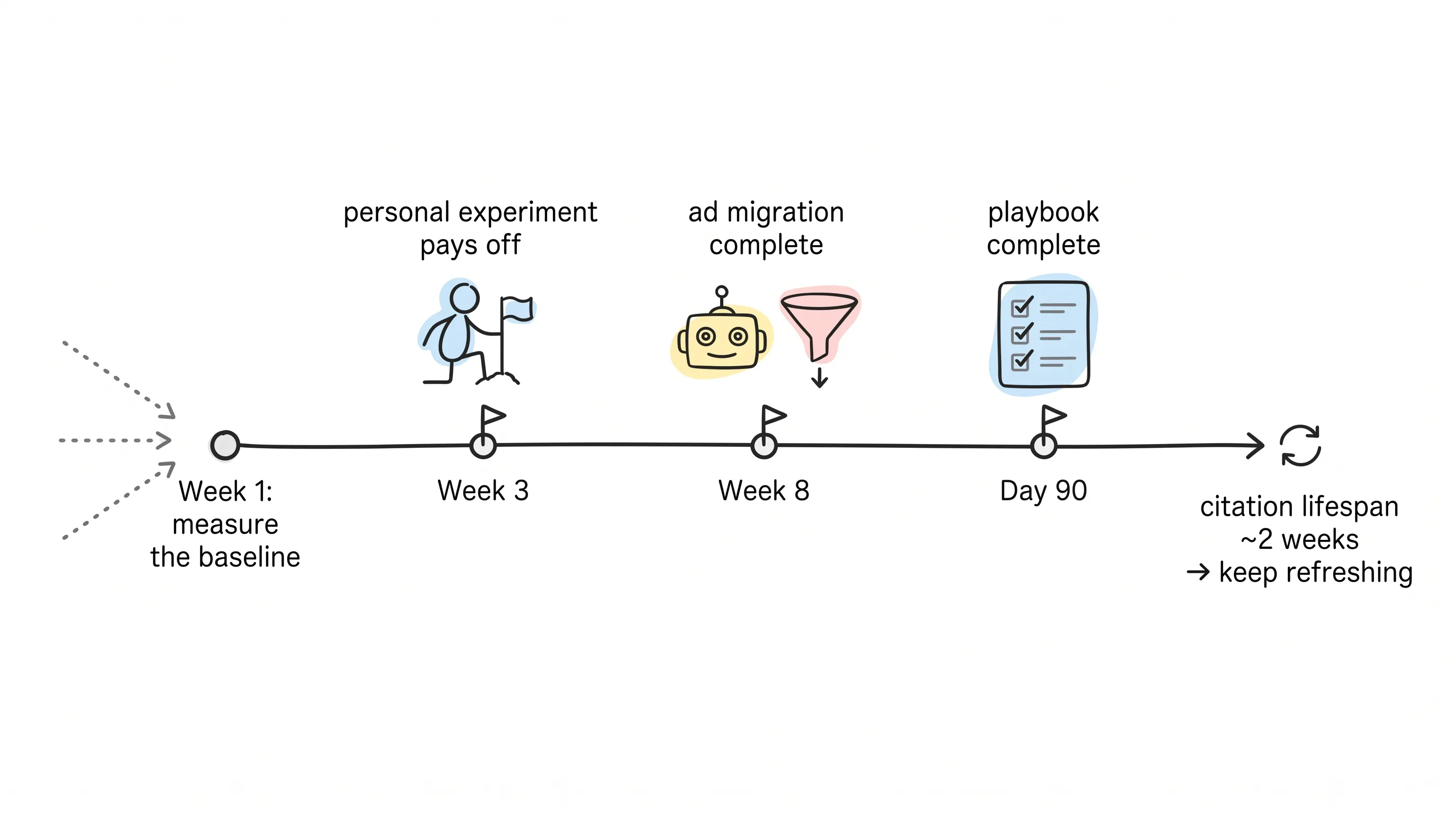
Today's biggest reminder comes from two pairs of contrasts: OpenAI's $1 billion ARR against eMarketer's sub-$1-billion market forecast, and the 3.8x ROAS in Ryze's piece against its own customer-acquisition stake. The numbers are all real; the counting method decides what they mean. There's also a fact that's easy to miss: the average lifespan of an AI citation is only about two weeks. The HubSpot piece likewise likens citations to a portfolio that needs continuous tending — the winners are the people who can put refresh cadence, metric definitions, and a governance owner onto the calendar, not the ones who finish one optimization and call it a day. In 2026, the first skill of AI marketing is interrogating how numbers are counted; only the second is using the tools.
Continue reading
Related articles

AI Marketing Daily · 2026-10-09
AI marketing daily for 2026-10-09 covering 11 items: brand measurement moving from survey panels to search, social, e-commerce, and AI prompt signals; GEO and share of model playbooks; safety guardrails for agentic ad buying; and tool roundups for ad platforms, cross-border tools, and social media uses.

AI Marketing Daily · 2026-10-08
AI Marketing Daily for 2026-10-08 curates 20 items across AI search visibility (GEO), advertising, platform selection, cross-border e-commerce, and ROI measurement. The headline argues that strategic marketing decisions should stay with humans while AI assists execution.

AI Marketing Daily · 2026-10-07
Today's throughline is answer engine optimization (AEO — getting your brand quoted in AI answer engines).