
You've Published Plenty of Coverage — So Why Is AI's Answer Missing You?
A learn article explaining why media coverage and backlinks built for search engines often go uncited in AI answers, and outlining three AEO outreach steps: identify which sources get cited, prioritize by citation impact, and track placements through visibility data.
A few days ago, I had dinner with a friend who works in B2B marketing. He showed me his team's outreach scoreboard: over the past six months, they'd landed media coverage in more than twenty outlets, plus several hundred backlinks — the majority from high-authority sites.
"Nice," I said. "Then let me ask you one question."
Open any AI chat box, type in the question your customers ask most often, and check: does the answer mention you?
He paused for a second, pulled out his phone, and tried. Nope.
Twenty-plus outlets, hundreds of backlinks — collectively invisible in AI's answers.
My first thought: this is a textbook case. Because the outreach playbook, from its roots, was designed for search engines.
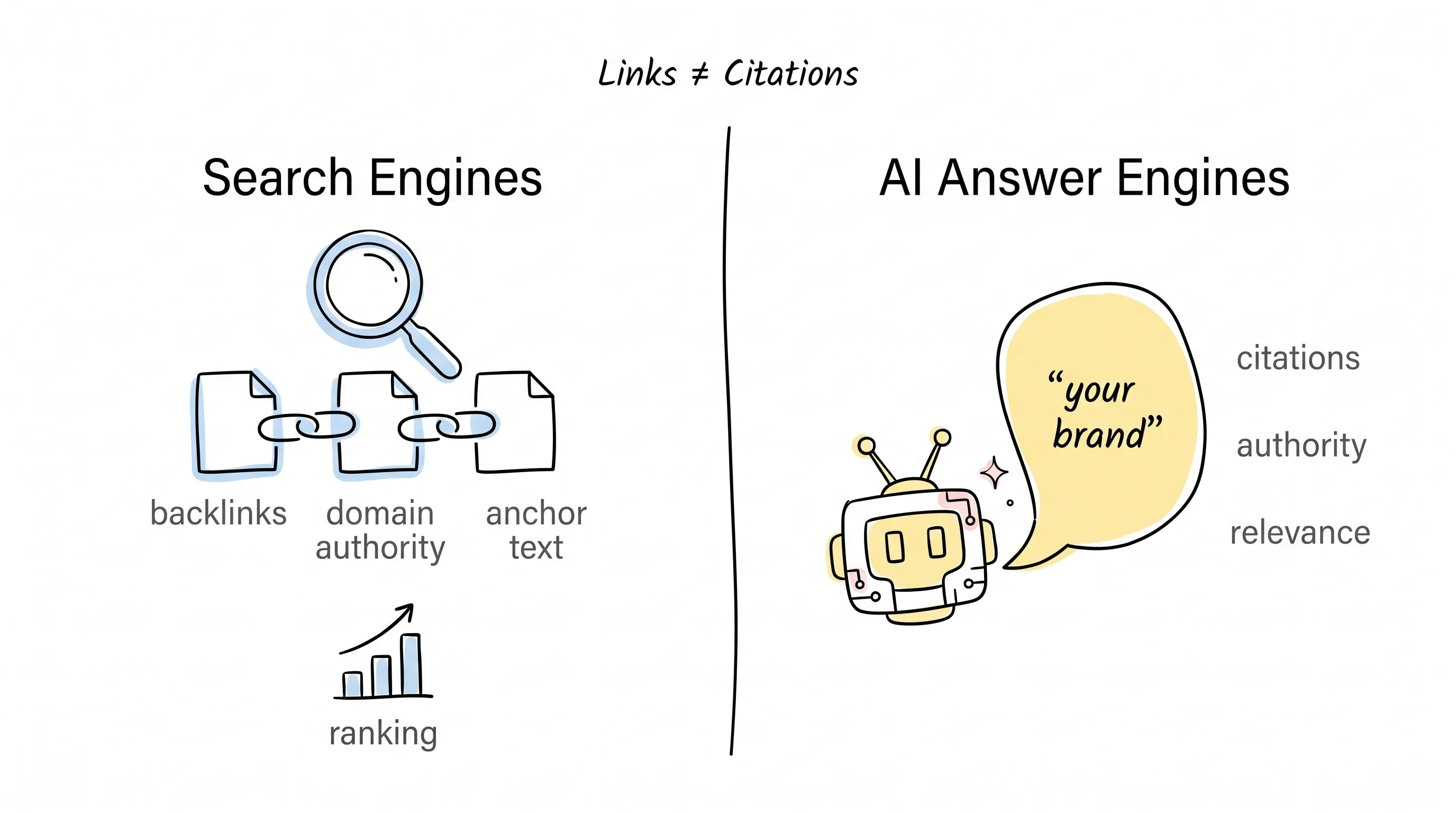
What does "designed for search engines" mean? It means accumulating that handful of signals: domain authority, anchor text, referring-domain count. Search engines look at these; you accumulate these; your ranking climbs. Marketing teams around the world have run this process for a decade — it's a well-worn playbook you can mass-produce.
But answer engines don't look at any of that.
So who does it cite? Not the batch with the most backlinks. It answers to exactly one criterion: for a specific question, whose content is authoritative and relevant enough. And note — authority and relevance are its judgment call, not your link equity.
Which leaves you in an awkward bind: the coverage you worked hard to earn, it doesn't recognize — while the sources it actually picks up and cites may never have been on your outreach list at all.
What kinds of places are these sources? Forums, review sites, editorial media, community platforms. Many of them share zero overlap with the list you're currently working. Worse still, even when an outlet links to you, that's no guarantee it gets cited.
Links are for search engines. Citations are for AI. Two different things.
So what do you do? Three things.
First: Figure Out Who Is Actually Getting Cited
Stop building your outreach list on gut feeling.
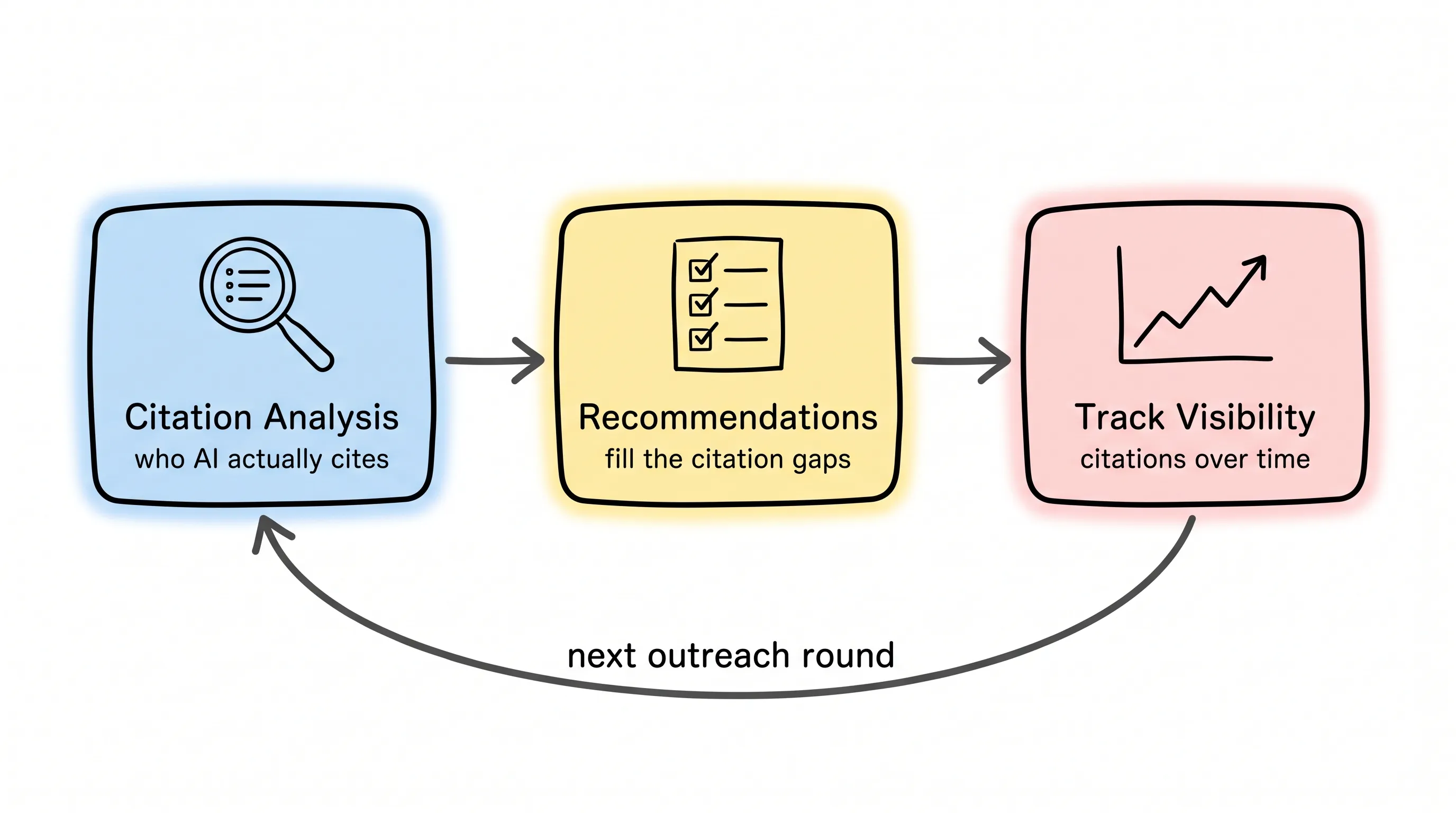
Getting cited is something you can actually see. HubSpot's AEO (Answer Engine Optimization) tools, for example, have a Citation Analysis feature that tells you directly: right now, in AI answers, which publications, which community platforms, and which types of content are speaking for you.
One look at the data may make you gasp: the big-name outlets you spent money and headcount courting have never been cited once. Meanwhile, a single thread on some industry forum gets quoted by AI over and over.
It stings. But that's the truth.
Only with this list in hand do you have a real basis for re-choosing your outreach targets.
Second: Prioritize by Citation Impact, Not by Traffic
Outreach headcount is limited. There are only so many people on the team, and only so many partnerships you can land in a month.
So what drives your ranking? Most teams go on instinct or habit — "we've always pitched this outlet." But neither instinct nor habit is evidence of whether AI will actually cite that outlet. Rank by feel, and your effort goes where your gut says, not where the data says.
HubSpot's AEO tools also have a Recommendations feature. Against your current citation gaps, it points straight at which types of content and which types of sources are missing from your citation profile. Your outreach calendar should be scheduled around filling exactly those gaps.
Plainly put: replace "I feel we should pitch them" with "the data says this is what to fill."
Third: Make Every Placement Trackable
Outreach ROI has historically been a ledger nobody could balance.
The team spends time landing a placement — then what? The actual impact on the brand sits several layers downstream, impossible to pin down. The placement exists, but you can't point to anything it changed; when the boss asks, you can only mumble something vague.
AEO, ironically, straightens the books: if a placement truly produced citations, it shows up directly in your visibility data — you can't hide it.
HubSpot's Brand Visibility Dashboard does exactly this tracking: brand visibility score, share of voice, citation count — all charted over time. Run one round of outreach per the recommendations, come back after a while, and look: has your citation profile changed? Has the score moved?
It moved — the approach is right, double down. It didn't move — the targets were wrong, switch.
This is the feedback loop outreach should have. Every round of placements helps the next one land more precisely.
A Final Word
Truth is, AEO outreach isn't some brand-new job.
It's a sharper version of what you're already doing. Same outlets, same headcount; the only thing that changes is the yardstick: from "did they give me a link" to "did they get AI to say your name."
The signals are measurable, the list is buildable, the results are traceable.
The real homework is just figuring out which placements to chase — and whether they truly landed.
Here's hoping that at your next dinner, when your friend pulls out his phone to try again, the answer says your name.
Continue reading
Related articles

Cross-Border Business: Time to Upgrade Your AI Toolbox
A learn article explaining how AI tools help cross-border e-commerce sellers clear five hurdles: language, regulation, logistics, payments, and fraud. It outlines a five-compartment toolbox, a five-step adoption path, and metrics such as conversion rate and CLV, while cautioning against over-reliance on AI.

AI Is Taking Over the Dirty Work of Social Media Marketing, One Task at a Time
This learn article outlines four social media marketing tasks AI can handle — audience analytics, content drafting and design, ad targeting and creative testing, and spam moderation — and cautions that taste, judgment, and data security remain human responsibilities.

AI Is Already This Good — Why Is Your Social Media Marketing Still Pure Manpower?
An overview of 18 AI tools for social media marketing, organized into six categories covering audience research, content creation, scheduling, comment and DM handling, ad management, and visual production, plus notes on personalization, prediction, and emerging trends.