
Cross-Border Business: Time to Upgrade Your AI Toolbox
A learn article explaining how AI tools help cross-border e-commerce sellers clear five hurdles: language, regulation, logistics, payments, and fraud. It outlines a five-compartment toolbox, a five-step adoption path, and metrics such as conversion rate and CLV, while cautioning against over-reliance on AI.
A while back, I had dinner with a friend who runs a cross-border e-commerce business.
He sells small appliances on Amazon, mainly for the European market. Halfway through the meal, he started venting: one shipment bound for Germany had the wrong VAT (value-added tax) number filled in, and it sat stuck at customs for three full weeks. A French buyer messaged him about a product in the middle of the night; he replied in halting English, and after just a couple of exchanges the buyer went off and ordered from someone else. Then there was a refund from Portugal that, once he looked into it, turned out to be fraud.
He said: this is brutal.
I told him: that's not "brutal." That's taking the toolkit you built for the domestic game and bringing it to an international tournament.
So What Exactly Makes Cross-Border Hard?
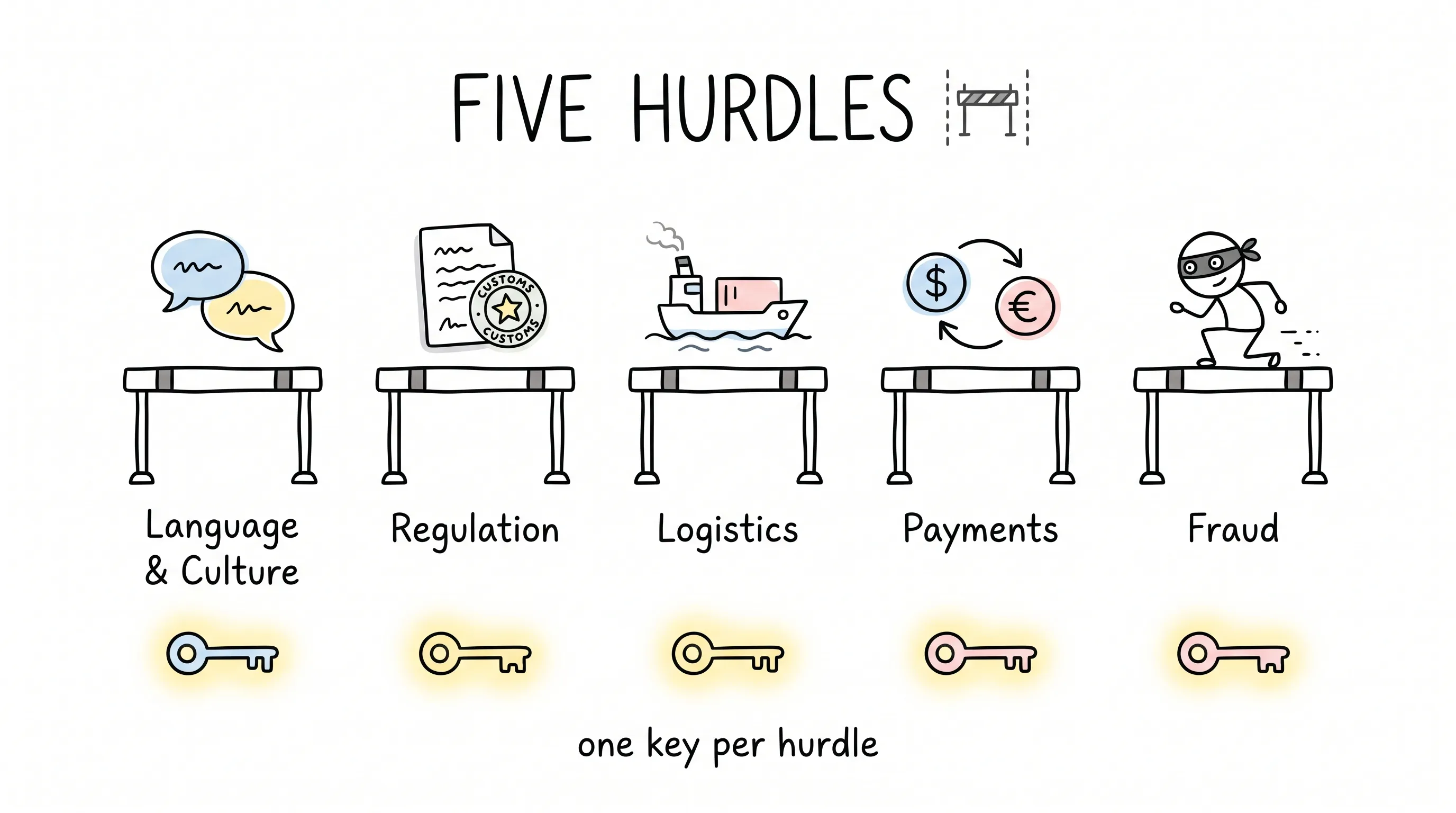
What is cross-border e-commerce? Buyers and sellers doing business across a national border. It sounds simple — in reality there are five hurdles in the way.
Hurdle one: language and culture. Your customers speak French, German, Portuguese — plus a whole pile of local customs you'd never even think of.
Hurdle two: regulation. Taxes, customs, trade rules — different in every single country.
Hurdle three: logistics. Shipping costs, delivery times, tracking — cross one border line and the complexity multiplies several times over.
Hurdle four: payments. Multiple currencies, exchange rates, secure settlement — not one of them can slip.
Hurdle five: fraud. Cross-border transactions are a fraudster's favorite. Both data security and fraud risk run higher than at home.
These five hurdles used to be cleared by piling on people. Hire translators, hire legal, hire operations staff — one team per market.
Expensive, and slow.
And now?
What Are AI Tools? In Plain Words, Your Digital Employees
What are cross-border e-commerce AI tools?
Software that uses machine learning, natural language processing, and predictive analytics to level those five hurdles, one stretch at a time.
Let me translate those three into plain talk for you.
Machine learning: programs that learn from experience on their own. Like predicting what goods will sell next month, or analyzing how customers buy.
Natural language processing: machines that can understand and produce human language. Translation and multilingual customer service depend on it.
Predictive analytics: using historical data to project the future. How much stock to prepare, how much to spend on ads — you'll know where you stand.
Don't underestimate these three. Years ago, analysts were already forecasting that global e-commerce would reach $6.3 trillion in 2024, with cross-border transactions taking an ever-larger share. In a market this large, whoever can make translation, stocking, and customer service fast and accurate can push costs down and lift the experience up.
Five Hurdles, Five Keys
So how do you level them? One hurdle, one key.
For the language hurdle, use AI translation. DeepL and the Google Translate API give you translations with context, not word-by-word literalism. To manage multilingual content, there are tools like Lokalise to keep it all under one roof.
For the regulation hurdle, use compliance software. Avalara and TaxJar calculate taxes automatically and keep watch on each country's rules for you.
For the logistics hurdle, use AI logistics platforms. ShipBob and Flexport straighten out shipping routes and inventory management.
For the payments hurdle, use multi-currency gateways. Payoneer and Stripe take care of currency conversion and secure settlement for you.
For the fraud hurdle, use risk-control systems. Riskified and Signifyd use machine learning to recognize fraudsters, far faster than human eyes.
Have you noticed? These five keys share just one thing in common:
They swap the question "should we hire one more person?" for the question "should we add one more tool?"
What Does a Decent Toolbox Look Like?
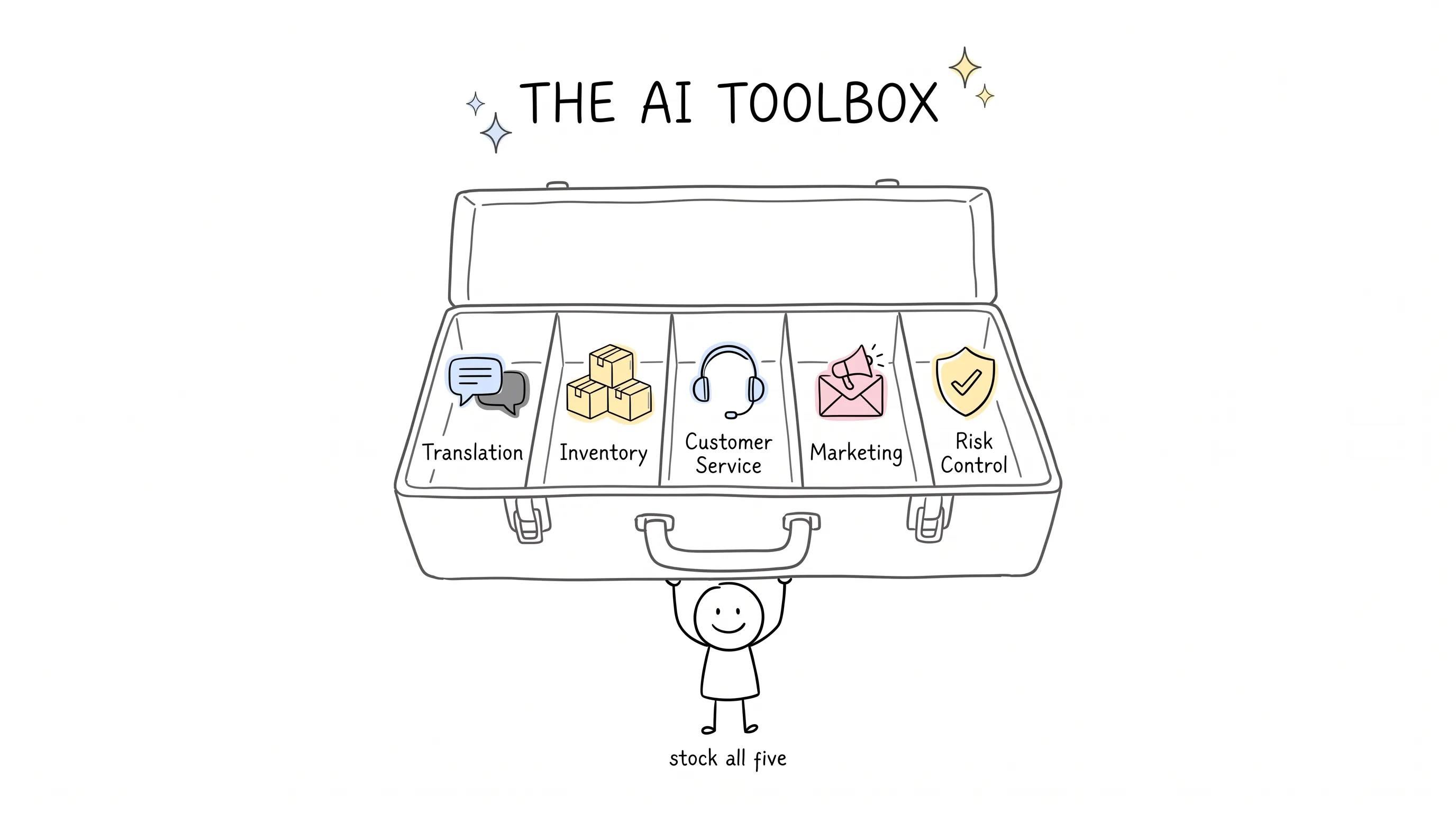
Keys are scattered; a toolbox is a complete set. If you're doing cross-border business, I suggest you stock these five compartments.
Compartment one, translation: DeepL, Google Translate API, Lokalise.
Compartment two, inventory: TradeGecko and Skubana — real-time stock counting, plus demand forecasting.
Compartment three, customer service: Zendesk AI and Intercom — 24-hour multilingual service that never sleeps.
Compartment four, marketing: HubSpot and Klaviyo — segment your users, send personalized email.
Compartment five, risk control: Riskified and Forter — keep fraud outside the door.
Looking one step further ahead, several new technologies are already aboard. AR (augmented reality) try-on lets buyers "see it on themselves" without leaving home; voice shopping lets you place an order just by asking; and blockchain makes international logistics traceable from end to end.
These aren't concepts. They're business happening right now.
Others Are Already Off and Running
Take Amazon Global Store: it uses AI for personalized recommendations, and its logistics network is scheduled by algorithms — the efficiency on cross-border orders is visible to the naked eye.
Alibaba's Tmall Global uses AI to analyze consumer trends. What sells in which market is decided by the data — which then feeds back into product selection.
And ASOS uses AI customer service for multilingual support, with recommendations tailored to each individual shopper.
Do you see it? The big players aren't competing on who has more people. They're competing on whose machines are smarter.
How Do You Start? Just Five Steps
Step one: pick your market. Use AI tools to analyze market trends, choose one or two high-potential regions, and get in there first.
Step two: pick your tools. Missing translation, add translation; missing risk control, add risk control. Configure for your own weak spots — don't chase the full suite for its own sake.
Step three: hook up your systems. Tools need to be connected to your existing e-commerce platform and CRM, otherwise you just build information silos.
Step four: train the team. However good the tool, if the team can't use it, it's worth zero.
Step five: watch the data and keep adjusting. This step has no endpoint.
The cardinal sin of cross-border business is spreading across ten markets in one go. Break through one or two first, then let the snowball roll.
Does It Work? Let the Numbers Talk
Don't go by feeling. Look at these numbers.
Conversion rate: of the visitors who come, how many buy. Customer lifetime value (CLV): how much money one customer contributes to you over a lifetime. Cart abandonment rate: the proportion who fill a cart and then walk away. Delivery time: how long the goods take to reach international buyers. And customer satisfaction (CSAT).
The tools are all ready-made. Google Analytics for traffic and conversion, Tableau and Power BI for visualization, Kissmetrics for digging into user behavior and retention.
Let's do some arithmetic with CLV. Say one customer buys three times a year on average, 40 euros per purchase, and keeps buying for five years — then he's worth 600 euros. Once you've done that math, you know how much customer acquisition is a bargain — and how much is just burning money.
A business that doesn't run the numbers is running on a muddle.
Some Blunt Words, Up Front
AI tools are not a miracle cure. A few things you need to hear.
Tools must align with goals — don't do AI for AI's sake. Localization has to be done for real: product descriptions, marketing materials, customer-service scripts all need to be adapted to the local language and culture; after the machine translates, the key materials are best passed through human eyes once more. Decisions should rest on data, not on gut calls. Don't push your luck on compliance — international regulations are untouchable. Keep updating and optimizing your tools; coasting on the past is moving backward.
You also have to own the risks: data security, compliance risk, and the most easily overlooked one — over-relying on AI with nobody keeping watch. Machines are strong at recognizing fraudsters, but the last gate has to be a person.
Back to That Dinner
At the end of that dinner, I asked my friend: the tax number matter — how did it get resolved in the end?
He said he switched to a new system. Now taxes are calculated automatically, and customer service is AI-first with humans as the backstop. That fraudulent Portugal refund was blocked outright by the risk-control tool.
When I heard that, I had just one reaction: that's impressive.
Tools can't choose your market for you or set your strategy. But they can level those five hurdles, one hurdle at a time.
In cross-border business, when the fight goes the distance, what wins isn't courage — it's the toolbox.
Here's hoping you assemble the full set of your own.
Continue reading
Related articles

AI Is Taking Over the Dirty Work of Social Media Marketing, One Task at a Time
This learn article outlines four social media marketing tasks AI can handle — audience analytics, content drafting and design, ad targeting and creative testing, and spam moderation — and cautions that taste, judgment, and data security remain human responsibilities.

AI Is Already This Good — Why Is Your Social Media Marketing Still Pure Manpower?
An overview of 18 AI tools for social media marketing, organized into six categories covering audience research, content creation, scheduling, comment and DM handling, ad management, and visual production, plus notes on personalization, prediction, and emerging trends.

Ad Buying Is Getting a New Division of Labor
An explainer on AI ad automation: how it collects, analyzes, predicts, recommends, and learns across platforms like Google Ads and Meta Ads, plus common pitfalls and adoption steps. It frames AI as handling repetitive execution while humans keep strategy and judgment.