
AI Is Already This Good — Why Is Your Social Media Marketing Still Pure Manpower?
An overview of 18 AI tools for social media marketing, organized into six categories covering audience research, content creation, scheduling, comment and DM handling, ad management, and visual production, plus notes on personalization, prediction, and emerging trends.
A while back, a friend of mine who runs a brand invited me to dinner.
The dishes had barely hit the table before his phone started buzzing. Replying to comments, checking group chats, tweaking copy. By the end of the meal, he sighed: the comments section alone was more than he could keep up with, he was always three posts behind on content, and he had no real sense of whether the ad money was doing anything.
I asked: why aren't you using AI?
He said: tried a couple, but the copy they wrote had a robotic smell, so he never dared go further.
I told him: then you're either using it in the wrong direction or using the wrong tool. Using AI for social media marketing stopped being an experiment a long time ago. Your users' standards have been raised: fast replies, content relevant to them, a frictionless experience. All three, on pure manpower? It doesn't hold up.
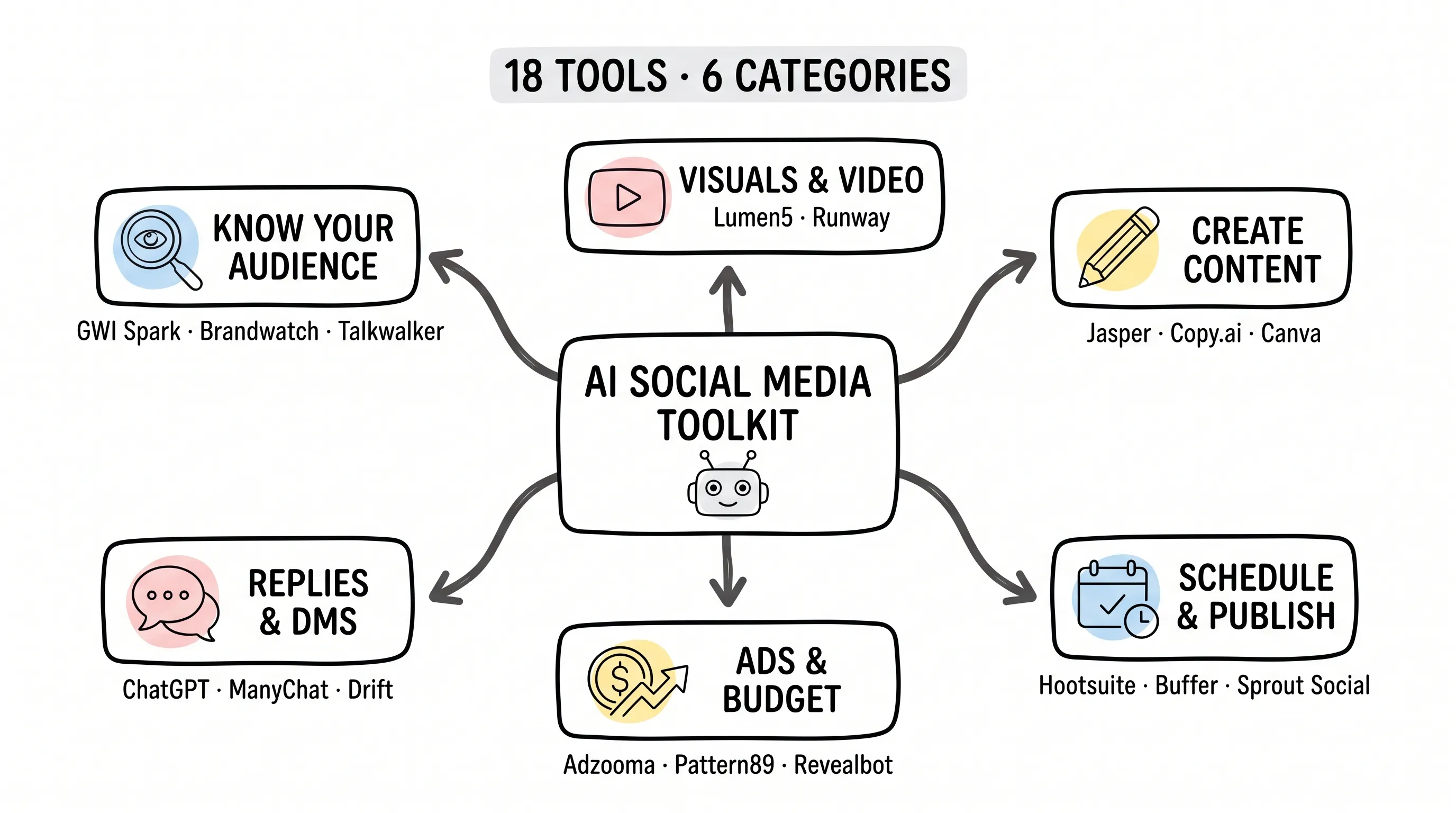
So what do you do? You get leverage. In this piece, I'll walk through 18 of the most widely used AI tools, sorted into six categories by what they're for. Think of it as a selection map.
First, Let's Clear One Thing Up: AI Isn't Here to Take Your Job
For many people, the first reaction to AI is: is it coming to replace me?
No.
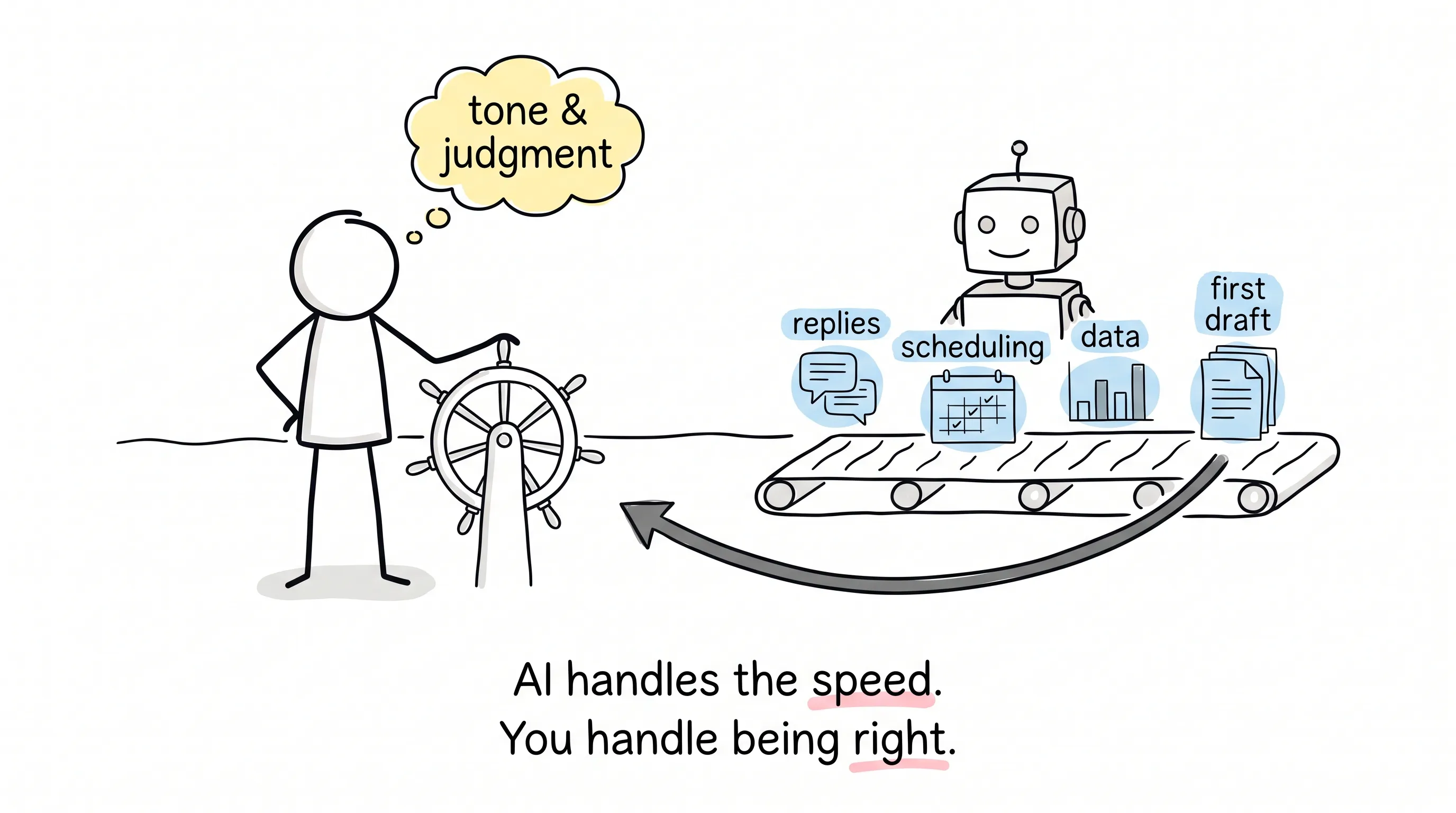
AI can write copy, schedule content, and watch the data, but it doesn't know what your brand should say — or must never say. Think about it: however smart a tool is, it has never chatted with your users, never revised a proposal to version eight at midnight. What it gives you is a first draft, not the answer.
What does a good pairing look like? A human up front, controlling tone and judgment; AI in the back, taking over all the repetitive labor.
AI handles the speed. You handle being right.
Once that clicks, the tools below start to make sense.
Category One: Figure Out Who Your Users Are
Every strategy starts with the same job: figuring out who your users really are, where they are, and what they like.
What is GWI Spark? It's an AI market-research assistant. You ask questions in plain language; behind the scenes it's connected to real survey data from nearly 1 million consumers across 50+ markets. It gives you answers in seconds, produces charts in one click, and lets you pin and save them — ready to paste straight into your social media plan.
Say you want to know which platforms your audience mostly lives on. One question. Do they prefer short video or images-and-text? One more question. A lot of research tools go scraping public data off the web; GWI Spark is different — it runs on first-party survey data. Different quality, different depth of insight. That's a real edge.
Social listening — many people have heard the term without really getting it. What is social listening? It means not just looking at your own account's backend numbers, but watching the whole web: when people mention your brand, what are they saying, and is the sentiment praise or attack?
In this category, Brandwatch is the veteran player. Real-time brand-mention monitoring, custom dashboards, sentiment analysis — all table stakes. Where it's strongest is brand health and public sentiment: how to set your PR strategy, how to catch a crisis when it comes, what your competitors are doing — it sees all of it clearly.
Talkwalker runs a similar lane, and its signature is making insights faster to get and faster to share. AI segments audiences automatically, so you're not wrestling spreadsheets; real-time monitoring means you see a trend the moment it starts to surface. One especially practical use case: one day the mention volume of some topic suddenly explodes, and it alerts you first thing. That's when you hurry to go look: is good news spreading, or bad news brewing? See it early, respond early.
Category Two: Actually Produce the Content
Content has to keep flowing out, and keep its standard. This, honestly, is hard.
Jasper solves "write fast, and make it sound like you wrote it." It has plenty of templates — product intros, ad copy, social posts all ready-made — and you can feed it your brand voice, so what comes out tastes like yours. It's easy to pick up, essentially zero learning cost. When you're out of inspiration, it's also great for brainstorming.
Copy.ai leans toward short copy. Captions, tweets, ad headlines, little product blurbs — give it a few keywords and it hands you several versions in one go. What's the benefit? You can take a few versions into A/B testing and let users vote, instead of the boss going on gut feel. For big promos and campaigns where you need to write fast and publish fast, it's very handy.
What about images? Canva's Magic Studio stuffs AI into design. Don't know Photoshop? That's fine. Features like Magic Switch and Magic Grab can quickly rework existing assets, cut out subjects, convert formats — one piece of content, ten ways to publish it. It can also generate copy matching your brand voice right inside your designs. Making materials for Instagram, TikTok, LinkedIn gets a lot more efficient.
Creativity — AI can't give you the soul of it, but it can give you time. With time, you can even talk about soul.
Category Three: Get Content Out on Time, Every Time
Running multiple platforms is basically acrobatics: spinning five plates at once, and not a single one can drop.
Hootsuite's idea is to pull everything into one place. Its OwlyWriter AI can write copy in your brand voice automatically, come up with post ideas, bring hashtags along; it also analyzes your audience data and tells you the exact hour and minute when posts perform best. You don't even need to cut over to design — Canva is built in.
Buffer goes the lightweight route. Clean interface, scheduling, content calendar, basic analytics — one person can manage several accounts without it turning into a mess. For small teams and independent marketers, starting from it carries the least burden.
Sprout Social is the heavy-duty setup. Beyond scheduling, it packs in deep analytics and social listening, plus a unified inbox: comments, DMs, @-mentions, all handled in one place, so you don't get blasted into amnesia by notifications. If you want a panoramic view of your brand, look here.
Category Four: Comments and DMs — Don't Make Users Wait
A user sends you a message, waits half an hour with no reply, and he's gone. In this era, nobody has patience.
Everyone has used ChatGPT, but once it's wired into your social media tools, it can do more than you'd imagine: auto-reply to comments, draft responses, generate content ideas. Tuned properly, it doesn't talk like a robot — the tone is friendly, on-topic, and carries your brand's voice. When comment volume explodes during a big promo, it can help you catch the conversation.
ManyChat specializes in DM automation for Facebook, Instagram, and WhatsApp. Drag-and-drop to build chat flows, connect email and CRM, and it can automatically collect leads, answer FAQs, push products. For interactive campaigns in Instagram Stories or Messenger, it's also a standard tool.
Drift takes another path, tilted toward B2B. It uses AI to screen leads: who genuinely wants to buy, who's just browsing — it sorts them for you first, then uses CRM data to push different messages to different people, and when a conversation goes deep it can hand off to a real human salesperson in real time. Turning social traffic into sales conversations — that's exactly the work it does.
Category Five: Don't Let Your Ad Money Go Down the Drain
What's the biggest pain point in ad buying? The money's burned, and you don't know which half was wasted.
Adzooma helps you manage your ads across Facebook, Google, and Microsoft in one place. How to split the budget, how to adjust bids — it makes suggestions, can execute them automatically, and raises an alarm when performance looks wrong. For small teams wanting to save manpower, it's a good fit.
Pattern89 goes harder — it strikes before the ad even goes live. Which combination of colors, copy, and images is most likely to perform well, it calculates for you from historical data, and it can even score your creative. Effectively, it chops the cost of the "trial and error" step by more than half.
Revealbot plays rules-based automation. You set the rules: this ad underperforms, pause it automatically; that one's running well, add budget automatically. It's especially smooth on Facebook and Instagram. Let the rules watch the dashboards. You just write the rules.
Category Six: Visuals Are the Lifeline
On social media, words are the substance, images are the face. If the face doesn't work, the substance never even gets seen.
Lumen5's job is turning old content into video. Blogs, press releases, long LinkedIn posts — toss them in, and the AI automatically matches visuals, animation, music, splits the scenes, and you drag, trim a little, and publish. For cutting long content into short video, it's one of the best in the business.
Runway is a professional editing suite inside the browser. Background removal, object tracking, style transfer, text-to-video — all done online. When influencer or UGC footage needs processing, or you're racing a short-deadline video, it can compress the production timeline dramatically.
Deep Dream Generator is a niche curiosity. Neural networks turn ordinary photos into surreal art images, with a very aggressive style. Used well, your visuals are the brightest in the room; used badly, it's easy to scare people. Use with caution, but worth knowing.
One Level Deeper: AI Changes How You Play
Tools are tactics. Above tactics sits the way. What AI truly changes are three underlying moves of social media marketing.
First, personalization. Your users weren't stamped from the same mold, and your content shouldn't be either. With behavioral data, preferences, and interaction habits in hand, AI can turn hyper-personalization into an everyday operation: the same dynamic ad, a different version for every viewer. This used to be something only the big players could afford. Not anymore.
Second, prediction. What is predictive analytics? It's getting on board before the trend explodes. AI can fish out topics, hashtags, and shifts in consumer behavior that are just starting to surface. The beauty world's glass skin (dewy, poreless "porcelain" skin) wave, the finance world's crypto-topic wave — the brands that moved fast ate the dividends. What AI helps you with long ago stopped being "reviewing which numbers looked good last week"; it tells you what is rising right now. These are two different abilities.
Third, community. Auto-replies keep the conversation from going dead, AI-drafted DMs make reach scale, and smart tools will even flag which comments deserve a reply from you personally. Influencer selection is changing too: AI looks at engagement quality, niche fit, audience overlap — follower counts get pushed to the back of the line. An account with a million followers may engage worse than one with fifty thousand, and AI can figure that out with one calculation.
One More Look Ahead
Three things deserve a place on your radar.
First, virtual influencers. Lil Miquela — this character, you may have scrolled past her. She's not a real person; she's a fictional digital avatar, but she's long worked with major brands, and fans chase her all the same. Virtual humans are online forever, never get canceled, brand safety maxed out. Going forward, as younger generations take digital identity more and more seriously, more brands will go try this. Put plainly: they're testing what happens when story and technology collide.
Second, the algorithms keep changing masks. Platforms' recommendation mechanisms have already gone from "passively reactive" to "actively predictive": machine learning decides what content gets pushed to whom, and when. Every piece of content you post faces a complex system that is constantly learning. If you want to stay seen, you have to keep decoding. Whoever uses AI not just to make content but to break down why content runs well — that's who wins.
Third, ethics and transparency. The more AI content floods in, the more users want to know: the one chatting with me on the other side — person or machine? Regulation is catching up too. Label what should be labeled, and don't treat your users as fools.
Using AI is smart. Pretending you don't use AI is stupid.
Finally
At the end of the dinner, I sent this list to my friend.
Two weeks later he wrote back: the comments are handled by automation, scheduling runs on Buffer, his ads run on rules he's set — and every day he saves about two hours. He said he wished he'd started sooner.
AI isn't here to take your job — it's here to hand you weapons. The question was never whether you use it, but how fast you make it work for you.
May your comments section always be one you can keep up with.
Continue reading
Related articles

Cross-Border Business: Time to Upgrade Your AI Toolbox
A learn article explaining how AI tools help cross-border e-commerce sellers clear five hurdles: language, regulation, logistics, payments, and fraud. It outlines a five-compartment toolbox, a five-step adoption path, and metrics such as conversion rate and CLV, while cautioning against over-reliance on AI.

AI Is Taking Over the Dirty Work of Social Media Marketing, One Task at a Time
This learn article outlines four social media marketing tasks AI can handle — audience analytics, content drafting and design, ad targeting and creative testing, and spam moderation — and cautions that taste, judgment, and data security remain human responsibilities.

Ad Buying Is Getting a New Division of Labor
An explainer on AI ad automation: how it collects, analyzes, predicts, recommends, and learns across platforms like Google Ads and Meta Ads, plus common pitfalls and adoption steps. It frames AI as handling repetitive execution while humans keep strategy and judgment.