
You've Bought All Those AI Tools — So Why Can't You Calculate the ROI?
This article explains why owning many AI tools does not guarantee measurable ROI and argues that returns depend on how work flows between steps. It introduces multi-agent teams for content creation, translation, and publishing, with examples from training, website, and e-commerce content operations.
A while back, I had dinner with the head of marketing at a large company.
When the conversation turned to AI, he set down his chopsticks and let out a sigh before he even spoke. His company had bought no fewer than ten AI tools — for writing proposals, for running meetings, for handling customer support. Every one of them was fast. Yet when his boss asked at year-end where the returns on AI were, he simply couldn't come up with the number.
The money was spent, and work did seem to move faster. So where did the returns go?
I've heard this question far too many times lately. Today, I want to settle it once and for all.
First, a Look Back at 2025: The Tools Weren't a Waste — But They Only Sped Up Half the Job
All through 2025, nearly every large company was experimenting with AI.
Marketing used AI to draft content. HR rolled out chatbots. Training piloted translation software. Customer support let AI take a first pass at triaging tickets. IT was busy evaluating one agent framework after another.
Did any of it help? Yes. Drafts came out faster, questions got answered faster, review cycles got shorter.
But notice one detail: all of this speed happened inside individual departments, cubicle by cubicle.
Marketing finishes its draft — then what? Who translates it? Who adjusts the formatting? Who updates the regional versions? Who reviews it for compliance? And who is the approval waiting on?
All of that work still depends on people moving it along by hand, one piece at a time.
AI sped up every individual workstation; what decides the return is the stretch of road between the workstations.
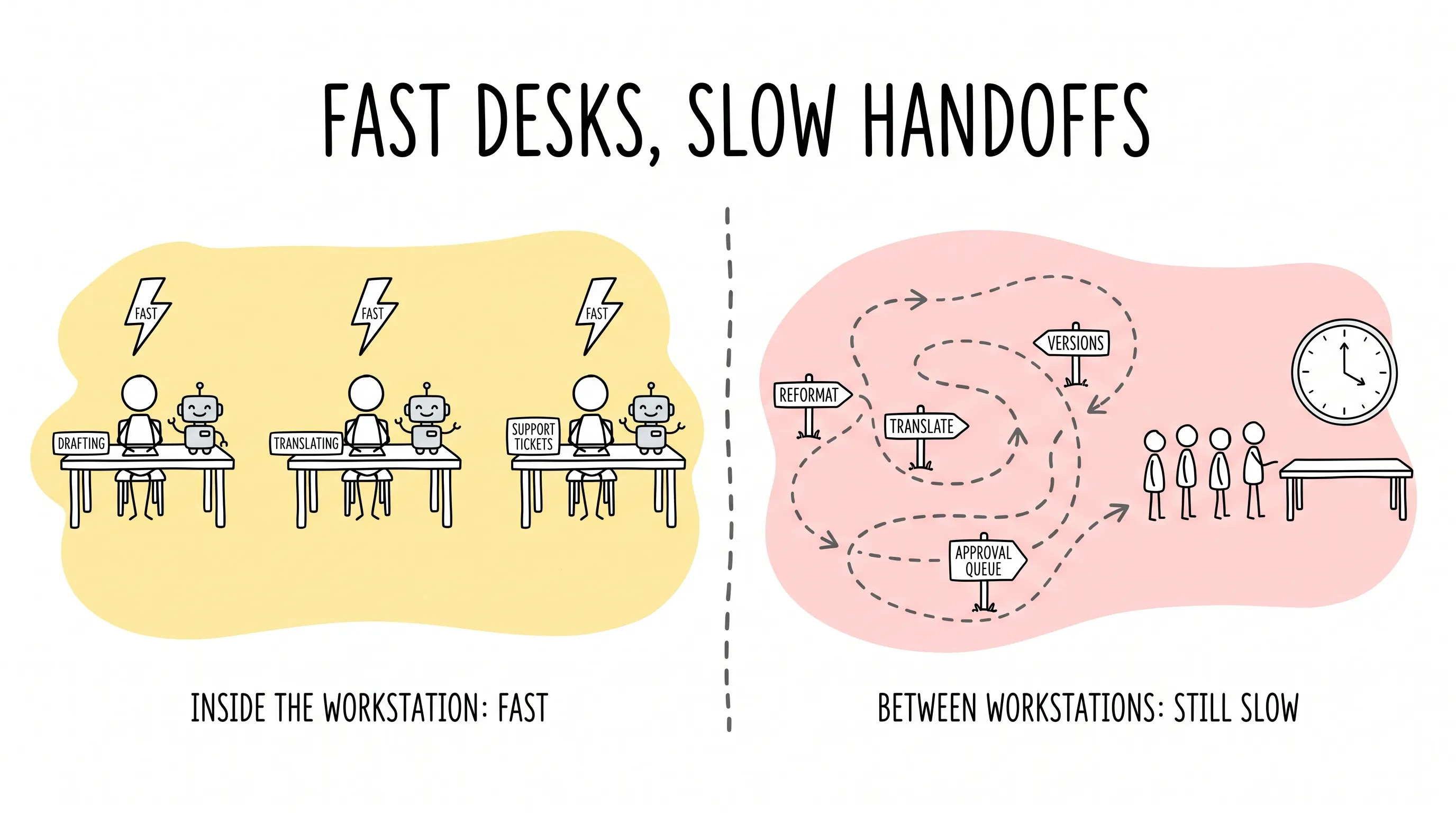
And that stretch of road is full of seams: moving files around, reformatting, updating content region by region, keeping versions consistent, managing multilingual websites, applying brand and compliance rules, waiting for approvals.
Companies lose enormous amounts of time in those seams. However fast AI gets, it can't outpace an approval queue.
That's why the companies that genuinely collected returns last year often weren't the biggest tool buyers — but they did automate that stretch of road.
What Is a Multi-Agent Team?
This year, the wind has shifted. More and more companies have stopped asking "which tool should we buy" and started asking "how do we get AI to run the entire workflow end to end."
There's a term for this: multi-agent teams. It sounds abstract, so let me translate it into plain language.
What is an agent (Agent)? A digital employee who can pick up work and get it done without you watching over their shoulder.
What is a multi-agent team? You divide the work among a group of digital employees: one handles writing, one guards the brand voice, one handles translation, one manages terminology, one takes care of layout, one handles publishing.
One writes, one proofreads, one translates, one formats, one publishes. Think of a restaurant kitchen: someone preps the ingredients, someone runs the stove, someone plates the dishes, someone carries them out. From kitchen to table, the head chef never has to run the delivery himself.
Each of these digital employees has a station of their own. They take on standardized work, deliver predictable results, and can run in parallel. So a single piece of content flows automatically through five steps: creation, quality check, localization, formatting, and publishing.
And people? People show up only where judgment is needed.
Agents handle scale and execution; people handle context and judgment.
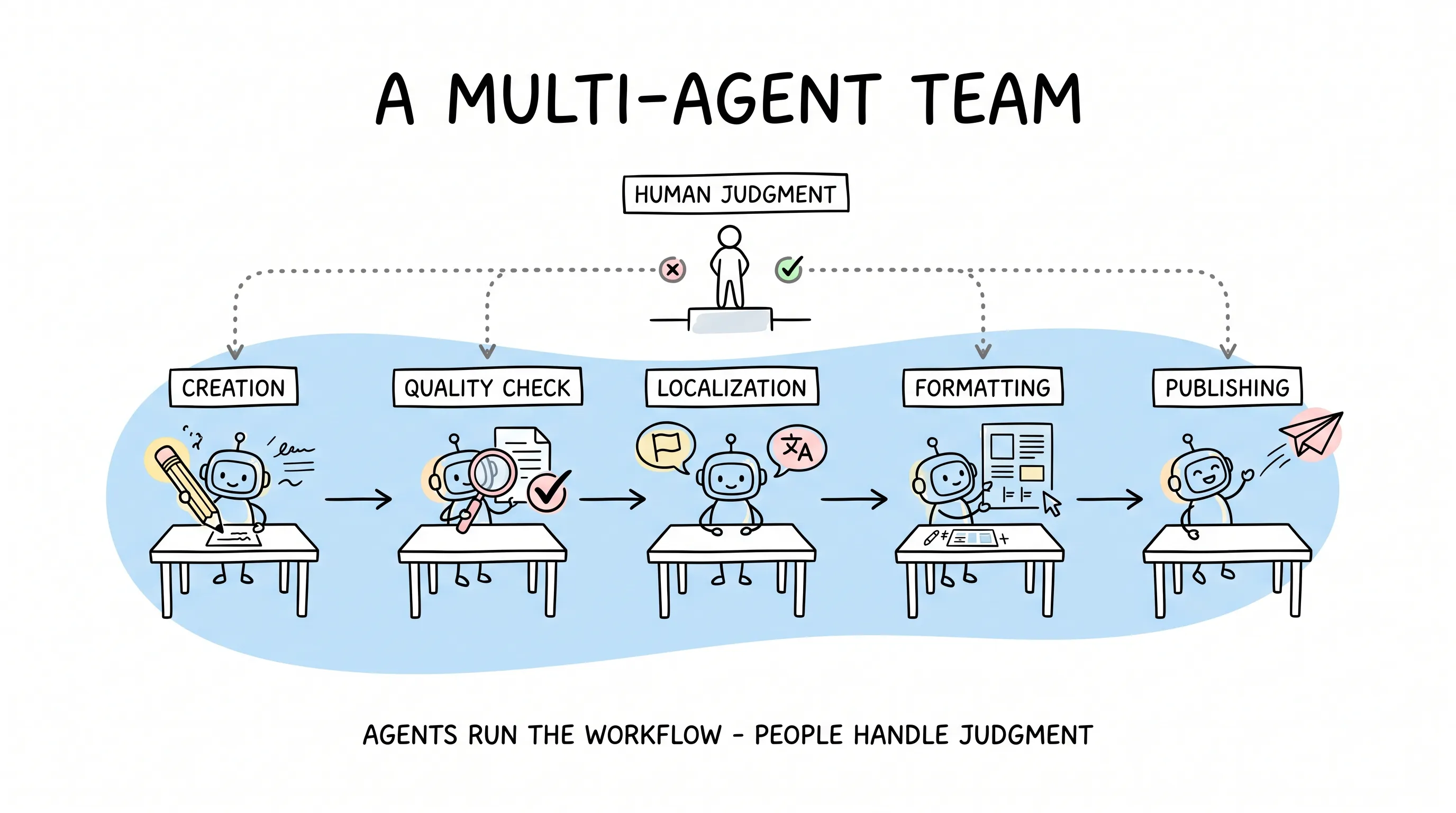
This isn't about stealing jobs — it's about pulling people out of the seams in the assembly line.
Let Me Tell You Three Stories
At this point, the argument may still feel abstract. So let me tell you three stories that actually happened.
Why these three? Because together they cover the three kinds of work that grind companies down the most: training content, website content, and e-commerce content.
First, the medical technology company Smith & Nephew.
For companies doing global business, training is a chronic headache. The moment a policy changes, training materials across dozens of markets and more than twenty languages all have to be revised — one cycle takes months.
Once the agent workflows were in place: a policy update automatically triggers a fresh draft; terminology and compliance rules are applied on the spot; more than twenty languages are localized in parallel; and the revised materials publish straight into the training system.
What used to be counted in weeks is now counted in days. The training team can finally concentrate on whether the courses are actually good, instead of which revision number they're on.
Their translation manager put it plainly: a truly global company must deliver training in the language each and every employee speaks.
Second, the baby and toddler products company Kids2.
Global websites change every day: product pages, help centers, landing pages. The old process meant people watching for what changed, queueing content up for translation, and pushing it out one region at a time.
Now, the moment an agent spots an update to the source content, it immediately generates localized versions, applies the brand and terminology rules, and pushes them straight into each region's website backend.
Weeks of work, finished in hours. Every market's pages stay aligned at all times.
Third, the marketing agency Wunderman Thompson.
They manage Amazon storefronts and e-commerce content for more than 150 clients. The hardest part is consistency: over a hundred clients, dozens of markets, and every single brand voice is different.
After brand voices, terminology databases, translation memories (databases of past translations that get reused automatically), and multi-market publishing were threaded into the same pipeline, the same headcount produced 30% more output.
Thirty percent. Without hiring a single person. That's remarkable.
Why Not Build It Yourself?
If you've read this far, you might be asking: couldn't we just build this system ourselves?
Plenty of companies actually tried this in 2025. The result: it works on a small scale, then stalls the moment you try to roll it out.
Where does it stall? Three places.
Engineering teams are already swamped, so pulling people off to build in-house means robbing Peter to pay Paul; integration with existing systems always takes longer than expected; and then there's governance and data security — clearing one checkpoint after another.
The usual ending: the proof of concept works fine, but the system falls apart the moment it hits production. One department runs it like clockwork; the rollout never goes company-wide.
And the return the boss wants is a number you can calculate today — not a promised pie that shows up after a three-year development cycle.
The Third Path
Use a ready-made platform.
Take Smartcat, which does exactly this: it provides a ready-to-use workflow environment for human-AI collaboration, connecting creation, translation, review, and publishing in one place.
The numbers back up that choice: more than a quarter of the Fortune 1000 use it to run their global content operations.
The CTO of the consumer brand Huel said in a public review: what used to take weeks now takes minutes. Translation runs in parallel with the rest of the work, and the marketing team can manage the whole thing end to end by themselves.
Minutes versus weeks. You don't need me to do that math for you.
Finally, Back to That Dinner
Over the past year and a half, I've become more and more sure of one thing.
The return on AI has little to do with how many tools you bought. What truly determines the return is how work flows.
A new division of labor is taking shape: people handle decisions, creativity, and context; agents handle repetition, coordination, and consistency; systems connect every link in the chain, across regions, languages, and platforms. Some call this "human-agent pods." The name doesn't matter — the division of labor does.
At the end of that dinner, I left the marketing head with one line: the next time your boss asks about ROI, don't start from "how many tools we bought" — start from "how the work flows."
Here's hoping you, too, can invite AI into your workflow — instead of just parking it next to your desk.
Continue reading
Related articles

Cross-Border Business: Time to Upgrade Your AI Toolbox
A learn article explaining how AI tools help cross-border e-commerce sellers clear five hurdles: language, regulation, logistics, payments, and fraud. It outlines a five-compartment toolbox, a five-step adoption path, and metrics such as conversion rate and CLV, while cautioning against over-reliance on AI.

AI Is Taking Over the Dirty Work of Social Media Marketing, One Task at a Time
This learn article outlines four social media marketing tasks AI can handle — audience analytics, content drafting and design, ad targeting and creative testing, and spam moderation — and cautions that taste, judgment, and data security remain human responsibilities.

AI Is Already This Good — Why Is Your Social Media Marketing Still Pure Manpower?
An overview of 18 AI tools for social media marketing, organized into six categories covering audience research, content creation, scheduling, comment and DM handling, ad management, and visual production, plus notes on personalization, prediction, and emerging trends.