
You're Using AI in Influencer Marketing — But Probably Only the First Layer
An article outlining three layers of applying AI in influencer marketing, from back-office task automation to strategy support and early-stage campaign prediction.
A few days ago, I had dinner with a friend who runs a consumer goods brand.
Holding his cup of tea, he said with pride: "Our team has gone all-in on AI."
"Oh?" I said. "How so?"
"Emails, weekly reports, meeting notes — we hand it all to AI. Productivity has doubled."
I nearly choked on my tea. Not because he was wrong, but because everything he described probably only touches the first layer of AI.
When people talk about "using AI for marketing," the conversation usually goes in circles — because the AI each person has in mind isn't the same thing at all. Lay out the influencer marketing pipeline end to end, and you'll see that AI can plug in at at least three layers. And layer by layer, the maturity is completely different.
What are these three layers? Let's take them one at a time.
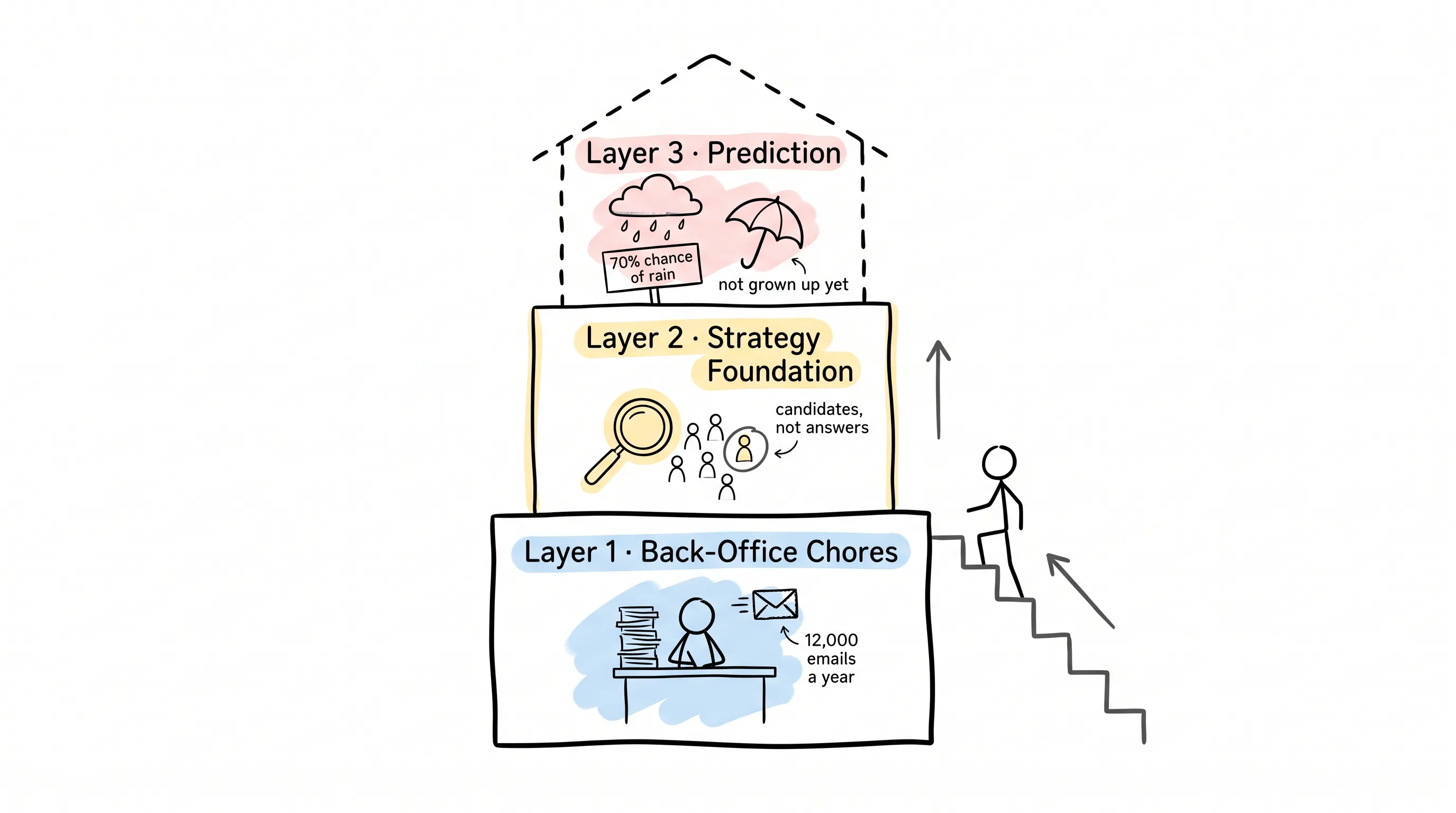
Layer 1: Back-Office Chores
The bottom layer is the back office: writing briefs, answering emails, managing schedules, checking contracts, chasing close-outs.
What is AI at this layer like? Like an intern who never gets tired and never throws a tantrum.
Think about it: for a mid-sized brand, running fifty or sixty influencer campaigns a year is completely routine. And each campaign — from rounds of back-and-forth on the brief, to tracking the schedule, to chasing the final close-out report — takes two to three hundred emails from start to finish.
Do the math. Sixty campaigns at two hundred emails each: 12,000 emails. At three minutes per email, that's 600 hours — which works out to a full 75 working days.
A quarter of a year, spent on relaying messages.
Why does AI swallow this layer first? Because chores come with standard routines — and standard routines can be learned. So today, this layer is already quite mature; most teams have adopted it to some degree.
If you've already adopted it, don't get smug yet. Because this is only the foundation.
Layer 2: The Foundation of Strategy
Climb one level up, and you reach strategy.
What happens at this layer? Profiling your target audience, building lookalike audience expansion (what the industry calls "lookalike"), and screening and discovering influencers.
How did influencer selection work in the old days? Like an old-style arranged blind date. You relied on a matchmaker's introduction, on gut feel, on "I heard their numbers are pretty decent" — and then you made the call.
The result? A million followers — and ¥300 in sales.
Now, AI has turned the blind date into a screening process. What your target audience looks like — it computes that for you. The wider circle of people who "resemble" them — it expands and finds them for you. And among tens of millions of creators, it screens out, one by one, the ones who genuinely match your audience.
The dirty work, the heavy lifting — it does it all. You only handle the final human checkpoint.
At this point you might ask: so at the strategy layer, can AI already make decisions for me?
Not so fast. The strategy layer gives you candidates, not answers. Making the final call is, for now, still not AI's job.
Layer 3: Prediction, Not Yet Grown Up
The top layer is the least mature today — but the one with the highest ceiling: prediction.
Using large models to estimate what results a campaign will deliver before it ever goes live.
Battles used to be reviewed only after they were fought. Now you run the simulation before the battle even begins.
Marketing used to be like stepping outside and gambling on the weather — you only realized you should have brought an umbrella after you got soaked. Now, before you leave the house, someone tells you: there's a 70% chance of rain today, take the umbrella.
How hard is this layer? Very. Marketing deals with living, breathing people — more variables than the weather. That's why few teams today dare to bet their entire budget on prediction. But the direction is right: prediction gives you probability, not a guarantee. If the forecast says 70% chance of rain, and you bring the umbrella and the day turns out sunny — you can't blame the umbrella.
Where's the Ceiling?
That's the three layers. So what's above them?
Nothing. This is the top.
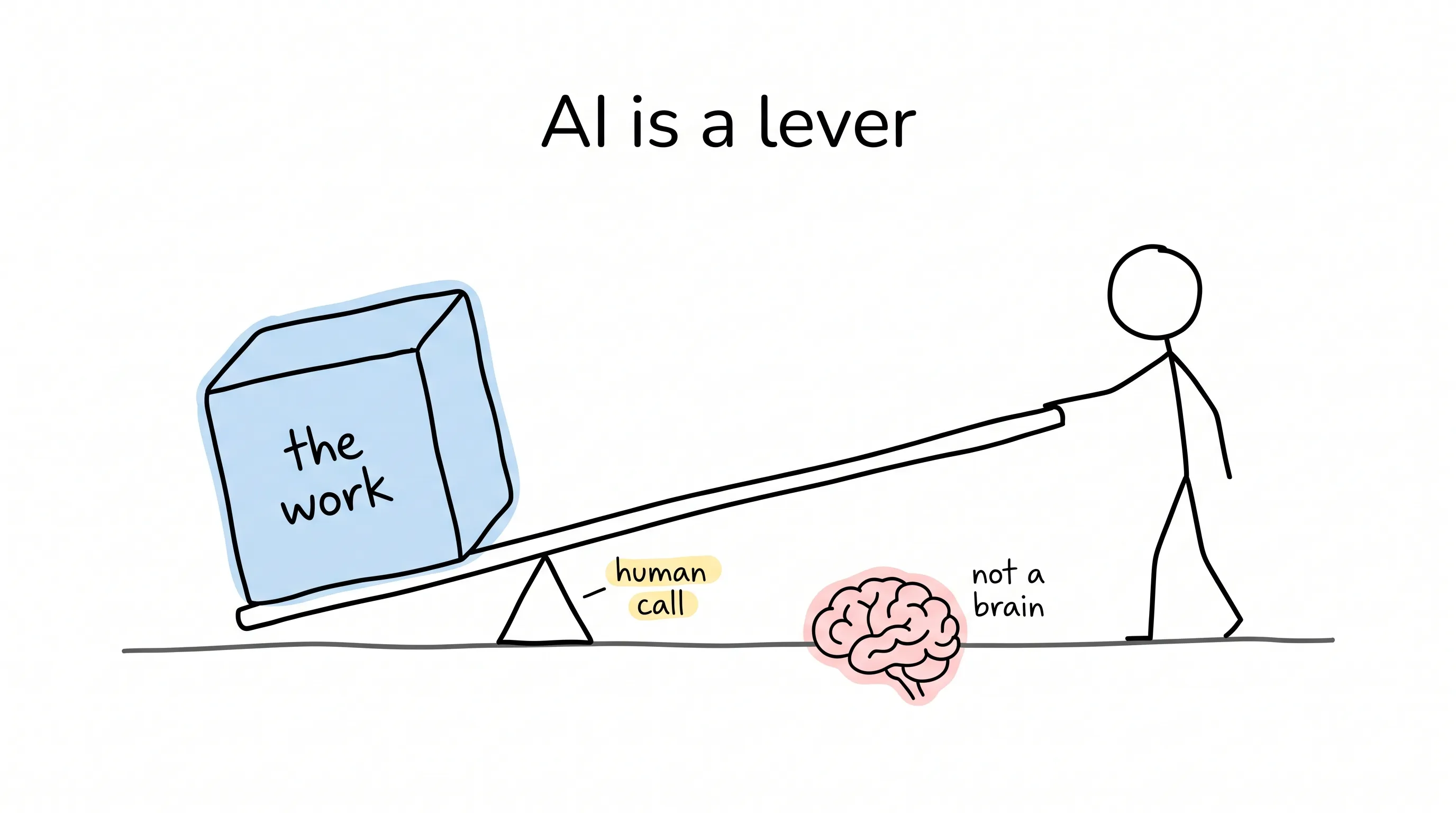
AI's job is to make the work faster, more abundant, and cheaper. Deciding what work to do — that's a human call.
This, I believe, is the ceiling of the whole thing. AI is a lever, not a brain. However long the lever, you still have to place the fulcrum. If you really outsource the thinking to AI as well, the brainpower you saved will come back, sooner or later, on some late night — with interest.
After that dinner, I walked my friend through the three layers. He stayed silent for a long while, then finally managed: "So the AI we've been using is basically just an intern who types really fast?"
I said, yes. But there's no shame in that. In a three-story building, everyone climbs from the first floor.
Here's to reaching the second layer soon. As for the third — once it matures, remember not to pin all the blame on it.
Continue reading
Related articles

Cross-Border Business: Time to Upgrade Your AI Toolbox
A learn article explaining how AI tools help cross-border e-commerce sellers clear five hurdles: language, regulation, logistics, payments, and fraud. It outlines a five-compartment toolbox, a five-step adoption path, and metrics such as conversion rate and CLV, while cautioning against over-reliance on AI.

AI Is Taking Over the Dirty Work of Social Media Marketing, One Task at a Time
This learn article outlines four social media marketing tasks AI can handle — audience analytics, content drafting and design, ad targeting and creative testing, and spam moderation — and cautions that taste, judgment, and data security remain human responsibilities.

AI Is Already This Good — Why Is Your Social Media Marketing Still Pure Manpower?
An overview of 18 AI tools for social media marketing, organized into six categories covering audience research, content creation, scheduling, comment and DM handling, ad management, and visual production, plus notes on personalization, prediction, and emerging trends.