
Your Rankings Are Still There, But Customers Can't See You Anymore: How to Choose Among 10 GEO Tools
A guide to generative engine optimization (GEO), explaining why brand visibility in AI answers matters even when search rankings hold, with five selection criteria and a breakdown of ten GEO tools grouped into monitoring, content, and integration camps.
Last week, an old friend who runs a SaaS business invited me out for tea. He sat down and sighed.
He said something strange: his website's rankings hadn't dropped, his traffic hadn't dropped, but inbound leads had dropped thirty percent.
Thirty percent. Rankings rock-solid, inbound leads down thirty percent.
I asked him: do your customers still search?
He froze. Later he went and asked a few of his customers, and that's when he learned: they weren't searching at all anymore. When they want to buy something, they ask AI first. The AI drops a single line — "maybe consider A and B" — and the customer turns right around and books demos with A and B.
His company's name wasn't in that answer.
Your rankings are still there, but customers can't see you anymore. That's the wall a lot of marketers have walked face-first into this year. Over the better part of a year, I've tried about ten GEO tools one after another — tools built specifically to track "whether you're in the AI answer." In this piece, I'll first give you 5 hard criteria for choosing, then break down all 10 tools in detail, grouped by what they're actually for.
What Is GEO?
GEO stands for Generative Engine Optimization.
The first time I heard the term, I was skeptical: another made-up concept invented to sell courses? Then I thought it through and realized: no. The customer's buying path has genuinely moved somewhere else.
What counts as a generative engine? The whole crop of AI answer products — ChatGPT, Google's AI Overviews, Gemini, Perplexity.
What's the biggest difference between them and search engines?
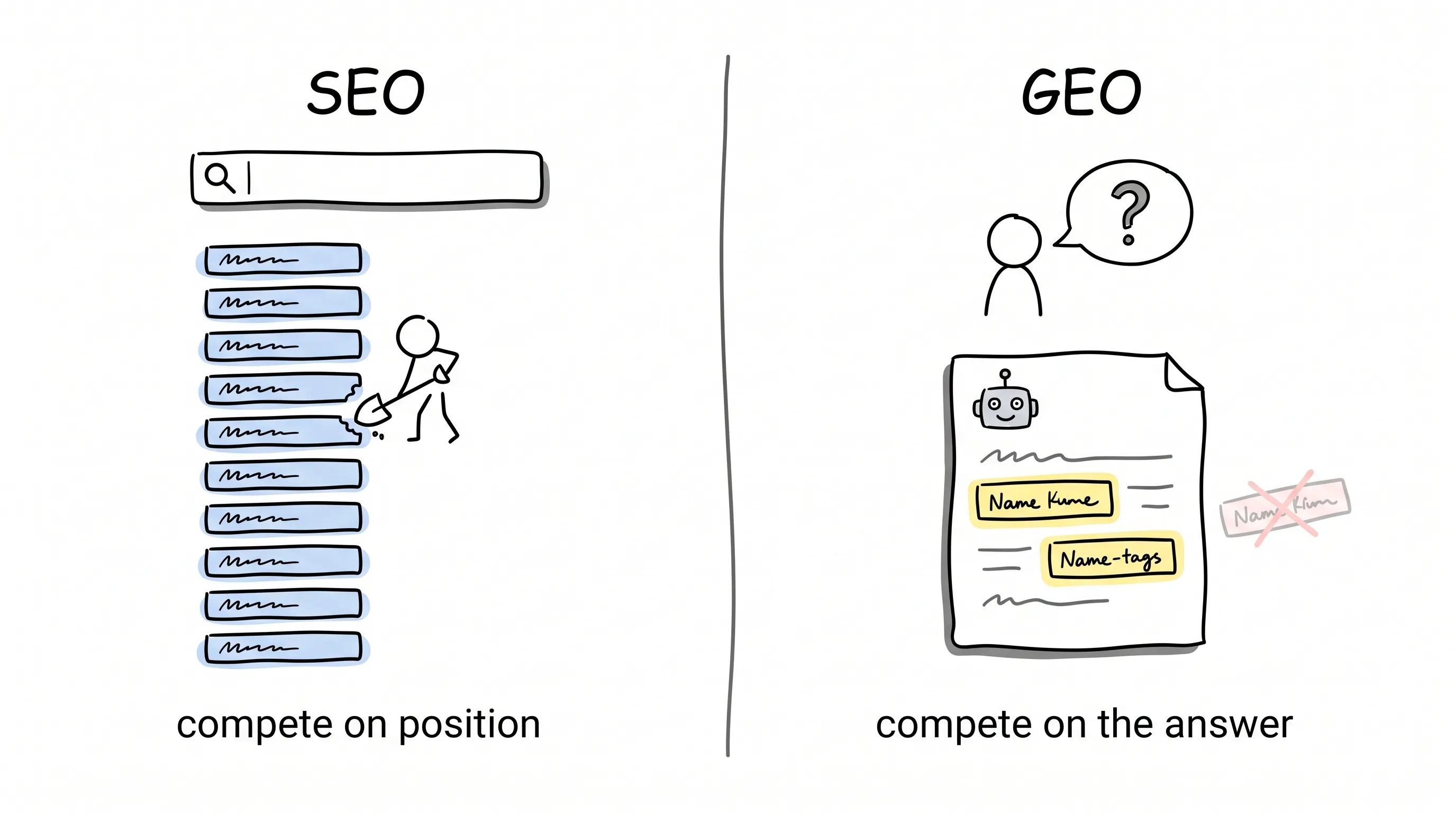
A search engine hands you a page of links and lets you dig through them yourself. AI hands you a finished, written-out answer — it even draws the conclusion for you.
Think about what that means.
So what used to get you seen? Rankings. Position was traffic. Now the customer's question gets compressed into a single answer. Whoever the answer mentions is the one customers will actually check out; whoever it doesn't mention stays invisible, no matter how high they rank.
So GEO watches something completely different from SEO:
Does the AI answer mention you? When it does, does it cite you as a source? Did you make it into that summary? For any specific question, do you appear at all? And on the same question, between you and your competitors, who shows up more?
Put simply, SEO competes on position; GEO competes on whether you're in the answer at all.
So how do you actually do this? Peel it back and there are four layers: first, figure out which questions trigger AI product recommendations; then watch each of the AIs and track where and how often you appear; then adjust your content and authority so you're easier to cite; finally, tie the rises and falls in AI visibility back to rankings, backlinks, and traffic to close the loop.
The products that turn these steps into software are GEO tools.
Five Ground Rules Before You Pick a Tool
Far more products call themselves GEO tools than the ones I'll list here. But quite a few are just old SEO features with a new name slapped on, sold a second time.
I screen with 5 hard criteria. Here they are, one by one.
Rule one: track real answers, not simulated scores. Some products hand you an "AI visibility score" that looks impressive but is actually a simulated value. Real monitoring means capturing the answers AI actually generates. You need to know what the AI specifically said today — not a vague score.
Rule two: coverage across multiple models. Watching ChatGPT alone isn't enough. Among your customers, some use Gemini, some use Perplexity, and some run straight into Google's AI Overviews. Tracking only one model means you've tested only half the market.
Rule three: granularity down to the prompt level. A single aggregate number can't guide action. You need to be able to see "in which category of questions am I not showing up" to know which content to fix. A coarse dashboard is for gawking, not for steering.
Rule four: competitor comparison. Looking only at yourself, you never know where you stand. You show up in 30% of answers, your competitor in 45% — where the gap is, plain as day. Monitoring without competitor comparison is a checkup that only takes your own temperature.
Rule five: it must reconcile with SEO data. AI visibility went up — did backlinks start working? Did your content changes hit the mark? Or did a competitor slip? If the numbers don't line up, optimization is blind guessing.
Someone will say: I manually ask AI every day — doesn't that keep me covered?
No. AI answers change when you rephrase the question, change when the model gets upgraded, and may change when you switch accounts or switch cities. Manual monitoring is Swiss cheese.
Ten Tools, Three Camps
First, let's be clear about one thing: these tools aren't even the same species.
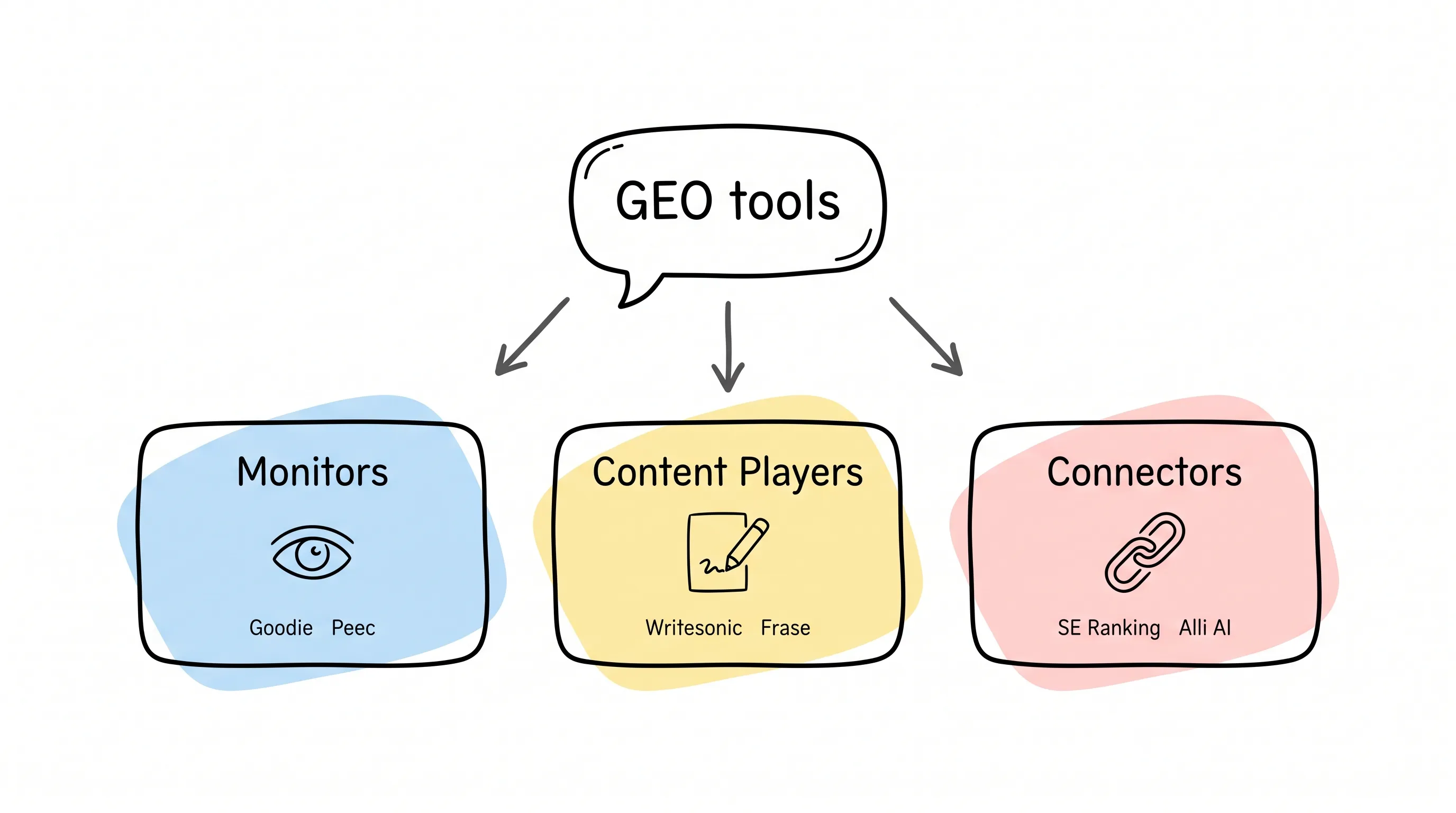
Some handle content, producing articles that AI finds easier to cite; some handle monitoring, tracking your traces inside AI answers; some handle connection, linking monitoring and execution into a single line. Stacking them up against each other is pointless. I'll sort them into three camps by what they're for.
Camp One: The Monitors
Goodie AI. A specialist — it does exactly one thing: track your brand mentions and citation frequency question by question. Which AI is mentioning you more or less than before, you see at a glance on the dashboard, and it also calculates your competitors' AI share of voice. Custom pricing; book a demo. The shortcoming is just as plain: very few technical SEO integrations, and backlink and ranking data are basically not connected. Suits brand teams who simply want a dedicated sentry on AI watch.
GetCito. Takes the citation intelligence route. It analyzes which websites and sources AI-generated answers depend on, where your authority stands in AI's eyes, and exactly where competitors get cited more than you — all broken down for you. Anyone doing link building and authority building will especially like this angle. Starting at $299/month, with a free but limited plan you can try first. Pure analysis tool; it doesn't handle content execution.
Peec AI. Simple, cheap, quick to start. From €89/month, it tracks brand mentions on ChatGPT and AI Overviews and alerts you when something changes. For teams just starting out, it's a handy way in. Don't expect much depth, and the integrations are shallow too.
Rankscale AI. Turns AI exposure into a scoring system, quantified by question and by model, and it can even rank your competitors. From €20/month. The first time I saw that price, I thought a zero had gone missing. The shortcoming: its connections to other SEO tools are fairly shallow, and backlink analysis is essentially absent.
AthenaHQ. The enterprise-grade dashboard. Cross-model monitoring, competitor benchmarks, market-level exposure analysis, trend forecasting — it's built for management to look at. From $295/month; demos by appointment. Expensive, and skewed toward strategy — few tactical tools for the people doing hands-on work.
Profound AI. The interesting part: it doesn't just count how many times you're mentioned — it analyzes how AI "describes" you. When you come up, is it as an industry benchmark, or a passing remark? For brands, that's another dimension. Entry at $99/month, but sold through consultation. Not suitable for small teams.
Camp Two: The Content Players
Writesonic. Enters GEO through content production. AI writes articles and landing pages, paired with search research and content scoring, organizing content in an "answer-style" structure so AI is more willing to cite it. You can lay down topical authority on a subject remarkably fast. From $249/month, with a trial. On the flip side, it's thin on tracking whether AI actually cited you, and competitor comparison is shallow too. Strong production, weak monitoring.
Frase. Also on the content side, and cheaper — from $49/month. It clusters user questions, generates content briefs, scores your content, and on the side analyzes competitors' answer structures — like a content researcher. It doesn't do AI mention monitoring; don't expect it to keep watch for you.
Camp Three: The Connectors
SE Ranking. The most complete setup I tried. It doesn't just build a standalone AI monitor; it installs AI visibility directly into the entire SEO system: mentions and citations on ChatGPT, AI Overviews, Gemini, and Perplexity, together with keyword rankings, search result features, backlink growth, content audits, and competitor movements, all in the same console.
Why does that matter? The moment AI visibility rises or falls, you can immediately see: did rankings move? Did new content go live? Was something technical fixed? Or did a competitor make a move? Monitoring becomes diagnosis.
Prompt-level monitoring can be attached to keywords, landing pages, and competitors; reports can be exported and white-labeled (white-label: reports you can rebrand as your own), and it connects to Google Analytics, Search Console, and Looker Studio. For agencies managing multiple clients, this setup saves a lot of hassle.
Pricing: Core at $103.2/month (billed annually), Growth at $233.2/month. AI Search is an add-on starting at $71.2/month, priced by prompt volume. 14-day free trial.
Now the downsides: the feature set is large, so onboarding takes time; AI tracking isn't in the base plan — it costs extra.
Alli AI. An execution machine. Batch page optimization, technical SEO changes, structured data deployment — hundreds of pages changed together, without a person clicking through them one by one. From $299/month, with a trial. It doesn't track AI mentions directly; its positioning is to make optimization moves run at full speed. Paired with a monitoring platform, it's a great partner; used alone, it's missing a pair of eyes.
Before You Buy, Get One Thing Straight
By now you can see it. These three camps map to three jobs: content tools that support GEO, monitoring platforms that track GEO, and full-stack systems that actually run GEO.
My test for whether a product is a real GEO tool comes down to three checks: Does it watch real AI output? Does it compare competitor exposure? Does it connect to business metrics?
Miss any one of the three, and it's not top-tier.
My way of choosing is simple — match the tool to the need: for full-stack integration, SE Ranking; for citation intelligence, GetCito; for building content fast, Writesonic and Frase; for a board-level view for management, AthenaHQ or Profound AI; on a tight budget and just starting out, Rankscale AI or Peec AI.
Monitoring depth and execution capability have to match each other. Monitoring without acting is reading the checkup report and never taking the medicine; acting without monitoring is performing surgery with your eyes closed.
Three Questions People Always Ask
Will GEO kill off SEO?
No. SEO handles rankings, impressions, and clicks; GEO handles whether AI answers include you. It extends SEO into the AI-discovery scenario. Rankings, backlinks, content quality — inside GEO, these are still the underlying variables.
How long until it works?
Faster than traditional SEO. After content restructuring and authority building, early signs of visibility usually appear within a few weeks. But in a fiercely competitive niche, be prepared for a long haul. Speed depends on a few things: whether your content clearly states who you are and what you do (in industry jargon, entity alignment), whether your backlinks and authority are solid enough, whether structured data is in place, and whether your topical focus is tight.
Where should a small team start?
On the tightest budget, look first at Rankscale AI (from €20/month) or Peec AI (from €89/month) — get tracking in place first, then talk. For content, Frase at $49/month has the lowest bar. Once you've learned to read the board, it won't be too late to move up to a full-stack system like SE Ranking.
One Last Thing
Writing this, I keep thinking of my friend.
His routine has changed: every week, like clockwork, he checks where his own brand shows up across the major AI assistants, and he has already reworked his core pages into an answer-style format. Last month he told me a customer had come knocking — the customer's exact words: "I came because an AI recommended you."
You see — the answer is written before the customer ever speaks.
GEO doesn't kill off SEO. It extends SEO into AI's answers.
May your name always be in the AI's first sentence.
Continue reading
Related articles

Cross-Border Business: Time to Upgrade Your AI Toolbox
A learn article explaining how AI tools help cross-border e-commerce sellers clear five hurdles: language, regulation, logistics, payments, and fraud. It outlines a five-compartment toolbox, a five-step adoption path, and metrics such as conversion rate and CLV, while cautioning against over-reliance on AI.

AI Is Taking Over the Dirty Work of Social Media Marketing, One Task at a Time
This learn article outlines four social media marketing tasks AI can handle — audience analytics, content drafting and design, ad targeting and creative testing, and spam moderation — and cautions that taste, judgment, and data security remain human responsibilities.

AI Is Already This Good — Why Is Your Social Media Marketing Still Pure Manpower?
An overview of 18 AI tools for social media marketing, organized into six categories covering audience research, content creation, scheduling, comment and DM handling, ad management, and visual production, plus notes on personalization, prediction, and emerging trends.