
Your Next Customer Might Not Be Human: Five Things Happening in B2B Marketing in 2026
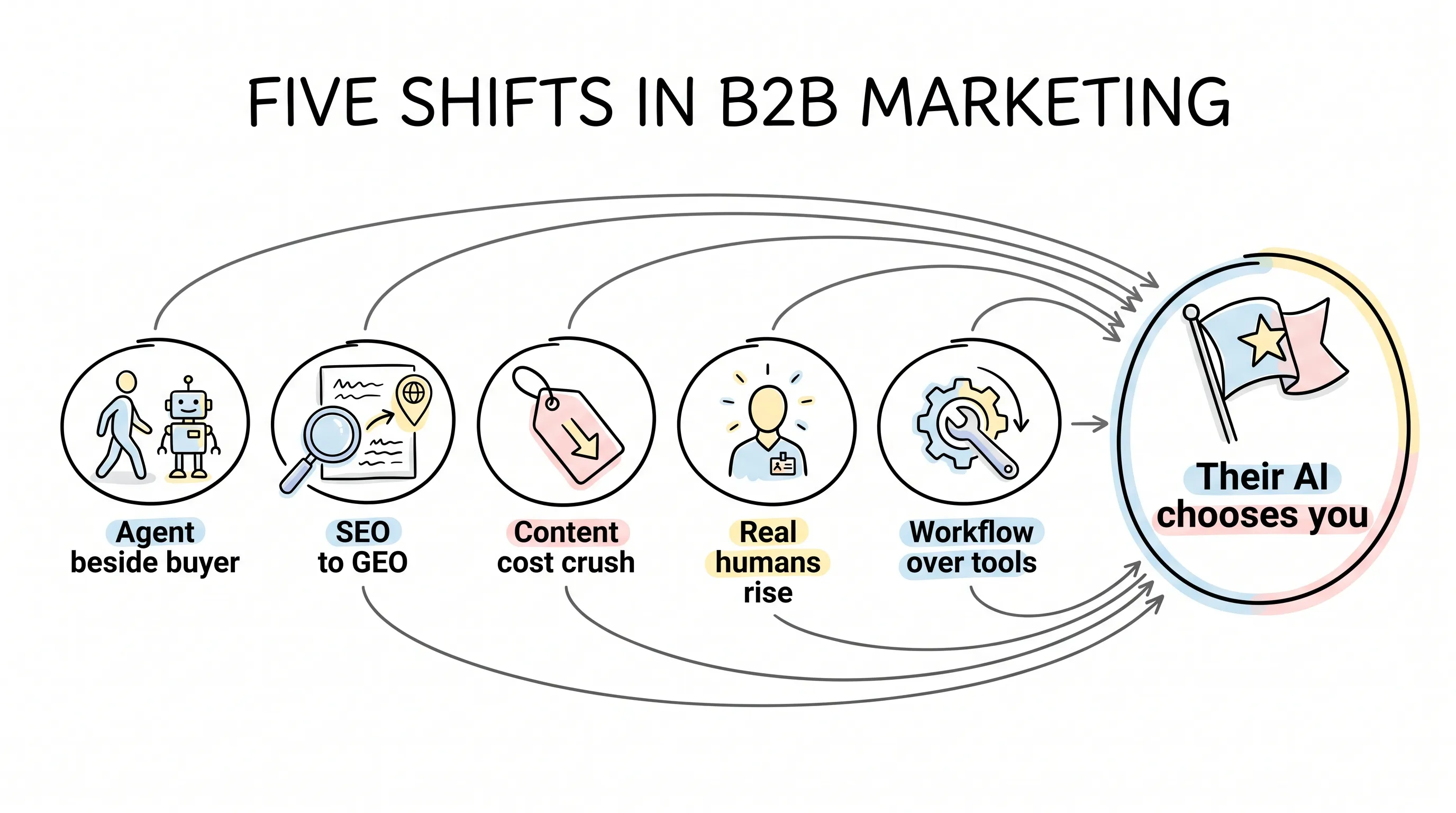
A learn article outlines five B2B marketing shifts for 2026, including AI agents brokering purchases, GEO beyond SEO, cheaper content production, rising value of identifiable human authors, and workflow over tool hoarding.
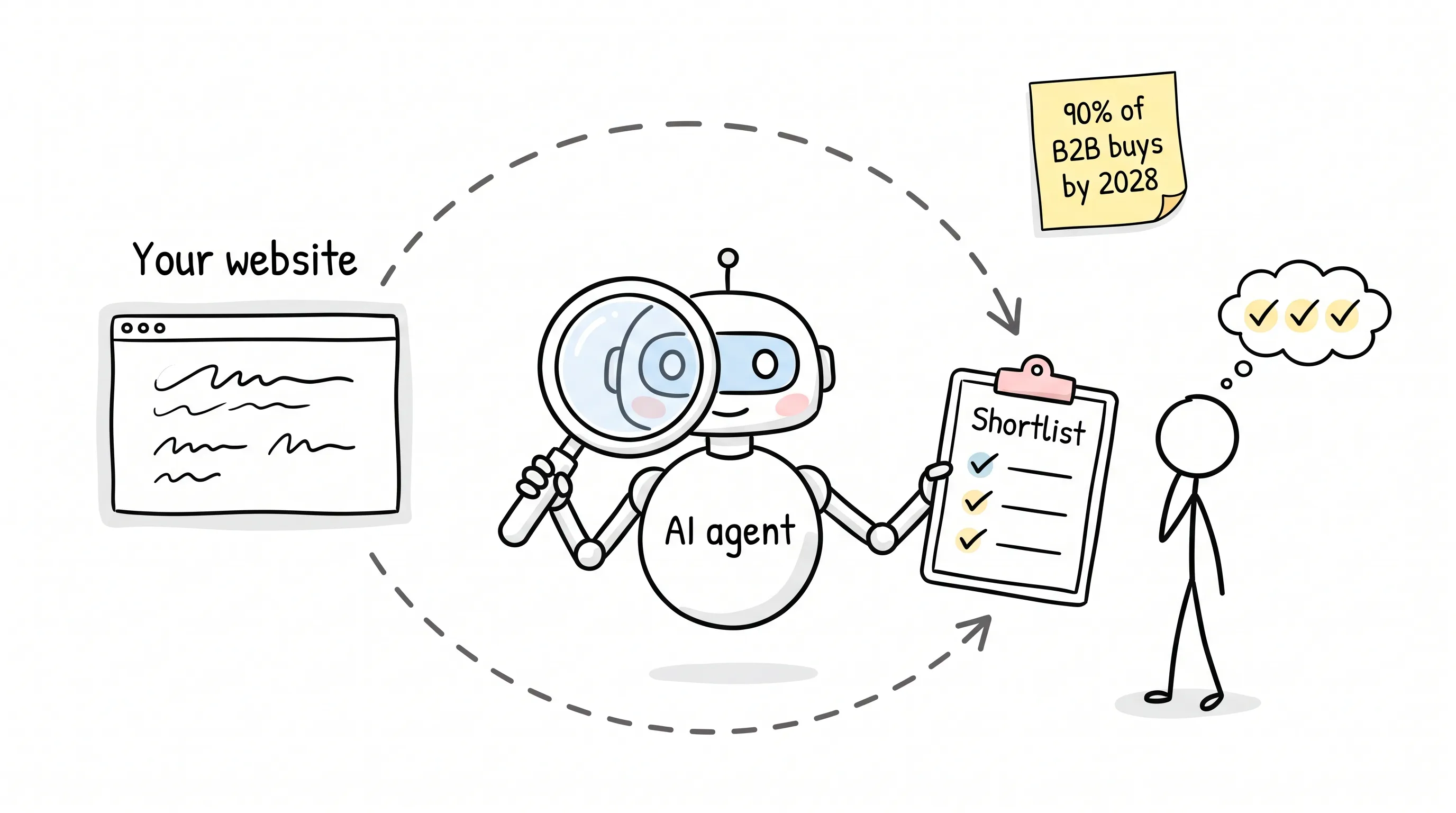
A few days ago, I asked an AI agent to research a collaboration software product for me.
It broke down the requirements by itself, searched for materials by itself, pulled the specs by itself, and built the comparison table by itself. Twenty minutes later, it handed me three candidates, each with a short "why this one" attached.
I never opened a single web page during the whole process.
The moment it turned in its work, a chill ran down my spine: if I were the head of marketing at one of those software companies, no matter how beautiful my website or how moving my copy, not a single word of it might ever have been seen by a "human."
Because the first one to see it was AI.
Over the past year, names like ChatGPT, Perplexity, and DeepSeek have become the air and water of many people's lives. AI has gone from novelty to daily habit. And in 2026, things have moved a step deeper: AI is no longer just another tool in your toolbox — it is starting to stand beside your customers and do work on their behalf.
What exactly happened? Let me tell you five things. By the time I'm done, you'll understand why my spine went cold.
The First Thing: Your Customer Now Has an "Agent" at Their Side
What is an AI agent?
It's the kind of AI that doesn't answer your questions — instead, you give it a task, and it breaks it down, executes it, and delivers the results all on its own.
For most of 2025, it was doing grunt work in the background: crawling web pages, running searches, grabbing structured data. By the end of the year, the picture changed. Pilot programs for autonomous shopping started to appear, and browsers began to grow the ability to say: "I'll take care of this myself." The agent moved from the workbench to center stage.
Gartner once put a number on it: by 2028, 90% of B2B purchases will be brokered by AI agents. Trailing behind that figure is procurement spending measured in the trillions.
90%. This is no small tweak — this is swapping out the entire engine of the procurement assembly line.
For B2B companies, this change is make-or-break. Before, your marketing target was a "person" — you studied people's minds, people's decision chains. Now, between the person and you, there is one more layer: an agent. It reads your materials first, screens out a batch on the person's behalf, makes comparisons, filters and recommends, and finally hands a shortlist to the person.
By the time a person actually sees you, the sifting has already happened.
Whether you make it onto that list depends on your digital footprint — and on your authority signals in the eyes of AI.
So in 2026, keep your eyes on one thing: can that AI running errands for your customer figure out the full story of who you are?
The Second Thing: After SEO, Here Comes GEO
Marketers used to compete on SEO, courting the search engines' crawlers.
Now there's a new discipline on the block, called GEO — Generative Engine Optimization.
What is GEO?
Put simply: it's about making AI willing to mention you, cite you, and recommend you when it generates answers.
This is a different beast from SEO. A crawler only cares about indexing your pages. AI has to "read" your content — and then write its own "book report" on you: is this company worth trusting?
How does it judge? It looks at a few things: whether the content has depth, whether it's clearly explained, whether real experience backs it up, whether authoritative endorsement stands behind it. It will also take your claims and cross-check them against other sources.
So those shallow, empty, templated, purely AI-mass-produced pieces of content get seen through at a glance and filtered out. Meanwhile, the pits you've stepped in yourself, the projects you've done, the first-hand data you've obtained — these have instead become the hardest currency there is.
AI doesn't lack information. What AI lacks is the one piece worth making the final call on for its owner.
Played this way, the game is actually good news for people who take content seriously. The fakers? Their time is up.
The Third Thing: The Cost of Content Production Just Got Crushed
In 2025, generative AI bloomed across text, images, audio, and video — video especially, with OpenAI's Sora leading the charge.
How far has it pushed? Often the only way to tell AI-generated content from human-made content is to squint and study it closely. Interestingly, some consumers have begun to suspect that "real content" is made by AI; other consumers can't even be bothered to wonder "is this content made by AI."
Good grief. This is no longer "can't tell real from fake" — this is "can't be bothered to tell real from fake."
The change on the production side is more practical: work that once took several teams, a pile of equipment, and months of dragging can now yield a working prototype from one skilled marketer working alone. That's right — one person now does what half a department used to.
Who placed the first bets? Big companies. Coca-Cola has already pushed AI-generated ads straight in front of consumers. The results? A mixed bag.
But the direction is clear. Generative AI cannot replace creative strategy; what it replaces is execution speed. Its value is that it crushed the cost of "trying": iterations got faster, testing multiplied, and personalized content can now run in small batches at speed.
Small teams use it to move faster; big companies use it to place bets. Those who lag behind simply haven't figured it out yet.
The Fourth Thing: The More AI Content, the More Expensive Real Humans Get
There's something counterintuitive here.
After AI content flooded everything, you'd think people would go numb and swallow it whole?
Exactly the opposite. People have started chasing the question: who, exactly, is behind this content?
Look at the faceless channels — even there, the comments say: "Thank you. I like content from real people." Just for those two words — "real person" — people will stop.
The logic isn't complicated. The more synthetic content floods the space, the scarcer named, identifiable people become. The scarcer they get, the more they're worth.
So in 2026, showing the author, showing the opinions, showing real experience is a legitimate strategy. Industry experts with real experience and small niche creators will command more influence than ever before.
Machines are in charge of output; humans are in charge of making people believe.
The Fifth Thing: Tools Are the Weapons, Workflow Is the Kung Fu
On the tools front, here's my view.
ChatGPT and Perplexity remain the twin stars, just with different specialties: ChatGPT shines at writing, ideation, and reasoning; Perplexity shines at research and real-time information. One generates ideas, the other verifies facts — run them as a pair.
Farther down the list: for content and search optimization, there's Copy.ai, Jasper, Surfer SEO; on the CRM side, HubSpot AI; for graphics and copy editing, Canva and Grammarly; for video generation, keep your eyes on Sora; and agentic browsers are just emerging — worth keeping on your radar.
But here's something you may not want to hear:
Don't hoard tools.
The lesson of 2025 is already out in the open: not one of the teams that use AI well got there by piling up tools. They embedded AI into specific workflows. Research, writing first drafts, predictive analysis, cutting footage — AI can lend a hand with all of these; automate what should be automated, and keep human eyes glued to what demands watching. AI to this day is not a tool that "does everything by itself" — you need to know its failure modes cold.
Tools solve for output; judgment solves for right and wrong. Judgment still lives in people.
But Everything Has a Flip Side
After all that optimism, time to pour a bucket of cold water.
Compute's appetite keeps growing, and infrastructure is starting to show cracks. In November 2025, that Cloudflare outage took a whole batch of websites down with it. The foundation isn't as solid as everyone thinks.
There are also people worrying whether this round of AI investment is a bubble. Improvement across models has been uneven — some are real breakthroughs, others are just cost cuts and tightened safety rails — layer on earnings-season uncertainty, and the worry isn't unreasonable.
Regulation is tightening too. Gartner predicts that by the end of 2026, legal disputes involving AI misuse or insufficient safeguards will multiply.
So, doing the solid work on ethical design and human oversight isn't sloganeering — it's buying insurance against the lawsuits to come.
Finally, Back to That Collaboration Software
After the research finished, I made a point of looking at what those three candidates my agent had handed me were showing online.
The companies the AI could read clearly had materials that were clearly structured, with depth, real case studies, and authority signals. The ones it couldn't were scattered everywhere, talking to themselves — even I couldn't be bothered to look a second time.
You see, this screening was already over before the customer ever showed up.
The contest of the future isn't whether customers choose you — it's whether their AI chooses you.
Here's to always being on that shortlist.
Continue reading
Related articles

Cross-Border Business: Time to Upgrade Your AI Toolbox
A learn article explaining how AI tools help cross-border e-commerce sellers clear five hurdles: language, regulation, logistics, payments, and fraud. It outlines a five-compartment toolbox, a five-step adoption path, and metrics such as conversion rate and CLV, while cautioning against over-reliance on AI.

AI Is Taking Over the Dirty Work of Social Media Marketing, One Task at a Time
This learn article outlines four social media marketing tasks AI can handle — audience analytics, content drafting and design, ad targeting and creative testing, and spam moderation — and cautions that taste, judgment, and data security remain human responsibilities.

AI Is Already This Good — Why Is Your Social Media Marketing Still Pure Manpower?
An overview of 18 AI tools for social media marketing, organized into six categories covering audience research, content creation, scheduling, comment and DM handling, ad management, and visual production, plus notes on personalization, prediction, and emerging trends.