
Your Next Customer Might Not Be Human
A commentary on InMobi co-founder Abhay Singhal's talk about agent-to-agent advertising: ads becoming conversational interfaces, generative AI try-ons in agentic commerce, token cost economics, and five changes the author says marketers should watch, from AI-mediated research to harder attribution.
A while back, I watched a talk by Abhay Singhal, co-founder of InMobi. By the end, I felt a chill down my spine.
Not the scared kind. The kind you get when you realize the rules of the game have changed — and you're still holding the old map.
What did he say?
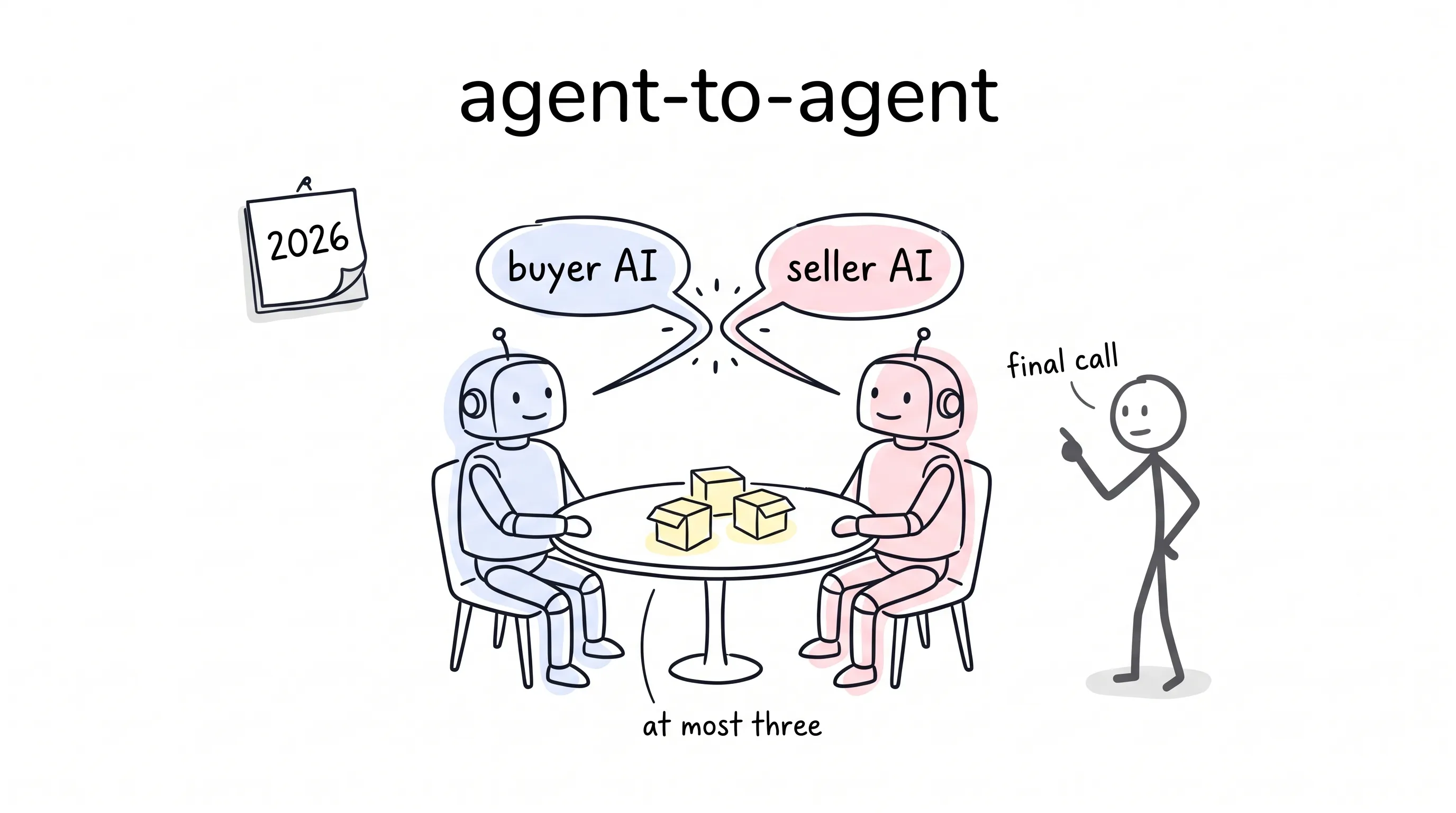
He said advertising is heading toward a whole new mode of interaction: agent-to-agent. AI to AI.
What does that mean?
Start With Something You Do Every Day
When you shop today, it probably goes like this: open a shopping app, search, compare prices, skim reviews, add to cart, check out.
You do every step yourself. Tiring, but reassuring.
But this routine may soon disappear entirely.
You only have to say one sentence: "Help me buy a shirt for autumn, under 200 yuan, that doesn't look cheap."
Then your AI sets off. It researches, filters, and compares. It knows your preferred style, your price range, which brands you've worn without regret. In the end, it comes back with an answer — at most three.
You make the final call. But the entire hunt has been outsourced.
This is agent-to-agent: the AI representing the consumer, and the AI representing the brand, sit down and talk.
The buyer is an AI. The seller is an AI too.
Singhal even gave a specific time point: 2026. Which means: now.
From here on, what you optimize for may no longer be "being seen" — but "being understood by machines."
The Billboard Becomes a Sales Assistant
What does this mean for advertising?
Think about it: what is an ad today? A line.
The user sees the ad, clicks, lands on a page — either they convert, or they walk away. Every step leaks.
But in an AI-driven environment, that line gets flattened into a single interaction layer.
Discovery, comparison, persuasion — all completed inside one conversation.
The ad is no longer that static poster. It becomes an interface that can chat.
Put bluntly, the ad goes from billboard to sales assistant.
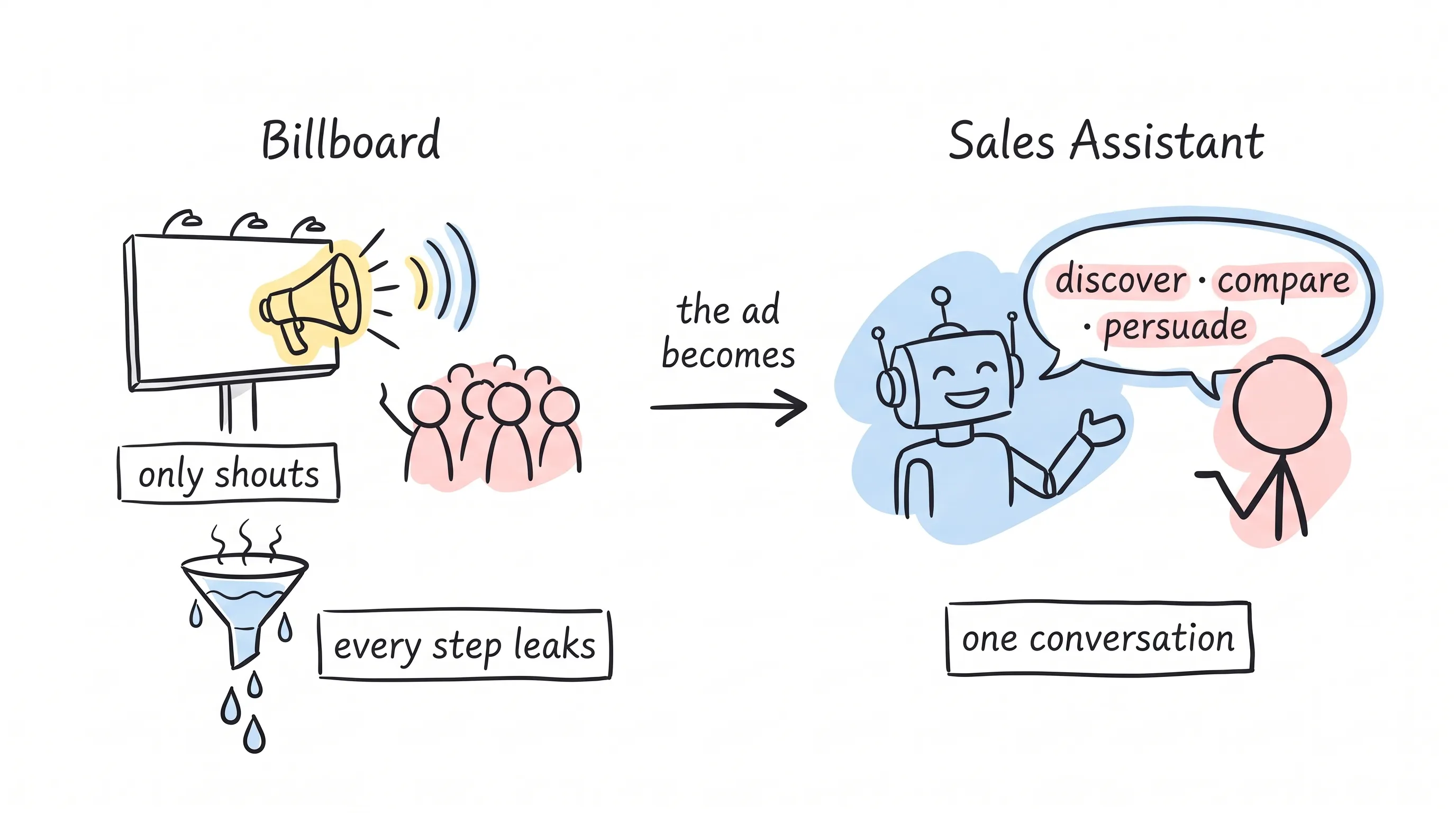
A billboard only shouts. A sales assistant asks about your budget, your household, how the thing you bought last time is holding up.
Whoever does interaction well stays inside the AI's recommendation chain. Whoever does it poorly, the AI won't even mention you.
That bar is far higher than "does the creative look good."
Try It On, No Imagination Required
The second thing is about e-commerce — more specific, and more interesting.
One category of products is born to be sold online: books, electronics. Specs are clear, one glance at the picture, place the order.
But another category has always sold awkwardly online: clothes, furniture, home decor, and pet supplies.
Why?
Because they test your imagination. What would this shirt actually look like on me? Will this table crowd my living room? If you can't picture it, you don't buy.
This is the Achilles' heel of online conversion for many high-ticket categories.
Generative AI is dismantling that Achilles' heel.
Singhal gave an example from his own company, Glance. Glance is an agentic commerce platform (what is agentic commerce? It's e-commerce where the AI shops, tries on, and picks for you). On Glance, when you take a fancy to a shirt, there's no need to fill in the picture in your head — the AI simply generates what you'd look like wearing it.
Just like that, the imagination barrier is gone.
The results are already showing on the books: campaigns using AI-generated visual assets, he said, deliver noticeably higher returns on ad spend.
Once you've "seen" yourself wearing it with your own eyes, the psychology of ordering changes: from "should be fine" to "this is the one." And choosing gets much easier on the brain.
This isn't about making the page a bit prettier. This is opening the valve on online transactions for an entire category of goods.
Does the Math for This Business Work?
The third thing is the most realistic: money.
A great AI experience is great — but it burns cash.
How many impressions does an ad platform process each month? On the order of hundreds of billions, even trillions. If every single interaction has to run a generative model, the compute bill is a terrifying number.
No one can afford to run that.
InMobi's answer is pragmatic: use advertising revenue to subsidize the token (the billing unit of AI compute) costs of AI. Then design ad formats such that the revenue generated by user engagement covers the cost of compute.
Does that sound like a platitude? It's not. In early tests, this model penciled out as net-positive on the publisher side. That is: as long as users genuinely engage, the math works.
For marketers, this surfaces a new layer of KPIs.
We used to track click-through rate, cost per click, conversion rate. Going forward, you'll need to track two more numbers: what does each AI interaction cost? And is token efficiency high enough?
You may have never managed tokens. Soon enough, they'll show up in your reports.
Your creative quality and your interaction design are no longer just brand questions. They directly determine whether this infrastructure survives.
Five Changes Already Happening
Put all this together, and I believe marketers need to hold on to at least five things.
First, research hasn't been eliminated — it's been outsourced.
Consumers hand the filtering work to AI, but the final decision stays firmly in their own hands. So your brand must live in the world the AI knows. If the AI doesn't know you, neither does the customer.
Second, ads will become experiences, not interruptions.
Static creative will look more and more like background noise. The winning form is the kind of experience that walks you to a conclusion the way a conversation does.
Third, personalization moves from segmentation to simulation.
In the past we divided people into 25 to 34 years old, tier-1 and tier-2 cities, white-collar. Going forward, brands simulate an entire set of experiences for a single individual, in real time. Segmentation is dressing a crowd in one-size-fits-all; simulation is tailoring for one person.
Fourth, creative teams and media teams will merge.
When the ad itself is an interactive system, the people doing creative, the people doing UX, and the people optimizing campaigns are doing the same thing. Three teams, one workflow.
Fifth, attribution (figuring out which touchpoint drove the sale) will become harder.
AI is wedged in the middle, and the user journey has been scrambled. Which impression, which conversation contributed to the deal? The old attribution models can't hold up; new frameworks must be built.
Finally, Back to That Question
At the start I asked: your next customer might not be human.
Now I can add the second half of the sentence: it might be the customer's AI.
Between brands and consumers, a layer of AI agents is being slipped in. How demand is discovered, how it is compared, how it is satisfied — all of it is being reshuffled inside that layer.
This is not a matter of switching channels to run ads. This is the entire system of demand — from birth to transaction — being rewritten.
The winners won't be the brands with the loudest voice, but the ones that move fastest and are most willing to remake themselves into something AI can read.
When a system-level change arrives, those who understand it first are the first aboard.
Here's to understanding it early.
Continue reading
Related articles

Cross-Border Business: Time to Upgrade Your AI Toolbox
A learn article explaining how AI tools help cross-border e-commerce sellers clear five hurdles: language, regulation, logistics, payments, and fraud. It outlines a five-compartment toolbox, a five-step adoption path, and metrics such as conversion rate and CLV, while cautioning against over-reliance on AI.

AI Is Taking Over the Dirty Work of Social Media Marketing, One Task at a Time
This learn article outlines four social media marketing tasks AI can handle — audience analytics, content drafting and design, ad targeting and creative testing, and spam moderation — and cautions that taste, judgment, and data security remain human responsibilities.

AI Is Already This Good — Why Is Your Social Media Marketing Still Pure Manpower?
An overview of 18 AI tools for social media marketing, organized into six categories covering audience research, content creation, scheduling, comment and DM handling, ad management, and visual production, plus notes on personalization, prediction, and emerging trends.