
Your Next Customer Might Not Be Human
An analysis of how AI agents are redefining marketing: reaching algorithm audiences, shifting from SEO rankings to citations in AI answers, and dissolving walls between marketing, sales, and service.
A while back, an old friend who works in marketing came back from Cannes Lions with a single observation: the shape of this industry is being swapped out.
I said, is it really that bad? Adland has cried "the sky is falling" every year.
He said, go look at one place and you'll understand. Cannes Lions, the Oscars of the advertising world. The famous Boulevard de la Croisette in the south of France has always been the home turf where ad agencies flex their wealth — the taller the building and the brighter the sign, the clearer it was who ran the industry.
Now the names along that boulevard are tech companies, one after another: Amazon, Google, Meta, Microsoft, Netflix, Pinterest, Reddit, Spotify, Salesforce.
The traditional advertising giants are almost nowhere to be seen.
Back in 2011, Marc Andreessen said something famous: software is eating the world. More than a decade later, other industries have taken a bite — marketing is about to have the whole plate carried off.
And this may only be the beginning. What's truly worth a marketer's attention is this:
Marketing itself is being redefined.
Why do I say that? Let's peel it back layer by layer.
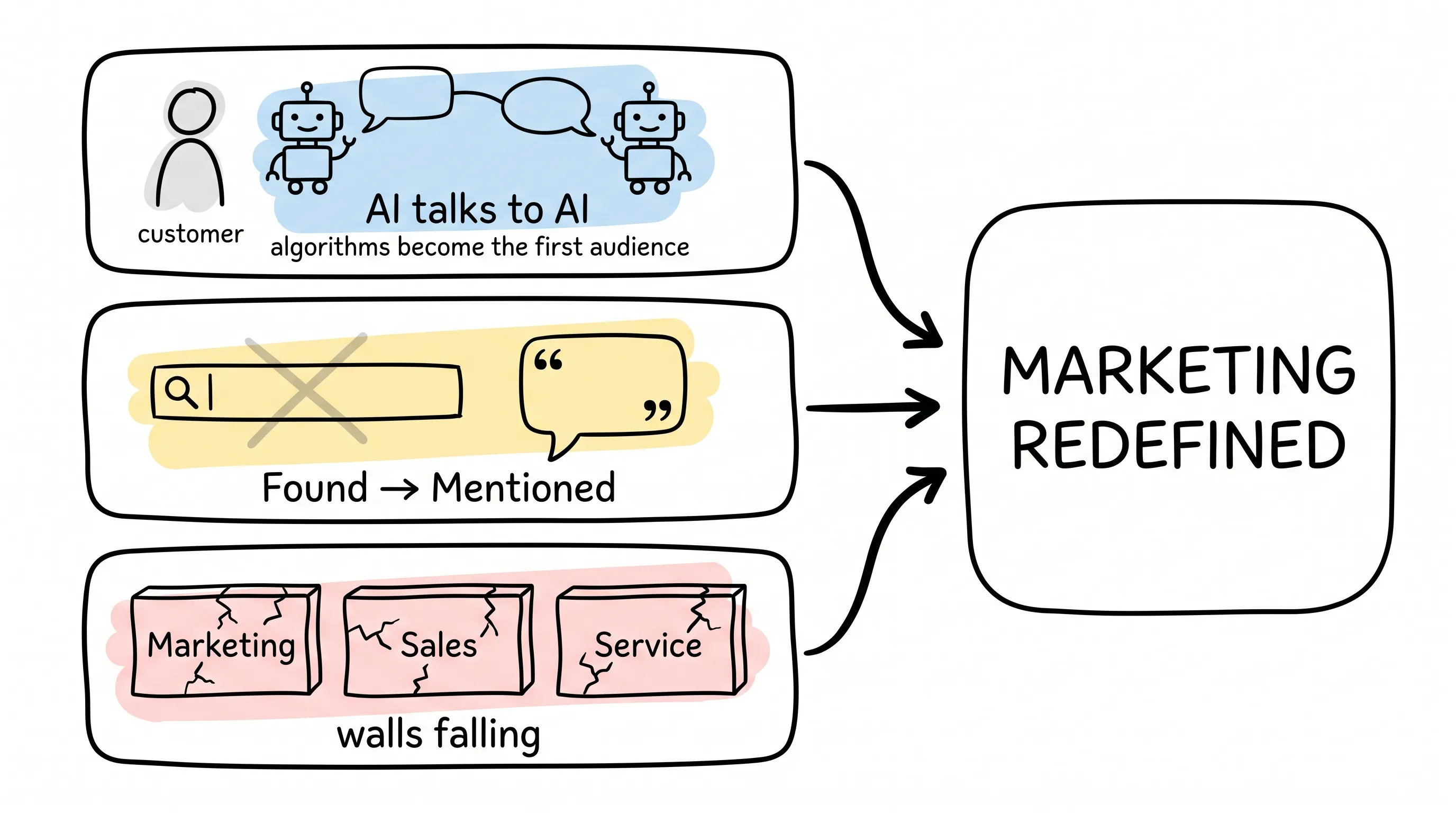
Layer One: AI Has Slipped In Among Your Customers
What is marketing, plainly put? Getting your message to the customer, so they remember you and pick you.
But some "customers" today aren't people at all.
Picture this scene. A customer wants to buy something. He doesn't open your website, doesn't click your ads, has never even searched for you. He just tells his AI assistant: find me something suitable, and buy it.
Then his AI and your AI start talking.
Researching the product, comparing prices, negotiating terms, placing the order. A few minutes, start to finish. By the time the human shows up, the deal is already done.
This isn't science fiction. There's a line in an IDC report that stuck with me: marketers used to aim their campaigns at customers; now the shortlist is decided by AI.
What does that mean? However beautiful your advertising is, if the AI doesn't pick you during its screening, you never even make the final cut.
And this is no longer just an early signal. PwC's survey shows 35% of companies are using AI agents at scale, and another 17% have put them into almost every process. IDC predicts that by 2028, three-fifths of marketing functions will be carried out by AI; by 2029, companies will spend 3x more on "optimizing for AI" than on traditional search engines.
Marketing used to target people. From now on, you have to convince the algorithm before you get your turn with the person.
Marketing's first audience is shifting from humans to algorithms.
Layer Two: From "Being Found" to "Being Mentioned"
Customers changed, and the road they take to find you changed with them.
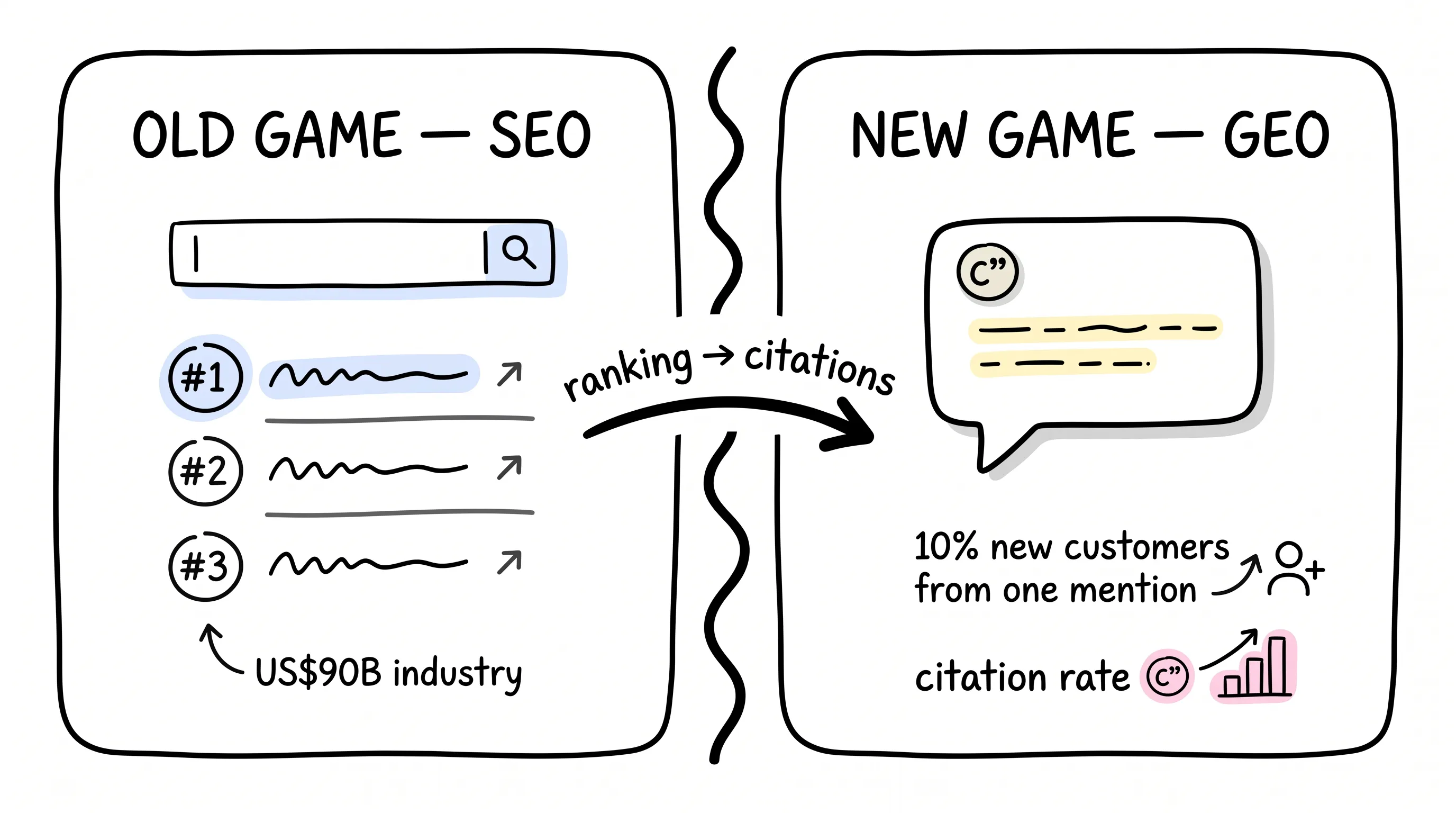
For the past twenty years, the word marketers knew best was SEO. How big a business is that? Roughly US$90 billion. Countless companies pump money into keyword research, all for one goal: ranking near the top of search results.
That playbook is breaking down.
Why? Because search is moving from the search box to the chat box. People increasingly can't be bothered to dig through ten blue links; they just ask an AI for one answer. Apple has already plugged AI search tools (Perplexity, for one) into Safari. The venture capital firm a16z gave this trend a name: GEO, Generative Engine Optimization — stop optimizing your ranking, start optimizing the one sentence about you inside an AI's answer.
How big is this? Let me run the numbers.
Vercel's CEO Guillermo Rauch noticed that when ChatGPT merely mentioned their product in passing, it brought in 10% of their new customers.
Wild. No ads bought, no campaigns run — one offhand mention from an AI, and 10% of new customers.
So the scoreboard changes too. Page views used to be the metric; now there's a new one, the citation rate: how often AI mentions you when answering users' questions. A wave of tools has already sprung up — Brandrank.ai, Peec.ai, Quni.ai — each built to watch one thing for you: what every AI out there is actually saying about you.
Zach Cohen of a16z put it sharply: how you get written into the AI layer is the new competitive advantage.
Before, the game was ranking. From here on, the game is citations.
Layer Three: The Walls Between Departments Are Falling
Customers changed, the road changed — and there's a more thorough change still: the three walls separating marketing, sales, and service are coming down.
Think about it. When a customer's AI comes to talk business with your company's AI, does it distinguish between "I'm here to inquire" and "I'm here to complain"?
It doesn't. It's one continuous conversation.
A well-designed AI knows the customer's name, remembers what he has bought, can field technical questions, can process the return, and can recommend an upgrade while it's at it. So tell me — is that marketing, sales, or customer service?
All of them. And none of the labels matter anymore. What matters is whether the conversation flows.
The demands on the organization are entirely different now. Data has to be joined up, definitions have to agree, and departments can no longer each manage just their own stretch of the customer relationship. The fast movers have already begun reorganizing around AI platforms, instead of drawing org charts around functional divisions.
And What About People?
By now, you might be asking: if AI does all the work, where do people go?
In a 2024 industry survey, 78% of marketers expected that within three years, at least a quarter of their daily tasks would be automated; more than a third expected more than half.
Meta's public roadmap states it plainly: ad buying goes fully automatic, with humans only setting budgets and goals. Google, Amazon, and Microsoft are all building targeting, creative, and optimization that run without a human hand.
It does sound a bit cold. But honestly, what gets replaced is execution, not judgment.
Once the routine work is taken away, the human role actually comes into focus: set strategy, make the creative calls, guard the ethics, and lead a mixed team of people and AI. Tomorrow's head of marketing will be roughly half creative director, half technologist — with a working grasp of data science.
That topic is a whole other article; I'll leave it for another day.
Which Assets Are Worth More Now
Once the functions are redefined, two things become more valuable, not less.
The first: brand.
Why? AI is trained on oceans of data, so its recommendations naturally tilt toward famous, trustworthy brands. Which sets up a snowball loop: the more famous you are, the more often AI cites you; the more often AI cites you, the more famous you get.
The second: first-party data.
What is first-party data? It's the customer information you collect yourself, bit by bit, staying on the right side of law and regulation. It's the fuel that trains your own AI. In an era of ever-tightening privacy rules and the death of third-party cookies, that pile of data is your moat.
One governs "are you being cited"; the other governs "can you catch the customer after the citation." Both are worth starting to stack up today.
So What Should You Do?
Finally, what to do about all this.
First, a frightening pace: on tasks like language and image generation, AI capability roughly doubles every six months. What does that mean? Past technology waves took a decade, give or take, to go from emerging to everywhere. This wave counts in months.
By the time you're done "looking around and waiting a bit," the window has closed.
Three things worth starting right now:
- Put AI tools and agents to work. Hands on first, meetings later;
- Train the team to run human–AI hybrid — teach people to direct the AI;
- Rebuild your systems around unified customer data. The pipeline that feeds your AI has to be laid first.
But what I most want to say isn't any of those three.
It's the more fundamental thing: when AI becomes the middleman between you and your customers, how should you handle that relationship?
My view: your AI has to be genuinely useful and genuinely trustworthy; it has to make the connection better, not replace the connection. Machines can run the errands, but they cannot earn trust on your behalf.
Back to that boulevard in Cannes.
Decades ago, it belonged to the ad agencies. Later, it belonged to the tech companies. Who does it belong to next? Nobody can say.
The only certainty is that trillions of AI agents will soon be living alongside billions of people. The rules of marketing are being rewritten.
The new script — are you the one copying it, or the one writing it?
May you be the one who writes it.
Continue reading
Related articles

Cross-Border Business: Time to Upgrade Your AI Toolbox
A learn article explaining how AI tools help cross-border e-commerce sellers clear five hurdles: language, regulation, logistics, payments, and fraud. It outlines a five-compartment toolbox, a five-step adoption path, and metrics such as conversion rate and CLV, while cautioning against over-reliance on AI.

AI Is Taking Over the Dirty Work of Social Media Marketing, One Task at a Time
This learn article outlines four social media marketing tasks AI can handle — audience analytics, content drafting and design, ad targeting and creative testing, and spam moderation — and cautions that taste, judgment, and data security remain human responsibilities.

AI Is Already This Good — Why Is Your Social Media Marketing Still Pure Manpower?
An overview of 18 AI tools for social media marketing, organized into six categories covering audience research, content creation, scheduling, comment and DM handling, ad management, and visual production, plus notes on personalization, prediction, and emerging trends.