
Your Next Customer May Never Even Open Your Website
A learn article introducing GEO (Generative Engine Optimization): how AI answers are replacing link-based search, how GEO builds on an SEO foundation, and seven tactics for creating content AI may cite, along with common pitfalls to avoid.
A few days ago, I asked ChatGPT to help me pick a CRM.
It didn't hand me ten blue links. It gave me the answer outright: a comparison of several products, each with its own strengths and weaknesses — and at the end it added, "If your team is twenty people or fewer, focus on these two."
Let me ask you: do you think I clicked through to any of the websites it listed?
Probably not. The answer was already complete — what would be the point of clicking in?
That stopped me cold. Because I realized the relationship between users and search has truly changed.
In the past, you typed "best project management software" into a search engine, and it handed you a page of links. You browsed, compared, and clicked on your own. Whoever you clicked got the traffic; whoever had the traffic had the business. That whole game kept countless SEO agencies fed.
Now you ask an AI: "We're a twenty-person remote team on a tight budget — which project management software should we use?"
It gives you a complete answer. Not a single click happens.
From search engine to answer engine to recommendation engine. This shift may be the biggest migration in marketing since the search engine was born.
What Is GEO?
GEO — Generative Engine Optimization.
Put simply, it means: making AI willing to mention you when it answers questions on a user's behalf.
You used to optimize content for search engines, chasing a ranking. Now you optimize content for AI, hoping that when it answers, it counts you in.
Think about how people get information these days: asking ChatGPT, scanning the AI Overviews at the top of Google, researching a product with Perplexity, or casually checking with Gemini and Claude.
These platforms give answers, not lists of links. Your content either becomes part of the answer, or it simply doesn't exist.
SEO helps search engines find you; GEO helps AI trust you.
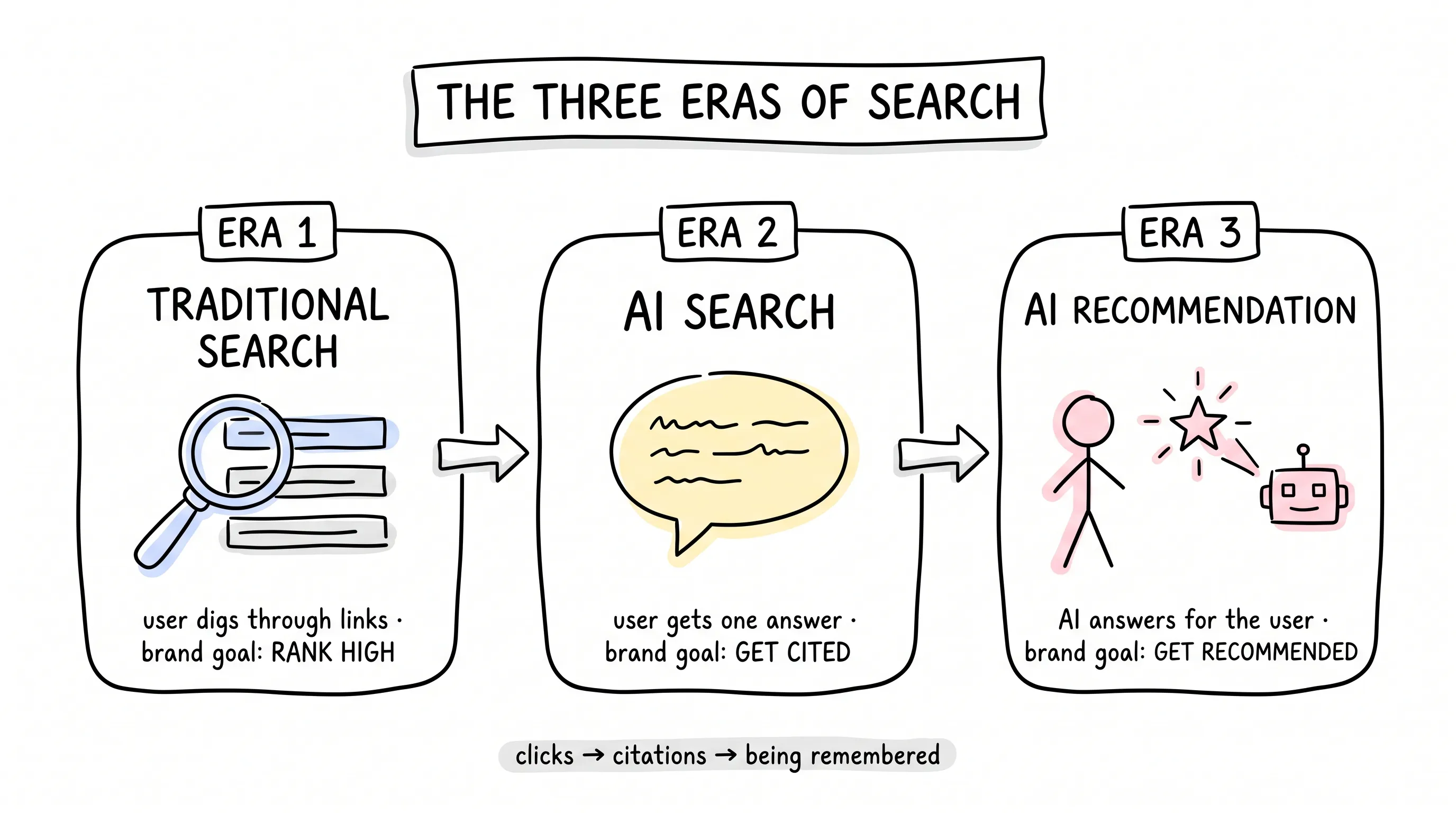
The Three Eras of Search
I break this down into three stages.
Stage one: traditional search. Users dug through links themselves, and the brand's job was to rank high.
Stage two: AI search. Users got answers directly, and the brand's job was to be cited.
Stage three: AI recommendation. Users started asking directly for solutions and advice. By then, the brand's job was to become the one AI recommends.
In the past, everyone fought for clicks. Today, what everyone competes for is being treated as a trusted source. Further out, the winners may be the brands AI names before the user has even opened their website.
So, Will GEO Kill SEO?
Many people open with exactly this question. My judgment: no. These two are partners.
Where's the difference? Set them side by side and it becomes clear.
SEO optimizes search rankings — it watches keywords and positions, and it measures traffic. GEO optimizes AI's answers — it watches authority and trust, and it measures citation counts and frequency of appearance.
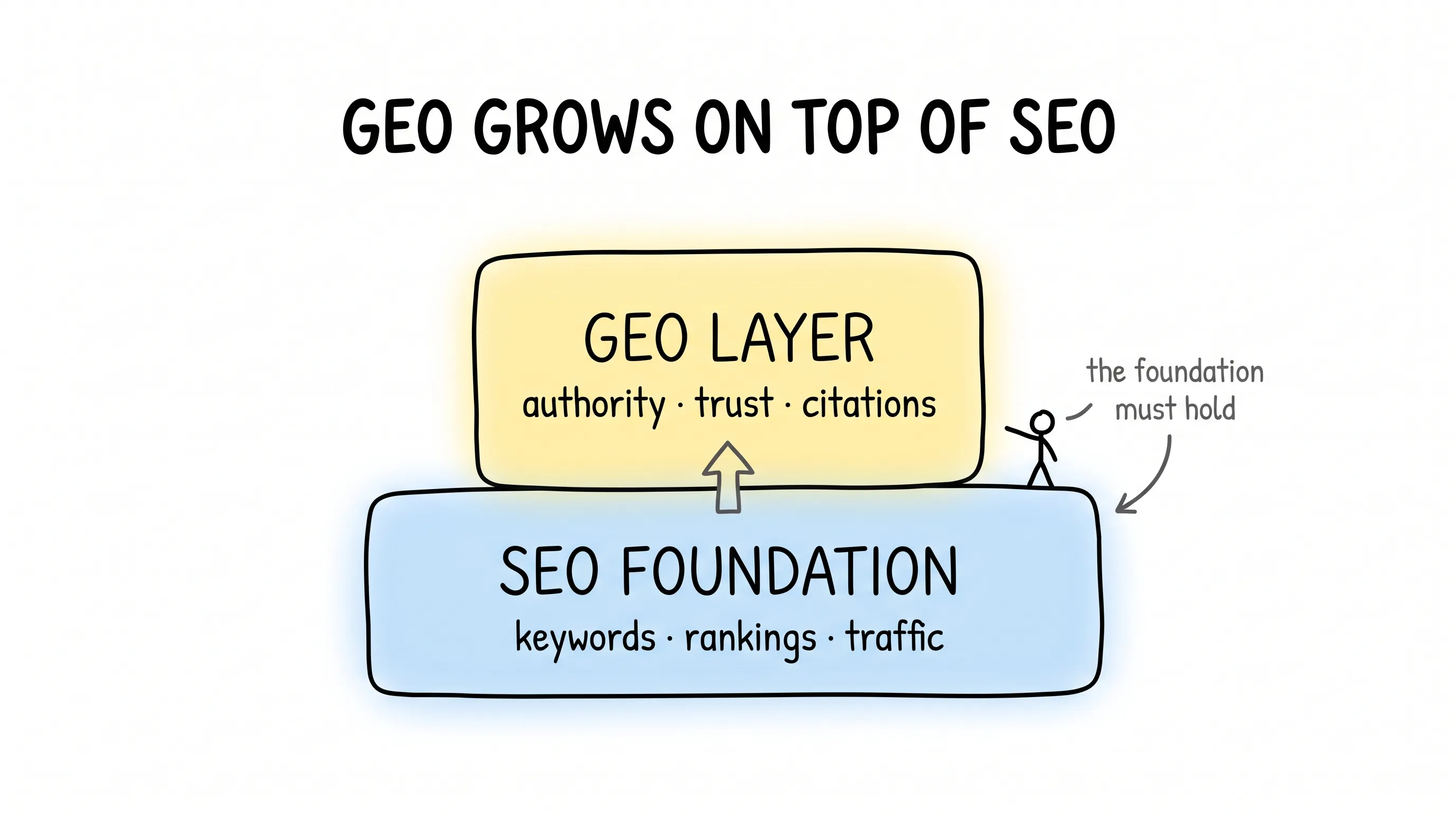
But note: these two don't operate in isolation. For a website with a shallow SEO foundation, doing GEO is an uphill battle. Why? Because one of the things AI weighs when judging your credibility is how you perform in traditional search. If the foundation isn't solid, the building won't rise.
GEO is a new layer that has grown on top of SEO's foundation.
What Exactly Makes AI Recommend A Over B?
Plenty of articles online say AI just likes "high-quality content."
That says nothing at all. What counts as high quality? AI isn't a person — how would it judge?
Broken down, when AI picks content, it looks at roughly these things: Is the information clear? Does it match the user's question? Is the source credible? Is the claim consistent across the web? Is there real expertise? Is the content fresh?
The one I most want to stress: consistency across the web.
Think about it: if a pile of credible sources all say roughly the same thing about a topic, AI considers the information reliable. Conversely, if the only place in the world saying it is your own website, would AI dare cite you?
That's the value of brand authority. A company that keeps publishing useful content, has been covered by the media, has solid user reviews, and gets mentioned by other reputable sites — all those signals combined work better than shouting "we're the industry leader" a hundred times on your own website.
When AI judges you, it doesn't look at what you say. It looks at what others say about you.
How Do You Actually Do It? Seven Moves
These tactics aren't mysticism — they're fundamentals proven to work right now.
-
Answer first, elaborate after. AI likes content that gets straight to the point. Answer the question in the opening; put the details behind it. Don't write like an academic paper that buries the point under three paragraphs of setup.
-
Go deep in one domain; don't cast a wide net. A hundred unrelated articles are worth less than one domain covered thoroughly. When AI judges who is authoritative, it looks at depth of coverage.
-
Create what no one else has. The internet is not short of template articles; what it's short of is your own research, customer cases, industry observations, proprietary frameworks. AI can't repeat what you've never written.
-
Write the way people talk. When users ask AI, they ask the way they speak. The more your content sounds like human speech, the better it lines up with those questions.
-
Get the structure right. Clear headings, short paragraphs, tables where tables make sense, definitions stated explicitly. Well-structured content is easy for AI to parse and comfortable for people to read.
-
Spread beyond your website. The places AI gathers information aren't limited to your official site. Industry media, review platforms, podcasts, discussions on social media — they're all sources it draws on. The more consistently you show up in credible places, the thicker your authority grows.
-
Don't let your content rot in the archive. Outdated information isn't just useless — it costs you points. Refreshing old articles regularly tells AI: this source is still alive.
The Pitfalls to Avoid
I've watched plenty of companies charge in the moment they hear AI search is hot — and get every move wrong.
Mass-generating content with AI and publishing it without a single human glance. That's pitfall one.
Chasing keywords while ignoring what users actually want to ask. Pitfall two.
Pursuing volume at the expense of expertise. Pitfall three.
Treating GEO as a replacement for SEO — and shutting down the original SEO too. Pitfall four.
Leaving articles untouched for three years, still hanging on the website as a storefront. Pitfall five.
Before writing any piece of content, ask one question first: why would AI cite it?
Finally, Back to That CRM
Did I end up buying the one ChatGPT recommended?
I did.
Which means, in that entire transaction, I never once opened any brand's website. Those few sentences from AI handled the self-introductions for several brands. Some brands got mentioned; others never even got the chance to be mentioned.
The more I think about it, the more I believe: from now on, judging whether a brand stands a chance may start with one question — does AI mention you?
No ranking is as valuable as being remembered by AI.
Maybe one day, before your customer ever meets you, AI will have already made your introduction for you. Whether those few words about you are good or bad depends on whether you started working on GEO today.
Here's to becoming the name AI recommends.
Continue reading
Related articles

Cross-Border Business: Time to Upgrade Your AI Toolbox
A learn article explaining how AI tools help cross-border e-commerce sellers clear five hurdles: language, regulation, logistics, payments, and fraud. It outlines a five-compartment toolbox, a five-step adoption path, and metrics such as conversion rate and CLV, while cautioning against over-reliance on AI.

AI Is Taking Over the Dirty Work of Social Media Marketing, One Task at a Time
This learn article outlines four social media marketing tasks AI can handle — audience analytics, content drafting and design, ad targeting and creative testing, and spam moderation — and cautions that taste, judgment, and data security remain human responsibilities.

AI Is Already This Good — Why Is Your Social Media Marketing Still Pure Manpower?
An overview of 18 AI tools for social media marketing, organized into six categories covering audience research, content creation, scheduling, comment and DM handling, ad management, and visual production, plus notes on personalization, prediction, and emerging trends.