
Your Next Customer May Never Click on Your Website
A learn article explaining how zero-click AI search changes how local businesses get discovered, introducing GEO (Generative Engine Optimization) as a complement to traditional SEO, warning against manipulative AI SEO tactics, and pairing AI efficiency with authentic human storytelling.
A while back, I took a trip to San Diego and stayed in a little seaside town called Encinitas.
One evening, craving seafood, I pulled out my phone and asked an AI search assistant: what's a good spot nearby to take friends to?
Guess what it gave me?
Not ten blue links.
A paragraph. It came right out and said: go to this one. Eight hundred meters away, and its reviews have kept climbing over the past month.
Unbelievable. It had even figured out which place had the owner with the warmest smile.
In that instant, one thing hit me: my friend — the guy who runs a surf shop in Carlsbad and sells a little sunscreen on the side — his next customer may never click on his website.
Half of All Searches Never End on Your Website
This story starts with a set of numbers.
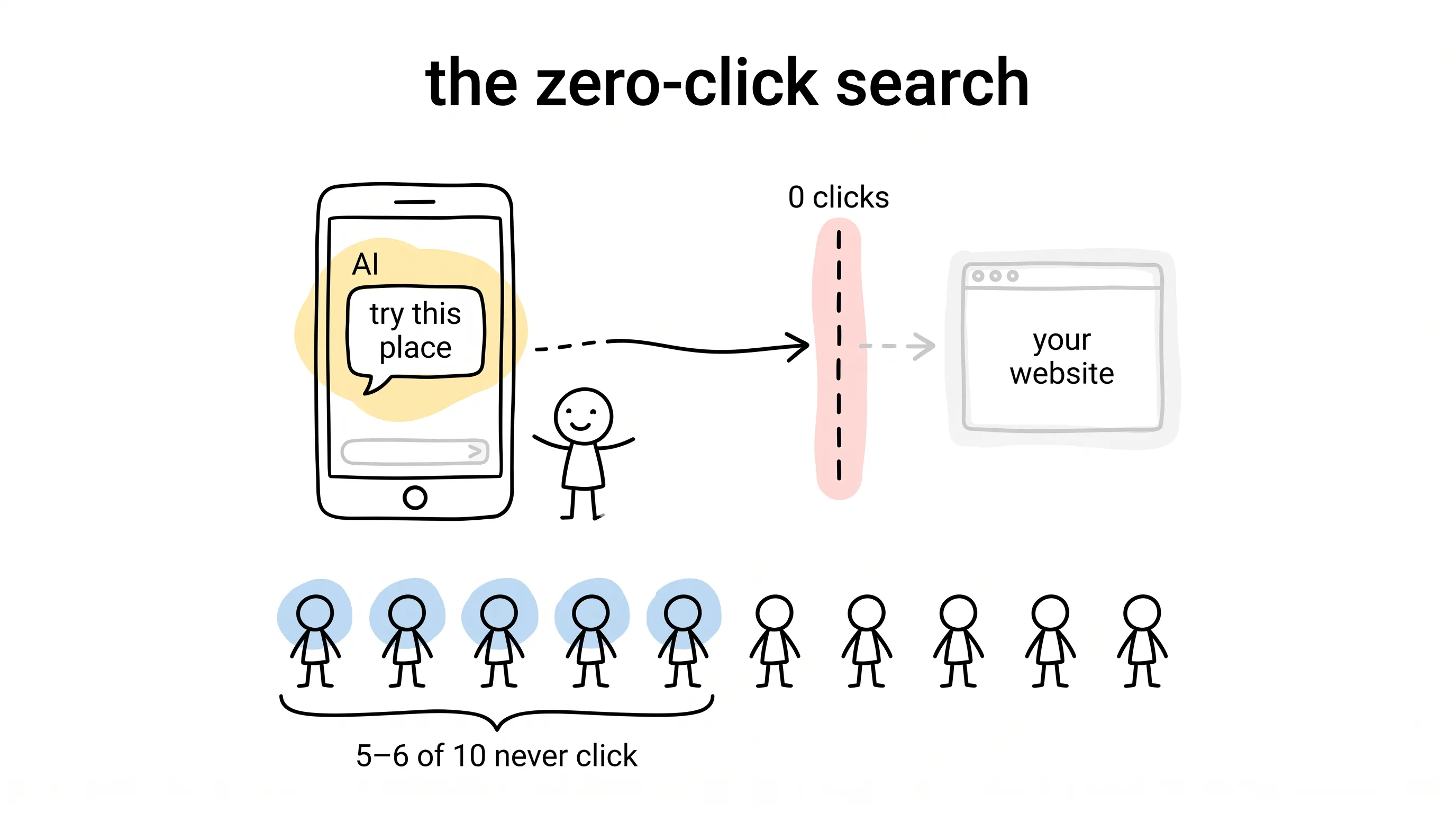
I've read several industry studies, and they all point to the same figure: today, more than half of all searches end in "zero clicks."
What does zero-click mean?
It means the user searches, reads, and buys — without ever setting foot inside a single website.
Do the math. Out of ten people searching for "good food near me," five or six go from question to decision entirely within the AI's answer. They never compare prices. They never open the homepage you carefully designed.
Yes — your homepage. They never even glanced at it.
What does that tell you?
That the battlefield has moved. You used to fight the shop next door for search rankings. Now you fight for the answer the AI gives, the handful of recommendations on the map, and that one line in a conversation: "I think you should try this place."
That's how it works in Google Search, and it's no different on Meta's platforms.
AI Is Like a Local Guide
When I told my friend about this, he got a little uneasy: "So was all my SEO for nothing?"
"Don't panic yet," I said. Think of search as two different things.
Search used to be like the Yellow Pages. You spent money and sweat to get your name toward the front, and whoever the customer flipped to got the call.
AI search today is like a savvy local guide. Ask it where to eat, where to buy a surfboard, which guesthouse suits a family with kids, and it names two or three places without missing a beat.
The Yellow Pages only cared about money and keywords. What does the guide care about?
The guide only recommends the shops it trusts — the ones it keeps hearing good things about.
So what does it take for Google — this "guide" — to know you and trust you?
What it looks at is actually quite plain: whether you've earned recent reviews, whether your business profile (yes, the Google Business Profile) has been consistently looked after, whether you have genuine local photos, and whether your name, address, and hours tell the same story on every platform.
All of it is unglamorous groundwork. None of it can be patched up with an overnight hack.
So stop agonizing over "was my SEO wasted." Rankings still matter. But what truly pays today is being the business AI trusts enough to recommend.
What Is GEO?
That's how a new term was born: GEO — Generative Engine Optimization.
So what exactly is GEO?
Put simply, it means treating "getting recommended by AI" as a discipline you take seriously: use real, location-grounded content to give the AI a reason to vouch for you.
But — hear me out on this "but."
Google has already stepped in, explicitly cracking down on manipulative AI SEO tactics. Mass-produced low-quality blogs, keyword stuffing, junk strategies engineered to "fool the AI" — what awaits them is likely a penalty.
In the Yellow Pages era, a clever trick at worst meant nobody ever flipped to your page.
Try to game the guide today, and the guide remembers. It stops recommending you — and may even warn others to steer clear.
AI reads your content, and it reads your persona, too.
Along the San Diego coast, where tourism props up half the economy, from Oceanside to La Jolla — restaurants, guesthouses, real estate agents, wellness clinics — nobody escapes this logic: AI has seen plenty of fake prosperity. It's the genuinely real that has become scarce.
How the Winners Play It
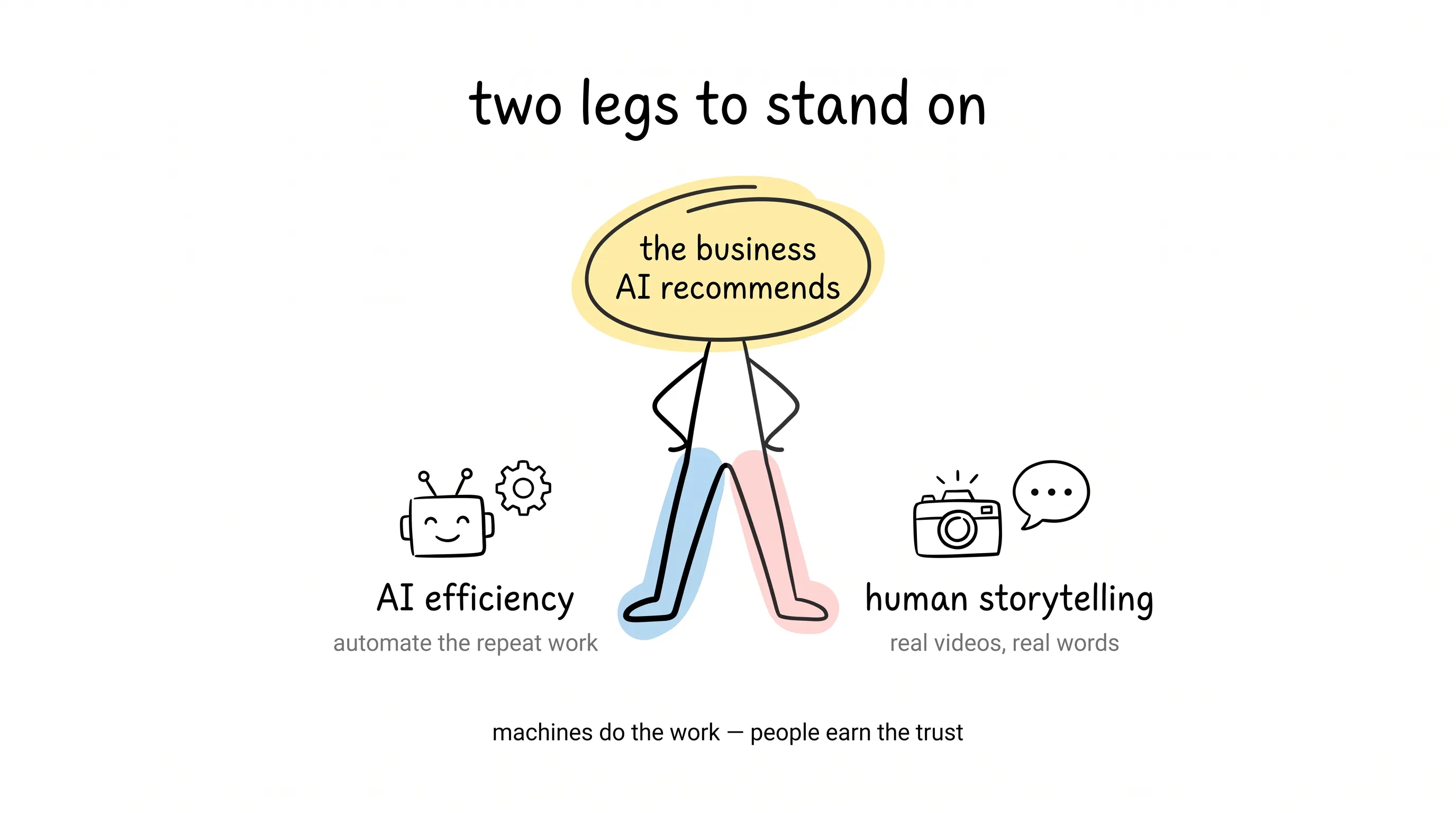
So what do you do? You need two legs to stand on.
The first leg is AI-powered efficiency: automate what should be automated, hand the batch-and-repeat work to AI, and pull people out of repetitive labor.
The other leg is human storytelling.
Film short videos of your business actually running — a little camera shake never hurt anyone. Collect your customers' own words — rough edges and all. And write about your own street, your own stretch of ocean, instead of copying the generic copy everyone else uses.
One leg runs cold, the other warm, but they point the same way: AI's job is to make you show up fast and often; real people's job is to make others believe you.
Machines can do the work for you. They can't earn your reputation for you.
Back to That Seafood Dinner
That night, I did go to the place the AI recommended.
When we left, the owner waved us out the door and told us to come find her next time.
You ask me how to run a local business in the AI era? My answer is plain: let the AI remember the real you, and let your customers remember your honest words.
Here's to you — and to the light in your shop — may you always be the one the AI trusts enough to recommend.
Continue reading
Related articles

Cross-Border Business: Time to Upgrade Your AI Toolbox
A learn article explaining how AI tools help cross-border e-commerce sellers clear five hurdles: language, regulation, logistics, payments, and fraud. It outlines a five-compartment toolbox, a five-step adoption path, and metrics such as conversion rate and CLV, while cautioning against over-reliance on AI.

AI Is Taking Over the Dirty Work of Social Media Marketing, One Task at a Time
This learn article outlines four social media marketing tasks AI can handle — audience analytics, content drafting and design, ad targeting and creative testing, and spam moderation — and cautions that taste, judgment, and data security remain human responsibilities.

AI Is Already This Good — Why Is Your Social Media Marketing Still Pure Manpower?
An overview of 18 AI tools for social media marketing, organized into six categories covering audience research, content creation, scheduling, comment and DM handling, ad management, and visual production, plus notes on personalization, prediction, and emerging trends.