
Your Next Customer May Ask AI First — and Only Then Find You
An explainer on GEO (Generative Engine Optimization), covering why AI answers may replace traditional search clicks and how content structure, entity clarity, and EEAT-style trust signals influence AI citations.
A while back, a friend of mine who runs an enterprise-services business invited me out for coffee. He sat down and opened with: "Something's off."
"What's up?" I said.
He said his website's keyword rankings were still sitting comfortably on page one — yet his inbound inquiries had dropped thirty percent. His team spent three months digging and couldn't find anything wrong.
I asked him one question: "Are your customers still 'searching'?"
He froze.
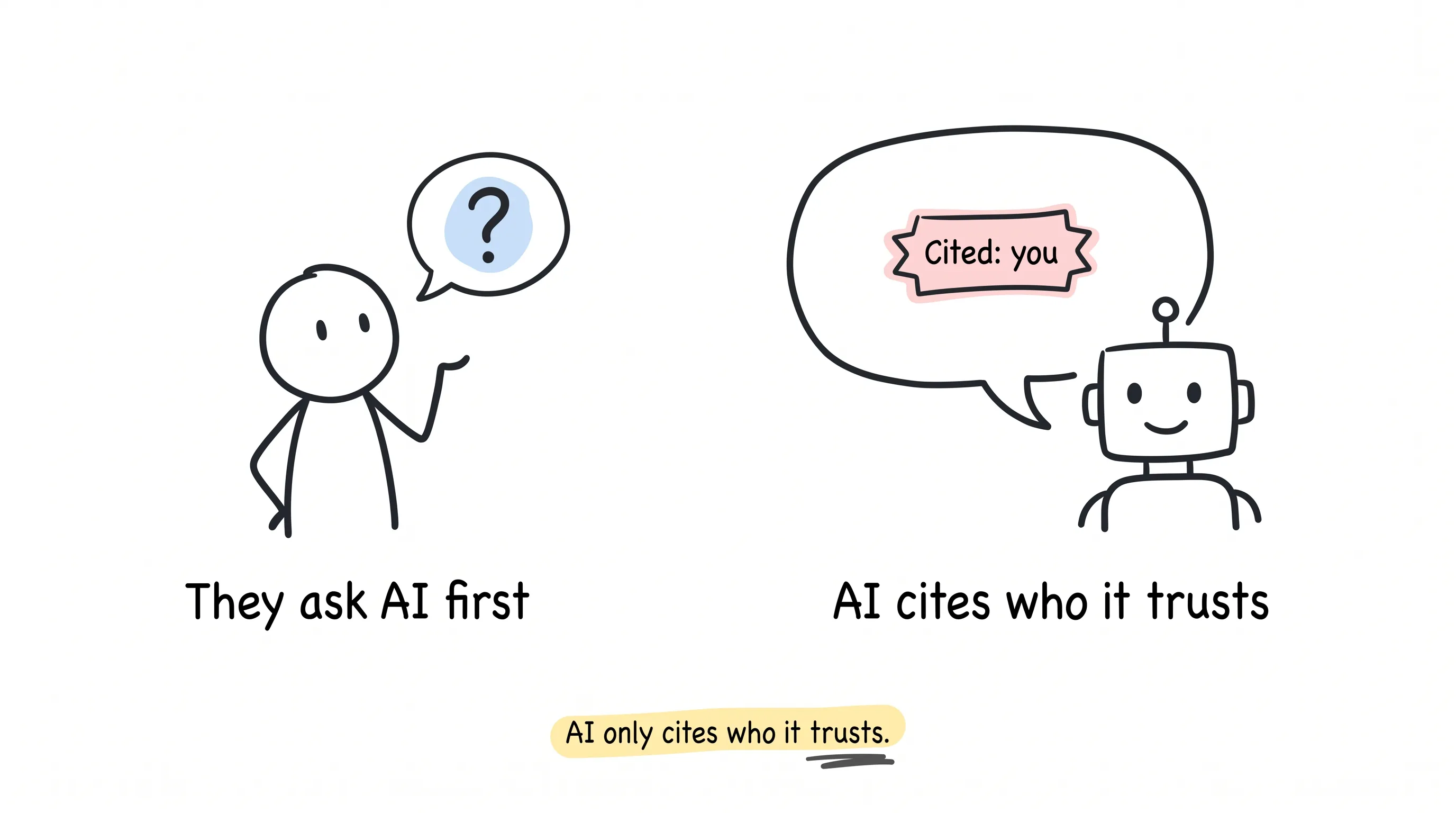
I knew the answer. His customers now open ChatGPT, Perplexity, or Google's AI search. Got a question? Just ask. They take a plausible-looking answer and they're gone. That string of blue links on the results page — they can't be bothered to glance at it.
Behind this lies a keyword quietly rewriting an entire industry. Today I'll walk you through it.
What Is GEO?
What is GEO?
GEO — Generative Engine Optimization. Put simply, it's about getting your content "cited" by AI.
In the old days of SEO, the goal was clear: get your webpage onto the first page of search results. User clicks, lands on your site, converts. What you were serving was the ranking rules.
And now? Users ask AI directly: "Which enterprise SEO platform is right for optimizing in the AI era?" AI won't toss you ten links. It generates an answer. If your brand shows up in that answer, you win. If it doesn't, you don't even get the chance to be turned down.
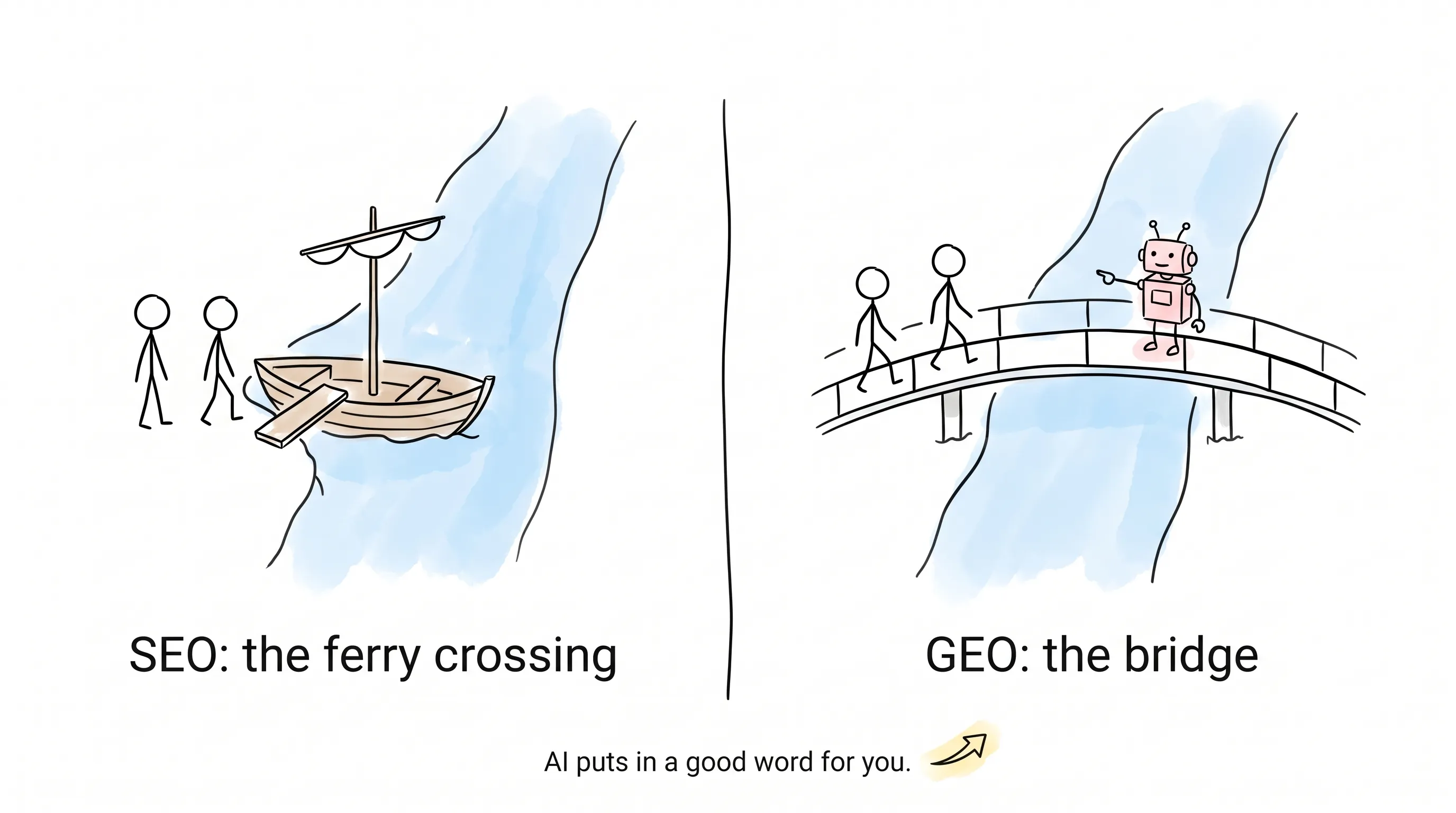
Here's an analogy. Traditional SEO is like guarding a ferry crossing on a river: customers queue up to board your boat, and you collect the fare. In the GEO era, a bridge has been built straight across the river, and customers walk over it without so much as a backward glance.
So what do you do? Get AI to stand on that bridge and put in a good word for you.
That's GEO.
Why Would AI Cite You?
So why would AI cite you, and not someone else?
Let me break it down — four things in all.
First, who you serve has changed. Traditional SEO served the ranking algorithm; GEO serves the AI model, plus the training data it has swallowed. What you feed the internet is its textbook.
Second, the shape of content has changed. AI favors short, authoritative answers it can lift verbatim. Write three thousand words of throat-clearing, and it can't quote a single one. Lead with the conclusion, the data, the definition — and it recites them on the spot.
Third, the rules of the game have changed. AI recognizes "entities" and semantic relationships — not keyword stuffing. What's an entity? It's the clear picture of you inside AI's eyes: who you are, what you do, and whether you truly know your trade.
Fourth — the one that matters most: trust. When AI cites content, it's extremely picky about sources. Is there real, hands-on experience? Is there a named author? Can it be verified? This whole set of criteria has a name: EEAT (Experience, Expertise, Authoritativeness, Trustworthiness).
Four things, one sentence: AI no longer grades your ranking. It grades your credibility.
Do This Arithmetic Now, Not Next Year
Some of you may be thinking: this trend sounds distant — can't I deal with it next year?
Let me run the numbers for you.
Gartner issued a prediction in 2025: by 2027, 65% of searches will be resolved directly by AI-generated answers. In other words, within two years, most searches will no longer produce a click.
And the businesses that ignore this? They could lose as much as 40% of their organic traffic.
What does 40% actually mean? It's as if four of the ten people on your sales team didn't show up tomorrow — because customers never get to them in the first place.
Back to my friend. Here's what he did next: he rewrote every core page of his website. On each page, the first paragraph delivers the answer, the data, and quotable statements that can be lifted verbatim. He calls it "the textbook you feed the AI."
Did his inquiries come back? Honestly, I don't know how much they'll ultimately recover. But at the very least, when AI answers customer questions now, it has started mentioning his name.
Three Things You Can Do Right Now
Three actions, none of them hard.
-
Write your content into a shape that "can be cited." Skip the buildup; lead with the conclusion. One page, one problem, explained in full.
-
Make "who you are" unmistakably clear. Let AI recognize you as an entity: your expertise, your case studies, your real-world experience. To a source with no face, AI won't dare give a citation.
-
Put your proof of trust on display. Real professional history, verifiable data, genuine named authorship. Those four letters — EEAT — will be your ticket into the AI era.
Finally, never mistake GEO for a stand-in for SEO.
It's SEO's next chapter. Those still writing for blue links and those already writing for AI parted ways long ago.
In the future, customers won't come looking for you. They'll ask AI first.
And AI only cites the people it trusts.
Here's wishing you're the one AI calls by name.
Continue reading
Related articles

Cross-Border Business: Time to Upgrade Your AI Toolbox
A learn article explaining how AI tools help cross-border e-commerce sellers clear five hurdles: language, regulation, logistics, payments, and fraud. It outlines a five-compartment toolbox, a five-step adoption path, and metrics such as conversion rate and CLV, while cautioning against over-reliance on AI.

AI Is Taking Over the Dirty Work of Social Media Marketing, One Task at a Time
This learn article outlines four social media marketing tasks AI can handle — audience analytics, content drafting and design, ad targeting and creative testing, and spam moderation — and cautions that taste, judgment, and data security remain human responsibilities.

AI Is Already This Good — Why Is Your Social Media Marketing Still Pure Manpower?
An overview of 18 AI tools for social media marketing, organized into six categories covering audience research, content creation, scheduling, comment and DM handling, ad management, and visual production, plus notes on personalization, prediction, and emerging trends.