
Your Next Customer Is Asking AI Whether to Choose You
A learn article on AEO and GEO: how brands get mentioned, cited, and recommended in AI answers, with documented case studies, platform-by-platform differences, and tactics such as llms.txt, quotable content structure, and E-E-A-T trust building.
A while back, I met an old friend for tea. He runs a cross-border business-services company.
His company isn't big — tens of millions in revenue a year, with most of its customers coming through the website. Two years ago, his favorite boast over dinner drinks was how rock-solid his search rankings were.
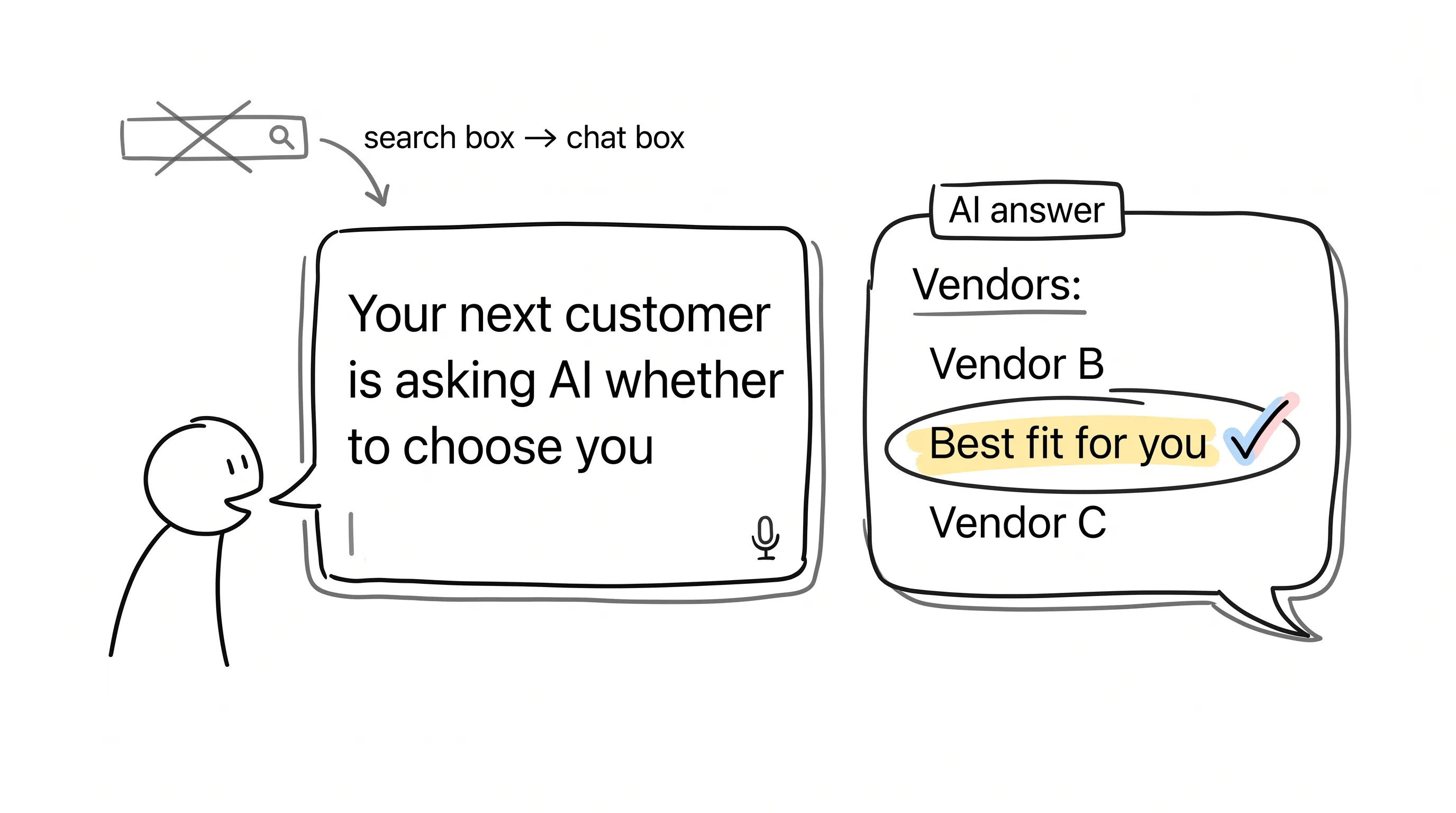
That day, he didn't talk about rankings. He said he'd lost a deal the month before, and when they sat down to review what went wrong, the client said something that cut him to the bone: "When we were evaluating vendors, we asked an AI assistant. Its recommended shortlist didn't include you."
The rankings were still there. The traffic was still there. The deal was gone.
On the way home, one thought kept circling in my head: the entry point of customer decisions has moved. From the search box to the chat box.
So I did one thing afterward: I combed through every AEO case study with real numbers that I could find. AEO — Answer Engine Optimization — is the business of getting AI to mention you, cite you, and recommend you in its answers.
Right now, the noise around this business is deafening. Agencies promise AI exposure, consultants sell citation strategies, tools hawk monitoring dashboards. But what do the real results actually look like?
In this piece, I'll walk you through every report card I found, exactly as it reads.
First, Let's Get Two Terms Straight
What is AEO? What is GEO? Plenty of people can't tell them apart. Honestly, you don't need to.
AEO fights for the "standard answer." The AI overview at the top of Google's search results, and answer-first engines like Perplexity — that's its turf.
GEO — Generative Engine Optimization — fights to be cited. Which content ChatGPT, Claude, Gemini, Copilot, and Grok draw on when they answer questions is what it governs.
Two faces of the same thing. Interest in the term GEO has jumped 315% over the past year, with an average of 4,400 searches a month. The buzz is loud.
But look at the teams actually getting results: almost none of them obsess over the vocabulary. They do both.
Jargon is for meetings. Results don't care.
Before You Read the Report Cards, Learn to Pick Them
This field has an awkward problem: stories everywhere, evidence scarce.
Why? Three reasons.
Too new. This wave of optimization only really got going in 2024 and 2025, so there hasn't been much time for anyone to show off results.
Hard to attribute. From "an AI mentioned you once" to "the customer paid," several steps sit in between, and tracking them is harder than traditional search. The good news: GA4 can now break out AI-channel traffic separately, which at least gives you something to hold on to.
The platforms won't give you a back door. Google at least hands you Search Console; the AI platforms hand you nothing. And the companies genuinely riding the wave tend to keep quiet about it. Keeping your head down while the money rolls in is instinct.
So I set three rules for myself, and only accepted cases that met them: a baseline number from before the work started, an observation window of at least 90 days, and a clear account of what was actually done.
One big trap deserves a special warning. AI platforms' user bases can grow 30% to 50% in a single quarter. If your traffic went up during that stretch, chances are the tide was rising — not necessarily your own doing.
Any spike without a control group gets a question mark first.
The Three Hardest Numbers
Start with the big ones. The three cases below carry the strongest evidence of everything I found.
First, a B2B tech company.
The content agency they hired, The Optimist, published the results: in 14 months, revenue from large-language-model referral channels grew 4,900%. Traffic grew 2,622%.
You read that right. Do the math: it's the equivalent of going from one to fifty.
How did they do it? You might not believe it: by creating their own data. While everyone else recycled industry reports, they organized their team to run original research, producing survey after survey and dataset after dataset that no one else had. When an AI needed to cite a statistic and traced it back to the source, all it found was them.
Proprietary data is a moat that can't be copied.
Second, the chemical giant Chemours. Chemicals is a field with extremely specialized content and a narrow audience — traditionally one of the hardest industries to market. Yet they pushed their AI citation rate on their target question set to 82% to 84%, and the sales pipeline brought in through AI-assisted discovery has topped $90 million.
The playbook sounds plain: bylined authors who are recognized experts in the industry, white papers that cite patents and peer-reviewed papers, and authoritative backlinks built up across industry publications. When an AI picks whom to cite, it thinks like an interviewer — it wants to know whether you've actually done the work.
Third, Mentimeter, the online presentation tool.
The agency Siege Media did one thing for them: it restructured the entire site's content into a shape that's easy to quote. The definition comes in the very first sentence, the data all sits in tables, the methods are laid out step by step. Then they planted Mentimeter into all kinds of listicles and comparison directories, because when AI generates recommendations, that's the content it loves to leaf through.
The result: in a single month, 124,000 visits and 3,400 conversions from ChatGPT.
Wild.
Let me do the math for you: 3,400 divided by 124,000 is a conversion rate of roughly 2.7%. That holds its own against traditional search — it's even better.
Has Traditional SEO's Foundation Collapsed?
No. Quite the opposite.
The agency iPullRank published a case study of a fintech platform: over 12 months, organic traffic up 52.6%, and conversion rate up 17x. Among the moves they made, restructuring content for AI came first.
Note one detail: content optimized to be quoted by AI also climbed in traditional search rankings.
There's also a telecom case, from the same agency: an average of 1.41 million AI-overview impressions a month, up 253% year over year. The post-mortem found that a large share of what the AI overviews cited were pages that already ranked high.
When AI copies homework, it copies the best students first.
The peripherals brand SteelSeries took a different route. Gaming headsets, keyboards, and mice — a space crowded with giants. The agency NoGood spent six months structuring product information so that AI could quote it accurately every time, paired with expert reviews and comparison content. Conversions from AI channels grew 3.2x.
For a smaller brand trying to squeeze onto AI's recommendation lists, that's the whole game: make your information easy to understand and easy to quote.
On the e-commerce side, here's a counterintuitive number: only about 4% of shopping-related questions trigger an AI overview, versus 65% to 70% for B2B technical questions.
Looks grim? Not so fast. Once AI does start recommending products, the users who arrive have extremely high purchase intent. iPullRank documented one large e-commerce platform: over 18 months, organic impressions up 175% year over year, and revenue attributed to organic search up $290 million.
When AI recommends products, it weighs two things above all: structured product specifications and genuine reviews. Whether your schema (structured-data labels that tell machines what your products are) is complete and your reviews are deep decides directly whether AI dares to recommend you.
One Question, Six AIs, Six Tempers
Don't assume that one optimization pass wins on every platform. These AIs have very different temperaments.
Google's AI Overview is loyal to what it already knows. It leans heavily on content that already ranks high; get your traditional SEO right, and you're halfway there with it.
ChatGPT judges your fundamentals. Training data shapes its basic impression of you; only after it opened up web access did new content have a way in.
Perplexity is the most transparent. It puts its sources out in the open — every citation is a real piece of exposure, and its click-through rate runs higher than the others'. It also cares a great deal about how fresh your content is.
Claude weighs provenance. Whoever has solid citations and careful analysis gets quoted. Among professionals and developers, its influence keeps growing.
Gemini stands on Google's index, so multimodal content like images and video carries more weight there. Copilot is rooted in enterprise office scenarios — the traffic from it is people in the middle of getting work done. Grok is plugged into the real-time feed of the X platform; for chasing breaking news, it's the sharpest.
Small Businesses Have Bigger Opportunities Than You'd Think
Everything so far has been big-company stories. Can small businesses play?
Here are the report cards of three small-business clients.
A restaurant called The Albert: 7,200 website visits and 520 reservation and inquiry forms. Every form is a person who might walk through the door.
A property management company, 444Social: the properties under its management reached full occupancy.
And a side-hustle platform, SideGigster: more than 2,000 leads in 90 days.
All three were served by the same local marketing agency, 97 Switch, for modest budgets. Lay out the public cases from the past year or so and the pattern is consistent: local businesses investing $1,000 to $3,000 a month see positive returns within 3 to 5 months.
Think about it. In the past, when a local merchant fought a big brand for exposure, they were fighting for ad slots — a fight they could never win. Now, inside an AI's answer, a big brand and you each get one line, in the same size font.
For the first time, small merchants stand in the same answer as the big brands.
Three Moves, Repeatedly Proven
Put all the cases side by side and three moves keep proving themselves. I've ordered them from the least investment to the most.
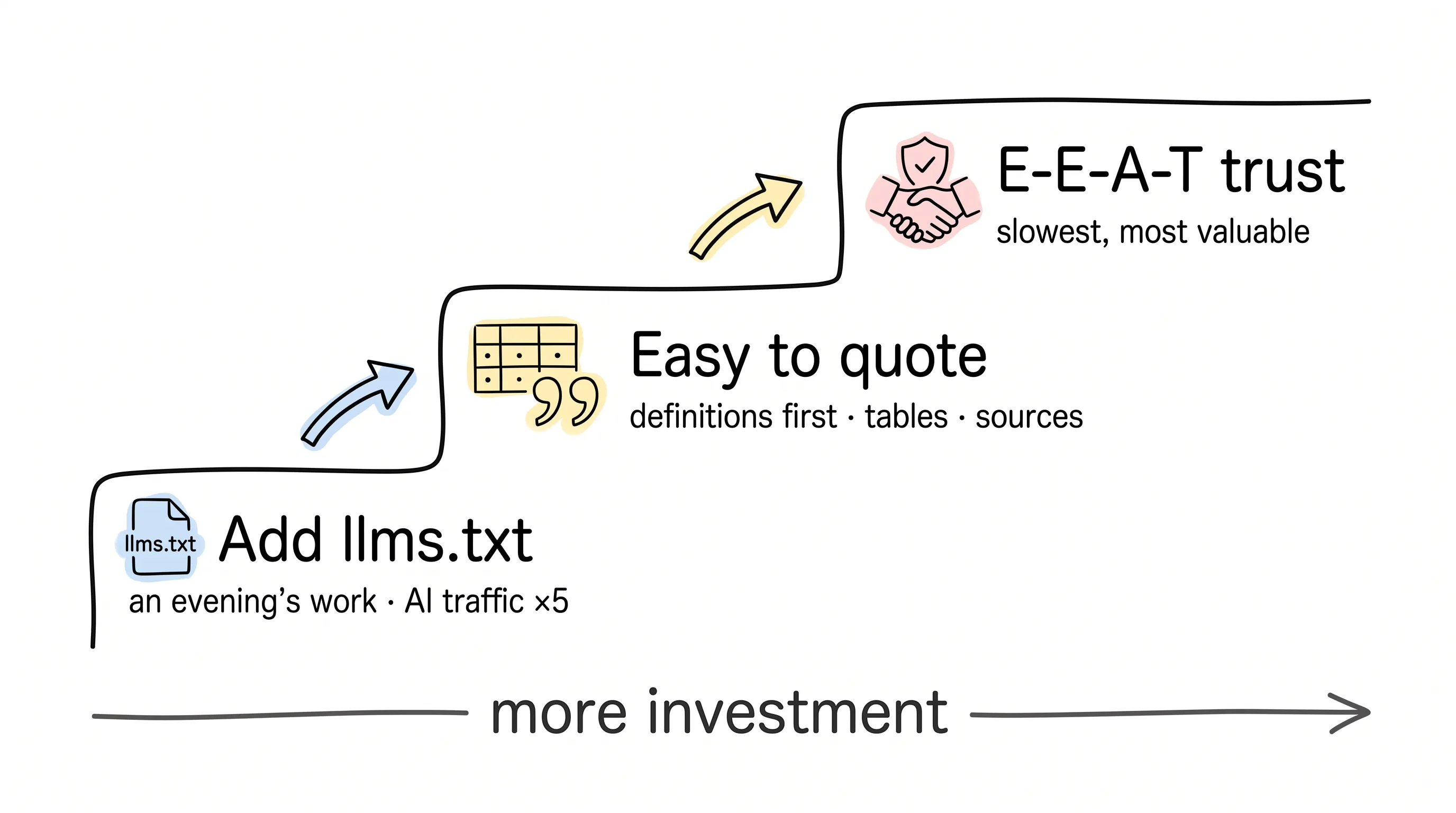
First, the cheapest: add an llms.txt file.
It works like a lobby directory for AI crawlers — similar to robots.txt, it sits in your domain's root directory and spells out which pages matter most and what each page covers. One company, The Concurate, saw its AI-channel traffic grow 5x after adding it. It's an evening's worth of work; get it done first and ask questions later.
Second, the most fundamental: make your content "easy to quote."
AI doesn't read your article from start to finish — it extracts. So the first sentence of every section should present the definition; don't bury data in paragraphs, put it in tables; note the source for every claim; one paragraph, one point. The Mentimeter case above was cashing in on this dividend the whole way.
Third, the slowest and the most valuable: build trust that holds.
In AI circles this is called E-E-A-T — Experience, Expertise, Authoritativeness, Trustworthiness. Chemours' citation rate above 82% rests on exactly this. None of it can be rushed, but once it takes root, no one can take it away from you.
Your Own Living Room vs. Someone Else's Dinner Table
One more distinction, especially useful in practice.
Optimization done on your own pages is called owned. Restructuring content, adding schema, publishing llms.txt, accumulating expert bylines — all of it counts.
Building presence on other people's turf is called earned. Answering questions on Reddit and Quora, getting into listicles and directories, letting third-party pages speak for you.
When do you use which move? It depends on the question type.
When users ask "How good is product X?", the AI will most likely come to your house for the answer. When users ask "What are the best X's?", the AI will go around everyone's dinner table to see how all of them mention you.
And the metric for this should shift from "share of voice" to "share of answer": across a batch of target questions, how likely your name is to show up in the AI's answer. Share of voice is you shouting; share of answer is others bringing you up.
Finally, the Full Ledger
How much do you invest, and how long until it pays off? Lay the public cases out flat, and the going rates look roughly like this.
B2B software: $5,000 to $15,000 a month, expected returns of 300% to 500%, break-even in 4 to 6 months. E-commerce: $3,000 to $10,000 a month, returns of 150% to 300%, 6 to 9 months. Local services: $1,000 to $3,000 a month, returns of 200% to 400%, 3 to 5 months. Professional services: $3,000 to $8,000 a month, returns of 250% to 400%, 5 to 7 months.
The rhythm is fairly consistent too: the first three months are groundwork, with barely any movement. Months four to six, citations begin and traffic trickles in. Months seven to nine, the compounding kicks in. Most projects taken seriously turn positive somewhere between months six and nine.
Don't get greedy with attribution. Use three methods together: check AI-channel conversions directly in your analytics tool; mark the users who had consulted an AI before converting; keep an eye on the lift in branded-search volume. Better to undercount than overcount.
It's a slow ledger, not a get-rich-quick story. But slow ledgers are compounding's best friends.
Back to That Old Friend
After that cup of tea, I pushed him to do three things: rewrite his core product pages so the definitions and specs could be quoted at a glance; run a small industry survey with his own hands, copying no one's data; and add that llms.txt to his website's root directory.
We spoke on the phone again last month. The numbers were nowhere near explosive, but he said something I still remember: a new client had shortlisted him again. That client said it was AI's recommendation.
Your next customer may, at this very moment, be asking AI whether to choose you.
I hope your name is in that answer.
Continue reading
Related articles

Cross-Border Business: Time to Upgrade Your AI Toolbox
A learn article explaining how AI tools help cross-border e-commerce sellers clear five hurdles: language, regulation, logistics, payments, and fraud. It outlines a five-compartment toolbox, a five-step adoption path, and metrics such as conversion rate and CLV, while cautioning against over-reliance on AI.

AI Is Taking Over the Dirty Work of Social Media Marketing, One Task at a Time
This learn article outlines four social media marketing tasks AI can handle — audience analytics, content drafting and design, ad targeting and creative testing, and spam moderation — and cautions that taste, judgment, and data security remain human responsibilities.

AI Is Already This Good — Why Is Your Social Media Marketing Still Pure Manpower?
An overview of 18 AI tools for social media marketing, organized into six categories covering audience research, content creation, scheduling, comment and DM handling, ad management, and visual production, plus notes on personalization, prediction, and emerging trends.