
Your Funnel Has Been Leaking All Along
Explains how AI reshapes the buyer journey from a linear funnel into a web of touchpoints, covering intent detection, real-time automation, and predictive service, with four starting steps: connect data, contextual content, integrated tools, and separate playbooks for new and returning customers.
A few nights ago, I was lying in bed scrolling on my phone, and I bought a charger.
Here's how it went. I came across a review in a short-video feed, couldn't help myself, and saved it. The next day at lunch, I searched "which charging cable is fastest," dug through the review sections on shopping platforms, and made a point of reading a few of the negative ones. At noon on day three, a limited-time deal notification arrived. I glanced at the price and tapped "Buy Now."
Three days. Four or five platforms. Seven or eight pages.
Notice something? Through that entire process, I never exchanged a single word with a "salesperson."
And yet there's no denying it: I was sold to — successfully.
Sold by whom? The more I thought about it, the stranger it felt. Then it finally clicked: I was sold by an AI system. What time that push notification went out, how that "recommended for you" page got ranked — behind every bit of it, a machine was making the calls.
And I'm not the only one. Over the past few years, AI has been quietly rewriting the entire road a consumer travels from "hearing of you" to "buying from you." The rewrite has been quiet, but it has been thorough.
What exactly did it change? And what should you do about it? Let me take it one piece at a time.
The Funnel: Why It Can No Longer Contain Today's Consumer
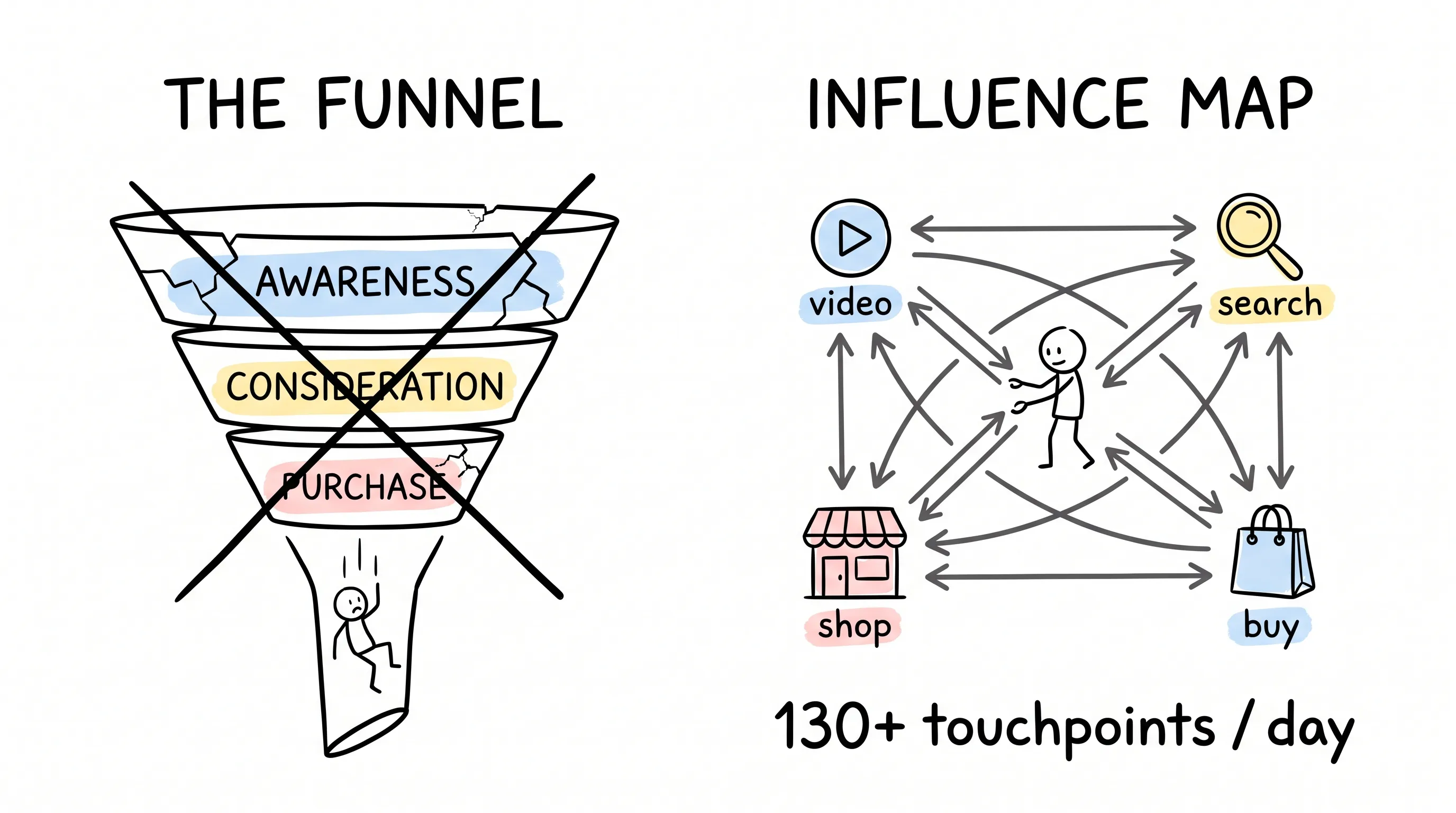
What is a funnel? It's that diagram you've probably drawn a hundred times: "awareness" at the top, "consideration" in the middle, "purchase" at the bottom. People enter at the top and drip down, layer by layer.
The model rests on one assumption: that people move in order.
People today don't move in order.
Boston Consulting Group (BCG) and Google ran a joint study finding that today's consumer is, at almost every moment, soaking in four states at once: watching videos, searching for things, browsing stores, and buying. All four ping-pong back and forth, with no fixed sequence.
Researchers have actually run the numbers: an ordinary person bumps into more than 130 touchpoints on their phone in a single day.
More than 130 touchpoints. How many boxes are on your funnel diagram?
So BCG simply gave this road a new name: the "influence map." A map is a web — points scattered here and there, lines connecting them. A funnel is a straight tube — people can only fall from top to bottom.
Consumers haven't gotten lost. Your map has expired.
Behavior Changed. The Systems Didn't.
Picture this.
Someone scrolls past a new pair of earbuds on a social platform. Thinks they're nice. Doesn't buy. A day later, at lunch break, they're sprawled on the couch combing through reviews on a shopping site. Half a day after that, a push notification lands, and they place the order before lunch.
Along this entire journey, what did your analytics tools see?
Just the last line: order completed.
The user walked this whole road. Your system just doesn't contain it.
How did buyers get this impatient? Frankly, they were spoiled — by Amazon and Netflix. Tap for recommendations, ask and get an answer — instant, personalized response became the default setup long ago. The big players answer in seconds with AI. A smaller brand that's half a beat slower watches users turn and walk.
Yes — turn and walk.
What's more, today's buyer has armed themselves to the teeth before ever pressing "contact sales": read the reviews, watched unboxing videos, combed the forums, asked friends — some have even taken a lap through a competitor's website. It's called self-education. By the time they actually call you, the homework is long done. What they want isn't a tutorial. It's a quote.
The first phone call lands at the end of the journey. The old funnel still thinks it's at the top.
Worse still, what actually decides the sale is often not one of the big stages, but the micro-moments scattered along the way. What's a micro-moment? Someone searches "fastest charging cable," then taps "Buy" immediately after — that one second is it. Too small, too fragmented; traditional analytics either blends it into the traffic or misses it entirely.
What you can't see, you can't catch.
AI Is Doing What Humans Can't
So what is AI actually doing along this road?
One thing, plainly: connecting the dots. It takes the fragments scattered across dozens of platforms and several screens and assembles them into one complete picture.
Broken down, it does three things.
It reads intent. How many seconds someone watches a product video, how long they linger on the pricing page, which review they open — none of these micro-actions looks like much on its own, but AI can string them together into a buying signal. It keeps watch over everything no human eye could track.
It reacts in real time. The moment you abandon your cart, within seconds an on-site message and an email carrying a discount code are on their way — no human hands anywhere in the loop. Response time has gone from "days" to "seconds."
It predicts the next step. This is its most ruthless trick. It doesn't just return your serve — it plays fortune-teller: predicting who is about to buy, which customers are about to churn, then adjusting the pitch and the offer ahead of time, before you ever open your mouth.
You have to hand it to it. No human team, however clever, can stay awake 24/7, eyes glued to every micro-move on millions of screens.
AI can. It's doing exactly that right now.
Every Leg of the Journey Has an Invisible Hand
Zoom the lens in, and from discovery to the deal, AI's fingerprints are on every stretch.
Farthest upstream: ad buying. Close to a third of internet users run ad blockers — indiscriminate blasting no longer works. AI's approach is to speak only to the people "who might actually care." It saves money, and it doesn't get on anyone's nerves.
In the middle: answering questions. That little window that pops up while you browse a website, answering your questions and recommending content. It's a machine. But you might not be able to tell.
At the bottom: win-back. It senses you hesitating on the checkout page and immediately triggers a round of retention moves.
In all three stretches, AI is never the lead actor — it's the one who delivers the star, right on cue.
Three Quiet Changes
Some changes happen backstage — and they are very quiet.
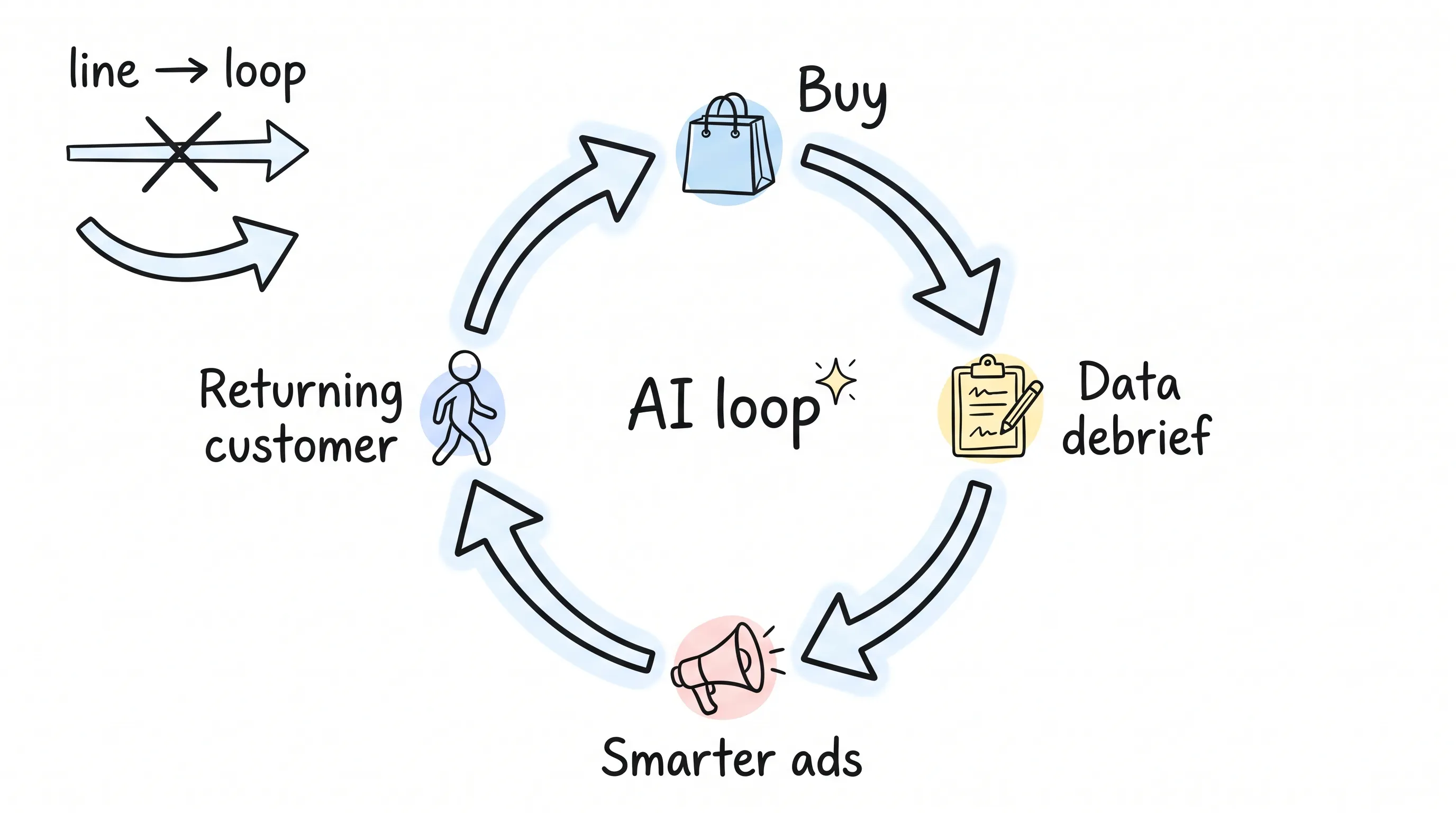
First, the journey has turned from a line into a loop. The sale is not the finish line; it's the starting line of the next round. The moment you buy, the system runs an instant debrief: where this person came from, what content they saw — then feeds the answers into the next round of ad buying. By the time a returning customer comes back, the new ads they see have already grown out of their last purchase.
Second, every action is being booked into the ledger. A single like, the hour an email gets opened — all of it gets recorded and analyzed. Which kinds of content keep people around, which channel genuinely drives sales: the algorithm keeps score. Marketing has gone from "the review after the campaign ends" to a dashboard that pulses in real time.
Third, customer service has gone from taking calls to reading minds. Detect frustration in a chat log, and it's handed to a human within seconds; questions about a new feature suddenly multiply, and the help widget ships early — it doesn't wait for users to get stuck. It also reads the history: which patterns tend to precede a subscription cancellation — and when it spots one forming, it offers a graceful off-ramp in advance.
Service used to be "you ask, we answer." Now it's "we answer before you ask."
Small Shops, Don't Panic — This Problem Has an Answer
At this point you might say: these are all toys for the big players. What do they have to do with my little shop?
They do — and closer to home than you'd think.
Surveys show that roughly 75% of small and midsize businesses are already experimenting with AI; among the fast-growing SMBs, that figure is 83%. A Salesforce survey also found that 86% of SMB leaders use AI-powered reporting to fuel their expansion. In another survey, 51% of SMBs have already gotten started, and 25% use it every single day.
And the moves they use are remarkably plain:
Gyms and hair salons hang an AI bot on their webpage that takes bookings and answers questions 24 hours a day. Even the customer who shows up at midnight gets served. Small retailers use the AI built into their email tools to segment customers by purchase history and pick send times — like hiring a marketing team that works for free. Small SaaS teams use the AI inside their CRM to flag which trial users are close to converting and which are close to churning, then hand them the right email at the right moment.
One money-saving tip: don't rush to buy new tools. Dig through the email system and the CRM you already use — many come with AI features built in. Start with one thing, like email segmentation. If it works, add more.
Ready to Act? Start With These Four
First, connect your data. AI can only connect dots when the data lives in the same pool. CRM, email, ads, analytics — feed them into one customer profile, or put in a customer data platform (CDP). Otherwise you get blind spots everywhere: an email gets opened, but it can't be tied to the website visit that followed, so you never learn which piece of content brought that person in. There's a simple yardstick for whether the connection work is done right: can AI draw you one end-to-end picture? Give each user a single ID across systems, then wire in the offline store interactions too — only then does the loop close. Once it's connected, watch four numbers first: conversion rate by channel, Net Promoter Score (NPS), churn rate, and customer lifetime value (CLV). These four numbers are the thermometer of your AI system's health.
Second, content wants context, not volume. What AI rewards is "the right words said to the right people." Sending more is useless. The winter-coat promo email goes only to people who have browsed or bought; when searches for "how to fix a cracked phone screen" suddenly multiply, you publish that piece immediately. Blast indiscriminately, and the more you send, the more you waste.
Third, make your tools talk to each other instead of shouting on their own. A user abandons their cart; the email sequence starts up automatically while the on-site bot lights up at the same time — that's tools triggering each other, and it takes integration at the API level. One number makes the point: among growing companies, 66% have a connected tech stack; among stalled ones, only 32%. A twofold gap. And don't let automation become a wind-up machine you start and forget. Have AI watch the results — if an automated email stops pulling its weight, replace it. A tool stack that responds is intelligent; one that only broadcasts is just a louder megaphone.
Fourth, new and returning customers get two different playbooks. New visitors need "why choose you" — show them reasons, show them content; returning customers want exclusive offers and restock alerts. The beauty of it: AI serves both crowds at once — and never complains about the double shift.
Some Are Already Off and Running
Finally, let's look at a few other people's numbers.
On the e-commerce side, Amazon's recommendation engine, all by itself, contributes roughly 35% of its sales. You only came to buy a phone case, yet it knows you need a pair of headphones. What does 35% mean? Nearly one order in three comes from something the machine "thought up."
On the coffee side, Starbucks built a system called Deep Brew that mines the data from its loyalty app: when it's cold, push hot lattes; and combining weather with nearby events, it predicts the next day's store traffic. The payoff: in the US market, three in ten orders now come in by mobile.
That is seriously impressive.
SaaS companies use AI to watch how users behave inside the software: a key feature goes unused for a few days and the account gets flagged "high risk," automatically triggering a check-in and training content. Clinics and restaurants use bots to take bookings and answer questions, keeping human hands for the places that truly need a human. Khan Academy's Khanmigo gives every student a one-on-one tutor — and, on the side, helps teachers draft lesson plans and quizzes. In healthcare, AI bots run symptom Q&A, medication reminders, and triage suggestions; the doctor clocks out, and it's still on duty. Over in real estate, Zillow's Zestimate goes further still: machine learning digests public records and transaction data, and prices every home in real time; once its data tooling moved to AWS, valuations went from being computed by the day to being computed by the second.
Every industry has a different answer. But it's the same exam question.
A Final Word
Back to that charger from the beginning.
Across those three days, I thought I was browsing freely. In fact, at every step, a machine was there to receive me. Behind the counter there was no clerk — only a system I couldn't see.
So stop treating the funnel as a map. Your customers don't line up, and they don't descend layer by layer — they bounce among more than 130 touchpoints. Whoever connects the fragments into a line first is the first to get the map.
The customer journey has no last stop — only the next loop.
Here's to seeing your own map — soon.
Continue reading
Related articles

Cross-Border Business: Time to Upgrade Your AI Toolbox
A learn article explaining how AI tools help cross-border e-commerce sellers clear five hurdles: language, regulation, logistics, payments, and fraud. It outlines a five-compartment toolbox, a five-step adoption path, and metrics such as conversion rate and CLV, while cautioning against over-reliance on AI.

AI Is Taking Over the Dirty Work of Social Media Marketing, One Task at a Time
This learn article outlines four social media marketing tasks AI can handle — audience analytics, content drafting and design, ad targeting and creative testing, and spam moderation — and cautions that taste, judgment, and data security remain human responsibilities.

AI Is Already This Good — Why Is Your Social Media Marketing Still Pure Manpower?
An overview of 18 AI tools for social media marketing, organized into six categories covering audience research, content creation, scheduling, comment and DM handling, ad management, and visual production, plus notes on personalization, prediction, and emerging trends.