
Your Employees Are Already Using AI. Why Isn't Your Organization Ready?
A learn article arguing that employees often adopt AI faster than their organizations, and walking through six readiness questions covering strategy, people, data, governance, technology, and workflows.
A while back, a friend of mine in consumer electronics took me out to dinner. The moment the conversation turned to his company's AI projects, his face fell.
Last year they kicked things off: hired a consulting firm, launched a flagship "AI-Empower-the-Business" program, seven-figure budget. At the six-month retrospective: two pilots had died, and the rest were gathering dust on the shelf.
And here's the strange part.
His company's employees had long since been using AI to the hilt. Designers producing visuals with AI, ops writing their weekly reports with it, sales using it to organize client call recordings, meeting minutes generating themselves. Nobody approved it. Nobody taught it. They just figured it out.
One company, two worlds. Up top, the failed projects; down below, a thriving crowd of self-starters running their own shows.
People are already off and running. The organization is the one falling behind.
First, a Few Uncomfortable Numbers
I'm not the only one sensing this. Two numbers from SmarterX's 2026 State of AI Report, published this year, are downright telling when you put them side by side.
More than five in ten people have moved past the experimentation stage and made AI part of their daily routine. Yet fewer than three in ten organizations say they have a real AI roadmap.
Sit with that gap for a moment.
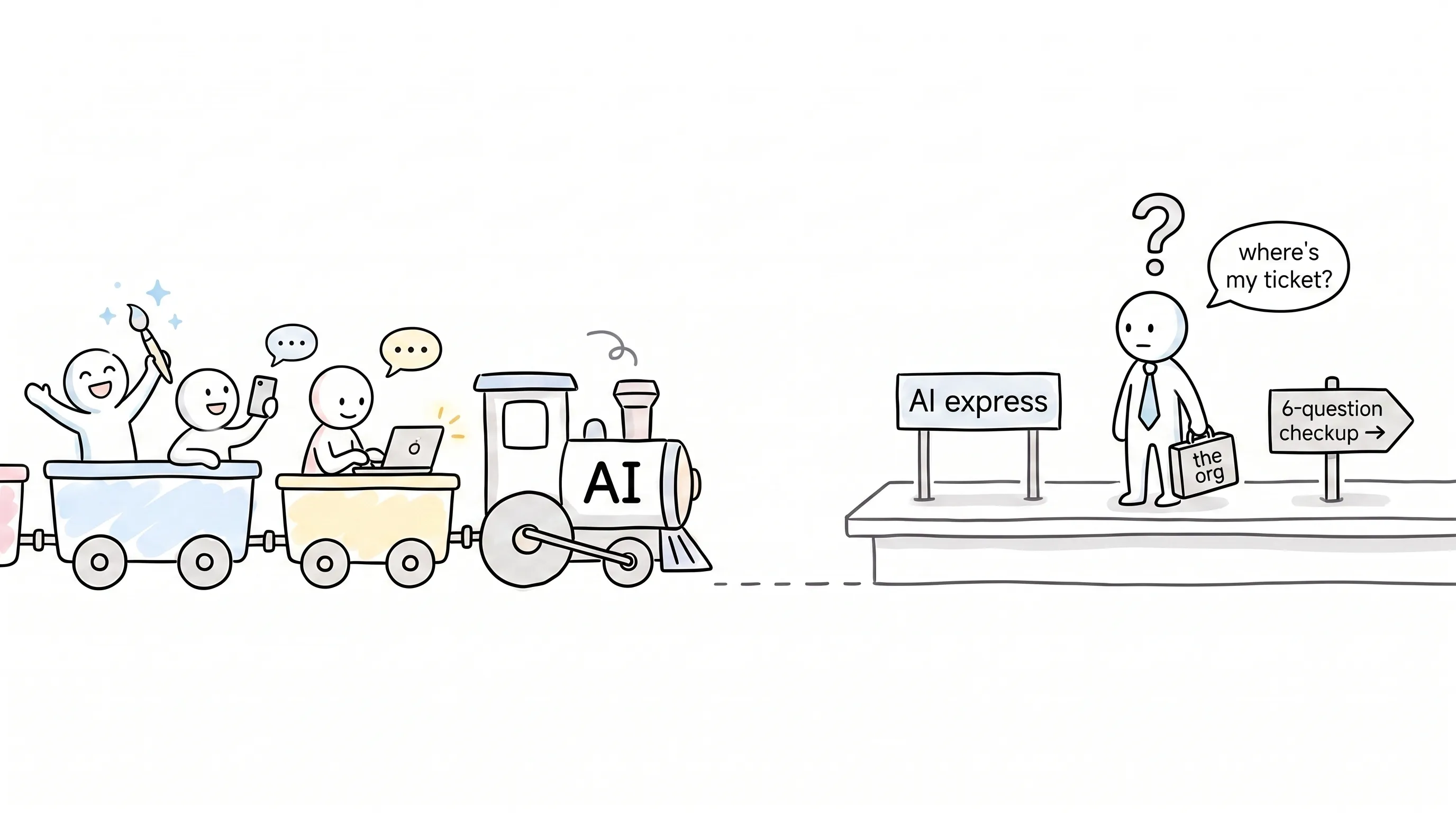
Employees have boarded the train.
The organization is still on the platform, looking for its ticket.
So the next time AI struggles to land in your company, stop blaming "employee resistance to change." That excuse held up three years ago; today it barely holds at all. People were using it long ago. What's actually stuck is the organization itself — it isn't ready.
So what do you do?
My advice: don't rush to launch programs or buy tools. Before you operate on the organization, give it a checkup.
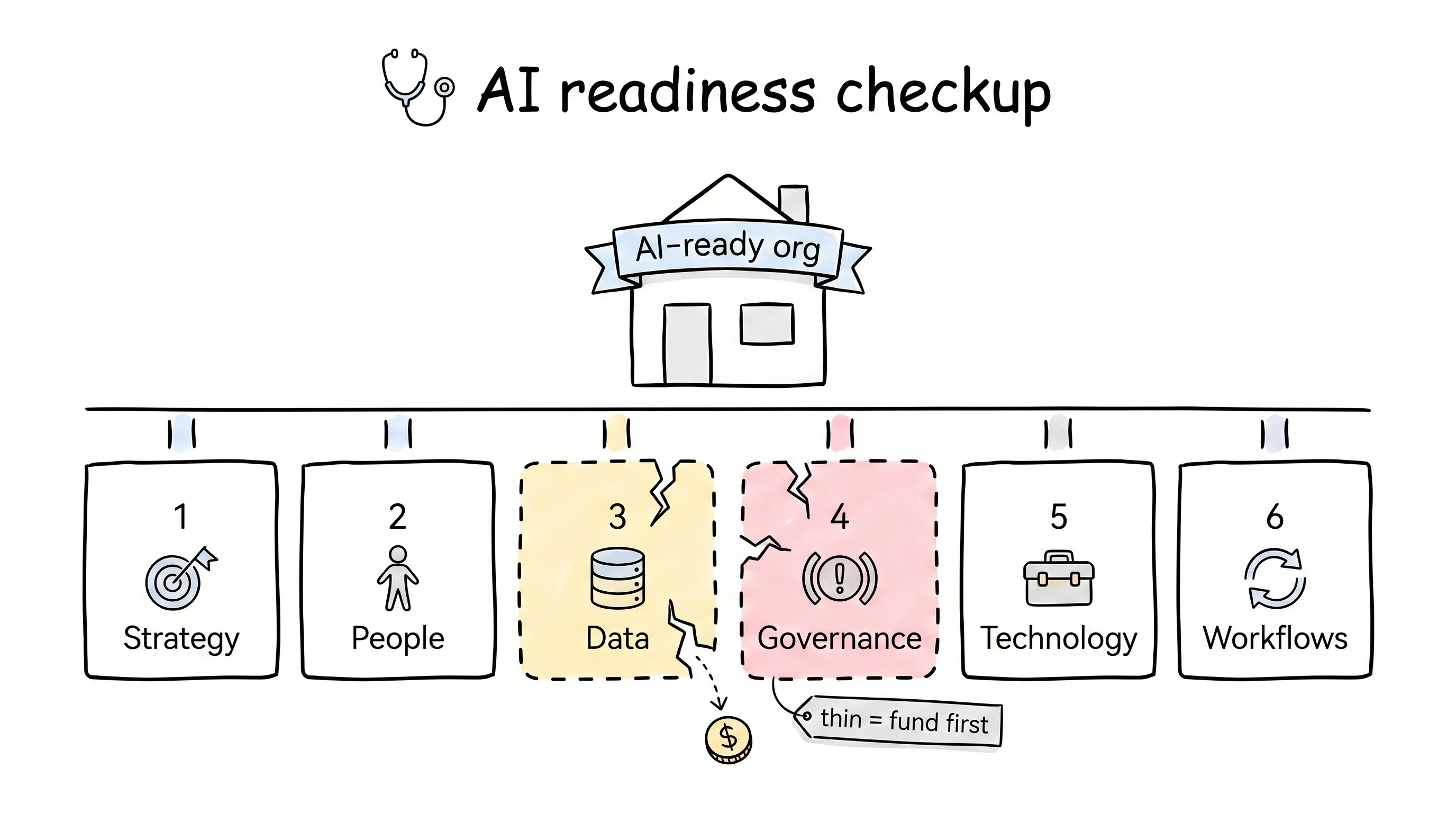
Six questions, mapped to six foundations: strategy, people, data, governance, technology, and workflows. Pull up this list right now and walk through it one block at a time. When you're done, you'll see at a glance which foundations are anemic.
Question 1: What Business Problem Is AI Actually Solving for You?
Plenty of companies' AI strategies boil down to a single slogan: "Embrace AI, boost efficiency everywhere."
That's not a strategy. That's a wish.
What does a real AI strategy look like? At minimum, you can articulate three things: which specific business problems AI will solve for you; how those solutions connect to the company's business goals; and which opportunities are worth the most, so you know which to strike first.
And one more thing, the easiest to miss: think clearly about what you should NOT use AI for.
Success criteria need to be defined up front, too. What does "working" mean? How many hours saved? How much lift in conversion? Write it down in black and white. If you can't, the project will probably live out its days in the status-update deck.
Question 2: Are Your Team's Skills Keeping Up with the Tools?
Tools don't create value on their own. People who know how to use them do.
For a team to use AI well, a few things are non-negotiable.
Baseline literacy: the team has to know what AI can do and what it can't. Treat it neither as magic nor as a toy.
What about certainty? Employees need to know which tools are company-approved, and where the lines are when doing work with AI. Leave it unsaid, and everyone improvises on their own — when someone steps in a hole, whose fault is it?
Expectation management can't be dodged either. Which roles will change, and how the daily work will change, needs to be said in advance. When people can't see clearly, their first reaction is to defend, not to embrace.
And finally, champions. In every key function, you need one or two early adopters who figure it out for themselves first, then turn around and pull others along.
Ask yourself: of these four, which one is your team missing?
Question 3: Can Your Data Actually Feed AI?
AI is the stove; data is the fuel. If the fuel is wet, it doesn't matter how hot the fire burns.
Start with one question: where is your data scattered? Is it accurate? Can it be used as-is?
More critical still is the third item: employees must know exactly which data is sensitive, confidential, or proprietary. Otherwise, the day a client list ends up inside a public large language model, it will be too late for tears.
And there's one more account to settle: how will you prove AI is making you money?
Before launch, you need a baseline. After launch, KPIs. A quarter or two in, the ROI has to be computable. Without this measuring stick, every claim of "significant results" is just a feeling. And feelings won't fund next year's budget.
Question 4: Have You Installed the Brakes?
Mention governance and a lot of people frown: here they come to police us again.
Quite the opposite. Governance isn't about stopping people from using AI — it's about letting them use AI with confidence.
What do guardrails look like? A clear policy that spells out what AI may and may not touch; where the boundaries of confidential information and personal privacy sit; what the hard legal and compliance requirements are; which company knowledge AI systems may access, and where that knowledge lives.
The last one is the easiest to forget: when something goes wrong, who's watching?
Every organization needs a named, identifiable accountable owner. Guardrails without an accountable owner are as good as none at all.
Question 5: Can What You Already Own Support the Ambition?
Hear "AI readiness" and many executives' first reaction is: buy a few more tools.
Hold on.
AI readiness does not mean adding to the cart. The right order is to take inventory first: what AI capabilities are already hiding inside your current systems? Where are the real gaps? If you do need a new platform, what criteria will you evaluate it against? What security process does a new tool go through before onboarding?
A small example. Gemini, ChatGPT, Claude, NotebookLM — each on its own is a part; put together, they become a machine. Plenty of non-technical teams now design their own prompts and rig up a lightweight workflow that eliminates an entire repetitive step in one sweep. That kind of trial and error runs on what you already have — it doesn't necessarily need new budget.
Take inventory first. Open the shopping cart second.
Question 6: Are You Rethinking the Work, or Just Speeding Up the Old Process?
Of the six questions, this one carries the most weight.
Many teams' use of AI amounts to automating the most grinding step in an existing process: copy gets written faster, images get made faster. And then? The process is still the same process — just a little faster.
The genuinely valuable opportunity hides in the other direction. Use AI as the knife to rethink the work itself: does this step still need to exist? Could processes A and B be merged into one? The plays you never dared to imagine because you didn't have the headcount — can you try them now?
Don't go big all at once. Pick the two or three workflows with the biggest business impact, pilot them on a small scale, and roll them out once they work. And bring your people along: when a process changes, tell whoever's daily routine will change ahead of time — and train them ahead of time, too.
Once the Checkup Is Done, You'll Know Where the Money Should Go
Back to that friend from the beginning.
How did they break through in the end? The boss killed the big flagship program, called a small meeting, and walked through the six questions one by one. The two thinnest boards: first, customer data scattered across five systems with definitions that never matched up; second, a blank page where the governance policy should be — your people were out there running completely exposed.
Six months later, their first AI roadmap was built to repair exactly those two things. They bought no new tools.
So there you have it: AI readiness isn't about who buys the most tools. It's about how solid your six foundations are.
Wherever a foundation is thin, that's where the money goes. Fill in one block, and AI can finally stop being the employees' secret weapon and become the organization's everyday capability.
Here's to your organization soon outrunning its own employees.
Continue reading
Related articles

Cross-Border Business: Time to Upgrade Your AI Toolbox
A learn article explaining how AI tools help cross-border e-commerce sellers clear five hurdles: language, regulation, logistics, payments, and fraud. It outlines a five-compartment toolbox, a five-step adoption path, and metrics such as conversion rate and CLV, while cautioning against over-reliance on AI.

AI Is Taking Over the Dirty Work of Social Media Marketing, One Task at a Time
This learn article outlines four social media marketing tasks AI can handle — audience analytics, content drafting and design, ad targeting and creative testing, and spam moderation — and cautions that taste, judgment, and data security remain human responsibilities.

AI Is Already This Good — Why Is Your Social Media Marketing Still Pure Manpower?
An overview of 18 AI tools for social media marketing, organized into six categories covering audience research, content creation, scheduling, comment and DM handling, ad management, and visual production, plus notes on personalization, prediction, and emerging trends.