
Your Customers Stopped Searching. Now They Just Ask.
A learn article explaining how buyers now ask AI assistants instead of searching, distinguishing answer engines, on-site AI search, and AEO tools. It compares examples such as HubSpot AEO, ChatGPT, Perplexity, Algolia, and Coveo, and lists five criteria for evaluating AI search tools.
A while back, a friend of mine who runs an enterprise services business told me something that genuinely caught me off guard.
One of the big clients his company had just signed asked them: why don't you show up in ChatGPT?
My friend was baffled. What does that mean? We rank really well on Google, and our website traffic is solid.
The client explained: before making the purchase decision, I asked ChatGPT about each of the shortlisted vendors, one by one. Who got mentioned and who didn't — that gave me my list. You're not on it.
Oh no.
My first reaction, when I heard this, was: it's over. The way customers do their research has completely changed.
How did buyers use to do their homework? Open a search engine, type in keywords, click blue link after blue link, dig through a dozen-plus pages, and piece the answer together themselves.
And now? They just ask.
They ask ChatGPT, ask Perplexity, ask Gemini. They want one answer, not ten web pages.
For those of us in marketing, this shift pulls the rug out from under everything. Because for the past decade-plus, our entire playbook has rested on one assumption: customers will search, customers will click, customers will come to my website.
Customers still search — but they don't necessarily click, and they don't necessarily come.
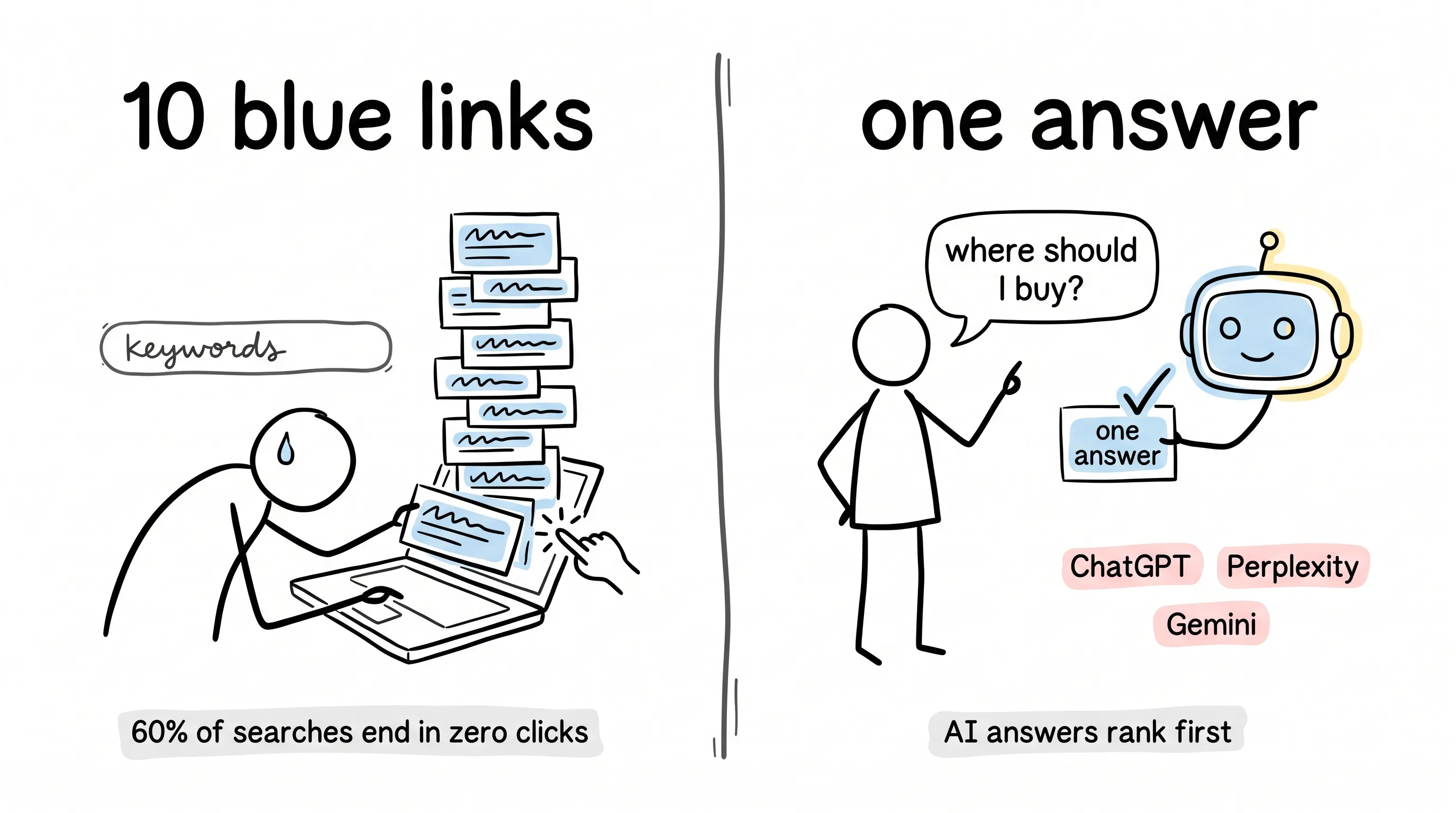
The question has shifted from "What's my ranking?" to "Does the AI mention me at all?"
What Exactly Counts as an AI Search Tool?
Don't panic yet. To respond to this, you first need to get the concepts straight. What is an AI search tool, exactly?
Put simply, it's software that uses artificial intelligence to find information, organize it, and answer questions for you. But the term is a big basket holding three completely different things. Lots of people use the labels interchangeably, and that's a big mistake. Because three kinds of tools serve three kinds of people doing three kinds of jobs — pick the wrong one and your money is wasted.
Let me break it down.
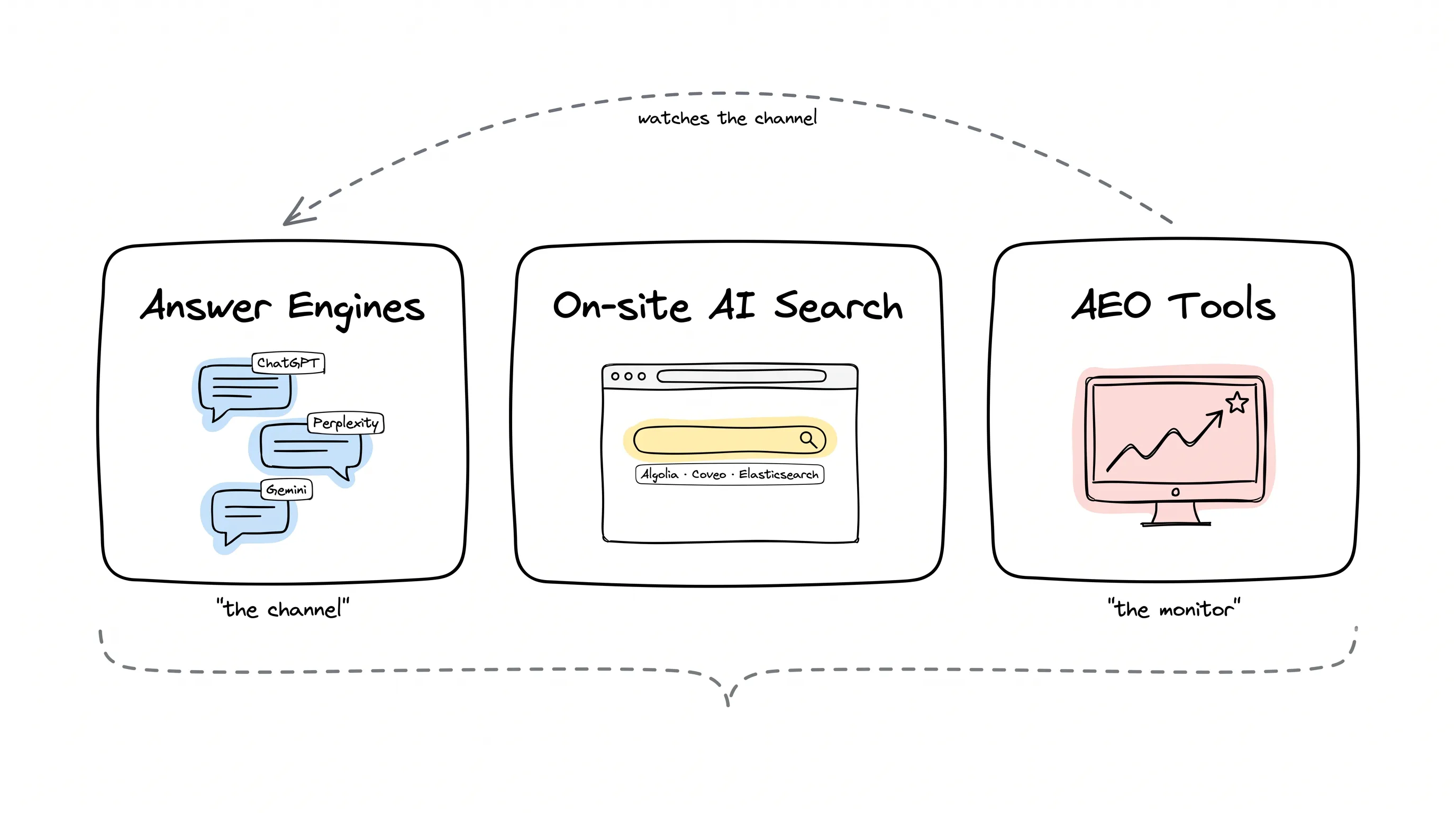
The first kind: answer engines.
ChatGPT, Perplexity, and Gemini all fall into this category. You ask a question in plain language, it reads through piles of material, then hands you the one answer it thinks is best. Some cite their sources, some don't. Some are connected to the live web, some rely only on older data from training.
The goal: give you an answer, not a pile of web pages for you to sift through yourself.
The second kind: on-site AI search.
Ever had this experience? You're browsing an e-commerce site looking for something specific, you type into that search box at the top, and it actually understands plain language — even guesses what you want to buy.
That search box is on-site AI search. It lives on a company's own website, app, or internal knowledge base, and helps visitors find what they need without leaving the page. Algolia, Coveo, and Elasticsearch are all playing in this space.
The third kind: AEO tools.
AEO stands for Answer Engine Optimization. These are tools built specifically for us marketers: they track whether your brand shows up in AI answers, how many times, whether you look strong or weak against competitors, where you fall short, and how to fix it.
Here's a way to think about it: answer engines are the channel; AEO tools are the monitor for that channel.
Why does the distinction matter so much? Because the most common mistake marketers make is thinking "I use ChatGPT, so I'm doing AI search." No. You're just a user. Whether your brand appears in ChatGPT's answers isn't up to you — you need the third kind of tool to tell you.
Your Customer's Homework Is Done Before You Ever Show Up
OK, concepts cleared up. Back to my friend's client.
He's not an outlier. Later I went digging through the data myself, and what I found sent a chill down my spine.
Forrester ran a survey: 94% of B2B buyers used AI in a recent purchase process. Among those using AI, 55% used it to compare vendors, 54% to research products, and 47% to write internal approval documents.
Note that all of this happens before meeting a single salesperson.
In other words, by the time a buyer fills out your demo request form or replies to your sales call, their homework is long done. The shortlist is drawn up, the candidates filtered, the internal pitch even finished. The "inquiry" you receive is often not the starting line — it's the last stop before the finish.
That's B2B. What about B2C?
McKinsey's research says roughly half of consumers — every age bracket included, older generations too — are already using AI search to make purchase decisions.
Adobe Digital Insights found that during the 2025 holiday shopping season, 56% of US consumers used generative AI, up 45% from the year before.
Even Grandma and Grandpa are asking AI what to buy.
There's one detail in the data that made me restless: in Forrester's survey, AI answer engines now rank first among the information sources buyers use for research.
First place. Ahead of whom? Ahead of vendor websites, ahead of sales reps, ahead of product experts.
The salesperson your customers trust most right now might be an AI.
Bain & Company ran a different calculation: 60% of searches now end in zero clicks. People search, read the answer, and leave — without clicking a single link. AI search is the biggest driver of this trend.
If your brand isn't in the AI's answers, your brand isn't in the buyer's field of view.
How to Choose Among the Three Types of Tools
Enough theory — on to the tools. But first, one principle: choose based on the job you need done, not on what's trending.
The same tool is a powerhouse for Company A and just for show at Company B. Happens all the time. Here's a walk-through for four typical needs, one by one.
Want to Know Your Brand's Visibility in AI: Look at AEO Tools
This is the bread-and-butter need for marketers. Consumers use answer engines, so we need to know what our brand looks like inside them.
For this category, I'll use HubSpot AEO as the example, because its approach is fairly representative: it tracks how your brand appears in ChatGPT, Perplexity, and Gemini, and also keeps an eye on newer players like Google's AI search features.
What's the biggest difference between it and standalone AEO tools (such as RankPrompt)? It uses real customer data from your CRM to predict what questions your buyers are most likely to type into AI.
Think about what that means.
Typical AEO tools guess prompts from industry-generic keywords — they're guessing what "people in general" will ask. This one guesses what your customers will ask. Different starting point, different level of accuracy in the conclusions.
And the results? HubSpot itself published a number: customers who used the AEO beta and treated answer engines as a priority channel saw referral traffic from AI grow 20%. Over the same period, their overall organic traffic fell 27%.
One up, one down. The baton handoff between old and new channels is happening right between those two numbers.
Pricing: included with Marketing Hub Pro and Enterprise; standalone it's $50 per month. If you're unsure about committing, start with HubSpot's free AI Search Grader — a one-time snapshot of where your brand stands in AI search, a zero-cost look at the baseline.
Want an All-Purpose Research Assistant: ChatGPT
If what you want is a day-to-day research companion — looking things up, competitive analysis, brainstorming topics, quickly synthesizing a pile of information — ChatGPT is still the most widespread choice.
How widespread? In HubSpot's survey, 88% of marketers had already used it at work. Second place, Gemini, came in at 52%. A lead of 36 percentage points — a runaway.
OpenAI's own numbers: ChatGPT processes more than 2.5 billion prompts a day.
Bain & Company research found 68% of LLM users rely on these platforms to gather, organize, and summarize information; 42% ask them directly "what should I buy?"
Look at that 42%, then think back to the 60% zero-click figure above. The two curves line up. AI isn't just helping people look things up — it's making consumption decisions on their behalf.
The free tier is enough to start; the paid tier is $20 a month. One more thing: HubSpot has a deep research connector for ChatGPT that pipes in customer data from your CRM, so the AI's analysis runs right up against your own customers. That combination is interesting.
When Every Answer Needs a Source: Perplexity
ChatGPT is powerful, but it has a chronic issue: it gives you answers, not always sources. Anyone doing serious research never quite feels at ease.
Perplexity grew out of exactly that pain point.
On the surface it looks a lot like ChatGPT. But it was designed from the ground up for "real-time, sourced": every single answer comes with inline citations. Sources aren't a free extra here — they're a first-class citizen of the product.
B2B buyers especially love it, and especially for in-depth vendor evaluation. Because evaluation needs evidence: hearing conclusions isn't enough, you have to be able to click through and verify the source.
Perplexity's CEO Aravind Srinivas revealed at Bloomberg's Tech Summit that in May 2025 alone it processed 780 million queries, with month-over-month growth exceeding 20%.
So is it accurate? Columbia Journalism Review tested citation accuracy across 8 AI search tools. Perplexity had the lowest error rate: 37%.
Thirty-seven percent — honestly, that's not low. More than one in three wrong.
But this is exactly the thing I most want to flag for you: every AI answer engine today makes mistakes; Perplexity is just the one that errs the least. It's the most reliable member of an unreliable bunch, not an infallible god.
So for anything an AI tells you: verify independently, and don't cut corners on a single item.
Want to Stop On-Site Visitors from Leaking Away: Algolia or Coveo
Third scenario: your problem isn't outside — it's inside. Visitors come to your site, can't find what they're looking for, and leave. Or your employees can't dig up the documents they need in your internal knowledge pile.
What you need here is on-site search, not an answer engine.
Two representatives. Algolia, whose calling cards are speed and developer flexibility — heavily used by e-commerce and SaaS sites, and recently expanding into generative AI with NeuralSearch and Ask AI. Coveo, which specializes in enterprise-grade, complex knowledge bases, with native integrations for Salesforce and SAP, plus personalized recommendations in customer-facing portals.
How to pick? A simple heuristic: strong technical team, e-commerce-oriented — look at Algolia. Company runs on Salesforce or SAP, knowledge base large and messy — look at Coveo; the custom development those native connectors spare you is not small change.
Both are quote-based on pricing; Algolia offers a free tier to start.
The Five Things I Watch When Picking a Tool
The tool list is done. But sooner or later you'll face another problem: this market is overwhelming, new tools pop up every month, and the feature lists all read almost identically.
Judge by feature lists alone, and you'll be choosing blind.
My own habit is to watch five things:
One: how transparent are the sources? Which pages an answer engine pulled its material from, which domains an AEO tool counts as cited — can you actually see this data? If you can't see the sources, you can't judge credibility, and you can't audit privacy risk.
Two: how high is the error rate — and are you mentally prepared for it? As mentioned above, Columbia tested this: AI answer engines deliver inaccurate citation information more than 60% of the time. Over sixty percent! So every AI-supplied conclusion needs a human verification step. That's a precondition for use, not an optional extra.
Three: how is data handled? Especially in enterprise settings: what data does it ingest? Are your queries used to train models? How does it handle GDPR and data localization requirements? For on-site search deployed with customer data, if this box isn't checked, nothing else matters.
Four: does reporting break down by platform? This one is specifically for choosing AEO tools. ChatGPT and Perplexity differ greatly in citation logic and user base. A tool that only gives you one blended score hides the differences between platforms — and those differences often hold the most important signals.
Five: does it tell you what to do next? A monitoring dashboard is merely the passing grade. The real value lies in whether it can tell you: which content you're missing, which questions your brand should appear for but doesn't, where the citation opportunities are. Spotting problems isn't the skill; prescribing actions is.
Finally, Back to That Friend of Mine
After that conversation, the first thing my friend did when he got back was type the ten most critical customer questions for his company, one by one, into ChatGPT, Perplexity, and Gemini.
The result: ten questions, and not a single mention of them.
He said that one evening of testing woke him up more sharply than every market report of the past six months combined.
Here's the interesting part: there's actually nothing new in the lesson. Do solid content, provide sources and evidence, build up your brand's professional credibility — none of these old-school disciplines lost their value in the AI search era; they became more valuable, because what AI cites is precisely the credible, clearly articulated, repeatedly validated content.
The only genuinely new thing is this: measurement.
In the Google era we had ranking tools; we could see exactly where we stood. In the AI era, there is no "ChatGPT Search Console." If you don't go measure it yourself, you know nothing about where your brand stands inside AI.
And the gap between knowing and not knowing is exactly one evening like my friend's: ask the AI the questions your customers would ask, before they do.
Don't wait until a customer shows up with an AI-generated list and you discover your name isn't on it.
Answer engines are doing your customers' homework for them. Your job is to get yourself into their answers first.
Here's hoping you get a seat in there soon.
Continue reading
Related articles

Cross-Border Business: Time to Upgrade Your AI Toolbox
A learn article explaining how AI tools help cross-border e-commerce sellers clear five hurdles: language, regulation, logistics, payments, and fraud. It outlines a five-compartment toolbox, a five-step adoption path, and metrics such as conversion rate and CLV, while cautioning against over-reliance on AI.

AI Is Taking Over the Dirty Work of Social Media Marketing, One Task at a Time
This learn article outlines four social media marketing tasks AI can handle — audience analytics, content drafting and design, ad targeting and creative testing, and spam moderation — and cautions that taste, judgment, and data security remain human responsibilities.

AI Is Already This Good — Why Is Your Social Media Marketing Still Pure Manpower?
An overview of 18 AI tools for social media marketing, organized into six categories covering audience research, content creation, scheduling, comment and DM handling, ad management, and visual production, plus notes on personalization, prediction, and emerging trends.