
Your Customers Stopped Clicking Search Results: What Exactly Is AEO?
A few days ago, I asked a recent grad on my team to run some competitive research.
A few days ago, I asked a recent grad on my team to run some competitive research.
A while later, I walked past her desk and glanced at her screen — and froze. She wasn't on a search engine. She had an AI chat window open, talking to it like an old friend: help me compare these vendors, which one suits a mid-sized team? Within seconds, it handed back a comparison.
I went over and asked: why aren't you using search?
Without even looking up, she said: after searching, I'd still have to click through myself, compare myself, summarize myself. The AI just gives me the answer.
Right. Every word of it. And this isn't just her habit — it's the default setting for an entire generation.
For those of us in SEO, our bread-and-butter comes down to three things: rankings, organic traffic, conversion rates. They still work, but there's a blind spot: they can't see whether your brand ever appears in the answer an AI hands out.
Customers are using ChatGPT, Gemini, and Perplexity to do research, compare vendors, and find the category leader. The AI summarizes the results, and the customer may never touch a traditional search results page from start to finish.
So something new has been thrust into the spotlight: Answer Engine Optimization, or AEO.
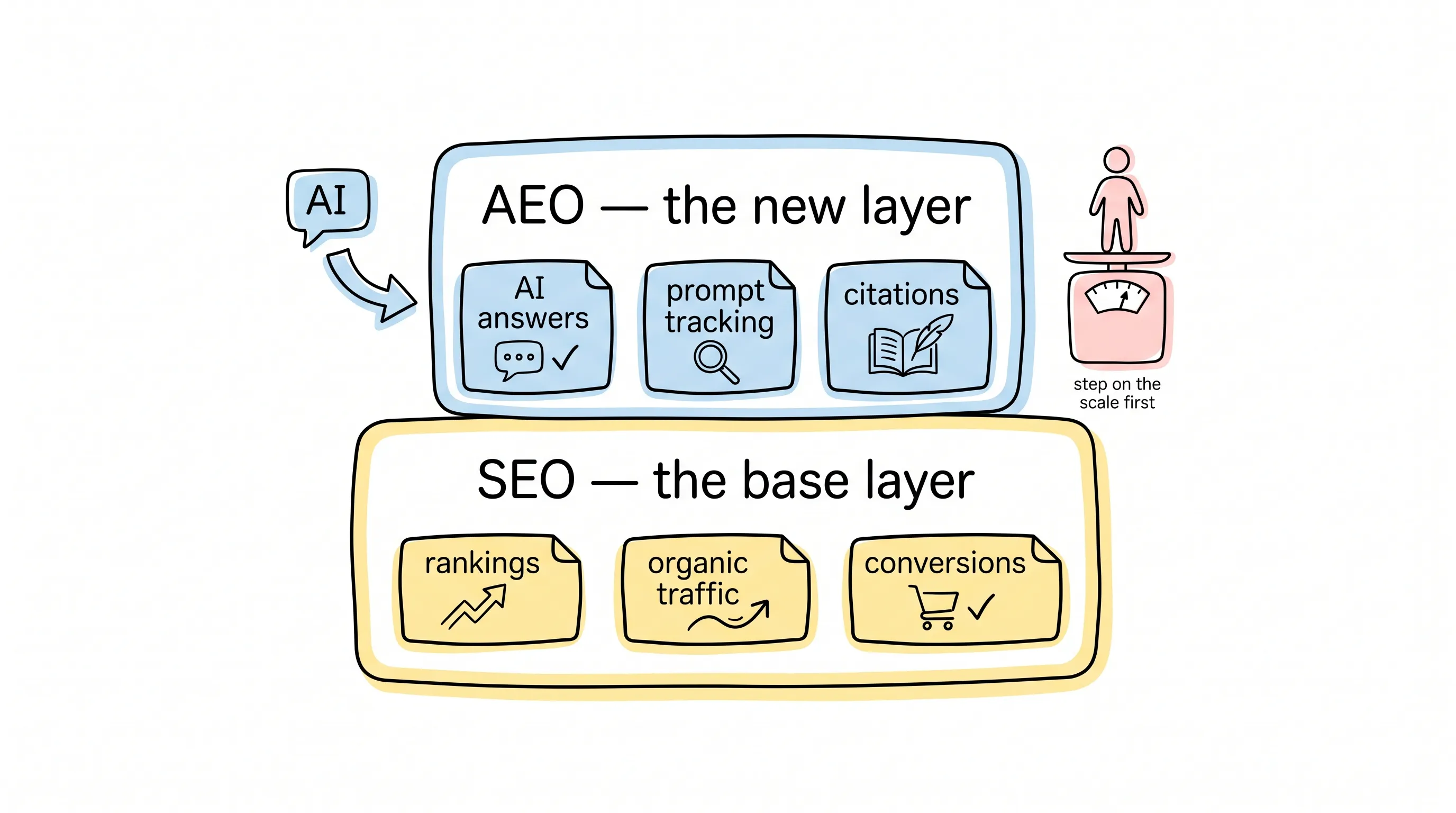
What is AEO? Put simply, it's another layer of measurement and optimization stacked on top of your existing search optimization: Did your brand show up in the AI's answer? Under which prompts? Compared with your competitors, who's showing up more often? Whose content is the AI citing?
So where do you start with this layer?
Step One: Step on the Scale First
To optimize anything, you need a baseline first. It's like losing weight: weigh yourself before you talk about a plan.
Four things to get a read on: which engines mention your brand; which of the prompts you track bring you up; how your visibility stacks up against competitors'; what kinds of sources the AIs are citing.
Traditional search metrics can't answer a single one of these. Take the most common scenario: you rank well on Google, yet for the prompts you track, the competitor is the one showing up most often in the answers. Only when you put the two datasets side by side does "search visibility" become a complete concept.
Take HubSpot AEO as an example. It gives you a "Brand Visibility Score": across the batch of prompts you track, it analyzes the answers each engine returns, and the percentage of answers in which your brand appears is that score. Prompt tracking lets you flip straight through the verbatim answers ChatGPT, Gemini, and Perplexity return each day; the citations report tells you which sources the engines are actually drawing their answers from.
These prompts run automatically every day.
One discipline worth flagging: don't draw conclusions from a single day of data. Pull at least several days — ideally several weeks — of trend before you judge.
One day of fluctuation is noise. A trend over weeks is signal.
With a baseline in hand, what's next? Look at the citations data to decide which content to create and which to update.
Step Two: See Who's Speaking for You
AI answers don't come out of thin air — they cite content. Whoever gets cited, gets recommended.
Who does it cite? Your own website, competitors, industry media, social platforms, content written by users themselves — all on the list. Lay these types of citations out side by side, and you'll know: which domains, which pages, which channels, and which content formats are actually shaping the answers for the prompts you track.
For teams with big content libraries, going through every prompt and every engine by hand is exhausting — and not necessarily accurate. Better to have one centralized dashboard that puts "pages performing well in traditional search" and "pages showing up in AI answers" at the same table.
The Citations tab in HubSpot AEO does exactly this: it lists the domains and pages cited most often, puts your citation share next to your competitors', and groups everything by content type and by channel. There's also a Recommendations tab which, based on citation patterns and site audit results, hands you prioritized suggestions: which owned content to create or update, which social posts are worth publishing, which outreach is worth pursuing.
Once you have the recommendations, prioritize and get to work. After each round, check the trends again.
Now — can this visibility, these citations, be converted into leads and deals?
Step Three: Make the Data Show Money
This is the step that matters most. If all you can say is "our brand is showing up in AI answers," the boss will ask: showing up — and then? Where are the leads? Where are the deals?
A standalone AEO report can't answer that question. You have to wire it into traffic sources and CRM data.
HubSpot tags visits coming in from known AI platforms as "AI Referrals" in the traffic-source properties. What's more, the companies and deals associated with those contacts automatically inherit the contact's source properties. That means you can filter and pull reports: how do AI-driven contacts and deals stack up on quality against other channels?
But one caveat here: the two datasets are complementary — neither one proves the other. AEO reports on the prompts you track, on visibility, on citations; traffic sources record the visits that actually clicked in from AI platforms. Two different things, measuring two different actions. So don't decide that a particular deal came from AI just because an answer mentioned you once. Causality isn't that cheap.
HubSpot's own internal data says customers using AEO generate 2.6x more leads. Treat that number as a reference point. What you should really watch is what happens inside your own account: as visibility and citation coverage grow, do the AI-driven contacts and deals grow along with them?
Don't Treat AEO as Firefighting
Last, some straight talk.
Don't treat AEO as a one-off emergency measure, dousing fires wherever they flare up. It should grow into your SEO team's daily routine — like a health check, stepping on the scale at regular intervals.
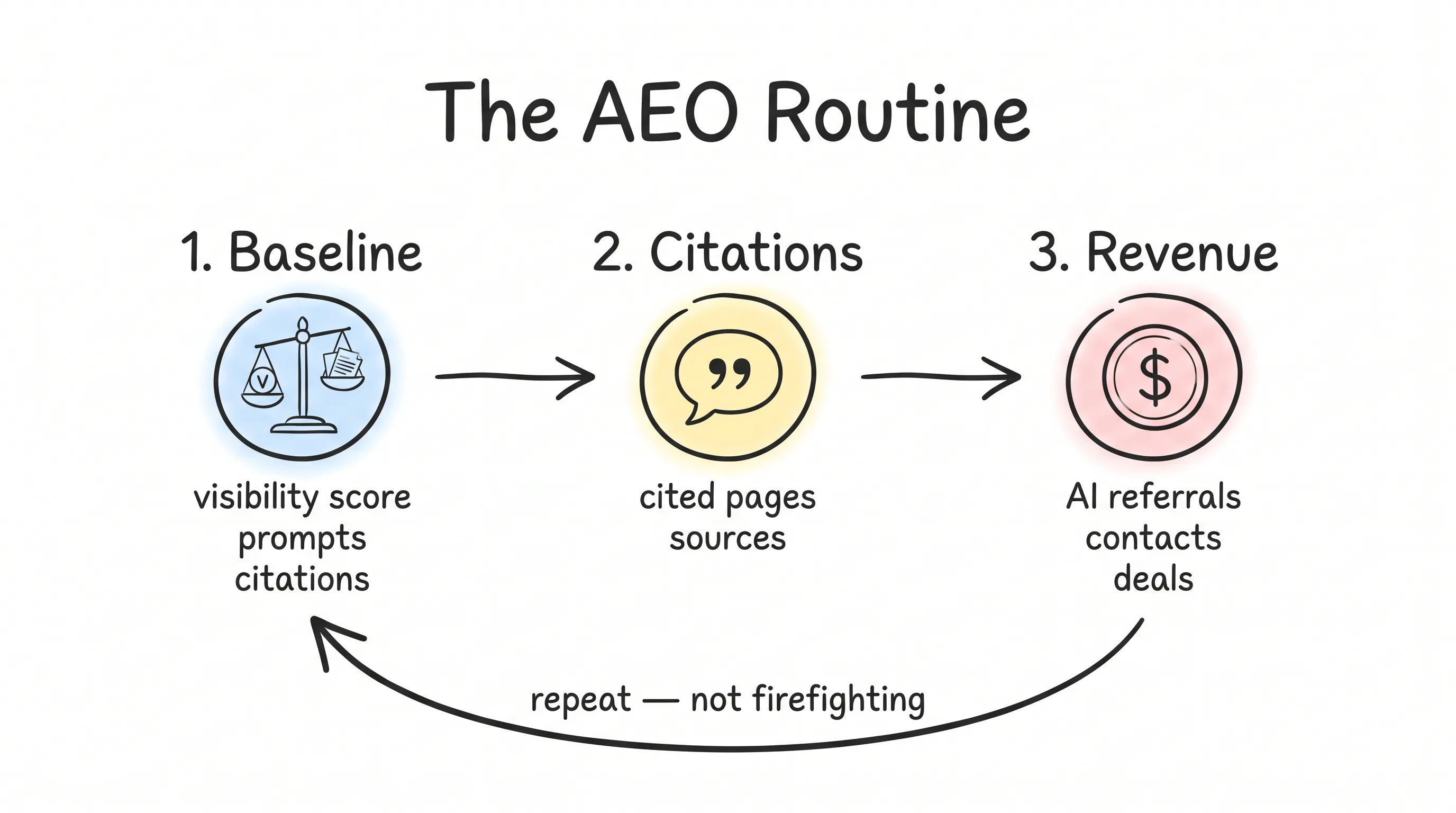
Set up the baseline and get the measurement running now. Then, one day, when the boss stops asking "should we invest in AEO" and starts asking "why didn't we start sooner," you'll be holding a stack of evidence.
Back to the recent grad from the beginning. She is your customer for the next decade — someone who asks, gets an answer, and never clicks a link.
Whether you're in the answer when a customer asks AI — that's the new ranking.
Here's to getting your baseline built before the boss ever asks.
Continue reading
Related articles

Cross-Border Business: Time to Upgrade Your AI Toolbox
A learn article explaining how AI tools help cross-border e-commerce sellers clear five hurdles: language, regulation, logistics, payments, and fraud. It outlines a five-compartment toolbox, a five-step adoption path, and metrics such as conversion rate and CLV, while cautioning against over-reliance on AI.

AI Is Taking Over the Dirty Work of Social Media Marketing, One Task at a Time
This learn article outlines four social media marketing tasks AI can handle — audience analytics, content drafting and design, ad targeting and creative testing, and spam moderation — and cautions that taste, judgment, and data security remain human responsibilities.

AI Is Already This Good — Why Is Your Social Media Marketing Still Pure Manpower?
An overview of 18 AI tools for social media marketing, organized into six categories covering audience research, content creation, scheduling, comment and DM handling, ad management, and visual production, plus notes on personalization, prediction, and emerging trends.