
Your Customers Have Started Asking AI. So Why Won't It Cite Your Website?
A learn article explaining why AI answer engines may not cite a website despite strong search rankings, covering content and technical foundations, snippet controls, per-engine citation differences, and a 90-day rollout plan for AI visibility.
Last month, an old friend who runs an enterprise services business invited me out for coffee. He sat down, and his very first words were: something weird is going on.
I said, take a sip first, then tell me slowly.
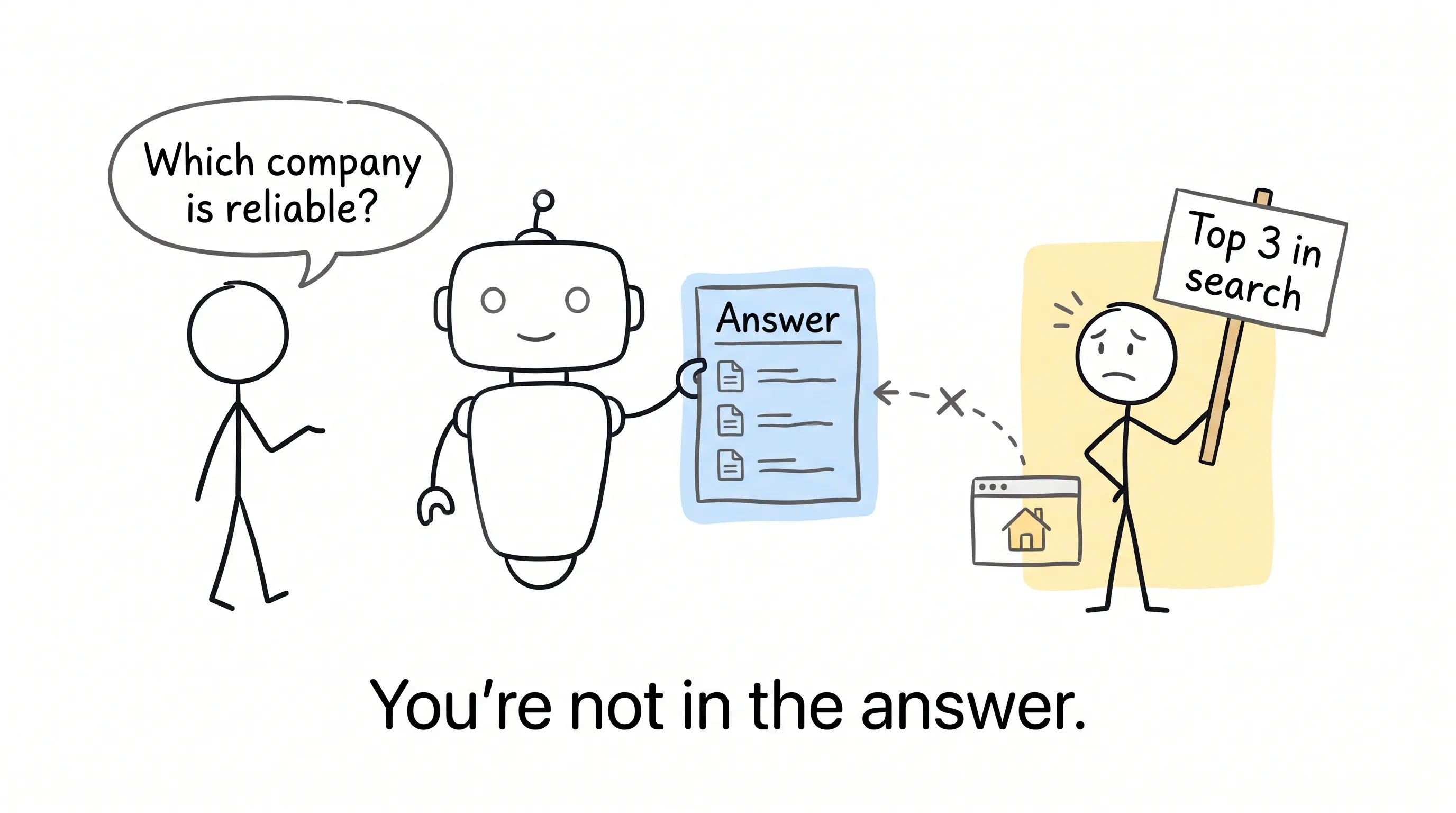
He said his company's website had always ranked well on Google — top three for its core keywords, year after year. But a couple of days earlier, a young woman from the marketing team came running over: Boss, I asked ChatGPT "which companies in our industry are actually reliable," and after scrolling through the answer for ages — we're not in it.
He couldn't wrap his head around it: the rankings were perfectly fine. Customers switched to a different place to ask, and suddenly I don't exist?
I told him: there's nothing strange about this at all. What you ran into is the new wall a lot of people are running into right now: AI search.
So what exactly is AI search?
The way you used search engines, you asked a question, then dug through the answers yourself. AI search flips that around: it hands you the answer directly, and attaches the references underneath. ChatGPT, Perplexity, and Google's AI Overviews all belong to this category. The industry calls this whole business AEO — Answer Engine Optimization.
How fast is this market growing? Wix Studio pulled together a set of numbers: across mainstream answer engines, monthly unique visitors were 634 million in Q1 2025. By Q1 2026, that had grown to 904 million. One year — up more than 40 percent.
Your customers are moving over en masse. They used to search; now they ask. If you want to know whether you've hit that wall, try HubSpot's free AI Search Grader first — it scores your brand's presence inside answer engines.
But don't panic just yet, and don't rush off to learn some mystical new tricks. Because there's one basic judgment call you may have gotten exactly backwards.
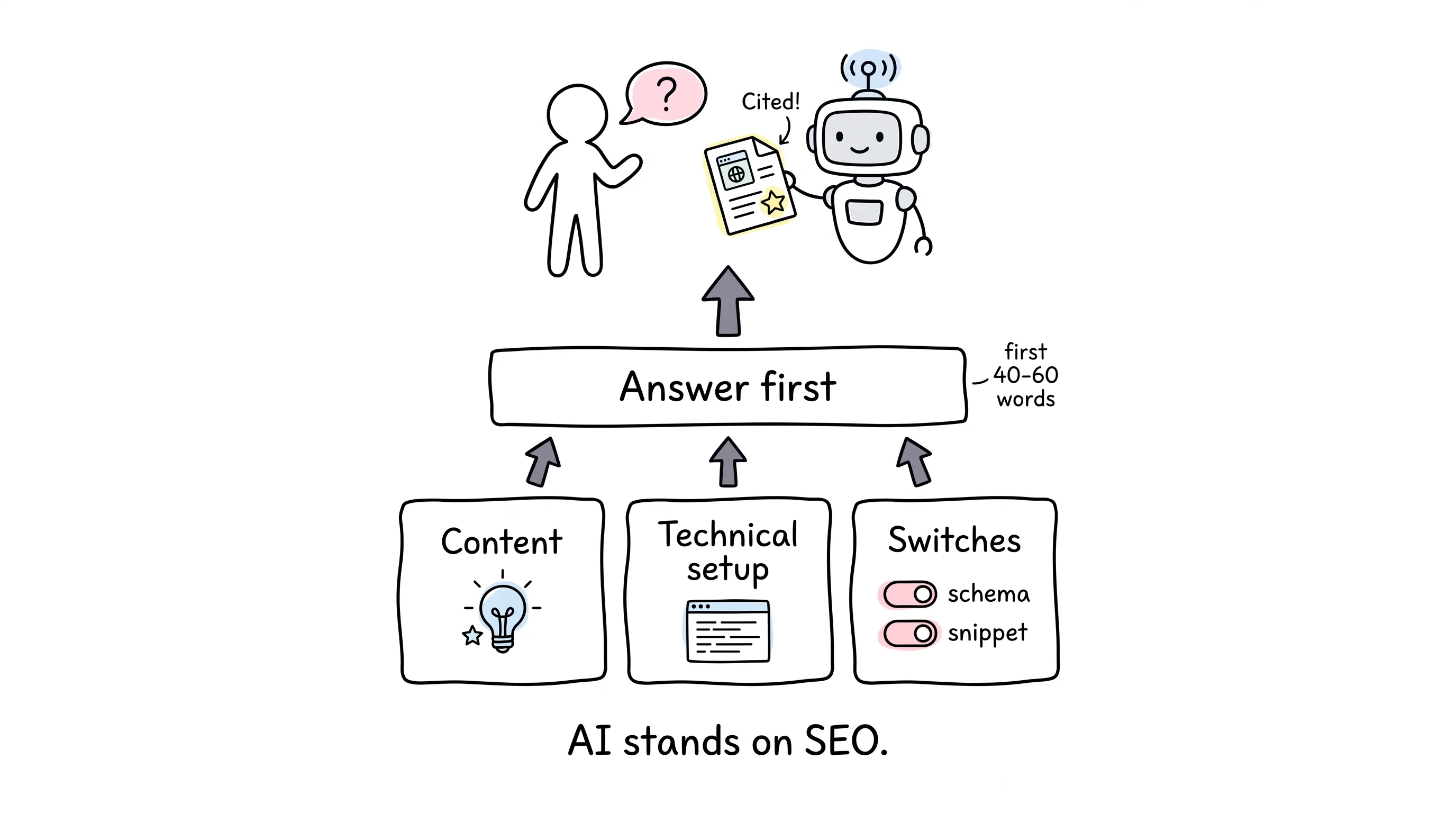
AI search hasn't replaced SEO. It stands on SEO's shoulders.
Think about it: for an answer engine to cite your page in an answer, what does it have to do first?
It has to find you — crawl. Read you — index. Weigh whether you deserve the spot — rank. That entire sequence is the same one traditional search uses. Google itself has said that AI Overviews runs on a customized version of Gemini, backed by its existing search system. ChatGPT search is no different — part of its web results comes from suppliers like Bing.
So the foundation is the same foundation. A page that search engines can't crawl or index has even less of a seat in AI's answers.
How do you lay that foundation? Start with the heaviest slab.
The First Foundation: Content
Google puts it bluntly in its own AI optimization guidance: unique, engaging, and useful content has the biggest impact on your site's presence in generative search. It also draws a line between two kinds of content: one is commoditized content — the common knowledge already circulating online, repackaged once more; the other is content built on first-hand experience and genuine expertise.
Think about it: AI itself is the absolute ceiling at "repackaging common knowledge." Why would it cite a page it could have generated itself?
No motive.
AI doesn't cite what it can generate on its own. What it truly treasures is what it can't generate: original data, the judgment of industry veterans, real first-hand experience.
There's data backing this up. SE Ranking analyzed 216,000 web pages and found: content that quoted expert opinions got cited by ChatGPT an average of 4.1 times; content that didn't, 2.4 times. Pages carrying 19 or more data points averaged 5.4 citations; data-thin ones, 2.8.
And there's one move that matters a lot when you write: lay out your insights one sentence at a time, plainly and clearly. When an engine pulls an excerpt, it wants a passage that can stand on its own, complete in meaning. The more self-contained your writing, the easier it is to lift.
The Second Foundation: Technical Setup
Google is very clear: there is no extra bar for a page to enter AI Overviews. The prerequisites are just two — being indexed, and being eligible to be shown as a snippet.
Speed quietly adds or subtracts points, too. SE Ranking's numbers: pages with a First Contentful Paint (the moment the first content appears on screen) under 0.4 seconds got cited by ChatGPT an average of 6.7 times; pages slower than 1.13 seconds, only 2.1 times. A threefold gap. Slow really does get you cited less.
There's also one particularly well-hidden pitfall: JavaScript.
Googlebot will render JavaScript, as long as you don't block it. But many AI crawlers read only the raw HTML and never execute scripts. If your page depends entirely on scripts drawing the core content inside the browser, then in the eyes of ChatGPT and Perplexity, it may as well be a blank sheet of paper.
What to do? Serve the core content straight out as server-side rendered HTML — don't make crawlers guess. And while you're at it, check your robots.txt so you don't accidentally turn away the crawlers you meant to invite in.
Don't skimp on internal links either — they're the signposts for crawlers. Page structure should be just as clear: a clean heading hierarchy, body copy in plain text, kept cleanly apart from ads and sidebars. That's good for readers, and good for models.
Two Switches That Are Easy to Overlook
First, structured data — schema. It's like sticking a machine-readable label on your page: this is a product, the price is this, the author is so-and-so, the rating is four stars. The more accurate the label, the less the engine has to guess, and the more confidently it cites you.
But labels come with one iron rule: they must be honest. Whatever the label says has to match what human eyes can see on the page. One version for crawlers, another for users — search engines have a dedicated name for that: cloaking. It's an old-school violation.
Schema is an amplifier. It amplifies content that was already clear and credible; it can't rescue a page of empty talk.
Now the second switch — I call it the "snippet knob." Google's rule: a page only qualifies for AI Overviews if it sits in a state that allows snippets to be displayed. Which means the switches that control your snippets also hold your fate in AI answers.
There are three of them:
nosnippet — snippets disabled for the entire page. It's telling AI: don't cite me.
max-snippet — rationed supply. Set it to 0, and it's the same as nosnippet; set it to -1, no limit, and Google decides the length itself.
data-nosnippet — surgical blocking. If some passage on the page shouldn't be excerpted on its own, tag it with this marker; everything else stays as is. Good for protecting passages that could be taken out of context.
Where do these three switches live? In the page's robots meta tag, or in the X-Robots-Tag HTTP header. Mainstream CMSs and SEO plugins can all set them — no need to touch code. Before publishing, run the page through a schema validation tool to confirm it parses properly.
One reminder: the day you find a perfectly good article that simply won't get cited, go check its robots tags first. Very likely a forgotten nosnippet, or a max-snippet set too small, has blocked the road.
Put the Answer Right Up Front
CXL analyzed how citations are distributed across AI Overviews, and the conclusion is blunt: most cited passages come from the top third of the page; the bottom 40 percent of the content contributes only a fifth of the citations.
HubSpot's AEO guide offered a more concrete move: put each section's core answer inside the first 40 to 60 words. Conclusion first, details after.
Subheadings matter too. Kevin Indig studied ChatGPT's citation habits and found two things: cited text carries question marks at roughly twice the rate of ordinary text; and among question-related citations, 78.4 percent point to headings. Write your H2s and H3s as the very questions readers would ask, and you're handing the engine a ready-made exam question — with a model answer sitting right beside it.
Key facts: break them into lists and tables as much as possible. A 2026 preprint studied structured formatting: with the same information, extraction accuracy from lists and tables ran 43 percent higher than from paragraphs of prose.
Oh, and one preparation step before you start writing: cluster the questions your customers ask most often, then connect your brand, products, and core topics into a relationship map. Only when the engine can see clearly how you all relate to each other can it place your content into an answer.
AI Reads Pictures Too
Generative results can come with images and video. You don't need to prepare anything extra for this — set up your images, text, and video the way standard SEO practice already calls for, and AI benefits as a side effect.
Video deserves its own mention. Fan Out ran a study of off-site citations: YouTube was the second most-cited platform, taking 1,531 citations. Even more interesting, 13.7 percent of those citations pointed straight to a specific timestamped moment inside the video.
But don't expect AI to actually "watch" the video. It judges relevance largely from the text around the video. So when you upload one, remember the three-piece set: transcript, summary, timestamps.
Local and product data is another route in. Google says its generative answers will pull product listings, product information, and local business information when appropriate. If you want your goods showing up in those answers, keep both your Merchant Center feed and your Google Business Profile fresh — let neither go fallow. Google has also rolled out Business Agent, a conversational experience attached to Search where customers can chat directly with your brand. If you're in retail or services, worth keeping an eye on.
Every Engine, Its Own Game
You think all AIs have the same taste? Not even close.
Start with citation volume. Fan Out's numbers: of off-site citations, Perplexity alone accounts for 59 percent, averaging 10.8 sources per answer — a citation fiend. ChatGPT is far pickier, citing only 3.3 per query on average.
Then, what they eat. Perplexity loves roaming discussion forums — pages like LinkedIn, G2, and Reddit make up 17.35 percent of its citations, more than twice the average across engines. For queries on B2B SaaS topics, 96 percent of LinkedIn citations come from Perplexity alone. It also favors fresh, clearly structured content with source links. ChatGPT leans toward traditional long-form articles.
Even how fast they pick up new pages is different. SE Ranking and Search Engine Land ran a fake-brand experiment: for a freshly published page, Perplexity pushed it to the top position within one to three days; ChatGPT was slower to react, but the further along it went, the more solidly the brand got cited.
The most sobering number is this: only 7.7 percent of cited URLs appear in more than one engine.
Which means you can be eating it alive in Perplexity while ChatGPT stays dead silent. And vice versa. Don't expect one article to sweep every engine — run each engine as its own channel.
Four Folk Remedies — Don't Try a Single One
Lately, every kind of AEO folk remedy is flying around. I've picked the four hottest and will pour cold water on each in turn.
Remedy No. 1: llms.txt. A little note passed to AI — sounds lovely, right? In November 2025, SE Ranking analyzed nearly 300,000 domains, and the conclusion: whether you have this file has no correlation with AI citations. Even more humbling: delete this variable from the predictive model, and the model actually gets more accurate. Google has said it plainly: we ignore these special AI files. Do honest SEO.
Remedy No. 2: building a separate .md version of pages just for machines. One version for humans to read, one for AI? Google's John Mueller is firmly against it: LLMs have been able to parse ordinary HTML from day one — they don't need you to cook them special meals. Besides, serving crawlers one set of content and people another — as we said earlier, that's cloaking, and it crosses the line.
Remedy No. 3: dedicated "AI markup." Google says generative search doesn't need any special schema. But what does the data say? The two sides are at odds. On the AirOps and Kevin Indig side, pages with JSON-LD got cited by ChatGPT at a rate of 38.5 percent, versus 32 percent without — a 6.5-point edge. But Ahrefs ran a controlled experiment on 1,885 pages and measured no meaningful lift; AI Overviews citations actually dropped 4.6 percent, and there was no way to say for sure that schema was the culprit. My advice: treat schema as a hygiene habit — labels that honestly describe what's visible on the page. Just don't expect it to be rocket fuel.
Remedy No. 4: manufacturing mentions — carpeting forums with fake praise to feed AI's answers. Can it work? Short term, it really can. Same fake-brand experiment as before: one fictitious brand, and within 30 days it had captured nearly all brand-term visibility on five answer engines. But note this — all it won were brand terms only it could answer; on competitive topics it won nothing at all. And Google classifies manipulating generative answers as spam; manipulative content at scale gets demoted. Short-term gamble, long-term collapse.
You Got Cited. Now What?
Counting citations alone is applauding yourself. Watch two things: visibility, and conversion.
On visibility: take a baseline snapshot first. There are free scoring tools on the market — HubSpot's AEO Grader, for instance, can snapshot your brand's presence in ChatGPT, Perplexity, and Gemini, with a share-of-voice comparison against competitors thrown in. HubSpot's AEO product can keep watching these engines continuously and spot the questions where you're sliding. Which page to refresh first — look at the data, don't go by gut feel.
On conversion, there's a counterintuitive number. Microsoft Clarity studied more than 1,200 websites: traffic from AI accounts for less than 1 percent. Sounds pitiful, right? But those visitors click through to signup at a rate of 1.66 percent, while traditional search only manages 0.15 percent. More than ten times over. WebFX analyzed 2.3 billion sessions: visitors arriving via AI convert at roughly 1.2 times the rate of organic search.
Low volume, high quality. That's the personality of AI traffic.
Next, hook this traffic into your CRM and follow the money. HubSpot's AI Referrals (available in the Professional and Enterprise tiers of Marketing Hub and Content Hub) can isolate traffic from ChatGPT, Perplexity, and Gemini as its own source, viewed separately from ordinary organic search. Marketing Hub Enterprise adds multi-touch revenue attribution, tracing those AI visitors all the way to closed deals.
But one pitfall needs spelling out: a lot of AI discovery is "zero-click" — the customer saw your brand in the answer and never clicked through at all. That share can't be counted by any website tool; attribution only covers the part that clicked a link. Know this limitation, and the reports won't fool you.
Then review on a fixed cadence: retake the baseline snapshot every month, see which questions you won and which you lost, and feed it back into the next round of edits. Once this loop spins, one-off optimization turns into compound interest.
Ninety Days to Make It a System
Finally, a rollout cadence.
Days 1 to 30: name an owner. Designate one person or one small team to be responsible for AI visibility, the same way you assigned an owner for SEO. Baseline snapshots, which pages to rescue first — they make the call. Responsibility only sticks when it lands on a specific head; otherwise everyone owns it, and no one owns it.
Days 31 to 60: set the cadence. Turn the monthly review into a system written into the calendar: which pages to audit, on what cycle, watching which signals. Pages whose topics heat up fast get a tighter cycle; evergreen content can breathe a little.
Days 61 to 90: set the rules. The more people collaborate, the more quality drifts. Write your selection criteria, naming conventions, schema usage, and answer-first formatting into documents so everyone works to one standard. Add one more layer — a risk review: topics like health, finance, legal, and safety get repeated by AI directly as answers, and mistakes there are costly. Run a fact-check before publishing, and bring in compliance where it's warranted.
The engines will keep changing. With the people, the cadence, and the guardrails unchanged, this thing rolls on by itself.
Back to That Cup of Coffee
After finishing this piece, I sent my friend a reply: don't rush to blame AI for playing favorites. Go back and check three things: can your pages be crawled, are they fast enough, and is the core content server-side rendered. Then rewrite the first 60 words of every section as "answer first." Finally, study what Perplexity and ChatGPT each like to eat, and serve them separately.
Three months, and we'll see the verdict.
Maybe he'll still be complaining to me by then. But the complaint might have become: a customer asks AI some casual question, and the answer is all about his company.
That wouldn't be an accident anymore.
That would be an asset.
Continue reading
Related articles

Cross-Border Business: Time to Upgrade Your AI Toolbox
A learn article explaining how AI tools help cross-border e-commerce sellers clear five hurdles: language, regulation, logistics, payments, and fraud. It outlines a five-compartment toolbox, a five-step adoption path, and metrics such as conversion rate and CLV, while cautioning against over-reliance on AI.

AI Is Taking Over the Dirty Work of Social Media Marketing, One Task at a Time
This learn article outlines four social media marketing tasks AI can handle — audience analytics, content drafting and design, ad targeting and creative testing, and spam moderation — and cautions that taste, judgment, and data security remain human responsibilities.

AI Is Already This Good — Why Is Your Social Media Marketing Still Pure Manpower?
An overview of 18 AI tools for social media marketing, organized into six categories covering audience research, content creation, scheduling, comment and DM handling, ad management, and visual production, plus notes on personalization, prediction, and emerging trends.