
Your Customers Have Started Asking AI. So What Now for Content Marketing?
A learn article on Answer Engine Optimization (AEO): as buyers ask AI assistants like ChatGPT and Perplexity, it covers auditing brand visibility in AI answers, using citation data to plan content, and tracking AI-referred traffic, with references to HubSpot's AEO tooling.
A few days ago, I had dinner with a friend who works in content.
He looked miserable.
I asked what was wrong.
He said his team reliably turns out dozens of articles every month, and website traffic is decent. But at a meeting last week, his boss asked him one question that stumped him: "Customers have gone to AI for answers now. Go ask AI about us and see who it names."
Guess what happened?
AI named a few competitors.
Not them.
That's what I want to talk about today: Answer Engine Optimization, or AEO.
So what is AEO?
Put simply: SEO used to mean getting your articles to rank at the top of search results and waiting for people to click in. Now, more and more buyers do their homework somewhere else — ChatGPT, Gemini, Perplexity and other AI assistants. They ask directly, AI answers directly. And once the answer lands, plenty of people never click on any website at all.
No matter how good your content is, if AI doesn't cite you, then as far as buyers are concerned, it was never said.
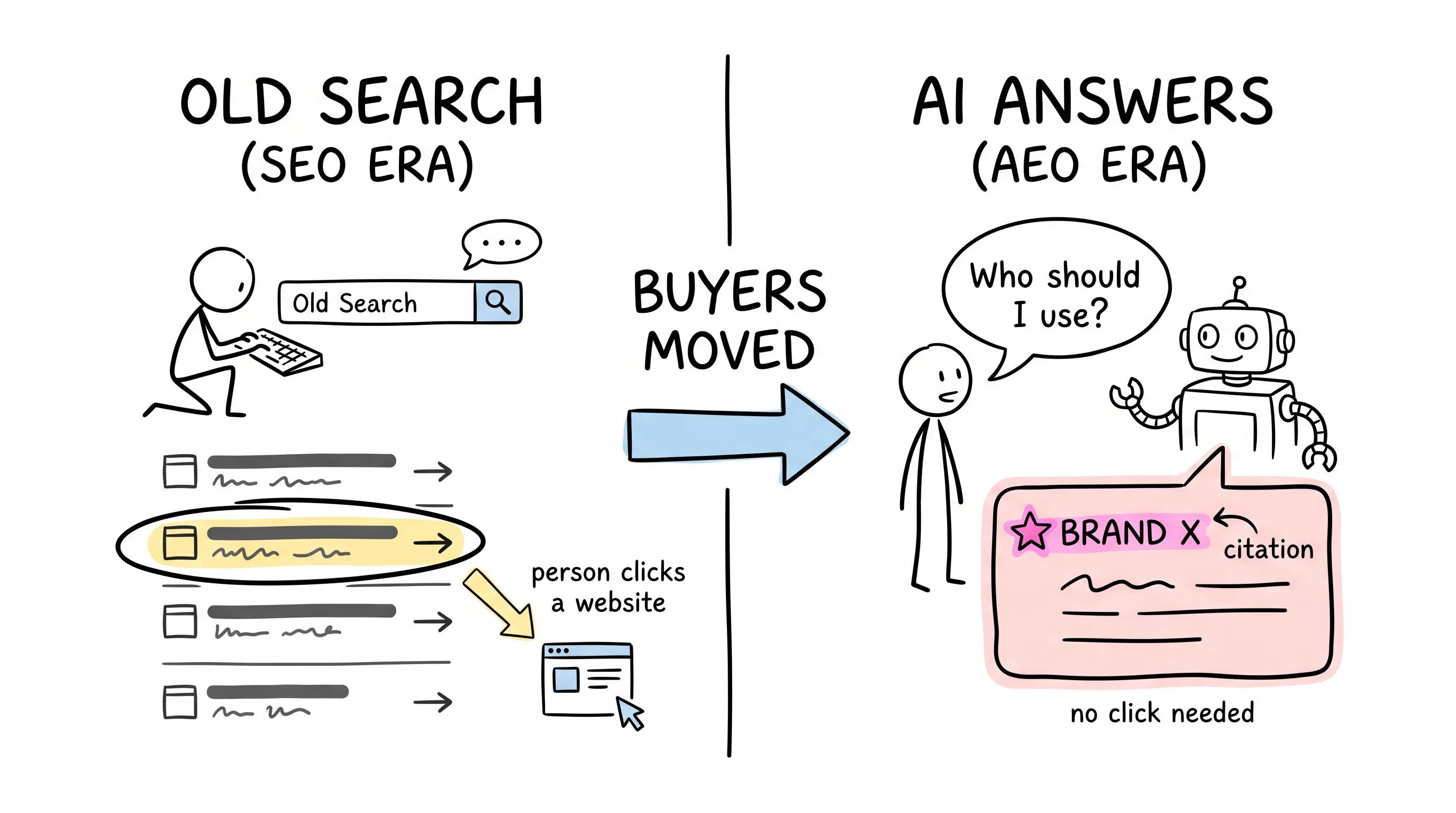
Don't panic yet. Here's the good news: AEO is not some brand-new craft you have to learn from scratch. Everything you already know — what your audience is asking, making useful content, testing results — not one bit of it goes to waste. What changed is the exam room.
So where do you start? Three steps.
Step One: Take Stock First
What does "taking stock" mean?
Answering three questions: among the questions that matter to your business, which AI engines mention you? How do they describe you? And when you don't show up, who does?
Think about it like running a store. Before heading out, a customer asks a savvy friend. Whether that friend mentions you, how they describe you, and who they name instead when they don't — if you know none of this, how can you possibly improve?
Taking stock needs tools. Take HubSpot's AEO tool, for example: it gives your brand a visibility score, covering ChatGPT, Gemini, and Perplexity, tracks down to the specific prompt, and lets you benchmark against competitors.
Without that baseline in hand, you can't even tell which topics to shore up. Let alone judge whether the changes you make are actually working.
Step Two: Let Citation Data Decide What You Write
In AI answers, who gets cited?
Once you read the citation patterns clearly, content opportunities line up on their own: what to write, what to update — all laid out.
HubSpot's approach is to embed the recommendations directly into its content tools. With Marketing Hub Professional and Enterprise editions, you never leave the platform — a recommendation pops up, and you act on it on the spot.
This step pays off in numbers you can count.
HubSpot's own data: customers actively optimizing for AI search generated 170% more marketing-qualified leads (MQLs — the leads marketing hands off to sales) than comparable customers who didn't.
When I saw that number, I paused for a second.
What does 170% actually mean?
If you were getting 100, now you're getting 270.
Those extra 70 leads are the mindshare premium.
Step Three: Plug AI-Driven Traffic Into the Business
Here's a spot where people easily get confused.
Exposure and clicks are two different things.
A buyer sees your brand in an AI answer but doesn't click through — that's exposure, and it's hard to attribute directly. A buyer clicks from an AI assistant into your website — that's a real, countable visit. It's like a friend mentioning your name over dinner versus that friend texting your store's address straight to their phone: the first means they remembered you; the second means they can walk in today.
For the latter, HubSpot files this kind of traffic under AI Referrals. Contacts carry a source property, and the deals tied to them get logged right alongside.
And just like that, a measurement loop closes: watch which AI answers your brand shows up in, use citation data to decide what to write and what to update, then fold AI-driven traffic into the whole business picture.
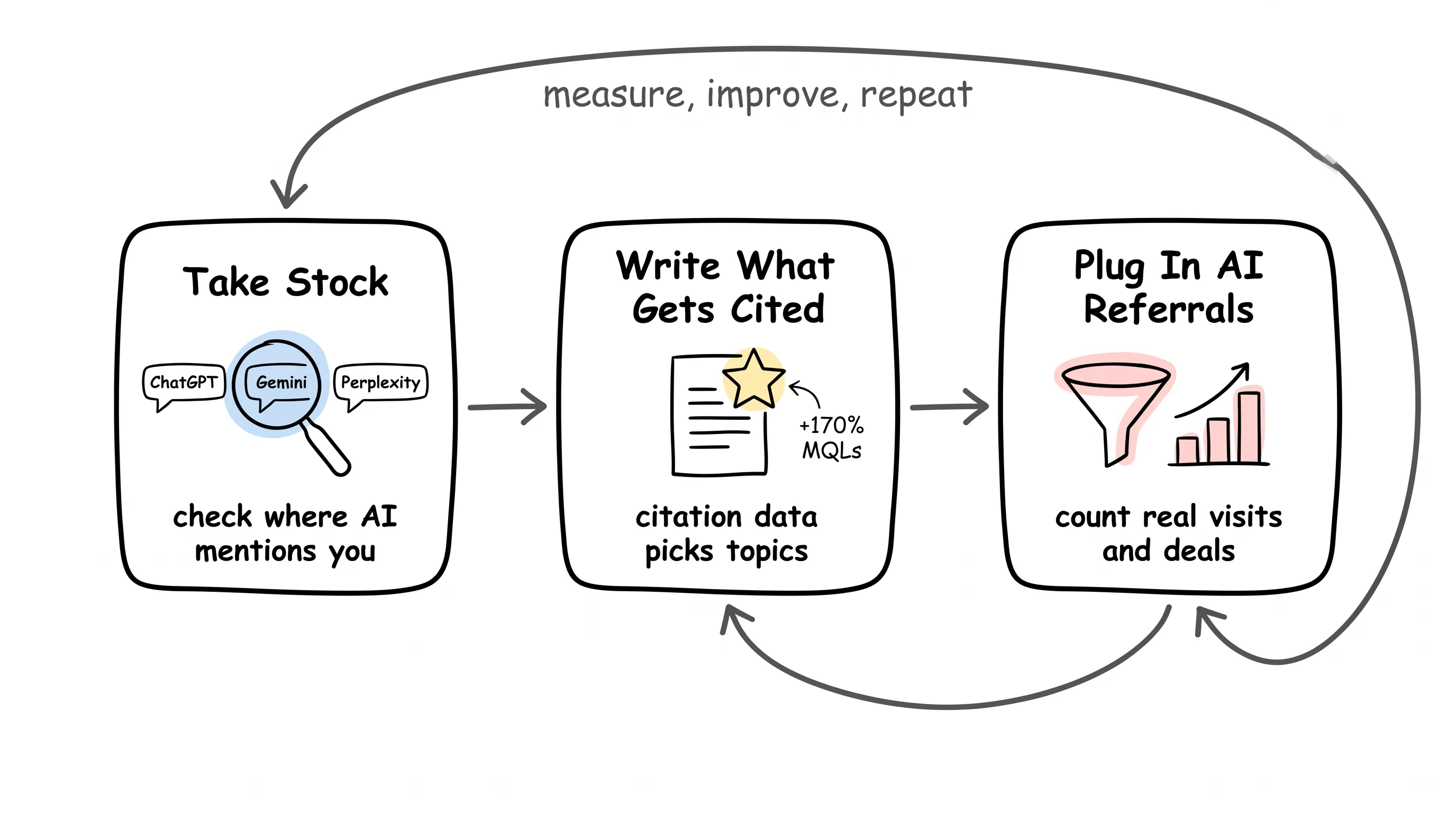
If you can see it, you can improve it. If you can count it, you can invest in it.
Finally, Back to My Friend
After that dinner, the first thing he did when he got back was put his own brand and a handful of competitors into ChatGPT, Gemini, and Perplexity, one by one.
Fill the gaps. Refresh old articles. Watch the data.
He said it felt like the first time he learned SEO — nervous and excited all at once.
Nervous is right. Buyers have changed where they ask for directions, and you can't keep standing at the old intersection holding up a sign.
Excited is right too. The table just changed — whoever sits down first draws first.
May you always be the first to hand in your paper in this new exam room.
Continue reading
Related articles

Cross-Border Business: Time to Upgrade Your AI Toolbox
A learn article explaining how AI tools help cross-border e-commerce sellers clear five hurdles: language, regulation, logistics, payments, and fraud. It outlines a five-compartment toolbox, a five-step adoption path, and metrics such as conversion rate and CLV, while cautioning against over-reliance on AI.

AI Is Taking Over the Dirty Work of Social Media Marketing, One Task at a Time
This learn article outlines four social media marketing tasks AI can handle — audience analytics, content drafting and design, ad targeting and creative testing, and spam moderation — and cautions that taste, judgment, and data security remain human responsibilities.

AI Is Already This Good — Why Is Your Social Media Marketing Still Pure Manpower?
An overview of 18 AI tools for social media marketing, organized into six categories covering audience research, content creation, scheduling, comment and DM handling, ad management, and visual production, plus notes on personalization, prediction, and emerging trends.