
Your Customers Are Outsourcing Search to AI
A couple of days ago, a friend who sells B2B software came to me to vent: his website traffic hadn't really dropped, but inquiries were down.
A couple of days ago, a friend who sells B2B software came to me to vent: his website traffic hadn't really dropped, but inquiries were down. His keyword rankings were still on page one, and he'd been digging at it forever and still couldn't crack it.
I asked him: when you look something up these days, do you still open Google and page through the results one by one?
He paused for a beat. He doesn't. He opens ChatGPT and just asks.
Right. Aren't you doing the same thing yourself?
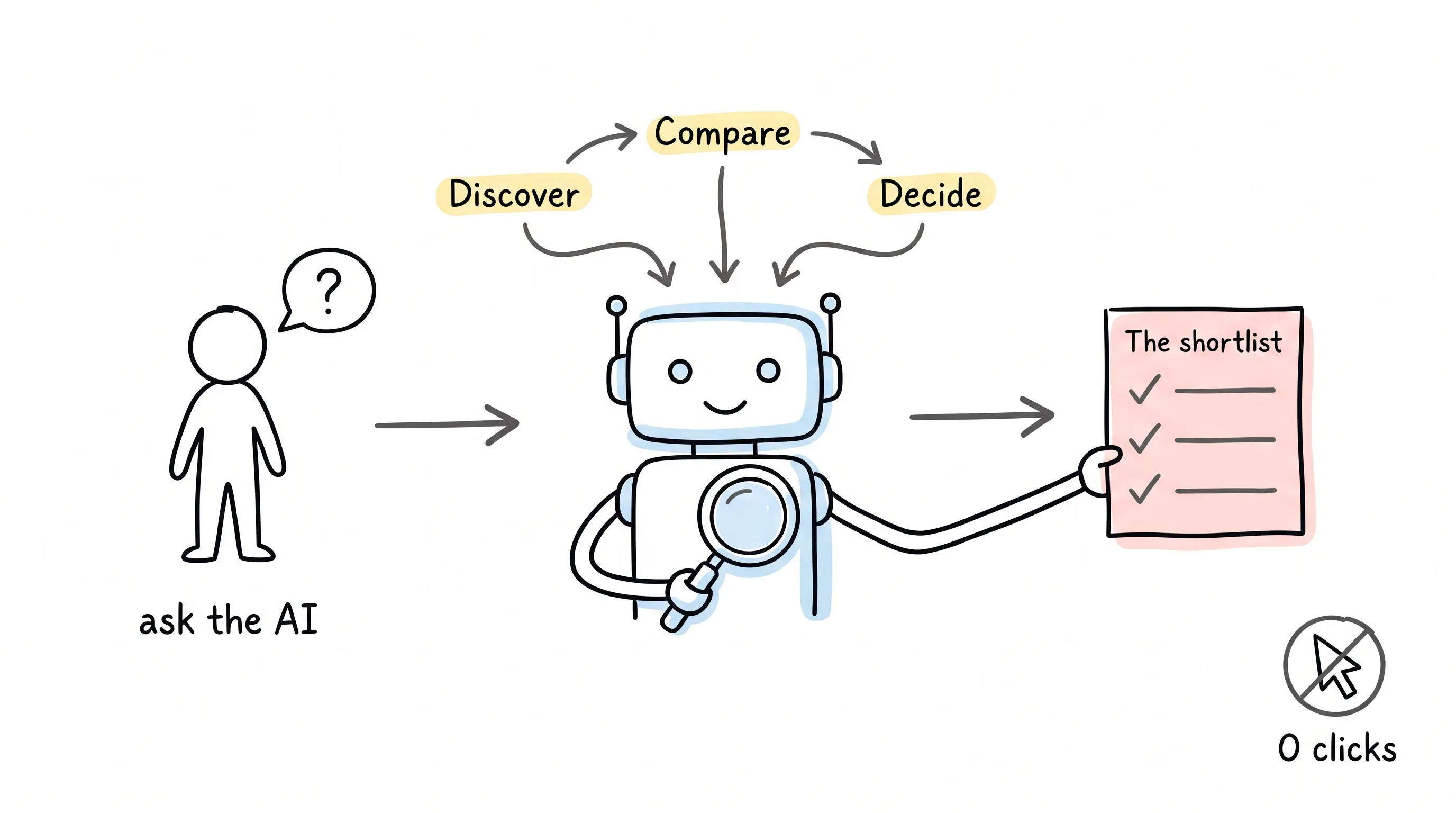
That's exactly what I want to talk to you about: your customers are outsourcing the whole journey — discover, compare, decide — to AI.
So If Traffic Didn't Drop, Where Did the Business Go?
First, a few numbers for you.
By Google's own account, AI Overviews already reach more than 2.5 billion monthly active users, and AI Mode has passed 1 billion. A G2 survey shows that 51% of B2B software buyers start their research by asking an AI — asking it more often than they ask Google. And on the question of what most influences the vendor shortlist, AI chatbots rank first.
Now look at the other end. In the first four months of this year, 68% of Google searches in the US ended with zero clicks.
Zero clicks.
Think about what that means: the user asks the AI, the task is done, and they never click through to any website at all.
So the old metrics — rankings, clicks — are breaking down. A brand may already have won, or lost, before a customer ever opens its website. The questions worth asking have become: Did the AI retrieve me? Did it get me right? Are there credible sources to vouch for me? When it builds the shortlist, am I on it?
This new craft has a name: GEO, Generative Engine Optimization.
Some people treat GEO as just SEO's next move. I don't think it's that simple. It's a cross-functional craft: how content is structured, how the technical setup is configured, how the brand gets talked about, how results are measured — all of it has to move.
So how far along is this craft today?
Honestly? There's no standard answer yet. The playbook is still being written, slowly, by a small group of people who research, build tools, and run experiments on the models — all at once.
I'm going to tell you the stories of 7 people. In my eyes, they're the strongest practitioners this discipline has right now.
Seven People, Seven Crafts
First, Kevin Indig.
An independent growth advisor who writes an industry newsletter called Growth Memo, specializing in breaking big data down into operating manuals for marketing executives.
This July, he ran a behavioral study: 56 participants, 221 ChatGPT shopping tasks. The result? The brands that ultimately got chosen had an answer share of 24%; the brands that got skipped had only 11%.
What is answer share? The proportion of the AI's answer in which you get mentioned.
Even sharper: 92.8% of the tasks never produced a single click out to the open web — the whole thing got done inside the conversation.
Wow. How the AI presents you almost directly decides whether customers choose you.
He also broke down 1.2 million AI answers and 18,012 verified citations, and found that 44.2% of ChatGPT's citations come from the top 30% of a page's content.
In one sentence: put the answer up front. No throat-clearing, nothing buried.
Second, Mike King.
Founder of iPullRank, the systematizer among the technical crowd. He gave this craft a harder-edged name: Relevance Engineering — fusing information retrieval, content strategy, experience design, digital PR, and measurement into one integrated whole, rather than shrinking it down to editing a few paragraphs of copy.
Behind Google's AI Mode sits a key technique called query fan-out. Mike was one of the first to explain it thoroughly, and he open-sourced the first query fan-out tool. His long-form breakdown of how AI Mode works is one of the earliest systematic analyses in the entire industry.
Third, Josh Blyskal.
On measurement, you can't get around Josh.
He started at HubSpot, where he co-founded the marketing AI business and built the first version of AI Search Grader. He then joined Profound as the company's second employee, building the entire AEO (Answer Engine Optimization) methodology from scratch — turning prompt research, visibility measurement, and citation analysis into processes enterprises can run repeatably. The methodology was hammered out one client at a time — 300-plus of them.
He has done two things people will keep bringing up.
In May 2025, he released the first report at scale proving that Reddit is one of ChatGPT's most important citation sources. A few months later, Reddit itself cited his data in its Q2 shareholder letter, saying it had become the most-cited domain in AI models.
A report written by the researcher, stamped as true by the researched. Rare.
This June, he used more than 50 million real ChatGPT conversations to run the first large-scale classification of AI user intent: 37.5% was generative intent — having the AI write and create for you; navigational intent had dropped to 2.1%; and transactional intent ran 9 times higher than in traditional search.
Nine times. Think about what that means.
Fourth, Aleyda Solis.
An AI search optimization consultant at Orainti — the best system-builder among consultants.
Her AI Search Optimization Checklist runs from choosing prompts and customer journeys, all the way to visibility diagnostics, source analysis, implementation, and validation cycles — one checklist that runs the whole show, just updated this May. She also maintains LearningAIsearch, a free AI search learning site, and her YouTube channel interviews front-line practitioners every week.
Her three-layer measurement model is the one I especially want you to remember: AI Presence — are you there at all; Readiness — can you catch what it sends; Business Impact — does any of this actually bring in business.
With those three layers, you won't mistake a passing mention for making money.
Her analysis this July also turned up a counterintuitive finding: the bulk of the weighting behind AI citations comes from places other than your own website.
So don't just patch up your own walls. Get out there and earn goodwill across the web.
Fifth, Chris Long.
VP of Marketing at Go Fish Digital, now working at Nectiv.
Using a long-tail regex, he dug the "searches that look like prompts" out of Google Search Console, finding his team a zero-cost route into prompt research.
He also ran a controlled experiment: feeding the same AI Instructions page to each AI. ChatGPT cited it within 48 hours. Gemini, AI Mode, Claude — nothing.
See? Same move, different engines, completely different responses. Unless you run this yourself, you'll never know.
Sixth, Lily Ray.
VP of SEO Strategy at Amsive Digital, the fiercest "stress-tester" in the field.
She fabricated a fake ranking and put it out there. Within 24 hours, Google AI Overviews, AI Mode, Gemini, ChatGPT — every one of them accepted it as fact.
Fake. Every single one believed it.
Her 2026 B2B software study carries an even more gutting number: AI Overviews cite those "Top 10 Best" listicles while failing to recommend the publishers behind them 69% of the time.
Being cited is not the same as being chosen.
That line deserves a frame on the wall. She has since launched Algorythmic and a Gemini RAG analysis tool that cracks open exactly what AI retrieves and what it cites, for you to see.
Seventh, Jason Barnard.
Founder of Kalicube. He comes last because he coined the term.
He proposed answer engine optimization back in 2017, and by 2018 the industry had independently documented it. While others were still arguing about how to pronounce the term, he was already a decade down the road: from "getting the direct answer" to "making AI understand you as an entity and trust you as a person."
He pulled all of this into the AI Engine Pipeline — an assembly line with ten gates, running from being discovered and indexed all the way to being adopted and recommended. His Kalicube Process and Entity Home frameworks teach brands to nail down three questions first: Who am I? What do I do? Who can vouch for what I say?
In June 2025, he published a book devoted to how brands win in Google and AI.
That's all seven.
So You Get the Idea — What Do You Actually Do?
From these seven people's research, I've distilled a few things you can put to work.
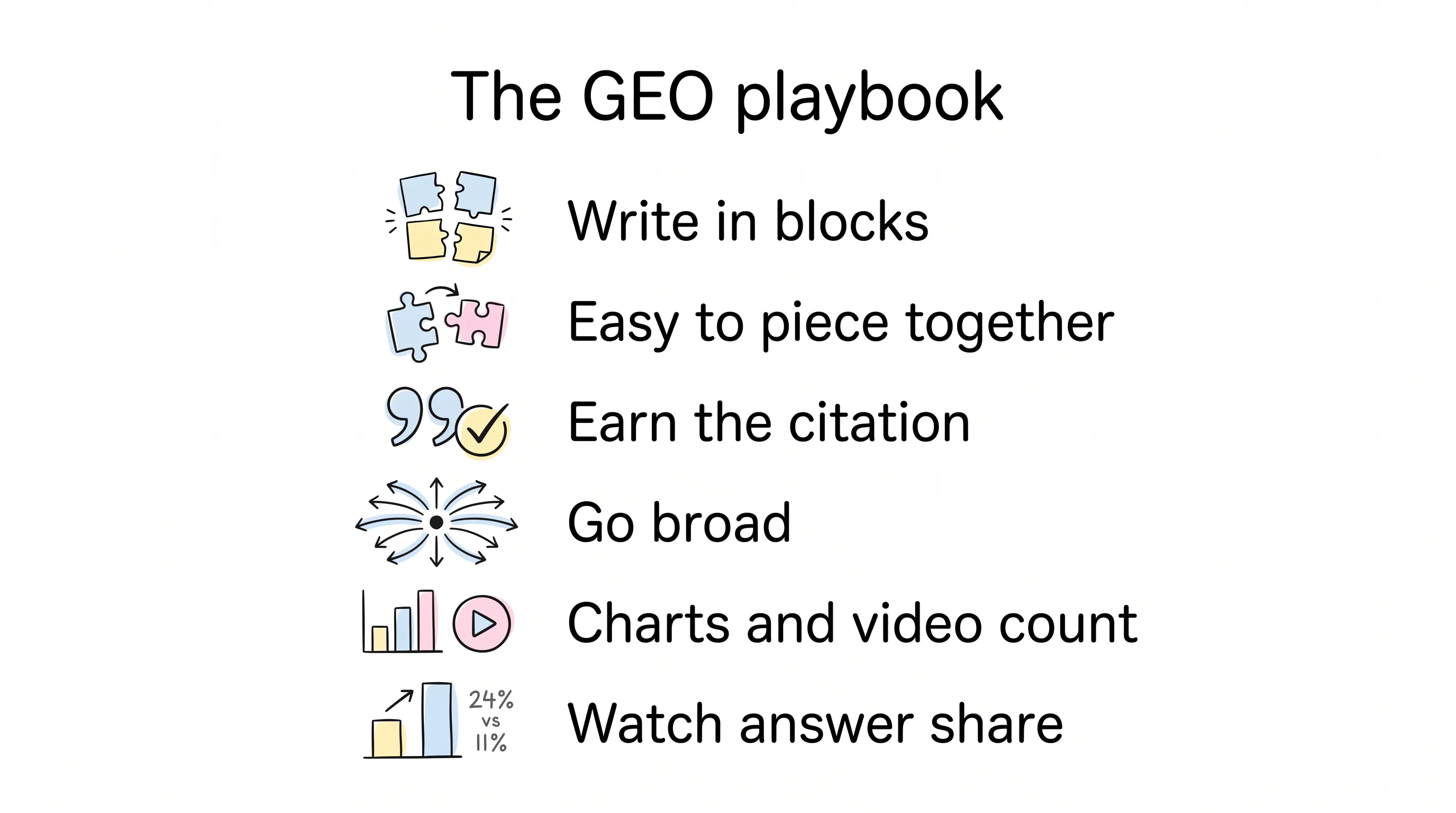
First, don't write "one whole page" — write "block by block." AI doesn't read your entire article. It splits content into small blocks — the jargon term is chunk — and when answering, pulls in only the most relevant few from among millions of articles. It's like tearing out the few pages most likely to show up on the exam instead of reading the whole textbook. So every section has to stand on its own as an answer.
Second, make your content "easy to piece together." AI will assemble blocks from several sources into a single answer. The clearer and more extractable your content structure, the more easily it gets pieced in. Tables, steps, comparisons — those are the shapes that piece together well.
Third, getting pulled in isn't enough — you still have to deserve the credit. Not every block that gets used also gets cited. To earn the credit, your content has to be more accurate, more current, and backed by others speaking for you. Lily Ray's 69% is the cautionary tale.
Fourth, breadth is depth too. Query fan-out splits one complex question into a dozen-plus smaller ones, all fired at once, each fanning out on its own search. The more completely you cover the whole topic, the wider the surface you give the AI to pull from.
Fifth, charts and videos count too. AI is increasingly pulling in images, tables, and videos. Don't put all your effort into grinding out words.
Sixth, watch answer share, not just rankings. Measure how often you show up in the AI's answer, not where you rank. Remember Kevin's numbers? 24% versus 11%. Half the answer share, half the odds of winning.
So what do you actually use?
Purpose-built tools already exist. Profound's Answer Engine Insights, for example, runs structured prompts every day across engines like ChatGPT, Perplexity, Google AI Overviews, and Microsoft Copilot, measuring a brand's citation share and answer share and locating authority gaps in the AI's eyes; Agent Analytics keeps tabs on which AI crawlers have visited your site and what they looked at; Conversation Explorer lets you see directly what real users are asking AI, and how different brands get compared in the answers.
Josh's methodology was built on these tools.
Finally, Back to That Friend
Later I told him: your traffic hasn't dropped — it's the same people as before. They've just changed their first stop from your homepage to a chat box.
AI is drawing up a shortlist on behalf of your customers.
The list is short. Too short to hold many "good enoughs."
Is your brand the one on that list?
Here's wishing that whenever AI speaks, you're the one it calls by name.
Continue reading
Related articles

Cross-Border Business: Time to Upgrade Your AI Toolbox
A learn article explaining how AI tools help cross-border e-commerce sellers clear five hurdles: language, regulation, logistics, payments, and fraud. It outlines a five-compartment toolbox, a five-step adoption path, and metrics such as conversion rate and CLV, while cautioning against over-reliance on AI.

AI Is Taking Over the Dirty Work of Social Media Marketing, One Task at a Time
This learn article outlines four social media marketing tasks AI can handle — audience analytics, content drafting and design, ad targeting and creative testing, and spam moderation — and cautions that taste, judgment, and data security remain human responsibilities.

AI Is Already This Good — Why Is Your Social Media Marketing Still Pure Manpower?
An overview of 18 AI tools for social media marketing, organized into six categories covering audience research, content creation, scheduling, comment and DM handling, ad management, and visual production, plus notes on personalization, prediction, and emerging trends.