
Your Customer Only Gives You Two Seconds
A learn article summarizing Adobe's annual AI marketing study conducted with Oxford Economics, covering consumer attention spans, generative AI adoption outcomes, AI agent expectations versus actual deployment, customer trust gaps, and data, measurement, and internal alignment barriers.
First, a question.
A promotional email, an ad in your feed — how many seconds are you willing to give it?
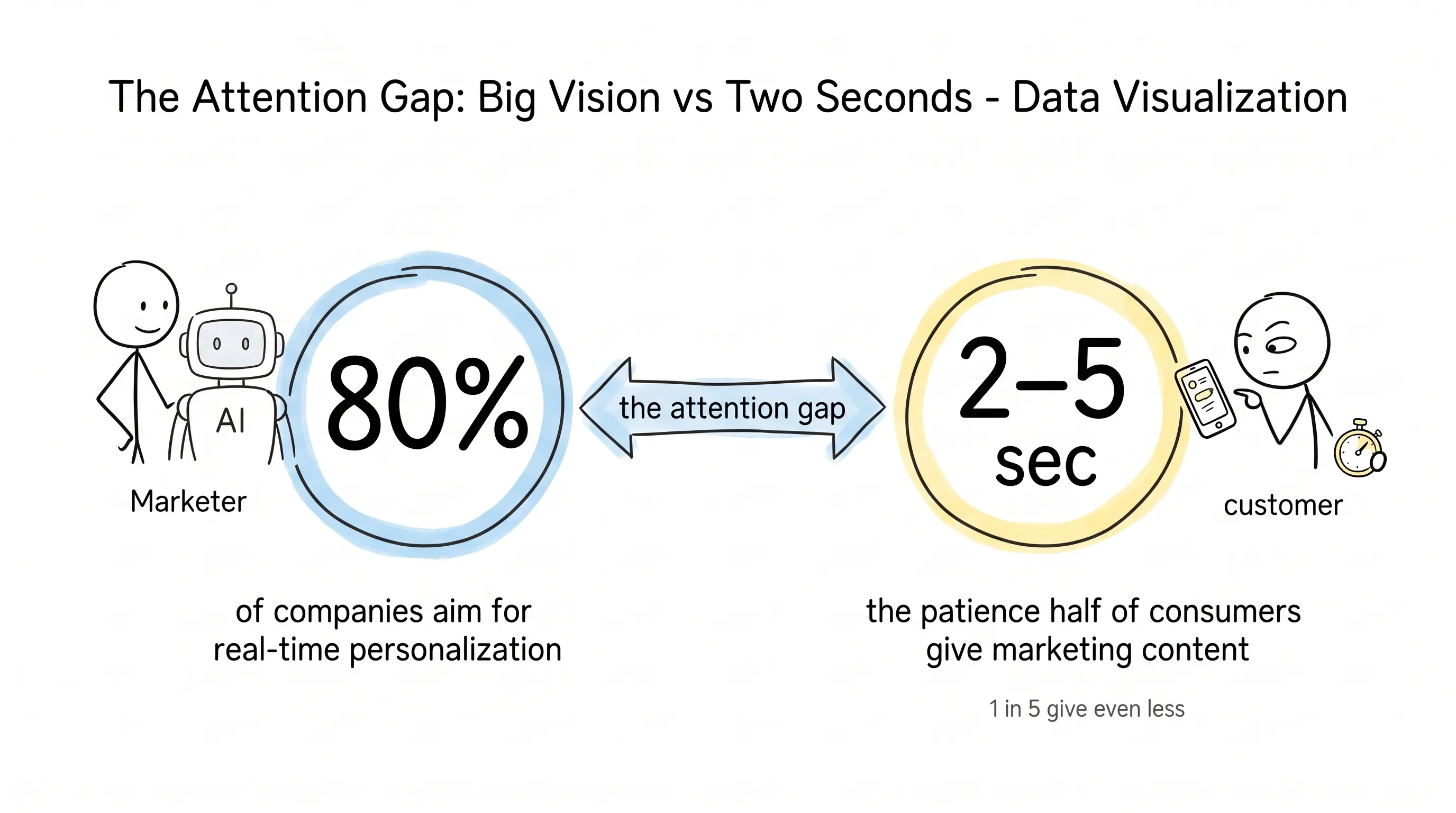
Last October and November, Oxford Economics ran a major global survey on behalf of Adobe, interviewing 3,000 business leaders and front-line practitioners, plus 4,000 ordinary consumers. One answer from the consumer side stings: half say this kind of marketing content gets two to five seconds to grab them. And nearly one in five won't even bother with two.
Two seconds. Two blinks.
In that same survey, 80% of companies have set themselves a goal for the next few years: personalized experiences that anticipate customer needs in real time.
Big vision. Short patience.
This research is now in its 16th year. Earlier this year, Adobe packaged the latest round of results into its annual report, and I've been through it several times. Here's the one-sentence takeaway up front: AI is off and running — but most companies haven't built the road for it.
Unpacked, it's really four or five stories. Let me take them one at a time.
The Good News First
Three years in, the companies that have put generative AI to work have real results to show for it: 70% say personalization has gotten better than before, 64% say acquiring new customers has gotten easier, and 59% say they're holding on to existing customers better.
Zoom in further: 76% of companies are producing more content; 70% say non-creative departments can now produce content on their own; 69% say employees work faster; 67% say innovation is up; 65% say revenue is up.
Roughly two-thirds. In any corporate survey, that counts as hard data.
But here's where it gets interesting.
In that same survey, 57% of companies admit their digital maturity is, at best, average compared with their peers — often below. Only 36% dare call themselves leaders.
Enjoying the taste, yet quietly unsure. Why?
Because most of the sweetness is still stuck at the "pilot" stage. Across the workflows the survey covers, only a quarter to a third of companies have tried it at small scale, and the ones that have rolled generative AI out company-wide are a minority within the minority.
Plenty have had a taste. Few have actually served the dish.
The Real Power Move Hasn't Dropped Yet
If generative AI is an assistant who writes exceptionally well, the one every company has its eye on now is somebody else: the AI agent.
What's an AI agent?
Generative AI talks — you ask, it answers. An AI agent acts — you give it a task, and it breaks the steps down and executes them itself: checking inventory, placing orders, rebooking flights, handling returns, seeing the whole thing through, with barely any hand-holding from you.
The temptation is enormous. One number from the survey stuck with me: about a third of companies are placing their bets on agentic technology like this — ranking it ahead of the more mature generative AI.
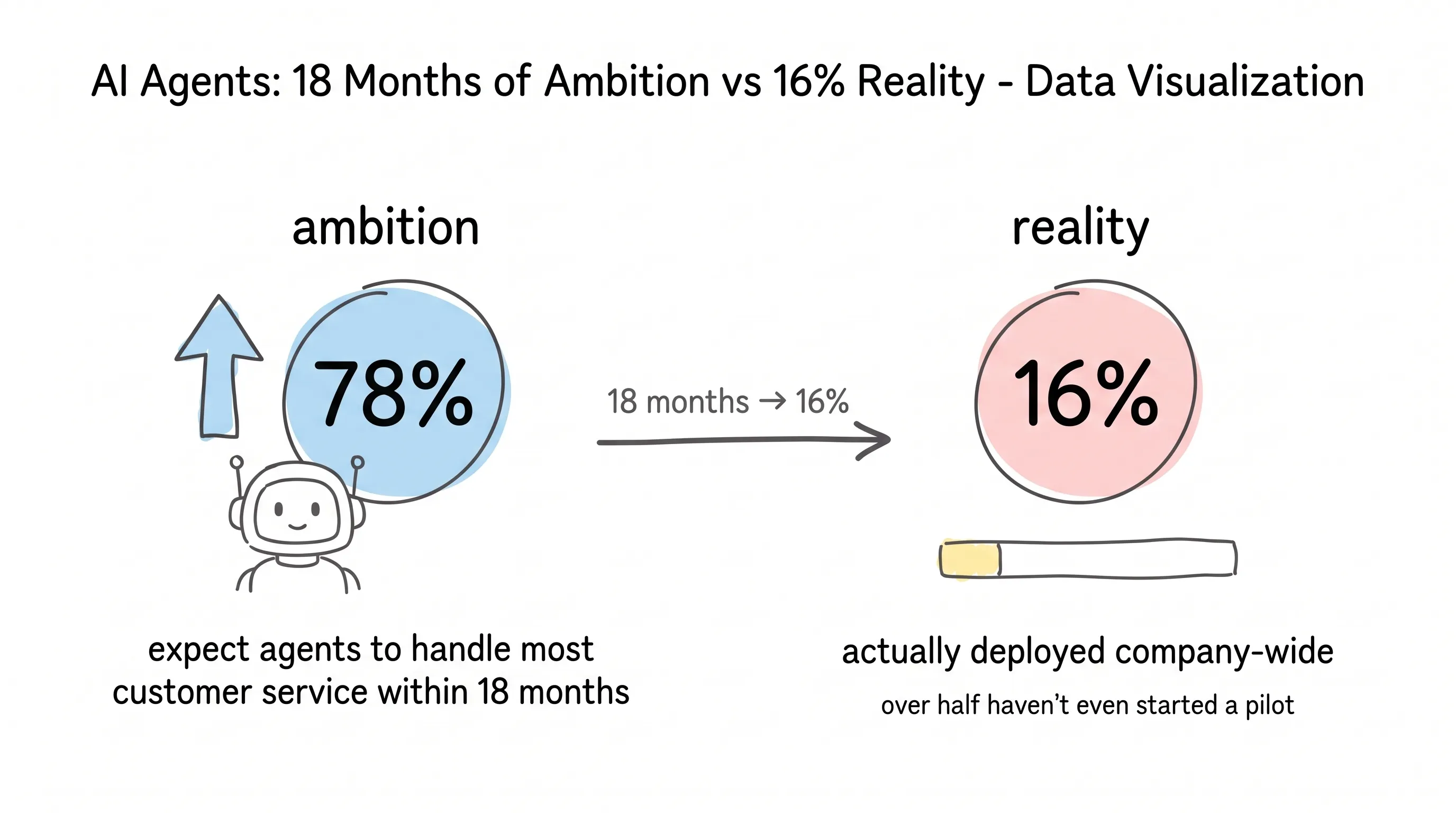
The expectations are real, too: 63% of companies believe AI agents can pull employees out of the grunt work and onto tasks that actually require thinking; 78% expect that, within 18 months, most of the customer-service workload can simply be handed to agents.
Oh?
And how much has actually landed?
Deployed for real, company-wide: 16% in customer service, 13% in brand search optimization, lower everywhere else. More than half haven't even started a pilot.
The ambition is written in 18 months. The reality is stuck at 16%.
Companies Have Got the Customer Math All Wrong
Companies are sharpening their knives. How do customers feel about it?
One fact first: a quarter of consumers already treat AI platforms as their first stop for researching information and making purchase decisions — ahead of brand websites and user reviews. On the customer side, the question isn't whether to use AI anymore — they already do.
No surprise, then, that 43% of consumers say they'd be willing to try an AI concierge if a brand offered one.
But the moment things get concrete, attitudes tighten up.
The survey asked the same set of questions to businesses and consumers separately: imagine a customer with their own AI assistant dealing with brands on their behalf — how far would customers be willing to let it go?
Businesses overestimated across the board.
Handing the AI assistant off to a brand's human customer service: companies estimated 55% would accept it. Reality: 45%.
Letting AI make the final call on a purchase: companies estimated 35%. Reality: 21%.
Letting AI carry a big-ticket purchase from research to negotiation to payment, end to end: companies estimated 29%. Reality: 16%.
The biggest gap is here: 49% of companies believe customers will eventually make AI their main gateway for dealing with brands. 19% of customers agree.
A 30-point gap.
And more bluntly: 37% of customers say that if they think they're talking to a human and find out mid-conversation it's AI, they walk away.
Companies are building the future for their customers off their own imagination, while customers are holding a different blueprint. What you think is attentiveness, your customer may read as an intrusion.
To their credit, companies have a sense of this. Asked how to earn customer trust in AI, 68% chose "clearly disclose that it's AI," and 61% chose "always able to reach a human." The direction is right. But between knowing and doing stands a wall.
Which brings us to that wall.
What the Wall Is Built From
Two bricks.
The first is data.
75% of companies admit that data integration and quality are the biggest roadblocks to adopting AI agents. 44% rate their data quality as barely adequate for AI. 39% have a customer data platform (a central hub that unifies all your customer information) solid enough to support agents.
The infrastructure math is starker. Cloud technology that can support generative AI: 89% of companies have it. For AI agents, it drops to 51%. Responsible-use guidelines: 65% versus 37%. Tools for connecting systems: 72% versus 37%.
Same building: foundation poured for the ground floor, and the second floor hanging in midair.
The second brick is the math.
Whether AI is actually paying off — many companies can't say. 44% have built a measurement framework for generative AI; 31% for AI agents; 47% have neither, or aren't sure whether they do.
More tangled still: 52% of companies admit that metrics like customer satisfaction can't articulate the return on their AI investment, while at 56% of companies, the boss evaluates AI on financial numbers alone. Put those two sentences together: the metrics that can tell the story are ones the boss doesn't look at; the metrics the boss looks at can't tell the story.
Without a solid foundation, the numbers never add up. And while the numbers don't add up, the foundation never gets fixed.
And There's an Invisible Wall: The Human Gap
There's a contrast in the survey I particularly enjoyed.
On AI, front-line practitioners are broadly more optimistic than executives — and closer to reality. Those who believe "companies that don't adopt AI agents will be left behind": 49% of the front line, 41% of executives. The front line is more likely to say their teams are genuinely using the tech; executives are more likely to say the benefits aren't obvious.
Where's the disconnect? The survey offers a rather brutal answer: 61% of respondents rank "executive misunderstanding of AI" as the number-one reason their organization is out of step internally.
The two groups set different goals, too. Executives put more weight on revenue growth and customer satisfaction; the front line on getting content made and processes running. On "scale up content production and distribution": 36% of the front line, 14% of executives.
There's another layer. 57% of companies admit AI is changing work faster than employees can adapt; 58% say people who don't touch AI will fall behind in their roles. Yet only 45% of companies have an AI training program worth the name.
61% of companies say employees should treat AI as a colleague they can't do without. Fewer than half, though, have properly onboarded that colleague.
The whip cracks fast; the running shoes never got handed out.
So What Do You Do?
The report closes with a few recommendations. Here they are, in plain language.
One: shore up the data foundation. Quality, integration, connectivity — get these solid first, so your AI isn't squinting at a pile of mismatched spreadsheets trying to guess what customers want.
Two: upgrade the content pipeline. 53% of companies admit their content production line is still linear and painfully labor-intensive. If you want personalization at scale, the pipeline has to scale first.
Three: get executives and the front line aligned on goals. The top fixes in the survey are strikingly simple: make AI goals explicit (72%), plan together (69%). And don't measure alignment only in dollars saved — spell out what it actually delivers for customers.
Four — the one most easily forgotten: design your AI around customer comfort, not company imagination. One door to a human that's always easy to push open is worth more than ten flashy features.
Finally, Back to the Two Seconds
Technology reinvents itself every year; customer patience only shrinks.
If you can't hook them in two seconds, nothing that comes after ever gets its moment on stage.
So by the time I reached the end of this report, what stuck was something very plain: AI can do a great deal of work for you, but there's one thing it can't do — make a customer willing to give you those two seconds.
The foundation is yours to build. The numbers are yours to run. The customer is yours to charm.
Here's hoping that, two seconds in, your customer still wants to stay.
Continue reading
Related articles

Cross-Border Business: Time to Upgrade Your AI Toolbox
A learn article explaining how AI tools help cross-border e-commerce sellers clear five hurdles: language, regulation, logistics, payments, and fraud. It outlines a five-compartment toolbox, a five-step adoption path, and metrics such as conversion rate and CLV, while cautioning against over-reliance on AI.

AI Is Taking Over the Dirty Work of Social Media Marketing, One Task at a Time
This learn article outlines four social media marketing tasks AI can handle — audience analytics, content drafting and design, ad targeting and creative testing, and spam moderation — and cautions that taste, judgment, and data security remain human responsibilities.

AI Is Already This Good — Why Is Your Social Media Marketing Still Pure Manpower?
An overview of 18 AI tools for social media marketing, organized into six categories covering audience research, content creation, scheduling, comment and DM handling, ad management, and visual production, plus notes on personalization, prediction, and emerging trends.