
Your Customer Journey Map Might Die the Day You Finish Drawing It
A learn article explaining how AI-driven customer journey mapping turns static funnel maps into real-time, behavior-triggered journeys, with a six-step process and operational rhythm for B2B SaaS and DTC marketers.
A few days ago, a friend of mine in B2B SaaS came to vent.
Their company has every analytics tool you can name, event tracking crammed into everything, dashboards that look gorgeous. And? One user viewed the pricing page twice in two days, got stuck at step two of signup, then re-opened a product email. Stack those three signals together and they say one thing, plain as day: "I'm about to buy."
What did the system serve this user? A lukewarm batch-and-blast nurture email. The fourth one, identical to the ones before it.
One thing hit me as I listened: they bought a pile of tools and hung a journey map on the wall. But that map is dead.
Today I want to talk about how to bring that map to life.
First, What a Customer Journey Map Actually Is
So what is a customer journey map?
It's your entire relationship with a customer, drawn as one picture. Where they first ran into you, where they hesitated, when they placed the order, how they use the product afterward — stage by stage, strung together.
Why are marketers so obsessed with this picture?
Think about it: customers almost never walk in and buy on the spot. They pass through several steps — notice you, get to know you, compare, hesitate, purchase, start using. Whoever can read those steps clearly knows exactly where to push at each one. That's the map's first job: getting marketing, sales, and support to see the same picture. Otherwise marketing runs one script, sales another, support a third — and nobody can say where the customer actually is.
The second job: spotting "about-to-go-wrong moments" before they happen. A customer stalls halfway through checkout and asks a question that sits unanswered for three days. Without a map, you can only run the post-mortem after they churn; with one, you see it coming and fix it on the spot.
The third job is the most practical: hand over the right thing at the right moment. When you know when a customer is most ready to buy, you can give a gentle nudge at exactly that point. Conversion goes up; acquisition cost comes down. Talking to someone at the right moment never wastes a shot.
So what's an AI customer journey?
Plainly put: AI takes over the job of reading the map, drawing the map, and revising the map. It analyzes user behavior in real time, predicts the next step, and automatically adjusts the interaction at every touchpoint.
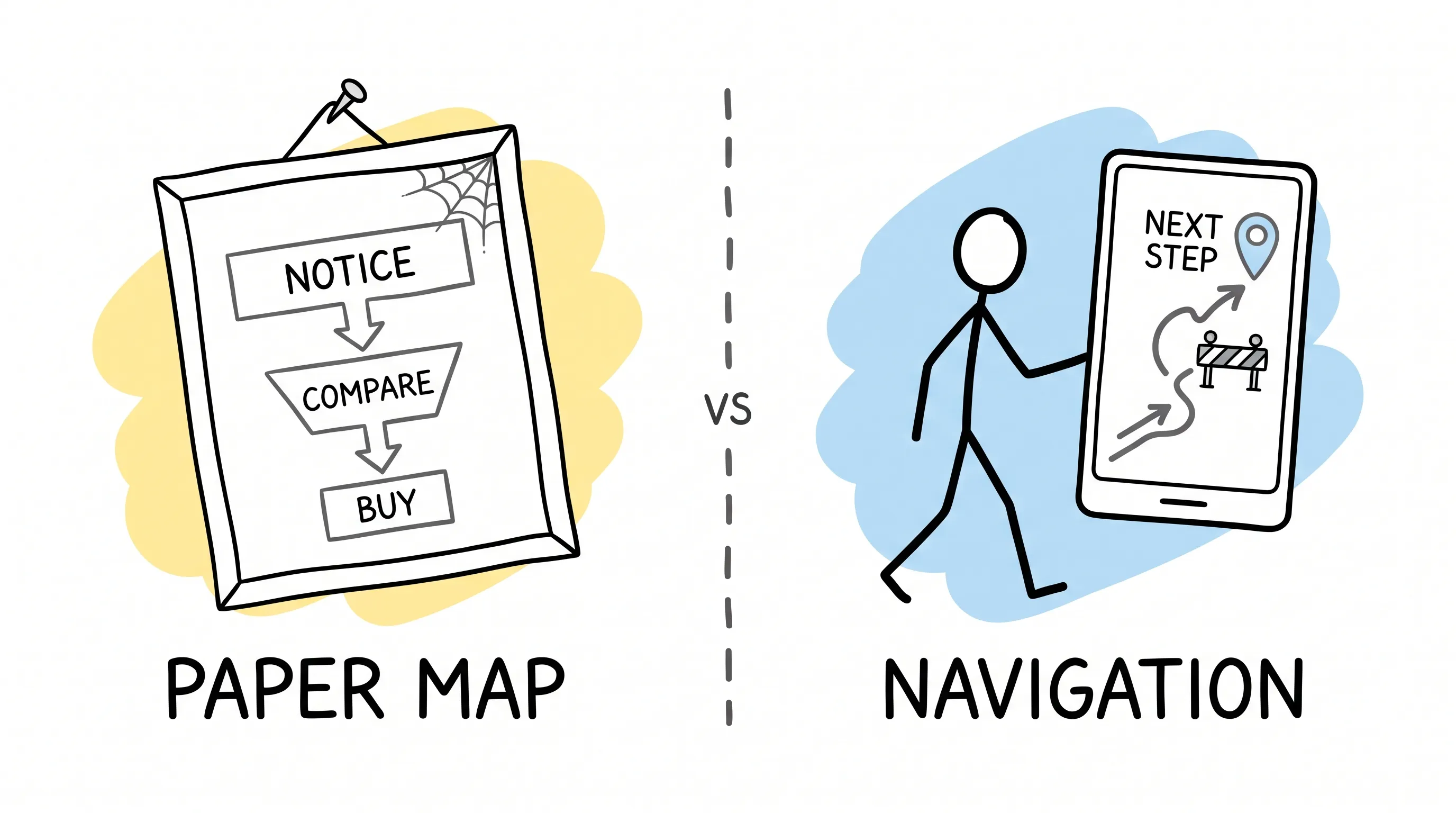
One analogy and it clicks. A traditional journey map is a paper map on the wall — drawn with real care, and unchanged from the day it's finished. An AI-driven journey is a navigation app: traffic ahead, it reroutes immediately; you take a wrong turn, it recalculates on the spot.
The wall map records the past. The navigation app is always computing the next second.
Both are called maps. They aren't even the same species.
How to Draw One: Six Steps
Step one: get clear on what this map is supposed to fix. Is a touchpoint underperforming? Are customers not sticking? Can't figure out why people abandon their carts? Without a clear goal, the prettiest map is just decoration.
Step two: figure out who you're drawing it for. Every journey map corresponds to one specific kind of customer: who they are, what problem they're solving, why they'd pick you. AI can now lend a hand here — M1-Project's ICP Generator, for one, computes an ideal customer profile (ICP) straight from the data, far more dependable than gut feel.
Step three: find every touchpoint. Ads, social media, website, app, email, support — everywhere a customer has crossed paths with you needs to be marked. This is where data tools earn their keep: Google Analytics 4 traces on-site paths and conversions, Mixpanel watches in-app behavior patterns, Amplitude pinpoints the moments that actually move retention. Which channels work, which steps grate — the data will tell you.
Step four: walk it yourself. This is the one I most want to hammer home. However complete your data, blind spots remain. Sign up once, place an order once, and plenty of problems buried in your reports will run straight into you. Heatmaps and behavior analytics help too — they can see where users furrow their brows.
Step five: start optimizing. Automate what should be automated: Intercom and Drift can take over a large share of support and sales conversations, and IBM Watson Assistant handles even complex inquiries. Personalize what should be personalized: Dynamic Yield tunes page content to each user's interests, Adobe Sensei adapts ad creative automatically, and HubSpot takes care of segmentation and email personalization end to end.
Step six: keep it current. Customers change; a path that worked last year may not work this year. A map can't be sealed away the day it's finished — revisit it regularly and revise it against the data. Platforms like M1-Project monitor behavioral shifts automatically and tell you where something needs to move.
Get this far, and you're at passing grade. To pull ahead, read on.
Finishing the Map Is Just the Start
I've always felt that "drawing it" and "using it" are two different things.
You can collect events in Google Analytics 4 or Amplitude forever, and revenue won't rise just because you collected a lot of them. Revenue happens at one instant: the moment the system decides what happens next. Who gets this person? What message do they receive? Through which channel? In what tone?
What is a signal?
A user's behavior isn't a data point. It's them talking to you.
Back to the story at the top. Two pricing-page views in two days, stuck at step two, re-opening the email. Link the three actions together and you get a high-intent person stuck at one specific spot. The right response is to hand over something that unblocks it. Another "thanks for your interest" email? That answers nothing.
Concretely: first, an ICP generator scores this person — how strong the fit is, how urgent the intent. Then Marketing Strategy Builder translates the score into action: which route to take, what channel mix to run, which direction the copy should lean.
The prediction layer has a clean division of labor too: Salesforce Einstein forecasts who will close and who's about to churn; Zeta Global reads behavior and recommends the next interaction; Pecan AI digs patterns out of the data so your budget lands where it cuts deepest.
The best footnotes to this logic come from places with nothing to do with marketing.
Netflix has published a number: 80% of watch time comes from its recommendation system. Amazon said it even earlier — roughly 35% of revenue is driven by its recommendation engine. Seriously — sit with those two numbers for a second. Users never wanted more choices. They wanted the feeling of "watch this next" — as if it were inevitable.
McKinsey's research points the same direction: top players that personalize well lift revenue by 10% to 15% and improve the efficiency of marketing spend by as much as 20%. Bain studied another group of companies rebuilding their journeys dynamically: their pipeline progression ran up to 25% faster. There was one precondition — personalization had to hang off triggers: what they viewed, where they stalled, whether they came back. A mass send keyed to coarse audience tags doesn't connect.
The same holds for content. Why does Spotify Wrapped take over the internet every single year? Because each person receives the story of their own year. That psychological mechanism carries straight over into B2B and SaaS. Epsilon ran a survey: 80% of consumers said they're more likely to buy when a brand's experience is personalized enough. Meta's research for advertisers keeps pointing at the same thing: when creative themes align with downstream intent, lead quality improves noticeably. And the reports show an interesting pattern: MQL (marketing-qualified lead) volume may not rise, but the share of SQLs (sales-qualified leads) climbs. Fewer leads in raw numbers — but far more of them you can actually catch.
One more discipline worth stealing. Booking.com has shared publicly that it runs thousands of experiments at the same time. You don't need their scale — steal the habit: ship new creative variants every week, hold one group out as a control, and lock in whoever wins.
A map isn't meant to hang on a wall. It's meant to make decisions.
The Most Common Cause of Death: Draw It, Then Shelve It
Now for a bucket of cold water.
The most common failure I've seen is drawing the map as a funnel: awareness to conversion in one straight line, a set of automations wired up, launch, victory declared. Where's the problem? Customers keep changing; the workflow never moves.
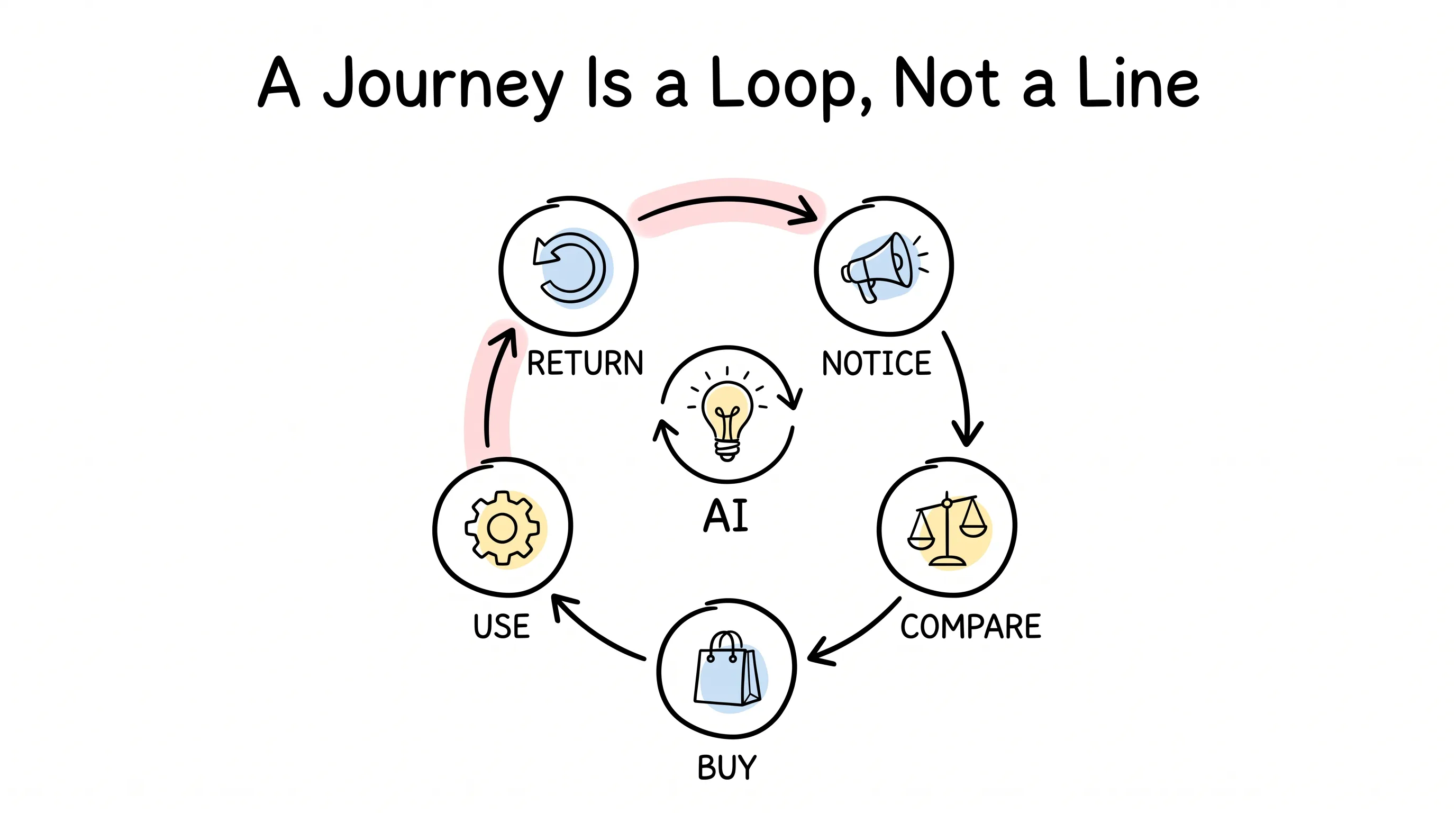
McKinsey offers a judgment I completely share: the customer journey is increasingly a loop, not a line. Keep interacting, gather feedback, re-activate the silent ones, and keep the circle turning. If your strategy refuses to acknowledge this, all of your "personalization" is reaction after the fact — nothing close to prediction.
Salesforce put a number on it in its State of Marketing report: 78% of high-performing organizations already use AI to trigger interactions in real time. They're adjusting continuously; if you adjust once a week, that's exactly how the gap opens.
Here's a "junk data into gold" example. A customer opens three onboarding emails in a row, goes quiet for a week, then opens the pricing page. Each event on its own is unremarkable. Strung together, they form a textbook micro-pattern. The value of AI is fishing patterns like this out of oceans of data and flagging them before the churn actually happens.
Go one step further, and you can rewrite the journey itself in real time. Say ICP Generator flags a lead with a strong fit and weak intent. What the system should do then is turn down the sales firepower and push valuable content up. Less "buy me," more "this is useful to you."
Notice what the system is doing at this point: the work has outgrown the word "responding." It is reshaping the entire journey.
If your journey map never learns, what you've built is infrastructure for yesterday's customers.
A Rhythm You Can Actually Run
Enough theory. Here are six moves you can copy as-is.
- Set outcomes and guardrails first. Write down the caps on conversion, retention, and customer acquisition cost (CAC) before you start, and attach an assumption to every stage. Don't just look at last click — look for incremental lift.
- Make personas granular. Ditch stickers like "urban white-collar professional, early thirties." Feed in money-related signals: most recent purchase, purchase frequency, spend, price sensitivity. Only when the persona turns from a sticker into a probability is the journey truly aimed.
- Translate micro-patterns into next actions. A second pricing-page view within 72 hours, stuck at step two, two categories browsed with nothing added to cart. Every pattern gets a preset response: what content to send, and when.
- Let creative keep up with speed. Use M1-Project's Social Media Content Generator to spin out variants quickly for each micro-audience and each platform. Coca-Cola's Share a Coke printed names on bottles and reported double-digit sales growth in early markets. The principle: an experience that calls you by name is a more relevant experience. No global budget required — and you can use it every day.
- Run experiments like a production line. Keep a holdout group for key automations; split rollouts by geography. Only what proves incremental has earned the right to scale.
- Guard privacy and measurement. Hedge against signal loss with server-side tracking and consent-based first-party data; beyond attribution, add media mix modeling and incrementality testing. Gartner once warned that if data gaps go unfilled, most marketing teams could simply give up on personalization by 2025. Don't let a governance gap drag the credibility of the whole journey under water.
Once these six are humming, your map turns from wall ornament into an engine: high-fit, low-intent leads get the brakes applied automatically; when a niche audience suddenly heats up, content pivots within hours.
Finally, Back to My Friend
Later I asked my friend: did they ever fix that batch email?
They did. In their system now, "two pricing-page views in two days" is a trigger, and anyone it catches enters a different path. What they said stuck with me: the old map was drawn to show other people; the new one makes decisions for us.
Strip it all down, and AI changes the customer journey in exactly one way: it teaches the map to move. Behavior shifts, the map shifts; patterns shift, strategy shifts. You no longer have to guess which step the customer is on — the system delivers you to where they'll show up next, a beat earlier than they do.
Here's hoping your customer journey map comes to life soon, too.
Continue reading
Related articles

Cross-Border Business: Time to Upgrade Your AI Toolbox
A learn article explaining how AI tools help cross-border e-commerce sellers clear five hurdles: language, regulation, logistics, payments, and fraud. It outlines a five-compartment toolbox, a five-step adoption path, and metrics such as conversion rate and CLV, while cautioning against over-reliance on AI.

AI Is Taking Over the Dirty Work of Social Media Marketing, One Task at a Time
This learn article outlines four social media marketing tasks AI can handle — audience analytics, content drafting and design, ad targeting and creative testing, and spam moderation — and cautions that taste, judgment, and data security remain human responsibilities.

AI Is Already This Good — Why Is Your Social Media Marketing Still Pure Manpower?
An overview of 18 AI tools for social media marketing, organized into six categories covering audience research, content creation, scheduling, comment and DM handling, ad management, and visual production, plus notes on personalization, prediction, and emerging trends.