
Your Competitors Have Already Put AI on the Night Shift
A learn article on AI content marketing: how teams cut article production from 8 hours to 2, a four-step rollout covering baselines, measurable goals, reader personas, and workflow embedding, plus tool picks from ChatGPT to Surfer SEO and three guardrails on disclosure, bias screening, and data confidentiality.
A few days ago, a friend of mine who runs an enterprise-services business invited me to dinner.
He manages a content team of six or seven people at his company. Halfway through the meal, he started venting: the boss had just cut the budget by 20%, yet the demands on output went up instead of down. It used to be three pieces a week; now they wanted one a day if they could get it — WeChat Official Accounts, WeChat Channels (WeChat's short-video platform), email — all of it.
He asked me: no new hires, no overtime to add — how do you fight this battle?
I told him: your playbook itself might be outdated.
It's 2026. For teams still agonizing over "should we let AI write things," the problem is no longer efficiency. It's survival.
Why do I say that? Let me run some numbers for you first.
First, the Math
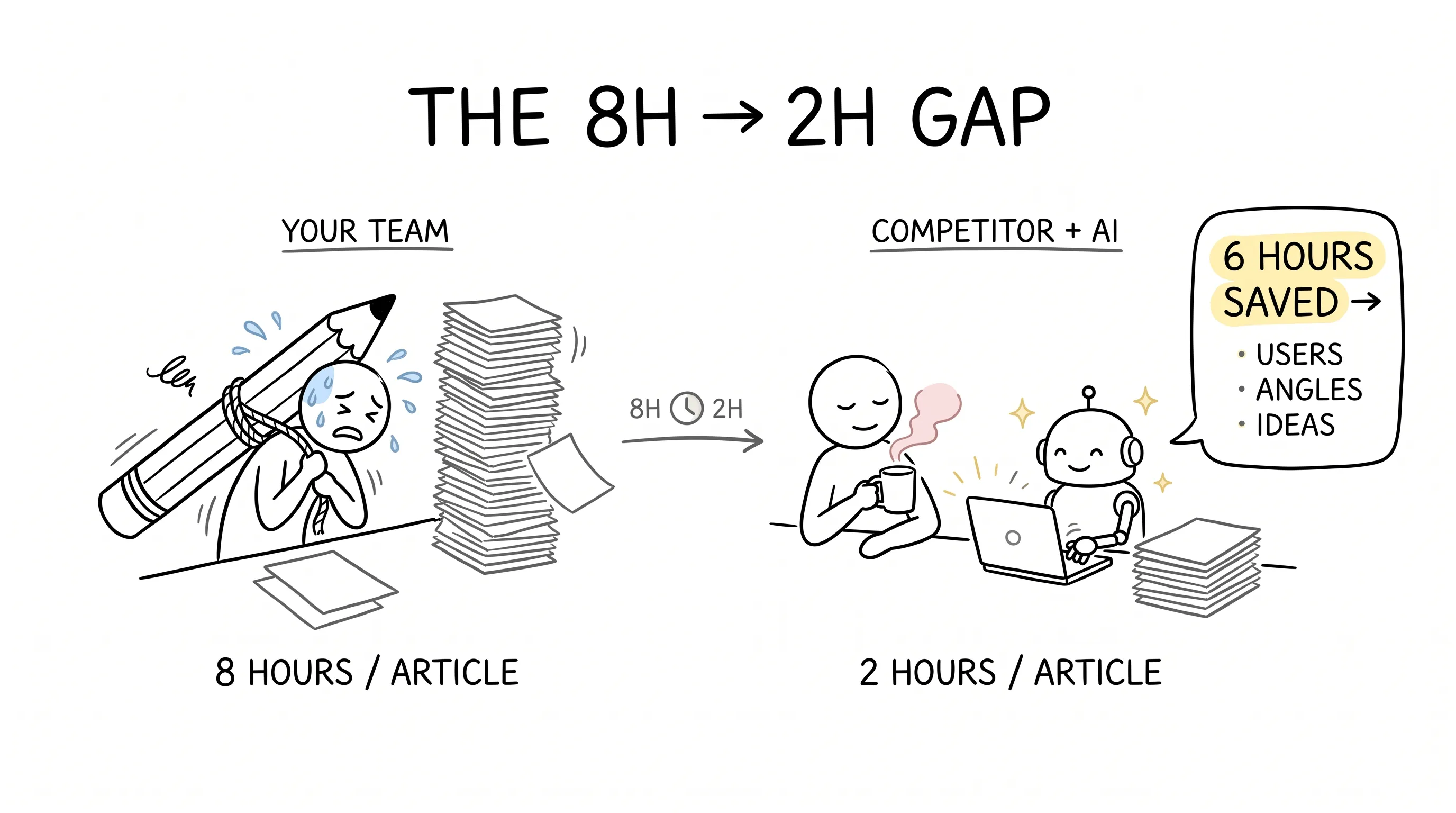
Say writing one decent in-depth article — from research and outlining to a finished draft with three rounds of revision — takes your team 8 hours on average.
Of those 8 hours, how much genuinely requires a human? Research is formula work, the first draft is grunt work, keyword optimization is technical work. The only things that truly test your skill are the angle and the judgment.
And that formula work, grunt work, and technical work is exactly what AI is best at.
Teams that have gotten good at it can compress the same article from 8 hours to roughly 2. What do they do with the 6 hours saved? Study their users, sharpen their ideas, and chase angles nobody else has thought of.
This is not science fiction. Worldwide, 78% of companies are already using generative AI in at least one business function. Odds are, your competitors are among them.
So the essence of this contest is: you spend 8 hours producing one thing, your competitor finishes it in 2, and with the 6 hours left over, they go do three more things you never had time for.
The gap doesn't widen slowly. One tool-adoption cycle is all it takes.
What Is AI Content Marketing?
Let's get the concept straight first. What is AI content marketing?
Put simply: you let AI handle the "repetitive but rule-based" work in the content production pipeline — research, outlining, first drafts, illustration, headline tweaks, adapting versions for different platforms. Humans hold the most valuable positions: setting strategy, making judgment calls, and injecting the experience and warmth that only a living person can bring.
Here's an analogy.
It's like gaining an intern who never sleeps, never throws a tantrum, and has read practically the entire web. In half an hour he can untangle the full backstory of a topic, hand you three workable outlines, and knock out a first draft while he's at it.
But this intern doesn't know why your company is pivoting this year, doesn't know what your customers hate hearing, and can't explain the potholes you hit last month.
Those things are still on you.
So the core of AI content marketing was never "AI writes in your place." It's AI laying the groundwork, with humans adding the finishing touch.
Machines make it fast. Humans make it right.
While we're at it, let's tear down three widespread misconceptions.
Misconception #1: AI will replace writers.
What replaces writers isn't AI — it's writers who use AI. AI can produce smooth sentences, but the angle, the insight, the "I know exactly what my reader is anxious about at this moment" — that, it cannot give you. The real danger is the writer who refuses to let AI play assistant.
Misconception #2: AI writing sounds robotic.
That robotic sound is a question of whether you're using it right. It usually means lazy prompts. The more specific the material you feed it, the more it writes like you. I've seen teams feed in their brand messaging, their past hits, and their speech habits wholesale — the output was so clean even a veteran editor couldn't find fault with it.
Misconception #3: It's too hard to learn.
There's a learning curve, of course, but it's not as steep as you imagine. Most teams are up and running in two or three weeks, and within a month or two they see the change in their output rhythm.
And your people may be more open to this than you'd think. The research firm Tech Informed ran a survey: 70% of employees are willing to hand part of their workload to AI. What people fear is not AI itself — it's whether AI will take their jobs. Spell it out — the hours saved won't cost anyone their job, they'll go to more valuable work — and the team's momentum turns around on the spot.
So How Do You Actually Make It Happen?
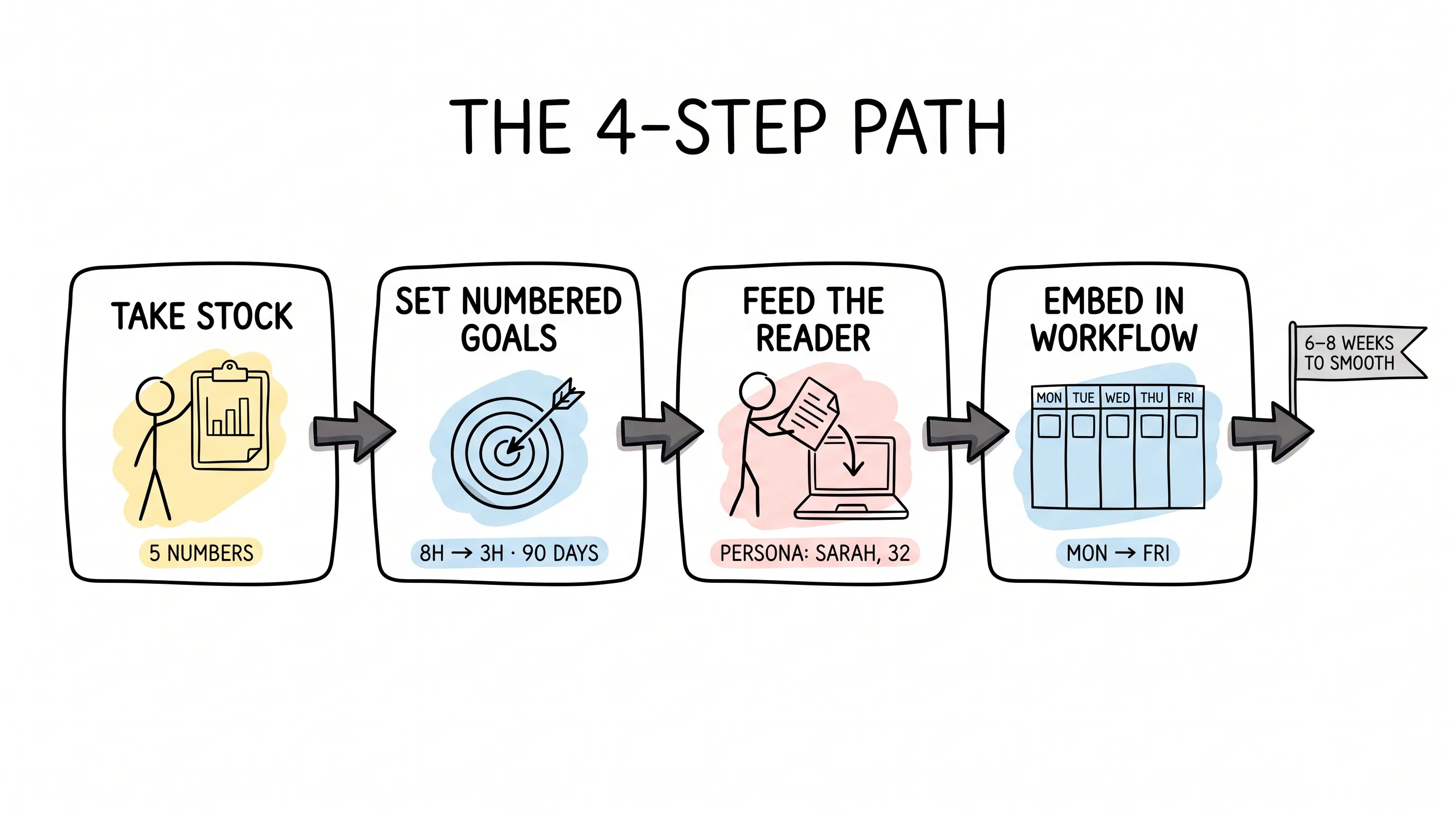
From the teams I've watched, I've distilled a path that runs from easy to hard. Four steps.
Step 1: Take Stock First
Before you open any AI tool, quantify where you stand.
How many hours does one piece take on average? How many pieces go out per month? What are engagement rates by channel? What does a single piece of content cost? How many leads and conversions does content ultimately bring in?
If you don't write these five numbers down, every later "improvement" has no baseline. The day your boss asks, "What has AI actually given us?" you won't have an answer.
Step 2: Set Goals You Can Put Numbers On
Goals need to come with a number and a deadline. Don't say "fully embrace AI." That's not a goal — it's a slogan.
For example: within 90 days, cut per-article production time from 8 hours to 3. Without adding a single person, raise monthly output from 12 pieces to 30. Within six months, bring content production costs down by 40%.
Then track just these numbers weekly: time per piece, publishing volume, engagement rate, cost per lead. Don't track them daily. People who track daily tend to start distorting what they do just to keep the curve pretty.
Step 3: Feed Your "Reader" to the AI
How well the AI writes is 80% down to who you tell it to write for.
Here's a real example. One team configured their AI like this: Sarah, 32, marketing manager, a dozen-plus projects on her plate at once, fighting fires every day, tight budget, boss demanding ROI, zero patience for beat-around-the-bush padding — she only wants steps she can copy straight into action.
See? The finer the persona, the closer the AI's output lands.
Where does this persona data come from? It's already in your hands: the analytics from your website and social accounts, email opens and clicks, the questions that keep coming up in your support records, the objections your salespeople hear every day. Feed it in, and the AI is writing for "your readers" rather than for "an imagined general public."
Step 4: Embed It in a Real Workflow
This is where teams most often stumble. Many treat AI as an isolated toy — use it for two days, and once the novelty wears off it sits idle.
Here's roughly what a week looks like for teams that make it work:
On Monday, AI produces topic ideas and outlines for 5 articles; humans choose, edit, and finalize. Tuesday to Thursday, team members turn outlines into finished pieces — AI supplies the first draft, humans layer in real examples, add judgment, add the details only they know. On Friday, AI does a unified pass on keywords and readability, then adapts the pieces into social versions and email versions.
Per article, that saves 4 to 6 hours on average.
At this pace, most teams have the whole process running smoothly in 6 to 8 weeks. The interesting part: you can see the change as early as around week 3.
One more trick for making it stick: don't hold a big meeting to announce "everyone embraces AI." Find the keenest colleague first, let them get fluent with it, and have them produce two solid pieces. A colleague's success works ten times better than an order from the boss.
How Do You Pick Your Tools?
My inbox is full of this question: with that many tools, which one do I actually pick?
My view: don't agonize over "which is strongest." First get clear on "what you lack most."
If you want an all-rounder that grabs outlining, first drafts, and brainstorming all at once, ChatGPT is the smoothest starting point. If you care most about whether the writing sounds like "one of our own," or you need to handle long documents and technical subjects, Claude's strength is keeping the tone consistent. If your team collaborates a lot and needs ready-made marketing templates and a fixed brand voice, a marketing-specific platform like Jasper is a better fit.
Beyond that, fill in your gaps.
If you run paid campaigns, write short copy, and need conversion rates, look at Copy.ai. If you live on search traffic, look at Surfer SEO. If you value topic research and want to master a subject inside out, look at Frase. For small and mid-sized teams on a budget, a value-for-money option like Writesonic will do the job. If social media scheduling is your main battlefield, Buffer's built-in AI is handy enough. If email marketing is the bulk of your work, Mailchimp's AI can help with subject lines and send times.
In one sentence: build the workflow first, then talk tools. Reverse the order, and whatever you buy just gathers dust.
Three Lines That Must Not Be Crossed
Finally, something serious. The deeper you go with AI, the tighter you need to hold on to three things.
First, don't play games about it. If AI took part in the creation, admit it openly. One line — "This article was completed with AI assistance and reviewed by humans" — will not drive readers away; being caught hiding it will. Content platforms are making their stance clearer too: transparency gains points, concealment loses them.
Second, screen out AI's biases for it. AI learns to speak from vast amounts of old data, and whatever is in that old data may come along with it: gender stereotypes, cultural assumptions, neglect of certain groups. Before you publish, have colleagues of different backgrounds each give it one read — that beats any detection tool.
Third, confidential data never crosses the threshold. Customer lists, unpublished financials, sensitive business information — do not feed them to any AI tool. Also, Europe's GDPR and California's CCPA draw clear lines about how data may be used; teams doing global business should not even touch that line.
In the end it comes down to one sentence:
AI may hold the pen, but a human must sign on the dotted line.
Content involving sensitive topics, data that needs verification, expressions of brand stance — the final gate always stays in human hands.
Back to That Dinner
The friend from the opening later called in the keenest young person on his team and ran those four steps for a month.
Last week he sent me a message: still the same six people, monthly output up from 12 pieces to 28, and for the first time in three months he had not worked overtime on a weekend.
I replied with four words: it's just the beginning.
This all reminded me of an American entrepreneur who spent a dozen-plus years in the content business. Her company, Express Writers, employed as many as 100 people at its peak, and she herself worked 80 hours a week, burning out again and again. Later she handed the whole business to AI systems: an AI writer custom-tuned to her voice, a set of landing pages and chatbots converting around the clock, and an AI avatar built in her own image fronting her YouTube channel for her. That avatar's account now has 250,000 subscribers. By her account, it now brings in $150,000 a month in revenue — and she no longer has to be chained to her desk.
Unbelievable. After 13 years of a business built on sweat, in the end it was a system that set her free.
So, back to you.
Content is still king — that has never changed. What has changed is how kings get made: some people are still staying up late hauling bricks by hand, while others are already directing machines to haul the bricks and freeing their own hands to build the tower.
AI cannot steal your creativity. It only ransoms your creativity out of the first draft.
May your team win back those 6 hours, and soon.
Continue reading
Related articles

Cross-Border Business: Time to Upgrade Your AI Toolbox
A learn article explaining how AI tools help cross-border e-commerce sellers clear five hurdles: language, regulation, logistics, payments, and fraud. It outlines a five-compartment toolbox, a five-step adoption path, and metrics such as conversion rate and CLV, while cautioning against over-reliance on AI.

AI Is Taking Over the Dirty Work of Social Media Marketing, One Task at a Time
This learn article outlines four social media marketing tasks AI can handle — audience analytics, content drafting and design, ad targeting and creative testing, and spam moderation — and cautions that taste, judgment, and data security remain human responsibilities.

AI Is Already This Good — Why Is Your Social Media Marketing Still Pure Manpower?
An overview of 18 AI tools for social media marketing, organized into six categories covering audience research, content creation, scheduling, comment and DM handling, ad management, and visual production, plus notes on personalization, prediction, and emerging trends.